JUnit PowerUP
Practical Testing Tips
James McGivern
About James
Likes cats

Talks fast
Technical Evangelist
Hates Marmite

Mathematician turned
Computer Scientist

Lives in London
JUnit
vs
TestNG
One Busy Day On
Concurrent Island...

Intro
Concurrency?
concurrent - adjective
1. occurring or existing simultaneously or side by
side: concurrent attacks by land, sea, and air.
2. acting in conjunction; co-operating.

3. having equal authority or jurisdiction.
4. accordant or agreeing.
5. tending to or intersecting at the same point: four
concurrent lines.
The behaviour of a single threaded application is
deterministic
A multithreaded application may appear
stochastic
Concurrency introduces new problems:
deadlocks
resource starvation (e.g livelocks)
race conditions
contention

•
•
•
•
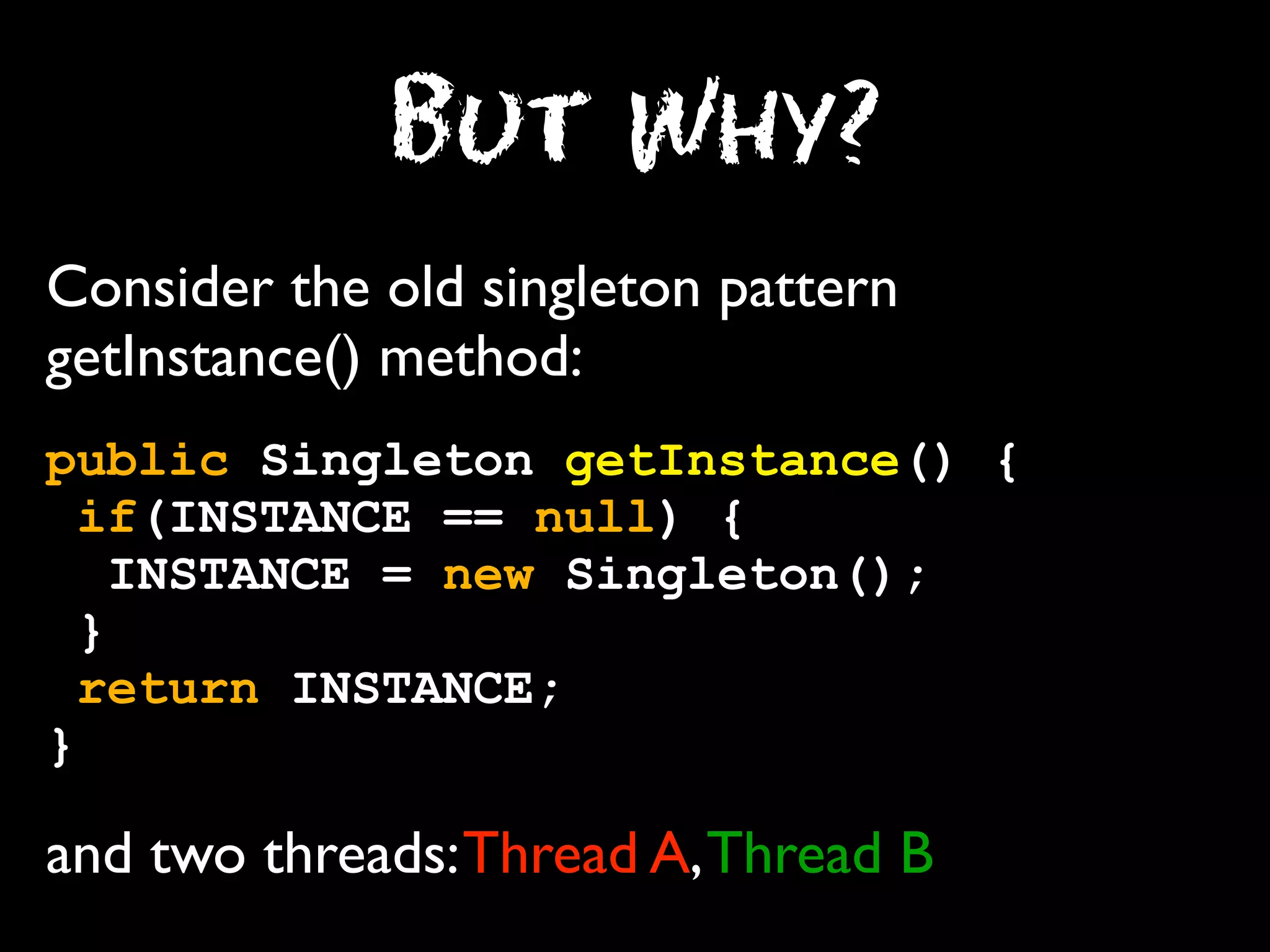
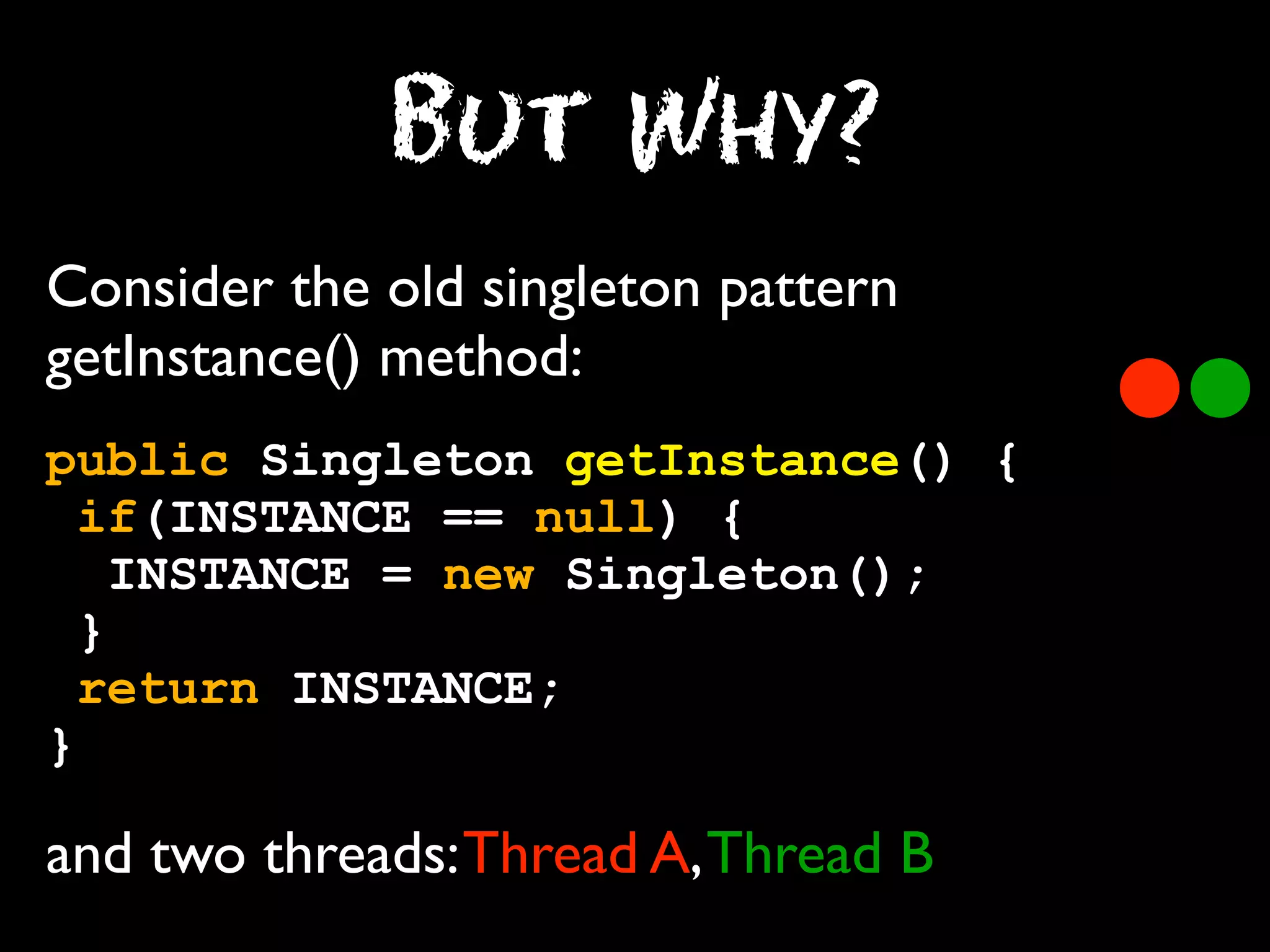
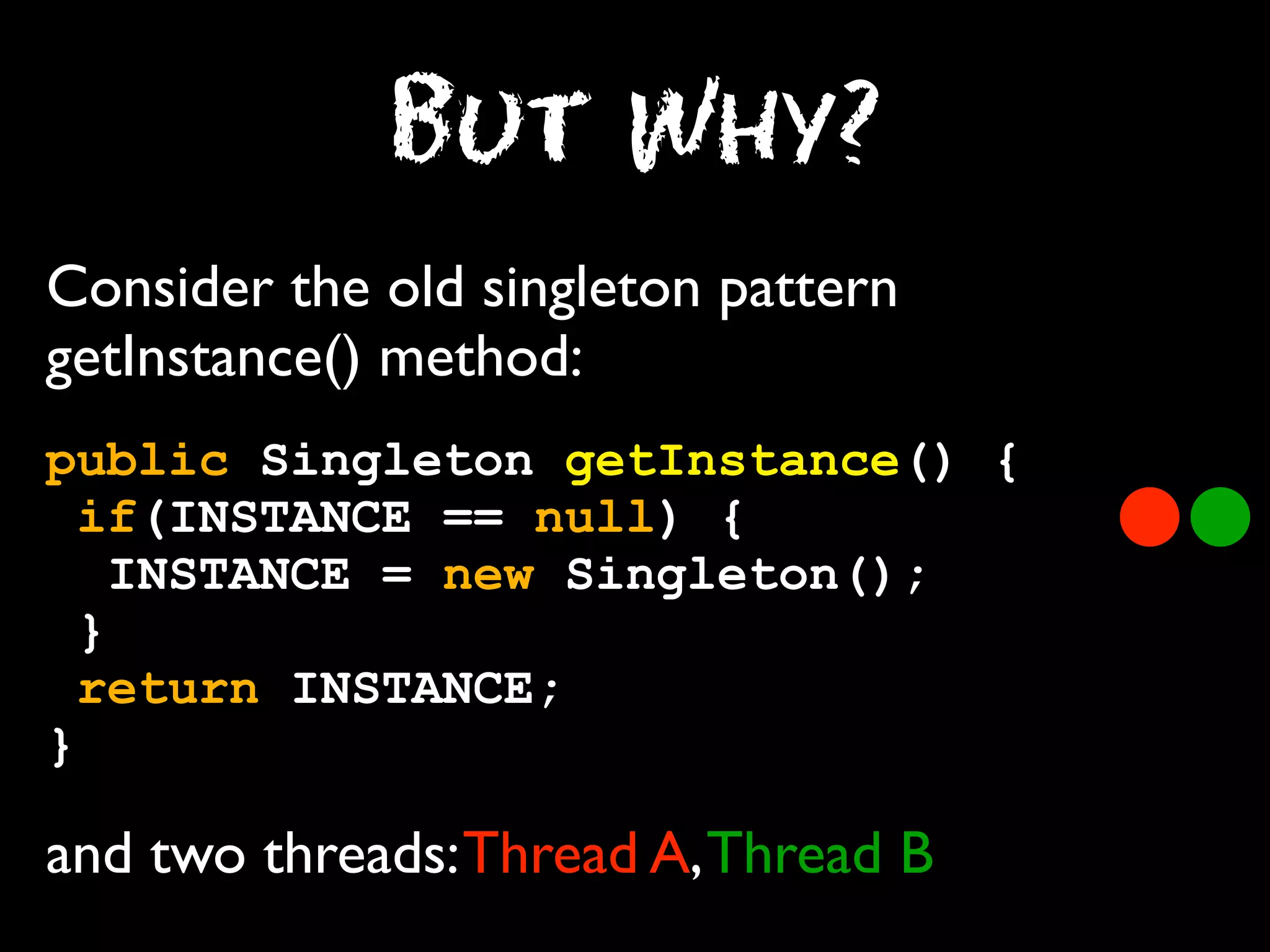
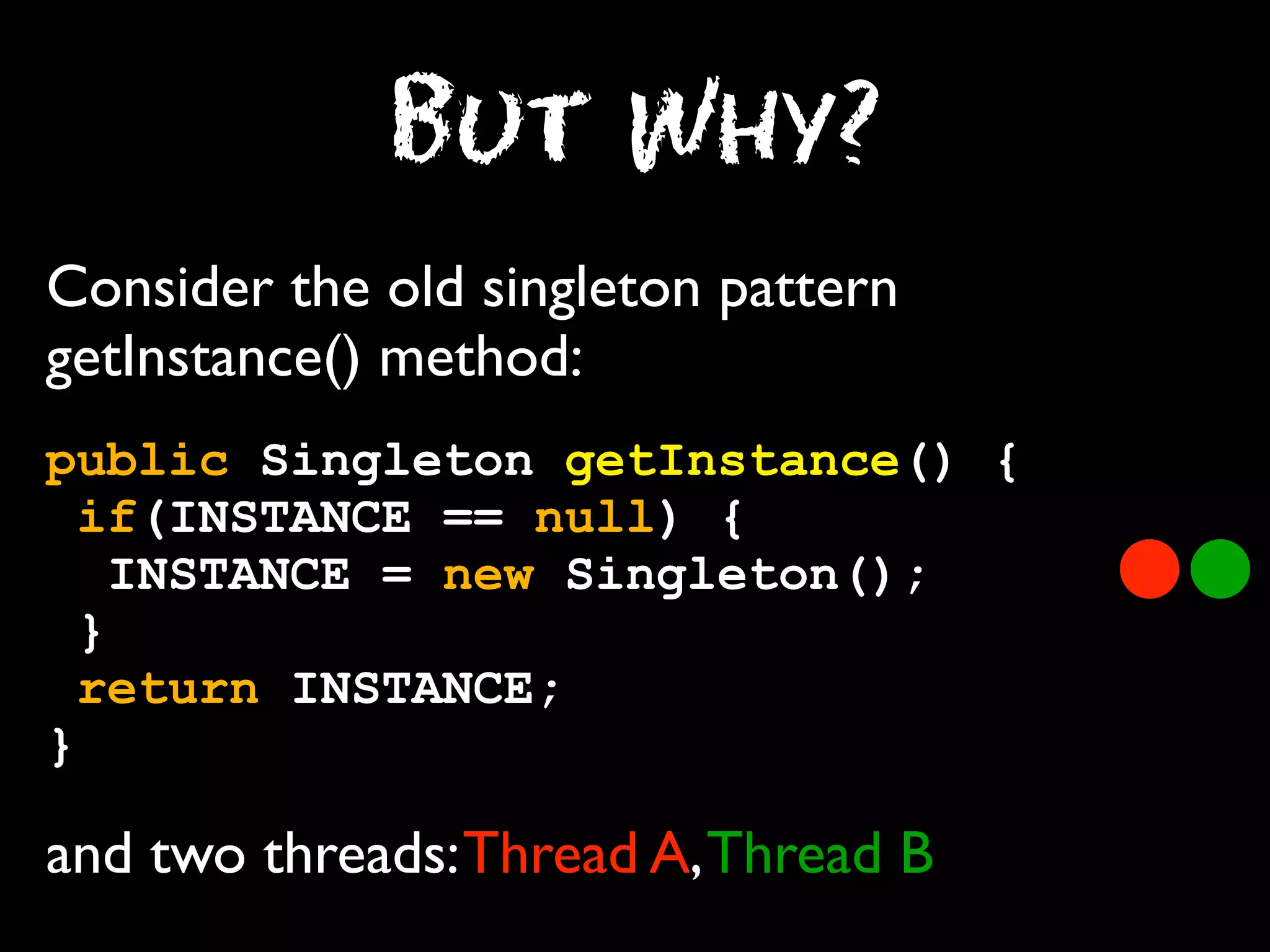
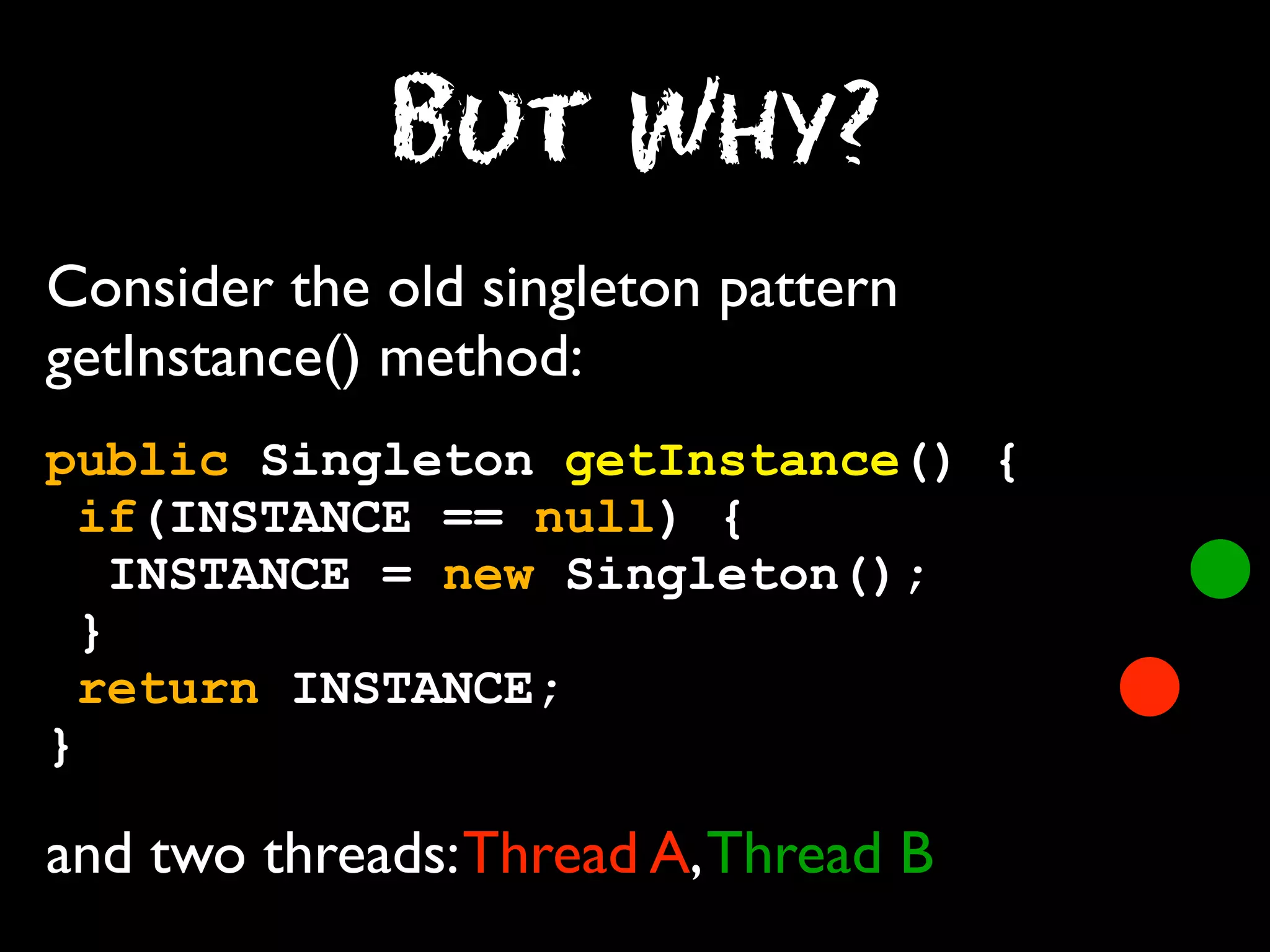
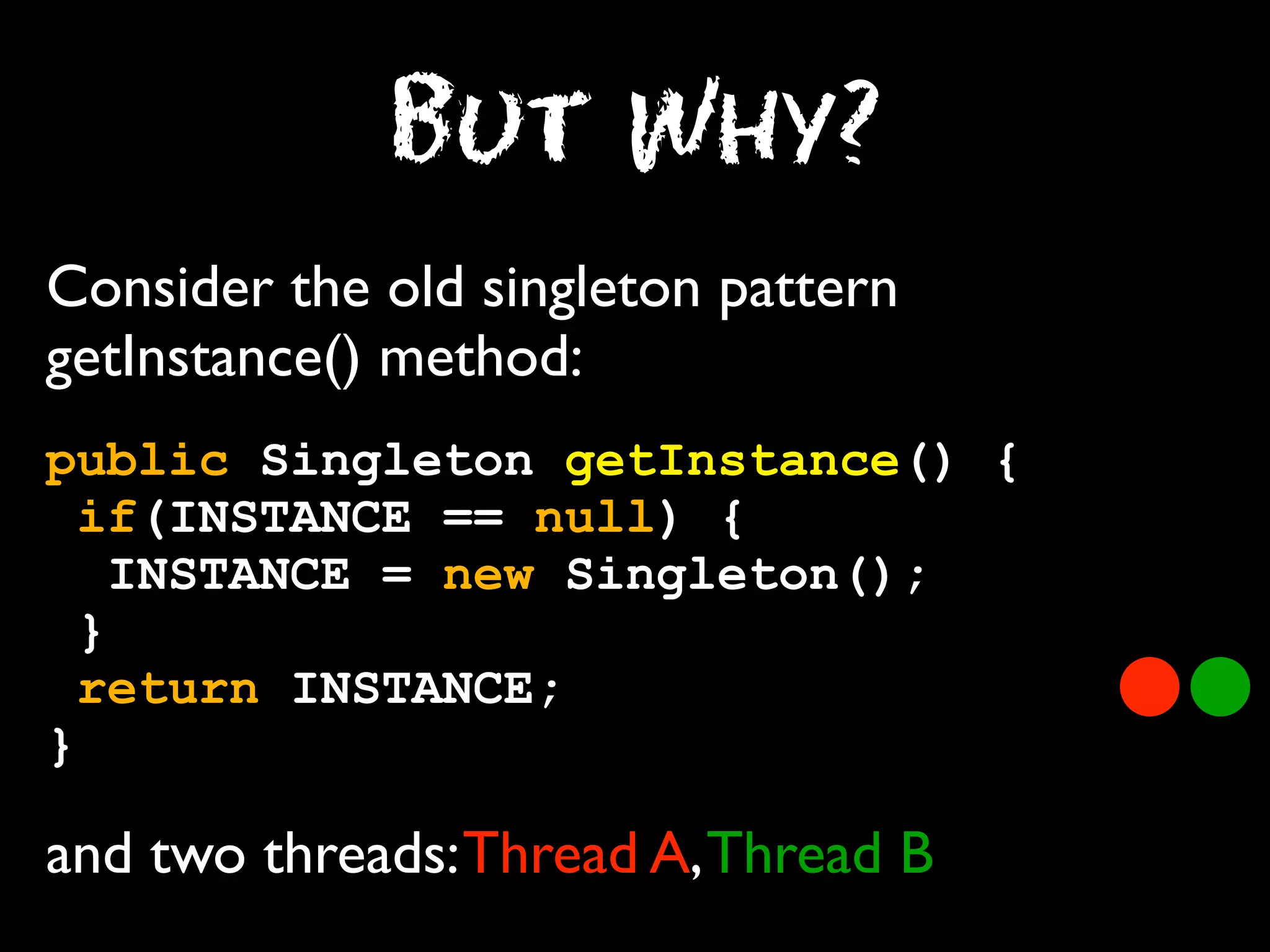
But Why?
Consider the old singleton pattern
getInstance() method:
public Singleton getInstance() {
if(INSTANCE == null) {
INSTANCE = new Singleton();
}
return INSTANCE;
}

and two threads: Thread A, Thread B
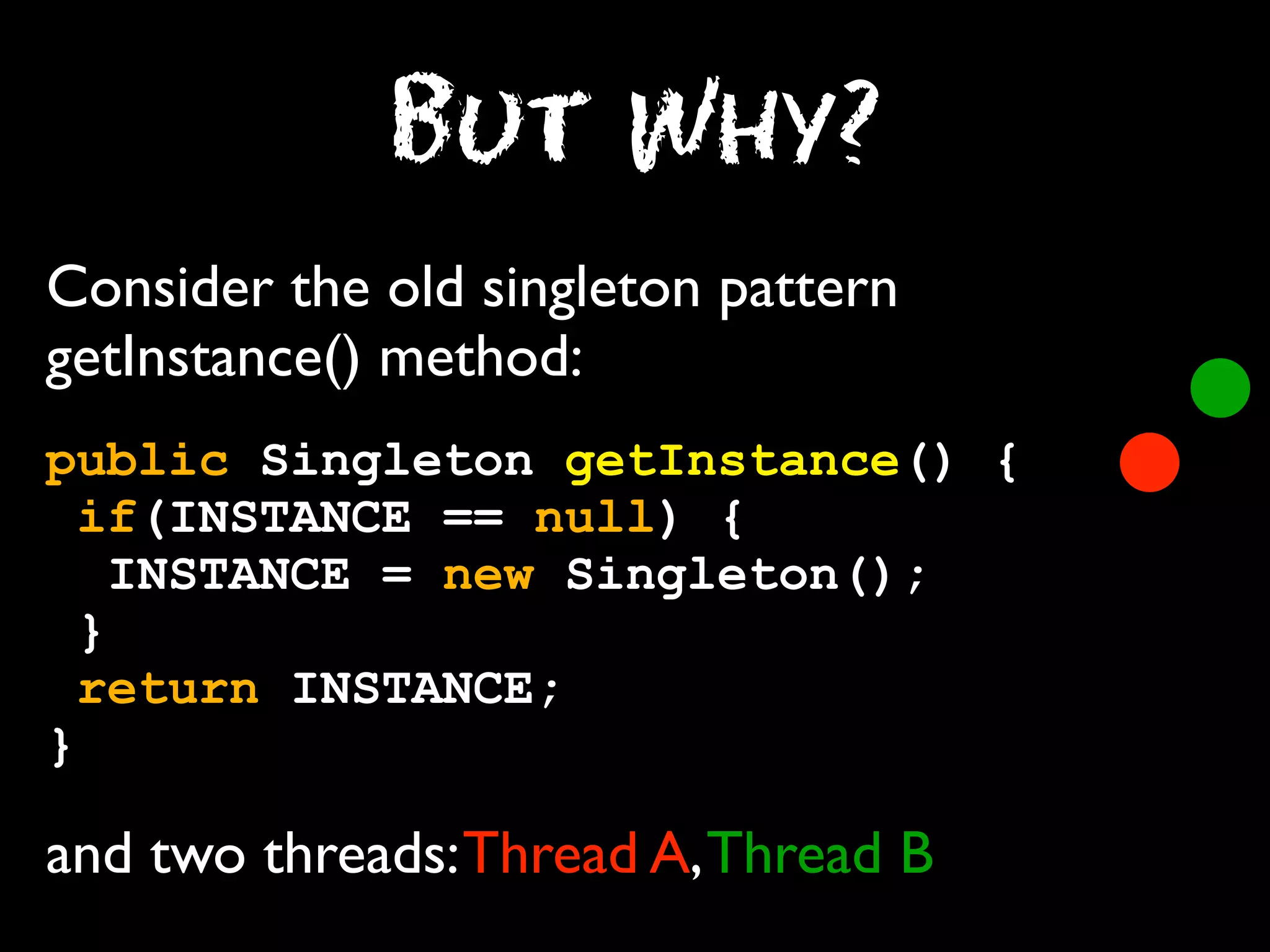
But Why?
Consider the old singleton pattern
getInstance() method:
public Singleton getInstance() {
if(INSTANCE == null) {
INSTANCE = new Singleton();
}
return INSTANCE;
}

and two threads: Thread A, Thread B
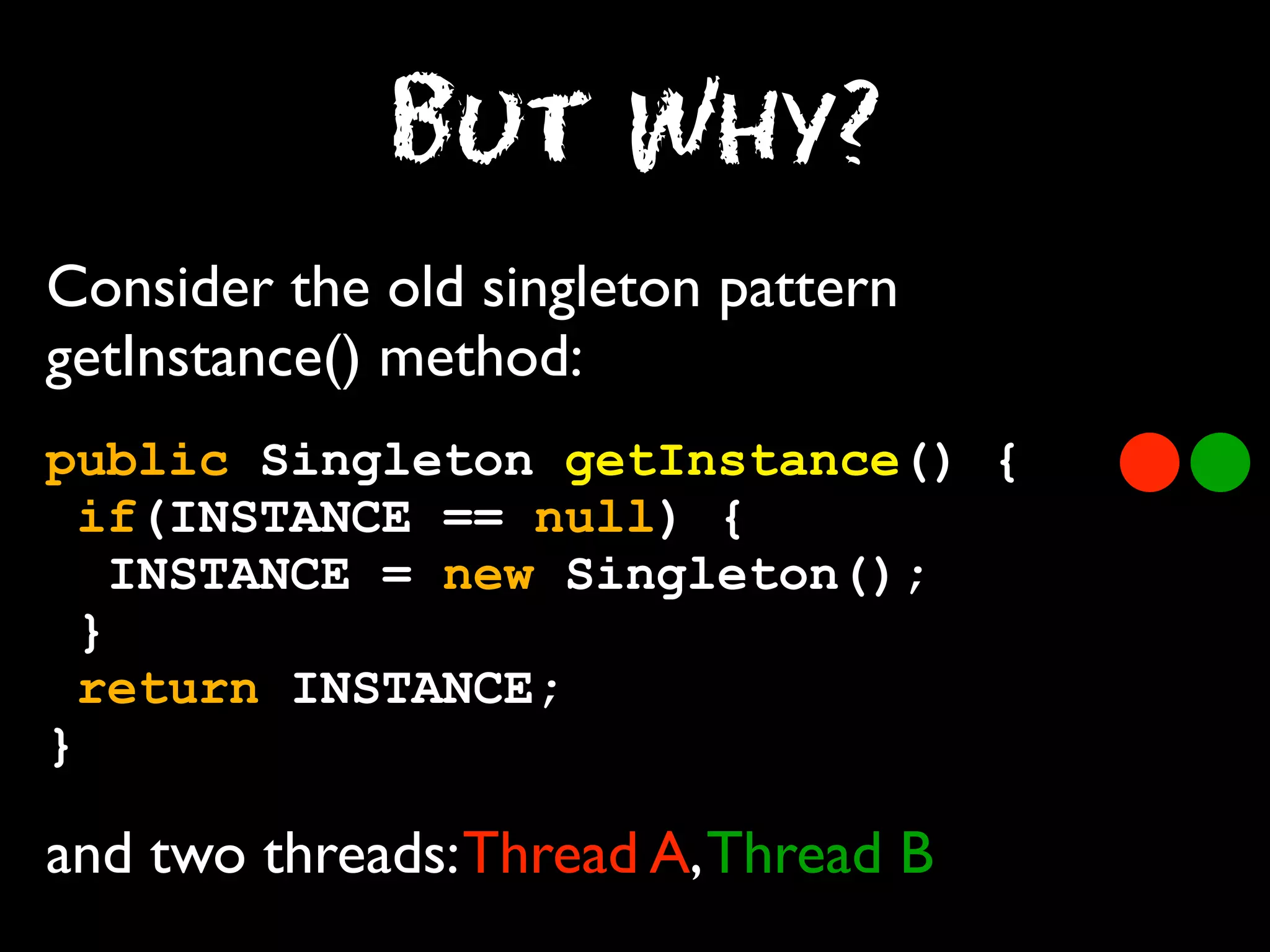
But Why?
Consider the old singleton pattern
getInstance() method:
public Singleton getInstance() {
if(INSTANCE == null) {
INSTANCE = new Singleton();
}
return INSTANCE;
}

and two threads: Thread A, Thread B
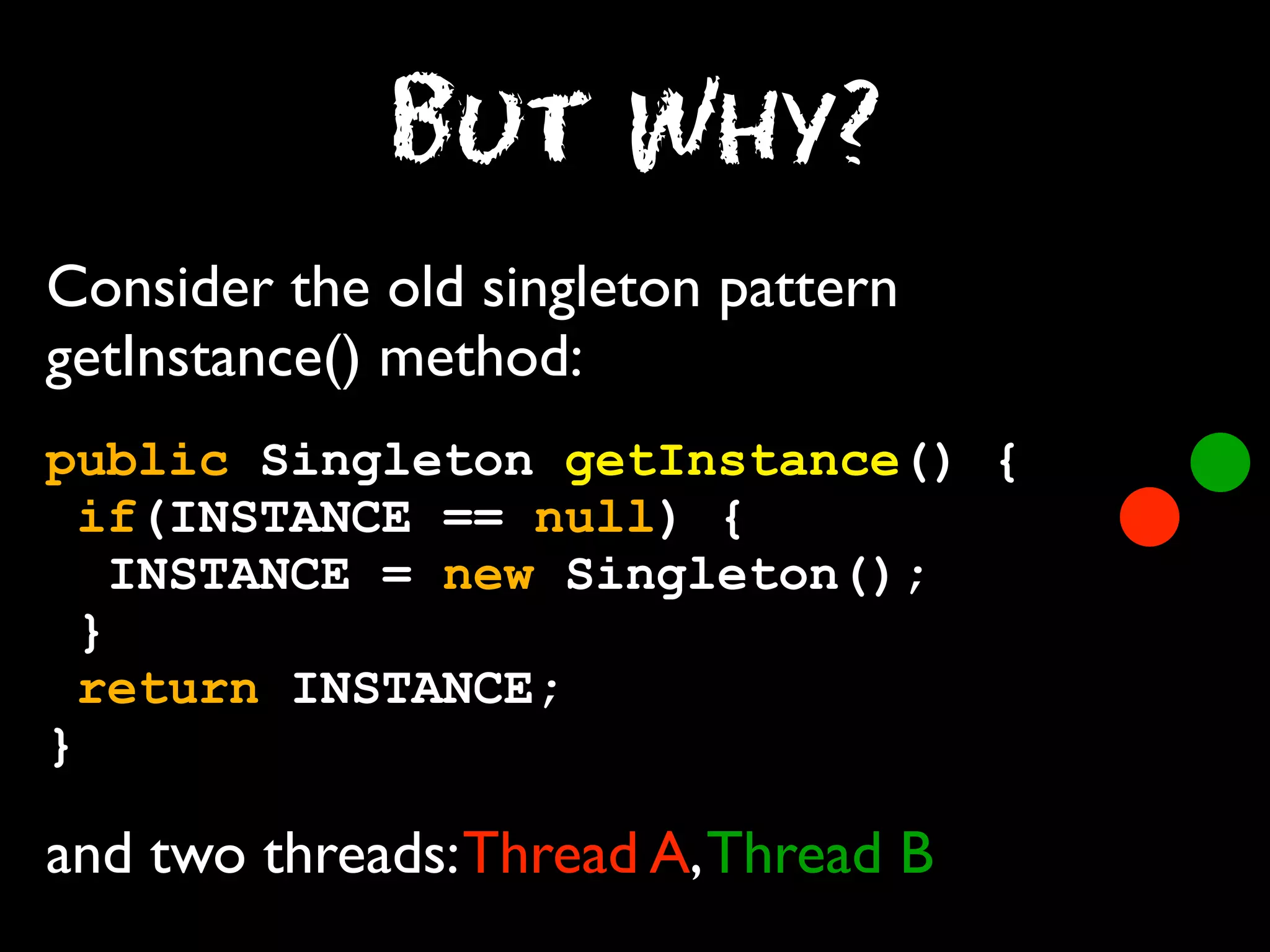
But Why?
Consider the old singleton pattern
getInstance() method:
public Singleton getInstance() {
if(INSTANCE == null) {
INSTANCE = new Singleton();
}
return INSTANCE;
}

and two threads: Thread A, Thread B
But Why?
Consider the old singleton pattern
getInstance() method:
public Singleton getInstance() {
if(INSTANCE == null) {
INSTANCE = new Singleton();
}
return INSTANCE;
}

and two threads: Thread A, Thread B
But Why?
Consider the old singleton pattern
getInstance() method:
public Singleton getInstance() {
if(INSTANCE == null) {
INSTANCE = new Singleton();
}
return INSTANCE;
}

and two threads: Thread A, Thread B
But Why?
Consider the old singleton pattern
getInstance() method:
public Singleton getInstance() {
if(INSTANCE == null) {
INSTANCE = new Singleton();
}
return INSTANCE;
}

and two threads: Thread A, Thread B
But Why?
Consider the old singleton pattern
getInstance() method:
public Singleton getInstance() {
if(INSTANCE == null) {
INSTANCE = new Singleton();
}
return INSTANCE;
}

and two threads: Thread A, Thread B
But Why?
Consider the old singleton pattern
getInstance() method:
public Singleton getInstance() {
if(INSTANCE == null) {
INSTANCE = new Singleton();
}
return INSTANCE;
}

and two threads: Thread A, Thread B
But Why?
Consider the old singleton pattern
getInstance() method:
public Singleton getInstance() {
if(INSTANCE == null) {
INSTANCE = new Singleton();
}
return INSTANCE;
}

and two threads: Thread A, Thread B
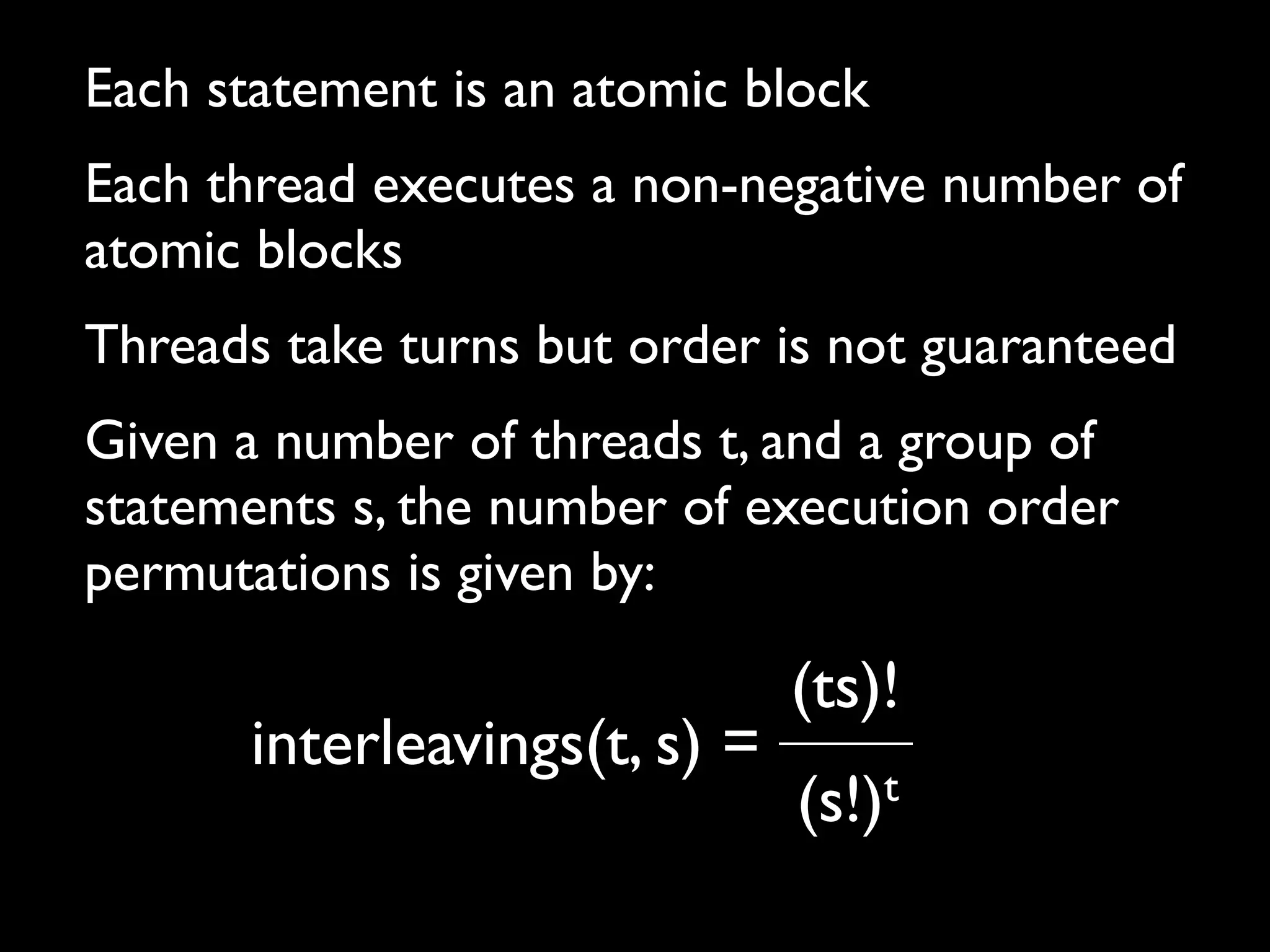
Each statement is an atomic block
Each thread executes a non-negative number of
atomic blocks
Threads take turns but order is not guaranteed
Given a number of threads t, and a group of
statements s, the number of execution order
permutations is given by:

interleavings(t, s) =

(ts)!
t
(s!)
The JUnit Cup
Challenge

Level 0
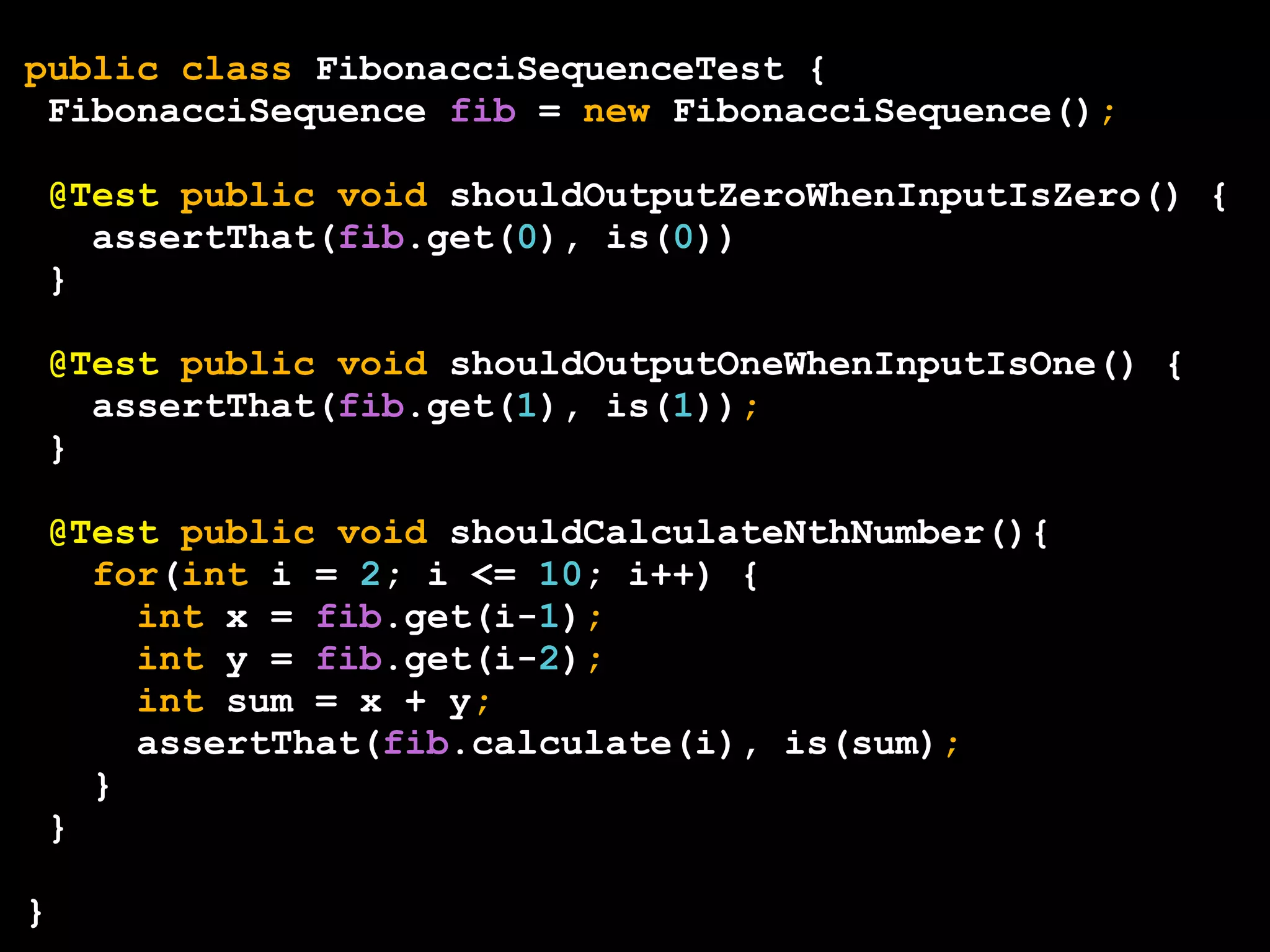
public class FibonacciSequenceTest {
FibonacciSequence fib = new FibonacciSequence();
@Test public void shouldOutputZeroWhenInputIsZero() {
assertThat(fib.get(0), is(0))
}
@Test public void shouldOutputOneWhenInputIsOne() {
assertThat(fib.get(1), is(1));
}
@Test public void shouldCalculateNthNumber(){
for(int i = 2; i <= 10; i++) {
int x = fib.get(i-1);
int y = fib.get(i-2);
int sum = x + y;
assertThat(fib.calculate(i), is(sum);
}
}
}
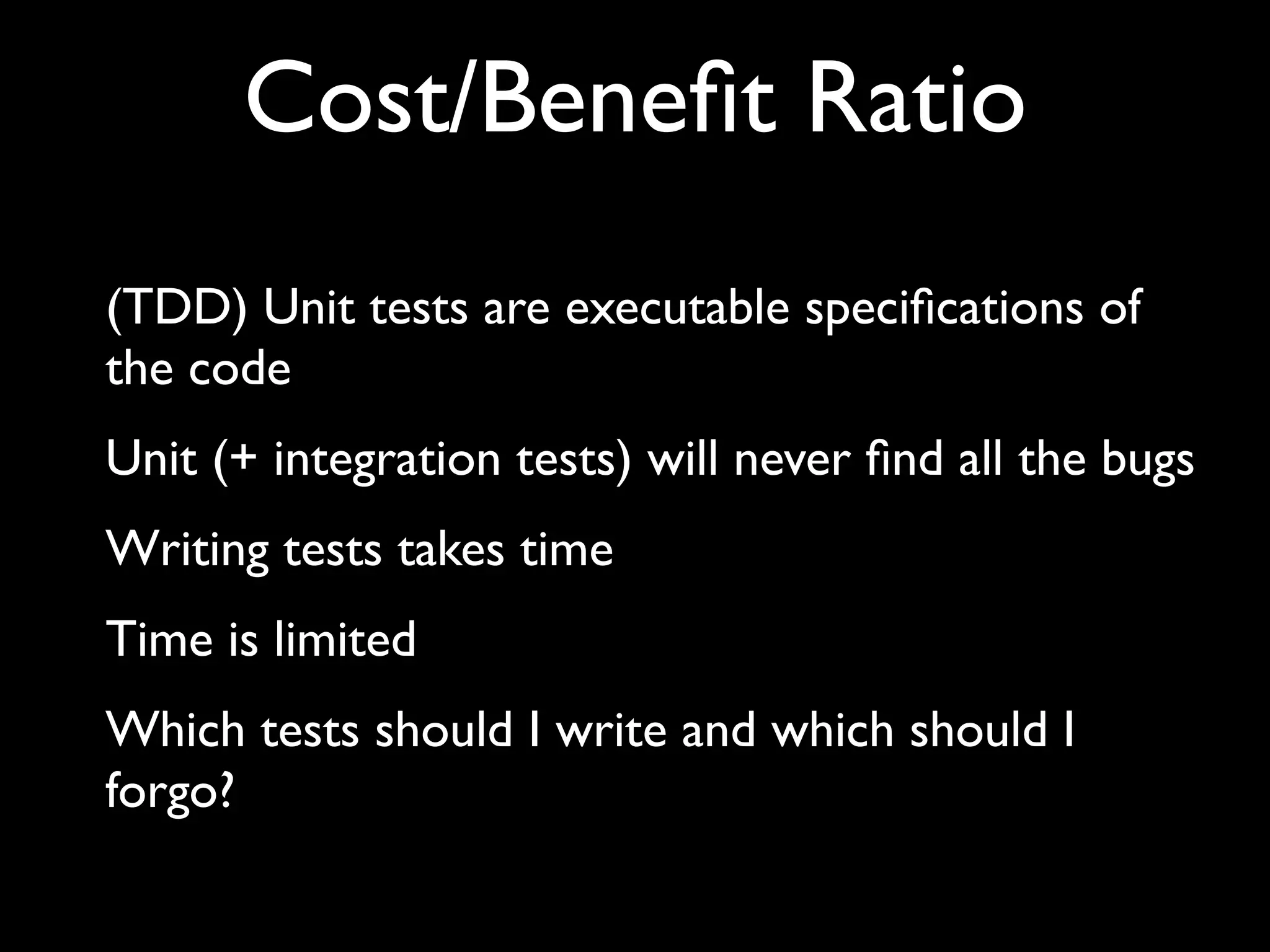
Cost/Benefit Ratio
(TDD) Unit tests are executable specifications of
the code
Unit (+ integration tests) will never find all the bugs
Writing tests takes time
Time is limited
Which tests should I write and which should I
forgo?
JUnit Runners
Bundled
Suite, Parameterized

•
• Theories, Categories, Enclosed

Popular 3rd party runners
Mockito, PowerMock(ito)

•

Custom
JBehave, Spock

•
• dynamic tests?
Custom Runner
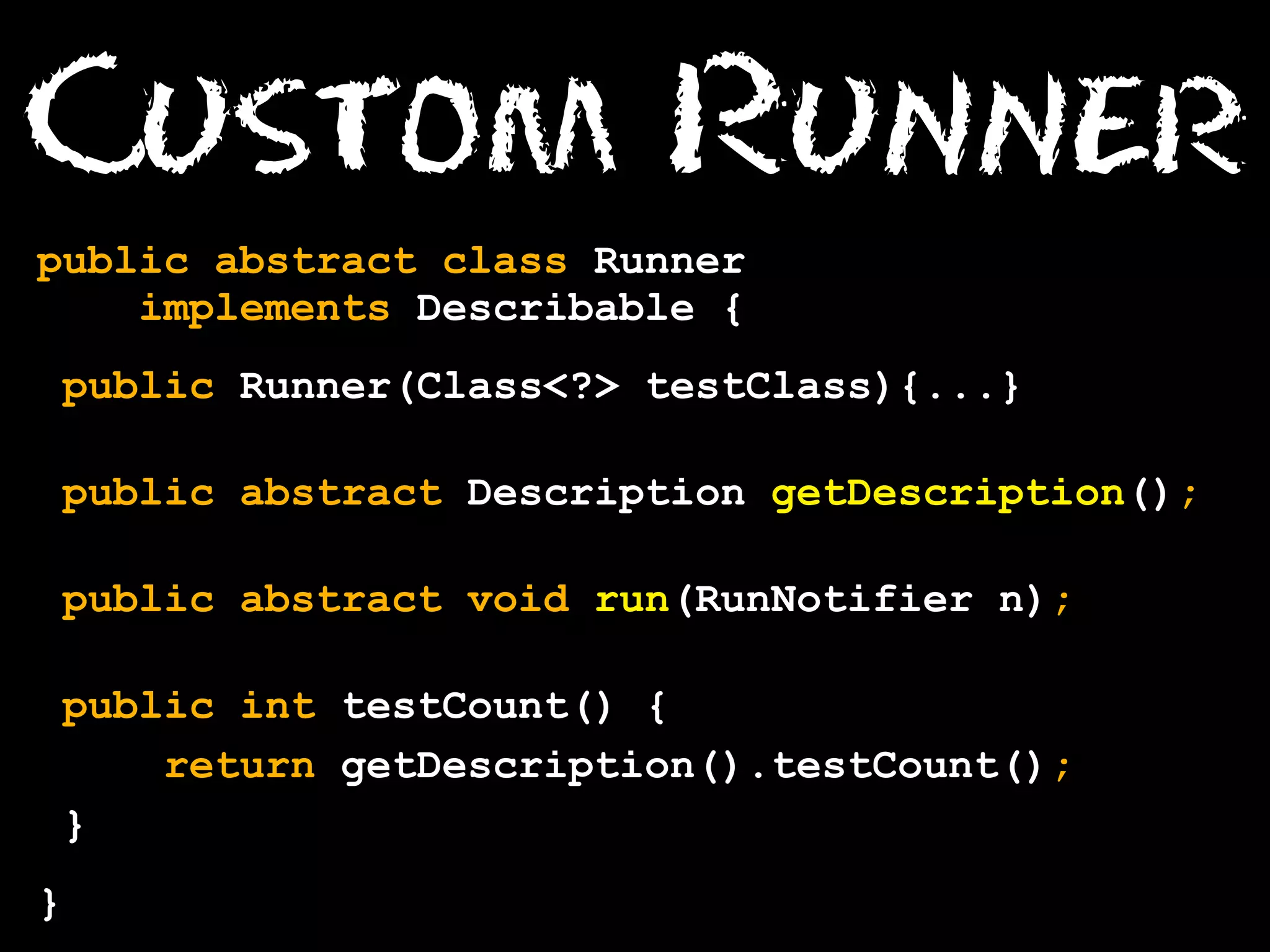
public abstract class Runner
implements Describable {
public Runner(Class<?> testClass){...}
public abstract Description getDescription();
public abstract void run(RunNotifier n);
public int testCount() {
return getDescription().testCount();
}
}
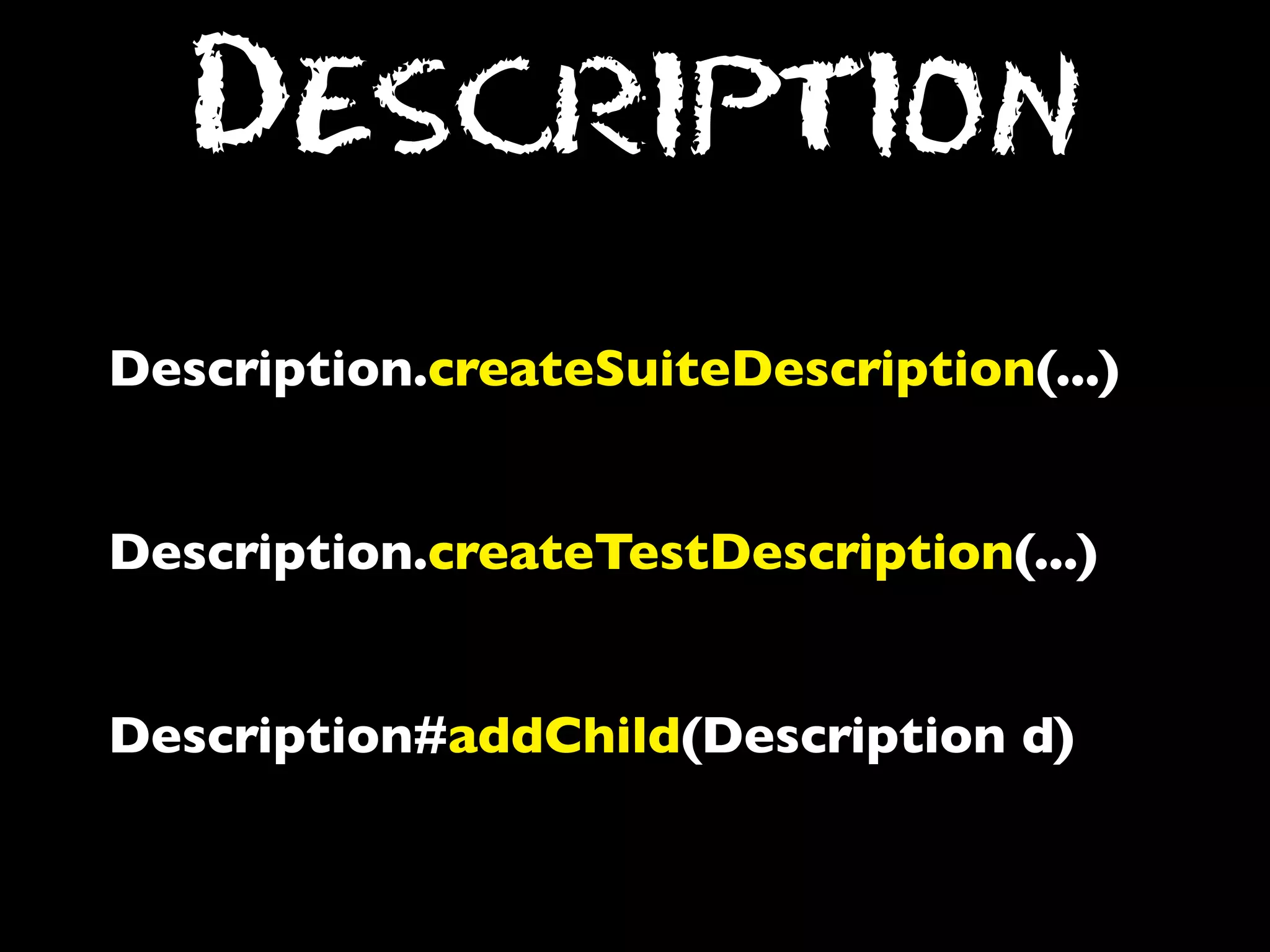
Description
Description.createSuiteDescription(...)
Description.createTestDescription(...)
Description#addChild(Description d)
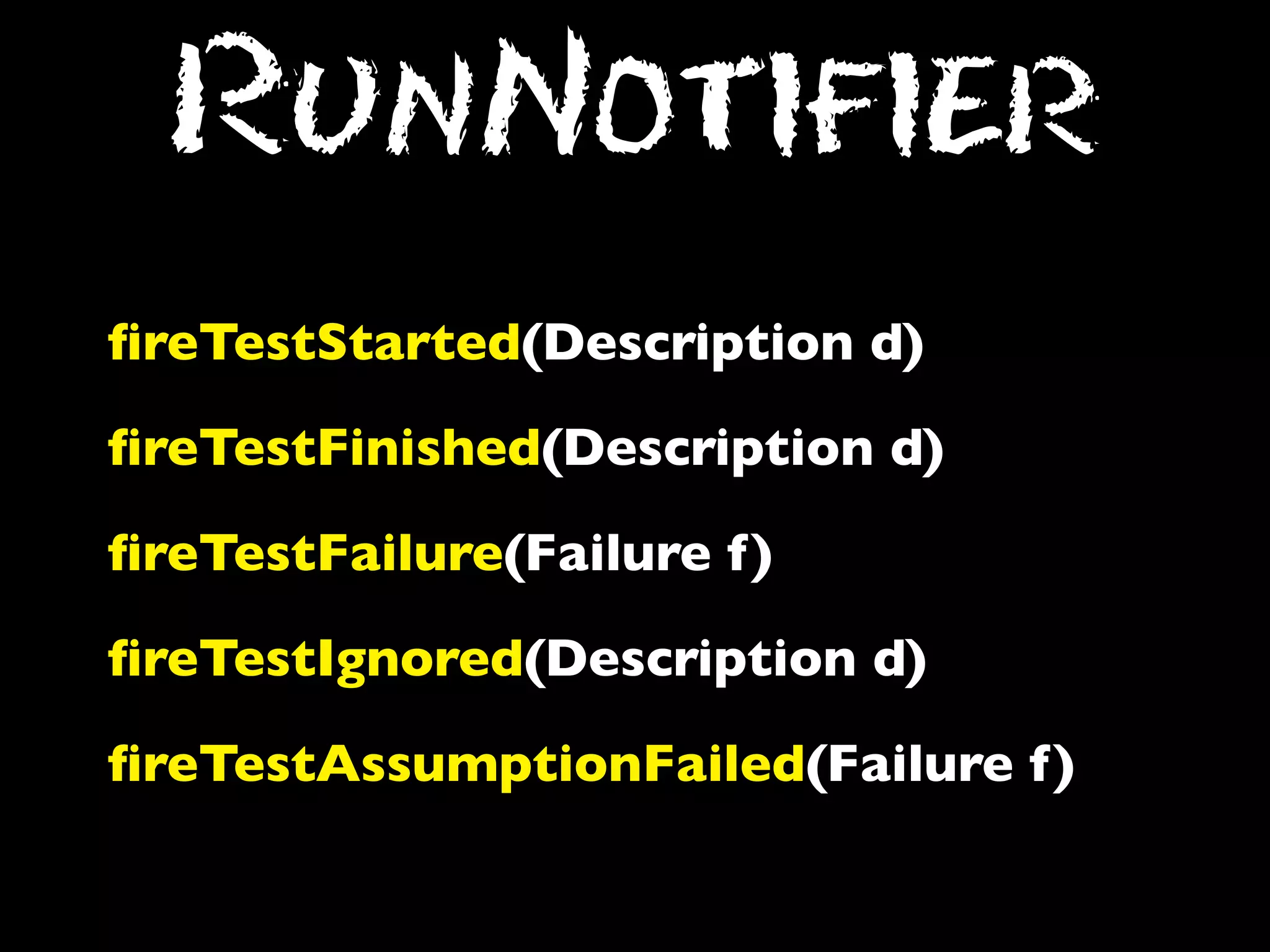
RunNotifier
fireTestStarted(Description d)
fireTestFinished(Description d)
fireTestFailure(Failure f)
fireTestIgnored(Description d)
fireTestAssumptionFailed(Failure f)
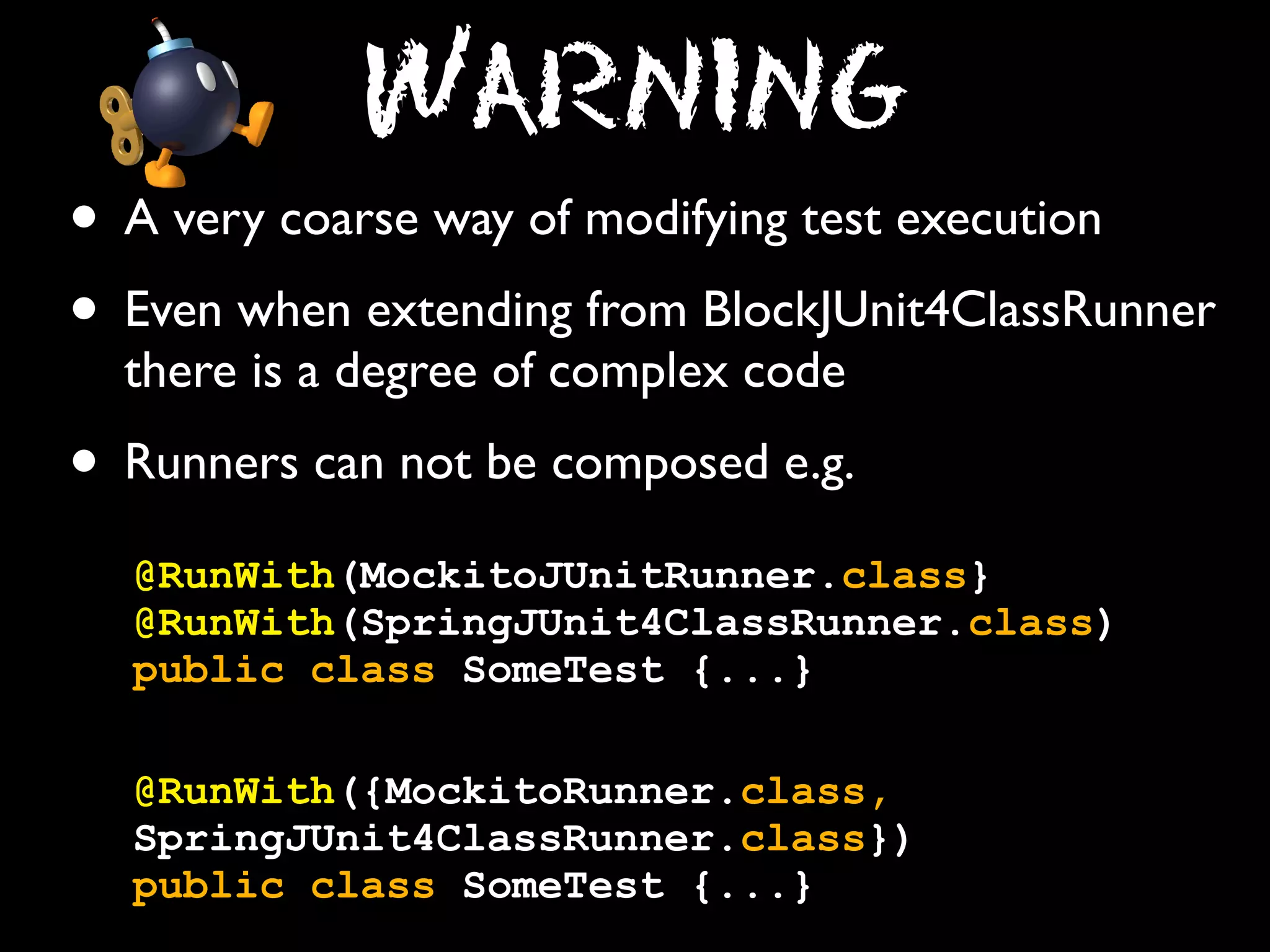
Warning
• A very coarse way of modifying test execution
• Even when extending from BlockJUnit4ClassRunner
there is a degree of complex code

• Runners can not be composed e.g.

@RunWith(MockitoJUnitRunner.class}
@RunWith(SpringJUnit4ClassRunner.class)
public class SomeTest {...}
@RunWith({MockitoRunner.class,
SpringJUnit4ClassRunner.class})
public class SomeTest {...}
JUnit Rules

PowerUP
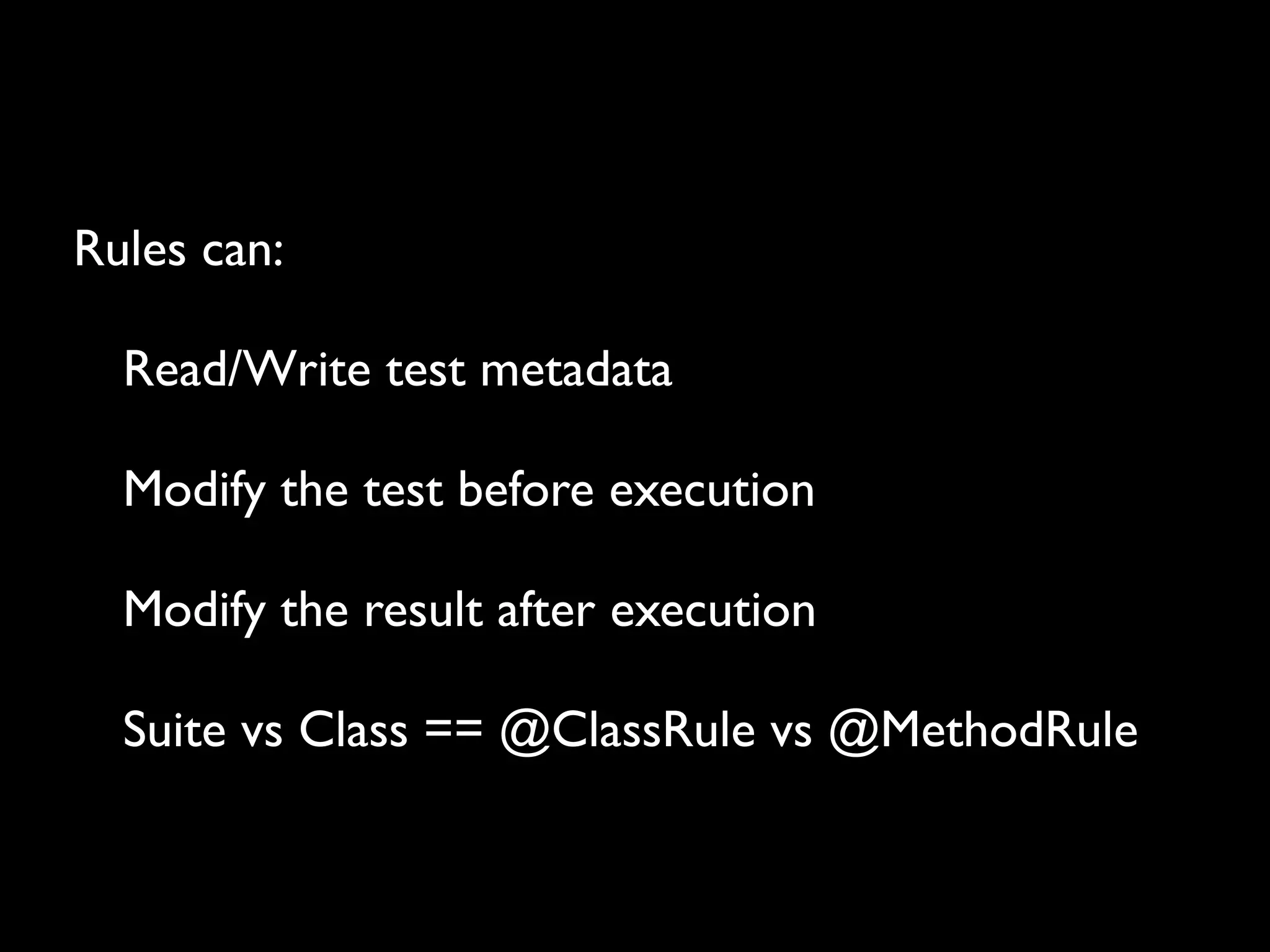
Rules can:
Read/Write test metadata
Modify the test before execution
Modify the result after execution
Suite vs Class == @ClassRule vs @MethodRule
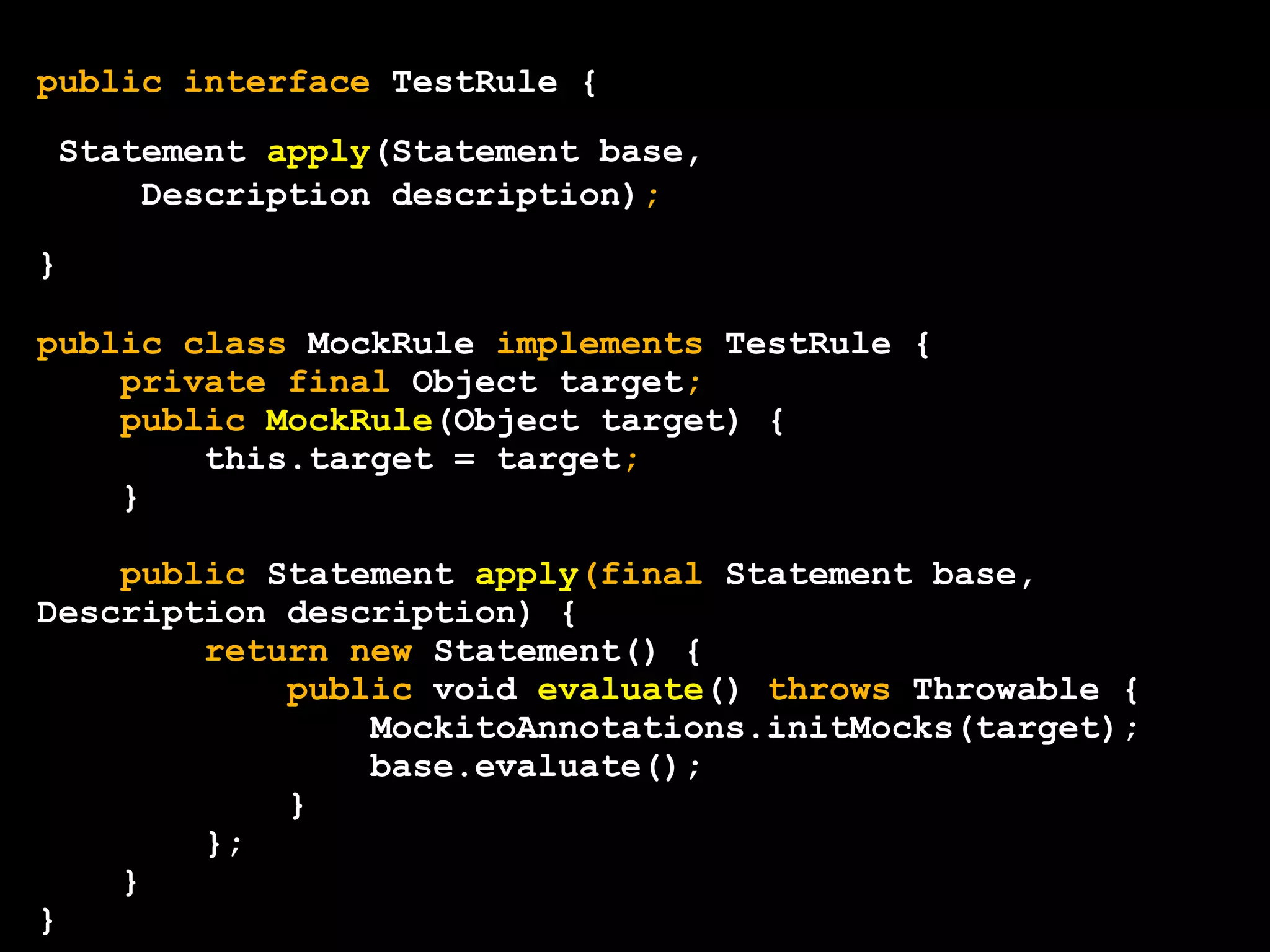
public interface TestRule {
Statement apply(Statement base,
Description description);
}
public class MockRule implements TestRule {
private final Object target;
public MockRule(Object target) {
this.target = target;
}
public Statement apply(final Statement base,
Description description) {
return new Statement() {
public void evaluate() throws Throwable {
MockitoAnnotations.initMocks(target);
base.evaluate();
}
};
}
}
The Thread
Challenge

Level 1
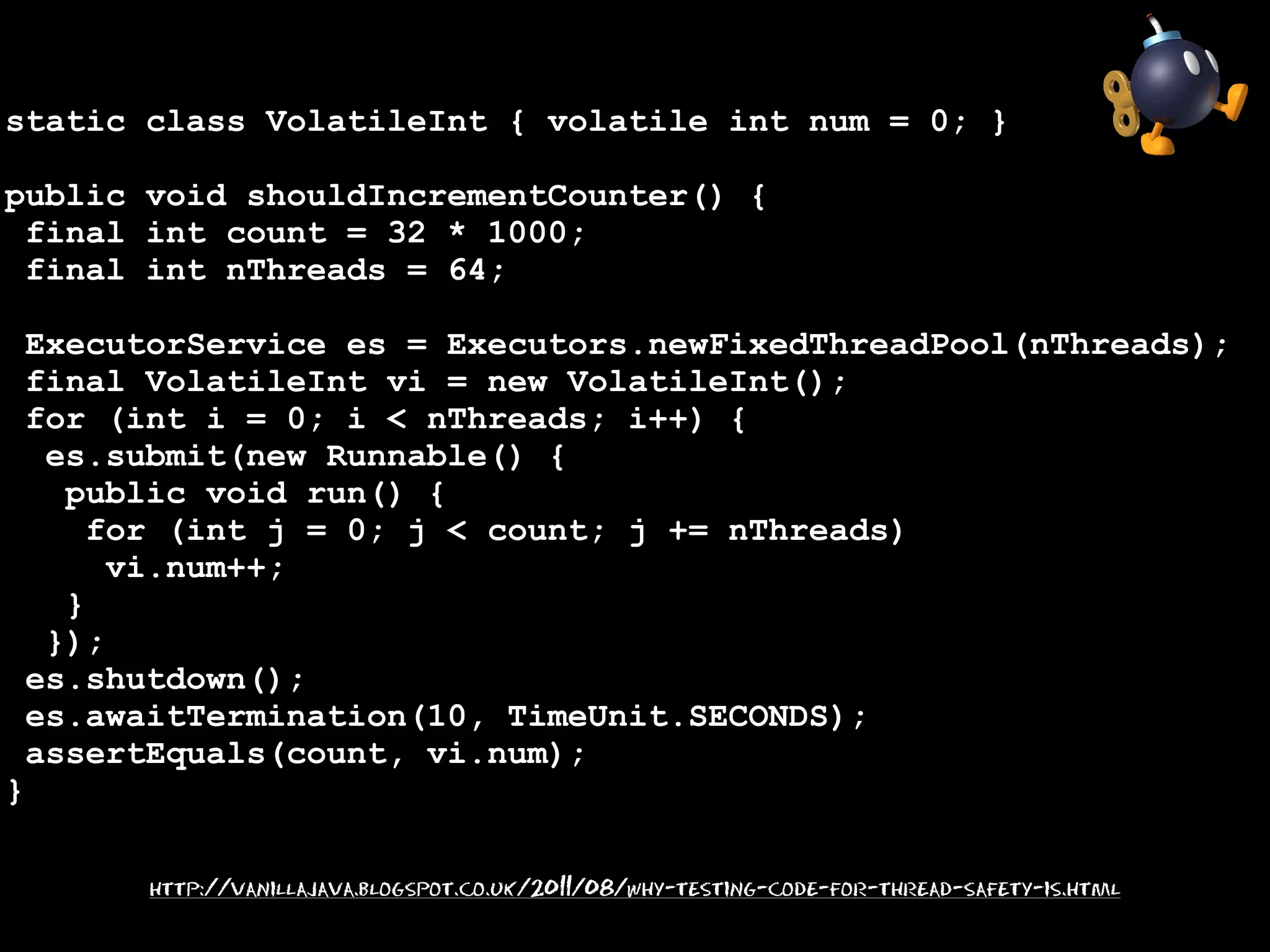
static class VolatileInt { volatile int num = 0; }
public void shouldIncrementCounter() {
final int count = 32 * 1000;
final int nThreads = 64;
ExecutorService es = Executors.newFixedThreadPool(nThreads);
final VolatileInt vi = new VolatileInt();
for (int i = 0; i < nThreads; i++) {
es.submit(new Runnable() {
public void run() {
for (int j = 0; j < count; j += nThreads)
vi.num++;
}
});
es.shutdown();
es.awaitTermination(10, TimeUnit.SECONDS);
assertEquals(count, vi.num);

}

http://vanillajava.blogspot.co.uk/2011/08/why-testing-code-for-thread-safety-is.html
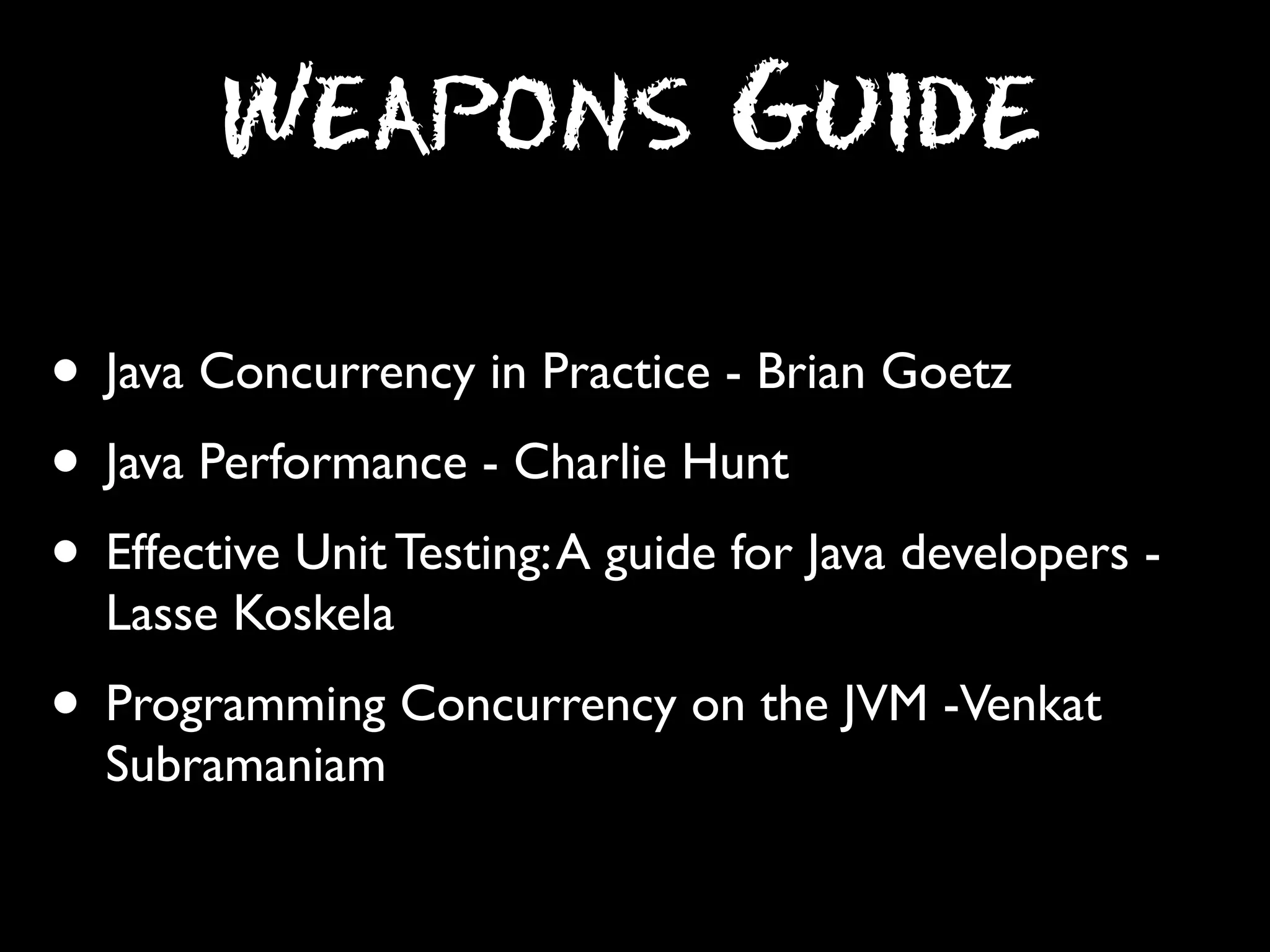
Weapons Guide
• Java Concurrency in Practice - Brian Goetz
• Java Performance - Charlie Hunt
• Effective Unit Testing: A guide for Java developers Lasse Koskela

• Programming Concurrency on the JVM -Venkat
Subramaniam
Choreographer’s
Workshop

Level 2
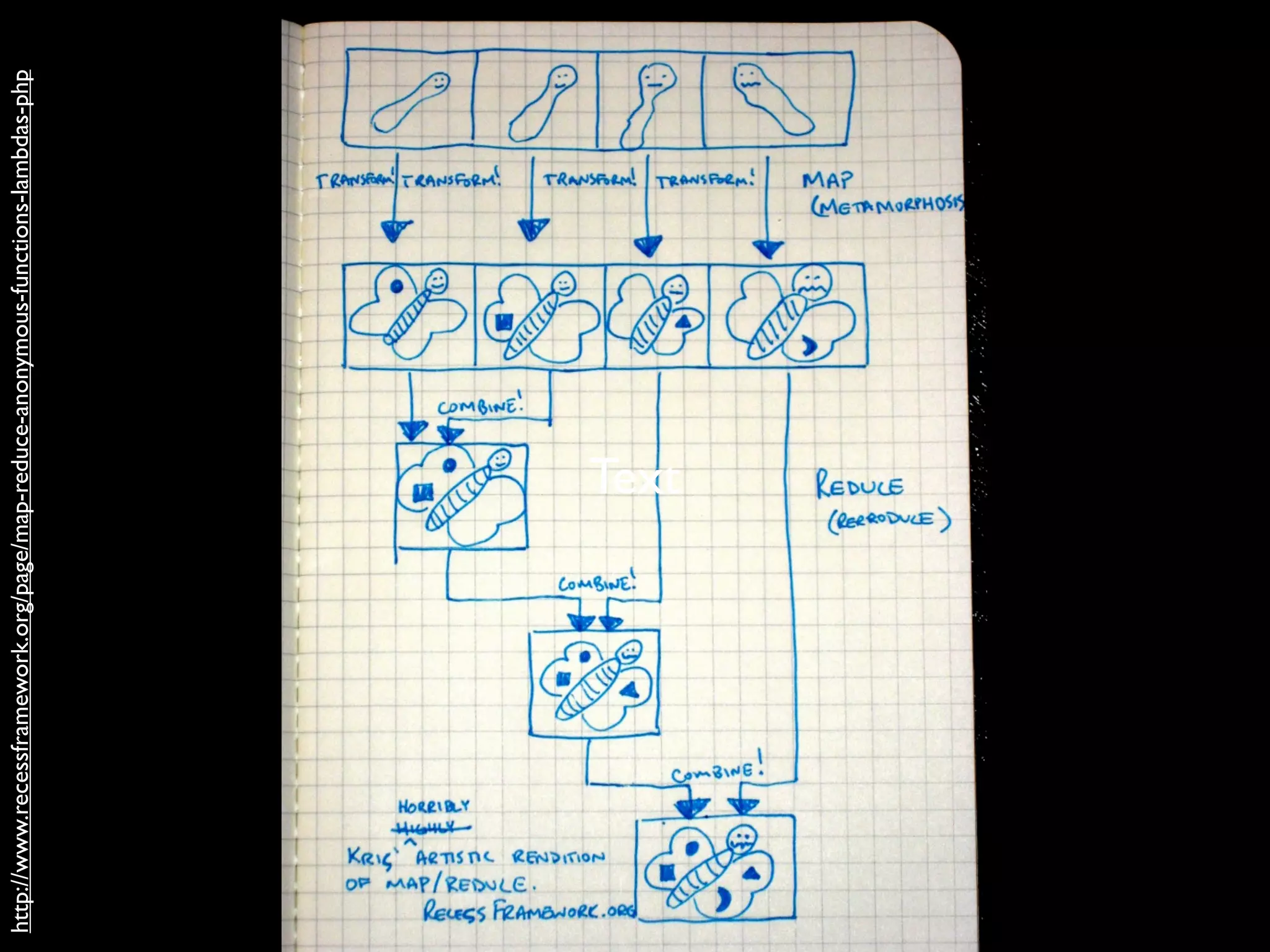
http://www.recessframework.org/page/map-reduce-anonymous-functions-lambdas-php

Text
Awaitility

PowerUP
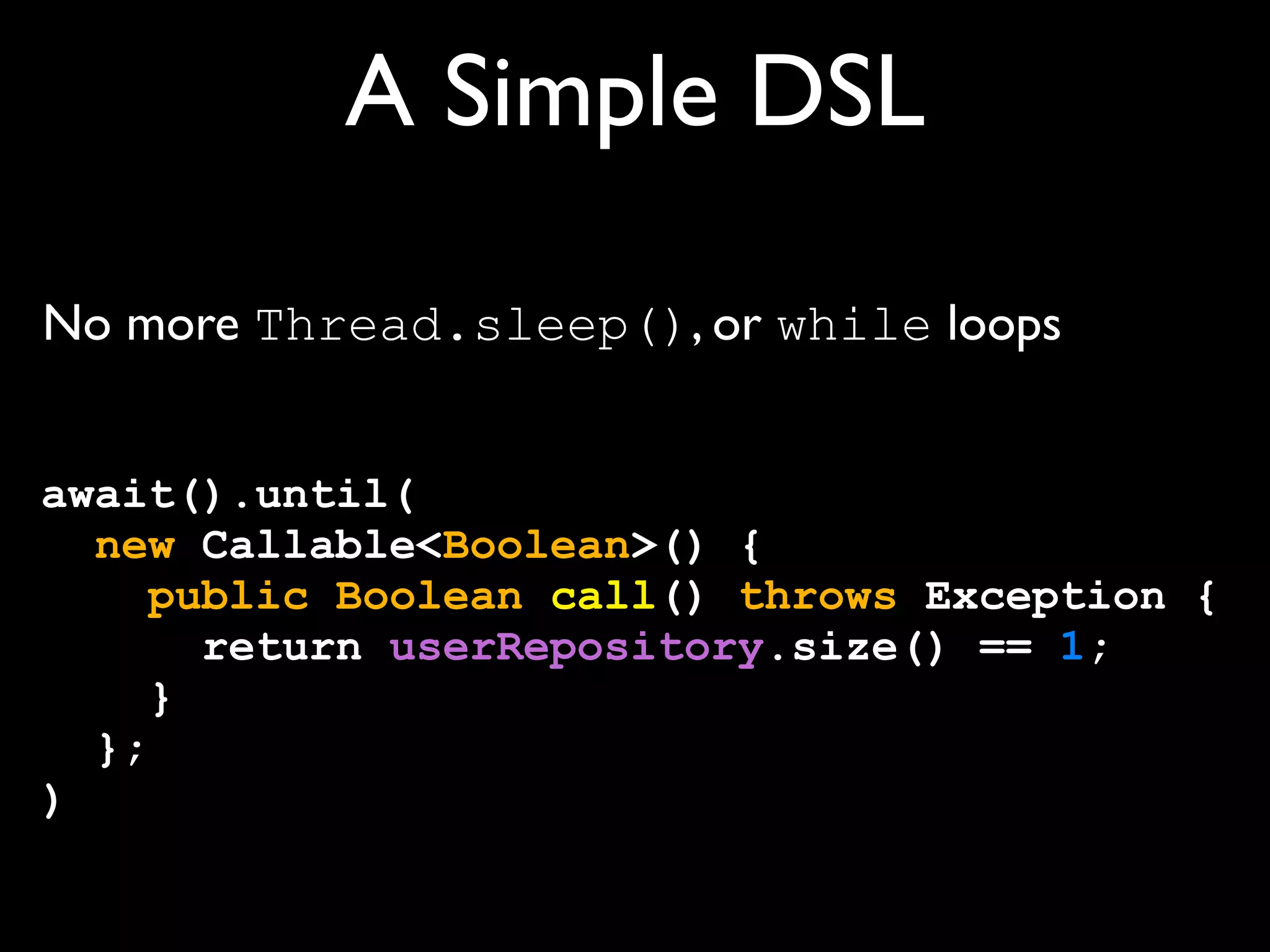
A Simple DSL
No more Thread.sleep(), or while loops
await().until(
new Callable<Boolean>() {
public Boolean call() throws Exception {
return userRepository.size() == 1;
}
};
)
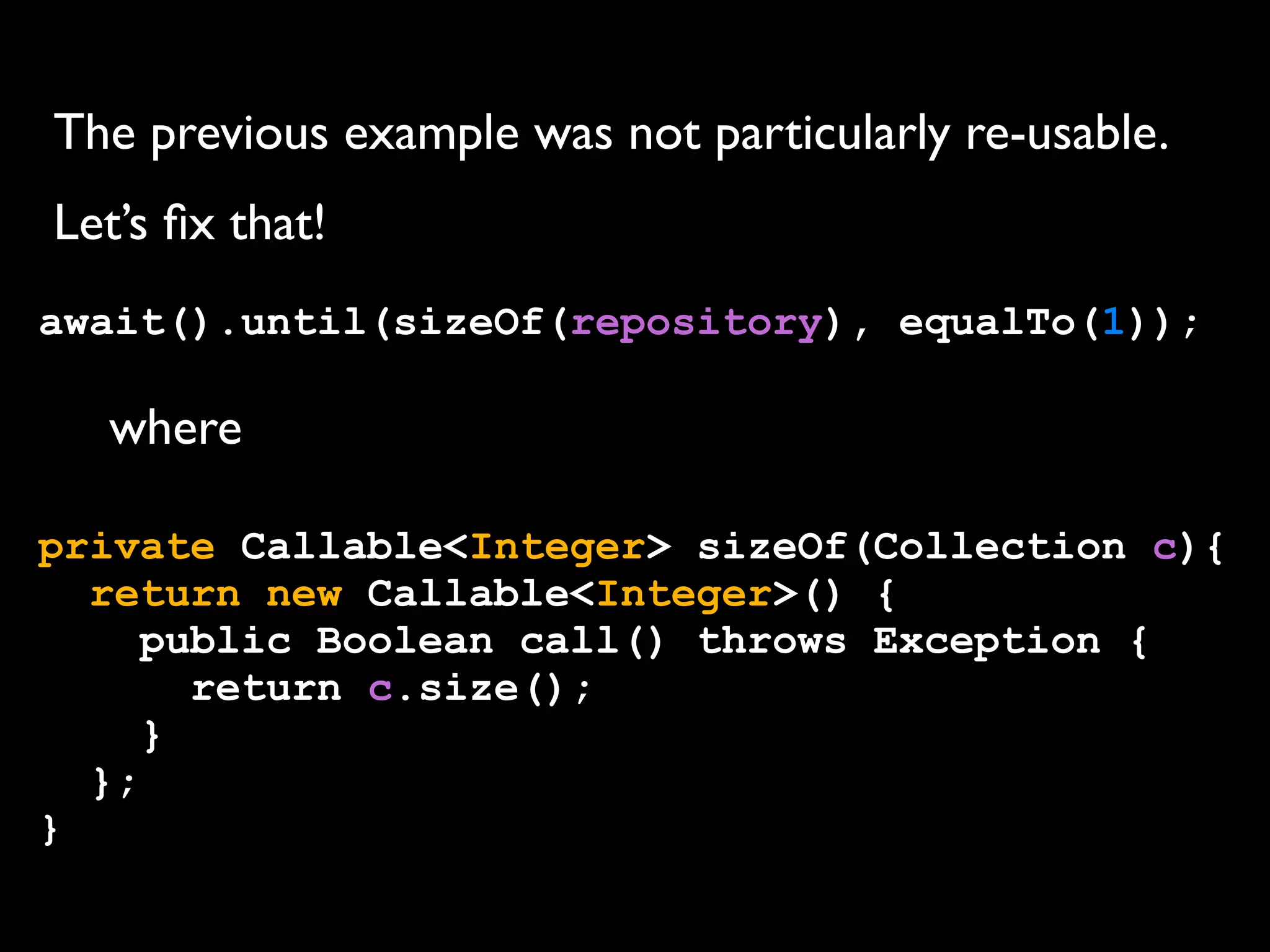
The previous example was not particularly re-usable.
Let’s fix that!
await().until(sizeOf(repository), equalTo(1));

where
private Callable<Integer> sizeOf(Collection c){
return new Callable<Integer>() {
public Boolean call() throws Exception {
return c.size();
}
};
}
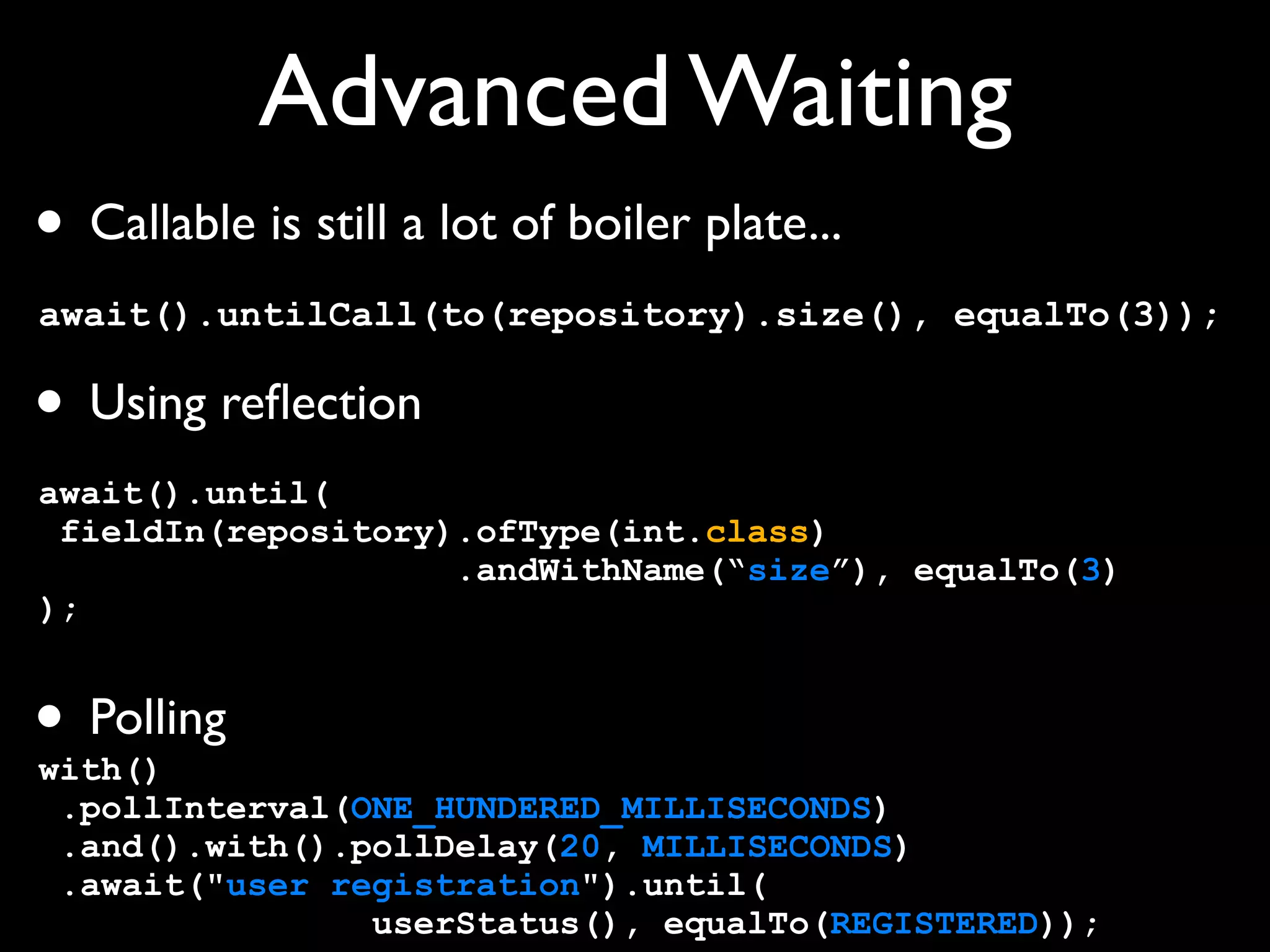
Advanced Waiting
• Callable is still a lot of boiler plate...
await().untilCall(to(repository).size(), equalTo(3));

• Using reflection
await().until(
fieldIn(repository).ofType(int.class)
.andWithName(“size”), equalTo(3)
);

• Polling

with()
.pollInterval(ONE_HUNDERED_MILLISECONDS)
.and().with().pollDelay(20, MILLISECONDS)
.await("user registration").until(
userStatus(), equalTo(REGISTERED));
The Shared
Resource Contest

Level 3
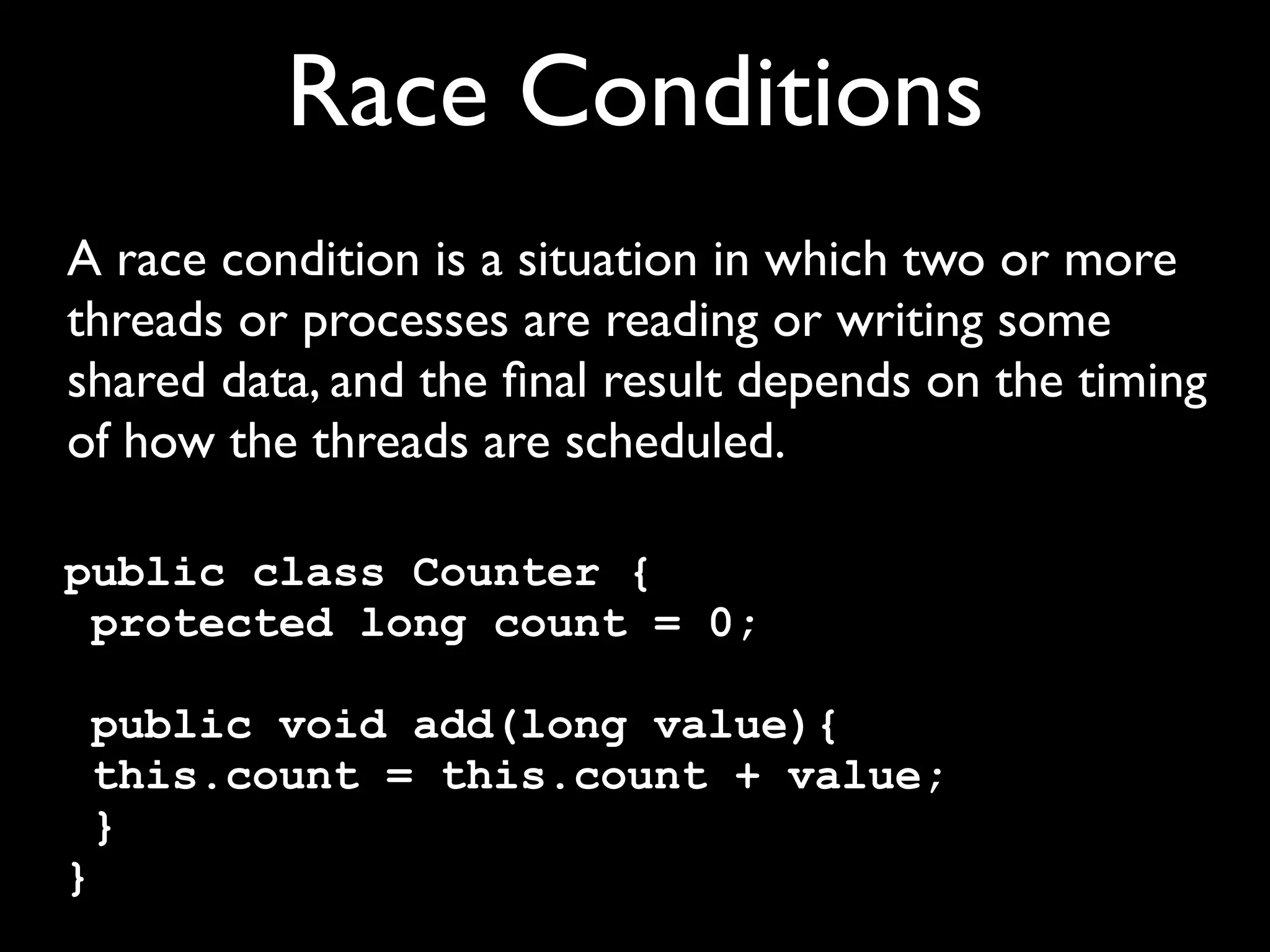
Race Conditions
A race condition is a situation in which two or more
threads or processes are reading or writing some
shared data, and the final result depends on the timing
of how the threads are scheduled.
public class Counter {
protected long count = 0;
public void add(long value){
this.count = this.count + value;
}
}
ThreadWeaver

PowerUP
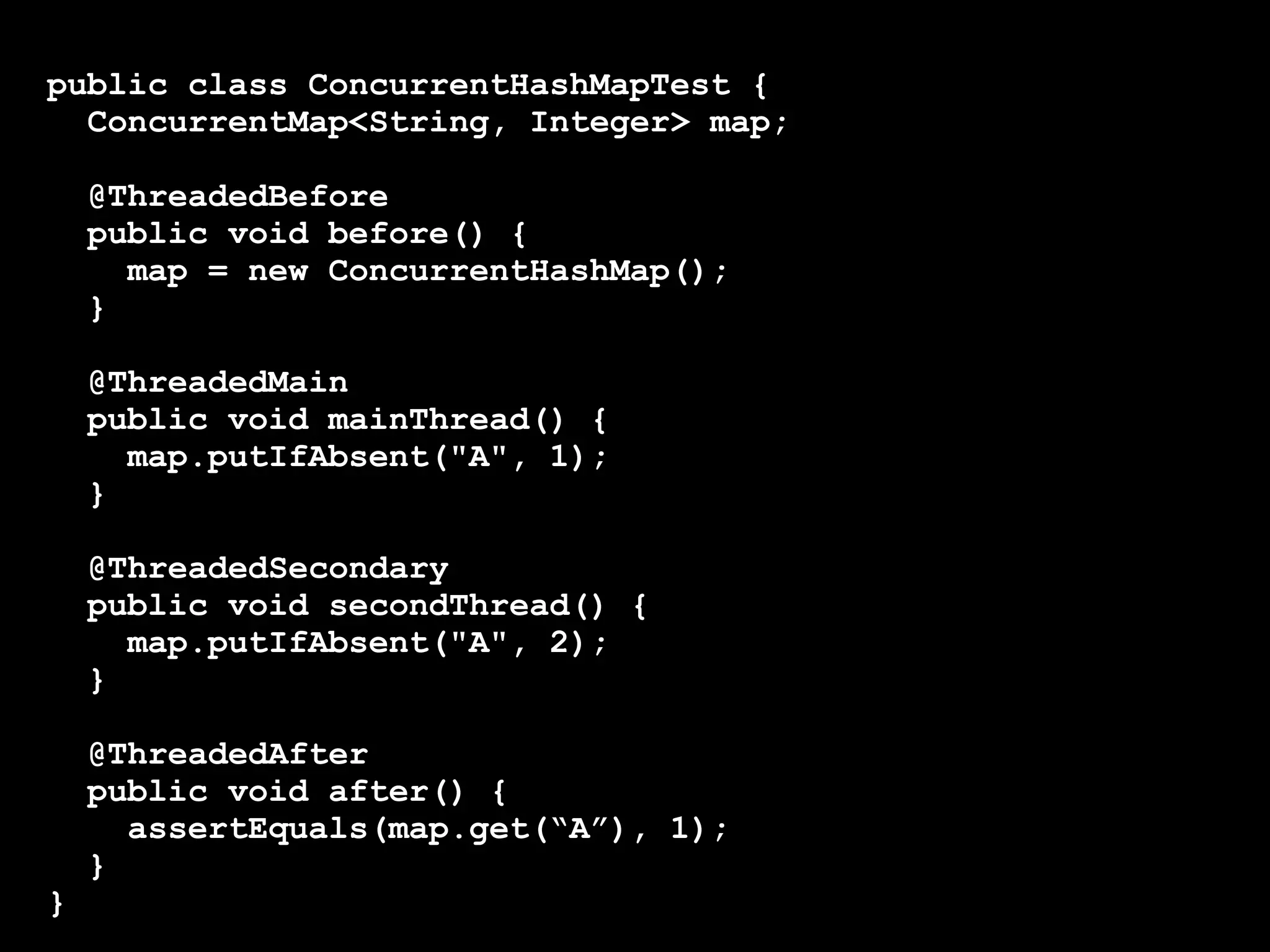
public class ConcurrentHashMapTest {
ConcurrentMap<String, Integer> map;
@ThreadedBefore
public void before() {
map = new ConcurrentHashMap();
}
@ThreadedMain
public void mainThread() {
map.putIfAbsent("A", 1);
}
@ThreadedSecondary
public void secondThread() {
map.putIfAbsent("A", 2);
}

}

@ThreadedAfter
public void after() {
assertEquals(map.get(“A”), 1);
}
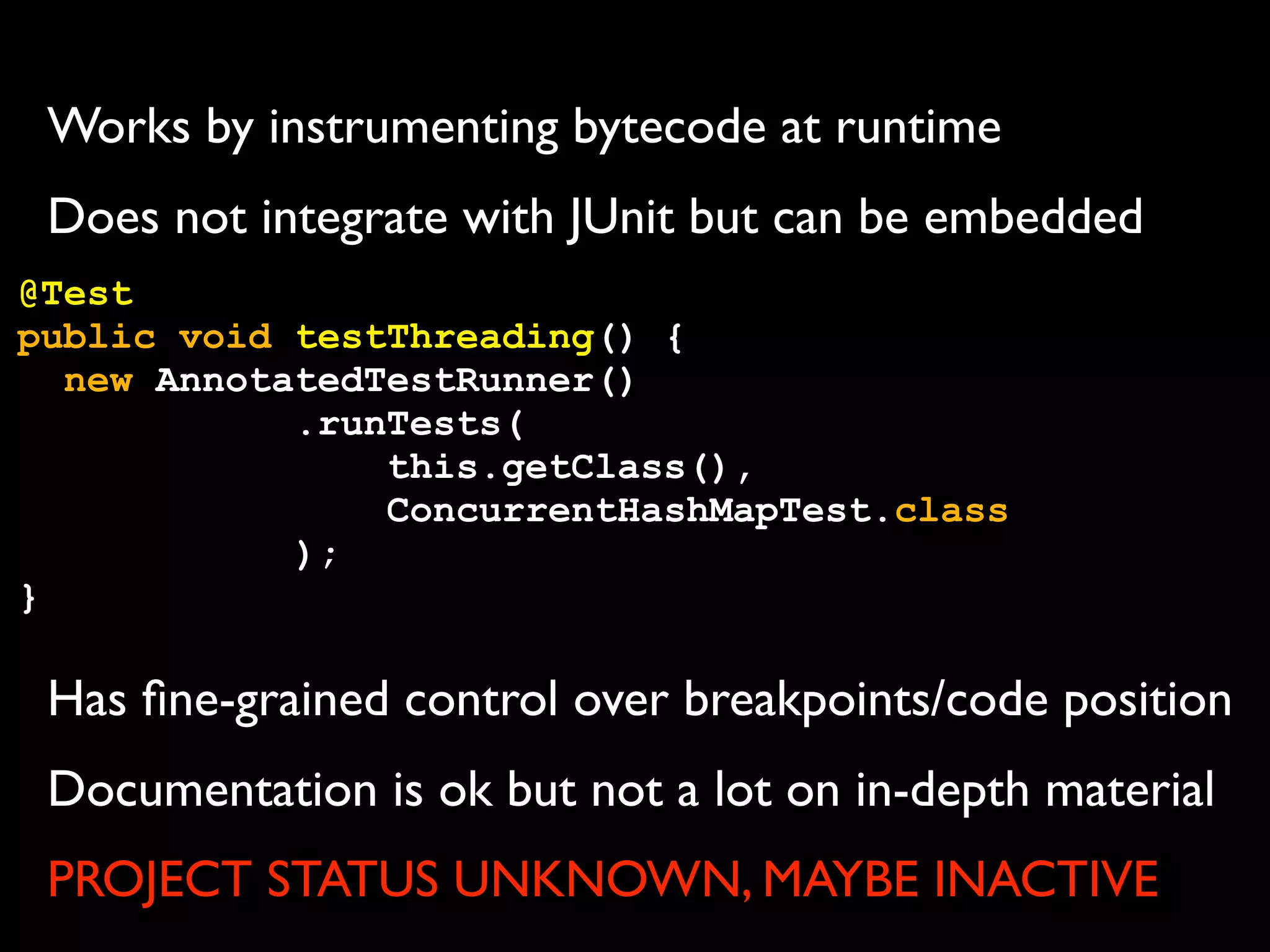
Works by instrumenting bytecode at runtime
Does not integrate with JUnit but can be embedded
@Test
public void testThreading() {
new AnnotatedTestRunner()
.runTests(
this.getClass(),
ConcurrentHashMapTest.class
);
}

Has fine-grained control over breakpoints/code position
Documentation is ok but not a lot on in-depth material
PROJECT STATUS UNKNOWN, MAYBE INACTIVE
Princess
Protection HQ

Level 4
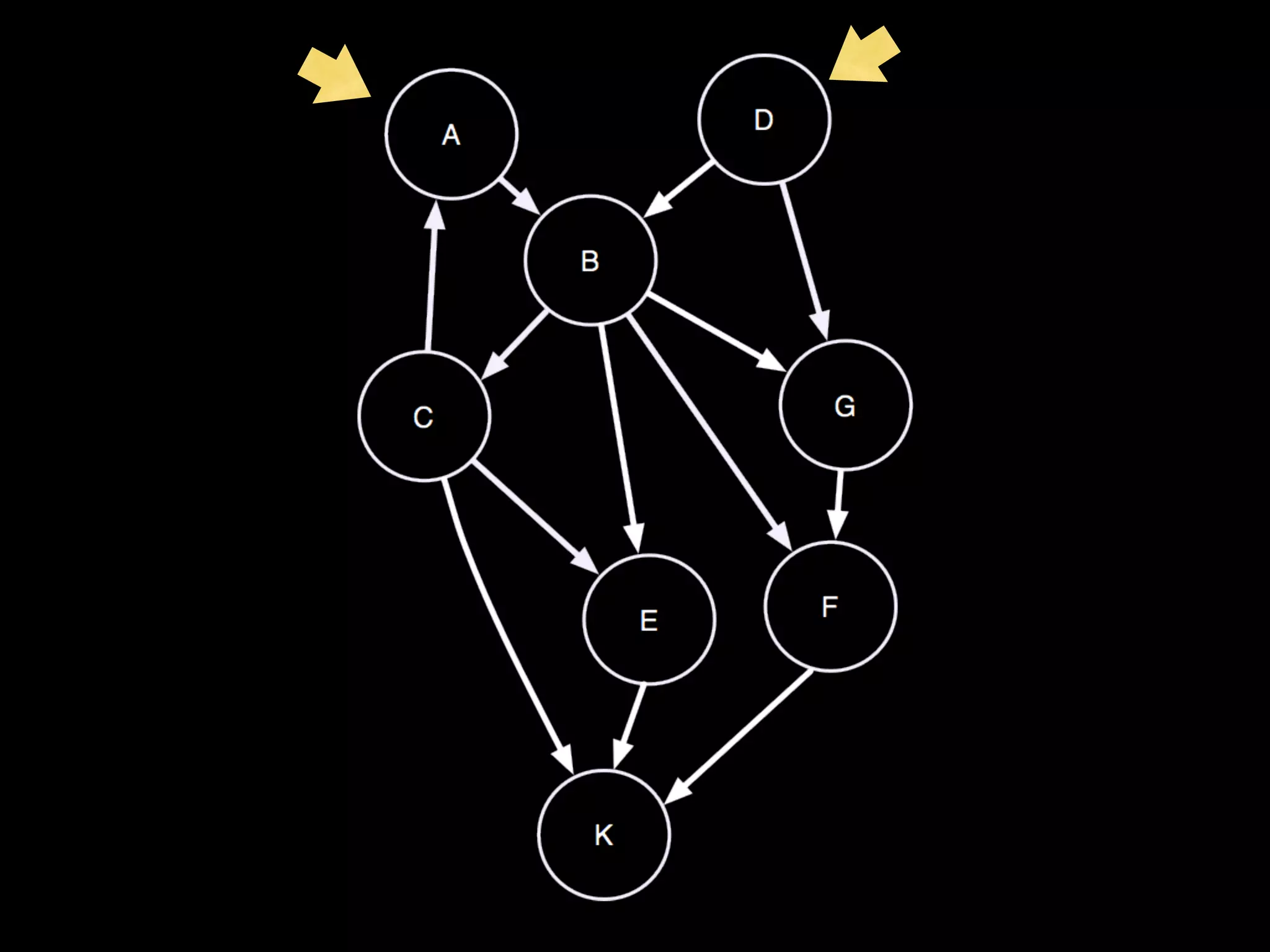
A recurrent
producer-consumer
information
processing network
for anomaly
detection
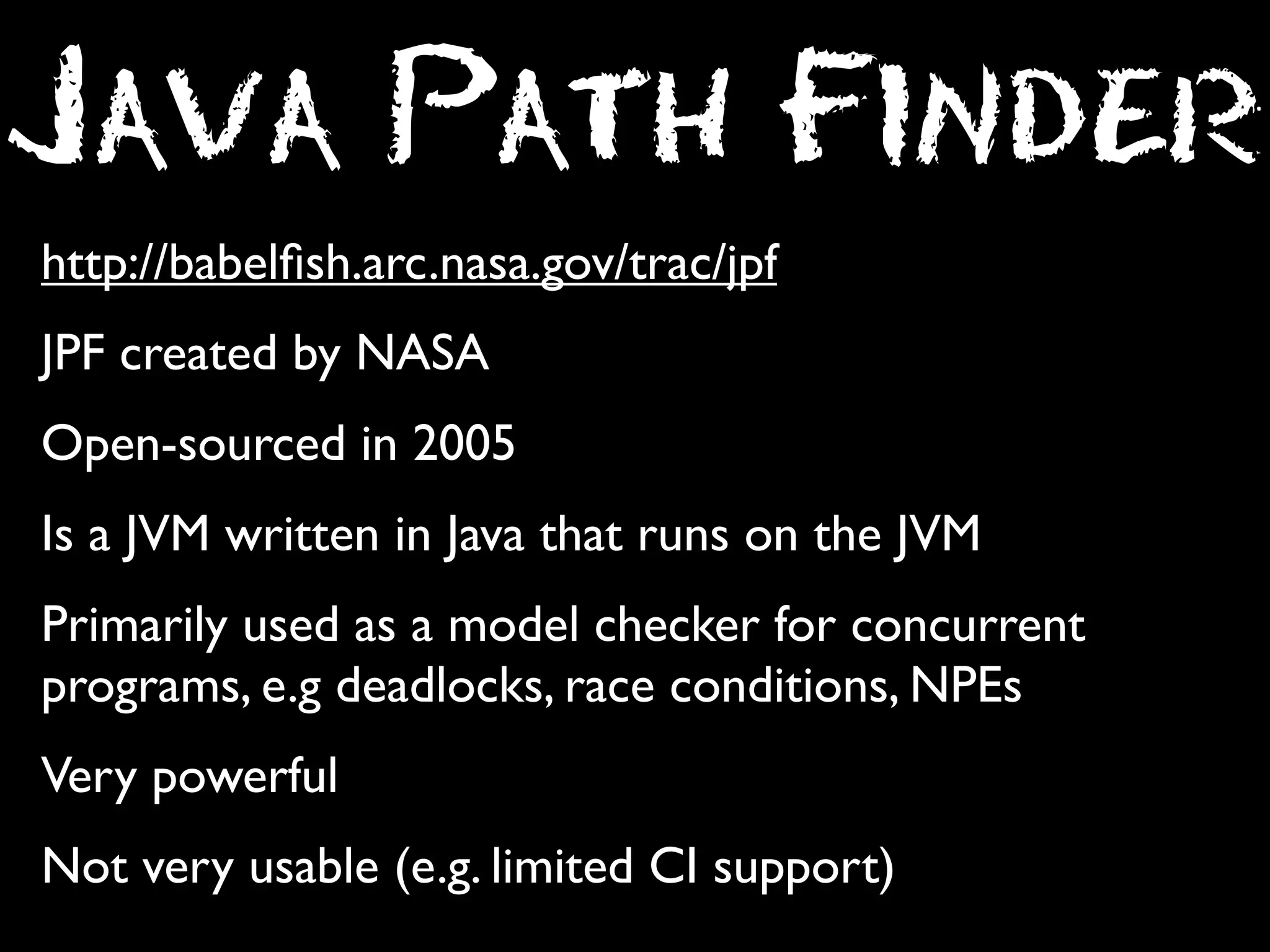
Java Path Finder
http://babelfish.arc.nasa.gov/trac/jpf
JPF created by NASA
Open-sourced in 2005
Is a JVM written in Java that runs on the JVM
Primarily used as a model checker for concurrent
programs, e.g deadlocks, race conditions, NPEs
Very powerful
Not very usable (e.g. limited CI support)
Byteman

PowerUP
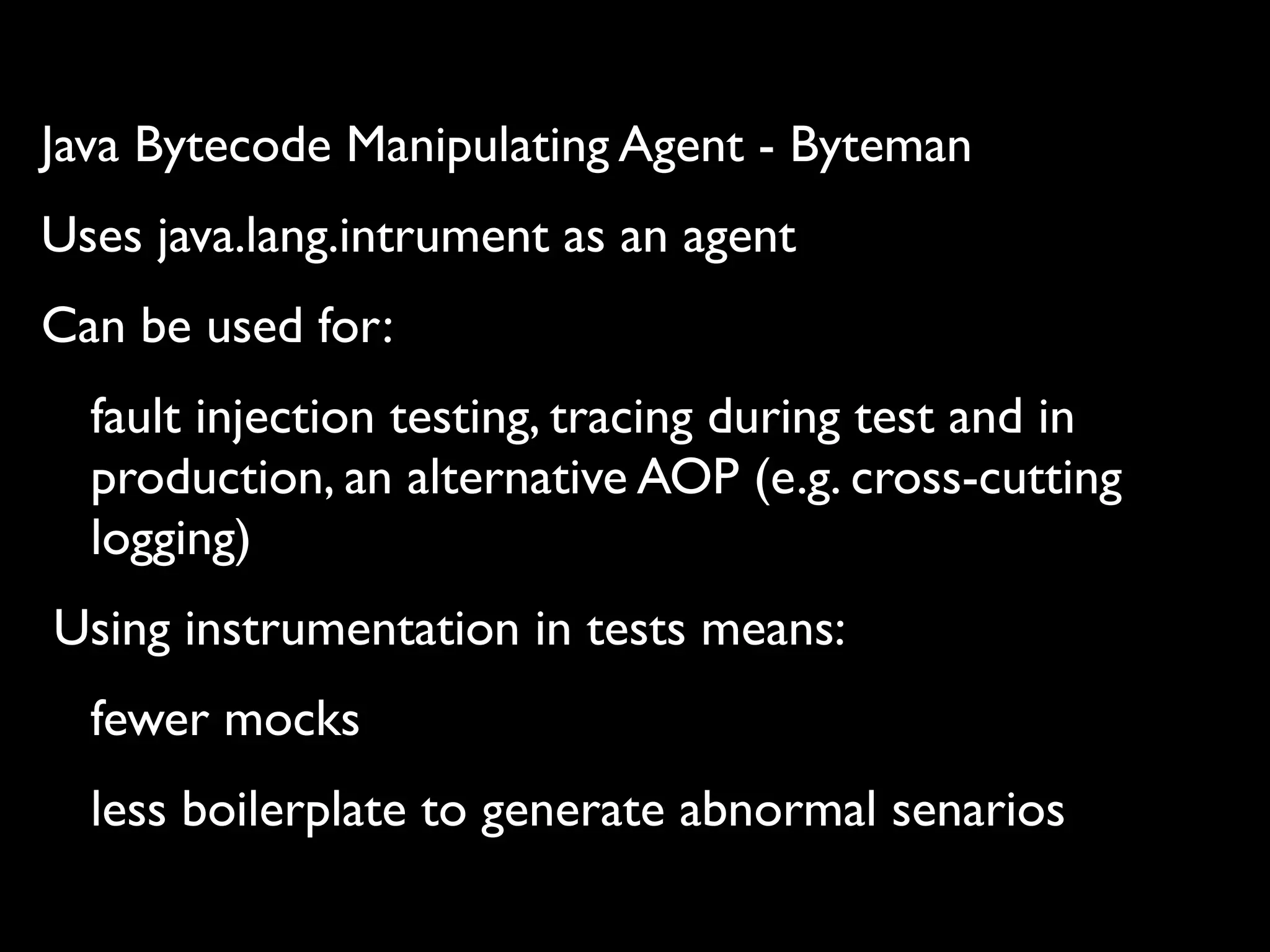
Java Bytecode Manipulating Agent - Byteman
Uses java.lang.intrument as an agent
Can be used for:
fault injection testing, tracing during test and in
production, an alternative AOP (e.g. cross-cutting
logging)
Using instrumentation in tests means:
fewer mocks
less boilerplate to generate abnormal senarios
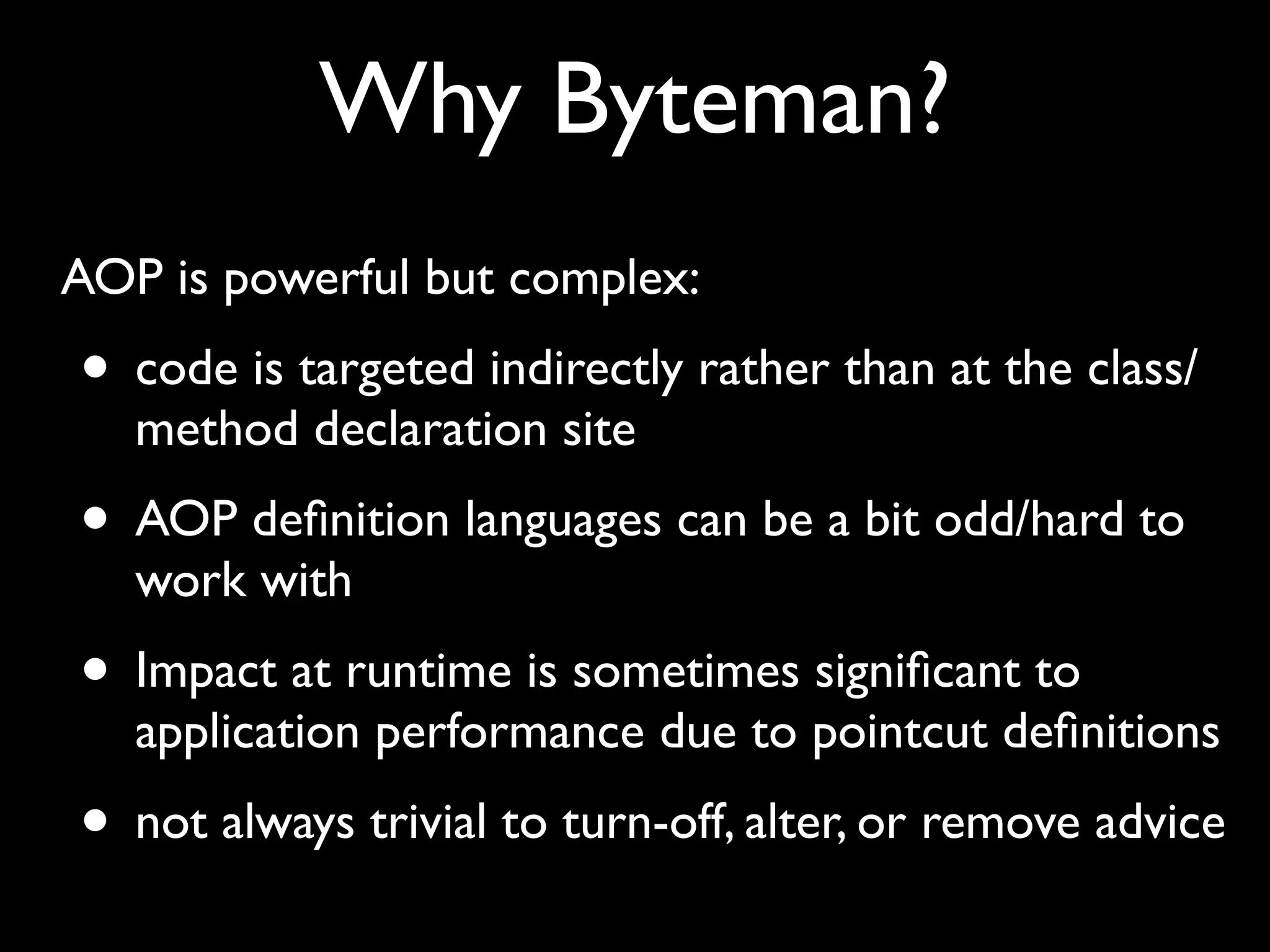
Why Byteman?
AOP is powerful but complex:

• code is targeted indirectly rather than at the class/
method declaration site

• AOP definition languages can be a bit odd/hard to
work with

• Impact at runtime is sometimes significant to

application performance due to pointcut definitions

• not always trivial to turn-off, alter, or remove advice
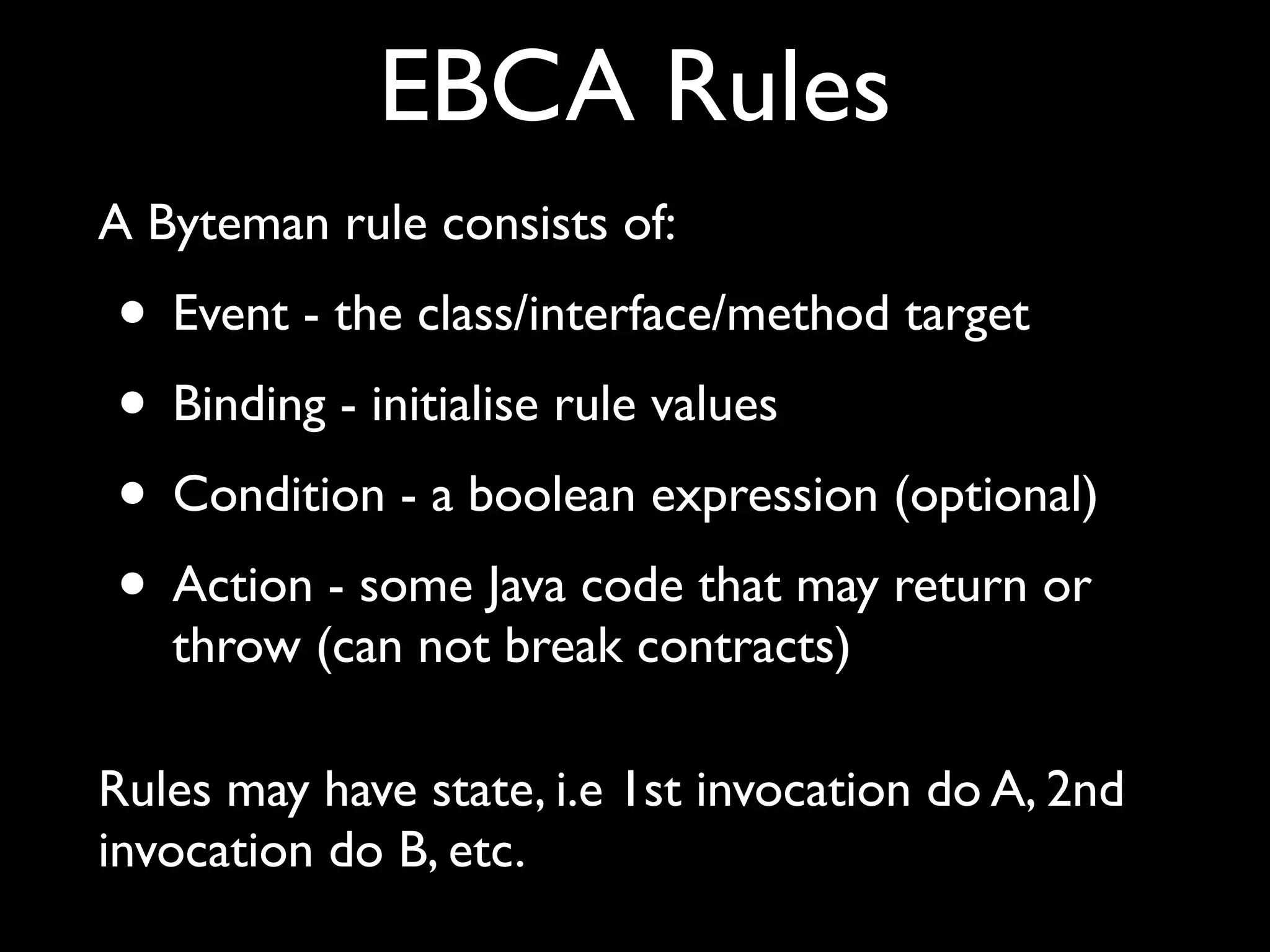
EBCA Rules
A Byteman rule consists of:

• Event - the class/interface/method target
• Binding - initialise rule values
• Condition - a boolean expression (optional)
• Action - some Java code that may return or
throw (can not break contracts)

Rules may have state, i.e 1st invocation do A, 2nd
invocation do B, etc.
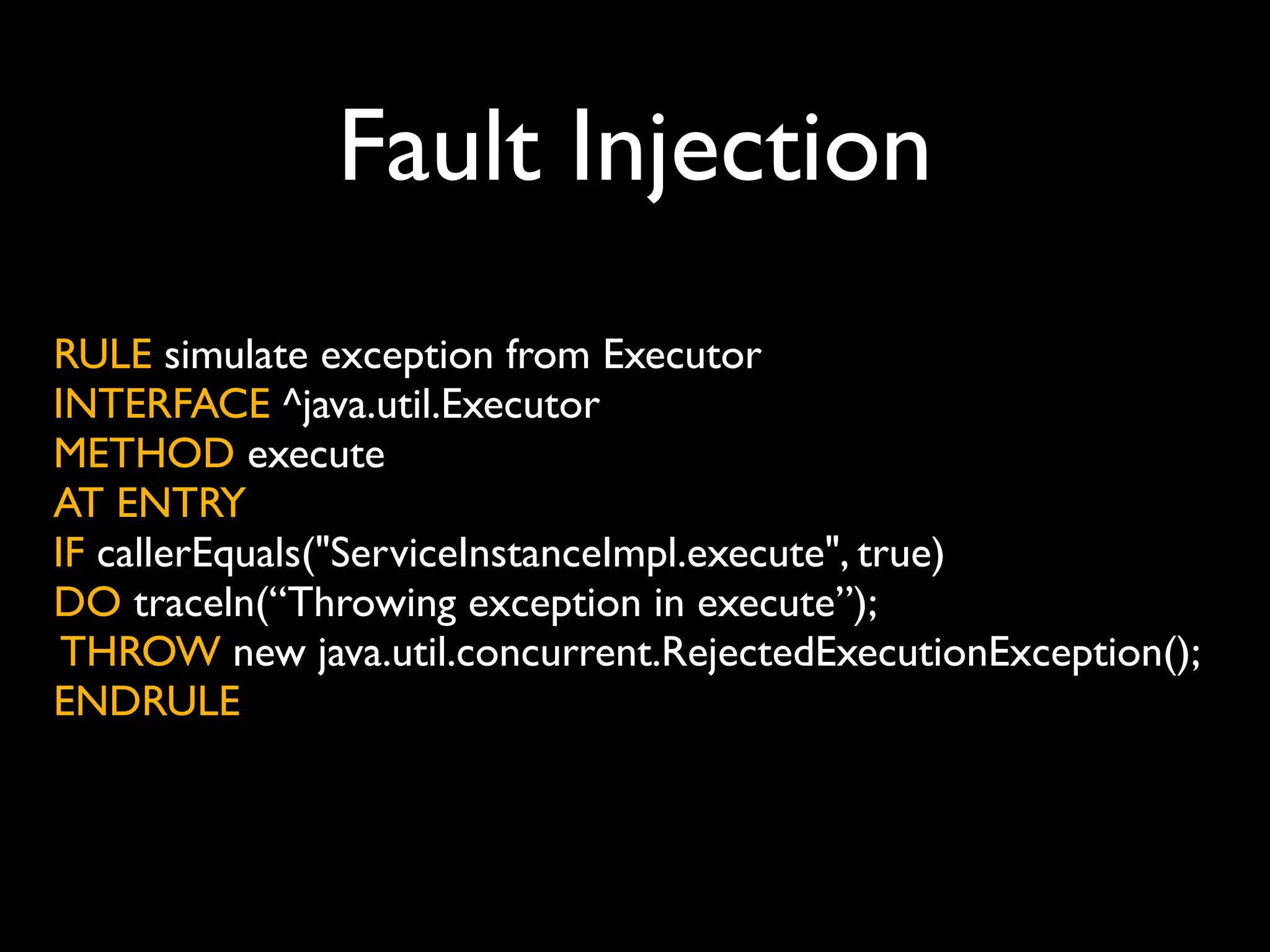
Fault Injection
RULE simulate exception from Executor
INTERFACE ^java.util.Executor
METHOD execute
AT ENTRY
IF callerEquals("ServiceInstanceImpl.execute", true)
DO traceln(“Throwing exception in execute”);
THROW new java.util.concurrent.RejectedExecutionException();
ENDRULE
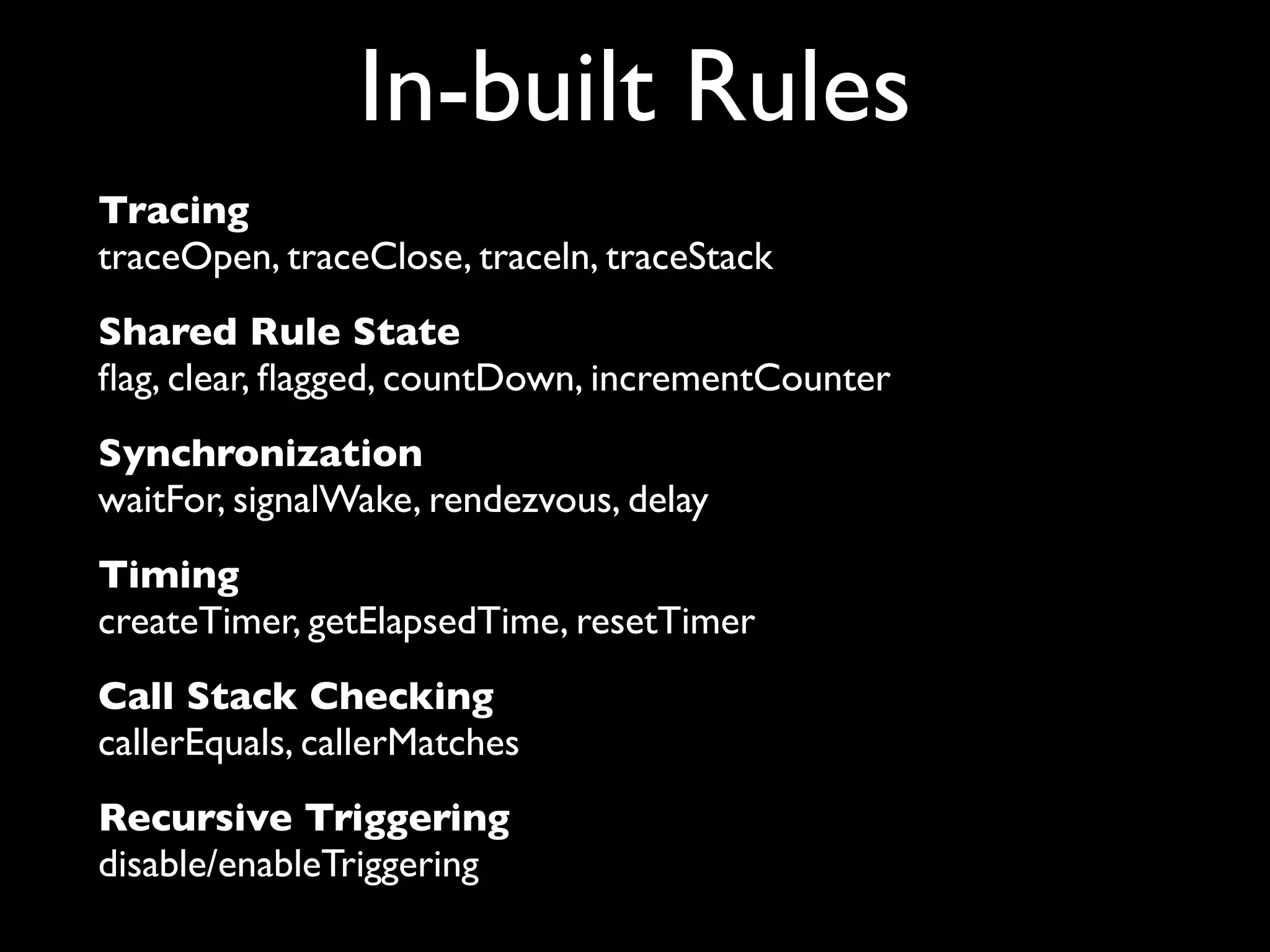
In-built Rules
Tracing
traceOpen, traceClose, traceln, traceStack
Shared Rule State
flag, clear, flagged, countDown, incrementCounter
Synchronization
waitFor, signalWake, rendezvous, delay
Timing
createTimer, getElapsedTime, resetTimer
Call Stack Checking
callerEquals, callerMatches
Recursive Triggering
disable/enableTriggering
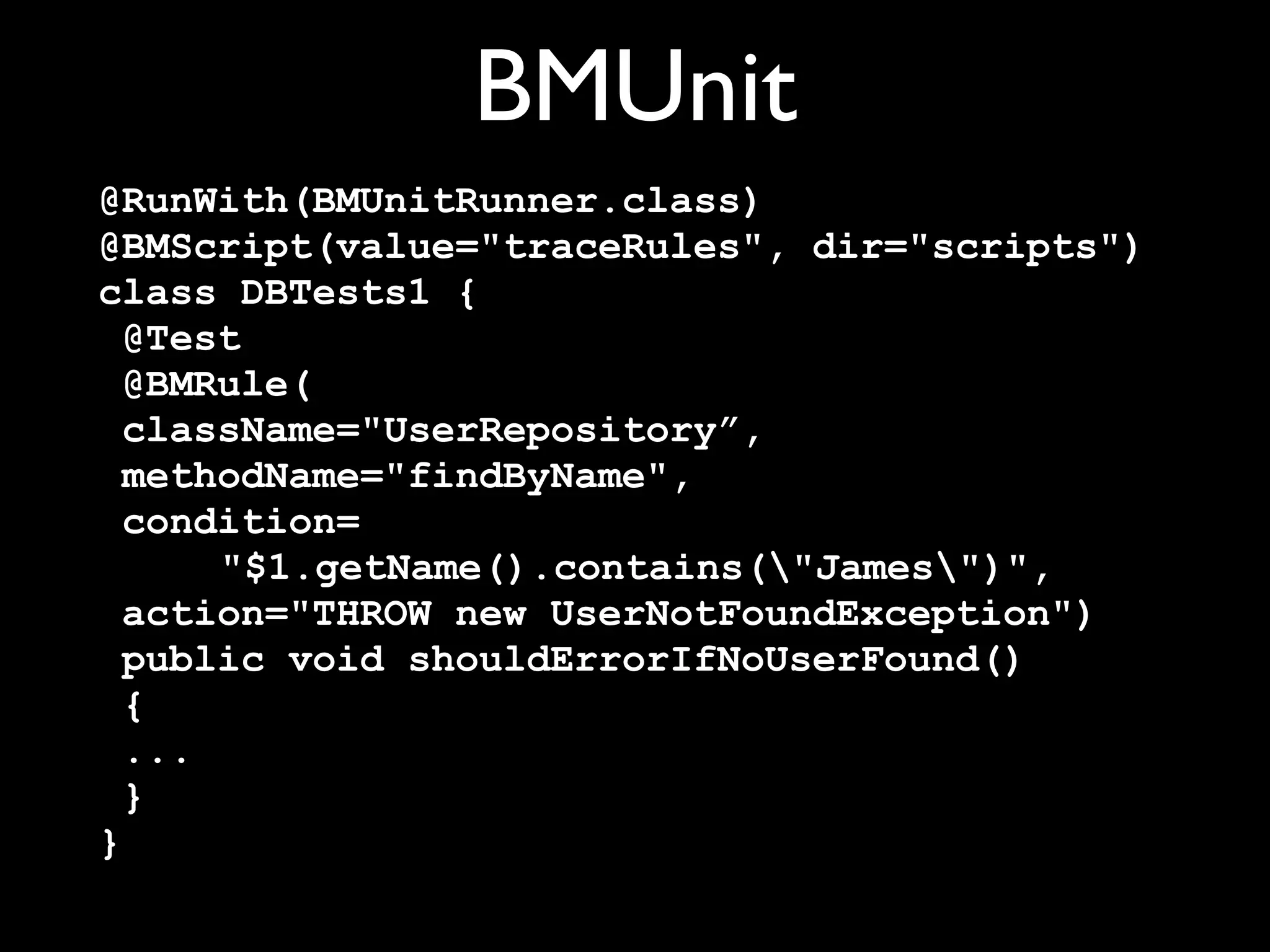
BMUnit
@RunWith(BMUnitRunner.class)
@BMScript(value="traceRules", dir="scripts")
class DBTests1 {
@Test
@BMRule(
className="UserRepository”,
methodName="findByName",
condition=
"$1.getName().contains("James")",
action="THROW new UserNotFoundException")
public void shouldErrorIfNoUserFound()
{
...
}
}
Machine Lab

Bouns LeveL
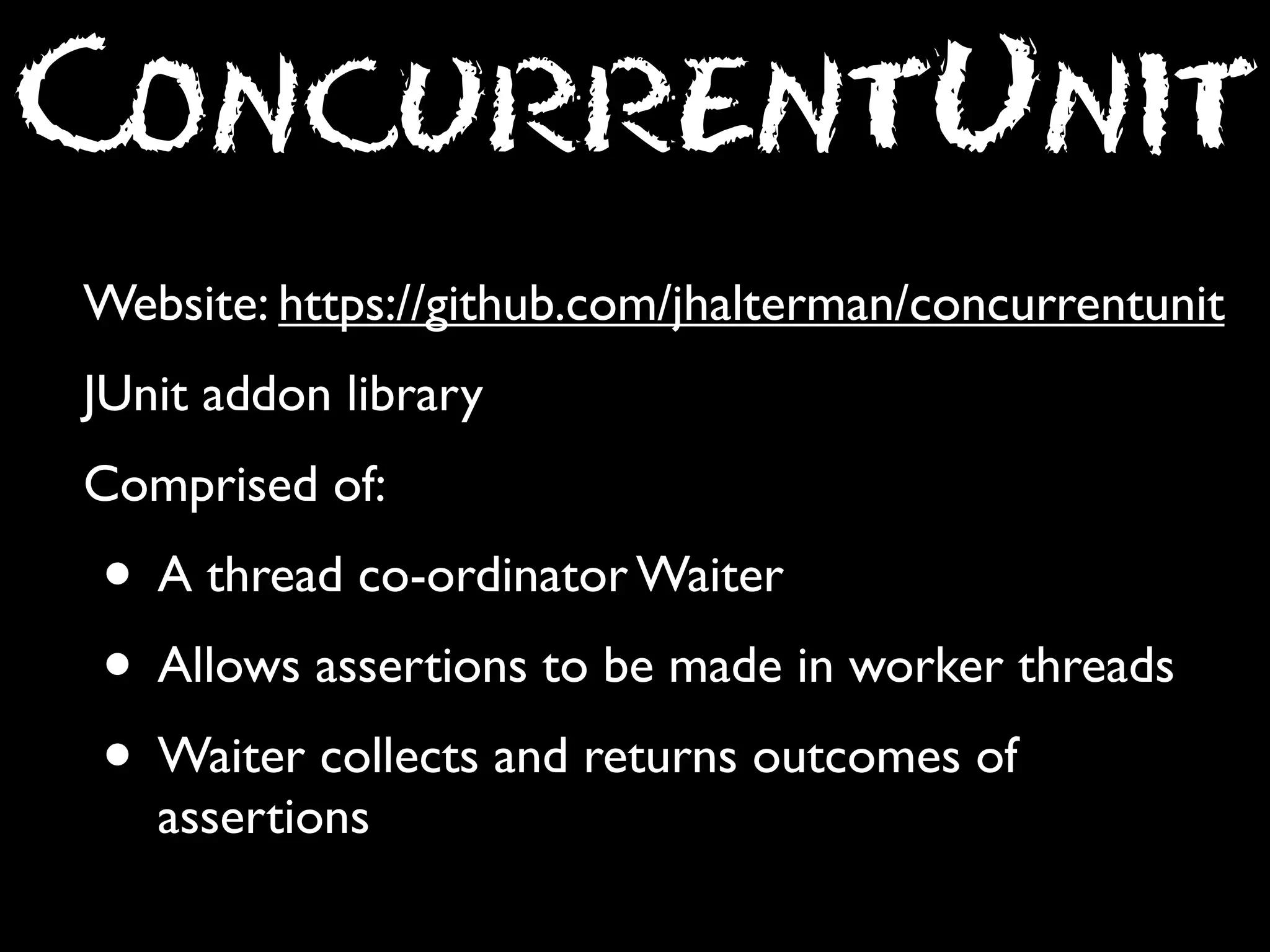
ConcurrentUnit
Website: https://github.com/jhalterman/concurrentunit
JUnit addon library
Comprised of:

• A thread co-ordinator Waiter
• Allows assertions to be made in worker threads
• Waiter collects and returns outcomes of
assertions
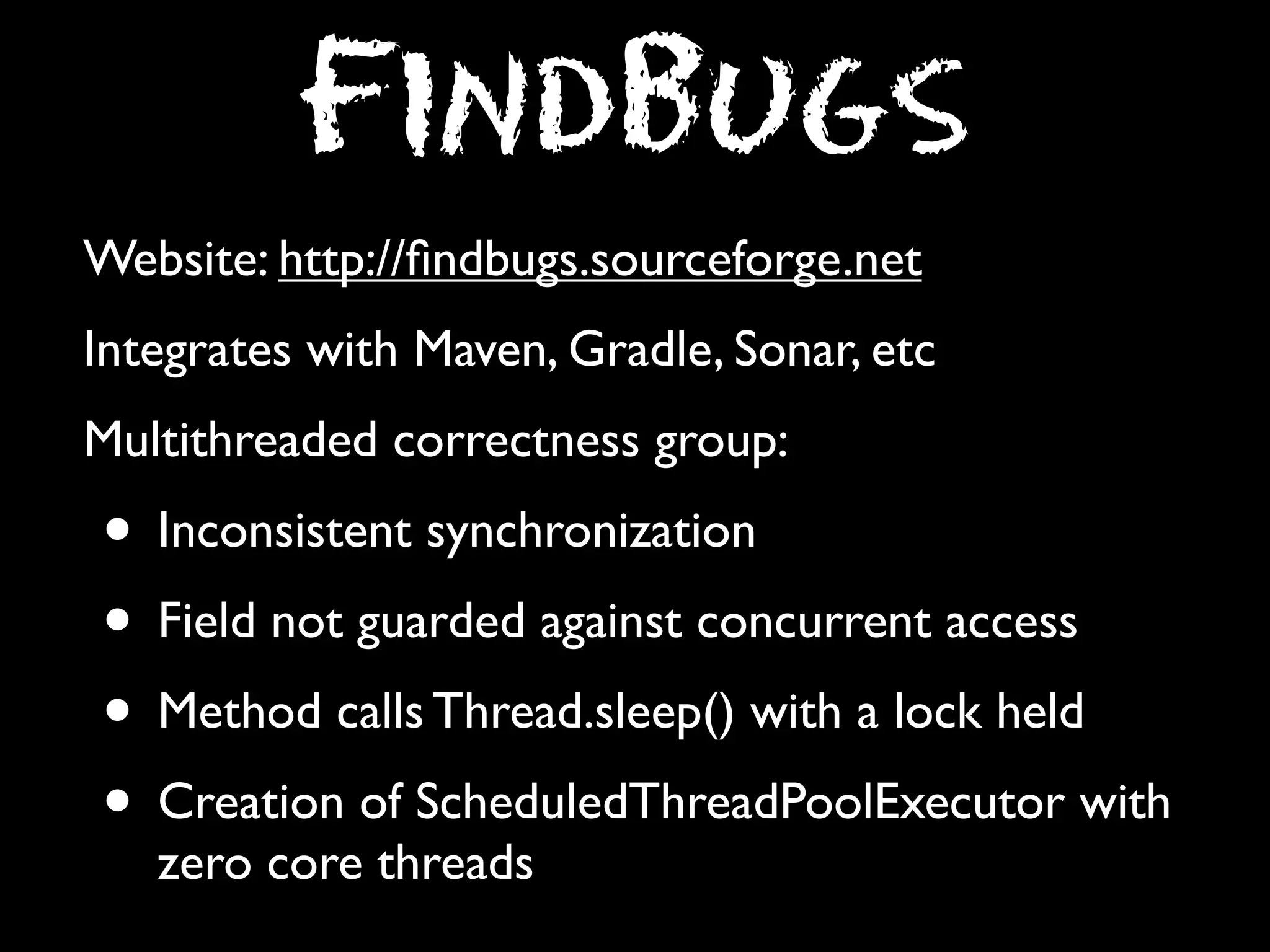
FindBugs
Website: http://findbugs.sourceforge.net
Integrates with Maven, Gradle, Sonar, etc
Multithreaded correctness group:

• Inconsistent synchronization
• Field not guarded against concurrent access
• Method calls Thread.sleep() with a lock held
• Creation of ScheduledThreadPoolExecutor with
zero core threads
Freud
Website: https://github.com/LMAX-Exchange/freud
A framework for writing static analysis tests
Lacks good documentation except code examples
Has rules for:
✦
✦

✦
✦

Java sources
Java class objects. (i.e analysing the java.lang.Class
object)
Java class files (i.e analysing the ".class" file)
Spring framework XML configuration files
Summary

Scores
Lv.0 - Testing Tutorial

• TDD is your friend
• Prefer rules over runners
• Don’t be afraid to write custom rules and
runners

• Ensure you spend your time on the
important tests
Lv.1 - The Thread
Challenge

• Modelling real world behaviour of your application
is hard

• Don’t assume your tests are exhaustively testing
the scenarios

• Behaviour depends heavily on the system (e.g. load)
• Know your stuff - read read read
Lv2. Choreographer’s
Workshop

• It is essential to test the co-ordinated
behaviour of threads

• If threads are not sharing resources we

don’t need to care about synchronisation
between thread

• Awaitility allows us to check that some end
state if finally reached (within the given
time)
Lv.3 - The Shared
Resource Contest

• When a resource is shared between

threads new problem cases can arise, e.g.
races

• Often the problem can be simplified to the
case of 2 threads

• To test the orders of execution of 2
threads we can use ThreadWeaver
Lv.4 - Princess
Protection HQ

• Many problems can’t be reduced to a 2 thread
model

• JPF can provide some automated analysis of
concurrency issues

• Byteman allows us to take control of the whole
application

• Both are very heavy weight and should not be
JUnit PowerUP

GAME OVER
Credits
JUnit
http://www.junit.org
Awaitility
http://code.google.com/p/awaitility
ByteMan
http://www.jboss.org/byteman

ThreadWeaver
http://code.google.com/p/thread-weaver
ConcurrentUnit
https://github.com/jhalterman/concurrentunit

FindBugs
http://findbugs.sourceforge.net
Freud
https://github.com/LMAX-Exchange/freud

Java PathFinder
http://babelfish.arc.nasa.gov/trac/jpf
JUnit PowerUP
Practical Testing Tips
James McGivern

JUnit PowerUp

  • 1.
  • 2.
    About James Likes cats Talksfast Technical Evangelist Hates Marmite Mathematician turned Computer Scientist Lives in London
  • 3.
  • 4.
    One Busy DayOn Concurrent Island... Intro
  • 6.
    Concurrency? concurrent - adjective 1.occurring or existing simultaneously or side by side: concurrent attacks by land, sea, and air. 2. acting in conjunction; co-operating. 3. having equal authority or jurisdiction. 4. accordant or agreeing. 5. tending to or intersecting at the same point: four concurrent lines.
  • 7.
    The behaviour ofa single threaded application is deterministic A multithreaded application may appear stochastic Concurrency introduces new problems: deadlocks resource starvation (e.g livelocks) race conditions contention • • • •
  • 8.
    But Why? Consider theold singleton pattern getInstance() method: public Singleton getInstance() { if(INSTANCE == null) { INSTANCE = new Singleton(); } return INSTANCE; } and two threads: Thread A, Thread B
  • 9.
    But Why? Consider theold singleton pattern getInstance() method: public Singleton getInstance() { if(INSTANCE == null) { INSTANCE = new Singleton(); } return INSTANCE; } and two threads: Thread A, Thread B
  • 10.
    But Why? Consider theold singleton pattern getInstance() method: public Singleton getInstance() { if(INSTANCE == null) { INSTANCE = new Singleton(); } return INSTANCE; } and two threads: Thread A, Thread B
  • 11.
    But Why? Consider theold singleton pattern getInstance() method: public Singleton getInstance() { if(INSTANCE == null) { INSTANCE = new Singleton(); } return INSTANCE; } and two threads: Thread A, Thread B
  • 12.
    But Why? Consider theold singleton pattern getInstance() method: public Singleton getInstance() { if(INSTANCE == null) { INSTANCE = new Singleton(); } return INSTANCE; } and two threads: Thread A, Thread B
  • 13.
    But Why? Consider theold singleton pattern getInstance() method: public Singleton getInstance() { if(INSTANCE == null) { INSTANCE = new Singleton(); } return INSTANCE; } and two threads: Thread A, Thread B
  • 14.
    But Why? Consider theold singleton pattern getInstance() method: public Singleton getInstance() { if(INSTANCE == null) { INSTANCE = new Singleton(); } return INSTANCE; } and two threads: Thread A, Thread B
  • 15.
    But Why? Consider theold singleton pattern getInstance() method: public Singleton getInstance() { if(INSTANCE == null) { INSTANCE = new Singleton(); } return INSTANCE; } and two threads: Thread A, Thread B
  • 16.
    But Why? Consider theold singleton pattern getInstance() method: public Singleton getInstance() { if(INSTANCE == null) { INSTANCE = new Singleton(); } return INSTANCE; } and two threads: Thread A, Thread B
  • 17.
    But Why? Consider theold singleton pattern getInstance() method: public Singleton getInstance() { if(INSTANCE == null) { INSTANCE = new Singleton(); } return INSTANCE; } and two threads: Thread A, Thread B
  • 18.
    Each statement isan atomic block Each thread executes a non-negative number of atomic blocks Threads take turns but order is not guaranteed Given a number of threads t, and a group of statements s, the number of execution order permutations is given by: interleavings(t, s) = (ts)! t (s!)
  • 19.
  • 21.
    public class FibonacciSequenceTest{ FibonacciSequence fib = new FibonacciSequence(); @Test public void shouldOutputZeroWhenInputIsZero() { assertThat(fib.get(0), is(0)) } @Test public void shouldOutputOneWhenInputIsOne() { assertThat(fib.get(1), is(1)); } @Test public void shouldCalculateNthNumber(){ for(int i = 2; i <= 10; i++) { int x = fib.get(i-1); int y = fib.get(i-2); int sum = x + y; assertThat(fib.calculate(i), is(sum); } } }
  • 22.
    Cost/Benefit Ratio (TDD) Unittests are executable specifications of the code Unit (+ integration tests) will never find all the bugs Writing tests takes time Time is limited Which tests should I write and which should I forgo?
  • 23.
    JUnit Runners Bundled Suite, Parameterized • •Theories, Categories, Enclosed Popular 3rd party runners Mockito, PowerMock(ito) • Custom JBehave, Spock • • dynamic tests?
  • 24.
    Custom Runner public abstractclass Runner implements Describable { public Runner(Class<?> testClass){...} public abstract Description getDescription(); public abstract void run(RunNotifier n); public int testCount() { return getDescription().testCount(); } }
  • 25.
  • 26.
    RunNotifier fireTestStarted(Description d) fireTestFinished(Description d) fireTestFailure(Failuref) fireTestIgnored(Description d) fireTestAssumptionFailed(Failure f)
  • 27.
    Warning • A verycoarse way of modifying test execution • Even when extending from BlockJUnit4ClassRunner there is a degree of complex code • Runners can not be composed e.g. @RunWith(MockitoJUnitRunner.class} @RunWith(SpringJUnit4ClassRunner.class) public class SomeTest {...} @RunWith({MockitoRunner.class, SpringJUnit4ClassRunner.class}) public class SomeTest {...}
  • 28.
  • 29.
    Rules can: Read/Write testmetadata Modify the test before execution Modify the result after execution Suite vs Class == @ClassRule vs @MethodRule
  • 30.
    public interface TestRule{ Statement apply(Statement base, Description description); } public class MockRule implements TestRule { private final Object target; public MockRule(Object target) { this.target = target; } public Statement apply(final Statement base, Description description) { return new Statement() { public void evaluate() throws Throwable { MockitoAnnotations.initMocks(target); base.evaluate(); } }; } }
  • 31.
  • 33.
    static class VolatileInt{ volatile int num = 0; } public void shouldIncrementCounter() { final int count = 32 * 1000; final int nThreads = 64; ExecutorService es = Executors.newFixedThreadPool(nThreads); final VolatileInt vi = new VolatileInt(); for (int i = 0; i < nThreads; i++) { es.submit(new Runnable() { public void run() { for (int j = 0; j < count; j += nThreads) vi.num++; } }); es.shutdown(); es.awaitTermination(10, TimeUnit.SECONDS); assertEquals(count, vi.num); } http://vanillajava.blogspot.co.uk/2011/08/why-testing-code-for-thread-safety-is.html
  • 34.
    Weapons Guide • JavaConcurrency in Practice - Brian Goetz • Java Performance - Charlie Hunt • Effective Unit Testing: A guide for Java developers Lasse Koskela • Programming Concurrency on the JVM -Venkat Subramaniam
  • 35.
  • 37.
  • 38.
  • 39.
    A Simple DSL Nomore Thread.sleep(), or while loops await().until( new Callable<Boolean>() { public Boolean call() throws Exception { return userRepository.size() == 1; } }; )
  • 40.
    The previous examplewas not particularly re-usable. Let’s fix that! await().until(sizeOf(repository), equalTo(1)); where private Callable<Integer> sizeOf(Collection c){ return new Callable<Integer>() { public Boolean call() throws Exception { return c.size(); } }; }
  • 41.
    Advanced Waiting • Callableis still a lot of boiler plate... await().untilCall(to(repository).size(), equalTo(3)); • Using reflection await().until( fieldIn(repository).ofType(int.class) .andWithName(“size”), equalTo(3) ); • Polling with() .pollInterval(ONE_HUNDERED_MILLISECONDS) .and().with().pollDelay(20, MILLISECONDS) .await("user registration").until( userStatus(), equalTo(REGISTERED));
  • 42.
  • 44.
    Race Conditions A racecondition is a situation in which two or more threads or processes are reading or writing some shared data, and the final result depends on the timing of how the threads are scheduled. public class Counter { protected long count = 0; public void add(long value){ this.count = this.count + value; } }
  • 45.
  • 46.
    public class ConcurrentHashMapTest{ ConcurrentMap<String, Integer> map; @ThreadedBefore public void before() { map = new ConcurrentHashMap(); } @ThreadedMain public void mainThread() { map.putIfAbsent("A", 1); } @ThreadedSecondary public void secondThread() { map.putIfAbsent("A", 2); } } @ThreadedAfter public void after() { assertEquals(map.get(“A”), 1); }
  • 47.
    Works by instrumentingbytecode at runtime Does not integrate with JUnit but can be embedded @Test public void testThreading() { new AnnotatedTestRunner() .runTests( this.getClass(), ConcurrentHashMapTest.class ); } Has fine-grained control over breakpoints/code position Documentation is ok but not a lot on in-depth material PROJECT STATUS UNKNOWN, MAYBE INACTIVE
  • 48.
  • 50.
  • 52.
    Java Path Finder http://babelfish.arc.nasa.gov/trac/jpf JPFcreated by NASA Open-sourced in 2005 Is a JVM written in Java that runs on the JVM Primarily used as a model checker for concurrent programs, e.g deadlocks, race conditions, NPEs Very powerful Not very usable (e.g. limited CI support)
  • 53.
  • 54.
    Java Bytecode ManipulatingAgent - Byteman Uses java.lang.intrument as an agent Can be used for: fault injection testing, tracing during test and in production, an alternative AOP (e.g. cross-cutting logging) Using instrumentation in tests means: fewer mocks less boilerplate to generate abnormal senarios
  • 55.
    Why Byteman? AOP ispowerful but complex: • code is targeted indirectly rather than at the class/ method declaration site • AOP definition languages can be a bit odd/hard to work with • Impact at runtime is sometimes significant to application performance due to pointcut definitions • not always trivial to turn-off, alter, or remove advice
  • 56.
    EBCA Rules A Bytemanrule consists of: • Event - the class/interface/method target • Binding - initialise rule values • Condition - a boolean expression (optional) • Action - some Java code that may return or throw (can not break contracts) Rules may have state, i.e 1st invocation do A, 2nd invocation do B, etc.
  • 57.
    Fault Injection RULE simulateexception from Executor INTERFACE ^java.util.Executor METHOD execute AT ENTRY IF callerEquals("ServiceInstanceImpl.execute", true) DO traceln(“Throwing exception in execute”); THROW new java.util.concurrent.RejectedExecutionException(); ENDRULE
  • 58.
    In-built Rules Tracing traceOpen, traceClose,traceln, traceStack Shared Rule State flag, clear, flagged, countDown, incrementCounter Synchronization waitFor, signalWake, rendezvous, delay Timing createTimer, getElapsedTime, resetTimer Call Stack Checking callerEquals, callerMatches Recursive Triggering disable/enableTriggering
  • 59.
    BMUnit @RunWith(BMUnitRunner.class) @BMScript(value="traceRules", dir="scripts") class DBTests1{ @Test @BMRule( className="UserRepository”, methodName="findByName", condition= "$1.getName().contains("James")", action="THROW new UserNotFoundException") public void shouldErrorIfNoUserFound() { ... } }
  • 60.
  • 62.
    ConcurrentUnit Website: https://github.com/jhalterman/concurrentunit JUnit addonlibrary Comprised of: • A thread co-ordinator Waiter • Allows assertions to be made in worker threads • Waiter collects and returns outcomes of assertions
  • 63.
    FindBugs Website: http://findbugs.sourceforge.net Integrates withMaven, Gradle, Sonar, etc Multithreaded correctness group: • Inconsistent synchronization • Field not guarded against concurrent access • Method calls Thread.sleep() with a lock held • Creation of ScheduledThreadPoolExecutor with zero core threads
  • 64.
    Freud Website: https://github.com/LMAX-Exchange/freud A frameworkfor writing static analysis tests Lacks good documentation except code examples Has rules for: ✦ ✦ ✦ ✦ Java sources Java class objects. (i.e analysing the java.lang.Class object) Java class files (i.e analysing the ".class" file) Spring framework XML configuration files
  • 65.
  • 67.
    Lv.0 - TestingTutorial • TDD is your friend • Prefer rules over runners • Don’t be afraid to write custom rules and runners • Ensure you spend your time on the important tests
  • 68.
    Lv.1 - TheThread Challenge • Modelling real world behaviour of your application is hard • Don’t assume your tests are exhaustively testing the scenarios • Behaviour depends heavily on the system (e.g. load) • Know your stuff - read read read
  • 69.
    Lv2. Choreographer’s Workshop • Itis essential to test the co-ordinated behaviour of threads • If threads are not sharing resources we don’t need to care about synchronisation between thread • Awaitility allows us to check that some end state if finally reached (within the given time)
  • 70.
    Lv.3 - TheShared Resource Contest • When a resource is shared between threads new problem cases can arise, e.g. races • Often the problem can be simplified to the case of 2 threads • To test the orders of execution of 2 threads we can use ThreadWeaver
  • 71.
    Lv.4 - Princess ProtectionHQ • Many problems can’t be reduced to a 2 thread model • JPF can provide some automated analysis of concurrency issues • Byteman allows us to take control of the whole application • Both are very heavy weight and should not be
  • 73.
  • 74.
  • 75.
  • 76.
  • 77.
  • 78.
  • 79.