An Introduction to JUnitAnimesh Kumar
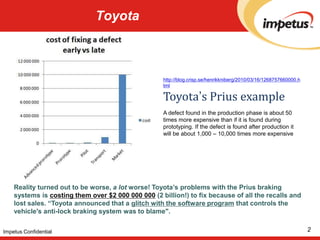
Toyota2Impetus Confidentialhttp://blog.crisp.se/henrikkniberg/2010/03/16/1268757660000.htmlToyota’s Prius exampleA defect found in the production phase is about 50 times more expensive than if it is found during prototyping. If the defect is found after production it will be about 1,000 – 10,000 times more expensiveReality turned out to be worse, a lot worse! Toyota’s problems with the Prius braking systems is costing them over $2 000 000 000 (2 billion!) to fix because of all the recalls and lost sales. “Toyota announced that a glitch with the software program that controls the vehicle's anti-lock braking system was to blame".
Why write tests?Write a lot of code, and one day something will stopworking!Fixing a bug is easy, but how about pinning it down? You never know where the ripples of your fixes can go.Are you sure the demon is dead?  3Impetus Confidential
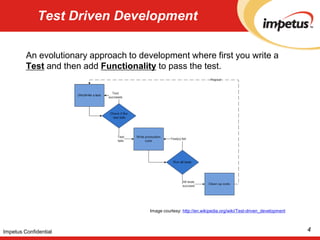
Test Driven DevelopmentAn evolutionary approach to development where first you write a Test and then add Functionality to pass the test. Image courtesy: http://en.wikipedia.org/wiki/Test-driven_development4Impetus Confidential
What is Unit Testing?A Unit Test is a procedure to validate a single Functionality of an application. One Functionality  One Unit TestUnit Tests are automated and self-checked. They run in isolation of each other.They do NOT depend on or connect to external resources, like DB, Network etc.They can run in any order and even parallel to each other and that will be fine. 5Impetus Confidential
What do we get?Obviously, we get tests to validate the functionalities, but that’s not all…One part of the program is isolated from others, i.e. proper separation of concerns. An ecology to foster Interface/Contract approached programming. Interfaces are documented. Refactoring made smooth like butter lathered floor. Quick bug identification.6Impetus Confidential
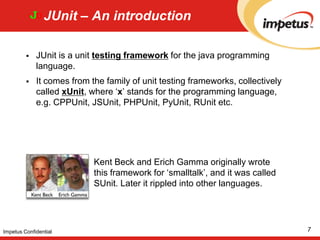
JUnit – An introductionJUnit is a unit testing framework for the java programming language. It comes from the family of unit testing frameworks, collectively called xUnit, where ‘x’ stands for the programming language, e.g. CPPUnit, JSUnit, PHPUnit, PyUnit, RUnit etc. 	Kent Beck and Erich Gamma originally wrote this framework for ‘smalltalk’, and it was called SUnit. Later it rippled into other languages. 7Impetus Confidential
Why choose JUnit?Of course there are many tools like JUnit, but none like it. JUnit is simple and elegant. JUnit checks its own results and provide immediate customized feedback. JUnit is hierarchal. JUnit has the widest IDE support, Eclipse, NetBeans, IntelliJ IDEA … you name it.JUnit is recognized by popular build tools like, ant, maven etc.And… it’s free.  8Impetus Confidential
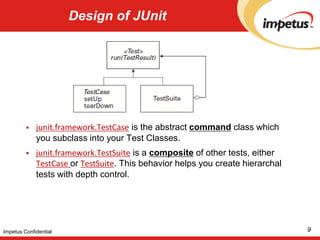
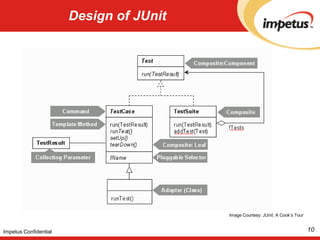
Design of JUnit9Impetus Confidentialjunit.framework.TestCase is the abstract command class which you subclass into your Test Classes.
junit.framework.TestSuite is a composite of other tests, either TestCaseor TestSuite. This behavior helps you create hierarchal tests with depth control. Design of JUnit10Impetus ConfidentialImage Courtesy: JUnit: A Cook’s Tour
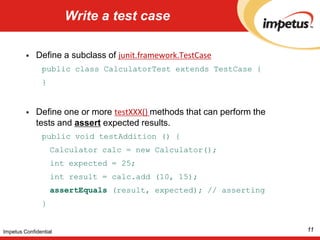
Write a test caseDefine a subclass of junit.framework.TestCasepublic class CalculatorTest extends TestCase {}Define one or more testXXX() methods that can perform the tests and assert expected results. public void testAddition () {	Calculator calc = new Calculator();int expected = 25;int result = calc.add (10, 15);assertEquals (result, expected); // asserting}11Impetus Confidential
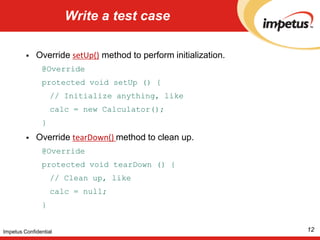
Write a test caseOverride setUp() method to perform initialization.@Overrideprotected void setUp () {	// Initialize anything, like	calc = new Calculator();}Override tearDown() method to clean up.@Overrideprotected void tearDown () {	// Clean up, like	calc = null;}12Impetus Confidential
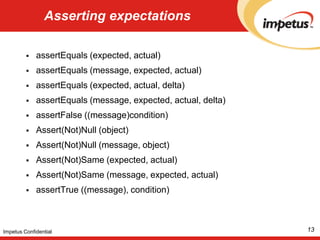
Asserting expectationsassertEquals (expected, actual) assertEquals (message, expected, actual) assertEquals (expected, actual, delta)assertEquals (message, expected, actual, delta)  assertFalse ((message)condition) Assert(Not)Null (object) Assert(Not)Null (message, object) Assert(Not)Same (expected, actual) Assert(Not)Same (message, expected, actual) assertTrue ((message), condition)13Impetus Confidential
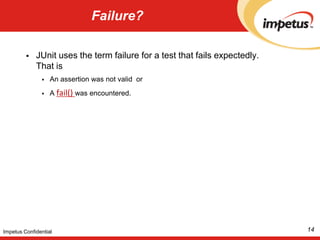
Failure?JUnit uses the term failure for a test that fails expectedly.That isAn assertion was not valid  or A fail() was encountered. 14Impetus Confidential
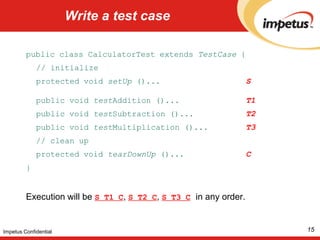
Write a test casepublic class CalculatorTest extends TestCase {	// initialize	protected void setUp ()...			Spublic void testAddition ()...  		T1	public void testSubtraction ()...		T2	public void testMultiplication ()...		T3	// clean up	protected void tearDownUp ()...		C }Execution will be S T1 C, S T2 C, S T3 Cin any order. 15Impetus Confidential
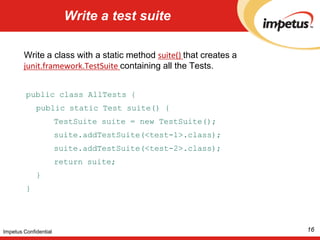
Write a test suiteWrite a class with a static method suite() that creates a junit.framework.TestSuitecontaining all the Tests. public class AllTests {	public static Test suite() {TestSuite suite = new TestSuite();suite.addTestSuite(<test-1>.class);suite.addTestSuite(<test-2>.class);		return suite;	}}16Impetus Confidential
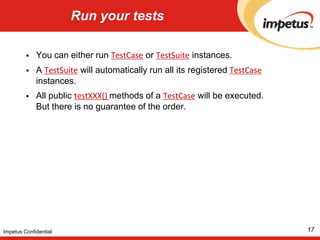
Run your testsYou can either run TestCase or TestSuite instances.A TestSuite will automatically run all its registered TestCase instances. All public testXXX() methods of a TestCase will be executed. But there is no guarantee of the order. 17Impetus Confidential
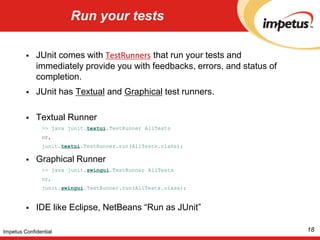
Run your testsJUnit comes with TestRunners that run your tests and immediately provide you with feedbacks, errors, and status of completion. JUnit has Textual and Graphical test runners. Textual Runner >> java junit.textui.TestRunnerAllTestsor,junit.textui.TestRunner.run(AllTests.class);Graphical Runner >> java junit.swingui.TestRunnerAllTestsor,junit.swingui.TestRunner.run(AllTests.class);IDE like Eclipse, NetBeans “Run as JUnit”18Impetus Confidential
Test maintenance19Impetus ConfidentialCreate 2 separate directories for source and testcodes.
Mirror source package structure into test.
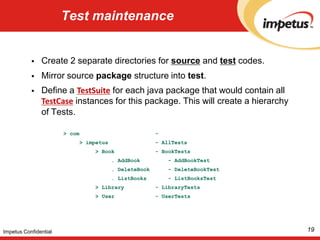
Define a TestSuite for each java package that would contain all TestCase instances for this package. This will create a hierarchy of Tests. > com		      	-> impetus	      	- AllTests> Book	      	- BookTests. AddBook	    - AddBookTest. DeleteBook	    - DeleteBookTest. ListBooks	    - ListBooksTest> Library	- LibraryTests> User		- UserTests
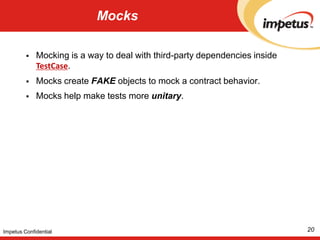
MocksMocking is a way to deal with third-party dependencies inside TestCase. Mocks create FAKE objects to mock a contract behavior. Mocks help make tests more unitary. 20Impetus Confidential
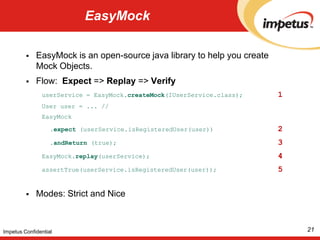
EasyMockEasyMock is an open-source java library to help you create Mock Objects.Flow:  Expect => Replay => VerifyuserService = EasyMock.createMock(IUserService.class);		1User user = ... //EasyMock	.expect (userService.isRegisteredUser(user))			2	.andReturn (true);						3EasyMock.replay(userService);					4assertTrue(userService.isRegisteredUser(user));		5Modes: Strict and Nice21Impetus Confidential
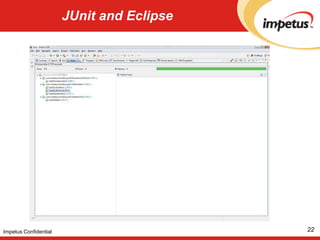
JUnit and Eclipse22Impetus Confidential
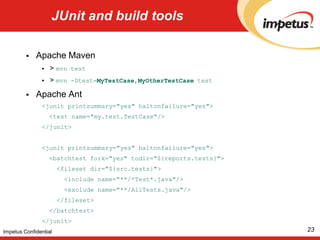
JUnit and build tools23Impetus ConfidentialApache Maven> mvn test> mvn -Dtest=MyTestCase,MyOtherTestCase testApache Ant<junitprintsummary="yes" haltonfailure="yes">  <test name="my.test.TestCase"/></junit><junitprintsummary="yes" haltonfailure="yes">  <batchtest fork="yes" todir="${reports.tests}">    <fileset dir="${src.tests}">      <include name="**/*Test*.java"/>      <exclude name="**/AllTests.java"/>    </fileset>  </batchtest></junit>
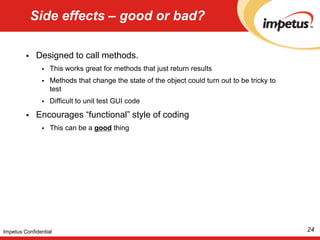
Side effects – good or bad?24Impetus ConfidentialDesigned to call methods.This works great for methods that just return resultsMethods that change the state of the object could turn out to be tricky to testDifficult to unit test GUI codeEncourages “functional” style of codingThis can be a good thing
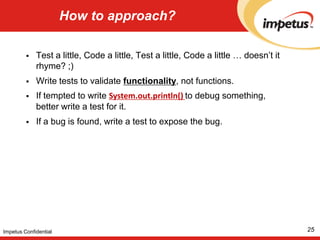
How to approach?25Impetus ConfidentialTest a little, Code a little, Test a little, Code a little … doesn’t it rhyme? ;) Write tests to validate functionality, not functions. If tempted to write System.out.println() to debug something, better write a test for it. If a bug is found, write a test to expose the bug.

JUNit Presentation

  • 1.
    An Introduction toJUnitAnimesh Kumar
  • 2.
    Toyota2Impetus Confidentialhttp://blog.crisp.se/henrikkniberg/2010/03/16/1268757660000.htmlToyota’s PriusexampleA defect found in the production phase is about 50 times more expensive than if it is found during prototyping. If the defect is found after production it will be about 1,000 – 10,000 times more expensiveReality turned out to be worse, a lot worse! Toyota’s problems with the Prius braking systems is costing them over $2 000 000 000 (2 billion!) to fix because of all the recalls and lost sales. “Toyota announced that a glitch with the software program that controls the vehicle's anti-lock braking system was to blame".
  • 3.
    Why write tests?Writea lot of code, and one day something will stopworking!Fixing a bug is easy, but how about pinning it down? You never know where the ripples of your fixes can go.Are you sure the demon is dead? 3Impetus Confidential
  • 4.
    Test Driven DevelopmentAnevolutionary approach to development where first you write a Test and then add Functionality to pass the test. Image courtesy: http://en.wikipedia.org/wiki/Test-driven_development4Impetus Confidential
  • 5.
    What is UnitTesting?A Unit Test is a procedure to validate a single Functionality of an application. One Functionality  One Unit TestUnit Tests are automated and self-checked. They run in isolation of each other.They do NOT depend on or connect to external resources, like DB, Network etc.They can run in any order and even parallel to each other and that will be fine. 5Impetus Confidential
  • 6.
    What do weget?Obviously, we get tests to validate the functionalities, but that’s not all…One part of the program is isolated from others, i.e. proper separation of concerns. An ecology to foster Interface/Contract approached programming. Interfaces are documented. Refactoring made smooth like butter lathered floor. Quick bug identification.6Impetus Confidential
  • 7.
    JUnit – AnintroductionJUnit is a unit testing framework for the java programming language. It comes from the family of unit testing frameworks, collectively called xUnit, where ‘x’ stands for the programming language, e.g. CPPUnit, JSUnit, PHPUnit, PyUnit, RUnit etc. Kent Beck and Erich Gamma originally wrote this framework for ‘smalltalk’, and it was called SUnit. Later it rippled into other languages. 7Impetus Confidential
  • 8.
    Why choose JUnit?Ofcourse there are many tools like JUnit, but none like it. JUnit is simple and elegant. JUnit checks its own results and provide immediate customized feedback. JUnit is hierarchal. JUnit has the widest IDE support, Eclipse, NetBeans, IntelliJ IDEA … you name it.JUnit is recognized by popular build tools like, ant, maven etc.And… it’s free.  8Impetus Confidential
  • 9.
    Design of JUnit9ImpetusConfidentialjunit.framework.TestCase is the abstract command class which you subclass into your Test Classes.
  • 10.
    junit.framework.TestSuite is acomposite of other tests, either TestCaseor TestSuite. This behavior helps you create hierarchal tests with depth control. Design of JUnit10Impetus ConfidentialImage Courtesy: JUnit: A Cook’s Tour
  • 11.
    Write a testcaseDefine a subclass of junit.framework.TestCasepublic class CalculatorTest extends TestCase {}Define one or more testXXX() methods that can perform the tests and assert expected results. public void testAddition () { Calculator calc = new Calculator();int expected = 25;int result = calc.add (10, 15);assertEquals (result, expected); // asserting}11Impetus Confidential
  • 12.
    Write a testcaseOverride setUp() method to perform initialization.@Overrideprotected void setUp () { // Initialize anything, like calc = new Calculator();}Override tearDown() method to clean up.@Overrideprotected void tearDown () { // Clean up, like calc = null;}12Impetus Confidential
  • 13.
    Asserting expectationsassertEquals (expected,actual) assertEquals (message, expected, actual) assertEquals (expected, actual, delta)assertEquals (message, expected, actual, delta) assertFalse ((message)condition) Assert(Not)Null (object) Assert(Not)Null (message, object) Assert(Not)Same (expected, actual) Assert(Not)Same (message, expected, actual) assertTrue ((message), condition)13Impetus Confidential
  • 14.
    Failure?JUnit uses theterm failure for a test that fails expectedly.That isAn assertion was not valid or A fail() was encountered. 14Impetus Confidential
  • 15.
    Write a testcasepublic class CalculatorTest extends TestCase { // initialize protected void setUp ()... Spublic void testAddition ()... T1 public void testSubtraction ()... T2 public void testMultiplication ()... T3 // clean up protected void tearDownUp ()... C }Execution will be S T1 C, S T2 C, S T3 Cin any order. 15Impetus Confidential
  • 16.
    Write a testsuiteWrite a class with a static method suite() that creates a junit.framework.TestSuitecontaining all the Tests. public class AllTests { public static Test suite() {TestSuite suite = new TestSuite();suite.addTestSuite(<test-1>.class);suite.addTestSuite(<test-2>.class); return suite; }}16Impetus Confidential
  • 17.
    Run your testsYoucan either run TestCase or TestSuite instances.A TestSuite will automatically run all its registered TestCase instances. All public testXXX() methods of a TestCase will be executed. But there is no guarantee of the order. 17Impetus Confidential
  • 18.
    Run your testsJUnitcomes with TestRunners that run your tests and immediately provide you with feedbacks, errors, and status of completion. JUnit has Textual and Graphical test runners. Textual Runner >> java junit.textui.TestRunnerAllTestsor,junit.textui.TestRunner.run(AllTests.class);Graphical Runner >> java junit.swingui.TestRunnerAllTestsor,junit.swingui.TestRunner.run(AllTests.class);IDE like Eclipse, NetBeans “Run as JUnit”18Impetus Confidential
  • 19.
    Test maintenance19Impetus ConfidentialCreate2 separate directories for source and testcodes.
  • 20.
    Mirror source packagestructure into test.
  • 21.
    Define a TestSuitefor each java package that would contain all TestCase instances for this package. This will create a hierarchy of Tests. > com -> impetus - AllTests> Book - BookTests. AddBook - AddBookTest. DeleteBook - DeleteBookTest. ListBooks - ListBooksTest> Library - LibraryTests> User - UserTests
  • 22.
    MocksMocking is away to deal with third-party dependencies inside TestCase. Mocks create FAKE objects to mock a contract behavior. Mocks help make tests more unitary. 20Impetus Confidential
  • 23.
    EasyMockEasyMock is anopen-source java library to help you create Mock Objects.Flow: Expect => Replay => VerifyuserService = EasyMock.createMock(IUserService.class); 1User user = ... //EasyMock .expect (userService.isRegisteredUser(user)) 2 .andReturn (true); 3EasyMock.replay(userService); 4assertTrue(userService.isRegisteredUser(user)); 5Modes: Strict and Nice21Impetus Confidential
  • 24.
  • 25.
    JUnit and buildtools23Impetus ConfidentialApache Maven> mvn test> mvn -Dtest=MyTestCase,MyOtherTestCase testApache Ant<junitprintsummary="yes" haltonfailure="yes"> <test name="my.test.TestCase"/></junit><junitprintsummary="yes" haltonfailure="yes"> <batchtest fork="yes" todir="${reports.tests}"> <fileset dir="${src.tests}"> <include name="**/*Test*.java"/> <exclude name="**/AllTests.java"/> </fileset> </batchtest></junit>
  • 26.
    Side effects –good or bad?24Impetus ConfidentialDesigned to call methods.This works great for methods that just return resultsMethods that change the state of the object could turn out to be tricky to testDifficult to unit test GUI codeEncourages “functional” style of codingThis can be a good thing
  • 27.
    How to approach?25ImpetusConfidentialTest a little, Code a little, Test a little, Code a little … doesn’t it rhyme? ;) Write tests to validate functionality, not functions. If tempted to write System.out.println() to debug something, better write a test for it. If a bug is found, write a test to expose the bug.

Editor's Notes

  • #3 Long hourswith stoned debuggers!
  • #4 Long hourswith stoned debuggers!
  • #5 Long hourswith stoned debuggers!
  • #6 Example of calculator!
  • #7 Example of calculator!
  • #8 Long hourswith stoned debuggers!
  • #9 Long hourswith stoned debuggers!
  • #10 Long hourswith stoned debuggers!
  • #11 Long hourswith stoned debuggers!
  • #12 Long hourswith stoned debuggers!
  • #13 Long hourswith stoned debuggers!
  • #14 Long hourswith stoned debuggers!
  • #15 Long hourswith stoned debuggers!
  • #16 Long hourswith stoned debuggers!
  • #17 Long hourswith stoned debuggers!
  • #18 Long hourswith stoned debuggers!
  • #19 Long hourswith stoned debuggers!
  • #20 Long hourswith stoned debuggers!
  • #21 Long hourswith stoned debuggers!
  • #22 Long hourswith stoned debuggers!
  • #23 Long hourswith stoned debuggers!
  • #24 Long hourswith stoned debuggers!
  • #25 Long hourswith stoned debuggers!
  • #26 Long hourswith stoned debuggers!
  • #27 Long hourswith stoned debuggers!