


GENC3003Personal Financial PlanningAndrew Hingstonandrew.hingston@unsw.edu.auUnit 7: Superannuation case study
2Case studyJohn will soon graduate as an engineer.He is aged 20 and expects to live to 81 His “preservation age” is 60. This is the age when he is allowed to withdraw money from his super to pay for living expenses.He plans to stop paid work at age 60. He wants $31,020 per year from his super when he stops work at age 60(adjusted for inflation).Any other savings outside super will simply provide extra spending money.
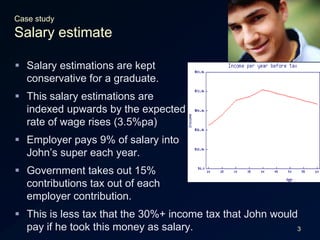
3Case studySalary estimateSalary estimations are keptconservative for a graduate.This salary estimations areindexed upwards by the expectedrate of wage rises (3.5%pa)Employer pays 9% of salary intoJohn’s super each year.Government takes out 15%contributions tax out of eachemployer contribution.This is less tax that the 30%+ income tax that John would pay if he took this money as salary.
4Case studyWillingness to take “risk”For a quality, diversified investment portfolio:risk does not mean “the risk of losing all your money”risk means “how much returns can vary from the average”.Eg. Low risk investment return = 5% +/- 1% per yearEg. High risk investment return = 8% +/- 20% per yearBetter to have higher returns and risk over 30 years.Let’s assume expected net returns are 7.01% p.a.Steady increase in super but may not be enough for financial independence in the long term Possibility of much more super in the long term but in some years your super will go down in value
5Case studySuperannuation projectionsJohn should have $511,400 in superat age 60.This amount has been adjusted for the effects of inflation at 2.5% p.a. (he actually will have a LOT more but it will buy less).
6Case studyWhat happens at age 60John stops full time work and declares himself to be retired (still has the option to return to work later!).He keeps his money in the “superannuation system” but converts it into an “allocated pension”.This allocated pension pays a regular income of $30,600 per yearinto John’s bank account (paid monthly) tax free. Investment returns are tax free.He can increase or decrease this regular amount and can also make lump sum withdrawals at any time.His superannuation should last to about age 81.
7Case studyBoosting his superannuationPick the high-growth investment optionIncreasing the riskiness of his portfolio will cause his super to fluctuate more from year to year.However, he should also have a lot more super in the long term.Bonus: $23,700 at age 60 … which means …Bonus: extra $1,680 income per year after age 60
8Case studyBoosting his superannuationSalary sacrificing $4,000 per year for 5 years nowJohn can choose to voluntarily save an extra part of his salary or wage into super.Not only will he pay less tax, but it will also help him achieve your long term goals.Bonus: $80,700 at age 60 … which means …Bonus: extra $4,260 income per year after age 60
9Case studyBoosting his superannuationPlanning to stop work at 65.Working for an extra 5 years can make an enormous difference to his super - especially when combined with the above factors.Bonus: extra $157,100 at age 65 … which means …Bonus: $14,290 income per year after age 65BUT … five years less to enjoy your retirement!
10Case studyTips for John nowConsolidate all of his super into one superannuation fund to cut down in administration fees and unnecessary insurance premiums.Make sure his super is invested in the “growth-option” and not the default option.Work towards a 5 year goal of building up at least $22,300 in his super.Provide his fund’s details to his new employer whenever he changes jobs.Consider salary sacrificing for a few years to jump-start his superannuation.
11Case studyWhat happens to John’s super if he dies?Superannuation is held “in trust” by the super fund on behalf of John. It is not directly owned by him so he can’t give instructions via his will.The trustee of the fund will pay his super to his dependants or next of kin or the beneficiaries he nominated on his application form. If none can be found then it will be paid to his estate.If super is paid to spouse or dependant child then they get it tax free.If paid to someone else then tax is taken out of balance.
12Case studyWhat if John’s super fund goes bankrupt?This is very unlikely to happen because super funds are closely regulated by APRA.Superannuation investments are held in a “trust” which is completely separate from the financial institution’s own accounts and assets.These “trusts” do not have any significant debts or liabilities so it is not really possible for them to go bankrupt.If financial institution goes bankrupt then trust remains separate and liquidator will sell off trust to another superannuation fun to administer.Bottom line – DON’T WORRY!

Unit 7b Case study

  • 1.
    GENC3003Personal Financial PlanningAndrewHingstonandrew.hingston@unsw.edu.auUnit 7: Superannuation case study
  • 2.
    2Case studyJohn willsoon graduate as an engineer.He is aged 20 and expects to live to 81 His “preservation age” is 60. This is the age when he is allowed to withdraw money from his super to pay for living expenses.He plans to stop paid work at age 60. He wants $31,020 per year from his super when he stops work at age 60(adjusted for inflation).Any other savings outside super will simply provide extra spending money.
  • 3.
    3Case studySalary estimateSalaryestimations are keptconservative for a graduate.This salary estimations areindexed upwards by the expectedrate of wage rises (3.5%pa)Employer pays 9% of salary intoJohn’s super each year.Government takes out 15%contributions tax out of eachemployer contribution.This is less tax that the 30%+ income tax that John would pay if he took this money as salary.
  • 4.
    4Case studyWillingness totake “risk”For a quality, diversified investment portfolio:risk does not mean “the risk of losing all your money”risk means “how much returns can vary from the average”.Eg. Low risk investment return = 5% +/- 1% per yearEg. High risk investment return = 8% +/- 20% per yearBetter to have higher returns and risk over 30 years.Let’s assume expected net returns are 7.01% p.a.Steady increase in super but may not be enough for financial independence in the long term Possibility of much more super in the long term but in some years your super will go down in value
  • 5.
    5Case studySuperannuation projectionsJohnshould have $511,400 in superat age 60.This amount has been adjusted for the effects of inflation at 2.5% p.a. (he actually will have a LOT more but it will buy less).
  • 6.
    6Case studyWhat happensat age 60John stops full time work and declares himself to be retired (still has the option to return to work later!).He keeps his money in the “superannuation system” but converts it into an “allocated pension”.This allocated pension pays a regular income of $30,600 per yearinto John’s bank account (paid monthly) tax free. Investment returns are tax free.He can increase or decrease this regular amount and can also make lump sum withdrawals at any time.His superannuation should last to about age 81.
  • 7.
    7Case studyBoosting hissuperannuationPick the high-growth investment optionIncreasing the riskiness of his portfolio will cause his super to fluctuate more from year to year.However, he should also have a lot more super in the long term.Bonus: $23,700 at age 60 … which means …Bonus: extra $1,680 income per year after age 60
  • 8.
    8Case studyBoosting hissuperannuationSalary sacrificing $4,000 per year for 5 years nowJohn can choose to voluntarily save an extra part of his salary or wage into super.Not only will he pay less tax, but it will also help him achieve your long term goals.Bonus: $80,700 at age 60 … which means …Bonus: extra $4,260 income per year after age 60
  • 9.
    9Case studyBoosting hissuperannuationPlanning to stop work at 65.Working for an extra 5 years can make an enormous difference to his super - especially when combined with the above factors.Bonus: extra $157,100 at age 65 … which means …Bonus: $14,290 income per year after age 65BUT … five years less to enjoy your retirement!
  • 10.
    10Case studyTips forJohn nowConsolidate all of his super into one superannuation fund to cut down in administration fees and unnecessary insurance premiums.Make sure his super is invested in the “growth-option” and not the default option.Work towards a 5 year goal of building up at least $22,300 in his super.Provide his fund’s details to his new employer whenever he changes jobs.Consider salary sacrificing for a few years to jump-start his superannuation.
  • 11.
    11Case studyWhat happensto John’s super if he dies?Superannuation is held “in trust” by the super fund on behalf of John. It is not directly owned by him so he can’t give instructions via his will.The trustee of the fund will pay his super to his dependants or next of kin or the beneficiaries he nominated on his application form. If none can be found then it will be paid to his estate.If super is paid to spouse or dependant child then they get it tax free.If paid to someone else then tax is taken out of balance.
  • 12.
    12Case studyWhat ifJohn’s super fund goes bankrupt?This is very unlikely to happen because super funds are closely regulated by APRA.Superannuation investments are held in a “trust” which is completely separate from the financial institution’s own accounts and assets.These “trusts” do not have any significant debts or liabilities so it is not really possible for them to go bankrupt.If financial institution goes bankrupt then trust remains separate and liquidator will sell off trust to another superannuation fun to administer.Bottom line – DON’T WORRY!