Important Information: The information in this presentation is provided for illustrative purposes only and does not take into consideration your personal circumstances. You are
encouraged to seek financial advice suitable to your circumstances to avoid a decision that is not appropriate. Any reference to your actual circumstances is coincidental. Magnitude
Group Pty Ltd and its representatives receive fees and brokerage from the provision of financial advice or placement of financial products.
Disclaimer
This information was prepared by Magnitude Group Pty Ltd, ABN 54 086 266 202 & AFSL
221557 (Magnitude) and is current as at May 2015.
This presentation provides an overview or summary only and it shouldn’t be considered a
comprehensive statement on any matter or relied upon as such. The information in this
publication does not take into account your objectives, financial situation or needs and so
you should consider its appropriateness having regard to these factors before acting on it
and obtain financial advice. Any taxation position described in this publication is a general
statement and should only be used as a guide. It does not constitute tax advice and is based
on current tax laws and our interpretation.
Your individual situation may differ and you should seek independent professional tax
advice. The rules associated with the super and tax regimes are complex and subject to
change and the opportunities and effects will differ depending on your personal
circumstances.
Transition to Retirement Pension
Boosting your retirement savings while saving tax
Liam Shorte
Financial Planner & SMSF Specialist Advisor™
VERANTE
Theory vs Reality
This webinar is focused on real issues
experienced in the actual setting up of an
SMSF
What tax rate* do you prefer?
Investment Structure
A B C D
Income 46.5% 30% 15% 0%
Capital Gains 24% 30% 10% 0%
Superannuation
Who can contribute to super?
• Anyone under 65
• Between 65 and 74 (‘work test’ required)
• Age 75 and older (unable to contribute other than mandated
employer contributions)
Maximum contribution limits - Concessional
• Concessional contributions capped at $30,000* p.a. under 49
• $35,000 for those over 49 on 1st July.
• More important to start salary sacrificing earlier than ever
before!
• 9.5% compulsory super counts towards this concessional cap
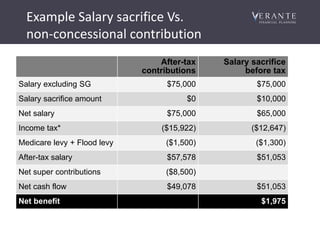
Example Salary sacrifice Vs.
non-concessional contribution
After-tax
contributions
Salary sacrifice
before tax
Salary excluding SG $75,000 $75,000
Salary sacrifice amount $0 $10,000
Net salary $75,000 $65,000
Income tax* ($15,922) ($12,647)
Medicare levy + Flood levy ($1,500) ($1,300)
After-tax salary $57,578 $51,053
Net super contributions ($8,500)
Net cash flow $49,078 $51,053
Net benefit $1,975
Maximum Contribution limits –
Non-concessional
• Personal contributions capped at $180,000 pa
• If under 65 you can bring forward 2 years of cap and
contribute up to $450,000
30 June 2015 30 June 2016 30 June 2017 30 June 2018
$540,000 $0 $0 $540,000 $0
30 June 2019
$180,000 $180,000 $180,000 $180,000 $180,000
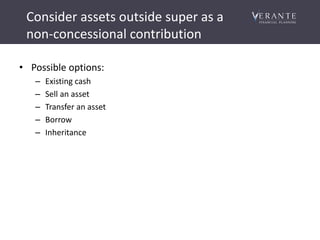
Consider assets outside super as a
non-concessional contribution
• Possible options:
– Existing cash
– Sell an asset
– Transfer an asset
– Borrow
– Inheritance
Accessing your super
Super Release Conditions
To access funds from superannuation either as a lump sum or
income stream the main conditions of release and ability to
access your super money are as follows:
• Retirement (at preservation age or terminating employment
after 60)
• Attaining age 65
• Death
• Terminal illness
• Permanent incapacity
• Temporary incapacity
• Transition to Retirement (pension option only)
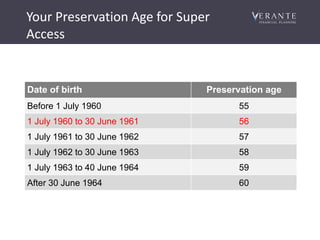
Your Preservation Age for Super
Access
Date of birth Preservation age
Before 1 July 1960 55
1 July 1960 to 30 June 1961 56
1 July 1961 to 30 June 1962 57
1 July 1962 to 30 June 1963 58
1 July 1963 to 40 June 1964 59
After 30 June 1964 60
Transition to Retirement
The Transition to
Retirement Option (TTR)
How to get a free kick-start
for your retirement
A transition to retirement strategy allows you to either cut back
hours while using your retirement savings to top-up your
income, or continue working and boost super in a tax-effective
manner.
Transition to
retirement
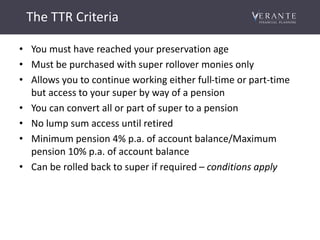
The TTR Criteria
• You must have reached your preservation age
• Must be purchased with super rollover monies only
• Allows you to continue working either full-time or part-time
but access to your super by way of a pension
• You can convert all or part of super to a pension
• No lump sum access until retired
• Minimum pension 4% p.a. of account balance/Maximum
pension 10% p.a. of account balance
• Can be rolled back to super if required – conditions apply
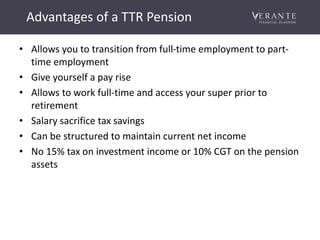
Advantages of a TTR Pension
• Allows you to transition from full-time employment to part-
time employment
• Give yourself a pay rise
• Allows to work full-time and access your super prior to
retirement
• Salary sacrifice tax savings
• Can be structured to maintain current net income
• No 15% tax on investment income or 10% CGT on the pension
assets
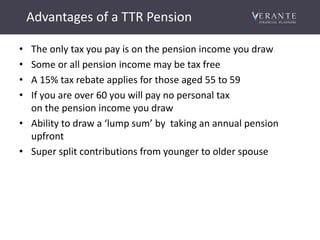
Advantages of a TTR Pension
• The only tax you pay is on the pension income you draw
• Some or all pension income may be tax free
• A 15% tax rebate applies for those aged 55 to 59
• If you are over 60 you will pay no personal tax
on the pension income you draw
• Ability to draw a ‘lump sum’ by taking an annual pension
upfront
• Super split contributions from younger to older spouse
Disdvantages of a TTR Pension
• You will need 2 separate super accounts one for pension
account and one for the accumulation account
• You can’t draw down a lump sum until retirement
• You must draw a pension income every year
• Your pension account could run out
• Maximum pension limited to 10% of your account balance
each year
• Unable to add additional contributions to pension account as
new pension must be established
A TTR pension example
Components
Age 55 – 59
Taxable $400,000
Tax-free $150,000
Super $550,000
Required income $50,000
Tax on pension received
Pension income $50,000
After age 60
Tax exempt
Less tax-free $13,636
Balance $36,364
Tax $3,006*
Less offsets $5,454#
Net tax $Nil
• FY15/16 rates, excludes Medicare levy
• # 15% Tax rebate on taxable pension
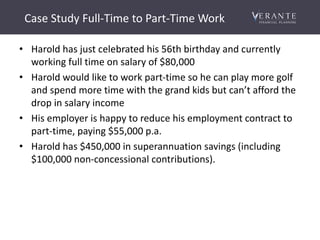
Case Study Full-Time to Part-Time Work
• Harold has just celebrated his 56th birthday and currently
working full time on salary of $80,000
• Harold would like to work part-time so he can play more golf
and spend more time with the grand kids but can’t afford the
drop in salary income
• His employer is happy to reduce his employment contract to
part-time, paying $55,000 p.a.
• Harold has $450,000 in superannuation savings (including
$100,000 non-concessional contributions).
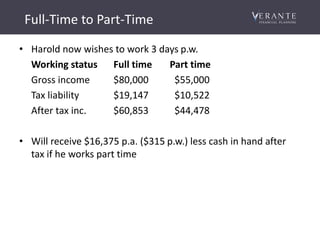
Full-Time to Part-Time
• Harold now wishes to work 3 days p.w.
Working status Full time Part time
Gross income $80,000 $55,000
Tax liability $19,147 $10,522
After tax inc. $60,853 $44,478
• Will receive $16,375 p.a. ($315 p.w.) less cash in hand after
tax if he works part time
The TTR Part-time Strategy
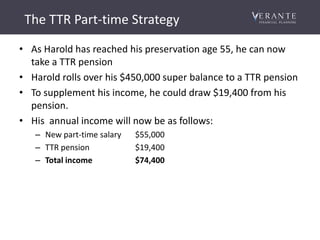
• As Harold has reached his preservation age 55, he can now
take a TTR pension
• Harold rolls over his $450,000 super balance to a TTR pension
• To supplement his income, he could draw $19,400 from his
pension.
• His annual income will now be as follows:
– New part-time salary $55,000
– TTR pension $19,400
– Total income $74,400
The Full-Time to Part-Time Strategy
Position Full time Part time
Part time +
TTR Strategy
Gross Income $80,000 $55,000 $74,400
Tax free amount $4,311
Taxable Inc $80,000 $55,000 $70,089
Tax $19,147 $10,522 ($15,728)
Pension tax
offset
$2,263
After Tax Inc $60,853 $44,478 $60,935
TTR Case study - Anna aged 55
Client Anna (aged 56)
Employment Full-time
Income $76,000 p.a.
Super $350,000 (includes $100,000 tax-free)
Anna’s TTR strategy
From 1 July 2015:
• We transfer her current super benefits to a transition to
retirement pension
• Draw pension each year required to be same after tax
position
• She salary sacrifices $35,000 p.a. to super (includes SG)
Assumptions: Salary indexed at 4% per annum
Income needs 3% increase per annum
Super investments earn 6% p.a. Net of tax
Pension investments earn 7% p.a. Net of tax
Excess income not re-invested
Case study B: Anna’s TTR Option
Do nothing Implement strategy
Gross income $76,000 $71,950
Tax payable $17,767 $13,399
Net income $58,233 $58,233
Super balance $377,046 $30,749
Pension balance $381,603
Net balance year 1 $409,825 $412,352
Balance at 65 $722,777 $845,279
Case Study B: Anna’s result
Asset Build Up
Before TTR
Do Nothing
With TTR
Date Value Accum Bal Pension Bal Total Assets
Improvement
from TTR
01 Jul 2014 $377,046 $0 $377,046 $377,046 $0
30 Jun 2015 $406,019 $30,749 $381,603 $412,352 $6,333
30 Jun 2016 $436,985 $30,858 $419,681 $450,538 $13,554
30 Jun 2017 $470,073 $30,663 $461,574 $492,237 $22,164
30 Jun 2018 $505,420 $33,202 $506,670 $539,872 $34,452
30 Jun 2019 $543,175 $36,287 $555,330 $591,617 $48,443
30 Jun 2020 $583,491 $39,020 $608,556 $647,576 $64,085
30 Jun 2021 $626,536 $41,972 $666,115 $708,088 $81,551
30 Jun 2022 $672,885 $45,156 $728,359 $773,516 $100,631
30 Jun 2023 $722,777 $49,622 $795,657 $845,279 $122,502
Case Study B: Anna’s result
That pays for replacement cars, extra holidays, medical treatment, lifestyle!
But what about the impact of negative
market movements?
Assume that markets fall on average 3% per year over the next 10 years, does the
strategy make a difference?
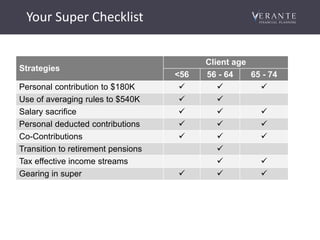
Your Super Checklist
Strategies
Client age
<56 56 - 64 65 - 74
Personal contribution to $180K   
Use of averaging rules to $540K  
Salary sacrifice   
Personal deducted contributions   
Co-Contributions   
Transition to retirement pensions 
Tax effective income streams  
Gearing in super   
Your best investment
• The best investment you can make is to seek advice!
• A good financial adviser will work through each stage of the
financial planning process with you, making sure you have a
clear understanding of each stage and that you are
comfortable with any recommendations they make.
• Their advice will be tailored specifically to your individual
needs, circumstances and financial objectives.
• A good Financial Adviser will not be afraid to work with your
Accountant and Solicitor
Questions?
Contact Us
Tel. 02 9894 1844
Fax. 02 9894 1944
contact@verante.com.au
Main Office
Suite 5, 15 Terminus
Street Castle Hill
PO Box 987, Castle
Hill NSW 1765
SMSF Office
Suite 2 Charrington Ct
Old Northern Road
Baulkham Hills
PO Box 6002, BHBC
Baulkham Hills NSW
2153
Windsor Office
Hawkesbury Chambers
Cnr George & Dight
Streets Windsor
PO Box 701, Windsor
NSW 2756
www.verante.com.au Verante Financial Planning Pty Ltd is a corporate authorised representative of
Magnitude Group Pty Ltd | ABN 54 086 266 202 | AFSL 221557

Using Transition to retirement pensions

  • 1.
    Important Information: Theinformation in this presentation is provided for illustrative purposes only and does not take into consideration your personal circumstances. You are encouraged to seek financial advice suitable to your circumstances to avoid a decision that is not appropriate. Any reference to your actual circumstances is coincidental. Magnitude Group Pty Ltd and its representatives receive fees and brokerage from the provision of financial advice or placement of financial products.
  • 2.
    Disclaimer This information wasprepared by Magnitude Group Pty Ltd, ABN 54 086 266 202 & AFSL 221557 (Magnitude) and is current as at May 2015. This presentation provides an overview or summary only and it shouldn’t be considered a comprehensive statement on any matter or relied upon as such. The information in this publication does not take into account your objectives, financial situation or needs and so you should consider its appropriateness having regard to these factors before acting on it and obtain financial advice. Any taxation position described in this publication is a general statement and should only be used as a guide. It does not constitute tax advice and is based on current tax laws and our interpretation. Your individual situation may differ and you should seek independent professional tax advice. The rules associated with the super and tax regimes are complex and subject to change and the opportunities and effects will differ depending on your personal circumstances.
  • 3.
    Transition to RetirementPension Boosting your retirement savings while saving tax Liam Shorte Financial Planner & SMSF Specialist Advisor™ VERANTE
  • 4.
    Theory vs Reality Thiswebinar is focused on real issues experienced in the actual setting up of an SMSF
  • 5.
    What tax rate*do you prefer? Investment Structure A B C D Income 46.5% 30% 15% 0% Capital Gains 24% 30% 10% 0% Superannuation
  • 6.
    Who can contributeto super? • Anyone under 65 • Between 65 and 74 (‘work test’ required) • Age 75 and older (unable to contribute other than mandated employer contributions)
  • 7.
    Maximum contribution limits- Concessional • Concessional contributions capped at $30,000* p.a. under 49 • $35,000 for those over 49 on 1st July. • More important to start salary sacrificing earlier than ever before! • 9.5% compulsory super counts towards this concessional cap
  • 8.
    Example Salary sacrificeVs. non-concessional contribution After-tax contributions Salary sacrifice before tax Salary excluding SG $75,000 $75,000 Salary sacrifice amount $0 $10,000 Net salary $75,000 $65,000 Income tax* ($15,922) ($12,647) Medicare levy + Flood levy ($1,500) ($1,300) After-tax salary $57,578 $51,053 Net super contributions ($8,500) Net cash flow $49,078 $51,053 Net benefit $1,975
  • 9.
    Maximum Contribution limits– Non-concessional • Personal contributions capped at $180,000 pa • If under 65 you can bring forward 2 years of cap and contribute up to $450,000 30 June 2015 30 June 2016 30 June 2017 30 June 2018 $540,000 $0 $0 $540,000 $0 30 June 2019 $180,000 $180,000 $180,000 $180,000 $180,000
  • 10.
    Consider assets outsidesuper as a non-concessional contribution • Possible options: – Existing cash – Sell an asset – Transfer an asset – Borrow – Inheritance
  • 11.
  • 12.
    Super Release Conditions Toaccess funds from superannuation either as a lump sum or income stream the main conditions of release and ability to access your super money are as follows: • Retirement (at preservation age or terminating employment after 60) • Attaining age 65 • Death • Terminal illness • Permanent incapacity • Temporary incapacity • Transition to Retirement (pension option only)
  • 13.
    Your Preservation Agefor Super Access Date of birth Preservation age Before 1 July 1960 55 1 July 1960 to 30 June 1961 56 1 July 1961 to 30 June 1962 57 1 July 1962 to 30 June 1963 58 1 July 1963 to 40 June 1964 59 After 30 June 1964 60
  • 14.
    Transition to Retirement TheTransition to Retirement Option (TTR) How to get a free kick-start for your retirement A transition to retirement strategy allows you to either cut back hours while using your retirement savings to top-up your income, or continue working and boost super in a tax-effective manner. Transition to retirement
  • 15.
    The TTR Criteria •You must have reached your preservation age • Must be purchased with super rollover monies only • Allows you to continue working either full-time or part-time but access to your super by way of a pension • You can convert all or part of super to a pension • No lump sum access until retired • Minimum pension 4% p.a. of account balance/Maximum pension 10% p.a. of account balance • Can be rolled back to super if required – conditions apply
  • 16.
    Advantages of aTTR Pension • Allows you to transition from full-time employment to part- time employment • Give yourself a pay rise • Allows to work full-time and access your super prior to retirement • Salary sacrifice tax savings • Can be structured to maintain current net income • No 15% tax on investment income or 10% CGT on the pension assets
  • 17.
    Advantages of aTTR Pension • The only tax you pay is on the pension income you draw • Some or all pension income may be tax free • A 15% tax rebate applies for those aged 55 to 59 • If you are over 60 you will pay no personal tax on the pension income you draw • Ability to draw a ‘lump sum’ by taking an annual pension upfront • Super split contributions from younger to older spouse
  • 18.
    Disdvantages of aTTR Pension • You will need 2 separate super accounts one for pension account and one for the accumulation account • You can’t draw down a lump sum until retirement • You must draw a pension income every year • Your pension account could run out • Maximum pension limited to 10% of your account balance each year • Unable to add additional contributions to pension account as new pension must be established
  • 19.
    A TTR pensionexample Components Age 55 – 59 Taxable $400,000 Tax-free $150,000 Super $550,000 Required income $50,000 Tax on pension received Pension income $50,000 After age 60 Tax exempt Less tax-free $13,636 Balance $36,364 Tax $3,006* Less offsets $5,454# Net tax $Nil • FY15/16 rates, excludes Medicare levy • # 15% Tax rebate on taxable pension
  • 20.
    Case Study Full-Timeto Part-Time Work • Harold has just celebrated his 56th birthday and currently working full time on salary of $80,000 • Harold would like to work part-time so he can play more golf and spend more time with the grand kids but can’t afford the drop in salary income • His employer is happy to reduce his employment contract to part-time, paying $55,000 p.a. • Harold has $450,000 in superannuation savings (including $100,000 non-concessional contributions).
  • 21.
    Full-Time to Part-Time •Harold now wishes to work 3 days p.w. Working status Full time Part time Gross income $80,000 $55,000 Tax liability $19,147 $10,522 After tax inc. $60,853 $44,478 • Will receive $16,375 p.a. ($315 p.w.) less cash in hand after tax if he works part time
  • 22.
    The TTR Part-timeStrategy • As Harold has reached his preservation age 55, he can now take a TTR pension • Harold rolls over his $450,000 super balance to a TTR pension • To supplement his income, he could draw $19,400 from his pension. • His annual income will now be as follows: – New part-time salary $55,000 – TTR pension $19,400 – Total income $74,400
  • 23.
    The Full-Time toPart-Time Strategy Position Full time Part time Part time + TTR Strategy Gross Income $80,000 $55,000 $74,400 Tax free amount $4,311 Taxable Inc $80,000 $55,000 $70,089 Tax $19,147 $10,522 ($15,728) Pension tax offset $2,263 After Tax Inc $60,853 $44,478 $60,935
  • 24.
    TTR Case study- Anna aged 55 Client Anna (aged 56) Employment Full-time Income $76,000 p.a. Super $350,000 (includes $100,000 tax-free)
  • 25.
    Anna’s TTR strategy From1 July 2015: • We transfer her current super benefits to a transition to retirement pension • Draw pension each year required to be same after tax position • She salary sacrifices $35,000 p.a. to super (includes SG) Assumptions: Salary indexed at 4% per annum Income needs 3% increase per annum Super investments earn 6% p.a. Net of tax Pension investments earn 7% p.a. Net of tax Excess income not re-invested
  • 26.
    Case study B:Anna’s TTR Option Do nothing Implement strategy Gross income $76,000 $71,950 Tax payable $17,767 $13,399 Net income $58,233 $58,233 Super balance $377,046 $30,749 Pension balance $381,603 Net balance year 1 $409,825 $412,352 Balance at 65 $722,777 $845,279
  • 27.
    Case Study B:Anna’s result Asset Build Up Before TTR Do Nothing With TTR Date Value Accum Bal Pension Bal Total Assets Improvement from TTR 01 Jul 2014 $377,046 $0 $377,046 $377,046 $0 30 Jun 2015 $406,019 $30,749 $381,603 $412,352 $6,333 30 Jun 2016 $436,985 $30,858 $419,681 $450,538 $13,554 30 Jun 2017 $470,073 $30,663 $461,574 $492,237 $22,164 30 Jun 2018 $505,420 $33,202 $506,670 $539,872 $34,452 30 Jun 2019 $543,175 $36,287 $555,330 $591,617 $48,443 30 Jun 2020 $583,491 $39,020 $608,556 $647,576 $64,085 30 Jun 2021 $626,536 $41,972 $666,115 $708,088 $81,551 30 Jun 2022 $672,885 $45,156 $728,359 $773,516 $100,631 30 Jun 2023 $722,777 $49,622 $795,657 $845,279 $122,502
  • 28.
    Case Study B:Anna’s result That pays for replacement cars, extra holidays, medical treatment, lifestyle!
  • 29.
    But what aboutthe impact of negative market movements? Assume that markets fall on average 3% per year over the next 10 years, does the strategy make a difference?
  • 30.
    Your Super Checklist Strategies Clientage <56 56 - 64 65 - 74 Personal contribution to $180K    Use of averaging rules to $540K   Salary sacrifice    Personal deducted contributions    Co-Contributions    Transition to retirement pensions  Tax effective income streams   Gearing in super   
  • 31.
    Your best investment •The best investment you can make is to seek advice! • A good financial adviser will work through each stage of the financial planning process with you, making sure you have a clear understanding of each stage and that you are comfortable with any recommendations they make. • Their advice will be tailored specifically to your individual needs, circumstances and financial objectives. • A good Financial Adviser will not be afraid to work with your Accountant and Solicitor
  • 32.
  • 33.
    Contact Us Tel. 029894 1844 Fax. 02 9894 1944 contact@verante.com.au Main Office Suite 5, 15 Terminus Street Castle Hill PO Box 987, Castle Hill NSW 1765 SMSF Office Suite 2 Charrington Ct Old Northern Road Baulkham Hills PO Box 6002, BHBC Baulkham Hills NSW 2153 Windsor Office Hawkesbury Chambers Cnr George & Dight Streets Windsor PO Box 701, Windsor NSW 2756 www.verante.com.au Verante Financial Planning Pty Ltd is a corporate authorised representative of Magnitude Group Pty Ltd | ABN 54 086 266 202 | AFSL 221557

Editor's Notes

  • #3 Good evening everyone, My name is Michael Rambaldini, I'm a Certified Financial Planner. I have been providing advice to clients here locally and over Australia for 20 years.
  • #6 This slide looks at the difference from a taxation aspect between a super fund and a non-super fund investment. Probably the most popular types of investments are in property, either directly or through a property trust, or shares, either directly or via managed funds. Let’s quickly go through the differences : Self-explanatory Looking at this, obviously super is a very attractive investment vehicle. But one of the disadvantages of super is you won’t be able to touch it until you retire, although we’ll talk shortly about another opportunity to maybe solve this problem.
  • #7 The main criteria for most of us to contribute is, as long as you are under the age of 65 you can contribute to a super fund - and by the way you don’t even have to be working. However if you are aged between 65 and 75 a simple work test has to apply, and this means you must have worked at least 40 hrs of gainful employment over a 30 day period during that financial year. Unfortunately once you reach the age of 75+ you are no longer able to contribute to a super fund. There are, however, proven methods to get rich slowly. If you are patient, and if you are disciplined, you can produce a golden nest egg that will hatch later in life.
  • #8 Because the tax incentive of making concessional contributions are so generous, there are limits. Go through limits including transitional provisions for over 50’s. A client meets the 50+ definition during the transitional period if they are age 50 at the end of a the financial year. The $30,000 cap in indexed in increments of $5,000 so depending on AWOTE it could increase to $35,000 by the time we reach the 2017/18 financial year Importance of starting early!!!
  • #9 A very common strategy for many people is contributing to super by way salary sacrifice. Speaker to explain what salary sacrifice means and go through example of salary sacrifice and the tax saving benefits and the difference between a concessional and non-concessional contribution. Key point is that concessional contributions are generally more tax effective than non-concessional.
  • #10 You also need to be conscious of limits placed on personal contributions. Its no longer a matter of moving all your assets into super on the day you retire, however with careful planning you can maximise the amount you move into the concessionally taxed environment of super. Demonstrate how the bring forward works and show them that they can get $720,000 into super in a short space of time by making $180,000 this year and $540,000 from the 1st of July.
  • #11 Where could we find some extra funds to contribute?
  • #13 Could also mention that some clients may have unrestricted non-preserved preservation status which can be accessed at any time.
  • #15 ‘Downshifting’ is a great solution if you still love your work but want a few days off each week to ease into retirement. You can now reduce your work hours and supplement your reduced salary by drawing from your ‘accumulated super benefit’ through a TTR income stream. Sometimes you can’t afford to retire or move to part-time employment. Or maybe you’d prefer to keep working full time, regardless of your age. If so, it’s possible to set up a TTR pension, and salary sacrifice additional amounts to super to continue to grow your retirement savings. This strategy can help ensure: your super savings continue to grow – despite receiving a pension • your income level (net of tax) is maintained through a combination of salary and pension income. It also gives you flexibility in the way you can use your super. You can control your working hours and draw on your super for extra income and its various benefits.
  • #17 Explain tax efficiencies of allocated pensions.
  • #18 Explain tax efficiencies of allocated pensions.
  • #20 Speaker to explain how an allocated or super pension operates from an income and tax perspective as per slide.
  • #21 How much you need to save for retirement, will depend on the type of lifestyle you plan to lead. Ask yourself the following questions: How do you want to spend your time in retirement? Are you happy to cut-down on expenses such as eating-out, entertainment and travel? Where do you want to live? Do you want to help out children and grandchildren? Do you have ageing parents you want to help care for? Do you plan to fully retire or are you happy to work part-time when needed? Are you planning any large expenses such as a big trip, home renovations or a new car? Have you factored in health expenses and aged care?
  • #25 Lets have a look at a case study taking advantage of TTR. Speaker to go through current position /self-explanatory Anna is a 55 year old full-time worker with a salary of $76,000 per annum. She currently has $350,000 in super ($100,000 of which is Non-Concessional).
  • #28 Retirement planning means making sure you will have enough money to live on after retiring from work. 25 years in retirement with no salary is a long time
  • #29 Retirement planning means making sure you will have enough money to live on after retiring from work. 25 years in retirement with no salary is a long time
  • #30 The overall objective hasn’t changed – she wants to suffer no drop in after-tax income each year. Employing the right strategy can achieve this, and still ensure she is ahead after 10 years. If you did nothing, his super would be worth $331,000 at age 65. But by employing the right TTR strategy, you can have almost $343,000 at age 65, as shown in the following chart.
  • #31 What can you do now?
  • #32 What can you do now?
  • #33 What can you do now?