Martin Luther King and the Non-Violent Civil Rights Movement
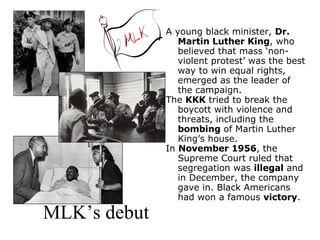
Montgomery Bus Boycott On 1 st  December 1955  Rosa Parks , a 42 year old black woman and NAACP member refused to give up her seat to a white man as was the law in Alabama. She was arrested and fined $10 However, her friends  organised a bus boycott  until the bus company agreed to seat all passengers on a ‘first come, first serve’ basis. Black customers made up  75%  of the Company’s business, so the boycott was very damaging. Black passengers  walked, shared lifts  or took taxis to work
MLK’s debut A young black minister,  Dr. Martin Luther King , who believed that mass ‘non- violent protest’ was the best way to win equal rights, emerged as the leader of the campaign.  The  KKK  tried to break the boycott with violence and threats, including the  bombing  of Martin Luther King’s house.  In  November 1956 , the Supreme Court ruled that segregation was  illegal  and in December, the company gave in. Black Americans had won a famous  victory .
“ There comes a time when people get tired. We are tired of being segregated and humiliated, tired of being kicked about. We have no choice but to protest. In our protests there will be no threats and bullying. Love must be our ideal. Love your enemies, bless them, and pray for them. Let no man pull you so low as to make you hate him.” (1955, Montgomery)
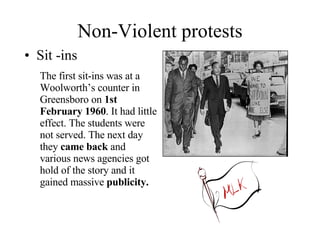
Non-Violent protests Sit -ins The first sit-ins was at a Woolworth’s counter in Greensboro on  1st February 1960 . It had little effect. The students were not served. The next day they  came back  and various news agencies got hold of the story and it gained massive  publicity.
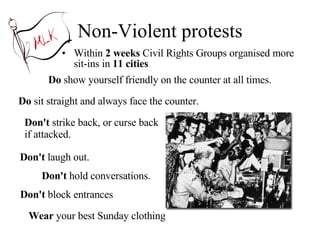
Non-Violent protests Within  2 weeks  Civil Rights Groups organised more sit-ins in  11 cities Do  show yourself friendly on the counter at all times.  Do  sit straight and always face the counter.  Don't  strike back, or curse back if attacked.  Don't  laugh out.  Don't  hold conversations.  Don't  block entrances  Wear  your best Sunday clothing
What were the effects of the sit-ins? Negative : Protesters were  arrested , instead of those who turned up to attack them ( 7,000  by 1961!) A judge literally  turned his back  on one black lawyer that turned up to defend the students in court One leading campaigner's house was  bombed
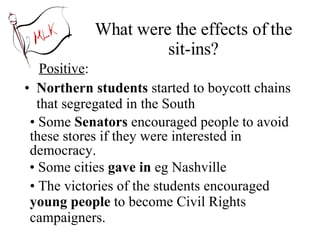
What were the effects of the sit-ins? Positive :  Northern students  started to boycott chains that segregated in the South Some  Senators  encouraged people to avoid these stores if they were interested in democracy. Some cities  gave in  eg Nashville The victories of the students encouraged  young people  to become Civil Rights campaigners.
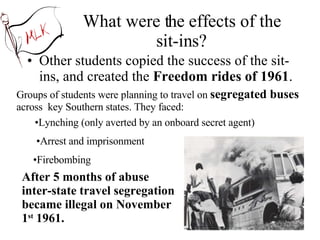
What were the effects of the sit-ins? Other students copied the success of the sit-ins, and created the  Freedom rides of 1961 . Groups of students were planning to travel on  segregated buses  across  key Southern states. They faced: Arrest and imprisonment Firebombing Lynching (only averted by an onboard secret agent) After 5 months of abuse inter-state travel segregation became illegal on November 1 st  1961.
1963 The SCLC and King had just finished a year long campaign in Albany, where they had  failed  to change any segregation laws. Focus moved to  Birmingham, Alabama . 3 rd  April, a series of  sit-ins  were arranged, gaining much  publicity . On the 6 th  police  arrested 45 protesters  marching from Sixteenth Street Baptist Church to city hall.
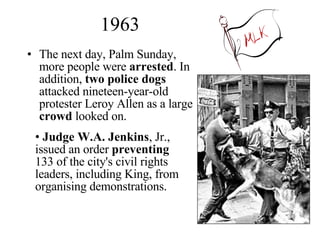
1963 The next day, Palm Sunday, more people were  arrested . In addition,  two police dogs  attacked nineteen-year-old protester Leroy Allen as a large  crowd  looked on. Judge W.A. Jenkins , Jr., issued an order  preventing  133 of the city's civil rights leaders, including King, from organising demonstrations.
Letter from Birmingham Jail There was nothing else to do but for  King  to allow himself to be  arrested . Whilst in  jail  King wrote (on the edge of newspapers and on toilet paper) “ While confined here in the Birmingham City Jail, I came across your recent statement calling our present activities " unwise and untimely"  . . . . Frankly I have never yet engaged in a  direct action movement  that was "well timed," according to the timetable of those who have  not suffered  unduly from the  disease  of segregation”
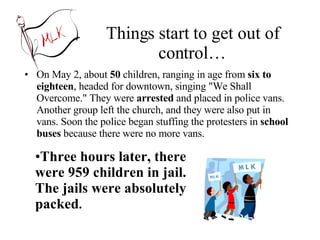
Things start to get out of control… On May 2, about  50  children, ranging in age from  six to eighteen , headed for downtown, singing "We Shall Overcome." They were  arrested  and placed in police vans. Another group left the church, and they were also put in vans. Soon the police began stuffing the protesters in  school buses  because there were no more vans.  Three hours later, there were 959 children in jail. The jails were absolutely packed .
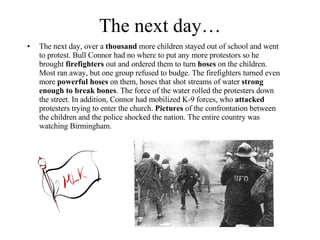
The next day… The next day, over a  thousand  more children stayed out of school and went to protest. Bull Connor had no where to put any more protestors so he brought  firefighters  out and ordered them to turn  hoses  on the children. Most ran away, but one group refused to budge. The firefighters turned even more  powerful hoses  on them, hoses that shot streams of water  strong enough to break bones . The force of the water rolled the protesters down the street. In addition, Connor had mobilized K-9 forces, who  attacked  protesters trying to enter the church.  Pictures  of the confrontation between the children and the police shocked the nation. The entire country was watching Birmingham.
The demonstrations escalated. Because the jails were filled, the police did not know what to do. Finally, the Birmingham business community, fearing damage to downtown stores, agreed to integrate lunch counters and hire more blacks, over the objections of city officials. King had gotten his much-needed victory.
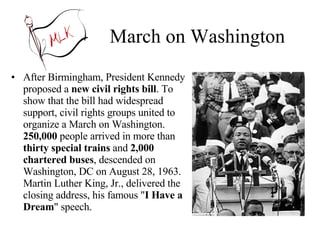
March on Washington After Birmingham, President Kennedy proposed a  new civil rights bill . To show that the bill had widespread support, civil rights groups united to organize a March on Washington.  250,000  people arrived in more than  thirty special trains  and  2,000 chartered buses , descended on Washington, DC on August 28, 1963. Martin Luther King, Jr., delivered the closing address, his famous " I Have a Dream " speech.
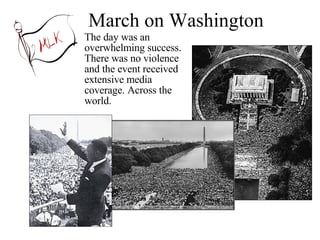
March on Washington The day was an overwhelming success. There was no violence and the event received extensive media coverage. Across the world.
1964 MLK turned his attention to  Selma  in 1964 after the city was still refusing to allow Blacks to  register to vote , based on reading tests. Protests  were organised and the situation that arose was called:  [ p]robably one of the most  vicious  situations that was in the whole Civil Rights Movement . . . . They  beat  people at random. They didn't have to be marching. All you had to do was be black. And they  hospitalised  probably fifteen or twenty folks. And they just was intending to  kill  somebody as an example, and they did kill Jimmie Jackson.
The public view… Further  protests were widely reported… "They literally  whipped  folk all the way back to the church," remembered one marcher. "They even came up in the yard of the  church , hittin' on folk. Ladies, men, babies, children -- they  didn't give a damn  who they were."  That night,  TV  stations interrupted their normal programming to show  clips of the violence  at Selma. ABC was showing a  documentary on Nazi war crimes ,  Judgment at Nuremberg . Many viewers thought the clips of the violence at Selma was  part of the film .
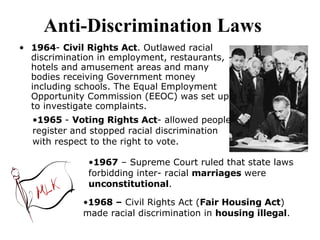
Anti-Discrimination Laws     1964 -  Civil Rights Act . Outlawed racial discrimination in employment, restaurants, hotels and amusement areas and many bodies receiving Government money including schools. The Equal Employment Opportunity Commission (EEOC) was set up to investigate complaints.  1965  -  Voting Rights Act - allowed people register and stopped racial discrimination with respect to the right to vote.  1967  – Supreme Court ruled that state laws forbidding inter- racial  marriages  were  unconstitutional .  1968 –  Civil Rights Act ( Fair Housing Act ) made racial discrimination in  housing illegal .
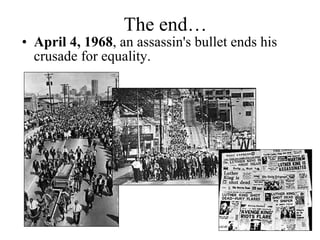
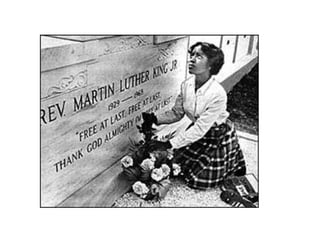
The end… April 4, 1968 , an assassin's bullet ends his crusade for equality.
 

Martin Luther King

  • 1.
    Martin Luther Kingand the Non-Violent Civil Rights Movement
  • 2.
    Montgomery Bus BoycottOn 1 st December 1955 Rosa Parks , a 42 year old black woman and NAACP member refused to give up her seat to a white man as was the law in Alabama. She was arrested and fined $10 However, her friends organised a bus boycott until the bus company agreed to seat all passengers on a ‘first come, first serve’ basis. Black customers made up 75% of the Company’s business, so the boycott was very damaging. Black passengers walked, shared lifts or took taxis to work
  • 3.
    MLK’s debut Ayoung black minister, Dr. Martin Luther King , who believed that mass ‘non- violent protest’ was the best way to win equal rights, emerged as the leader of the campaign. The KKK tried to break the boycott with violence and threats, including the bombing of Martin Luther King’s house. In November 1956 , the Supreme Court ruled that segregation was illegal and in December, the company gave in. Black Americans had won a famous victory .
  • 4.
    “ There comesa time when people get tired. We are tired of being segregated and humiliated, tired of being kicked about. We have no choice but to protest. In our protests there will be no threats and bullying. Love must be our ideal. Love your enemies, bless them, and pray for them. Let no man pull you so low as to make you hate him.” (1955, Montgomery)
  • 5.
    Non-Violent protests Sit-ins The first sit-ins was at a Woolworth’s counter in Greensboro on 1st February 1960 . It had little effect. The students were not served. The next day they came back and various news agencies got hold of the story and it gained massive publicity.
  • 6.
    Non-Violent protests Within 2 weeks Civil Rights Groups organised more sit-ins in 11 cities Do show yourself friendly on the counter at all times. Do sit straight and always face the counter. Don't strike back, or curse back if attacked. Don't laugh out. Don't hold conversations. Don't block entrances Wear your best Sunday clothing
  • 7.
    What were theeffects of the sit-ins? Negative : Protesters were arrested , instead of those who turned up to attack them ( 7,000 by 1961!) A judge literally turned his back on one black lawyer that turned up to defend the students in court One leading campaigner's house was bombed
  • 8.
    What were theeffects of the sit-ins? Positive : Northern students started to boycott chains that segregated in the South Some Senators encouraged people to avoid these stores if they were interested in democracy. Some cities gave in eg Nashville The victories of the students encouraged young people to become Civil Rights campaigners.
  • 9.
    What were theeffects of the sit-ins? Other students copied the success of the sit-ins, and created the Freedom rides of 1961 . Groups of students were planning to travel on segregated buses across key Southern states. They faced: Arrest and imprisonment Firebombing Lynching (only averted by an onboard secret agent) After 5 months of abuse inter-state travel segregation became illegal on November 1 st 1961.
  • 10.
    1963 The SCLCand King had just finished a year long campaign in Albany, where they had failed to change any segregation laws. Focus moved to Birmingham, Alabama . 3 rd April, a series of sit-ins were arranged, gaining much publicity . On the 6 th police arrested 45 protesters marching from Sixteenth Street Baptist Church to city hall.
  • 11.
    1963 The nextday, Palm Sunday, more people were arrested . In addition, two police dogs attacked nineteen-year-old protester Leroy Allen as a large crowd looked on. Judge W.A. Jenkins , Jr., issued an order preventing 133 of the city's civil rights leaders, including King, from organising demonstrations.
  • 12.
    Letter from BirminghamJail There was nothing else to do but for King to allow himself to be arrested . Whilst in jail King wrote (on the edge of newspapers and on toilet paper) “ While confined here in the Birmingham City Jail, I came across your recent statement calling our present activities " unwise and untimely" . . . . Frankly I have never yet engaged in a direct action movement that was "well timed," according to the timetable of those who have not suffered unduly from the disease of segregation”
  • 13.
    Things start toget out of control… On May 2, about 50 children, ranging in age from six to eighteen , headed for downtown, singing "We Shall Overcome." They were arrested and placed in police vans. Another group left the church, and they were also put in vans. Soon the police began stuffing the protesters in school buses because there were no more vans. Three hours later, there were 959 children in jail. The jails were absolutely packed .
  • 14.
    The next day…The next day, over a thousand more children stayed out of school and went to protest. Bull Connor had no where to put any more protestors so he brought firefighters out and ordered them to turn hoses on the children. Most ran away, but one group refused to budge. The firefighters turned even more powerful hoses on them, hoses that shot streams of water strong enough to break bones . The force of the water rolled the protesters down the street. In addition, Connor had mobilized K-9 forces, who attacked protesters trying to enter the church. Pictures of the confrontation between the children and the police shocked the nation. The entire country was watching Birmingham.
  • 15.
    The demonstrations escalated.Because the jails were filled, the police did not know what to do. Finally, the Birmingham business community, fearing damage to downtown stores, agreed to integrate lunch counters and hire more blacks, over the objections of city officials. King had gotten his much-needed victory.
  • 16.
    March on WashingtonAfter Birmingham, President Kennedy proposed a new civil rights bill . To show that the bill had widespread support, civil rights groups united to organize a March on Washington. 250,000 people arrived in more than thirty special trains and 2,000 chartered buses , descended on Washington, DC on August 28, 1963. Martin Luther King, Jr., delivered the closing address, his famous " I Have a Dream " speech.
  • 17.
    March on WashingtonThe day was an overwhelming success. There was no violence and the event received extensive media coverage. Across the world.
  • 18.
    1964 MLK turnedhis attention to Selma in 1964 after the city was still refusing to allow Blacks to register to vote , based on reading tests. Protests were organised and the situation that arose was called: [ p]robably one of the most vicious situations that was in the whole Civil Rights Movement . . . . They beat people at random. They didn't have to be marching. All you had to do was be black. And they hospitalised probably fifteen or twenty folks. And they just was intending to kill somebody as an example, and they did kill Jimmie Jackson.
  • 19.
    The public view…Further protests were widely reported… "They literally whipped folk all the way back to the church," remembered one marcher. "They even came up in the yard of the church , hittin' on folk. Ladies, men, babies, children -- they didn't give a damn who they were." That night, TV stations interrupted their normal programming to show clips of the violence at Selma. ABC was showing a documentary on Nazi war crimes , Judgment at Nuremberg . Many viewers thought the clips of the violence at Selma was part of the film .
  • 20.
    Anti-Discrimination Laws   1964 - Civil Rights Act . Outlawed racial discrimination in employment, restaurants, hotels and amusement areas and many bodies receiving Government money including schools. The Equal Employment Opportunity Commission (EEOC) was set up to investigate complaints. 1965 - Voting Rights Act - allowed people register and stopped racial discrimination with respect to the right to vote. 1967 – Supreme Court ruled that state laws forbidding inter- racial marriages were unconstitutional . 1968 – Civil Rights Act ( Fair Housing Act ) made racial discrimination in housing illegal .
  • 21.
    The end… April4, 1968 , an assassin's bullet ends his crusade for equality.
  • 22.

Editor's Notes

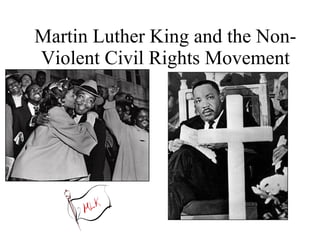
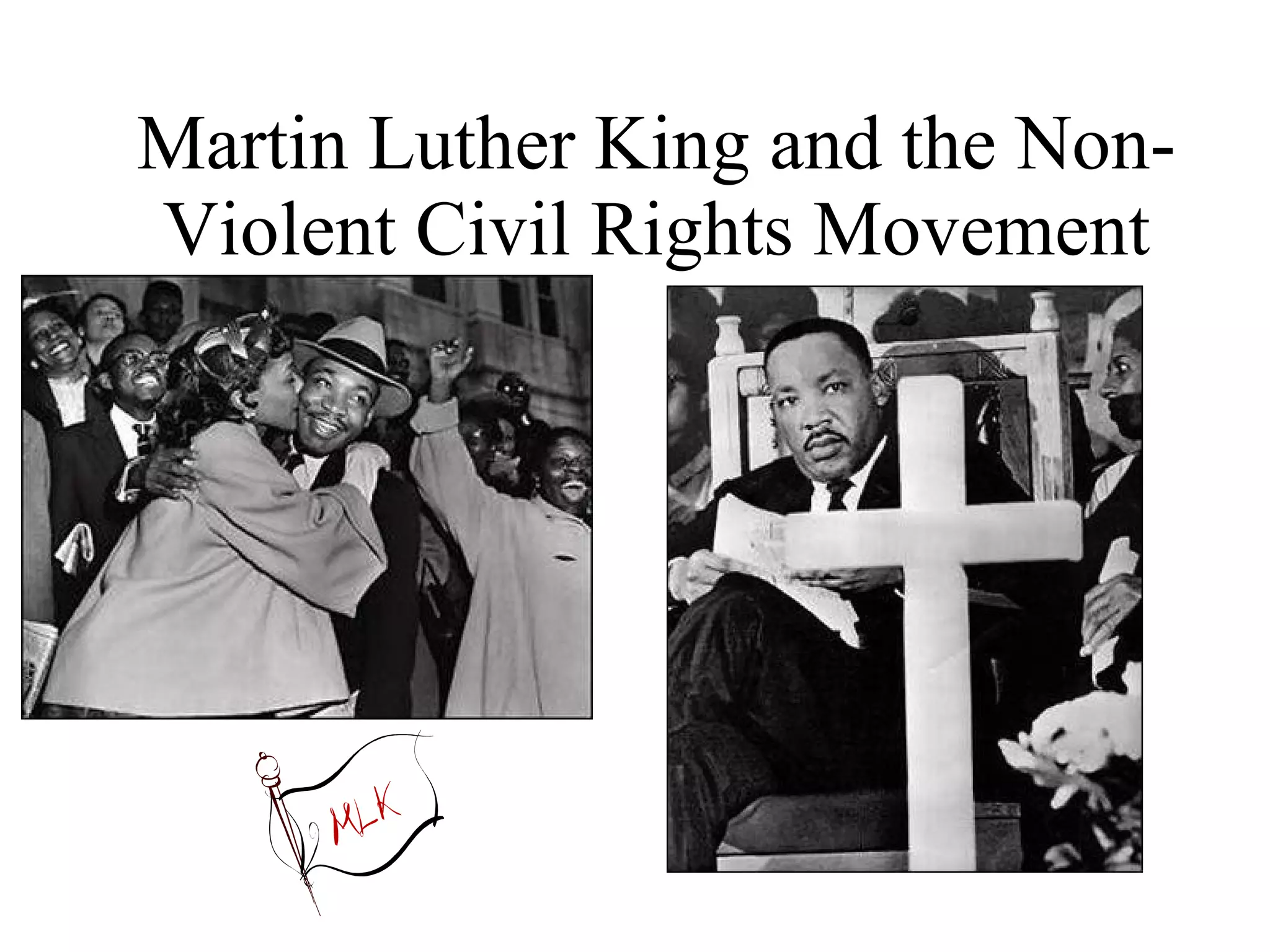
  • #2 MLK and his wife Coretta leaving the courtroom after the 1 st victory in Montgomery and at a church protest meeting