Objectives

  •   Evaluate Johnson’s policies up to his victory
      in the 1964 presidential election.

  •   Analyze Johnson’s goals and actions as seen
      in his Great Society programs.

  •   Assess the achievements of the Great
      Society.
Terms and People

•   Medicare – a federal program that provided basic
    hospital insurance for Americans aged 65 and older
•   Civil Rights Act – outlawed discrimination in voting,
    education, and public accommodations
•   Economic Opportunity Act – created programs,
    such as the Job Corps and VISTA, to provide
    opportunities for impoverished Americans
•   Great Society – a plan to end poverty and racial
    injustice and provide opportunity for every child
•   War on Poverty – federal programs designed to train
    the jobless, educate the uneducated, and provide
    healthcare for those in need
How did Johnson’s Great Society programs
change life for most Americans?

President Johnson shared the goals President
Kennedy had advanced.

He pushed important domestic legislation through
Congress.
In 1965, President Lyndon B. Johnson addressed a
 joint session of Congress. In the speech he talked
  about some of his hopes for America and how he
wished to be remembered by history. He explained,


 “I do not want to be the President who built empires, or
 sought grandeur, or extended dominion. I want to be
 the President who educated young children… who
 helped to feed the hungry… who helped the poor to find
 their own way…”
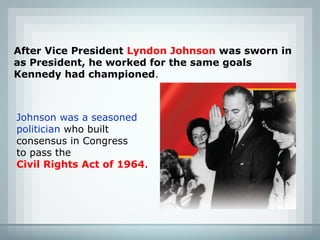
After Vice President Lyndon Johnson was sworn in
as President, he worked for the same goals
Kennedy had championed.


Johnson was a seasoned
politician who built
consensus in Congress
to pass the
Civil Rights Act of 1964.
The Civil Rights Act of 1964

•   outlawed discrimination in voting, education,
    and public accommodations
•   established the Equal Employment Opportunity
    Commission to fight discrimination in hiring
•   prohibited discrimination on the basis of a
    person’s sex in public accommodations and in
    hiring
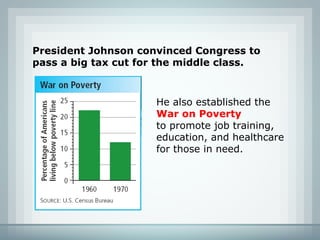
President Johnson convinced Congress to
pass a big tax cut for the middle class.


                     He also established the
                     War on Poverty
                     to promote job training,
                     education, and healthcare
                     for those in need.
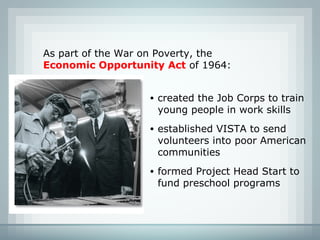
As part of the War on Poverty, the
Economic Opportunity Act of 1964:


                   •   created the Job Corps to train
                       young people in work skills
                   •   established VISTA to send
                       volunteers into poor American
                       communities
                   •   formed Project Head Start to
                       fund preschool programs
In the 1964      Johnson used his
presidential     popularity to call for
election,        a Great Society
President        that would end
Johnson          poverty and racial
defeated Barry   injustice and provide
Goldwater in a   opportunity for
landslide.       every child.
Johnson’s Great Society

•   created Medicare and Medicaid
•   provided funds to impoverished school districts
•   passed legislation to improve air and water
    quality
•   passed the Immigration and Nationality
    Act of 1965 to lift immigration quotas
•   created the National Endowment for the Arts
    and Humanities
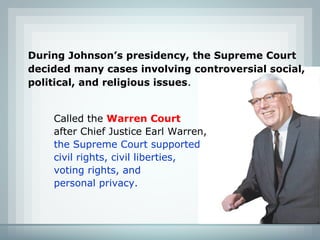
During Johnson’s presidency, the Supreme Court
decided many cases involving controversial social,
political, and religious issues.


    Called the Warren Court
    after Chief Justice Earl Warren,
    the Supreme Court supported
    civil rights, civil liberties,
    voting rights, and
    personal privacy.
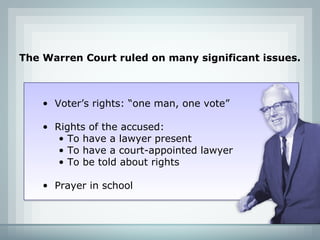
The Warren Court ruled on many significant issues.


    • Voter’s rights: “one man, one vote”

    • Rights of the accused:
       • To have a lawyer present
       • To have a court-appointed lawyer
       • To be told about rights

    • Prayer in school

Unit 6 section 1 lesson 2 johnsons great society

  • 2.
    Objectives • Evaluate Johnson’s policies up to his victory in the 1964 presidential election. • Analyze Johnson’s goals and actions as seen in his Great Society programs. • Assess the achievements of the Great Society.
  • 3.
    Terms and People • Medicare – a federal program that provided basic hospital insurance for Americans aged 65 and older • Civil Rights Act – outlawed discrimination in voting, education, and public accommodations • Economic Opportunity Act – created programs, such as the Job Corps and VISTA, to provide opportunities for impoverished Americans • Great Society – a plan to end poverty and racial injustice and provide opportunity for every child • War on Poverty – federal programs designed to train the jobless, educate the uneducated, and provide healthcare for those in need
  • 4.
    How did Johnson’sGreat Society programs change life for most Americans? President Johnson shared the goals President Kennedy had advanced. He pushed important domestic legislation through Congress.
  • 5.
    In 1965, PresidentLyndon B. Johnson addressed a joint session of Congress. In the speech he talked about some of his hopes for America and how he wished to be remembered by history. He explained, “I do not want to be the President who built empires, or sought grandeur, or extended dominion. I want to be the President who educated young children… who helped to feed the hungry… who helped the poor to find their own way…”
  • 6.
    After Vice PresidentLyndon Johnson was sworn in as President, he worked for the same goals Kennedy had championed. Johnson was a seasoned politician who built consensus in Congress to pass the Civil Rights Act of 1964.
  • 7.
    The Civil RightsAct of 1964 • outlawed discrimination in voting, education, and public accommodations • established the Equal Employment Opportunity Commission to fight discrimination in hiring • prohibited discrimination on the basis of a person’s sex in public accommodations and in hiring
  • 8.
    President Johnson convincedCongress to pass a big tax cut for the middle class. He also established the War on Poverty to promote job training, education, and healthcare for those in need.
  • 9.
    As part ofthe War on Poverty, the Economic Opportunity Act of 1964: • created the Job Corps to train young people in work skills • established VISTA to send volunteers into poor American communities • formed Project Head Start to fund preschool programs
  • 10.
    In the 1964 Johnson used his presidential popularity to call for election, a Great Society President that would end Johnson poverty and racial defeated Barry injustice and provide Goldwater in a opportunity for landslide. every child.
  • 11.
    Johnson’s Great Society • created Medicare and Medicaid • provided funds to impoverished school districts • passed legislation to improve air and water quality • passed the Immigration and Nationality Act of 1965 to lift immigration quotas • created the National Endowment for the Arts and Humanities
  • 12.
    During Johnson’s presidency,the Supreme Court decided many cases involving controversial social, political, and religious issues. Called the Warren Court after Chief Justice Earl Warren, the Supreme Court supported civil rights, civil liberties, voting rights, and personal privacy.
  • 13.
    The Warren Courtruled on many significant issues. • Voter’s rights: “one man, one vote” • Rights of the accused: • To have a lawyer present • To have a court-appointed lawyer • To be told about rights • Prayer in school