CIVIL RIGHTS
The Role of Modern Georgia
The End of the White Primary
   Georgia had a law declaring that only whites
    could vote in primary elections.
   It kept African-Americans from participating
    in the important primary elections.
   The White Primary was found
    unconstitutional in 1946.
The 1946 Governor’s Election
   Eugene Talmadge was elected but died before
    taking office.
   The General Assembly unsuccessfully tried to
    give the election to Herman Talmadge
    (Eugene’s son) instead .
   The GA Supreme Court ruled a new election
    was required.
   Herman Talmadge was elected in 1947.
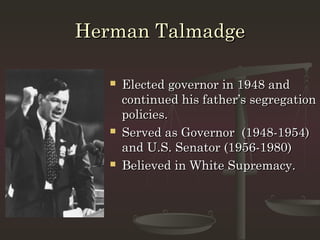
Herman Talmadge

      Elected governor in 1948 and
       continued his father’s segregation
       policies.
      Served as Governor (1948-1954)
       and U.S. Senator (1956-1980)
      Believed in White Supremacy.
Left Side Assignment
   The 1946 Election was called “The Three
    Governors’ Controversy”
   Read pages 632 and 633 to complete the
    following:
   Write a good paragraph explaining how
    Georgia ended up with three people
    believing they had the right to be governor
    in 1946. Please include information on what
    led to the controversy, who was involved,
    and how it ended.
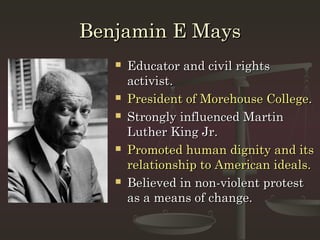
Benjamin E Mays
      Educator and civil rights
       activist.
      President of Morehouse College.
      Strongly influenced Martin
       Luther King Jr.
      Promoted human dignity and its
       relationship to American ideals.
      Believed in non-violent protest
       as a means of change.
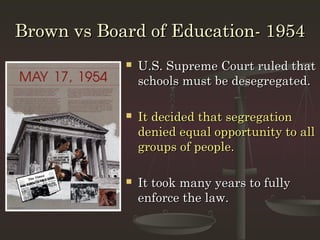
Brown vs Board of Education- 1954
               U.S. Supreme Court ruled that
                schools must be desegregated.

               It decided that segregation
                denied equal opportunity to all
                groups of people.

               It took many years to fully
                enforce the law.
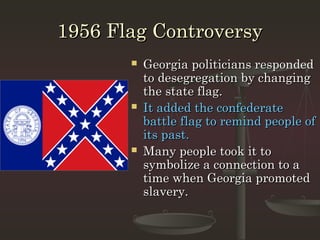
1956 Flag Controversy
          Georgia politicians responded
           to desegregation by changing
           the state flag.
          It added the confederate
           battle flag to remind people of
           its past.
          Many people took it to
           symbolize a connection to a
           time when Georgia promoted
           slavery.
Terms to Know
Write two definitions for each of the following words.
     A. The Text              B. Your own words

1.   Integration
2.   segregate
3.   sit-in
4.   discrimination
5.   racism
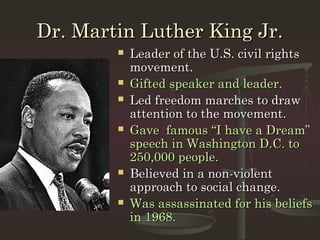
Dr. Martin Luther King Jr.
           Leader of the U.S. civil rights
            movement.
           Gifted speaker and leader.
           Led freedom marches to draw
            attention to the movement.
           Gave famous “I have a Dream”
            speech in Washington D.C. to
            250,000 people.
           Believed in a non-violent
            approach to social change.
           Was assassinated for his beliefs
            in 1968.
Student Non-violent-Coordinating Committee
                  SNCC

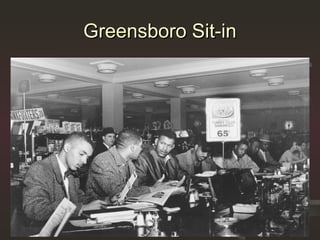
                  SNCC was a student formed
                   civil rights organization .
                  Used non-violent / direct action
                   methods (sit-ins, marches).
                  Protestors would occupy buses,
                   restaurants, etc. and refuse to
                   leave.
Greensboro Sit-in
Sibley Commission
   Formed to gather information about how
    Georgians felt about integration.
   Federal law was demanding that Georgia
    desegregate its schools.
   It found the majority of Georgians were
    willing to close schools rather than accept
    integration.
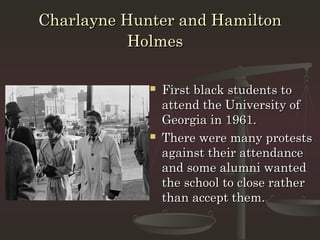
Charlayne Hunter and Hamilton
           Holmes

                First black students to
                 attend the University of
                 Georgia in 1961.
                There were many protests
                 against their attendance
                 and some alumni wanted
                 the school to close rather
                 than accept them.
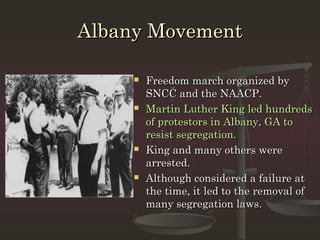
Albany Movement

        Freedom march organized by
         SNCC and the NAACP.
        Martin Luther King led hundreds
         of protestors in Albany, GA to
         resist segregation.
        King and many others were
         arrested.
        Although considered a failure at
         the time, it led to the removal of
         many segregation laws.
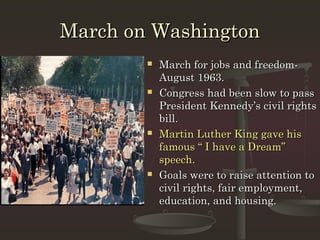
March on Washington
           March for jobs and freedom-
            August 1963.
           Congress had been slow to pass
            President Kennedy’s civil rights
            bill.
           Martin Luther King gave his
            famous “ I have a Dream”
            speech.
           Goals were to raise attention to
            civil rights, fair employment,
            education, and housing.
Left Side Assignment
              3 Facts and an Opinion
    In complete sentences, write 3 important
     facts about what you have learned and one
     opinion that you believe is significant about
     today’s information.
    Facts:
1.   Factual sentence 1
2.   Factual sentence 2
3.   Factual sentence 3
4.   A thoughtful opinion.
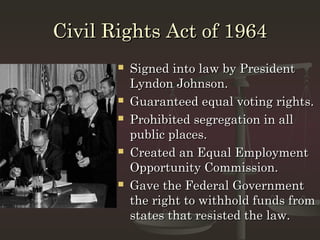
Civil Rights Act of 1964
          Signed into law by President
           Lyndon Johnson.
          Guaranteed equal voting rights.
          Prohibited segregation in all
           public places.
          Created an Equal Employment
           Opportunity Commission.
          Gave the Federal Government
           the right to withhold funds from
           states that resisted the law.
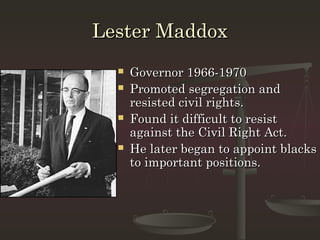
Lester Maddox
     Governor 1966-1970
     Promoted segregation and
      resisted civil rights.
     Found it difficult to resist
      against the Civil Right Act.
     He later began to appoint blacks
      to important positions.
End of County Unit System
   Georgia’s voting system favored rural white
    voters.
   In 1962, Federal Court decided that it
    violated the 14th Amendment.
   It was replaced with a “one person-one vote”
    system.
   Blacks were elected to state offices for the
    first time since Reconstruction.
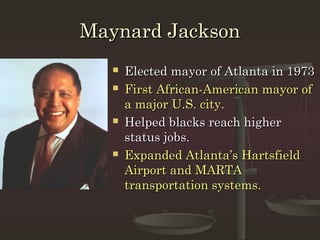
Maynard Jackson
      Elected mayor of Atlanta in 1973
      First African-American mayor of
       a major U.S. city.
      Helped blacks reach higher
       status jobs.
      Expanded Atlanta’s Hartsfield
       Airport and MARTA
       transportation systems.
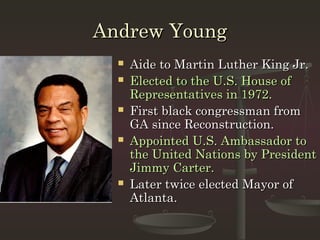
Andrew Young
     Aide to Martin Luther King Jr.
     Elected to the U.S. House of
      Representatives in 1972.
     First black congressman from
      GA since Reconstruction.
     Appointed U.S. Ambassador to
      the United Nations by President
      Jimmy Carter.
     Later twice elected Mayor of
      Atlanta.
Left Side Timeline
 There are 12 dates given in your notes.
 Pick at least 10 of those dates and place them

  in a timeline with the key information that
  goes with them.
 The first is given here:

1946- The Three Governors Controversy.
Other dates include:
  1948,1954,1956,1961,1962,1963,1964,1966,
  1968,1972,1973
List your dates from top to bottom on your page.
Civil Rights Notes Review

John Sibley Eugene Talmadge Martin Luther King Ellis Arnall
   Andrew Young Maynard Jackson Charlayne Hunter
   Lyndon Johnson Benjamin Mays Lester Maddox

1.    Mentor (influential) to Martin Luther King.
2.    President who signed the Civil Rights Act of 1964.
3.    One of the first black students at University of Georgia.
4.    Led a commission to see if Georgians would desegregate.
5.    Died before taking office as Georgia governor in 1946.
6.    Atlanta’s first black mayor.
7.    Governor who ordered a mass police force at MLK’s funeral.
8.    First black U.S. Congressman from Georgia since the 1800s.
9.    Gave the “I have a Dream” speech in 1963.
10.   Governor who lowered the voting age to 18 years.
Who would you meet?
   If you could have had lunch with one of
    the civil rights leaders we have learned
    about, who would you have liked to meet
    and why?
   A good paragraph-5-7 sentences.

Modern civil rights

  • 1.
    CIVIL RIGHTS The Roleof Modern Georgia
  • 2.
    The End ofthe White Primary  Georgia had a law declaring that only whites could vote in primary elections.  It kept African-Americans from participating in the important primary elections.  The White Primary was found unconstitutional in 1946.
  • 3.
    The 1946 Governor’sElection  Eugene Talmadge was elected but died before taking office.  The General Assembly unsuccessfully tried to give the election to Herman Talmadge (Eugene’s son) instead .  The GA Supreme Court ruled a new election was required.  Herman Talmadge was elected in 1947.
  • 4.
    Herman Talmadge  Elected governor in 1948 and continued his father’s segregation policies.  Served as Governor (1948-1954) and U.S. Senator (1956-1980)  Believed in White Supremacy.
  • 5.
    Left Side Assignment  The 1946 Election was called “The Three Governors’ Controversy”  Read pages 632 and 633 to complete the following:  Write a good paragraph explaining how Georgia ended up with three people believing they had the right to be governor in 1946. Please include information on what led to the controversy, who was involved, and how it ended.
  • 6.
    Benjamin E Mays  Educator and civil rights activist.  President of Morehouse College.  Strongly influenced Martin Luther King Jr.  Promoted human dignity and its relationship to American ideals.  Believed in non-violent protest as a means of change.
  • 7.
    Brown vs Boardof Education- 1954  U.S. Supreme Court ruled that schools must be desegregated.  It decided that segregation denied equal opportunity to all groups of people.  It took many years to fully enforce the law.
  • 8.
    1956 Flag Controversy  Georgia politicians responded to desegregation by changing the state flag.  It added the confederate battle flag to remind people of its past.  Many people took it to symbolize a connection to a time when Georgia promoted slavery.
  • 9.
    Terms to Know Writetwo definitions for each of the following words. A. The Text B. Your own words 1. Integration 2. segregate 3. sit-in 4. discrimination 5. racism
  • 10.
    Dr. Martin LutherKing Jr.  Leader of the U.S. civil rights movement.  Gifted speaker and leader.  Led freedom marches to draw attention to the movement.  Gave famous “I have a Dream” speech in Washington D.C. to 250,000 people.  Believed in a non-violent approach to social change.  Was assassinated for his beliefs in 1968.
  • 11.
    Student Non-violent-Coordinating Committee SNCC  SNCC was a student formed civil rights organization .  Used non-violent / direct action methods (sit-ins, marches).  Protestors would occupy buses, restaurants, etc. and refuse to leave.
  • 12.
  • 13.
    Sibley Commission  Formed to gather information about how Georgians felt about integration.  Federal law was demanding that Georgia desegregate its schools.  It found the majority of Georgians were willing to close schools rather than accept integration.
  • 14.
    Charlayne Hunter andHamilton Holmes  First black students to attend the University of Georgia in 1961.  There were many protests against their attendance and some alumni wanted the school to close rather than accept them.
  • 15.
    Albany Movement  Freedom march organized by SNCC and the NAACP.  Martin Luther King led hundreds of protestors in Albany, GA to resist segregation.  King and many others were arrested.  Although considered a failure at the time, it led to the removal of many segregation laws.
  • 16.
    March on Washington  March for jobs and freedom- August 1963.  Congress had been slow to pass President Kennedy’s civil rights bill.  Martin Luther King gave his famous “ I have a Dream” speech.  Goals were to raise attention to civil rights, fair employment, education, and housing.
  • 17.
    Left Side Assignment 3 Facts and an Opinion  In complete sentences, write 3 important facts about what you have learned and one opinion that you believe is significant about today’s information.  Facts: 1. Factual sentence 1 2. Factual sentence 2 3. Factual sentence 3 4. A thoughtful opinion.
  • 18.
    Civil Rights Actof 1964  Signed into law by President Lyndon Johnson.  Guaranteed equal voting rights.  Prohibited segregation in all public places.  Created an Equal Employment Opportunity Commission.  Gave the Federal Government the right to withhold funds from states that resisted the law.
  • 19.
    Lester Maddox  Governor 1966-1970  Promoted segregation and resisted civil rights.  Found it difficult to resist against the Civil Right Act.  He later began to appoint blacks to important positions.
  • 20.
    End of CountyUnit System  Georgia’s voting system favored rural white voters.  In 1962, Federal Court decided that it violated the 14th Amendment.  It was replaced with a “one person-one vote” system.  Blacks were elected to state offices for the first time since Reconstruction.
  • 21.
    Maynard Jackson  Elected mayor of Atlanta in 1973  First African-American mayor of a major U.S. city.  Helped blacks reach higher status jobs.  Expanded Atlanta’s Hartsfield Airport and MARTA transportation systems.
  • 22.
    Andrew Young  Aide to Martin Luther King Jr.  Elected to the U.S. House of Representatives in 1972.  First black congressman from GA since Reconstruction.  Appointed U.S. Ambassador to the United Nations by President Jimmy Carter.  Later twice elected Mayor of Atlanta.
  • 23.
    Left Side Timeline There are 12 dates given in your notes.  Pick at least 10 of those dates and place them in a timeline with the key information that goes with them.  The first is given here: 1946- The Three Governors Controversy. Other dates include: 1948,1954,1956,1961,1962,1963,1964,1966, 1968,1972,1973 List your dates from top to bottom on your page.
  • 24.
    Civil Rights NotesReview John Sibley Eugene Talmadge Martin Luther King Ellis Arnall Andrew Young Maynard Jackson Charlayne Hunter Lyndon Johnson Benjamin Mays Lester Maddox 1. Mentor (influential) to Martin Luther King. 2. President who signed the Civil Rights Act of 1964. 3. One of the first black students at University of Georgia. 4. Led a commission to see if Georgians would desegregate. 5. Died before taking office as Georgia governor in 1946. 6. Atlanta’s first black mayor. 7. Governor who ordered a mass police force at MLK’s funeral. 8. First black U.S. Congressman from Georgia since the 1800s. 9. Gave the “I have a Dream” speech in 1963. 10. Governor who lowered the voting age to 18 years.
  • 25.
    Who would youmeet?  If you could have had lunch with one of the civil rights leaders we have learned about, who would you have liked to meet and why?  A good paragraph-5-7 sentences.