Course Title: Poetry
   Course Code & NO.: LANE 447
   Course Credit Hrs.: 3 weekly
   Level: 7th Level Students


                             Victorianism
           Alfred Lord Tennyson’s “Ulysses”
        Emily Dickinson’s “A Bird Came Down the
                          Walk”
         Thomas Hardy’s “The Darkling Thrush”
Instructor: Dr. Noora Al-Malki
Credits of images and online content are to their original owners.
This Presentation
• Discusses characteristics of Victorian poetry.
• Presents a survey of the poetry written by
  some of the major Victorian poets (British &
  American) of the 19th C.
• Focuses on the presentation of themes
  related            philosophical/psychological
  representation of human nature and nature.


                   Dr. Noora Al-Malki 2012
                                               2
                   eaglenoora@yahoo.com
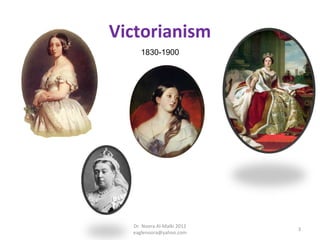
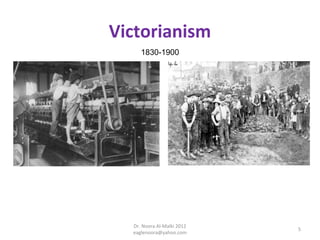
Victorianism
     1830-1900


  Dr. Noora Al-Malki 2012
                            3
  eaglenoora@yahoo.com
Victorianism
                                1830-1900


•rapid and unpredictable change (progress)
•economies of Europe expanded and accelerated
•emergence of “middle class,”
•scientific advancements vs. church law
•poverty (working classes)
•women had no rights

http://www.english.uwosh.edu/roth/VictorianEngland.htm
http://www.wwnorton.com/college/english/nael/victorian/welcome.htm
http://en.wikipedia.org/wiki/Victorian_era


                             Dr. Noora Al-Malki 2012
                                                                     4
                             eaglenoora@yahoo.com
Victorianism
     1830-1900


  Dr. Noora Al-Malki 2012
                            5
  eaglenoora@yahoo.com
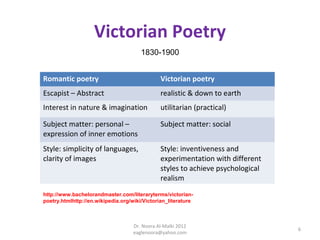
Victorian Poetry
                                       1830-1900


Romantic poetry                                Victorian poetry
Escapist – Abstract                            realistic & down to earth
Interest in nature & imagination               utilitarian (practical)

Subject matter: personal –                     Subject matter: social
expression of inner emotions
Style: simplicity of languages,                Style: inventiveness and
clarity of images                              experimentation with different
                                               styles to achieve psychological
                                               realism
http://www.bachelorandmaster.com/literaryterms/victorian-
poetry.htmlhttp://en.wikipedia.org/wiki/Victorian_literature


                                    Dr. Noora Al-Malki 2012
                                                                                 6
                                    eaglenoora@yahoo.com
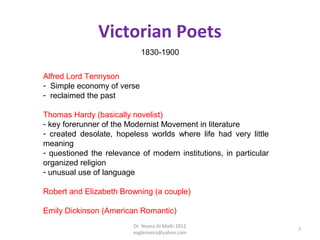
Victorian Poets
                            1830-1900


Alfred Lord Tennyson
- Simple economy of verse
- reclaimed the past

Thomas Hardy (basically novelist)
- key forerunner of the Modernist Movement in literature
- created desolate, hopeless worlds where life had very little
meaning
- questioned the relevance of modern institutions, in particular
organized religion
- unusual use of language

Robert and Elizabeth Browning (a couple)

Emily Dickinson (American Romantic)
                         Dr. Noora Al-Malki 2012
                                                                   7
                         eaglenoora@yahoo.com
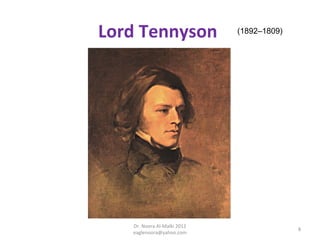
Lord Tennyson                (1892–1809)


   Dr. Noora Al-Malki 2012
                                           8
   eaglenoora@yahoo.com
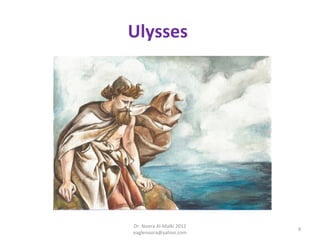
Ulysses


Dr. Noora Al-Malki 2012
                          9
eaglenoora@yahoo.com
Ulysses
First true Dramatic Monologue addressed               to an unknown
audience

Dramatic monologues are a way of expressing the views of a
character and offering the audience greater insight into that
character's feelings.

Origins: Greek (Homer’s Iliad & Odyssey)
        Italian (Dante’s Inferno)

Subject: Ulysses (The Greek Odysseus) desire to roam the world
and not be put down by his old age. It represents the chivalourous
spirit.
"To strive, to seek, to find, and not to yield".


                            Dr. Noora Al-Malki 2012
                                                                      10
                            eaglenoora@yahoo.com
Ulysses
Ulysses

It little profits that an idle king,
By this still hearth, among these barren crags,
Match'd with an aged wife, I mete and dole
Unequal laws unto a savage race,
That hoard, and sleep, and feed, and know not me.
I cannot rest from travel; I will drink
Life to the lees. All times I have enjoy'd
Greatly, have suffer'd greatly, both with those
That loved me, and alone; on shore, and when
Thro' scudding drifts the rainy Hyades
Vext the dim sea. I am become a name;
For always roaming with a hungry heart
Much have I seen and known,-- cities of men
And manners, climates, councils, governments,
                         Dr. Noora Al-Malki 2012
                                                    11
                         eaglenoora@yahoo.com
Ulysses

Myself not least, but honor'd of them all,--
And drunk delight of battle with my peers,
Far on the ringing plains of windy Troy.
I am a part of all that I have met;
Yet all experience is an arch wherethro'
Gleams that untravell'd world whose margin fades
For ever and for ever when I move.
How dull it is to pause, to make an end,
To rust unburnish'd, not to shine in use!
As tho' to breathe were life! Life piled on life
Were all too little, and of one to me
Little remains; but every hour is saved
>From that eternal silence, something more,

                          Dr. Noora Al-Malki 2012
                                                    12
                          eaglenoora@yahoo.com
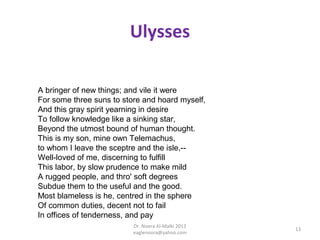
Ulysses

A bringer of new things; and vile it were
For some three suns to store and hoard myself,
And this gray spirit yearning in desire
To follow knowledge like a sinking star,
Beyond the utmost bound of human thought.
This is my son, mine own Telemachus,
to whom I leave the sceptre and the isle,--
Well-loved of me, discerning to fulfill
This labor, by slow prudence to make mild
A rugged people, and thro' soft degrees
Subdue them to the useful and the good.
Most blameless is he, centred in the sphere
Of common duties, decent not to fail
In offices of tenderness, and pay
                          Dr. Noora Al-Malki 2012
                                                    13
                          eaglenoora@yahoo.com
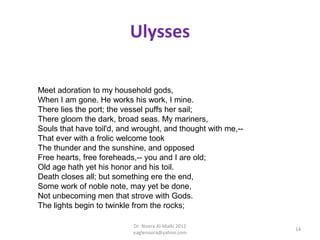
Ulysses

Meet adoration to my household gods,
When I am gone. He works his work, I mine.
There lies the port; the vessel puffs her sail;
There gloom the dark, broad seas. My mariners,
Souls that have toil'd, and wrought, and thought with me,--
That ever with a frolic welcome took
The thunder and the sunshine, and opposed
Free hearts, free foreheads,-- you and I are old;
Old age hath yet his honor and his toil.
Death closes all; but something ere the end,
Some work of noble note, may yet be done,
Not unbecoming men that strove with Gods.
The lights begin to twinkle from the rocks;

                           Dr. Noora Al-Malki 2012
                                                              14
                           eaglenoora@yahoo.com
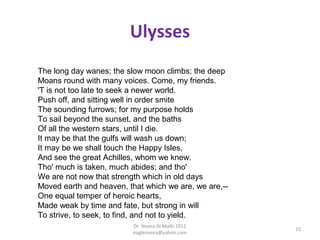
Ulysses
The long day wanes; the slow moon climbs; the deep
Moans round with many voices. Come, my friends.
'T is not too late to seek a newer world.
Push off, and sitting well in order smite
The sounding furrows; for my purpose holds
To sail beyond the sunset, and the baths
Of all the western stars, until I die.
It may be that the gulfs will wash us down;
It may be we shall touch the Happy Isles,
And see the great Achilles, whom we knew.
Tho' much is taken, much abides; and tho'
We are not now that strength which in old days
Moved earth and heaven, that which we are, we are,--
One equal temper of heroic hearts,
Made weak by time and fate, but strong in will
To strive, to seek, to find, and not to yield.
                          Dr. Noora Al-Malki 2012
                                                       15
                          eaglenoora@yahoo.com
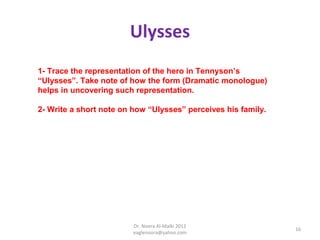
Ulysses
1- Trace the representation of the hero in Tennyson’s
“Ulysses”. Take note of how the form (Dramatic monologue)
helps in uncovering such representation.

2- Write a short note on how “Ulysses” perceives his family.


                         Dr. Noora Al-Malki 2012
                                                               16
                         eaglenoora@yahoo.com
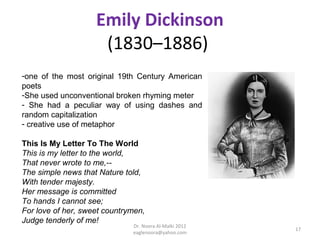
Emily Dickinson
                     (1830–1886)
-one of the most original 19th Century American
poets
-She used unconventional broken rhyming meter
- She had a peculiar way of using dashes and
random capitalization
- creative use of metaphor

This Is My Letter To The World
This is my letter to the world,
That never wrote to me,--
The simple news that Nature told,
With tender majesty.
Her message is committed
To hands I cannot see;
For love of her, sweet countrymen,
Judge tenderly of me!
                              Dr. Noora Al-Malki 2012
                                                        17
                              eaglenoora@yahoo.com
In the Garden

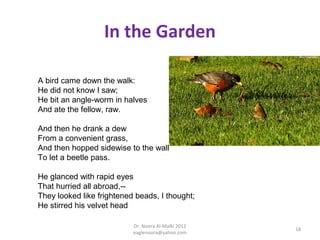
A bird came down the walk:
He did not know I saw;
He bit an angle-worm in halves
And ate the fellow, raw.

And then he drank a dew
From a convenient grass,
And then hopped sidewise to the wall
To let a beetle pass.

He glanced with rapid eyes
That hurried all abroad,--
They looked like frightened beads, I thought;
He stirred his velvet head

                           Dr. Noora Al-Malki 2012
                                                     18
                           eaglenoora@yahoo.com
In the Garden
Like one in danger; cautious,
I offered him a crumb,
And he unrolled his feathers
And rowed him softer home

Than oars divide the ocean,
Too silver for a seam,
Or butterflies, off banks of noon,
Leap, plashless, as they swim.


                            Dr. Noora Al-Malki 2012
                                                      19
                            eaglenoora@yahoo.com
In the Garden
                       Explication
"bizarre little narrative"

This is the finest example of Dickinson’s nature verse, for it
perfectly juxtaposes elements of superficial gentility against the
inner barbarity that characterizes the workings of the world. The
narrator chances to see a bird walking along a pathway, but just
as the scene appears perfect, the bird seizes upon a worm,
bites it in two, and devours it. The bird drinks some dew on
nearby grass (note the alternate for a drinking “glass”), then
graciously steps aside, right to a wall, to allow a beetle to pass.


                             Dr. Noora Al-Malki 2012
                                                                      20
                             eaglenoora@yahoo.com
In the Garden
                    Explication
The bird, like one fearful of being caught in an unacceptable
action, glances around quickly with darting eyes.
“Cautious” describes both the demeanor of the bird and that of
the observing narrator. Both feel threatened, the bird of the
possible consequences of its savagery, the narrator because
she is next on the bird’s path. She “offered him a Crumb,” not
because she admires the bird but out of fear and expediency.
The bird, sensing that it has escaped any potentially harmful
consequences for what it has done, struts a bit as “he unrolled
his feathers” and “rowed him softer home—.” Ironically, its walk
is too casual, softer than oars dividing a seamless ocean or
butterflies leaping into noon’s banks, all without a splash.
Behind its soft, charming, and genteel facade, nature is
menacing, and its hypocritical attempts to conceal its barbarism
make it more frightening.
http://salempress.com/store/pdfs/dickinson.pdf
                           Dr. Noora Al-Malki 2012
                                                                   21
                           eaglenoora@yahoo.com
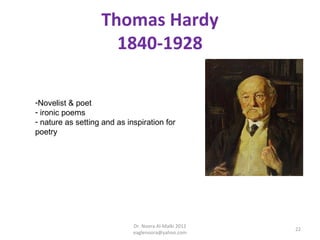
Thomas Hardy
                     1840-1928

-Novelist & poet
- ironic poems
- nature as setting and as inspiration for
poetry


                             Dr. Noora Al-Malki 2012
                                                       22
                             eaglenoora@yahoo.com
Darkling Thrush
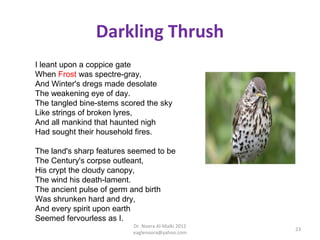
I leant upon a coppice gate
When Frost was spectre-gray,
And Winter's dregs made desolate
The weakening eye of day.
The tangled bine-stems scored the sky
Like strings of broken lyres,
And all mankind that haunted nigh
Had sought their household fires.

The land's sharp features seemed to be
The Century's corpse outleant,
His crypt the cloudy canopy,
The wind his death-lament.
The ancient pulse of germ and birth
Was shrunken hard and dry,
And every spirit upon earth
Seemed fervourless as I.
                          Dr. Noora Al-Malki 2012
                                                    23
                          eaglenoora@yahoo.com
Darkling Thrush
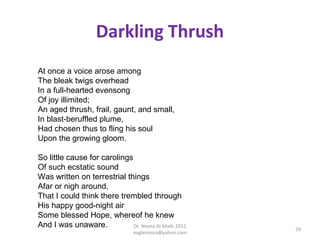
At once a voice arose among
The bleak twigs overhead
In a full-hearted evensong
Of joy illimited;
An aged thrush, frail, gaunt, and small,
In blast-beruffled plume,
Had chosen thus to fling his soul
Upon the growing gloom.

So little cause for carolings
Of such ecstatic sound
Was written on terrestrial things
Afar or nigh around,
That I could think there trembled through
His happy good-night air
Some blessed Hope, whereof he knew
And I was unaware.            Dr. Noora Al-Malki 2012
                                                         24
                                  eaglenoora@yahoo.com
Darkling Thrush
- "The Darkling Thrush" was originally called "The Century's
End, 1900” because it was written on the Eve of the 20th C.

-It describes an encounter with a frail bird which sings and
awakens the speaker to new possibilities.

-Apparently, the speaker is an aged and tired persona.

-The setting of the poem during winter also testifies to the old,
dying age.

- Thematically, the poem explores the signs of progress into the
20th C which were frightening as well as promising for Hardy.


                           Dr. Noora Al-Malki 2012
                                                                    25
                           eaglenoora@yahoo.com
“In the Garden” VS. “The Darkling Thrush”

 Compare and contrast the representation of nature in
 Dickinson’s “In the Garden” and Hardy’s “The Darkling
 Thrush”


                    Dr. Noora Al-Malki 2012
                                                         26
                    eaglenoora@yahoo.com

Unit 6-Victorianism

  • 1.
    Course Title: Poetry Course Code & NO.: LANE 447 Course Credit Hrs.: 3 weekly Level: 7th Level Students Victorianism Alfred Lord Tennyson’s “Ulysses” Emily Dickinson’s “A Bird Came Down the Walk” Thomas Hardy’s “The Darkling Thrush” Instructor: Dr. Noora Al-Malki Credits of images and online content are to their original owners.
  • 2.
    This Presentation • Discussescharacteristics of Victorian poetry. • Presents a survey of the poetry written by some of the major Victorian poets (British & American) of the 19th C. • Focuses on the presentation of themes related philosophical/psychological representation of human nature and nature. Dr. Noora Al-Malki 2012 2 eaglenoora@yahoo.com
  • 3.
    Victorianism 1830-1900 Dr. Noora Al-Malki 2012 3 eaglenoora@yahoo.com
  • 4.
    Victorianism 1830-1900 •rapid and unpredictable change (progress) •economies of Europe expanded and accelerated •emergence of “middle class,” •scientific advancements vs. church law •poverty (working classes) •women had no rights http://www.english.uwosh.edu/roth/VictorianEngland.htm http://www.wwnorton.com/college/english/nael/victorian/welcome.htm http://en.wikipedia.org/wiki/Victorian_era Dr. Noora Al-Malki 2012 4 eaglenoora@yahoo.com
  • 5.
    Victorianism 1830-1900 Dr. Noora Al-Malki 2012 5 eaglenoora@yahoo.com
  • 6.
    Victorian Poetry 1830-1900 Romantic poetry Victorian poetry Escapist – Abstract realistic & down to earth Interest in nature & imagination utilitarian (practical) Subject matter: personal – Subject matter: social expression of inner emotions Style: simplicity of languages, Style: inventiveness and clarity of images experimentation with different styles to achieve psychological realism http://www.bachelorandmaster.com/literaryterms/victorian- poetry.htmlhttp://en.wikipedia.org/wiki/Victorian_literature Dr. Noora Al-Malki 2012 6 eaglenoora@yahoo.com
  • 7.
    Victorian Poets 1830-1900 Alfred Lord Tennyson - Simple economy of verse - reclaimed the past Thomas Hardy (basically novelist) - key forerunner of the Modernist Movement in literature - created desolate, hopeless worlds where life had very little meaning - questioned the relevance of modern institutions, in particular organized religion - unusual use of language Robert and Elizabeth Browning (a couple) Emily Dickinson (American Romantic) Dr. Noora Al-Malki 2012 7 eaglenoora@yahoo.com
  • 8.
    Lord Tennyson (1892–1809) Dr. Noora Al-Malki 2012 8 eaglenoora@yahoo.com
  • 9.
    Ulysses Dr. Noora Al-Malki2012 9 eaglenoora@yahoo.com
  • 10.
    Ulysses First true DramaticMonologue addressed to an unknown audience Dramatic monologues are a way of expressing the views of a character and offering the audience greater insight into that character's feelings. Origins: Greek (Homer’s Iliad & Odyssey) Italian (Dante’s Inferno) Subject: Ulysses (The Greek Odysseus) desire to roam the world and not be put down by his old age. It represents the chivalourous spirit. "To strive, to seek, to find, and not to yield". Dr. Noora Al-Malki 2012 10 eaglenoora@yahoo.com
  • 11.
    Ulysses Ulysses It little profitsthat an idle king, By this still hearth, among these barren crags, Match'd with an aged wife, I mete and dole Unequal laws unto a savage race, That hoard, and sleep, and feed, and know not me. I cannot rest from travel; I will drink Life to the lees. All times I have enjoy'd Greatly, have suffer'd greatly, both with those That loved me, and alone; on shore, and when Thro' scudding drifts the rainy Hyades Vext the dim sea. I am become a name; For always roaming with a hungry heart Much have I seen and known,-- cities of men And manners, climates, councils, governments, Dr. Noora Al-Malki 2012 11 eaglenoora@yahoo.com
  • 12.
    Ulysses Myself not least,but honor'd of them all,-- And drunk delight of battle with my peers, Far on the ringing plains of windy Troy. I am a part of all that I have met; Yet all experience is an arch wherethro' Gleams that untravell'd world whose margin fades For ever and for ever when I move. How dull it is to pause, to make an end, To rust unburnish'd, not to shine in use! As tho' to breathe were life! Life piled on life Were all too little, and of one to me Little remains; but every hour is saved >From that eternal silence, something more, Dr. Noora Al-Malki 2012 12 eaglenoora@yahoo.com
  • 13.
    Ulysses A bringer ofnew things; and vile it were For some three suns to store and hoard myself, And this gray spirit yearning in desire To follow knowledge like a sinking star, Beyond the utmost bound of human thought. This is my son, mine own Telemachus, to whom I leave the sceptre and the isle,-- Well-loved of me, discerning to fulfill This labor, by slow prudence to make mild A rugged people, and thro' soft degrees Subdue them to the useful and the good. Most blameless is he, centred in the sphere Of common duties, decent not to fail In offices of tenderness, and pay Dr. Noora Al-Malki 2012 13 eaglenoora@yahoo.com
  • 14.
    Ulysses Meet adoration tomy household gods, When I am gone. He works his work, I mine. There lies the port; the vessel puffs her sail; There gloom the dark, broad seas. My mariners, Souls that have toil'd, and wrought, and thought with me,-- That ever with a frolic welcome took The thunder and the sunshine, and opposed Free hearts, free foreheads,-- you and I are old; Old age hath yet his honor and his toil. Death closes all; but something ere the end, Some work of noble note, may yet be done, Not unbecoming men that strove with Gods. The lights begin to twinkle from the rocks; Dr. Noora Al-Malki 2012 14 eaglenoora@yahoo.com
  • 15.
    Ulysses The long daywanes; the slow moon climbs; the deep Moans round with many voices. Come, my friends. 'T is not too late to seek a newer world. Push off, and sitting well in order smite The sounding furrows; for my purpose holds To sail beyond the sunset, and the baths Of all the western stars, until I die. It may be that the gulfs will wash us down; It may be we shall touch the Happy Isles, And see the great Achilles, whom we knew. Tho' much is taken, much abides; and tho' We are not now that strength which in old days Moved earth and heaven, that which we are, we are,-- One equal temper of heroic hearts, Made weak by time and fate, but strong in will To strive, to seek, to find, and not to yield. Dr. Noora Al-Malki 2012 15 eaglenoora@yahoo.com
  • 16.
    Ulysses 1- Trace therepresentation of the hero in Tennyson’s “Ulysses”. Take note of how the form (Dramatic monologue) helps in uncovering such representation. 2- Write a short note on how “Ulysses” perceives his family. Dr. Noora Al-Malki 2012 16 eaglenoora@yahoo.com
  • 17.
    Emily Dickinson (1830–1886) -one of the most original 19th Century American poets -She used unconventional broken rhyming meter - She had a peculiar way of using dashes and random capitalization - creative use of metaphor This Is My Letter To The World This is my letter to the world, That never wrote to me,-- The simple news that Nature told, With tender majesty. Her message is committed To hands I cannot see; For love of her, sweet countrymen, Judge tenderly of me! Dr. Noora Al-Malki 2012 17 eaglenoora@yahoo.com
  • 18.
    In the Garden Abird came down the walk: He did not know I saw; He bit an angle-worm in halves And ate the fellow, raw. And then he drank a dew From a convenient grass, And then hopped sidewise to the wall To let a beetle pass. He glanced with rapid eyes That hurried all abroad,-- They looked like frightened beads, I thought; He stirred his velvet head Dr. Noora Al-Malki 2012 18 eaglenoora@yahoo.com
  • 19.
    In the Garden Likeone in danger; cautious, I offered him a crumb, And he unrolled his feathers And rowed him softer home Than oars divide the ocean, Too silver for a seam, Or butterflies, off banks of noon, Leap, plashless, as they swim. Dr. Noora Al-Malki 2012 19 eaglenoora@yahoo.com
  • 20.
    In the Garden Explication "bizarre little narrative" This is the finest example of Dickinson’s nature verse, for it perfectly juxtaposes elements of superficial gentility against the inner barbarity that characterizes the workings of the world. The narrator chances to see a bird walking along a pathway, but just as the scene appears perfect, the bird seizes upon a worm, bites it in two, and devours it. The bird drinks some dew on nearby grass (note the alternate for a drinking “glass”), then graciously steps aside, right to a wall, to allow a beetle to pass. Dr. Noora Al-Malki 2012 20 eaglenoora@yahoo.com
  • 21.
    In the Garden Explication The bird, like one fearful of being caught in an unacceptable action, glances around quickly with darting eyes. “Cautious” describes both the demeanor of the bird and that of the observing narrator. Both feel threatened, the bird of the possible consequences of its savagery, the narrator because she is next on the bird’s path. She “offered him a Crumb,” not because she admires the bird but out of fear and expediency. The bird, sensing that it has escaped any potentially harmful consequences for what it has done, struts a bit as “he unrolled his feathers” and “rowed him softer home—.” Ironically, its walk is too casual, softer than oars dividing a seamless ocean or butterflies leaping into noon’s banks, all without a splash. Behind its soft, charming, and genteel facade, nature is menacing, and its hypocritical attempts to conceal its barbarism make it more frightening. http://salempress.com/store/pdfs/dickinson.pdf Dr. Noora Al-Malki 2012 21 eaglenoora@yahoo.com
  • 22.
    Thomas Hardy 1840-1928 -Novelist & poet - ironic poems - nature as setting and as inspiration for poetry Dr. Noora Al-Malki 2012 22 eaglenoora@yahoo.com
  • 23.
    Darkling Thrush I leantupon a coppice gate When Frost was spectre-gray, And Winter's dregs made desolate The weakening eye of day. The tangled bine-stems scored the sky Like strings of broken lyres, And all mankind that haunted nigh Had sought their household fires. The land's sharp features seemed to be The Century's corpse outleant, His crypt the cloudy canopy, The wind his death-lament. The ancient pulse of germ and birth Was shrunken hard and dry, And every spirit upon earth Seemed fervourless as I. Dr. Noora Al-Malki 2012 23 eaglenoora@yahoo.com
  • 24.
    Darkling Thrush At oncea voice arose among The bleak twigs overhead In a full-hearted evensong Of joy illimited; An aged thrush, frail, gaunt, and small, In blast-beruffled plume, Had chosen thus to fling his soul Upon the growing gloom. So little cause for carolings Of such ecstatic sound Was written on terrestrial things Afar or nigh around, That I could think there trembled through His happy good-night air Some blessed Hope, whereof he knew And I was unaware. Dr. Noora Al-Malki 2012 24 eaglenoora@yahoo.com
  • 25.
    Darkling Thrush - "TheDarkling Thrush" was originally called "The Century's End, 1900” because it was written on the Eve of the 20th C. -It describes an encounter with a frail bird which sings and awakens the speaker to new possibilities. -Apparently, the speaker is an aged and tired persona. -The setting of the poem during winter also testifies to the old, dying age. - Thematically, the poem explores the signs of progress into the 20th C which were frightening as well as promising for Hardy. Dr. Noora Al-Malki 2012 25 eaglenoora@yahoo.com
  • 26.
    “In the Garden”VS. “The Darkling Thrush” Compare and contrast the representation of nature in Dickinson’s “In the Garden” and Hardy’s “The Darkling Thrush” Dr. Noora Al-Malki 2012 26 eaglenoora@yahoo.com