Viri M. C.  Y Ceci    2008 Rev. Ceci Unit 5 Use of Present Continuos and Quantifiers
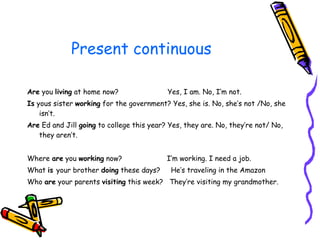
Present continuous   Are  you  living  at home now?  Yes, I am. No, I’m not.  Is  yous sister  working  for the government? Yes, she is. No, she’s not /No, she isn’t.  Are  Ed and Jill  going  to college this year? Yes, they are. No, they’re not/ No, they aren’t. Where  are  you  working  now?  I’m working. I need a job. What  is  your brother  doing  these days?  He’s traveling in the Amazon  Who  are  your parents  visiting  this week?  They’re visiting my grandmother.
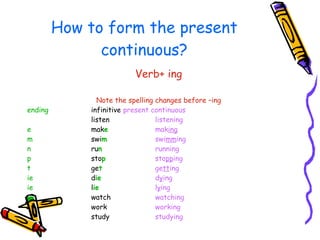
How to form the present continuous? Verb+ ing Note the spelling changes before –ing ending infinitive present continuous listen listening e mak e mak ing m swi m swi mm ing n ru n running p sto p sto pp ing t ge t ge tt ing ie d ie d y ing ie l ie l y ing watch watching work working study studying
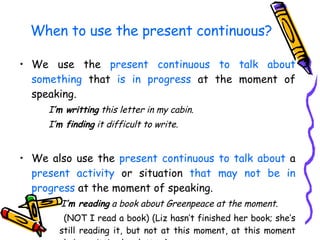
We use the  present continuous   to talk about   something  that  is in progress  at the moment of speaking. I ’m writting  this letter in my cabin.  I ’m finding  it difficult to write. We also use the  present continuous to talk about  a  present activity  or situation  that may not be in progress  at the moment of speaking. I ’m reading  a book about Greenpeace at the moment. (NOT I read a book) (Liz hasn’t finished her book; she’s still reading it, but not at this moment, at this moment she’s wrritting her letter.)   When to use the present continuous?
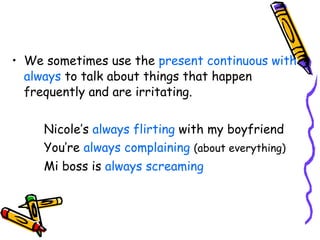
We sometimes use the  present continuous with always  to talk about things that happen frequently and are irritating. Nicole’s  always flirting  with my boyfriend You’re  always complaining  (about everything) Mi boss is  always screaming
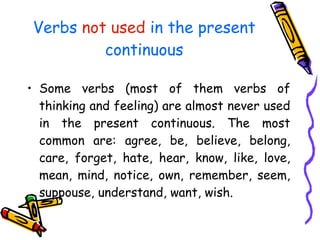
Verbs  not used  in the present continuous Some verbs (most of them verbs of thinking and feeling) are almost never used in the present continuous. The most common are: agree, be, believe, belong, care, forget, hate, hear, know, like, love, mean, mind, notice, own, remember, seem, suppouse, understand, want, wish.
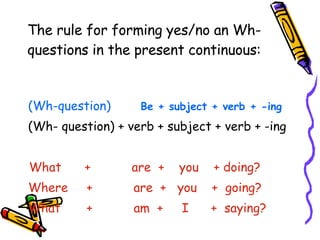
The rule for forming yes/no an Wh-questions in the present continuous: (Wh-question)   Be + subject + verb + -ing (Wh- question) + verb + subject + verb + -ing What  +  are  +  you  + doing? Where  +  are  +  you  +  going? What  +  am  +  I  +  saying ?
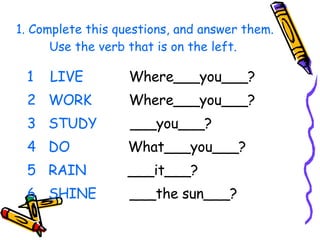
1. Complete this questions, and answer them. Use the verb that is on the left.  1  LIVE  Where___you___? WORK   Where___you___? STUDY   ___you___? DO   What___you___? RAIN  ___it___? SHINE   ___the sun___?
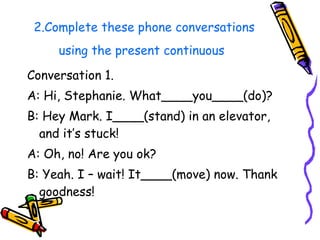
2.Complete these phone conversations using the present continuous   Conversation 1. A: Hi, Stephanie. What____you____(do)? B: Hey Mark. I____(stand) in an elevator, and it’s stuck! A: Oh, no! Are you ok? B: Yeah. I – wait! It____(move) now. Thank goodness!
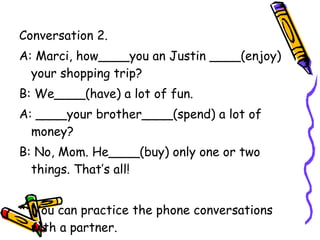
Conversation 2. A: Marci, how____you an Justin ____(enjoy) your shopping trip? B: We____(have) a lot of fun. A: ____your brother____(spend) a lot of money? B: No, Mom. He____(buy) only one or two things. That’s all! *  You can practice the phone conversations with a partner.
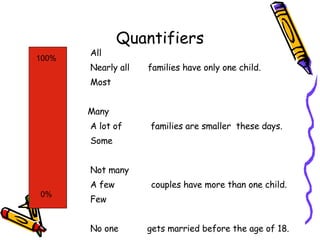
Quantifiers All Nearly all  families have only one child.  Most Many  A lot of  families are smaller  these days. Some Not many A few  couples have more than one child. Few No one  gets married before the age of 18.  100% 0%
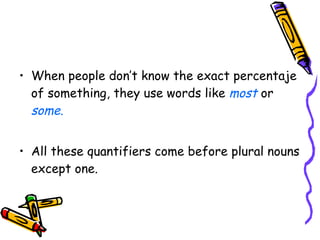
When people don’t know the exact percentaje of something, they use words like  most  or  some . All these quantifiers come before plural nouns except one.
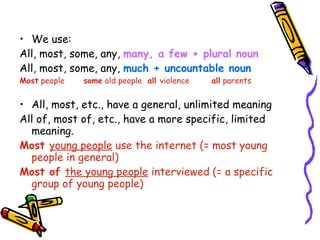
We use: All, most, some, any,  many, a few + plural noun All, most, some, any,  much   + uncountable noun Most  people some  old people  all  violence all  parents All, most, etc., have a general, unlimited meaning All of, most of, etc., have a more specific, limited meaning. Most  young people  use the internet (= most young people in general) Most of  the young people  interviewed (= a specific group of young people)
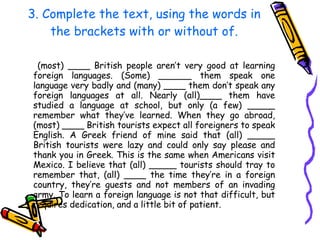
3. Complete the text, using the words in the brackets with or without of. (most) ____ British people aren’t very good at learning foreign languages. (Some) ______ them speak one language very badly and (many) ____ them don’t speak any foreign languages at all. Nearly (all)____ them have studied a language at school, but only (a few) _____ remember what they’ve learned. When they go abroad, (most) ____ British tourists expect all foreigners to speak English. A Greek friend of mine said that (all) _____ British tourists were lazy and could only say please and thank you in Greek. This is the same when Americans visit Mexico. I believe that (all) _____ tourists should tray to remember that, (all) ____ the time they’re in a foreign country, they’re guests and not members of an invading army. To learn a foreign language is not that difficult, but requires dedication, and a little bit of patient.
Bibliography Multilevel English Grammar Programme 1 by John Shepherd Interchange1. Teacher´s Book  by Jack C. Richards with Jonathan Hull and Susan Proctor English Grammar in Steps by David Bolton and Noel Goodey

Unit 5

  • 1.
    Viri M. C. Y Ceci 2008 Rev. Ceci Unit 5 Use of Present Continuos and Quantifiers
  • 2.
    Present continuous Are you living at home now? Yes, I am. No, I’m not. Is yous sister working for the government? Yes, she is. No, she’s not /No, she isn’t. Are Ed and Jill going to college this year? Yes, they are. No, they’re not/ No, they aren’t. Where are you working now? I’m working. I need a job. What is your brother doing these days? He’s traveling in the Amazon Who are your parents visiting this week? They’re visiting my grandmother.
  • 3.
    How to formthe present continuous? Verb+ ing Note the spelling changes before –ing ending infinitive present continuous listen listening e mak e mak ing m swi m swi mm ing n ru n running p sto p sto pp ing t ge t ge tt ing ie d ie d y ing ie l ie l y ing watch watching work working study studying
  • 4.
    We use the present continuous to talk about something that is in progress at the moment of speaking. I ’m writting this letter in my cabin. I ’m finding it difficult to write. We also use the present continuous to talk about a present activity or situation that may not be in progress at the moment of speaking. I ’m reading a book about Greenpeace at the moment. (NOT I read a book) (Liz hasn’t finished her book; she’s still reading it, but not at this moment, at this moment she’s wrritting her letter.) When to use the present continuous?
  • 5.
    We sometimes usethe present continuous with always to talk about things that happen frequently and are irritating. Nicole’s always flirting with my boyfriend You’re always complaining (about everything) Mi boss is always screaming
  • 6.
    Verbs notused in the present continuous Some verbs (most of them verbs of thinking and feeling) are almost never used in the present continuous. The most common are: agree, be, believe, belong, care, forget, hate, hear, know, like, love, mean, mind, notice, own, remember, seem, suppouse, understand, want, wish.
  • 7.
    The rule forforming yes/no an Wh-questions in the present continuous: (Wh-question) Be + subject + verb + -ing (Wh- question) + verb + subject + verb + -ing What + are + you + doing? Where + are + you + going? What + am + I + saying ?
  • 8.
    1. Complete thisquestions, and answer them. Use the verb that is on the left. 1 LIVE Where___you___? WORK Where___you___? STUDY ___you___? DO What___you___? RAIN ___it___? SHINE ___the sun___?
  • 9.
    2.Complete these phoneconversations using the present continuous Conversation 1. A: Hi, Stephanie. What____you____(do)? B: Hey Mark. I____(stand) in an elevator, and it’s stuck! A: Oh, no! Are you ok? B: Yeah. I – wait! It____(move) now. Thank goodness!
  • 10.
    Conversation 2. A:Marci, how____you an Justin ____(enjoy) your shopping trip? B: We____(have) a lot of fun. A: ____your brother____(spend) a lot of money? B: No, Mom. He____(buy) only one or two things. That’s all! * You can practice the phone conversations with a partner.
  • 11.
    Quantifiers All Nearlyall families have only one child. Most Many A lot of families are smaller these days. Some Not many A few couples have more than one child. Few No one gets married before the age of 18. 100% 0%
  • 12.
    When people don’tknow the exact percentaje of something, they use words like most or some . All these quantifiers come before plural nouns except one.
  • 13.
    We use: All,most, some, any, many, a few + plural noun All, most, some, any, much + uncountable noun Most people some old people all violence all parents All, most, etc., have a general, unlimited meaning All of, most of, etc., have a more specific, limited meaning. Most young people use the internet (= most young people in general) Most of the young people interviewed (= a specific group of young people)
  • 14.
    3. Complete thetext, using the words in the brackets with or without of. (most) ____ British people aren’t very good at learning foreign languages. (Some) ______ them speak one language very badly and (many) ____ them don’t speak any foreign languages at all. Nearly (all)____ them have studied a language at school, but only (a few) _____ remember what they’ve learned. When they go abroad, (most) ____ British tourists expect all foreigners to speak English. A Greek friend of mine said that (all) _____ British tourists were lazy and could only say please and thank you in Greek. This is the same when Americans visit Mexico. I believe that (all) _____ tourists should tray to remember that, (all) ____ the time they’re in a foreign country, they’re guests and not members of an invading army. To learn a foreign language is not that difficult, but requires dedication, and a little bit of patient.
  • 15.
    Bibliography Multilevel EnglishGrammar Programme 1 by John Shepherd Interchange1. Teacher´s Book by Jack C. Richards with Jonathan Hull and Susan Proctor English Grammar in Steps by David Bolton and Noel Goodey