Facultad de Psicología
                             Communicative Competence in English
                                     Self – Assessment

    Name: ____________________________________________            Date:____________________

    Next you are going to find the main structures revised from the First to the Forth Level of
    English, which precede to the course of Communicative Competence in English. It is important
    for us to know how you feel about these skills, which we presume you dominate at the moment
    of beginning the Third Level. If you find yourself not dominating some of these aspects, we
    recommend you to review those contents in a self study format.

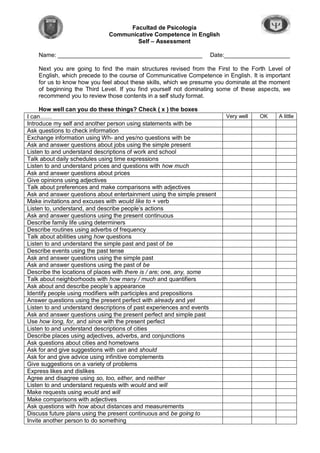
     How well can you do these things? Check ( x ) the boxes
I can……                                                                 Very well   OK     A little
Introduce my self and another person using statements with be
Ask questions to check information
Exchange information using Wh- and yes/no questions with be
Ask and answer questions about jobs using the simple present
Listen to and understand descriptions of work and school
Talk about daily schedules using time expressions
Listen to and understand prices and questions with how much
Ask and answer questions about prices
Give opinions using adjectives
Talk about preferences and make comparisons with adjectives
Ask and answer questions about entertainment using the simple present
Make invitations and excuses with would like to + verb
Listen to, understand, and describe people’s actions
Ask and answer questions using the present continuous
Describe family life using determiners
Describe routines using adverbs of frequency
Talk about abilities using how questions
Listen to and understand the simple past and past of be
Describe events using the past tense
Ask and answer questions using the simple past
Ask and answer questions using the past of be
Describe the locations of places with there is / are; one, any, some
Talk about neighborhoods with how many / much and quantifiers
Ask about and describe people’s appearance
Identify people using modifiers with participles and prepositions
Answer questions using the present perfect with already and yet
Listen to and understand descriptions of past experiences and events
Ask and answer questions using the present perfect and simple past
Use how long, for, and since with the present perfect
Listen to and understand descriptions of cities
Describe places using adjectives, adverbs, and conjunctions
Ask questions about cities and hometowns
Ask for and give suggestions with can and should
Ask for and give advice using infinitive complements
Give suggestions on a variety of problems
Express likes and dislikes
Agree and disagree using so, too, either, and neither
Listen to and understand requests with would and will
Make requests using would and will
Make comparisons with adjectives
Ask questions with how about distances and measurements
Discuss future plans using the present continuous and be going to
Invite another person to do something
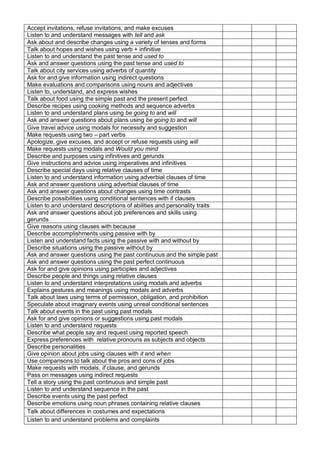
Accept invitations, refuse invitations, and make excuses
Listen to and understand messages with tell and ask
Ask about and describe changes using a variety of tenses and forms
Talk about hopes and wishes using verb + infinitive
Listen to and understand the past tense and used to
Ask and answer questions using the past tense and used to
Talk about city services using adverbs of quantity
Ask for and give information using indirect questions
Make evaluations and comparisons using nouns and adjectives
Listen to, understand, and express wishes
Talk about food using the simple past and the present perfect
Describe recipes using cooking methods and sequence adverbs
Listen to and understand plans using be going to and will
Ask and answer questions about plans using be going to and will
Give travel advice using modals for necessity and suggestion
Make requests using two – part verbs
Apologize, give excuses, and accept or refuse requests using will
Make requests using modals and Would you mind
Describe and purposes using infinitives and gerunds
Give instructions and advice using imperatives and infinitives
Describe special days using relative clauses of time
Listen to and understand information using adverbial clauses of time
Ask and answer questions using adverbial clauses of time
Ask and answer questions about changes using time contrasts
Describe possibilities using conditional sentences with if clauses
Listen to and understand descriptions of abilities and personality traits
Ask and answer questions about job preferences and skills using
gerunds
Give reasons using clauses with because
Describe accomplishments using passive with by
Listen and understand facts using the passive with and without by
Describe situations using the passive without by
Ask and answer questions using the past continuous and the simple past
Ask and answer questions using the past perfect continuous
Ask for and give opinions using participles and adjectives
Describe people and things using relative clauses
Listen to and understand interpretations using modals and adverbs
Explains gestures and meanings using modals and adverbs
Talk about laws using terms of permission, obligation, and prohibition
Speculate about imaginary events using unreal conditional sentences
Talk about events in the past using past modals
Ask for and give opinions or suggestions using past modals
Listen to and understand requests
Describe what people say and request using reported speech
Express preferences with relative pronouns as subjects and objects
Describe personalities
Give opinion about jobs using clauses with it and when
Use comparisons to talk about the pros and cons of jobs
Make requests with modals, if clause, and gerunds
Pass on messages using indirect requests
Tell a story using the past continuous and simple past
Listen to and understand sequence in the past
Describe events using the past perfect
Describe emotions using noun phrases containing relative clauses
Talk about differences in costumes and expectations
Listen to and understand problems and complaints
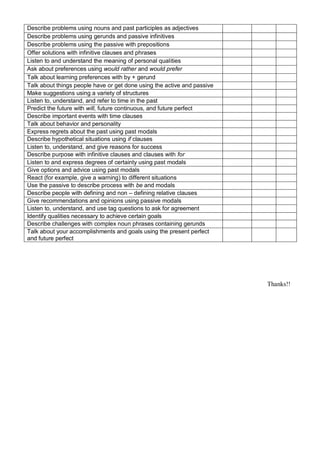
Describe problems using nouns and past participles as adjectives
Describe problems using gerunds and passive infinitives
Describe problems using the passive with prepositions
Offer solutions with infinitive clauses and phrases
Listen to and understand the meaning of personal qualities
Ask about preferences using would rather and would prefer
Talk about learning preferences with by + gerund
Talk about things people have or get done using the active and passive
Make suggestions using a variety of structures
Listen to, understand, and refer to time in the past
Predict the future with will, future continuous, and future perfect
Describe important events with time clauses
Talk about behavior and personality
Express regrets about the past using past modals
Describe hypothetical situations using if clauses
Listen to, understand, and give reasons for success
Describe purpose with infinitive clauses and clauses with for
Listen to and express degrees of certainty using past modals
Give options and advice using past modals
React (for example, give a warning) to different situations
Use the passive to describe process with be and modals
Describe people with defining and non – defining relative clauses
Give recommendations and opinions using passive modals
Listen to, understand, and use tag questions to ask for agreement
Identify qualities necessary to achieve certain goals
Describe challenges with complex noun phrases containing gerunds
Talk about your accomplishments and goals using the present perfect
and future perfect


                                                                         Thanks!!

Cci self assessment

  • 1.
    Facultad de Psicología Communicative Competence in English Self – Assessment Name: ____________________________________________ Date:____________________ Next you are going to find the main structures revised from the First to the Forth Level of English, which precede to the course of Communicative Competence in English. It is important for us to know how you feel about these skills, which we presume you dominate at the moment of beginning the Third Level. If you find yourself not dominating some of these aspects, we recommend you to review those contents in a self study format. How well can you do these things? Check ( x ) the boxes I can…… Very well OK A little Introduce my self and another person using statements with be Ask questions to check information Exchange information using Wh- and yes/no questions with be Ask and answer questions about jobs using the simple present Listen to and understand descriptions of work and school Talk about daily schedules using time expressions Listen to and understand prices and questions with how much Ask and answer questions about prices Give opinions using adjectives Talk about preferences and make comparisons with adjectives Ask and answer questions about entertainment using the simple present Make invitations and excuses with would like to + verb Listen to, understand, and describe people’s actions Ask and answer questions using the present continuous Describe family life using determiners Describe routines using adverbs of frequency Talk about abilities using how questions Listen to and understand the simple past and past of be Describe events using the past tense Ask and answer questions using the simple past Ask and answer questions using the past of be Describe the locations of places with there is / are; one, any, some Talk about neighborhoods with how many / much and quantifiers Ask about and describe people’s appearance Identify people using modifiers with participles and prepositions Answer questions using the present perfect with already and yet Listen to and understand descriptions of past experiences and events Ask and answer questions using the present perfect and simple past Use how long, for, and since with the present perfect Listen to and understand descriptions of cities Describe places using adjectives, adverbs, and conjunctions Ask questions about cities and hometowns Ask for and give suggestions with can and should Ask for and give advice using infinitive complements Give suggestions on a variety of problems Express likes and dislikes Agree and disagree using so, too, either, and neither Listen to and understand requests with would and will Make requests using would and will Make comparisons with adjectives Ask questions with how about distances and measurements Discuss future plans using the present continuous and be going to Invite another person to do something
  • 2.
    Accept invitations, refuseinvitations, and make excuses Listen to and understand messages with tell and ask Ask about and describe changes using a variety of tenses and forms Talk about hopes and wishes using verb + infinitive Listen to and understand the past tense and used to Ask and answer questions using the past tense and used to Talk about city services using adverbs of quantity Ask for and give information using indirect questions Make evaluations and comparisons using nouns and adjectives Listen to, understand, and express wishes Talk about food using the simple past and the present perfect Describe recipes using cooking methods and sequence adverbs Listen to and understand plans using be going to and will Ask and answer questions about plans using be going to and will Give travel advice using modals for necessity and suggestion Make requests using two – part verbs Apologize, give excuses, and accept or refuse requests using will Make requests using modals and Would you mind Describe and purposes using infinitives and gerunds Give instructions and advice using imperatives and infinitives Describe special days using relative clauses of time Listen to and understand information using adverbial clauses of time Ask and answer questions using adverbial clauses of time Ask and answer questions about changes using time contrasts Describe possibilities using conditional sentences with if clauses Listen to and understand descriptions of abilities and personality traits Ask and answer questions about job preferences and skills using gerunds Give reasons using clauses with because Describe accomplishments using passive with by Listen and understand facts using the passive with and without by Describe situations using the passive without by Ask and answer questions using the past continuous and the simple past Ask and answer questions using the past perfect continuous Ask for and give opinions using participles and adjectives Describe people and things using relative clauses Listen to and understand interpretations using modals and adverbs Explains gestures and meanings using modals and adverbs Talk about laws using terms of permission, obligation, and prohibition Speculate about imaginary events using unreal conditional sentences Talk about events in the past using past modals Ask for and give opinions or suggestions using past modals Listen to and understand requests Describe what people say and request using reported speech Express preferences with relative pronouns as subjects and objects Describe personalities Give opinion about jobs using clauses with it and when Use comparisons to talk about the pros and cons of jobs Make requests with modals, if clause, and gerunds Pass on messages using indirect requests Tell a story using the past continuous and simple past Listen to and understand sequence in the past Describe events using the past perfect Describe emotions using noun phrases containing relative clauses Talk about differences in costumes and expectations Listen to and understand problems and complaints
  • 3.
    Describe problems usingnouns and past participles as adjectives Describe problems using gerunds and passive infinitives Describe problems using the passive with prepositions Offer solutions with infinitive clauses and phrases Listen to and understand the meaning of personal qualities Ask about preferences using would rather and would prefer Talk about learning preferences with by + gerund Talk about things people have or get done using the active and passive Make suggestions using a variety of structures Listen to, understand, and refer to time in the past Predict the future with will, future continuous, and future perfect Describe important events with time clauses Talk about behavior and personality Express regrets about the past using past modals Describe hypothetical situations using if clauses Listen to, understand, and give reasons for success Describe purpose with infinitive clauses and clauses with for Listen to and express degrees of certainty using past modals Give options and advice using past modals React (for example, give a warning) to different situations Use the passive to describe process with be and modals Describe people with defining and non – defining relative clauses Give recommendations and opinions using passive modals Listen to, understand, and use tag questions to ask for agreement Identify qualities necessary to achieve certain goals Describe challenges with complex noun phrases containing gerunds Talk about your accomplishments and goals using the present perfect and future perfect Thanks!!