THE PRESENT
CONTINUOUS TENSE
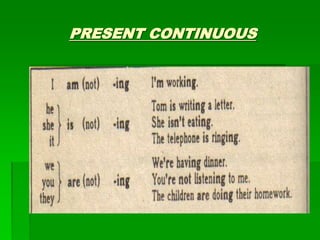
PRESENT CONTINUOUS
DEFINITION:
We use the present continuous when often the
action is happening at the time of speaking.
 Please be quiet. I´m working.
 Let´s go out now. It isn´t raining any more.
 I´m tired. I´m going to bed now. Good night!
 ´´Where´s Margaret?´´ ´´She´s having a
bath.´´
PRESENT CONTINUOUS
But the action is not necessarily happening at the
time of speaking. We use the present continuous
when we talk about things happening in a period
around now (for example, today / this week /
this evening etc.):
 ´´You´re working hard today.´´
 ´´Is Susan working this week?´´ ´´No, she´s on holiday.´´
We use the present continuous when we talk about changes
happening around now, but maybe not at the moment of
speaking, things are temporary:
 The population of the world is rising very fast.
 Is your English getting better?
PRESENT CONTINUOUS
AFFIRMATIVE
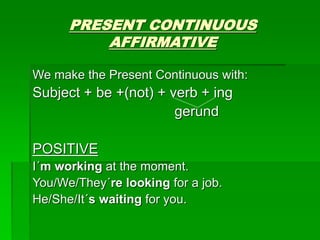
We make the Present Continuous with:
Subject + be +(not) + verb + ing
gerund
POSITIVE
I´m working at the moment.
You/We/They´re looking for a job.
He/She/It´s waiting for you.
PRESENT CONTINUOUS
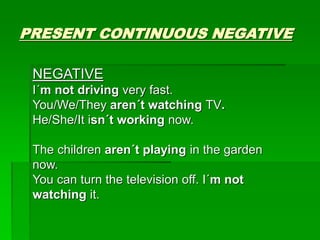
PRESENT CONTINUOUS NEGATIVE
NEGATIVE
I´m not driving very fast.
You/We/They aren´t watching TV.
He/She/It isn´t working now.
The children aren´t playing in the garden
now.
You can turn the television off. I´m not
watching it.
PRESENT CONTINUOUS
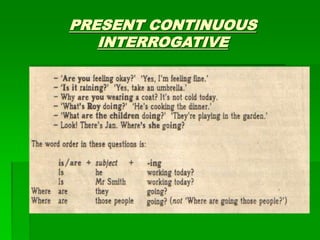
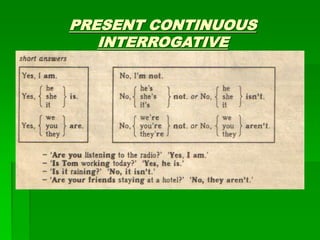
INTERROGATIVE
PRESENT CONTINUOUS
INTERROGATIVE
PRESENT CONTINUOUS
INTERROGATIVE
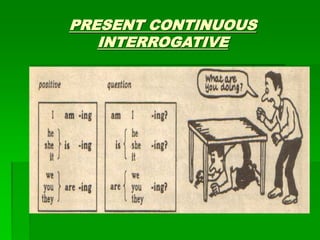
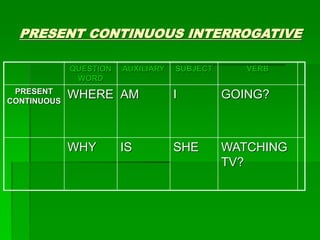
PRESENT CONTINUOUS INTERROGATIVE
QUESTION
WORD
AUXILIARY SUBJECT VERB
PRESENT
CONTINUOUS
WHERE AM I GOING?
WHY IS SHE WATCHING
TV?
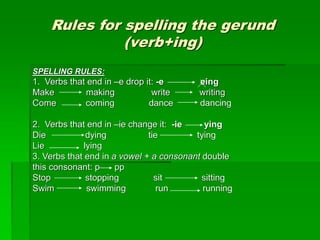
Rules for spelling the gerund
(verb+ing)
SPELLING RULES:
1. Verbs that end in –e drop it: -e eing
Make making write writing
Come coming dance dancing
2. Verbs that end in –ie change it: -ie ying
Die dying tie tying
Lie lying
3. Verbs that end in a vowel + a consonant double
this consonant: p pp
Stop stopping sit sitting
Swim swimming run running
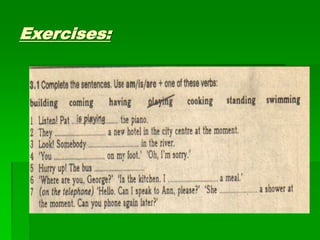
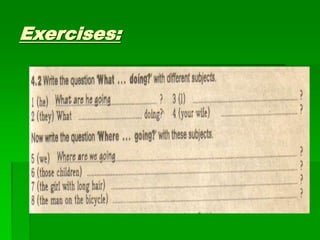
Exercises:
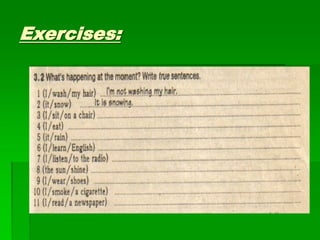
Exercises:
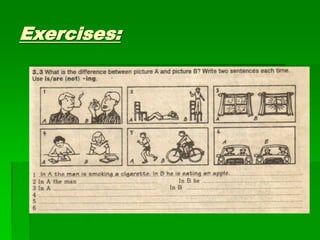
Exercises:
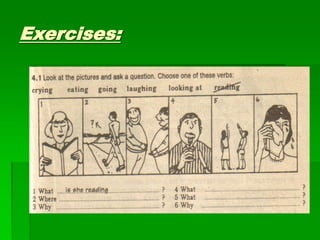
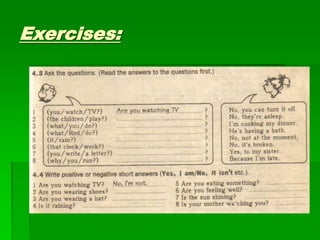
Exercises:
Exercises:
Exercises:
PRESENT CONTINUOUS
We use continuous tenses only for actions
and happenings. Some verbs are not action
verbs, but they describe states (the
physical/mental condition of sb.)
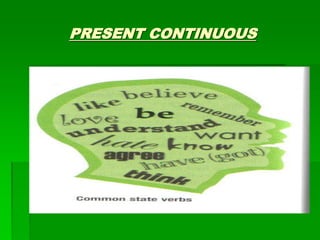
The following verbs are not normally used in
continuous tenses, but in simple tenses:
Like, love, hate, want, need, prefer, know,
realise, suppose, mean, understand, believe,
remember, belong, contain, consist, depend,
seem
PRESENT CONTINUOUS
PRESENT CONTINUOUS
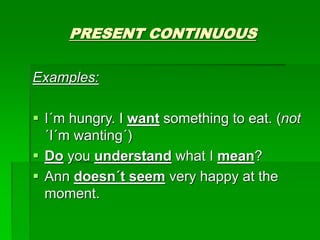
Examples:
 I´m hungry. I want something to eat. (not
´I´m wanting´)
 Do you understand what I mean?
 Ann doesn´t seem very happy at the
moment.

THE_PRESENT_CONTINUOUS_TENSE.ppt

  • 1.
  • 2.
    PRESENT CONTINUOUS DEFINITION: We usethe present continuous when often the action is happening at the time of speaking.  Please be quiet. I´m working.  Let´s go out now. It isn´t raining any more.  I´m tired. I´m going to bed now. Good night!  ´´Where´s Margaret?´´ ´´She´s having a bath.´´
  • 4.
    PRESENT CONTINUOUS But theaction is not necessarily happening at the time of speaking. We use the present continuous when we talk about things happening in a period around now (for example, today / this week / this evening etc.):  ´´You´re working hard today.´´  ´´Is Susan working this week?´´ ´´No, she´s on holiday.´´ We use the present continuous when we talk about changes happening around now, but maybe not at the moment of speaking, things are temporary:  The population of the world is rising very fast.  Is your English getting better?
  • 5.
    PRESENT CONTINUOUS AFFIRMATIVE We makethe Present Continuous with: Subject + be +(not) + verb + ing gerund POSITIVE I´m working at the moment. You/We/They´re looking for a job. He/She/It´s waiting for you.
  • 6.
  • 7.
    PRESENT CONTINUOUS NEGATIVE NEGATIVE I´mnot driving very fast. You/We/They aren´t watching TV. He/She/It isn´t working now. The children aren´t playing in the garden now. You can turn the television off. I´m not watching it.
  • 8.
  • 9.
  • 10.
  • 11.
    PRESENT CONTINUOUS INTERROGATIVE QUESTION WORD AUXILIARYSUBJECT VERB PRESENT CONTINUOUS WHERE AM I GOING? WHY IS SHE WATCHING TV?
  • 12.
    Rules for spellingthe gerund (verb+ing) SPELLING RULES: 1. Verbs that end in –e drop it: -e eing Make making write writing Come coming dance dancing 2. Verbs that end in –ie change it: -ie ying Die dying tie tying Lie lying 3. Verbs that end in a vowel + a consonant double this consonant: p pp Stop stopping sit sitting Swim swimming run running
  • 13.
  • 14.
  • 15.
  • 16.
  • 17.
  • 18.
  • 19.
    PRESENT CONTINUOUS We usecontinuous tenses only for actions and happenings. Some verbs are not action verbs, but they describe states (the physical/mental condition of sb.) The following verbs are not normally used in continuous tenses, but in simple tenses: Like, love, hate, want, need, prefer, know, realise, suppose, mean, understand, believe, remember, belong, contain, consist, depend, seem
  • 20.
  • 21.
    PRESENT CONTINUOUS Examples:  I´mhungry. I want something to eat. (not ´I´m wanting´)  Do you understand what I mean?  Ann doesn´t seem very happy at the moment.