A GLOBALIZED ECONOMY
UNIT 5
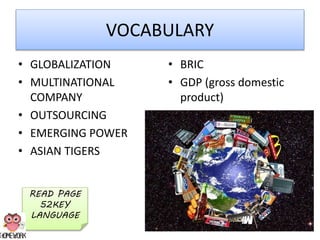
VOCABULARY
• GLOBALIZATION
• MULTINATIONAL
COMPANY
• OUTSOURCING
• EMERGING POWER
• ASIAN TIGERS
• BRIC
• GDP (gross domestic
product)
READ PAGE
52KEY
LANGUAGE
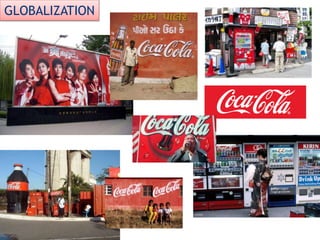
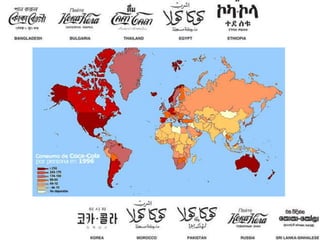
GLOBALIZATION
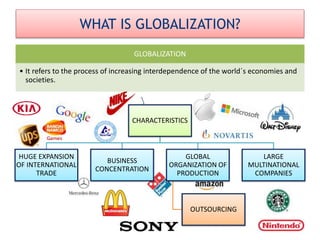
WHAT IS GLOBALIZATION?
GLOBALIZATION
• It refers to the process of increasing interdependence of the world´s economies and
societies.
CHARACTERISTICS
HUGE EXPANSION
OF INTERNATIONAL
TRADE
BUSINESS
CONCENTRATION
GLOBAL
ORGANIZATION OF
PRODUCTION
OUTSOURCING
LARGE
MULTINATIONAL
COMPANIES
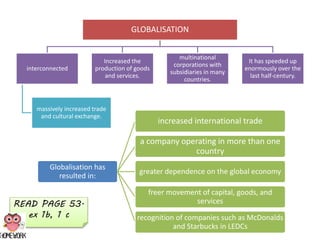
GLOBALISATION
interconnected
massively increased trade
and cultural exchange.
Increased the
production of goods
and services.
multinational
corporations with
subsidiaries in many
countries.
It has speeded up
enormously over the
last half-century.
Globalisation has
resulted in:
increased international trade
a company operating in more than one
country
greater dependence on the global economy
freer movement of capital, goods, and
services
recognition of companies such as McDonalds
and Starbucks in LEDCs
READ PAGE 53.
ex 1b, 1 c
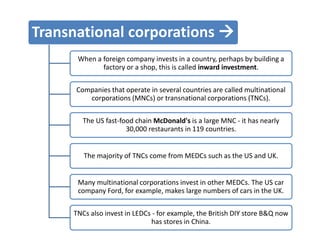
Transnational corporations 
When a foreign company invests in a country, perhaps by building a
factory or a shop, this is called inward investment.
Companies that operate in several countries are called multinational
corporations (MNCs) or transnational corporations (TNCs).
The US fast-food chain McDonald's is a large MNC - it has nearly
30,000 restaurants in 119 countries.
The majority of TNCs come from MEDCs such as the US and UK.
Many multinational corporations invest in other MEDCs. The US car
company Ford, for example, makes large numbers of cars in the UK.
TNCs also invest in LEDCs - for example, the British DIY store B&Q now
has stores in China.
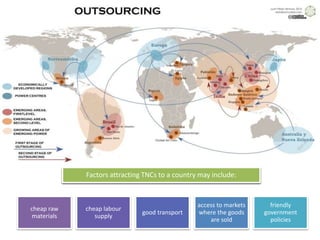
cheap raw
materials
cheap labour
supply
good transport
access to markets
where the goods
are sold
friendly
government
policies
Factors attracting TNCs to a country may include:
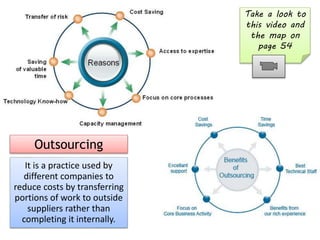
It is a practice used by
different companies to
reduce costs by transferring
portions of work to outside
suppliers rather than
completing it internally.
Outsourcing
Take a look to
this video and
the map on
page 54
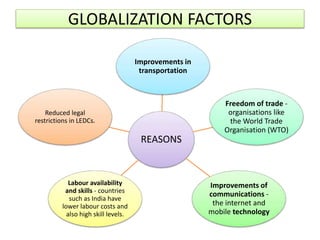
GLOBALIZATION FACTORS
REASONS
Improvements in
transportation
Freedom of trade -
organisations like
the World Trade
Organisation (WTO)
Improvements of
communications -
the internet and
mobile technology
Labour availability
and skills - countries
such as India have
lower labour costs and
also high skill levels.
Reduced legal
restrictions in LEDCs.
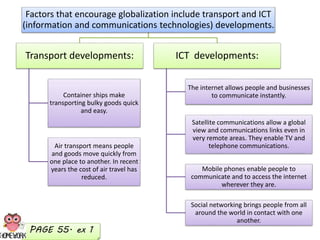
Factors that encourage globalization include transport and ICT
(information and communications technologies) developments.
Transport developments:
Container ships make
transporting bulky goods quick
and easy.
Air transport means people
and goods move quickly from
one place to another. In recent
years the cost of air travel has
reduced.
ICT developments:
The internet allows people and businesses
to communicate instantly.
Satellite communications allow a global
view and communications links even in
very remote areas. They enable TV and
telephone communications.
Mobile phones enable people to
communicate and to access the internet
wherever they are.
Social networking brings people from all
around the world in contact with one
another.
PAGE 55. ex 1
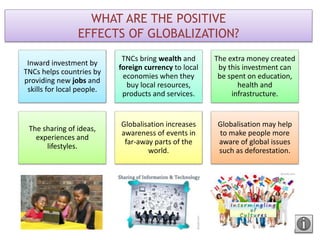
WHAT ARE THE POSITIVE
EFFECTS OF GLOBALIZATION?
Inward investment by
TNCs helps countries by
providing new jobs and
skills for local people.
TNCs bring wealth and
foreign currency to local
economies when they
buy local resources,
products and services.
The extra money created
by this investment can
be spent on education,
health and
infrastructure.
The sharing of ideas,
experiences and
lifestyles.
Globalisation increases
awareness of events in
far-away parts of the
world.
Globalisation may help
to make people more
aware of global issues
such as deforestation.
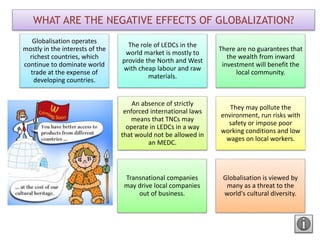
WHAT ARE THE NEGATIVE EFFECTS OF GLOBALIZATION?
Globalisation operates
mostly in the interests of the
richest countries, which
continue to dominate world
trade at the expense of
developing countries.
The role of LEDCs in the
world market is mostly to
provide the North and West
with cheap labour and raw
materials.
There are no guarantees that
the wealth from inward
investment will benefit the
local community.
Transnational companies
may drive local companies
out of business.
An absence of strictly
enforced international laws
means that TNCs may
operate in LEDCs in a way
that would not be allowed in
an MEDC.
They may pollute the
environment, run risks with
safety or impose poor
working conditions and low
wages on local workers.
Globalisation is viewed by
many as a threat to the
world's cultural diversity.
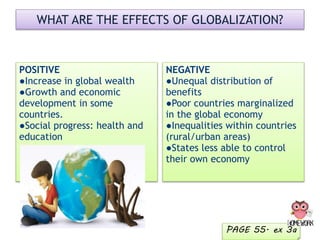
WHAT ARE THE EFFECTS OF GLOBALIZATION?
POSITIVE
●Increase in global wealth
●Growth and economic
development in some
countries.
●Social progress: health and
education
NEGATIVE
●Unequal distribution of
benefits
●Poor countries marginalized
in the global economy
●Inequalities within countries
(rural/urban areas)
●States less able to control
their own economy
PAGE 55. ex 3a
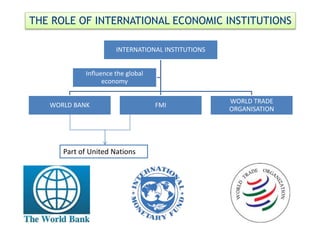
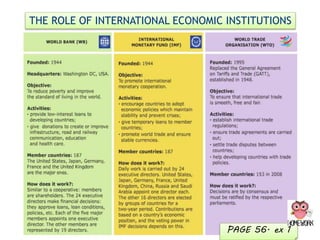
INTERNATIONAL INSTITUTIONS
WORLD BANK FMI
WORLD TRADE
ORGANISATION
Influence the global
economy
THE ROLE OF INTERNATIONAL ECONOMIC INSTITUTIONS
Part of United Nations
THE ROLE OF INTERNATIONAL ECONOMIC INSTITUTIONS
PAGE 56. ex 1
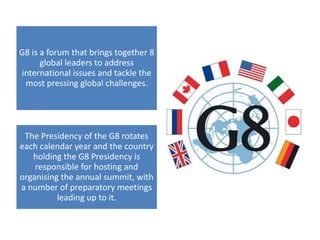
G8 is a forum that brings together 8
global leaders to address
international issues and tackle the
most pressing global challenges.
The Presidency of the G8 rotates
each calendar year and the country
holding the G8 Presidency is
responsible for hosting and
organising the annual summit, with
a number of preparatory meetings
leading up to it.
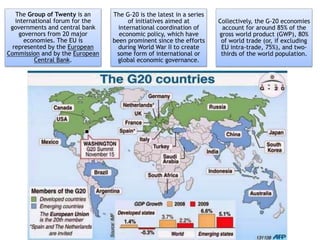
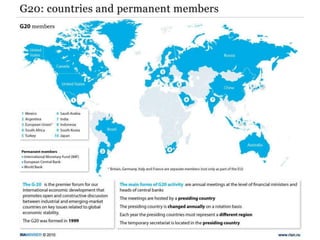
The Group of Twenty is an
international forum for the
governments and central bank
governors from 20 major
economies. The EU is
represented by the European
Commission and by the European
Central Bank.
The G-20 is the latest in a series
of initiatives aimed at
international coordination of
economic policy, which have
been prominent since the efforts
during World War II to create
some form of international or
global economic governance.
Collectively, the G-20 economies
account for around 85% of the
gross world product (GWP), 80%
of world trade (or, if excluding
EU intra-trade, 75%), and two-
thirds of the world population.
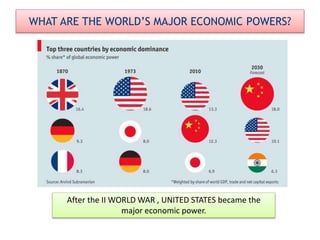
WHAT ARE THE WORLD’S MAJOR ECONOMIC POWERS?
After the II WORLD WAR , UNITED STATES became the
major economic power.
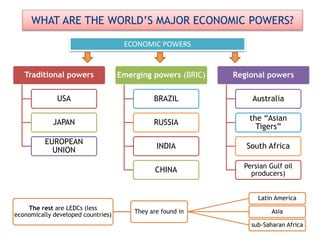
WHAT ARE THE WORLD’S MAJOR ECONOMIC POWERS?
Traditional powers
USA
JAPAN
EUROPEAN
UNION
Emerging powers (BRIC)
BRAZIL
RUSSIA
INDIA
CHINA
Regional powers
Australia
the “Asian
Tigers”
South Africa
Persian Gulf oil
producers)
ECONOMIC POWERS
The rest are LEDCs (less
economically developed countries)
They are found in
Latin America
Asia
sub-Saharan Africa
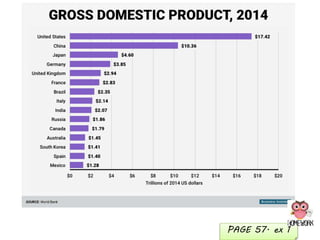
PAGE 57. ex 1
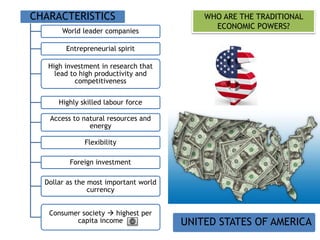
WHO ARE THE TRADITIONAL
ECONOMIC POWERS?
CHARACTERISTICS
World leader companies
Entrepreneurial spirit
High investment in research that
lead to high productivity and
competitiveness
Highly skilled labour force
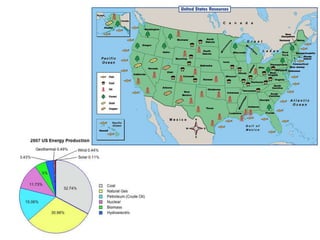
Access to natural resources and
energy
Flexibility
Foreign investment
Dollar as the most important world
currency
Consumer society  highest per
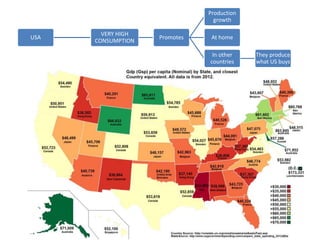
capita income UNITED STATES OF AMERICA
USA
VERY HIGH
CONSUMPTION
Promotes
Production
growth
At home
In other
countries
They produce
what US buys
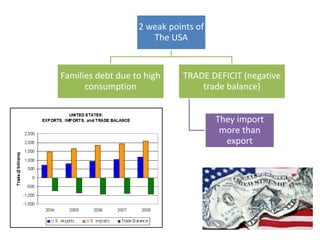
2 weak points of
The USA
Families debt due to high
consumption
TRADE DEFICIT (negative
trade balance)
They import
more than
export
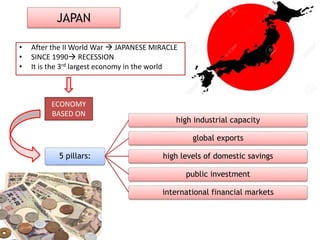
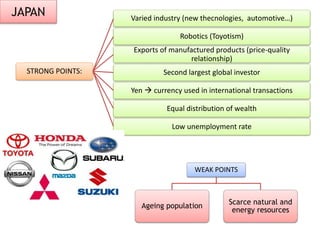
JAPAN
• After the II World War  JAPANESE MIRACLE
• SINCE 1990 RECESSION
• It is the 3rd largest economy in the world
5 pillars:
high industrial capacity
global exports
high levels of domestic savings
public investment
international financial markets
ECONOMY
BASED ON
STRONG POINTS:
Varied industry (new thecnologies, automotive…)
Robotics (Toyotism)
Exports of manufactured products (price-quality
relationship)
Second largest global investor
Yen  currency used in international transactions
Equal distribution of wealth
Low unemployment rate
JAPAN
WEAK POINTS
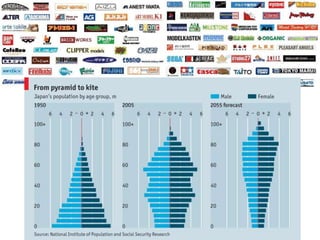
Ageing population
Scarce natural and
energy resources
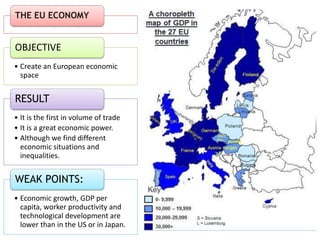
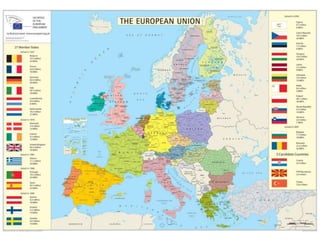
THE EU ECONOMY
• Create an European economic
space
OBJECTIVE
• It is the first in volume of trade
• It is a great economic power.
• Although we find different
economic situations and
inequalities.
RESULT
• Economic growth, GDP per
capita, worker productivity and
technological development are
lower than in the US or in Japan.
WEAK POINTS:
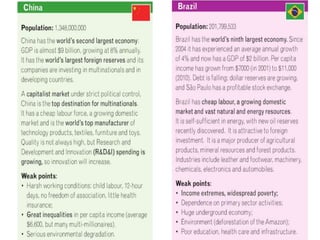
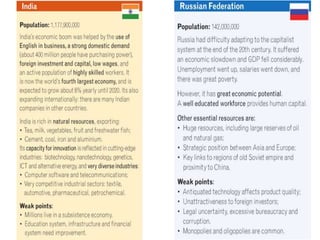
Who are the emerging economic powers?
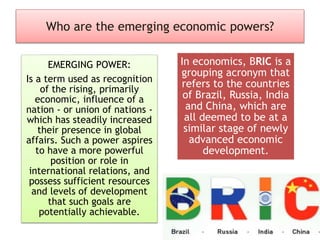
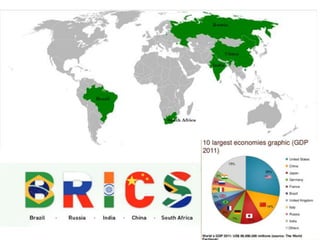
In economics, BRIC is a
grouping acronym that
refers to the countries
of Brazil, Russia, India
and China, which are
all deemed to be at a
similar stage of newly
advanced economic
development.
EMERGING POWER:
Is a term used as recognition
of the rising, primarily
economic, influence of a
nation - or union of nations -
which has steadily increased
their presence in global
affairs. Such a power aspires
to have a more powerful
position or role in
international relations, and
possess sufficient resources
and levels of development
that such goals are
potentially achievable.
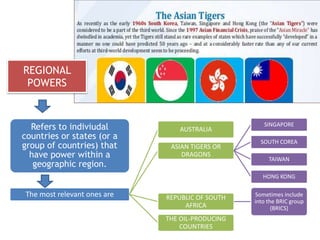
Refers to indiviudal
countries or states (or a
group of countries) that
have power within a
geographic region.
The most relevant ones are
AUSTRALIA
ASIAN TIGERS OR
DRAGONS
SINGAPORE
SOUTH COREA
TAIWAN
HONG KONG
REPUBLIC OF SOUTH
AFRICA
Sometimes include
into the BRIC group
(BRICS)
THE OIL-PRODUCING
COUNTRIES
REGIONAL
POWERS
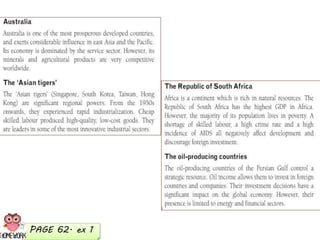
PAGE 62. ex 1

Topic 5 a globalized economy

  • 1.
  • 2.
    VOCABULARY • GLOBALIZATION • MULTINATIONAL COMPANY •OUTSOURCING • EMERGING POWER • ASIAN TIGERS • BRIC • GDP (gross domestic product) READ PAGE 52KEY LANGUAGE
  • 3.
  • 5.
    WHAT IS GLOBALIZATION? GLOBALIZATION •It refers to the process of increasing interdependence of the world´s economies and societies. CHARACTERISTICS HUGE EXPANSION OF INTERNATIONAL TRADE BUSINESS CONCENTRATION GLOBAL ORGANIZATION OF PRODUCTION OUTSOURCING LARGE MULTINATIONAL COMPANIES
  • 6.
    GLOBALISATION interconnected massively increased trade andcultural exchange. Increased the production of goods and services. multinational corporations with subsidiaries in many countries. It has speeded up enormously over the last half-century. Globalisation has resulted in: increased international trade a company operating in more than one country greater dependence on the global economy freer movement of capital, goods, and services recognition of companies such as McDonalds and Starbucks in LEDCs READ PAGE 53. ex 1b, 1 c
  • 7.
    Transnational corporations  Whena foreign company invests in a country, perhaps by building a factory or a shop, this is called inward investment. Companies that operate in several countries are called multinational corporations (MNCs) or transnational corporations (TNCs). The US fast-food chain McDonald's is a large MNC - it has nearly 30,000 restaurants in 119 countries. The majority of TNCs come from MEDCs such as the US and UK. Many multinational corporations invest in other MEDCs. The US car company Ford, for example, makes large numbers of cars in the UK. TNCs also invest in LEDCs - for example, the British DIY store B&Q now has stores in China.
  • 8.
    cheap raw materials cheap labour supply goodtransport access to markets where the goods are sold friendly government policies Factors attracting TNCs to a country may include:
  • 9.
    It is apractice used by different companies to reduce costs by transferring portions of work to outside suppliers rather than completing it internally. Outsourcing Take a look to this video and the map on page 54
  • 10.
    GLOBALIZATION FACTORS REASONS Improvements in transportation Freedomof trade - organisations like the World Trade Organisation (WTO) Improvements of communications - the internet and mobile technology Labour availability and skills - countries such as India have lower labour costs and also high skill levels. Reduced legal restrictions in LEDCs.
  • 11.
    Factors that encourageglobalization include transport and ICT (information and communications technologies) developments. Transport developments: Container ships make transporting bulky goods quick and easy. Air transport means people and goods move quickly from one place to another. In recent years the cost of air travel has reduced. ICT developments: The internet allows people and businesses to communicate instantly. Satellite communications allow a global view and communications links even in very remote areas. They enable TV and telephone communications. Mobile phones enable people to communicate and to access the internet wherever they are. Social networking brings people from all around the world in contact with one another. PAGE 55. ex 1
  • 14.
    WHAT ARE THEPOSITIVE EFFECTS OF GLOBALIZATION? Inward investment by TNCs helps countries by providing new jobs and skills for local people. TNCs bring wealth and foreign currency to local economies when they buy local resources, products and services. The extra money created by this investment can be spent on education, health and infrastructure. The sharing of ideas, experiences and lifestyles. Globalisation increases awareness of events in far-away parts of the world. Globalisation may help to make people more aware of global issues such as deforestation.
  • 15.
    WHAT ARE THENEGATIVE EFFECTS OF GLOBALIZATION? Globalisation operates mostly in the interests of the richest countries, which continue to dominate world trade at the expense of developing countries. The role of LEDCs in the world market is mostly to provide the North and West with cheap labour and raw materials. There are no guarantees that the wealth from inward investment will benefit the local community. Transnational companies may drive local companies out of business. An absence of strictly enforced international laws means that TNCs may operate in LEDCs in a way that would not be allowed in an MEDC. They may pollute the environment, run risks with safety or impose poor working conditions and low wages on local workers. Globalisation is viewed by many as a threat to the world's cultural diversity.
  • 16.
    WHAT ARE THEEFFECTS OF GLOBALIZATION? POSITIVE ●Increase in global wealth ●Growth and economic development in some countries. ●Social progress: health and education NEGATIVE ●Unequal distribution of benefits ●Poor countries marginalized in the global economy ●Inequalities within countries (rural/urban areas) ●States less able to control their own economy PAGE 55. ex 3a
  • 17.
    INTERNATIONAL INSTITUTIONS WORLD BANKFMI WORLD TRADE ORGANISATION Influence the global economy THE ROLE OF INTERNATIONAL ECONOMIC INSTITUTIONS Part of United Nations
  • 18.
    THE ROLE OFINTERNATIONAL ECONOMIC INSTITUTIONS PAGE 56. ex 1
  • 19.
    G8 is aforum that brings together 8 global leaders to address international issues and tackle the most pressing global challenges. The Presidency of the G8 rotates each calendar year and the country holding the G8 Presidency is responsible for hosting and organising the annual summit, with a number of preparatory meetings leading up to it.
  • 20.
    The Group ofTwenty is an international forum for the governments and central bank governors from 20 major economies. The EU is represented by the European Commission and by the European Central Bank. The G-20 is the latest in a series of initiatives aimed at international coordination of economic policy, which have been prominent since the efforts during World War II to create some form of international or global economic governance. Collectively, the G-20 economies account for around 85% of the gross world product (GWP), 80% of world trade (or, if excluding EU intra-trade, 75%), and two- thirds of the world population.
  • 22.
    WHAT ARE THEWORLD’S MAJOR ECONOMIC POWERS? After the II WORLD WAR , UNITED STATES became the major economic power.
  • 23.
    WHAT ARE THEWORLD’S MAJOR ECONOMIC POWERS? Traditional powers USA JAPAN EUROPEAN UNION Emerging powers (BRIC) BRAZIL RUSSIA INDIA CHINA Regional powers Australia the “Asian Tigers” South Africa Persian Gulf oil producers) ECONOMIC POWERS The rest are LEDCs (less economically developed countries) They are found in Latin America Asia sub-Saharan Africa
  • 24.
  • 25.
    WHO ARE THETRADITIONAL ECONOMIC POWERS? CHARACTERISTICS World leader companies Entrepreneurial spirit High investment in research that lead to high productivity and competitiveness Highly skilled labour force Access to natural resources and energy Flexibility Foreign investment Dollar as the most important world currency Consumer society  highest per capita income UNITED STATES OF AMERICA
  • 26.
    USA VERY HIGH CONSUMPTION Promotes Production growth At home Inother countries They produce what US buys
  • 28.
    2 weak pointsof The USA Families debt due to high consumption TRADE DEFICIT (negative trade balance) They import more than export
  • 29.
    JAPAN • After theII World War  JAPANESE MIRACLE • SINCE 1990 RECESSION • It is the 3rd largest economy in the world 5 pillars: high industrial capacity global exports high levels of domestic savings public investment international financial markets ECONOMY BASED ON
  • 30.
    STRONG POINTS: Varied industry(new thecnologies, automotive…) Robotics (Toyotism) Exports of manufactured products (price-quality relationship) Second largest global investor Yen  currency used in international transactions Equal distribution of wealth Low unemployment rate JAPAN WEAK POINTS Ageing population Scarce natural and energy resources
  • 32.
    THE EU ECONOMY •Create an European economic space OBJECTIVE • It is the first in volume of trade • It is a great economic power. • Although we find different economic situations and inequalities. RESULT • Economic growth, GDP per capita, worker productivity and technological development are lower than in the US or in Japan. WEAK POINTS:
  • 34.
    Who are theemerging economic powers? In economics, BRIC is a grouping acronym that refers to the countries of Brazil, Russia, India and China, which are all deemed to be at a similar stage of newly advanced economic development. EMERGING POWER: Is a term used as recognition of the rising, primarily economic, influence of a nation - or union of nations - which has steadily increased their presence in global affairs. Such a power aspires to have a more powerful position or role in international relations, and possess sufficient resources and levels of development that such goals are potentially achievable.
  • 38.
    Refers to indiviudal countriesor states (or a group of countries) that have power within a geographic region. The most relevant ones are AUSTRALIA ASIAN TIGERS OR DRAGONS SINGAPORE SOUTH COREA TAIWAN HONG KONG REPUBLIC OF SOUTH AFRICA Sometimes include into the BRIC group (BRICS) THE OIL-PRODUCING COUNTRIES REGIONAL POWERS
  • 39.