Module-1
Introduction to Advertising
Definitions of Advertising
⚫Advertising is any paid form of non- personal
presentation and promotion of ideas, goods and
services by an identified sponsor. – Kotler
⚫Advertising is a paid, mass mediated attempt
to persuade
Defining Modern Advertising
⚫ A complex form of communication using objectives
and strategies to impact consumer thoughts,
feelings, and actions.
⚫ A form of marketing communication (all the
techniques marketers use to reach their customers and
deliver their messages).
⚫ Five Basic Factors ofAdvertising
1. Paid communication
2. Sponsor is identified
3. Tries to inform or persuade (Convince)
4. Reaches a large audience
5. Message conveyed through many different kinds of
largely nonpersonal mass media
Principle:
An effective advertisement is one that can
be proven to meet its objectives.
Objectives, Importance & benefits of
advertising
• Introduce a product
• Introduce a brand
• Awareness creation
• Acquiring customers or Brand switching
• Differentiation and value creation
• Brand building
• Positioning the product – Product and brand recall
• Increase sales & Increase profits
Source https://www.marketing91.com/objectives-of-advertising/
Classification of advertisements
• Classification of Advertising on the Basis of Consumers
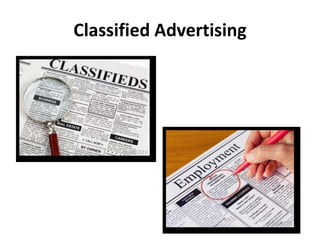
(i) Classified Advertising
(ii) Display Advertising
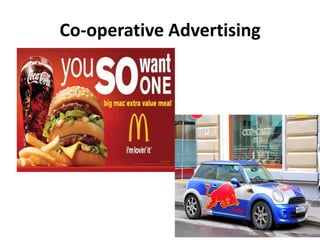
(iii) Co-operative Advertising
(iv) End Product Advertising
(v) Direct Response Advertising
• Classification of Advertising on the Basis of Media
(i)Print Media Advertising
(ii) Broadcast Media Advertising
(iii) Outdoor Media Advertising
(iv) Digital Media Advertising
• Classification of Advertising on the Basis of
Business/Advertiser
(i) Trade Advertising
(ii) Professional Advertising
(iii) Corporate Advertising
• Classification of Advertising on the Basis of Area
• (i) National Advertising
• (ii) Local Advertising
• (iii) Global Advertising
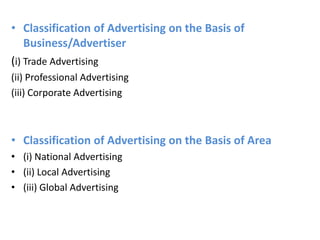
Classified Advertising
Display Advertising
Co-operative Advertising
End Product Advertising
end product advertising helps create demand for the ingredient that helps in
the sale of another product
Direct Response Advertising
This ad can stimulate a
physical reaction in their
stomach and in their mouth.
A Direct Response Advertisement:
1.Gets attention through design, ad size, placement, and timing.
2.Stimulates interest by touching on human emotions, desires, and
needs.
Print Media Advertising
Broadcast Media Advertising
Outdoor Media Advertising
Digital Media Advertising
Trade Advertising
Advertising that is aimed at one of the channels along the line of
distribution rather than the final consumer.
Professional Advertising
• Advertising that is directed at professionals, such as
doctors, dentists, etc.,
Corporate Advertising
Advertising which are designed to win a target audience with a specific
point of view is known as corporate or institutional advertising.
National Advertising
National advertising is not confined to any specific geographical area
within a nation. It conveys mass marketing effort.
Local Advertising
• The promotional messages in local advertising are directed to the
local population instead of mass market
Global Advertising
• What is Ad Agencies
Advertising Agency is just like a tailor. It creates
the ads, plans how, when and where it should
be delivered and hands it over to the client.
These agencies take all the efforts for selling the
product of the clients.
Advertising Agencies
Roles And Responsibilities Of An
Advertising Agency
• Conducting A Thorough Research.
• Developing Advertisements.
(copies of ads scripts of ad films are written, logos and posters are designed)
• Media Planning And Buying.
(media platforms chosen by you for showcasing your ads)
• Account Management.
(Account managers are responsible for bridging the gap between the clients and all other departments in an advertising
agency.)
• Budgeting.
• Sales Promotion.
• Public Relations.
(creating and maintaining a favorable image of a business in the market)
• Developing Marketing Strategies.
https://publicmediasolution.com/blog/roles-and-responsibilities-of-an-advertising-agency/
Some of the advertise agencies
• GS&P
• AksharaAdvertising
• Chaitra Leo Burnett Pvt Ltd
GS&P Ad agencies https://goodbysilverstein.com/clients
Structure of ad agency
here are 6 departments in any advertising agency
• Account Servicing
• Account Planning
• Media
• Creative
• Production
• Finance and Accounting
• Account service department
• Account Servicing
The account service, or the account management
department, is the link between the ad agency and its
clients. Depending upon the size of the account and its
advertising budget one or two account executives serve
as liaison (Link) to the client.
• Account Planning
The account executive is responsible for getting
approved the media schedules, budgets and rough ads
or story boards from the client
• The responsibility of the agency’s media
department is to develop a media plan to reach
the target audience effectively in a cost
effective manner.
Media department
Creative department
To a large extent, the success of an ad agency
depends upon the creative department
responsibility for the creation and execution of
the advertisements.
• Thecreativespecialistsare knownas copywriters.
• They are the ones who conceive ideas for the ads and write the headlines,
subheadsand the body copy.
Production department
• and the
illustrations the ad is sent to the production
department.
Generally agencies do not actually produce the finished
ads; instead they hire printers, photographers,
engravers(editors) typographers(choose the style, arrangement, or
appearance) and others to complete the finished ad.
For the production of the approved TV commercial, the
production department may supervise the casting of actors
to appear in the ad, the setting for scenes and selecting an
independent production studio. The production
department sometimes hires an outside director to
transform the creative concept to a commercial.
After the completion and approval of the copy & the
Finance & Accounting Department
• An advertising agency is in the business of providing
services and must be managed that way. Thus, it has to
perform various functions such as accounting, finance,
human resources etc.
• Also this department is important since bulk of the
agency’s income approx. 65% goes as salary and
benefits to the employees.
Types of Advertising Agencies
• All companies can do this work by themselves.
They can make ads, print or advertise them on
televisions or other media places, they can
manage the accounts also.
• Then why do they need advertising agencies?
The reasons behind hiring the advertising
agencies by the companies are:
• The agencies are expert in this field. They have a
team of different people for different functions
like copywriters, art directors, planners, etc.
• The agencies make optimum use of these people,
their experience and their knowledge.
• They work with an objective and are very
professionals.
• Hiring them leads in saving the costs up to some
extent.
There are basically 5 types of advertising
agencies.
• Full service Agencies
– Large size agencies.
– Deals with all stages of advertisement.
– Different expert people for different departments.
– Starts work from gathering data and analyzing and ends on
payment of bills to the media people.
• Interactive Agencies
– Modernized modes of communication are used.
– Uses online advertisements, sending personal
messages on mobile phones, etc.
– The ads produced are very interactive, having very
new concepts, and very innovative.
Creative Boutiques
• Very creative and innovative ads.
• No other function is performed other than creating actual ads.
• Small sized agencies with their own copywriters, directors, and
creative people.
Media Buying Agencies
• Buys place for advertise and sells it to the advertisers.
• Sells time in which advertisement will be placed.
• Schedules slots at different television channels and radio
stations.
• Finally supervises or checks whether the ad has been
telecasted at opted time and place or not.
In-House Agencies
• As good as the full service agencies.
• Big organization prefers these type of agencies which are in
built and work only for them.
• These agencies work as per the requirements of the
organizations.
Ad agency revenue earning models
• The classic advertising revenue model involved selling TV
commercials or newspaper ads to generate revenue.
• The advertising revenue model in e-commerce has
companies putting ad space on their sites and generating
money from the number of visitors who see or click on
them.
https://blog.antwerpmanagementschool.be/en/ron-meyer-episode-4-revenue-model-
framework
1.Ogilvy and Mather : Vodafone, Cadbury,Asian Paints
and Fevicol.
2. Mudra Communications: Tourism Australia,
Colgate and PolicyBazaar.com.
3. JWT: Listerine, Good night, and Teach for India.
(James Walter Thompson)
1. McCann Erickson India: MasterCard, Coca Cola, and
Greenlam Laminates.
2. Lowe Lintas :Idea, ICICI Prudential and Tata Tea.
Top 5in India

Module 1 Advertising

  • 1.
  • 2.
    Definitions of Advertising ⚫Advertisingis any paid form of non- personal presentation and promotion of ideas, goods and services by an identified sponsor. – Kotler ⚫Advertising is a paid, mass mediated attempt to persuade
  • 3.
    Defining Modern Advertising ⚫A complex form of communication using objectives and strategies to impact consumer thoughts, feelings, and actions. ⚫ A form of marketing communication (all the techniques marketers use to reach their customers and deliver their messages).
  • 4.
    ⚫ Five BasicFactors ofAdvertising 1. Paid communication 2. Sponsor is identified 3. Tries to inform or persuade (Convince) 4. Reaches a large audience 5. Message conveyed through many different kinds of largely nonpersonal mass media Principle: An effective advertisement is one that can be proven to meet its objectives.
  • 5.
    Objectives, Importance &benefits of advertising • Introduce a product • Introduce a brand • Awareness creation • Acquiring customers or Brand switching • Differentiation and value creation • Brand building • Positioning the product – Product and brand recall • Increase sales & Increase profits Source https://www.marketing91.com/objectives-of-advertising/
  • 6.
    Classification of advertisements •Classification of Advertising on the Basis of Consumers (i) Classified Advertising (ii) Display Advertising (iii) Co-operative Advertising (iv) End Product Advertising (v) Direct Response Advertising • Classification of Advertising on the Basis of Media (i)Print Media Advertising (ii) Broadcast Media Advertising (iii) Outdoor Media Advertising (iv) Digital Media Advertising
  • 7.
    • Classification ofAdvertising on the Basis of Business/Advertiser (i) Trade Advertising (ii) Professional Advertising (iii) Corporate Advertising • Classification of Advertising on the Basis of Area • (i) National Advertising • (ii) Local Advertising • (iii) Global Advertising
  • 8.
  • 9.
  • 10.
  • 11.
    End Product Advertising endproduct advertising helps create demand for the ingredient that helps in the sale of another product
  • 12.
    Direct Response Advertising Thisad can stimulate a physical reaction in their stomach and in their mouth. A Direct Response Advertisement: 1.Gets attention through design, ad size, placement, and timing. 2.Stimulates interest by touching on human emotions, desires, and needs.
  • 13.
  • 14.
  • 15.
  • 16.
  • 17.
    Trade Advertising Advertising thatis aimed at one of the channels along the line of distribution rather than the final consumer.
  • 18.
    Professional Advertising • Advertisingthat is directed at professionals, such as doctors, dentists, etc.,
  • 19.
    Corporate Advertising Advertising whichare designed to win a target audience with a specific point of view is known as corporate or institutional advertising.
  • 20.
    National Advertising National advertisingis not confined to any specific geographical area within a nation. It conveys mass marketing effort.
  • 21.
    Local Advertising • Thepromotional messages in local advertising are directed to the local population instead of mass market
  • 22.
  • 23.
    • What isAd Agencies Advertising Agency is just like a tailor. It creates the ads, plans how, when and where it should be delivered and hands it over to the client. These agencies take all the efforts for selling the product of the clients. Advertising Agencies
  • 24.
    Roles And ResponsibilitiesOf An Advertising Agency • Conducting A Thorough Research. • Developing Advertisements. (copies of ads scripts of ad films are written, logos and posters are designed) • Media Planning And Buying. (media platforms chosen by you for showcasing your ads) • Account Management. (Account managers are responsible for bridging the gap between the clients and all other departments in an advertising agency.) • Budgeting. • Sales Promotion. • Public Relations. (creating and maintaining a favorable image of a business in the market) • Developing Marketing Strategies. https://publicmediasolution.com/blog/roles-and-responsibilities-of-an-advertising-agency/
  • 25.
    Some of theadvertise agencies • GS&P • AksharaAdvertising • Chaitra Leo Burnett Pvt Ltd GS&P Ad agencies https://goodbysilverstein.com/clients
  • 26.
    Structure of adagency here are 6 departments in any advertising agency • Account Servicing • Account Planning • Media • Creative • Production • Finance and Accounting • Account service department
  • 27.
    • Account Servicing Theaccount service, or the account management department, is the link between the ad agency and its clients. Depending upon the size of the account and its advertising budget one or two account executives serve as liaison (Link) to the client. • Account Planning The account executive is responsible for getting approved the media schedules, budgets and rough ads or story boards from the client
  • 28.
    • The responsibilityof the agency’s media department is to develop a media plan to reach the target audience effectively in a cost effective manner. Media department Creative department To a large extent, the success of an ad agency depends upon the creative department responsibility for the creation and execution of the advertisements. • Thecreativespecialistsare knownas copywriters. • They are the ones who conceive ideas for the ads and write the headlines, subheadsand the body copy.
  • 29.
    Production department • andthe illustrations the ad is sent to the production department. Generally agencies do not actually produce the finished ads; instead they hire printers, photographers, engravers(editors) typographers(choose the style, arrangement, or appearance) and others to complete the finished ad. For the production of the approved TV commercial, the production department may supervise the casting of actors to appear in the ad, the setting for scenes and selecting an independent production studio. The production department sometimes hires an outside director to transform the creative concept to a commercial. After the completion and approval of the copy & the
  • 30.
    Finance & AccountingDepartment • An advertising agency is in the business of providing services and must be managed that way. Thus, it has to perform various functions such as accounting, finance, human resources etc. • Also this department is important since bulk of the agency’s income approx. 65% goes as salary and benefits to the employees.
  • 31.
    Types of AdvertisingAgencies • All companies can do this work by themselves. They can make ads, print or advertise them on televisions or other media places, they can manage the accounts also. • Then why do they need advertising agencies?
  • 32.
    The reasons behindhiring the advertising agencies by the companies are: • The agencies are expert in this field. They have a team of different people for different functions like copywriters, art directors, planners, etc. • The agencies make optimum use of these people, their experience and their knowledge. • They work with an objective and are very professionals. • Hiring them leads in saving the costs up to some extent.
  • 33.
    There are basically5 types of advertising agencies. • Full service Agencies – Large size agencies. – Deals with all stages of advertisement. – Different expert people for different departments. – Starts work from gathering data and analyzing and ends on payment of bills to the media people.
  • 34.
    • Interactive Agencies –Modernized modes of communication are used. – Uses online advertisements, sending personal messages on mobile phones, etc. – The ads produced are very interactive, having very new concepts, and very innovative.
  • 35.
    Creative Boutiques • Verycreative and innovative ads. • No other function is performed other than creating actual ads. • Small sized agencies with their own copywriters, directors, and creative people.
  • 39.
    Media Buying Agencies •Buys place for advertise and sells it to the advertisers. • Sells time in which advertisement will be placed. • Schedules slots at different television channels and radio stations. • Finally supervises or checks whether the ad has been telecasted at opted time and place or not.
  • 40.
    In-House Agencies • Asgood as the full service agencies. • Big organization prefers these type of agencies which are in built and work only for them. • These agencies work as per the requirements of the organizations.
  • 41.
    Ad agency revenueearning models • The classic advertising revenue model involved selling TV commercials or newspaper ads to generate revenue. • The advertising revenue model in e-commerce has companies putting ad space on their sites and generating money from the number of visitors who see or click on them.
  • 42.
  • 43.
    1.Ogilvy and Mather: Vodafone, Cadbury,Asian Paints and Fevicol. 2. Mudra Communications: Tourism Australia, Colgate and PolicyBazaar.com. 3. JWT: Listerine, Good night, and Teach for India. (James Walter Thompson) 1. McCann Erickson India: MasterCard, Coca Cola, and Greenlam Laminates. 2. Lowe Lintas :Idea, ICICI Prudential and Tata Tea. Top 5in India