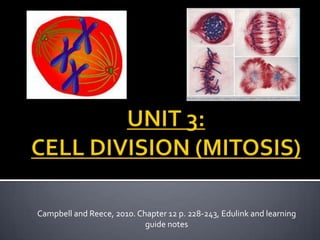
Campbell and Reece, 2010. Chapter 12 p. 228-243, Edulink and learning
guide notes
 Chromosomes form when the chromatin network in the
nucleus of the cell, coil up, shortens and thickens.
 Each organism has a specific amount of chromosomes.
 All humans have 46 chromosomes.
 These chromosomes are arranged in identical pairs
called homologous chromosome pairs –
 Therefore humans have 23 homologous pairs of
chromosomes.
 These chromosomes is only visible during cell division
processes.
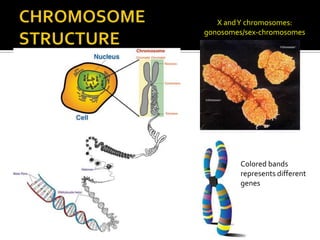
 One chromosome consist of 2 chromatids and one
centromere that attach the chromatids together.
 Each chromatid consist of genes which in turn consist of
DNA.
X andY chromosomes:
gonosomes/sex-chromosomes
Colored bands
represents different
genes
The cell cycle includes the following phases:
 Interphase (include G1- , S- [DNA synthesis]
and G2 phase)
 Mitosis
 Cytokinesis
 Growth
The result is 2 identical cells.
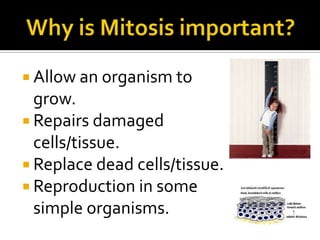
 Allow an organism to
grow.
 Repairs damaged
cells/tissue.
 Replace dead cells/tissue.
 Reproduction in some
simple organisms.
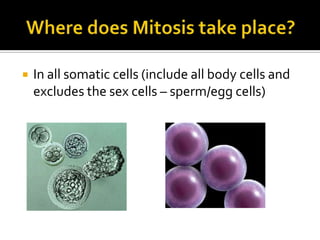
 In all somatic cells (include all body cells and
excludes the sex cells – sperm/egg cells)
 CONSIST OF A FEW PHASES:
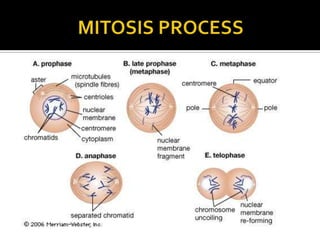
 INTERPHASE
 PROPHASE
 METAPHASE
 ANAPHASE
 TELOPHASE
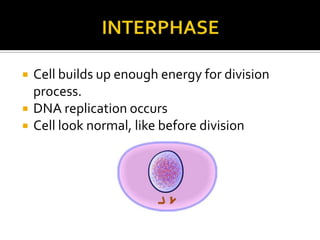
 Cell builds up enough energy for division
process.
 DNA replication occurs
 Cell look normal, like before division
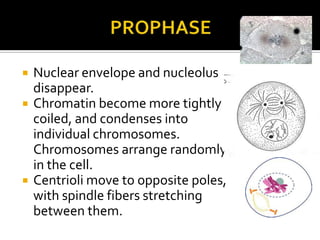
 Nuclear envelope and nucleolus
disappear.
 Chromatin become more tightly
coiled, and condenses into
individual chromosomes.
Chromosomes arrange randomly
in the cell.
 Centrioli move to opposite poles,
with spindle fibers stretching
between them.
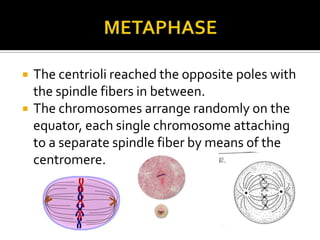
 The centrioli reached the opposite poles with
the spindle fibers in between.
 The chromosomes arrange randomly on the
equator, each single chromosome attaching
to a separate spindle fiber by means of the
centromere.
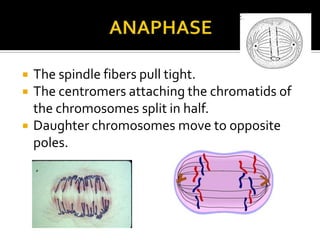
 The spindle fibers pull tight.
 The centromers attaching the chromatids of
the chromosomes split in half.
 Daughter chromosomes move to opposite
poles.
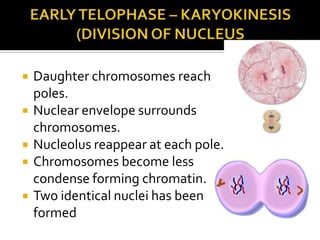
 Daughter chromosomes reach
poles.
 Nuclear envelope surrounds
chromosomes.
 Nucleolus reappear at each pole.
 Chromosomes become less
condense forming chromatin.
 Two identical nuclei has been
formed
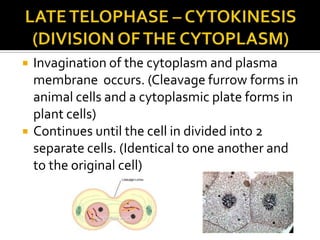
 Invagination of the cytoplasm and plasma
membrane occurs. (Cleavage furrow forms in
animal cells and a cytoplasmic plate forms in
plant cells)
 Continues until the cell in divided into 2
separate cells. (Identical to one another and
to the original cell)
 Cancer is caused by the loss of cell cycle controls
in cancer cells.
 Cancer cells usually continue to divide well
beyond a single layer, forming a clump of
overlapping cells called a tumor.
 Malignant tumors invade surrounding tissues and
can metastasize exporting cancer cells to other
parts of the body, where they may form secondary
tumors.
 They do not exhibit anchorage dependence or
density dependent inhibition.
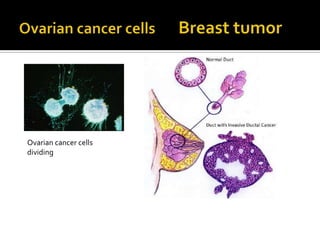
Ovarian cancer cells
dividing
 Divide into groups of 8.
 Design a research project for students using
the themeCancer.
 Complete the actual research project that
you have designed in detail as an example of
what you expect from a student.
Design
 Originality of the project 10
 Planning of the design 10
 Assessment you will be using 10
 Assessment criteria you will be using 10
 Design construction and set up. 10
 Clarity of task 10
 Cover page 10
 Index 10
 Content – scientific and true – no plagiarism 10
 Reference indicated in content 10
 Summary of references provided in Bibliography. 10
 Includes diagrams/ graphs/ tables/ statistics 10
 Includes own opinion and ideas. 10
 Neatness 10
 Overall impression (Did you do what the project required
you to do) 10
Total : 150

Unit 3 mitosis

  • 1.
    Campbell and Reece,2010. Chapter 12 p. 228-243, Edulink and learning guide notes
  • 2.
     Chromosomes formwhen the chromatin network in the nucleus of the cell, coil up, shortens and thickens.  Each organism has a specific amount of chromosomes.  All humans have 46 chromosomes.  These chromosomes are arranged in identical pairs called homologous chromosome pairs –  Therefore humans have 23 homologous pairs of chromosomes.  These chromosomes is only visible during cell division processes.  One chromosome consist of 2 chromatids and one centromere that attach the chromatids together.  Each chromatid consist of genes which in turn consist of DNA.
  • 3.
  • 4.
    The cell cycleincludes the following phases:  Interphase (include G1- , S- [DNA synthesis] and G2 phase)  Mitosis  Cytokinesis  Growth The result is 2 identical cells.
  • 5.
     Allow anorganism to grow.  Repairs damaged cells/tissue.  Replace dead cells/tissue.  Reproduction in some simple organisms.
  • 6.
     In allsomatic cells (include all body cells and excludes the sex cells – sperm/egg cells)
  • 7.
     CONSIST OFA FEW PHASES:  INTERPHASE  PROPHASE  METAPHASE  ANAPHASE  TELOPHASE
  • 8.
     Cell buildsup enough energy for division process.  DNA replication occurs  Cell look normal, like before division
  • 9.
     Nuclear envelopeand nucleolus disappear.  Chromatin become more tightly coiled, and condenses into individual chromosomes. Chromosomes arrange randomly in the cell.  Centrioli move to opposite poles, with spindle fibers stretching between them.
  • 10.
     The centriolireached the opposite poles with the spindle fibers in between.  The chromosomes arrange randomly on the equator, each single chromosome attaching to a separate spindle fiber by means of the centromere.
  • 11.
     The spindlefibers pull tight.  The centromers attaching the chromatids of the chromosomes split in half.  Daughter chromosomes move to opposite poles.
  • 12.
     Daughter chromosomesreach poles.  Nuclear envelope surrounds chromosomes.  Nucleolus reappear at each pole.  Chromosomes become less condense forming chromatin.  Two identical nuclei has been formed
  • 13.
     Invagination ofthe cytoplasm and plasma membrane occurs. (Cleavage furrow forms in animal cells and a cytoplasmic plate forms in plant cells)  Continues until the cell in divided into 2 separate cells. (Identical to one another and to the original cell)
  • 15.
     Cancer iscaused by the loss of cell cycle controls in cancer cells.  Cancer cells usually continue to divide well beyond a single layer, forming a clump of overlapping cells called a tumor.  Malignant tumors invade surrounding tissues and can metastasize exporting cancer cells to other parts of the body, where they may form secondary tumors.  They do not exhibit anchorage dependence or density dependent inhibition.
  • 16.
  • 18.
     Divide intogroups of 8.  Design a research project for students using the themeCancer.  Complete the actual research project that you have designed in detail as an example of what you expect from a student.
  • 19.
    Design  Originality ofthe project 10  Planning of the design 10  Assessment you will be using 10  Assessment criteria you will be using 10  Design construction and set up. 10  Clarity of task 10
  • 20.
     Cover page10  Index 10  Content – scientific and true – no plagiarism 10  Reference indicated in content 10  Summary of references provided in Bibliography. 10  Includes diagrams/ graphs/ tables/ statistics 10  Includes own opinion and ideas. 10  Neatness 10  Overall impression (Did you do what the project required you to do) 10 Total : 150