UNIT 3: A PLANET FULL OF LIFE
A  living thing  is an organism that is able to perform  three vital functions: nutrition, interaction and reproduction. All living things are made of  cells. Nutrition: Autotrophs:  They produce their own food. Heterotrophs:  They eat another organisms. Reproduction: Asexual:  Produces identical copies of itself Sexual:  Two living things join and provide  gametes.
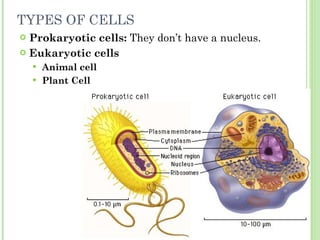
TYPES OF CELLS Prokaryotic cells:  They don’t have a nucleus. Eukaryotic cells Animal cell Plant Cell
 
THE FIVE KINGDOMS Monera kingdom:  Ex: Bacterias Protoctist kingdom:  Protozoa and Algae. Fungi kingdom:  Ex: Mould and Mushrooms. Plant kingdom:  Ex: Oak tree Animal kingdom : Ex: Dog
ACTIVITIES 1.  The following organisms have a sexual or asexual reproduction? A bacterium that produces two identical  bacteria. Fish that lay eggs in the water. 2. Mould grows and feeds on food leftovers. Do you think it is autotroph or heterotroph? Explain your answer. 3.Draw in your notebook a prokaryotic cell and eukaryotic cell. Label the elements in English and Spanish.
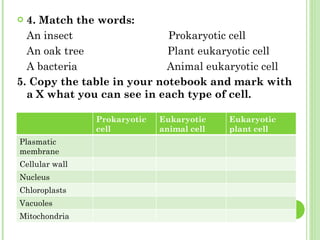
4. Match the words: An insect  Prokaryotic cell An oak tree  Plant eukaryotic cell A bacteria  Animal eukaryotic cell 5. Copy the table in your notebook and mark with a X what you can see in each type of cell. Prokaryotic cell Eukaryotic animal cell Eukaryotic plant cell Plasmatic membrane Cellular wall Nucleus Chloroplasts Vacuoles Mitochondria
6. Look up in the Internet the scientific names  of the following animals and write them in your notebook. Squirrel Mouse Rabbit Cat Sparrow Lynx Bear Dog
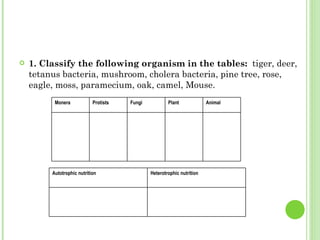
1. Classify the following organism in the tables:  tiger, deer, tetanus bacteria, mushroom, cholera bacteria, pine tree, rose, eagle, moss, paramecium, oak, camel, Mouse. Monera Protists Fungi Plant Animal Autotrophic nutrition Heterotrophic nutrition

Unit 3 Living things

  • 1.
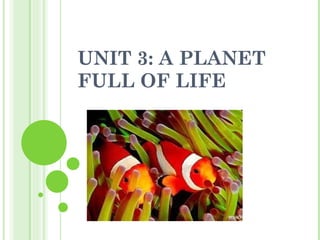
    UNIT 3: APLANET FULL OF LIFE
  • 2.
    A livingthing is an organism that is able to perform three vital functions: nutrition, interaction and reproduction. All living things are made of cells. Nutrition: Autotrophs: They produce their own food. Heterotrophs: They eat another organisms. Reproduction: Asexual: Produces identical copies of itself Sexual: Two living things join and provide gametes.
  • 3.
    TYPES OF CELLSProkaryotic cells: They don’t have a nucleus. Eukaryotic cells Animal cell Plant Cell
  • 4.
  • 5.
    THE FIVE KINGDOMSMonera kingdom: Ex: Bacterias Protoctist kingdom: Protozoa and Algae. Fungi kingdom: Ex: Mould and Mushrooms. Plant kingdom: Ex: Oak tree Animal kingdom : Ex: Dog
  • 6.
    ACTIVITIES 1. The following organisms have a sexual or asexual reproduction? A bacterium that produces two identical bacteria. Fish that lay eggs in the water. 2. Mould grows and feeds on food leftovers. Do you think it is autotroph or heterotroph? Explain your answer. 3.Draw in your notebook a prokaryotic cell and eukaryotic cell. Label the elements in English and Spanish.
  • 7.
    4. Match thewords: An insect Prokaryotic cell An oak tree Plant eukaryotic cell A bacteria Animal eukaryotic cell 5. Copy the table in your notebook and mark with a X what you can see in each type of cell. Prokaryotic cell Eukaryotic animal cell Eukaryotic plant cell Plasmatic membrane Cellular wall Nucleus Chloroplasts Vacuoles Mitochondria
  • 8.
    6. Look upin the Internet the scientific names of the following animals and write them in your notebook. Squirrel Mouse Rabbit Cat Sparrow Lynx Bear Dog
  • 9.
    1. Classify thefollowing organism in the tables: tiger, deer, tetanus bacteria, mushroom, cholera bacteria, pine tree, rose, eagle, moss, paramecium, oak, camel, Mouse. Monera Protists Fungi Plant Animal Autotrophic nutrition Heterotrophic nutrition