CONCEPT:
 In a simple way:
‘A group may be defined as the aggregation
of small number of persons who work for
common goals, develop a share attitude, and are
aware that they are a part of a group and perceive
themselves as such’.
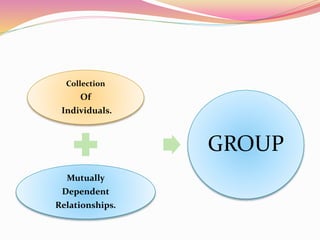
Collection
Of
Individuals.
Mutually
Dependent
Relationships.
GROUP
DEFINATION:
 “A collection of two or more interacting
individuals with a stable pattern of
relationships between them, who share
common goals and who perceive themselves as
being a group”
 The social process by which people interact
face- to face in small groups is called GROUP
DYNAMICS.
CHARACTERSTICS OF GROUP:
INTERACTION
AMONG
MEMBERS.
COMMON
INTEREST OF
GOALS
2 OR MORE
PEOPLE CAN
FORM A
GROUP.
COLLECTIVE
IDENTITY.
GROUP FORMATION/DEVELOPMENT
FORMING: awareness ,
commitment, acceptance.
STORMING: conflict,
clarification, belonging.
NORMING: cooperation,
development, support.
PERFORMING: productivity,
achievement, pride.
ADJOURNING: separation,
recognizing, satisfaction.
FORMAL GROUPS
 “Formal groups are the groups that are created and
maintained to fulfill specific needs or tasks which
are related to the total organizational mission.”
 Formal organization is
deliberately designed to
achieve some particular
objectives.
4 PILLARS OF FORMAL GROUP.
1. Structure
2. Division of labour
3. Scalar & functional process
4. Span of control.
Characteristics:
1) Designed by top management.
2) Structure is based on division of labour.
3) Job performance is given more importance.
4) Coordination.
CONTRUBUTION TO ORGANISATION
Accomplishment of complex
tasks
Coordinate interdepartmental
efforts.
Solving complex problems.
SOCIALIZE and train newcomers.
CONTRUBUTION TO INDIVIDUALS:
1. Satisfy needs for affiliation.
2. Confirm identity and enhance self esteem.
3. Reduce feeling of insecurity and powerlessness.
4. Solving of personal and interpersonal problems.
5. Test and share perception of social reality.
INFORMAL GROUPS
 “The informal organization refers to people
in an association at work, but these
associations are not so specified in the blue
of the formal organization.”
 It is a natural grouping of people on the
basis of similarity in an organization.
CHARACTERISTICS OF INFORMAL
GROUP.
1. It is voluntary.
2. A person can become member at any time.
3. Created on the basis of similarity.
4. Natural outcome at work place.
5. Group norms are used for control and
coordination.
CONTRUBUTION TO ORGANISATION
1. Solidify common objectives congruent with
organizational culture.
2. Provide enforce guidelines for proper behavior.
3. Provide social satisfaction .
4. Provide a sense of identity which often include
degree of status.
5. Enhance members access to information.
6. Help to integrate new employees.
CONTRIBUTION TO INDIVIDUALS
1. Satisfaction of social needs.
2. Satisfaction of needs for security & support
3. Enhanced status for members if the group is
perceived by others as prestigious.
4. Enhanced feelings of self esteem if a member is
valued by other group members.
5. Feeling more competent by sharing the power of
the group t influence and achieve.
1. Proximity
2. Security
3. Esteem
4. Affiliation
5. Power
6. Identity
7. Huddling
GROUP COHESIVENESS:
 Group cohesiveness is another important factor,
besides group norms, which affects group
behaviour.
 It means the degree of attachment of members to
their group.
 If group cohesiveness is high then the interaction
between members of group is also high & vice
versa.
FEATURES
1. Common interest & share group goals.
2. Numbers of members is small.
3. Interaction is frequent.
4. Group loyalty is high.
5. It has a history of past.
6. Members stand united against any external
threats.
CONCEPT OF TEAM:
 According to Katzenbach & smith:
“ A team is a small number of people with
complementary skills who are committed to a
common purpose, performing goals, and approach
for which they hold themselves mutually
accountable.”
CHARACTERISTICS OF TEAM.
1. Small number of people.
2. Complementary skills.
3. Common purpose & performance goals.
4. Common approach.
5. Mutual accountability.
IMPORTANCE OF TEAM:
IMPORTAN
CE
Enhanced
performance.
Employee
benefits.
Reduced
costs.
Organizational
enhancement.
• Job
categories.
Many narrow
categories.
One or two broad
categories.
•Authority.
Supervisor directly
controls daily
activities.
Team itself
controls daily
activities.
•Reward
system.
Depends on the
types of individuals
performance and
seniority.
Based on team
performance and
individual breadth
of skills.
Unit 3 group dynamics.

Unit 3 group dynamics.

  • 3.
    CONCEPT:  In asimple way: ‘A group may be defined as the aggregation of small number of persons who work for common goals, develop a share attitude, and are aware that they are a part of a group and perceive themselves as such’.
  • 4.
  • 5.
    DEFINATION:  “A collectionof two or more interacting individuals with a stable pattern of relationships between them, who share common goals and who perceive themselves as being a group”  The social process by which people interact face- to face in small groups is called GROUP DYNAMICS.
  • 6.
    CHARACTERSTICS OF GROUP: INTERACTION AMONG MEMBERS. COMMON INTERESTOF GOALS 2 OR MORE PEOPLE CAN FORM A GROUP. COLLECTIVE IDENTITY.
  • 7.
    GROUP FORMATION/DEVELOPMENT FORMING: awareness, commitment, acceptance. STORMING: conflict, clarification, belonging. NORMING: cooperation, development, support. PERFORMING: productivity, achievement, pride. ADJOURNING: separation, recognizing, satisfaction.
  • 9.
    FORMAL GROUPS  “Formalgroups are the groups that are created and maintained to fulfill specific needs or tasks which are related to the total organizational mission.”  Formal organization is deliberately designed to achieve some particular objectives.
  • 10.
    4 PILLARS OFFORMAL GROUP. 1. Structure 2. Division of labour 3. Scalar & functional process 4. Span of control.
  • 11.
    Characteristics: 1) Designed bytop management. 2) Structure is based on division of labour. 3) Job performance is given more importance. 4) Coordination.
  • 12.
    CONTRUBUTION TO ORGANISATION Accomplishmentof complex tasks Coordinate interdepartmental efforts. Solving complex problems. SOCIALIZE and train newcomers.
  • 13.
    CONTRUBUTION TO INDIVIDUALS: 1.Satisfy needs for affiliation. 2. Confirm identity and enhance self esteem. 3. Reduce feeling of insecurity and powerlessness. 4. Solving of personal and interpersonal problems. 5. Test and share perception of social reality.
  • 14.
    INFORMAL GROUPS  “Theinformal organization refers to people in an association at work, but these associations are not so specified in the blue of the formal organization.”  It is a natural grouping of people on the basis of similarity in an organization.
  • 15.
    CHARACTERISTICS OF INFORMAL GROUP. 1.It is voluntary. 2. A person can become member at any time. 3. Created on the basis of similarity. 4. Natural outcome at work place. 5. Group norms are used for control and coordination.
  • 16.
    CONTRUBUTION TO ORGANISATION 1.Solidify common objectives congruent with organizational culture. 2. Provide enforce guidelines for proper behavior. 3. Provide social satisfaction . 4. Provide a sense of identity which often include degree of status. 5. Enhance members access to information. 6. Help to integrate new employees.
  • 17.
    CONTRIBUTION TO INDIVIDUALS 1.Satisfaction of social needs. 2. Satisfaction of needs for security & support 3. Enhanced status for members if the group is perceived by others as prestigious. 4. Enhanced feelings of self esteem if a member is valued by other group members. 5. Feeling more competent by sharing the power of the group t influence and achieve.
  • 19.
    1. Proximity 2. Security 3.Esteem 4. Affiliation 5. Power 6. Identity 7. Huddling
  • 21.
    GROUP COHESIVENESS:  Groupcohesiveness is another important factor, besides group norms, which affects group behaviour.  It means the degree of attachment of members to their group.  If group cohesiveness is high then the interaction between members of group is also high & vice versa.
  • 22.
    FEATURES 1. Common interest& share group goals. 2. Numbers of members is small. 3. Interaction is frequent. 4. Group loyalty is high. 5. It has a history of past. 6. Members stand united against any external threats.
  • 23.
    CONCEPT OF TEAM: According to Katzenbach & smith: “ A team is a small number of people with complementary skills who are committed to a common purpose, performing goals, and approach for which they hold themselves mutually accountable.”
  • 24.
    CHARACTERISTICS OF TEAM. 1.Small number of people. 2. Complementary skills. 3. Common purpose & performance goals. 4. Common approach. 5. Mutual accountability.
  • 25.
  • 27.
    • Job categories. Many narrow categories. Oneor two broad categories. •Authority. Supervisor directly controls daily activities. Team itself controls daily activities. •Reward system. Depends on the types of individuals performance and seniority. Based on team performance and individual breadth of skills.