A bio-diverse area under
         threat
  The Daintree Rainforest,
    Queensland Australia
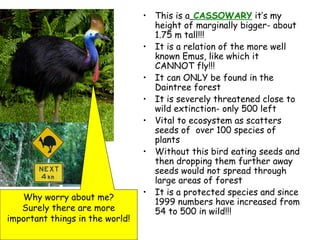
• This is a CASSOWARY it’s my
                                   height of marginally bigger- about
                                   1.75 m tall!!!
                                 • It is a relation of the more well
                                   known Emus, like which it
                                   CANNOT fly!!!
                                 • It can ONLY be found in the
                                   Daintree forest
                                 • It is severely threatened close to
                                   wild extinction- only 500 left
                                 • Vital to ecosystem as scatters
                                   seeds of over 100 species of
                                   plants
                                 • Without this bird eating seeds and
                                   then dropping them further away
                                   seeds would not spread through
                                   large areas of forest
                                 • It is a protected species and since
   Why worry about me?
                                   1999 numbers have increased from
   Surely there are more           54 to 500 in wild!!!
important things in the world!
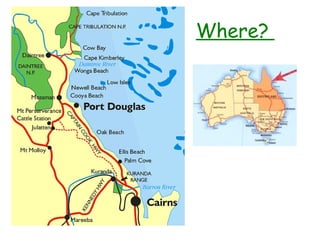
Where?
• The Daintree forest lies on the
  North East coast of Australia
  in the area called Queensland,
  it's a part of the larger area
  known as the wet tropics.
• It runs parallel to the other
  Australian wonderland the
  Great Barrier Reef
• The wet tropics are a world
  heritage site, covering an area
  of 900,000 hectares (1/2 size
  of Wales)
Where?
Why is the Daintree so special?
• 135 million years old- oldest in
  world
• Has plants there older than human
  life on Earth!!!!
• Home to greatest no. of plant/
  animal species that are rare,
  threatened anywhere in world!
• Of world’s 19 primitive plants 12
  are found here
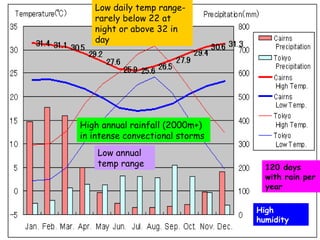
Low daily temp range-
   rarely below 22 at
   night or above 32 in
   day


High annual rainfall (2000m+)
in intense convectional storms
    Low annual
    temp range                     120 days
                                   with rain per
                                   year

                                 High
                                 humidity
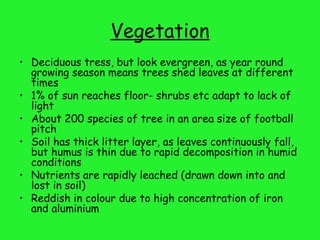
Vegetation
• Deciduous tress, but look evergreen, as year round
  growing season means trees shed leaves at different
  times
• 1% of sun reaches floor- shrubs etc adapt to lack of
  light
• About 200 species of tree in an area size of football
  pitch
• Soil has thick litter layer, as leaves continuously fall,
  but humus is thin due to rapid decomposition in humid
  conditions
• Nutrients are rapidly leached (drawn down into and
  lost in soil)
• Reddish in colour due to high concentration of iron
  and aluminium
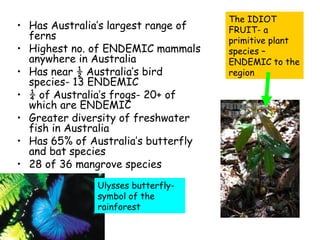
The IDIOT
• Has Australia’s largest range of   FRUIT- a
  ferns                              primitive plant
• Highest no. of ENDEMIC mammals     species –
  anywhere in Australia              ENDEMIC to the
• Has near ½ Australia’s bird        region
  species- 13 ENDEMIC
• ¼ of Australia’s frogs- 20+ of
  which are ENDEMIC
• Greater diversity of freshwater
  fish in Australia
• Has 65% of Australia’s butterfly
  and bat species
• 28 of 36 mangrove species
              Ulysses butterfly-
              symbol of the
              rainforest
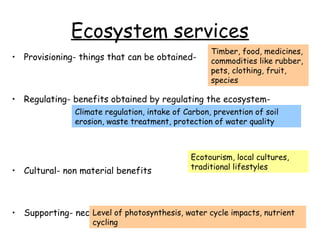
Ecosystem services
                                                    Timber, food, medicines,
• Provisioning- things that can be obtained-        commodities like rubber,
                                                    pets, clothing, fruit,
                                                    species

• Regulating- benefits obtained by regulating the ecosystem-
               Climate regulation, intake of Carbon, prevention of soil
               erosion, waste treatment, protection of water quality


                                              Ecotourism, local cultures,
                                              traditional lifestyles
• Cultural- non material benefits


• Supporting- necessary for all other services cycle impacts, nutrient
                  Level of photosynthesis, water provided
                   cycling
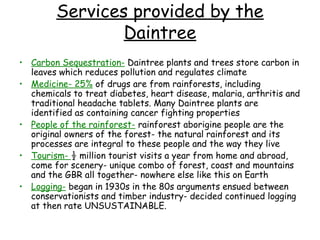
Services provided by the
                Daintree
• Carbon Sequestration- Daintree plants and trees store carbon in
  leaves which reduces pollution and regulates climate
• Medicine- 25% of drugs are from rainforests, including
  chemicals to treat diabetes, heart disease, malaria, arthritis and
  traditional headache tablets. Many Daintree plants are
  identified as containing cancer fighting properties
• People of the rainforest- rainforest aborigine people are the
  original owners of the forest- the natural rainforest and its
  processes are integral to these people and the way they live
• Tourism- ½ million tourist visits a year from home and abroad,
  come for scenery- unique combo of forest, coast and mountains
  and the GBR all together- nowhere else like this on Earth
• Logging- began in 1930s in the 80s arguments ensued between
  conservationists and timber industry- decided continued logging
  at then rate UNSUSTAINABLE.
Tasks
1) Group task
• Group 1- draw a spider diagram or like to show how a
   tourist would view the Daintree
• Group 2- same but from logging company viewpoint
• Group 3 same but from conservationist viewpoint
• Group 4 same but from Cassowary viewpoint
• Group 5 same but from a local governor from Douglas
   Shire Council view
• Group 6 same but from a local person perspective
• You have 5 minutes then feed info back to other
   groups
2) Which of the above mentioned conflict with each
   other? In what ways? Come up with a conflict matrix
   to highlight these.
What are the threats to the Daintree?
Tourism-

a)    Worth 141.7 million Australian $ a year
b)    Most come to see the scenery and the forest
c)    Many partake in destructive activities there- such as fishing, 4
      wheel drive tours, walking, reef diving, horse riding
d)    Ferry carries 700 vehicles across river daily
e)    0.5 million visitors annually
f)    Stay an average of 3.8 days
g)    Increased accommodation since 1991- 20 b+bs, 1278 beds
      nightly, 176 camping places actually in Daintree AND 58 b+bs,
      8822 beds and 770 camp itches in local area
h)    70% of tourists visit independently- 30% with registered
      coach companies
i)    Recent improvements- road tarmac increasing visitor numbers
j)    Visitors think there’s too much accommodation and enough
      walking tracks already in place
Growth and change in Port Douglas

a) Population 4000
b) Large visitor numbers have led to decline in small local shops
   replaced by a small supermarket
c) Property booms- some sold land to developers others priced
   from market
d) 2 new resorts just nearing completion, 2 underway and 2 more in
   process of planning
e) Small forest areas have been divided up and sold to developers-
   some have been built on and environmental concerns have been
   addressed others have been turned to cattle ranches
f) Red cedar became extinct in 2000 after builder removed all
g) If land clearing isn’t stopped 85 rare plant species stand to be
   lost
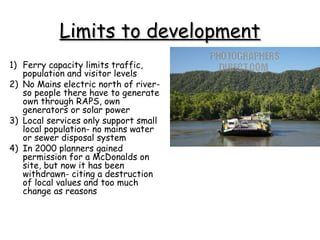
Limits to development
1) Ferry capacity limits traffic,
   population and visitor levels
2) No Mains electric north of river-
   so people there have to generate
   own through RAPS, own
   generators or solar power
3) Local services only support small
   local population- no mains water
   or sewer disposal system
4) In 2000 planners gained
   permission for a McDonalds on
   site, but now it has been
   withdrawn- citing a destruction
   of local values and too much
   change as reasons
Deforestation

• Began in late 1860’s to
  cultivate sugar cane
  production continued to
  early 1990s
• Most clearance today,
  for pasture (86%), with
  remainder cleared for
  crops (10%), mining
  infrastructure and
  settlement (4%)
• Shift from central to
  southern Queensland
  away from Daintree
Tasks
• Which threat/s to the Daintree do you
  perceive to be the biggest? Why?
• What are the causes of deforestation?
  Classify into social, economic and
  environmental
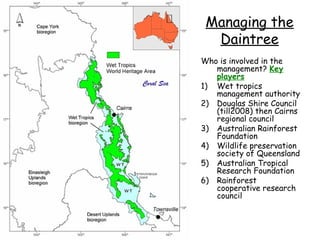
Managing the
  Daintree
Who is involved in the
   management? Key
   players
1) Wet tropics
   management authority
2) Douglas Shire Council
   (till2008) then Cairns
   regional council
3) Australian Rainforest
   Foundation
4) Wildlife preservation
   society of Queensland
5) Australian Tropical
   Research Foundation
6) Rainforest
   cooperative research
   council
Wet tropics management authority
•   Formed 1990
•   Based in Cairns, main functions-
•   Developing and implementing plans and policies
•   Researching and monitoring enhancing understanding
    of the importance of the heritage area- monitoring
    state of wet tropics
•   Developing management agreements with landholders
    and aborigines’
•   Providing education through visitor centres
•   Funding
•   Promotion of the area
Douglas Shire council
• Aims were to gradually reduce
  population in Daintree
• Increased ferry coasts to limit
  numbers, but numbers still increasing
• Rejected plans for a bridge across river
  to replace ferry and rejected another
  ferry option- on grounds that extra
  visitors and pop. Would endanger
  rainforest
Rainforest cooperative research council
      Report from 2000- found unless action was taken, area would
     see increase in residential development, loss of biodiversity and
     reduction in attractiveness to tourists. They implemented these
     strategies to try to build a SUSTAINABLE future for the area

1)    Community development-
•     12-1400 people to live in area and be involved in stewardship and
      conservation of land
•     Base employment on tourism, organic Farming, tropical
      horticulture and small business ops.
•     Settle about 600 blocks of land
2)    Biodiversity conservation-
•     adopt settlement and land management practices on private land
      to protect the outstanding biodiversity
•     Identify biodiversity hotspots for conservation for no
      development
•     Identify threats from wild animals
•     540 blocks remain unsettled
3)   Douglas Shire Council/ Cairns regional council-
•    Introduce planning controls for biodiversity conservation
•    Ensure settlement densities are sustainable
4)   Electricity supply-
•    When settlement densities are at sustainable level, use
     underground cables to extend supply far north as copper
     creek
•    People north of copper creek remain on RAPS
5)   Indigenous people-
•    Recognise the rights of aboriginal peoples to own land and
     promote their culture within the forest
6)   Water supply and waste management-
•    Keep water extraction from streams and underground supplies
     within sustainable limits
•    Use best available domestic tech for waste disposal
7)   Roads and ferry
•    Ferry to remain gateway to area as essential access
•    Improve tourist facilities south of river and recreation
     facilities north of
•    Reduce forest cut backs- the road to cap tribulation should be
     a green tunnel with windows through the forest to mountain
     and coast scenery
8)   Tourism-
•    Increase tourist numbers to 550,000 to boost and maintain
     local economy
•    Increase no. of tourists staying for 7ral nights or more and
     revisiting area
•    Monitor tourist impacts and ensure sustainability
9)   Financing
•    Use ferry income to assist community services infrastructure
     and conservation
•    Establish Daintree Land trust to support land acquisition and
     pay compensation for lost land
•    Meet cost of priority purchase and financial incentives for
     conservation
•    Subsidise electricity supply
Australian Rainforest Foundation (ARF)

• Not for profit organisation dedicated to education,
  research and habitat rehabilitation- involved in
  variety of projects-
• Operation Big Bird- creation of 250km wide wildlife
  corridor to help protect the Cassowary- path will link
  Cairns too southern coast town of Cardwell- these
  help biodiversity by enabling species movement to
  feed, breed and colonise
• Australian govt has funded ARF for range of
  conservation initiatives- including BUY BACK, process
  of buying back land from developers who previously
  purchased it to reduce development.
• Encourages remaining developers to do so in an eco
  way through education
Wildlife Preservation Society of
                 Queensland
• Community based not for profit conservation group.
  Committed to a sustainable future for people and
  wildlife
• Support ban on development in the area
Australian Tropical Research
             Foundation
• Created 1993
• Oversee operation of visitor centres and education
  facilities at the Cape tribulation tropical research
  station and the wet tropics visitor centre- highlight
  global importance of the tropical forest ecosystem
Tasks
1)   Read through the previous slides about managing the
     Daintree, complete the following-
2)   On an A3 page draw a 4 circled Venn diagram. The 4
     circles should contain the following headings-

     i.     Biodiversity protection
     ii.    Limiting development
     iii.   Education
     iv.    Economic incentives


3)   Put all the aforementioned proposals into your Venn
     diagram, some may apply to multiple areas add
     accordingly
Tasks
• There are obviously conflicts in the ways
  different groups want to manage the Daintree
• How far are the conflicts a case of economic
  v environment? Is anything as important?
  Why?
• How would you manage it? Which ideas would
  you keep/ discard? Why? Other ideas?
  Sustainability?

Daintree rainforestabiodiverseareaunderthreat

  • 1.
    A bio-diverse areaunder threat The Daintree Rainforest, Queensland Australia
  • 2.
    • This isa CASSOWARY it’s my height of marginally bigger- about 1.75 m tall!!! • It is a relation of the more well known Emus, like which it CANNOT fly!!! • It can ONLY be found in the Daintree forest • It is severely threatened close to wild extinction- only 500 left • Vital to ecosystem as scatters seeds of over 100 species of plants • Without this bird eating seeds and then dropping them further away seeds would not spread through large areas of forest • It is a protected species and since Why worry about me? 1999 numbers have increased from Surely there are more 54 to 500 in wild!!! important things in the world!
  • 3.
    Where? • The Daintreeforest lies on the North East coast of Australia in the area called Queensland, it's a part of the larger area known as the wet tropics. • It runs parallel to the other Australian wonderland the Great Barrier Reef • The wet tropics are a world heritage site, covering an area of 900,000 hectares (1/2 size of Wales)
  • 4.
  • 5.
    Why is theDaintree so special? • 135 million years old- oldest in world • Has plants there older than human life on Earth!!!! • Home to greatest no. of plant/ animal species that are rare, threatened anywhere in world! • Of world’s 19 primitive plants 12 are found here
  • 6.
    Low daily temprange- rarely below 22 at night or above 32 in day High annual rainfall (2000m+) in intense convectional storms Low annual temp range 120 days with rain per year High humidity
  • 7.
    Vegetation • Deciduous tress,but look evergreen, as year round growing season means trees shed leaves at different times • 1% of sun reaches floor- shrubs etc adapt to lack of light • About 200 species of tree in an area size of football pitch • Soil has thick litter layer, as leaves continuously fall, but humus is thin due to rapid decomposition in humid conditions • Nutrients are rapidly leached (drawn down into and lost in soil) • Reddish in colour due to high concentration of iron and aluminium
  • 8.
    The IDIOT • HasAustralia’s largest range of FRUIT- a ferns primitive plant • Highest no. of ENDEMIC mammals species – anywhere in Australia ENDEMIC to the • Has near ½ Australia’s bird region species- 13 ENDEMIC • ¼ of Australia’s frogs- 20+ of which are ENDEMIC • Greater diversity of freshwater fish in Australia • Has 65% of Australia’s butterfly and bat species • 28 of 36 mangrove species Ulysses butterfly- symbol of the rainforest
  • 9.
    Ecosystem services Timber, food, medicines, • Provisioning- things that can be obtained- commodities like rubber, pets, clothing, fruit, species • Regulating- benefits obtained by regulating the ecosystem- Climate regulation, intake of Carbon, prevention of soil erosion, waste treatment, protection of water quality Ecotourism, local cultures, traditional lifestyles • Cultural- non material benefits • Supporting- necessary for all other services cycle impacts, nutrient Level of photosynthesis, water provided cycling
  • 10.
    Services provided bythe Daintree • Carbon Sequestration- Daintree plants and trees store carbon in leaves which reduces pollution and regulates climate • Medicine- 25% of drugs are from rainforests, including chemicals to treat diabetes, heart disease, malaria, arthritis and traditional headache tablets. Many Daintree plants are identified as containing cancer fighting properties • People of the rainforest- rainforest aborigine people are the original owners of the forest- the natural rainforest and its processes are integral to these people and the way they live • Tourism- ½ million tourist visits a year from home and abroad, come for scenery- unique combo of forest, coast and mountains and the GBR all together- nowhere else like this on Earth • Logging- began in 1930s in the 80s arguments ensued between conservationists and timber industry- decided continued logging at then rate UNSUSTAINABLE.
  • 11.
    Tasks 1) Group task •Group 1- draw a spider diagram or like to show how a tourist would view the Daintree • Group 2- same but from logging company viewpoint • Group 3 same but from conservationist viewpoint • Group 4 same but from Cassowary viewpoint • Group 5 same but from a local governor from Douglas Shire Council view • Group 6 same but from a local person perspective • You have 5 minutes then feed info back to other groups 2) Which of the above mentioned conflict with each other? In what ways? Come up with a conflict matrix to highlight these.
  • 12.
    What are thethreats to the Daintree? Tourism- a) Worth 141.7 million Australian $ a year b) Most come to see the scenery and the forest c) Many partake in destructive activities there- such as fishing, 4 wheel drive tours, walking, reef diving, horse riding d) Ferry carries 700 vehicles across river daily e) 0.5 million visitors annually f) Stay an average of 3.8 days g) Increased accommodation since 1991- 20 b+bs, 1278 beds nightly, 176 camping places actually in Daintree AND 58 b+bs, 8822 beds and 770 camp itches in local area h) 70% of tourists visit independently- 30% with registered coach companies i) Recent improvements- road tarmac increasing visitor numbers j) Visitors think there’s too much accommodation and enough walking tracks already in place
  • 13.
    Growth and changein Port Douglas a) Population 4000 b) Large visitor numbers have led to decline in small local shops replaced by a small supermarket c) Property booms- some sold land to developers others priced from market d) 2 new resorts just nearing completion, 2 underway and 2 more in process of planning e) Small forest areas have been divided up and sold to developers- some have been built on and environmental concerns have been addressed others have been turned to cattle ranches f) Red cedar became extinct in 2000 after builder removed all g) If land clearing isn’t stopped 85 rare plant species stand to be lost
  • 14.
    Limits to development 1)Ferry capacity limits traffic, population and visitor levels 2) No Mains electric north of river- so people there have to generate own through RAPS, own generators or solar power 3) Local services only support small local population- no mains water or sewer disposal system 4) In 2000 planners gained permission for a McDonalds on site, but now it has been withdrawn- citing a destruction of local values and too much change as reasons
  • 15.
    Deforestation • Began inlate 1860’s to cultivate sugar cane production continued to early 1990s • Most clearance today, for pasture (86%), with remainder cleared for crops (10%), mining infrastructure and settlement (4%) • Shift from central to southern Queensland away from Daintree
  • 16.
    Tasks • Which threat/sto the Daintree do you perceive to be the biggest? Why? • What are the causes of deforestation? Classify into social, economic and environmental
  • 17.
    Managing the Daintree Who is involved in the management? Key players 1) Wet tropics management authority 2) Douglas Shire Council (till2008) then Cairns regional council 3) Australian Rainforest Foundation 4) Wildlife preservation society of Queensland 5) Australian Tropical Research Foundation 6) Rainforest cooperative research council
  • 18.
    Wet tropics managementauthority • Formed 1990 • Based in Cairns, main functions- • Developing and implementing plans and policies • Researching and monitoring enhancing understanding of the importance of the heritage area- monitoring state of wet tropics • Developing management agreements with landholders and aborigines’ • Providing education through visitor centres • Funding • Promotion of the area
  • 19.
    Douglas Shire council •Aims were to gradually reduce population in Daintree • Increased ferry coasts to limit numbers, but numbers still increasing • Rejected plans for a bridge across river to replace ferry and rejected another ferry option- on grounds that extra visitors and pop. Would endanger rainforest
  • 20.
    Rainforest cooperative researchcouncil Report from 2000- found unless action was taken, area would see increase in residential development, loss of biodiversity and reduction in attractiveness to tourists. They implemented these strategies to try to build a SUSTAINABLE future for the area 1) Community development- • 12-1400 people to live in area and be involved in stewardship and conservation of land • Base employment on tourism, organic Farming, tropical horticulture and small business ops. • Settle about 600 blocks of land 2) Biodiversity conservation- • adopt settlement and land management practices on private land to protect the outstanding biodiversity • Identify biodiversity hotspots for conservation for no development • Identify threats from wild animals • 540 blocks remain unsettled
  • 21.
    3) Douglas Shire Council/ Cairns regional council- • Introduce planning controls for biodiversity conservation • Ensure settlement densities are sustainable 4) Electricity supply- • When settlement densities are at sustainable level, use underground cables to extend supply far north as copper creek • People north of copper creek remain on RAPS 5) Indigenous people- • Recognise the rights of aboriginal peoples to own land and promote their culture within the forest 6) Water supply and waste management- • Keep water extraction from streams and underground supplies within sustainable limits • Use best available domestic tech for waste disposal
  • 22.
    7) Roads and ferry • Ferry to remain gateway to area as essential access • Improve tourist facilities south of river and recreation facilities north of • Reduce forest cut backs- the road to cap tribulation should be a green tunnel with windows through the forest to mountain and coast scenery 8) Tourism- • Increase tourist numbers to 550,000 to boost and maintain local economy • Increase no. of tourists staying for 7ral nights or more and revisiting area • Monitor tourist impacts and ensure sustainability 9) Financing • Use ferry income to assist community services infrastructure and conservation • Establish Daintree Land trust to support land acquisition and pay compensation for lost land • Meet cost of priority purchase and financial incentives for conservation • Subsidise electricity supply
  • 23.
    Australian Rainforest Foundation(ARF) • Not for profit organisation dedicated to education, research and habitat rehabilitation- involved in variety of projects- • Operation Big Bird- creation of 250km wide wildlife corridor to help protect the Cassowary- path will link Cairns too southern coast town of Cardwell- these help biodiversity by enabling species movement to feed, breed and colonise • Australian govt has funded ARF for range of conservation initiatives- including BUY BACK, process of buying back land from developers who previously purchased it to reduce development. • Encourages remaining developers to do so in an eco way through education
  • 24.
    Wildlife Preservation Societyof Queensland • Community based not for profit conservation group. Committed to a sustainable future for people and wildlife • Support ban on development in the area
  • 25.
    Australian Tropical Research Foundation • Created 1993 • Oversee operation of visitor centres and education facilities at the Cape tribulation tropical research station and the wet tropics visitor centre- highlight global importance of the tropical forest ecosystem
  • 26.
    Tasks 1) Read through the previous slides about managing the Daintree, complete the following- 2) On an A3 page draw a 4 circled Venn diagram. The 4 circles should contain the following headings- i. Biodiversity protection ii. Limiting development iii. Education iv. Economic incentives 3) Put all the aforementioned proposals into your Venn diagram, some may apply to multiple areas add accordingly
  • 27.
    Tasks • There areobviously conflicts in the ways different groups want to manage the Daintree • How far are the conflicts a case of economic v environment? Is anything as important? Why? • How would you manage it? Which ideas would you keep/ discard? Why? Other ideas? Sustainability?