
Unit 1 Exam Question Revision
Understanding the Papers: Unit 1
Part A Short Answer Questions
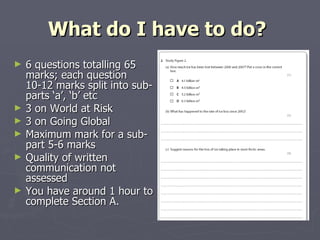
What do I have to do?  6 questions totalling 65 marks; each question 10-12 marks split into sub- parts ‘a’, ‘b’ etc 3 on World at Risk 3 on Going Global  Maximum mark for a sub-part 5-6 marks Quality of written communication not assessed You have around 1 hour to complete Section A.
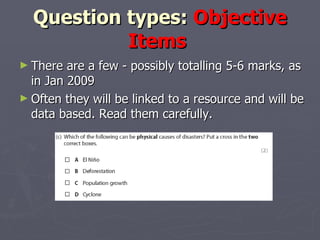
Question types:  Objective Items  There are a few - possibly totalling 5-6 marks, as in Jan 2009 Often they will be linked to a resource and will be data based. Read them carefully.
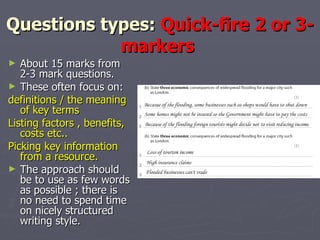
Questions types:  Quick-fire 2 or 3-markers  About 15 marks from 2-3 mark questions.  These often focus on: definitions / the meaning of key terms  Listing factors , benefits, costs etc.. Picking key information from a resource.  The approach should be to use as few words as possible ; there is no need to spend time on nicely structured writing style.
Question types:  Longer  The majority of the Section A marks will come from questions worth 4-6marks. These will be a little more open:
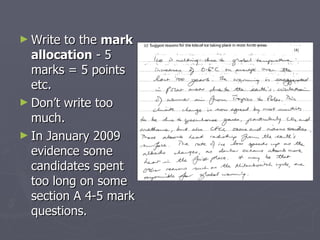
Write to the  mark allocation  - 5 marks = 5 points etc.  Don’t write too much. In January 2009  evidence some candidates spent too long on some section A 4-5 mark questions.
Pitfalls 1:  Resources  Remember that Section A uses Stimulus resources – there will be 6 of these (Figures), one for each question.  They will be a mixture of: Maps  Graphs Data tables  Photographs Diagrams / Cartoons
Figures have a nasty habit of tripping some candidates up, usually because they are rushing and: Don’t bother to read the Figure title  Ignore or mis-read keys,  scales and axes labels Ignore the resource altogether
 
Pitfalls 2:  Command Words  D escribe  and  explain  are sometimes confused leading to answers which fail to score marks using the Section A points mark schemes.  Make sure you don’t drift into explanation when you have been asked to describe:
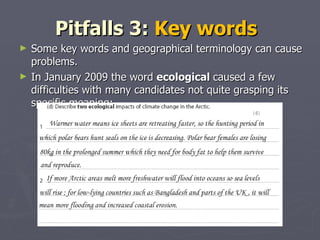
Pitfalls 3:  Key words  Some key words and geographical terminology can cause problems.  In January 2009 the word  ecological  caused a few difficulties with many candidates not quite grasping its specific meaning:
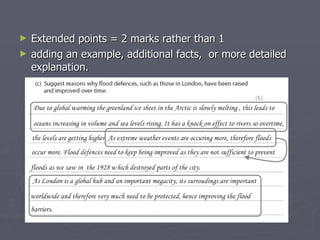
Pitfalls 4:  Range of reasons  4 and 5 mark questions require a  range  of points  OR  several extended points This candidate hasn’t quite grasped extended points
Extended points = 2 marks rather than 1 adding an example, additional facts,  or more detailed explanation.
Summary  Timing – spend no more than 1 hour on section A  Examine the resources carefully – look twice, answer once.  Move through the 1-3 mark questions quickly and efficiently – do not spend long writing  Spot the command words – especially the difference between describe an explain  Remember the mark allocation – 4/5 mark questions require answers with a range of points to gain full marks.
Part B Long Answer Questions
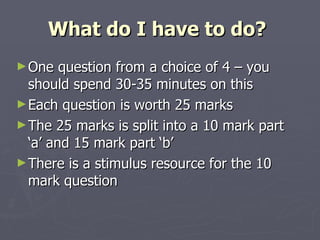
What do I have to do?  One question from a choice of 4 – you should spend 30-35 minutes on this Each question is worth 25 marks  The 25 marks is split into a 10 mark part ‘a’ and 15 mark part ‘b’ There is a stimulus resource for the 10 mark question
Choice of Question Questions will be based around 4 key themes you can expect to have a genuine choice:
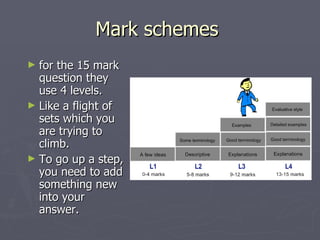
Mark schemes  for the 15 mark question they use 4 levels.  Like a flight of sets which you are trying to climb.  To go up a step, you need to add something new into your answer.
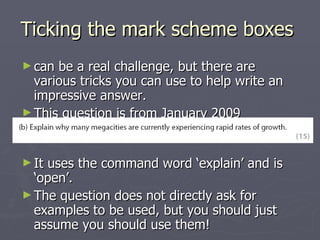
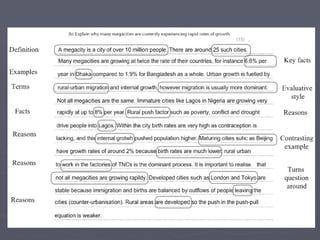
Ticking the mark scheme boxes  can be a real challenge, but there are various tricks you can use to help write an impressive answer.  This question is from January 2009 (Question 10b): It uses the command word ‘explain’ and is ‘open’. The question does not directly ask for examples to be used, but you should just assume you should use them!
Command Words
 
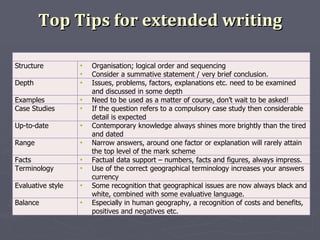
Top Tips for extended writing Structure  Organisation; logical order and sequencing  Consider a summative statement / very brief conclusion.  Depth  Issues, problems, factors, explanations etc. need to be examined and discussed in some depth  Examples  Need to be used as a matter of course, don’t wait to be asked! Case Studies  If the question refers to a compulsory case study then considerable detail is expected  Up-to-date Contemporary knowledge always shines more brightly than the tired and dated Range  Narrow answers, around one factor or explanation will rarely attain the top level of the mark scheme  Facts  Factual data support – numbers, facts and figures, always impress. Terminology  Use of the correct geographical terminology increases your answers currency  Evaluative style  Some recognition that geographical issues are now always black and white, combined with some evaluative language.  Balance Especially in human geography, a recognition of costs and benefits, positives and negatives etc.

Unit 1 Exam Question Revision

  • 1.
    Unit 1 ExamQuestion Revision
  • 2.
  • 3.
    Part A ShortAnswer Questions
  • 4.
    What do Ihave to do? 6 questions totalling 65 marks; each question 10-12 marks split into sub- parts ‘a’, ‘b’ etc 3 on World at Risk 3 on Going Global Maximum mark for a sub-part 5-6 marks Quality of written communication not assessed You have around 1 hour to complete Section A.
  • 5.
    Question types: Objective Items There are a few - possibly totalling 5-6 marks, as in Jan 2009 Often they will be linked to a resource and will be data based. Read them carefully.
  • 6.
    Questions types: Quick-fire 2 or 3-markers About 15 marks from 2-3 mark questions. These often focus on: definitions / the meaning of key terms Listing factors , benefits, costs etc.. Picking key information from a resource. The approach should be to use as few words as possible ; there is no need to spend time on nicely structured writing style.
  • 7.
    Question types: Longer The majority of the Section A marks will come from questions worth 4-6marks. These will be a little more open:
  • 8.
    Write to the mark allocation - 5 marks = 5 points etc. Don’t write too much. In January 2009 evidence some candidates spent too long on some section A 4-5 mark questions.
  • 9.
    Pitfalls 1: Resources Remember that Section A uses Stimulus resources – there will be 6 of these (Figures), one for each question. They will be a mixture of: Maps Graphs Data tables Photographs Diagrams / Cartoons
  • 10.
    Figures have anasty habit of tripping some candidates up, usually because they are rushing and: Don’t bother to read the Figure title Ignore or mis-read keys, scales and axes labels Ignore the resource altogether
  • 11.
  • 12.
    Pitfalls 2: Command Words D escribe and explain are sometimes confused leading to answers which fail to score marks using the Section A points mark schemes. Make sure you don’t drift into explanation when you have been asked to describe:
  • 13.
    Pitfalls 3: Key words Some key words and geographical terminology can cause problems. In January 2009 the word ecological caused a few difficulties with many candidates not quite grasping its specific meaning:
  • 14.
    Pitfalls 4: Range of reasons 4 and 5 mark questions require a range of points OR several extended points This candidate hasn’t quite grasped extended points
  • 15.
    Extended points =2 marks rather than 1 adding an example, additional facts, or more detailed explanation.
  • 16.
    Summary Timing– spend no more than 1 hour on section A Examine the resources carefully – look twice, answer once. Move through the 1-3 mark questions quickly and efficiently – do not spend long writing Spot the command words – especially the difference between describe an explain Remember the mark allocation – 4/5 mark questions require answers with a range of points to gain full marks.
  • 17.
    Part B LongAnswer Questions
  • 18.
    What do Ihave to do? One question from a choice of 4 – you should spend 30-35 minutes on this Each question is worth 25 marks The 25 marks is split into a 10 mark part ‘a’ and 15 mark part ‘b’ There is a stimulus resource for the 10 mark question
  • 19.
    Choice of QuestionQuestions will be based around 4 key themes you can expect to have a genuine choice:
  • 20.
    Mark schemes for the 15 mark question they use 4 levels. Like a flight of sets which you are trying to climb. To go up a step, you need to add something new into your answer.
  • 21.
    Ticking the markscheme boxes can be a real challenge, but there are various tricks you can use to help write an impressive answer. This question is from January 2009 (Question 10b): It uses the command word ‘explain’ and is ‘open’. The question does not directly ask for examples to be used, but you should just assume you should use them!
  • 22.
  • 23.
  • 24.
    Top Tips forextended writing Structure Organisation; logical order and sequencing Consider a summative statement / very brief conclusion. Depth Issues, problems, factors, explanations etc. need to be examined and discussed in some depth Examples Need to be used as a matter of course, don’t wait to be asked! Case Studies If the question refers to a compulsory case study then considerable detail is expected Up-to-date Contemporary knowledge always shines more brightly than the tired and dated Range Narrow answers, around one factor or explanation will rarely attain the top level of the mark scheme Facts Factual data support – numbers, facts and figures, always impress. Terminology Use of the correct geographical terminology increases your answers currency Evaluative style Some recognition that geographical issues are now always black and white, combined with some evaluative language. Balance Especially in human geography, a recognition of costs and benefits, positives and negatives etc.