QUANTITATIVE TECHNIQUES FOR
MANAGERS
UNIT-III RMB 207
DR. ZIAUL HASSAN BAKHSHI
Assignment Problem
• In assignment problems, the objective is to assign a number of
jobs to the equal number of persons at a minimum cost of
maximum profit.
• Suppose there are ‘n’ jobs to be performed and ‘n’ persons are
available for doing these jobs. Assume each person can do
each job at a time with a varying degree of efficiency. Let cij
be the cost of ith person assigned to jth job. Then the problem is
to find an assignment so that the total cost for performing all
jobs is minimum. Such problems are known as assignment
problems.
Algorithm for Assignment Problem (Hungarian Method)
Step 1
Subtract the minimum of each row of the effectiveness matrix, from all the
elements of the respective rows (Row reduced matrix).
Step 2
Further modify the resulting matrix by subtracting the minimum element of each
column from all the elements of the respective columns. Thus first modified
matrix is obtained.
Step 3
Draw the minimum number of horizontal and vertical lines to cover all the zeroes
in the resulting matrix. Let the minimum number of lines be N. Now there may
be two possibilities
If N = n, the number of rows (columns) of the given matrix then an optimal
assignment can be made. So make the zero assignment to get the required
solution.
If N < n then proceed to step 4
Step 4
Determine the smallest element in the matrix, not covered by N lines. Subtract this
minimum element from all uncovered elements and add the same element at the
intersection of horizontal and vertical lines. Thus the second modified matrix is
obtained.
Step 5
Repeat step 3 and step 4 until minimum number of lines become equal to number
of rows (columns) of the given matrix i.e. N = n.
Step 6
To make zero assignment - examine the rows successively until a row-wise exactly
single zero is found; mark this zero by ‘1’‘to make the assignment. Then, mark a ‘X’
over all zeroes if lying in the column of the marked zero, showing that they cannot
be considered for further assignment. Continue in this manner until all the rows
have been examined. Repeat the same procedure for the columns also.
Step 7
Repeat the step 6 successively until one of the following situations
arise
If no unmarked zero is left, then process ends
If there lies more than one of the unmarked zeroes in any column
or row, then mark ‘1’‘one of the unmarked zeroes arbitrarily and
mark a cross in the cells of remaining zeroes in its row and column.
Repeat the process until no unmarked zero is left in the matrix.
Step 8
Exactly one marked zero in each row and each column of the matrix
is obtained. The assignment corresponding to these marked zeroes
will give the optimal assignment.
A rule to draw minimum number of lines
A very convenient rule of drawing minimum number of lines to cover all
the 0’s of the reduced matrix is given in the following steps:
•Step 1. Tick rows that do not have any marked zero.
•Step 2. Tick columns having marked rows otherwise in ticked rows.
•Step 3.Tick rows having marked in ticked columns.
•Step 4. Repeat Step 2 and 3 until the chain of ticking is complete.
•Step 5. Draw lines through all the unticked rows and ticked columns. This
gives us the required minimum number of lines.
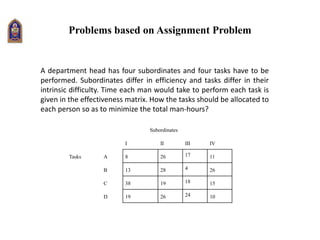
Problems based on Assignment Problem
Tasks
Subordinates
I II III IV
A 8 26 17 11
B 13 28 4 26
C 38 19 18 15
D 19 26 24 10
A department head has four subordinates and four tasks have to be
performed. Subordinates differ in efficiency and tasks differ in their
intrinsic difficulty. Time each man would take to perform each task is
given in the effectiveness matrix. How the tasks should be allocated to
each person so as to minimize the total man-hours?
Games Theory
Games theory is a type of decision theory in which one’s choice of action
is determined after taking into account all possible alternatives available to
an opponent playing the same game rather than just by possibilities.
The mathematical analysis of competitive problems is fundamentally based
upon the ‘minimax (maximin) criterion’ of J.Von Neumann (called the
father of game theory). This criterion implies the assumption of rationality
from which it is argued that each player will act so as to ‘maximise his
minimum gain’ or ‘minimize his maximum loss’.
Competitive Game
•A competitive situation is called a competitive game if it has the
following four properties:
•There are finite number (n) of competitors (called players) such that n≥2 .
In case ,n = 2 it is called a two-person game and in case n>2 , it is referred
to as n-person game.
•Each player has a set of finite number of possible activities (the list may
not be the same for each player).
Competitive Game
•A play is said to occur when each player chooses one of his activities. The
choices are assumed to be made simultaneously, i.e., no player knows the
choice of the other until he has decided on his own.
•Every combination of activities determines an outcome (which may be
points, money or any thing else whatsoever) which results in a gain of
payments (+ve, -ve or zero) to each player, provided each player is playing
uncompromisingly to get as much as possible. Negative gain implies the
loss of same amount.
Zero-sum and Non-zero-sum Games
•If the players make payments only to each other, i.e., the
loss of one is the gain of others, and nothing comes from
outside, the competitive game is said to be zero-sum.
•A game which is non-zero-sum is called a non-zero-sum
game. An example of a non-zero-sum game is the ‘poker’
game in which a certain part of the pot is removed from
the ‘house’ before the final payoff.
Strategy
A strategy for a given player is a set of rules that
specifies which of the available course of action he should
make at each play.
Pure Strategy: If a player knows exactly what the other
player is going to do, a deterministic situation is obtained
and objective function is to maximize the gain. Therefore,
the pure strategy is a decision rule always to select a
particular course of action.
Mixed Strategy
If a player is guessing as to which activity is to be
selected by the other on any particular occasion, a
probabilistic situation is obtained and the
objective function is to maximize the expected
gain. Thus, a mixed strategy is a selection among
pure strategies with fixed probabilities
Two-Person, Zero-Sum (Rectangular) Games
•A game with only two players (say, Player A and
Player B) is called a ‘two-person, zero-sum game’ if
losses of one player are equivalent to the gains of the
other, so that the sum of their net gains is zero.
•Two-Person, Zero-Sum games, are also called
rectangular games as these are usually represented
by a payoff matrix in rectangular form.
MINIMAX (MAXIMIN) CRITERION AND OPTIMAL STRATEGY
The ‘minimax criterion of optimality’ states that if a player
lists the worst possible outcomes of all his potential strategies,
he will choose that strategy to be the most suitable for him
which corresponds to the best of these worst outcomes. Such
a strategy is called an optimal strategy.
Saddle point
A saddle point of a payoff matrix is the position of such an
element in the payoff matrix which is minimum in its row and
maximum in its column.
Rules for Determining a Saddle Point
• Step 1. Select the minimum element of each row
of the payoff matrix and mark them by ‘o’.
• Step 2. Select the greatest element of each column
of the payoff matrix and mark them by.
• Step 3. If there appears an element in the payoff
matrix marked by ‘o’ and both, the position of that
element is a ‘saddle point’ of the payoff matrix.
SOLUTION OF GAMES WITH SADDLE POINTS
• To obtain a solution of a rectangular game, it
is feasible to find out:
• The best strategy for player A (ii) the best
strategy for player B, and (iii) the value of the
game .
• The value of the game to the player A is the
element at the saddle point, and the value to
the player B will be its negative.
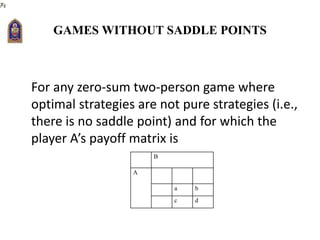
GAMES WITHOUT SADDLE POINTS
For any zero-sum two-person game where
optimal strategies are not pure strategies (i.e.,
there is no saddle point) and for which the
player A’s payoff matrix is
B
A
a b
c d
DOMINANCE PROPERTY
•Rule 1. If each element in any row is less than the element of
other row, then lesser value of the row is deleted.
•Rule 2. If each element in any column is greater than the
element of other column, then greater value of the column is
deleted.
•Rule 3. If rule 1 and 2 is not suit, then we take average of any
two row or column is less or greater than the element of other
row or column, then lesser or greater value of the row or
column is deleted.
GRAPHICAL METHOD (2*n)FOR and (m*2) GAMES
• This method enables us to reduce the or matrix game to that could be easily
solved by earlier methods.
• For (2*n) games, take 1st row on right side and 2nd row on left side, then find
the maximin point (highest point on the lowest boundary) which is the
intersection of two lines and reduce the game in matrix. After that, obtain the
optimal mixed strategies and value of the game.
• For (m*2) games, take 1st column on right side and 2nd column on left side,
then find the minimax point (lowest point on the upper most boundary) which
is the intersection of two lines and reduce the game in matrix. After that, obtain
the optimal mixed strategies and value of the game.

Unit 3 ap gt

  • 1.
    QUANTITATIVE TECHNIQUES FOR MANAGERS UNIT-IIIRMB 207 DR. ZIAUL HASSAN BAKHSHI
  • 2.
    Assignment Problem • Inassignment problems, the objective is to assign a number of jobs to the equal number of persons at a minimum cost of maximum profit. • Suppose there are ‘n’ jobs to be performed and ‘n’ persons are available for doing these jobs. Assume each person can do each job at a time with a varying degree of efficiency. Let cij be the cost of ith person assigned to jth job. Then the problem is to find an assignment so that the total cost for performing all jobs is minimum. Such problems are known as assignment problems.
  • 3.
    Algorithm for AssignmentProblem (Hungarian Method) Step 1 Subtract the minimum of each row of the effectiveness matrix, from all the elements of the respective rows (Row reduced matrix). Step 2 Further modify the resulting matrix by subtracting the minimum element of each column from all the elements of the respective columns. Thus first modified matrix is obtained. Step 3 Draw the minimum number of horizontal and vertical lines to cover all the zeroes in the resulting matrix. Let the minimum number of lines be N. Now there may be two possibilities If N = n, the number of rows (columns) of the given matrix then an optimal assignment can be made. So make the zero assignment to get the required solution. If N < n then proceed to step 4
  • 4.
    Step 4 Determine thesmallest element in the matrix, not covered by N lines. Subtract this minimum element from all uncovered elements and add the same element at the intersection of horizontal and vertical lines. Thus the second modified matrix is obtained. Step 5 Repeat step 3 and step 4 until minimum number of lines become equal to number of rows (columns) of the given matrix i.e. N = n. Step 6 To make zero assignment - examine the rows successively until a row-wise exactly single zero is found; mark this zero by ‘1’‘to make the assignment. Then, mark a ‘X’ over all zeroes if lying in the column of the marked zero, showing that they cannot be considered for further assignment. Continue in this manner until all the rows have been examined. Repeat the same procedure for the columns also.
  • 5.
    Step 7 Repeat thestep 6 successively until one of the following situations arise If no unmarked zero is left, then process ends If there lies more than one of the unmarked zeroes in any column or row, then mark ‘1’‘one of the unmarked zeroes arbitrarily and mark a cross in the cells of remaining zeroes in its row and column. Repeat the process until no unmarked zero is left in the matrix. Step 8 Exactly one marked zero in each row and each column of the matrix is obtained. The assignment corresponding to these marked zeroes will give the optimal assignment.
  • 6.
    A rule todraw minimum number of lines A very convenient rule of drawing minimum number of lines to cover all the 0’s of the reduced matrix is given in the following steps: •Step 1. Tick rows that do not have any marked zero. •Step 2. Tick columns having marked rows otherwise in ticked rows. •Step 3.Tick rows having marked in ticked columns. •Step 4. Repeat Step 2 and 3 until the chain of ticking is complete. •Step 5. Draw lines through all the unticked rows and ticked columns. This gives us the required minimum number of lines.
  • 7.
    Problems based onAssignment Problem Tasks Subordinates I II III IV A 8 26 17 11 B 13 28 4 26 C 38 19 18 15 D 19 26 24 10 A department head has four subordinates and four tasks have to be performed. Subordinates differ in efficiency and tasks differ in their intrinsic difficulty. Time each man would take to perform each task is given in the effectiveness matrix. How the tasks should be allocated to each person so as to minimize the total man-hours?
  • 8.
    Games Theory Games theoryis a type of decision theory in which one’s choice of action is determined after taking into account all possible alternatives available to an opponent playing the same game rather than just by possibilities. The mathematical analysis of competitive problems is fundamentally based upon the ‘minimax (maximin) criterion’ of J.Von Neumann (called the father of game theory). This criterion implies the assumption of rationality from which it is argued that each player will act so as to ‘maximise his minimum gain’ or ‘minimize his maximum loss’.
  • 9.
    Competitive Game •A competitivesituation is called a competitive game if it has the following four properties: •There are finite number (n) of competitors (called players) such that n≥2 . In case ,n = 2 it is called a two-person game and in case n>2 , it is referred to as n-person game. •Each player has a set of finite number of possible activities (the list may not be the same for each player).
  • 10.
    Competitive Game •A playis said to occur when each player chooses one of his activities. The choices are assumed to be made simultaneously, i.e., no player knows the choice of the other until he has decided on his own. •Every combination of activities determines an outcome (which may be points, money or any thing else whatsoever) which results in a gain of payments (+ve, -ve or zero) to each player, provided each player is playing uncompromisingly to get as much as possible. Negative gain implies the loss of same amount.
  • 11.
    Zero-sum and Non-zero-sumGames •If the players make payments only to each other, i.e., the loss of one is the gain of others, and nothing comes from outside, the competitive game is said to be zero-sum. •A game which is non-zero-sum is called a non-zero-sum game. An example of a non-zero-sum game is the ‘poker’ game in which a certain part of the pot is removed from the ‘house’ before the final payoff.
  • 12.
    Strategy A strategy fora given player is a set of rules that specifies which of the available course of action he should make at each play. Pure Strategy: If a player knows exactly what the other player is going to do, a deterministic situation is obtained and objective function is to maximize the gain. Therefore, the pure strategy is a decision rule always to select a particular course of action.
  • 13.
    Mixed Strategy If aplayer is guessing as to which activity is to be selected by the other on any particular occasion, a probabilistic situation is obtained and the objective function is to maximize the expected gain. Thus, a mixed strategy is a selection among pure strategies with fixed probabilities
  • 14.
    Two-Person, Zero-Sum (Rectangular)Games •A game with only two players (say, Player A and Player B) is called a ‘two-person, zero-sum game’ if losses of one player are equivalent to the gains of the other, so that the sum of their net gains is zero. •Two-Person, Zero-Sum games, are also called rectangular games as these are usually represented by a payoff matrix in rectangular form.
  • 15.
    MINIMAX (MAXIMIN) CRITERIONAND OPTIMAL STRATEGY The ‘minimax criterion of optimality’ states that if a player lists the worst possible outcomes of all his potential strategies, he will choose that strategy to be the most suitable for him which corresponds to the best of these worst outcomes. Such a strategy is called an optimal strategy.
  • 16.
    Saddle point A saddlepoint of a payoff matrix is the position of such an element in the payoff matrix which is minimum in its row and maximum in its column.
  • 17.
    Rules for Determininga Saddle Point • Step 1. Select the minimum element of each row of the payoff matrix and mark them by ‘o’. • Step 2. Select the greatest element of each column of the payoff matrix and mark them by. • Step 3. If there appears an element in the payoff matrix marked by ‘o’ and both, the position of that element is a ‘saddle point’ of the payoff matrix.
  • 18.
    SOLUTION OF GAMESWITH SADDLE POINTS • To obtain a solution of a rectangular game, it is feasible to find out: • The best strategy for player A (ii) the best strategy for player B, and (iii) the value of the game . • The value of the game to the player A is the element at the saddle point, and the value to the player B will be its negative.
  • 19.
    GAMES WITHOUT SADDLEPOINTS For any zero-sum two-person game where optimal strategies are not pure strategies (i.e., there is no saddle point) and for which the player A’s payoff matrix is B A a b c d
  • 20.
    DOMINANCE PROPERTY •Rule 1.If each element in any row is less than the element of other row, then lesser value of the row is deleted. •Rule 2. If each element in any column is greater than the element of other column, then greater value of the column is deleted. •Rule 3. If rule 1 and 2 is not suit, then we take average of any two row or column is less or greater than the element of other row or column, then lesser or greater value of the row or column is deleted.
  • 21.
    GRAPHICAL METHOD (2*n)FORand (m*2) GAMES • This method enables us to reduce the or matrix game to that could be easily solved by earlier methods. • For (2*n) games, take 1st row on right side and 2nd row on left side, then find the maximin point (highest point on the lowest boundary) which is the intersection of two lines and reduce the game in matrix. After that, obtain the optimal mixed strategies and value of the game. • For (m*2) games, take 1st column on right side and 2nd column on left side, then find the minimax point (lowest point on the upper most boundary) which is the intersection of two lines and reduce the game in matrix. After that, obtain the optimal mixed strategies and value of the game.