(eBook PDF) Global Innovation Science Handbook by Praveen Gupta
(eBook PDF) Global Innovation Science Handbook by Praveen Gupta
(eBook PDF) Global Innovation Science Handbook by Praveen Gupta
(eBook PDF) Global Innovation Science Handbook by Praveen Gupta
(eBook PDF) Global Innovation Science Handbook by Praveen Gupta
1.
(eBook PDF) GlobalInnovation Science Handbook
by Praveen Gupta download
https://ebookluna.com/product/ebook-pdf-global-innovation-
science-handbook-by-praveen-gupta/
Download full version ebook from https://ebookluna.com
2.
We believe theseproducts will be a great fit for you. Click
the link to download now, or visit ebookluna.com
to discover even more!
(eBook PDF) Global Innovation Science Handbook
https://ebookluna.com/product/ebook-pdf-global-innovation-science-handbook/
(eBook PDF) Business Ethics 2nd Edition by K. Praveen Parboteeah
https://ebookluna.com/product/ebook-pdf-business-ethics-2nd-edition-by-k-
praveen-parboteeah/
(eBook PDF) Pro Apache Log4j 2nd by Samudra Gupta
https://ebookluna.com/product/ebook-pdf-pro-apache-log4j-2nd-by-samudra-
gupta/
Innovation Strategies in Environmental Science 1st Edition Charis M.
Galanakis (Editor) - eBook PDF
https://ebookluna.com/download/innovation-strategies-in-environmental-
science-ebook-pdf/
3.
(eBook PDF) BiologicalScience 6th Global Edition by Scott Freeman
https://ebookluna.com/product/ebook-pdf-biological-science-6th-global-
edition-by-scott-freeman/
Science for Policy Handbook 1st edition - eBook PDF
https://ebookluna.com/download/science-for-policy-handbook-ebook-pdf/
Innovation in Nano-polysaccharides for Eco-sustainability: From Science to
Industrial Applications 1st Edition - eBook PDF
https://ebookluna.com/download/innovation-in-nano-polysaccharides-for-eco-
sustainability-from-science-to-industrial-applications-ebook-pdf/
(eBook PDF) Innovation and Entrepreneurship 3rd Edition by John Bessant
https://ebookluna.com/product/ebook-pdf-innovation-and-
entrepreneurship-3rd-edition-by-john-bessant/
(eBook PDF) Translational Medicine in CNS Drug Development, Volume 29
https://ebookluna.com/product/ebook-pdf-translational-medicine-in-cns-drug-
development-volume-29/
6.
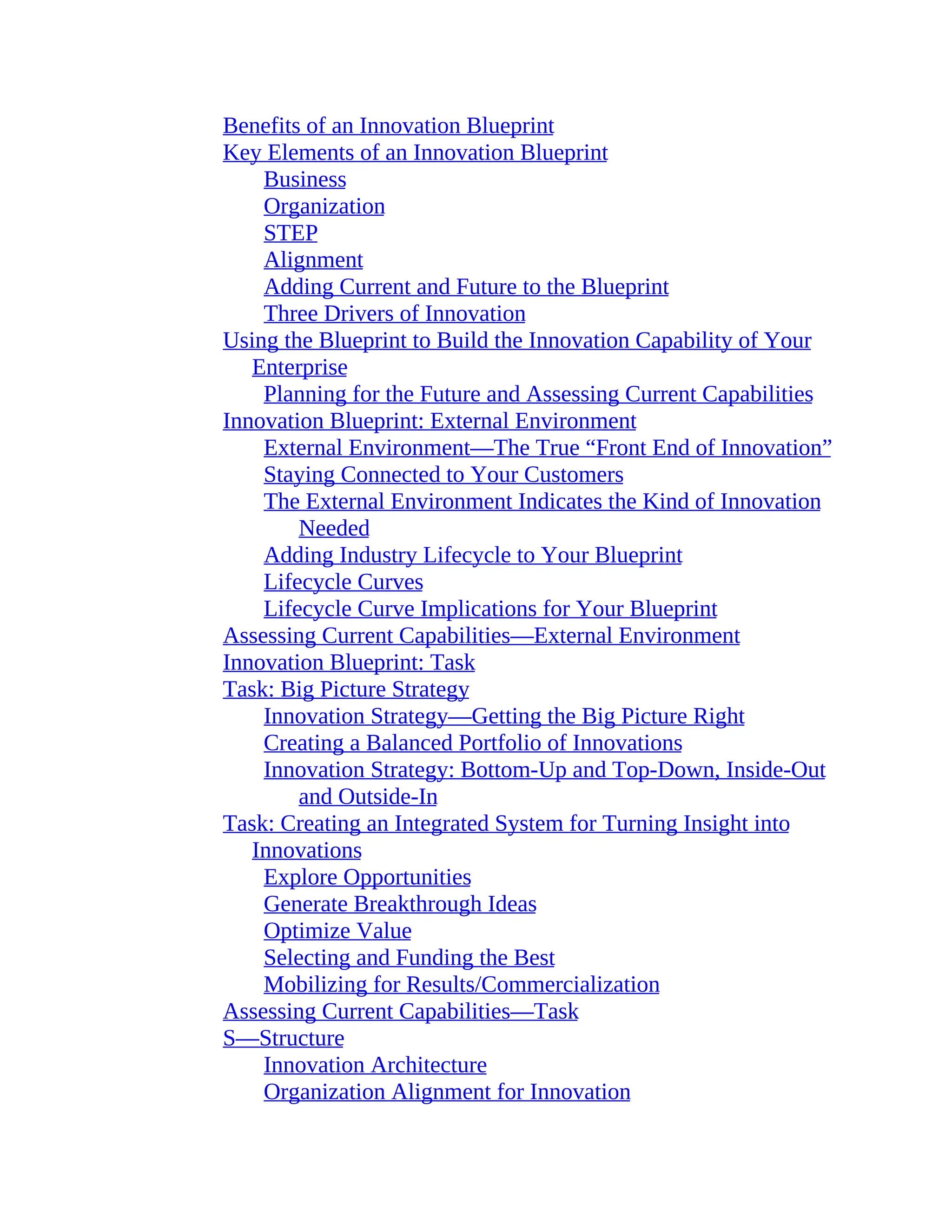
Benefits of anInnovation Blueprint
Key Elements of an Innovation Blueprint
Business
Organization
STEP
Alignment
Adding Current and Future to the Blueprint
Three Drivers of Innovation
Using the Blueprint to Build the Innovation Capability of Your
Enterprise
Planning for the Future and Assessing Current Capabilities
Innovation Blueprint: External Environment
External Environment—The True “Front End of Innovation”
Staying Connected to Your Customers
The External Environment Indicates the Kind of Innovation
Needed
Adding Industry Lifecycle to Your Blueprint
Lifecycle Curves
Lifecycle Curve Implications for Your Blueprint
Assessing Current Capabilities—External Environment
Innovation Blueprint: Task
Task: Big Picture Strategy
Innovation Strategy—Getting the Big Picture Right
Creating a Balanced Portfolio of Innovations
Innovation Strategy: Bottom-Up and Top-Down, Inside-Out
and Outside-In
Task: Creating an Integrated System for Turning Insight into
Innovations
Explore Opportunities
Generate Breakthrough Ideas
Optimize Value
Selecting and Funding the Best
Mobilizing for Results/Commercialization
Assessing Current Capabilities—Task
S—Structure
Innovation Architecture
Organization Alignment for Innovation
7.
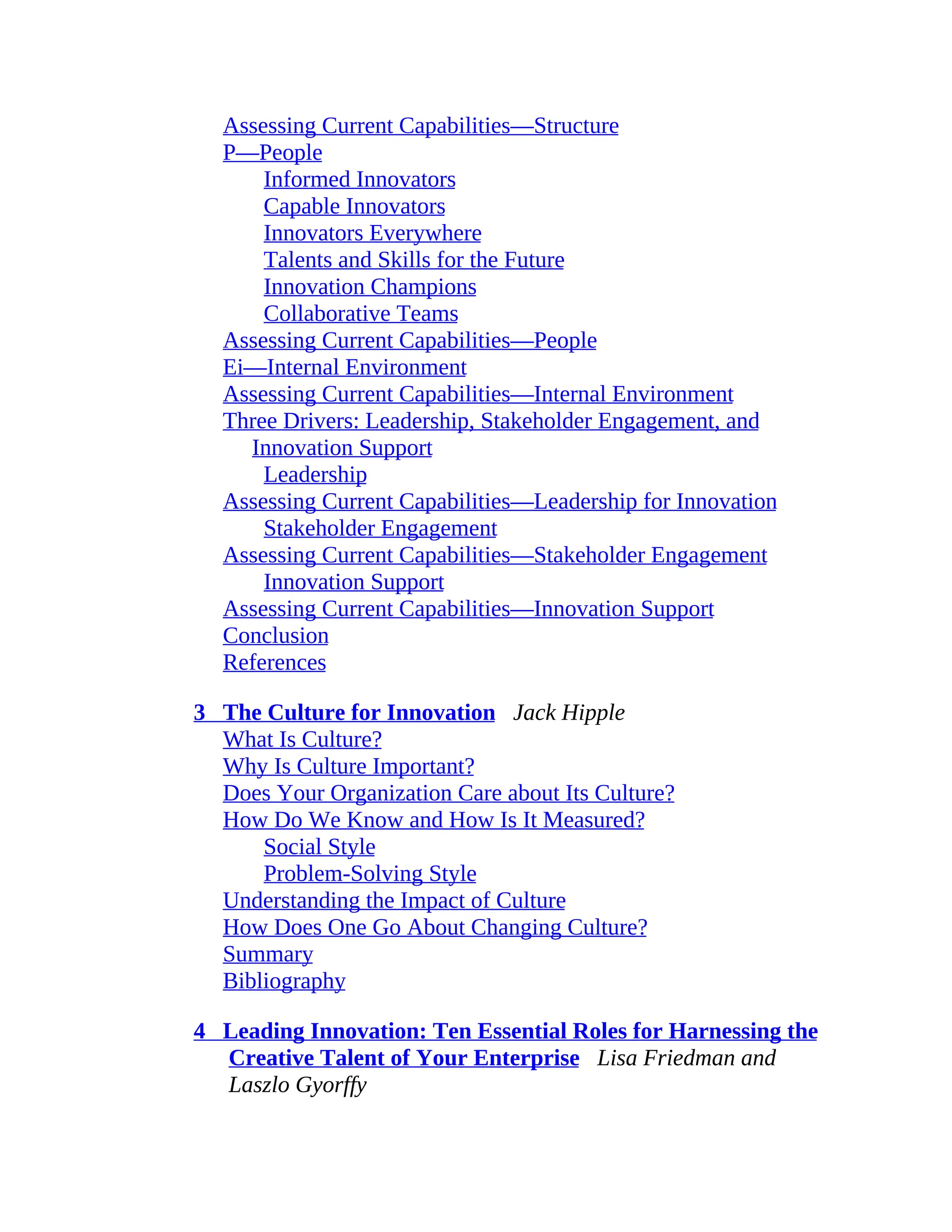
Assessing Current Capabilities—Structure
P—People
InformedInnovators
Capable Innovators
Innovators Everywhere
Talents and Skills for the Future
Innovation Champions
Collaborative Teams
Assessing Current Capabilities—People
Ei—Internal Environment
Assessing Current Capabilities—Internal Environment
Three Drivers: Leadership, Stakeholder Engagement, and
Innovation Support
Leadership
Assessing Current Capabilities—Leadership for Innovation
Stakeholder Engagement
Assessing Current Capabilities—Stakeholder Engagement
Innovation Support
Assessing Current Capabilities—Innovation Support
Conclusion
References
3 The Culture for Innovation Jack Hipple
What Is Culture?
Why Is Culture Important?
Does Your Organization Care about Its Culture?
How Do We Know and How Is It Measured?
Social Style
Problem-Solving Style
Understanding the Impact of Culture
How Does One Go About Changing Culture?
Summary
Bibliography
4 Leading Innovation: Ten Essential Roles for Harnessing the
Creative Talent of Your Enterprise Lisa Friedman and
Laszlo Gyorffy
8.
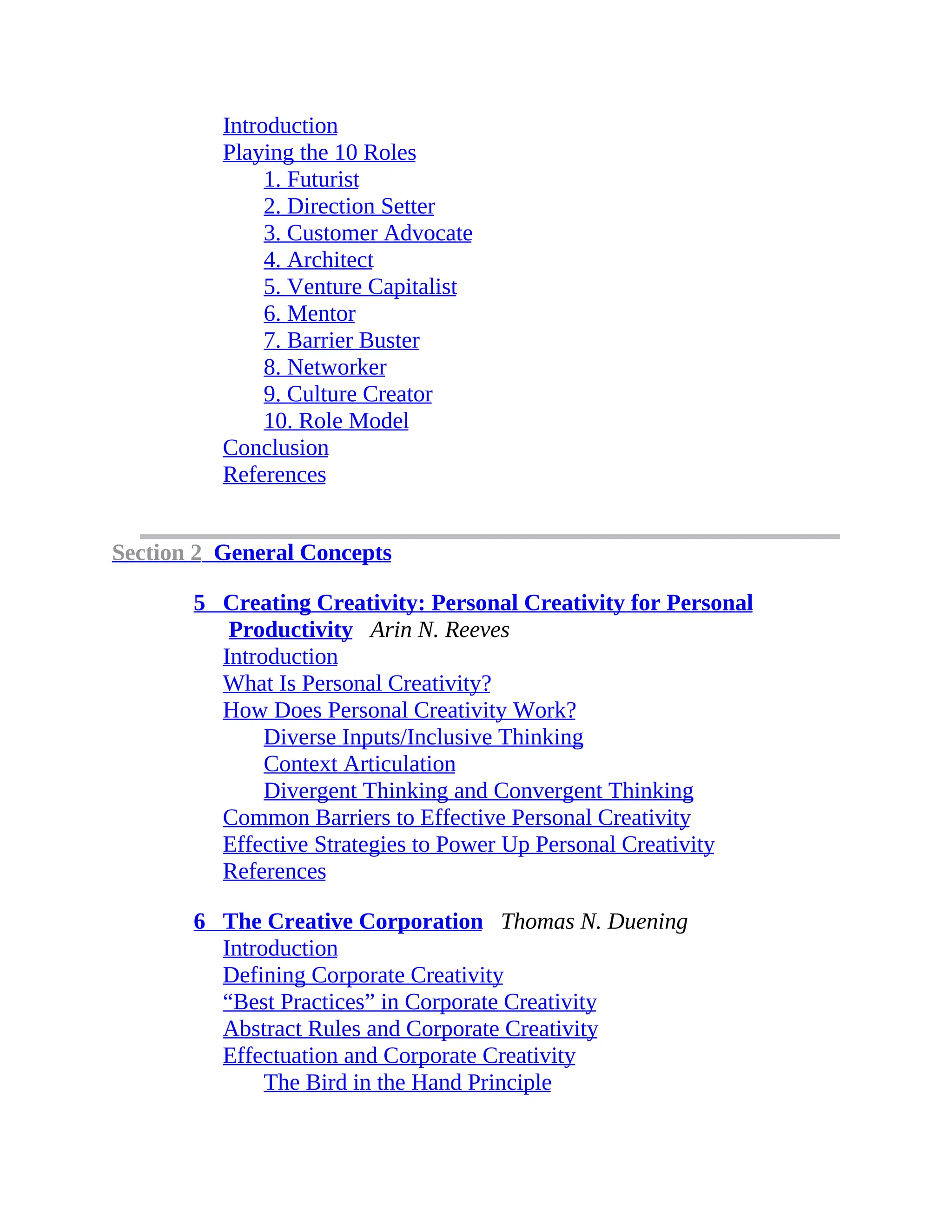
Introduction
Playing the 10Roles
1. Futurist
2. Direction Setter
3. Customer Advocate
4. Architect
5. Venture Capitalist
6. Mentor
7. Barrier Buster
8. Networker
9. Culture Creator
10. Role Model
Conclusion
References
Section 2 General Concepts
5 Creating Creativity: Personal Creativity for Personal
Productivity Arin N. Reeves
Introduction
What Is Personal Creativity?
How Does Personal Creativity Work?
Diverse Inputs/Inclusive Thinking
Context Articulation
Divergent Thinking and Convergent Thinking
Common Barriers to Effective Personal Creativity
Effective Strategies to Power Up Personal Creativity
References
6 The Creative Corporation Thomas N. Duening
Introduction
Defining Corporate Creativity
“Best Practices” in Corporate Creativity
Abstract Rules and Corporate Creativity
Effectuation and Corporate Creativity
The Bird in the Hand Principle
9.
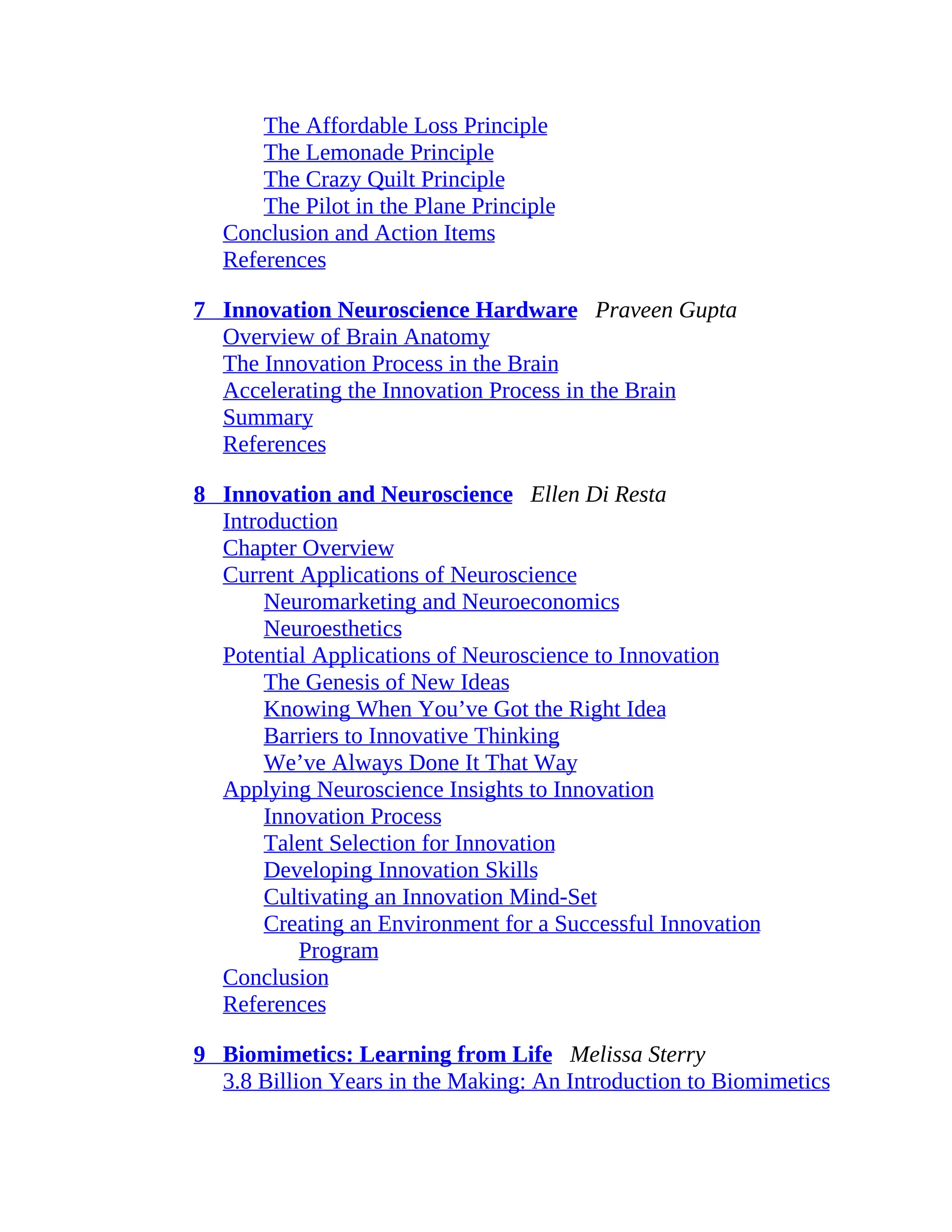
The Affordable LossPrinciple
The Lemonade Principle
The Crazy Quilt Principle
The Pilot in the Plane Principle
Conclusion and Action Items
References
7 Innovation Neuroscience Hardware Praveen Gupta
Overview of Brain Anatomy
The Innovation Process in the Brain
Accelerating the Innovation Process in the Brain
Summary
References
8 Innovation and Neuroscience Ellen Di Resta
Introduction
Chapter Overview
Current Applications of Neuroscience
Neuromarketing and Neuroeconomics
Neuroesthetics
Potential Applications of Neuroscience to Innovation
The Genesis of New Ideas
Knowing When You’ve Got the Right Idea
Barriers to Innovative Thinking
We’ve Always Done It That Way
Applying Neuroscience Insights to Innovation
Innovation Process
Talent Selection for Innovation
Developing Innovation Skills
Cultivating an Innovation Mind-Set
Creating an Environment for a Successful Innovation
Program
Conclusion
References
9 Biomimetics: Learning from Life Melissa Sterry
3.8 Billion Years in the Making: An Introduction to Biomimetics
10.
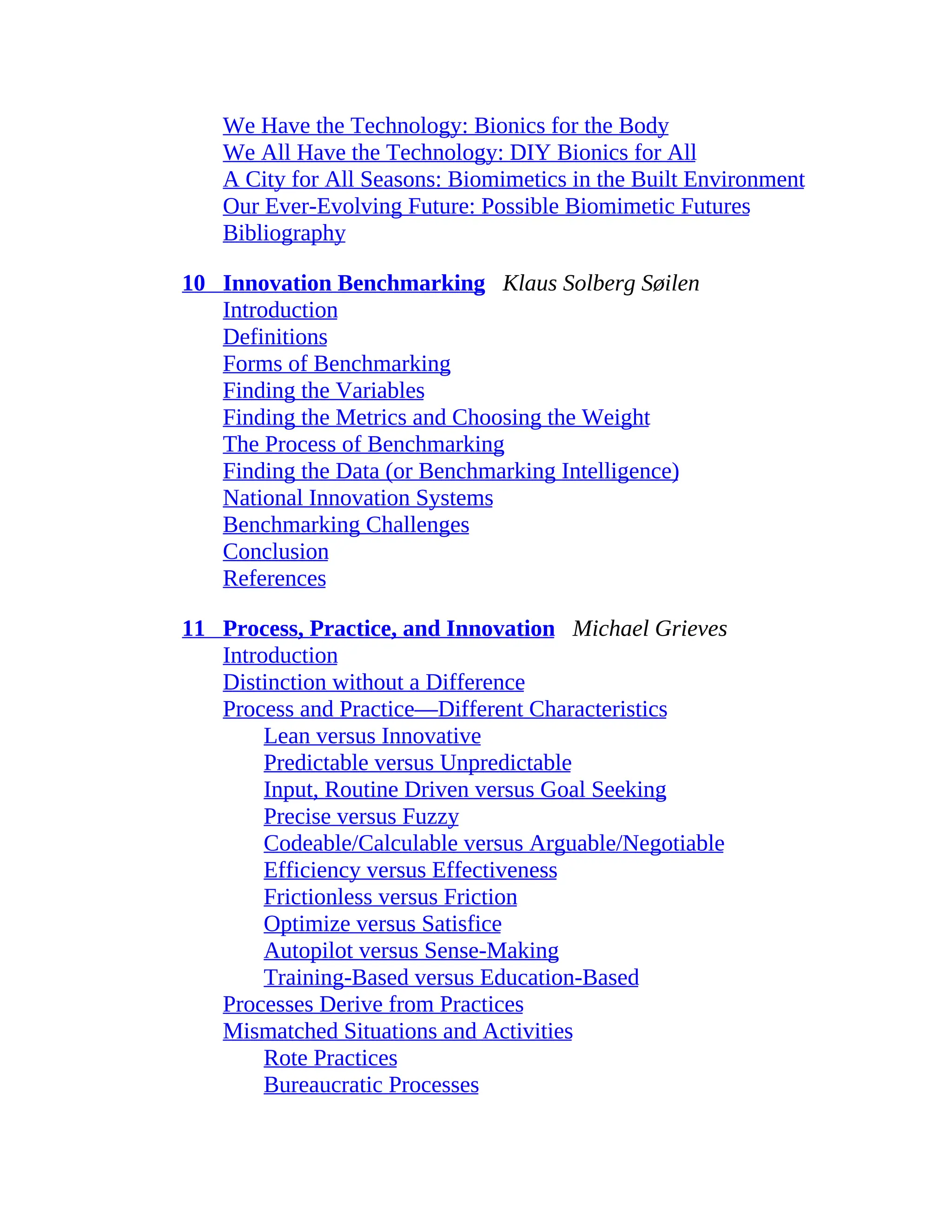
We Have theTechnology: Bionics for the Body
We All Have the Technology: DIY Bionics for All
A City for All Seasons: Biomimetics in the Built Environment
Our Ever-Evolving Future: Possible Biomimetic Futures
Bibliography
10 Innovation Benchmarking Klaus Solberg Søilen
Introduction
Definitions
Forms of Benchmarking
Finding the Variables
Finding the Metrics and Choosing the Weight
The Process of Benchmarking
Finding the Data (or Benchmarking Intelligence)
National Innovation Systems
Benchmarking Challenges
Conclusion
References
11 Process, Practice, and Innovation Michael Grieves
Introduction
Distinction without a Difference
Process and Practice—Different Characteristics
Lean versus Innovative
Predictable versus Unpredictable
Input, Routine Driven versus Goal Seeking
Precise versus Fuzzy
Codeable/Calculable versus Arguable/Negotiable
Efficiency versus Effectiveness
Frictionless versus Friction
Optimize versus Satisfice
Autopilot versus Sense-Making
Training-Based versus Education-Based
Processes Derive from Practices
Mismatched Situations and Activities
Rote Practices
Bureaucratic Processes
11.
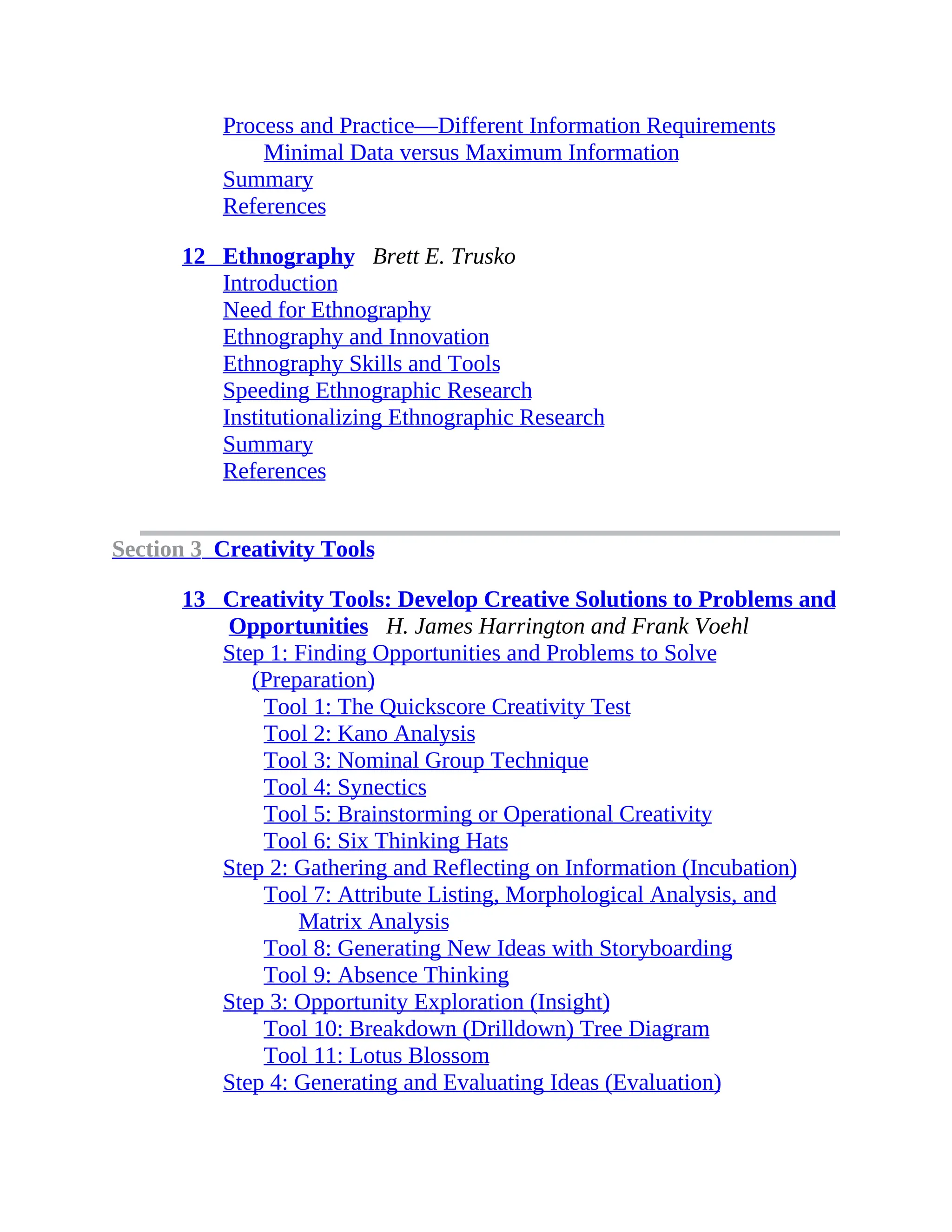
Process and Practice—DifferentInformation Requirements
Minimal Data versus Maximum Information
Summary
References
12 Ethnography Brett E. Trusko
Introduction
Need for Ethnography
Ethnography and Innovation
Ethnography Skills and Tools
Speeding Ethnographic Research
Institutionalizing Ethnographic Research
Summary
References
Section 3 Creativity Tools
13 Creativity Tools: Develop Creative Solutions to Problems and
Opportunities H. James Harrington and Frank Voehl
Step 1: Finding Opportunities and Problems to Solve
(Preparation)
Tool 1: The Quickscore Creativity Test
Tool 2: Kano Analysis
Tool 3: Nominal Group Technique
Tool 4: Synectics
Tool 5: Brainstorming or Operational Creativity
Tool 6: Six Thinking Hats
Step 2: Gathering and Reflecting on Information (Incubation)
Tool 7: Attribute Listing, Morphological Analysis, and
Matrix Analysis
Tool 8: Generating New Ideas with Storyboarding
Tool 9: Absence Thinking
Step 3: Opportunity Exploration (Insight)
Tool 10: Breakdown (Drilldown) Tree Diagram
Tool 11: Lotus Blossom
Step 4: Generating and Evaluating Ideas (Evaluation)
12.
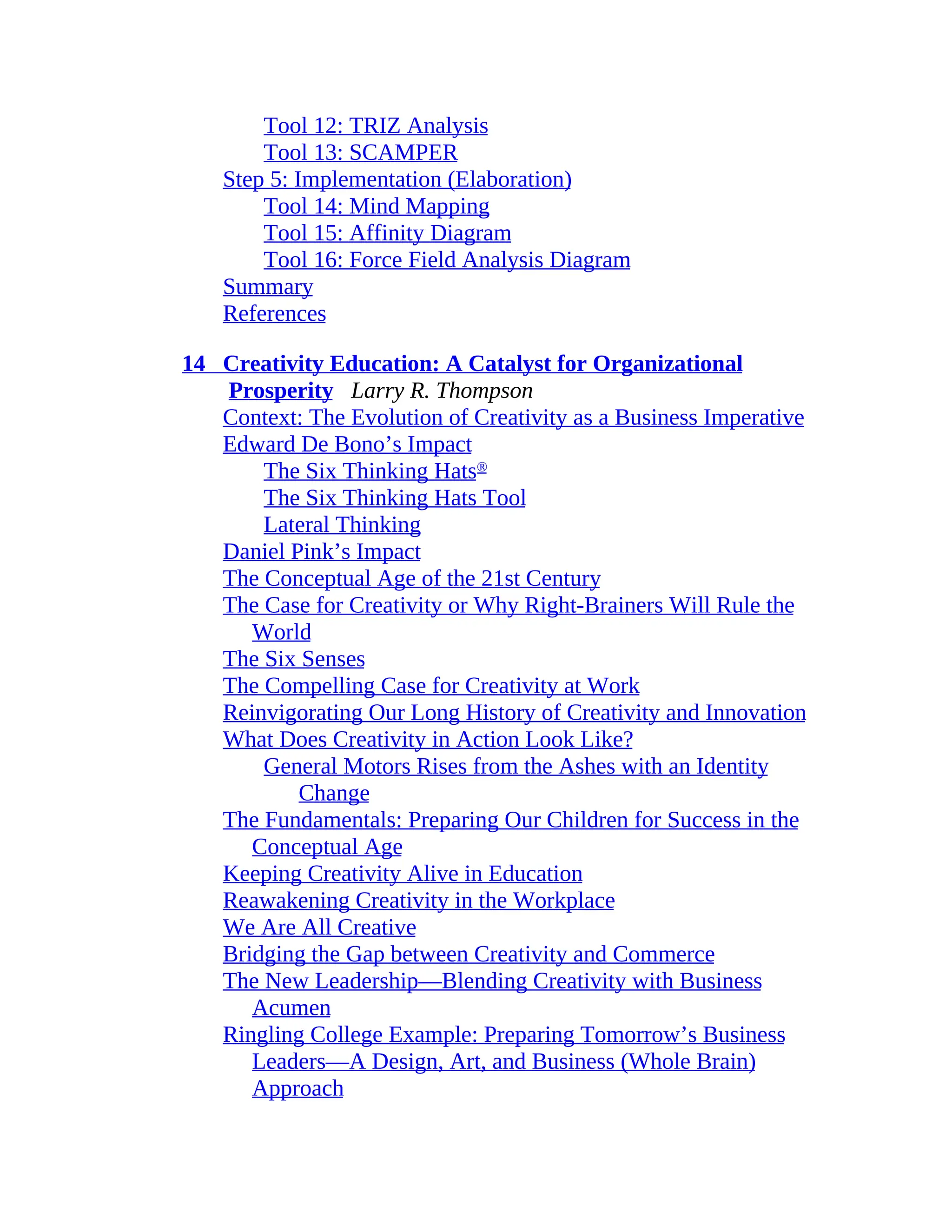
Tool 12: TRIZAnalysis
Tool 13: SCAMPER
Step 5: Implementation (Elaboration)
Tool 14: Mind Mapping
Tool 15: Affinity Diagram
Tool 16: Force Field Analysis Diagram
Summary
References
14 Creativity Education: A Catalyst for Organizational
Prosperity Larry R. Thompson
Context: The Evolution of Creativity as a Business Imperative
Edward De Bono’s Impact
The Six Thinking Hats®
The Six Thinking Hats Tool
Lateral Thinking
Daniel Pink’s Impact
The Conceptual Age of the 21st Century
The Case for Creativity or Why Right-Brainers Will Rule the
World
The Six Senses
The Compelling Case for Creativity at Work
Reinvigorating Our Long History of Creativity and Innovation
What Does Creativity in Action Look Like?
General Motors Rises from the Ashes with an Identity
Change
The Fundamentals: Preparing Our Children for Success in the
Conceptual Age
Keeping Creativity Alive in Education
Reawakening Creativity in the Workplace
We Are All Creative
Bridging the Gap between Creativity and Commerce
The New Leadership—Blending Creativity with Business
Acumen
Ringling College Example: Preparing Tomorrow’s Business
Leaders—A Design, Art, and Business (Whole Brain)
Approach
13.
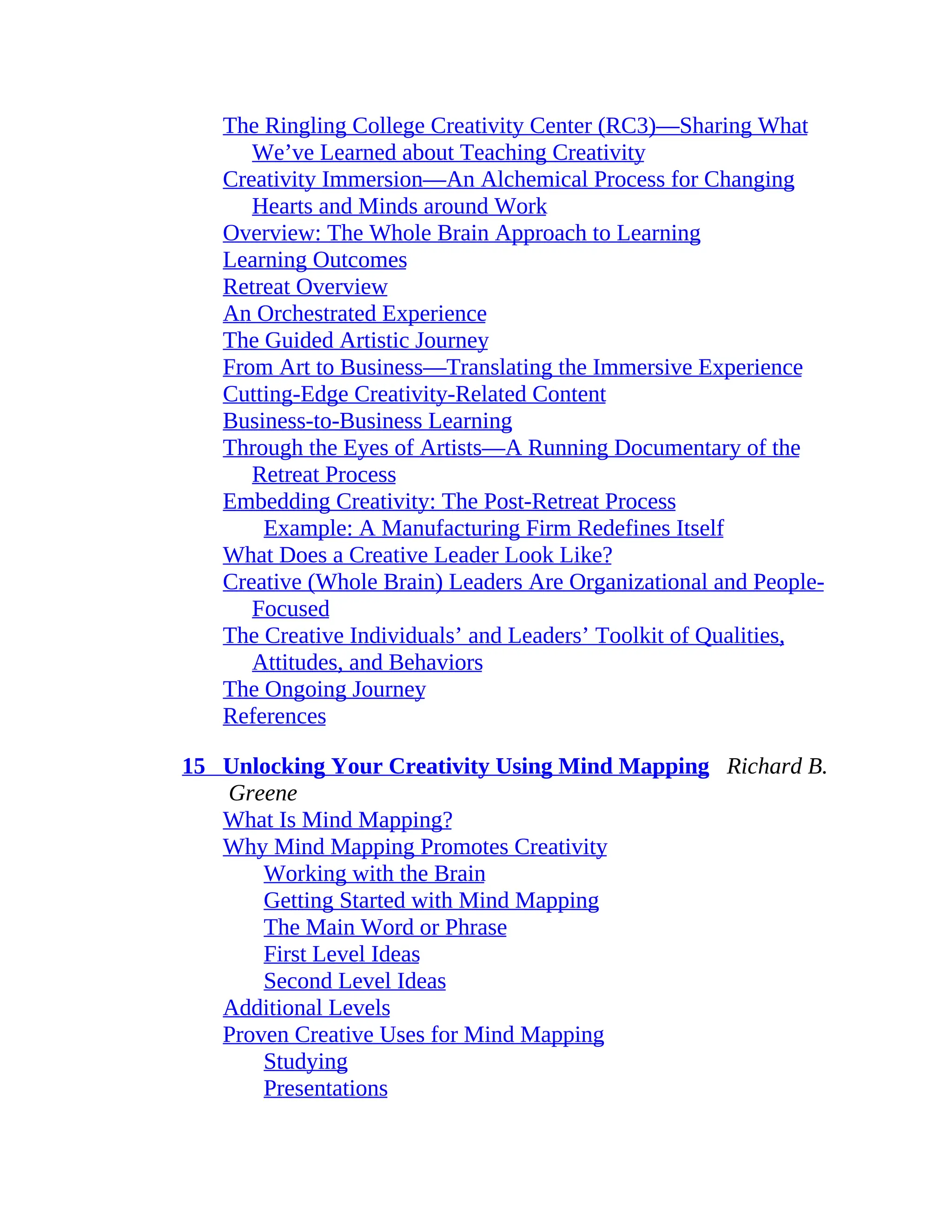
The Ringling CollegeCreativity Center (RC3)—Sharing What
We’ve Learned about Teaching Creativity
Creativity Immersion—An Alchemical Process for Changing
Hearts and Minds around Work
Overview: The Whole Brain Approach to Learning
Learning Outcomes
Retreat Overview
An Orchestrated Experience
The Guided Artistic Journey
From Art to Business—Translating the Immersive Experience
Cutting-Edge Creativity-Related Content
Business-to-Business Learning
Through the Eyes of Artists—A Running Documentary of the
Retreat Process
Embedding Creativity: The Post-Retreat Process
Example: A Manufacturing Firm Redefines Itself
What Does a Creative Leader Look Like?
Creative (Whole Brain) Leaders Are Organizational and People-
Focused
The Creative Individuals’ and Leaders’ Toolkit of Qualities,
Attitudes, and Behaviors
The Ongoing Journey
References
15 Unlocking Your Creativity Using Mind Mapping Richard B.
Greene
What Is Mind Mapping?
Why Mind Mapping Promotes Creativity
Working with the Brain
Getting Started with Mind Mapping
The Main Word or Phrase
First Level Ideas
Second Level Ideas
Additional Levels
Proven Creative Uses for Mind Mapping
Studying
Presentations
14.
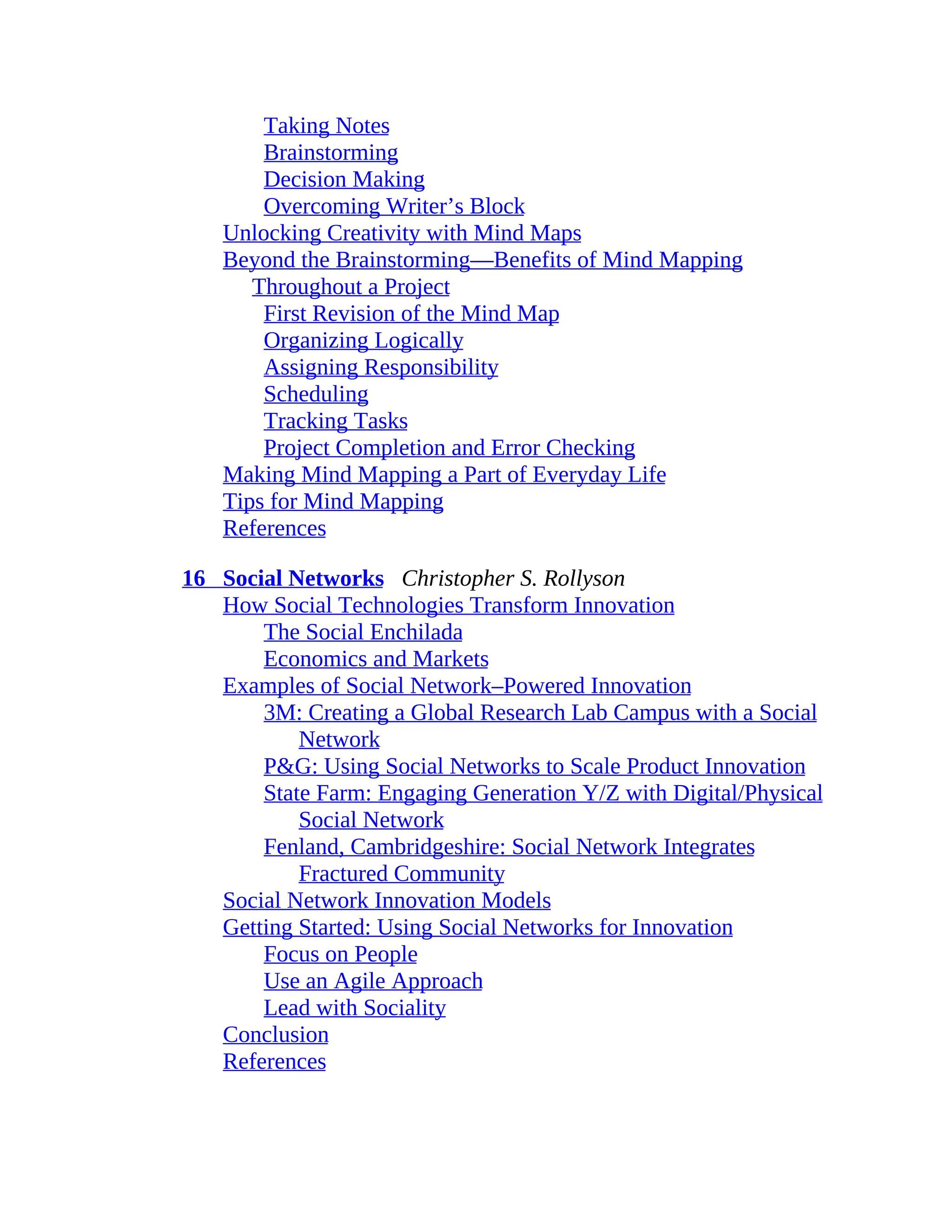
Taking Notes
Brainstorming
Decision Making
OvercomingWriter’s Block
Unlocking Creativity with Mind Maps
Beyond the Brainstorming—Benefits of Mind Mapping
Throughout a Project
First Revision of the Mind Map
Organizing Logically
Assigning Responsibility
Scheduling
Tracking Tasks
Project Completion and Error Checking
Making Mind Mapping a Part of Everyday Life
Tips for Mind Mapping
References
16 Social Networks Christopher S. Rollyson
How Social Technologies Transform Innovation
The Social Enchilada
Economics and Markets
Examples of Social Network–Powered Innovation
3M: Creating a Global Research Lab Campus with a Social
Network
P&G: Using Social Networks to Scale Product Innovation
State Farm: Engaging Generation Y/Z with Digital/Physical
Social Network
Fenland, Cambridgeshire: Social Network Integrates
Fractured Community
Social Network Innovation Models
Getting Started: Using Social Networks for Innovation
Focus on People
Use an Agile Approach
Lead with Sociality
Conclusion
References
15.
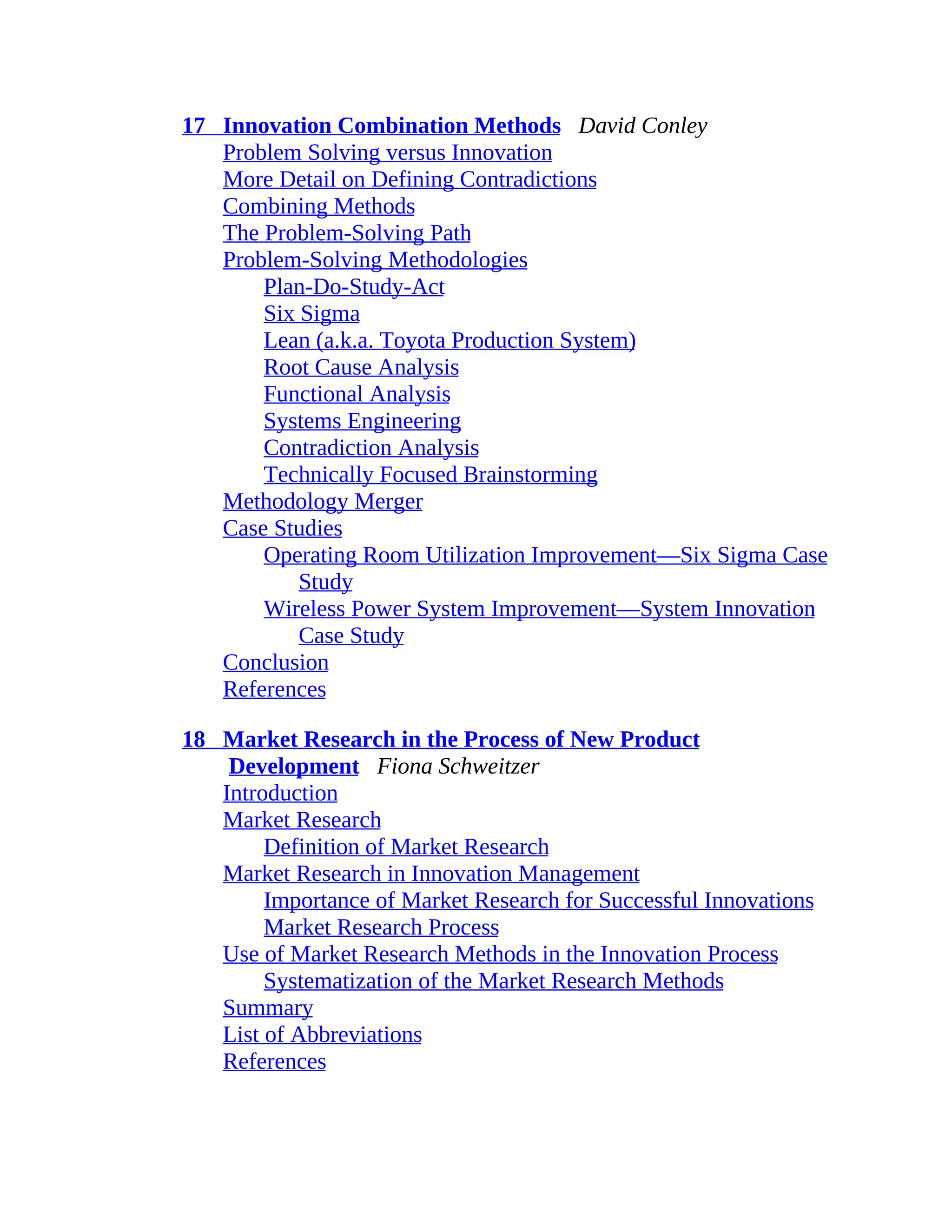
17 Innovation CombinationMethods David Conley
Problem Solving versus Innovation
More Detail on Defining Contradictions
Combining Methods
The Problem-Solving Path
Problem-Solving Methodologies
Plan-Do-Study-Act
Six Sigma
Lean (a.k.a. Toyota Production System)
Root Cause Analysis
Functional Analysis
Systems Engineering
Contradiction Analysis
Technically Focused Brainstorming
Methodology Merger
Case Studies
Operating Room Utilization Improvement—Six Sigma Case
Study
Wireless Power System Improvement—System Innovation
Case Study
Conclusion
References
18 Market Research in the Process of New Product
Development Fiona Schweitzer
Introduction
Market Research
Definition of Market Research
Market Research in Innovation Management
Importance of Market Research for Successful Innovations
Market Research Process
Use of Market Research Methods in the Innovation Process
Systematization of the Market Research Methods
Summary
List of Abbreviations
References
16.
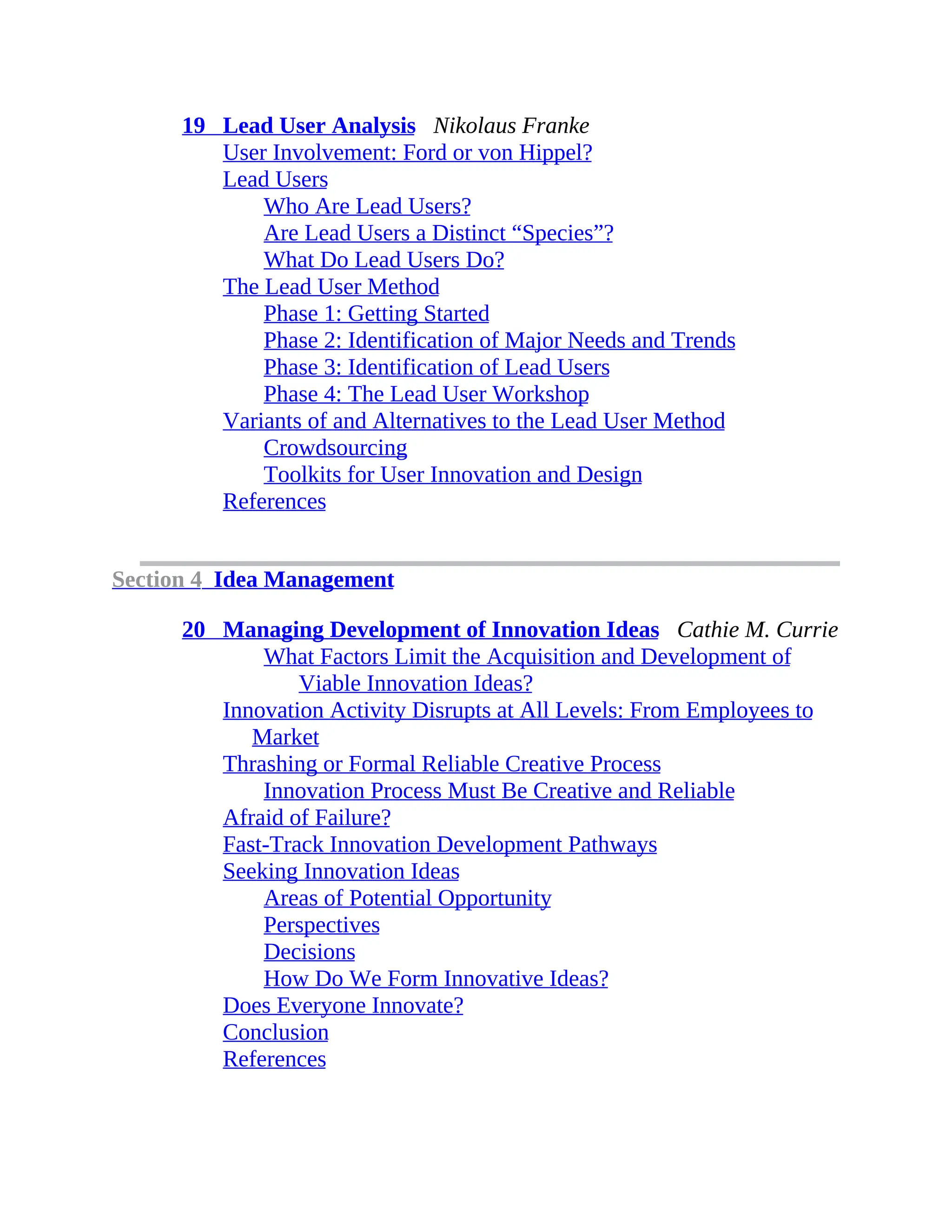
19 Lead UserAnalysis Nikolaus Franke
User Involvement: Ford or von Hippel?
Lead Users
Who Are Lead Users?
Are Lead Users a Distinct “Species”?
What Do Lead Users Do?
The Lead User Method
Phase 1: Getting Started
Phase 2: Identification of Major Needs and Trends
Phase 3: Identification of Lead Users
Phase 4: The Lead User Workshop
Variants of and Alternatives to the Lead User Method
Crowdsourcing
Toolkits for User Innovation and Design
References
Section 4 Idea Management
20 Managing Development of Innovation Ideas Cathie M. Currie
What Factors Limit the Acquisition and Development of
Viable Innovation Ideas?
Innovation Activity Disrupts at All Levels: From Employees to
Market
Thrashing or Formal Reliable Creative Process
Innovation Process Must Be Creative and Reliable
Afraid of Failure?
Fast-Track Innovation Development Pathways
Seeking Innovation Ideas
Areas of Potential Opportunity
Perspectives
Decisions
How Do We Form Innovative Ideas?
Does Everyone Innovate?
Conclusion
References
17.
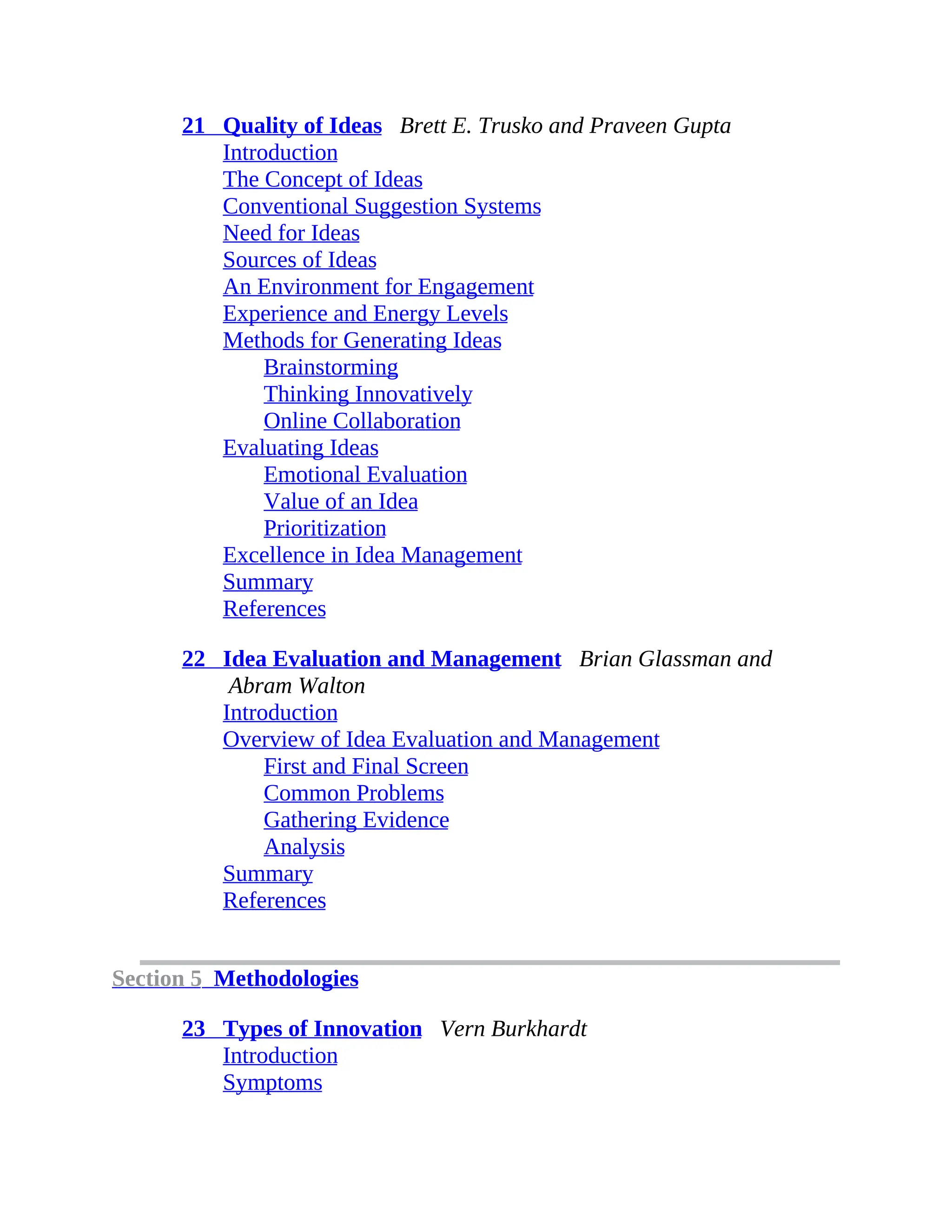
21 Quality ofIdeas Brett E. Trusko and Praveen Gupta
Introduction
The Concept of Ideas
Conventional Suggestion Systems
Need for Ideas
Sources of Ideas
An Environment for Engagement
Experience and Energy Levels
Methods for Generating Ideas
Brainstorming
Thinking Innovatively
Online Collaboration
Evaluating Ideas
Emotional Evaluation
Value of an Idea
Prioritization
Excellence in Idea Management
Summary
References
22 Idea Evaluation and Management Brian Glassman and
Abram Walton
Introduction
Overview of Idea Evaluation and Management
First and Final Screen
Common Problems
Gathering Evidence
Analysis
Summary
References
Section 5 Methodologies
23 Types of Innovation Vern Burkhardt
Introduction
Symptoms
18.
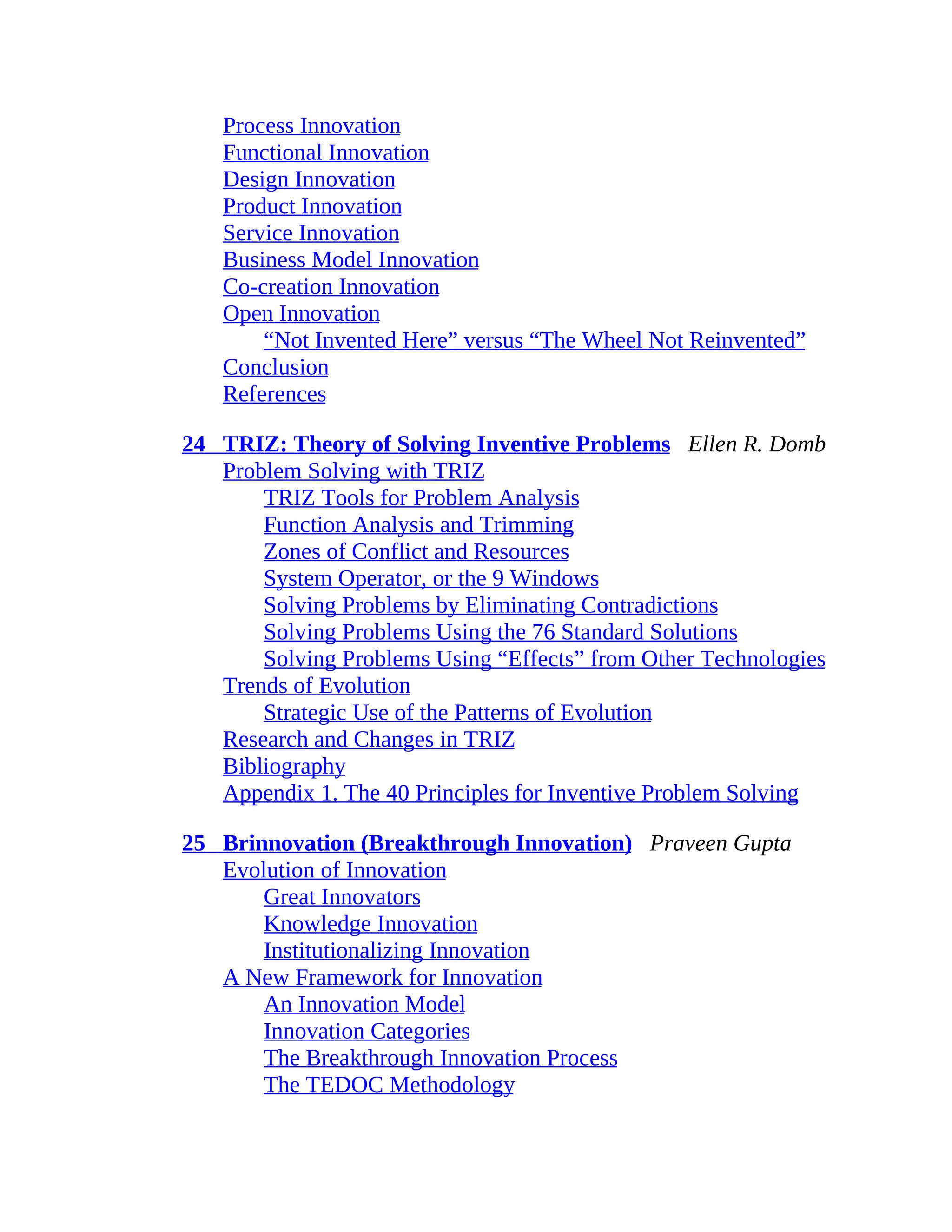
Process Innovation
Functional Innovation
DesignInnovation
Product Innovation
Service Innovation
Business Model Innovation
Co-creation Innovation
Open Innovation
“Not Invented Here” versus “The Wheel Not Reinvented”
Conclusion
References
24 TRIZ: Theory of Solving Inventive Problems Ellen R. Domb
Problem Solving with TRIZ
TRIZ Tools for Problem Analysis
Function Analysis and Trimming
Zones of Conflict and Resources
System Operator, or the 9 Windows
Solving Problems by Eliminating Contradictions
Solving Problems Using the 76 Standard Solutions
Solving Problems Using “Effects” from Other Technologies
Trends of Evolution
Strategic Use of the Patterns of Evolution
Research and Changes in TRIZ
Bibliography
Appendix 1. The 40 Principles for Inventive Problem Solving
25 Brinnovation (Breakthrough Innovation) Praveen Gupta
Evolution of Innovation
Great Innovators
Knowledge Innovation
Institutionalizing Innovation
A New Framework for Innovation
An Innovation Model
Innovation Categories
The Breakthrough Innovation Process
The TEDOC Methodology
19.
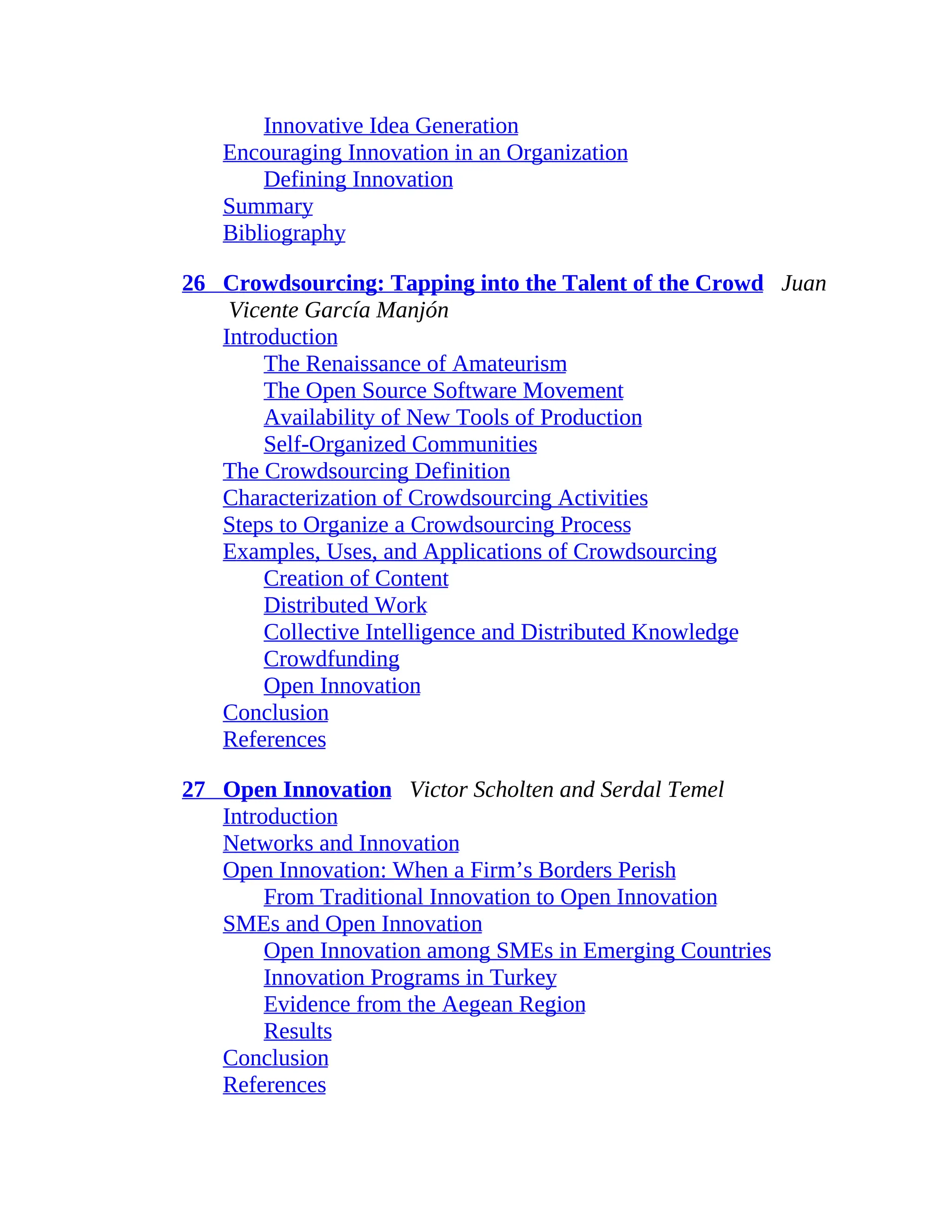
Innovative Idea Generation
EncouragingInnovation in an Organization
Defining Innovation
Summary
Bibliography
26 Crowdsourcing: Tapping into the Talent of the Crowd Juan
Vicente García Manjón
Introduction
The Renaissance of Amateurism
The Open Source Software Movement
Availability of New Tools of Production
Self-Organized Communities
The Crowdsourcing Definition
Characterization of Crowdsourcing Activities
Steps to Organize a Crowdsourcing Process
Examples, Uses, and Applications of Crowdsourcing
Creation of Content
Distributed Work
Collective Intelligence and Distributed Knowledge
Crowdfunding
Open Innovation
Conclusion
References
27 Open Innovation Victor Scholten and Serdal Temel
Introduction
Networks and Innovation
Open Innovation: When a Firm’s Borders Perish
From Traditional Innovation to Open Innovation
SMEs and Open Innovation
Open Innovation among SMEs in Emerging Countries
Innovation Programs in Turkey
Evidence from the Aegean Region
Results
Conclusion
References
20.
28 Systematic InnovationDonald A. Coates
Introduction
Brief History of Systematic Innovation
Why We Need Systematic Innovation
Summary
Anatomy of Systematic Innovation for Product Development
Conclusion
References
29 Eureka! What Insight Is and How to Achieve It Andrea
Meyer
Introduction
Myths about Insight
Dostoyevsky and the Complete and Whole Myth
Newton, Darwin, and the Single Trigger Myth
Technique #1: Emulating the Insightful
The Process of Insight
The Role of Experience in Insight
The Role of Recall and Adaptation
The Role of Curiosity, Questions, and Goals
Darwin’s Competitor: Parallels and Differences
Insight Defined
Technique #2: Making the Creative Connection
How to Get More Insights
Technique #3: Using Questions to Find Insightful Answers
Technique #4: Indexing Ideas for Better Reminding
Technique #5: Adapting Partial Matches
Substitution in Partial Matches
Non-Obvious Matches
Insights in Action: Some Final Examples
Sydney Opera House
Felice Frankel’s Photographs
Dostoyevsky Revisited: Crime and Punishment
Putting It All Together: Hunt’s Insight and Beyond
Exercise: Mulling over Hulls
Conclusion
21.
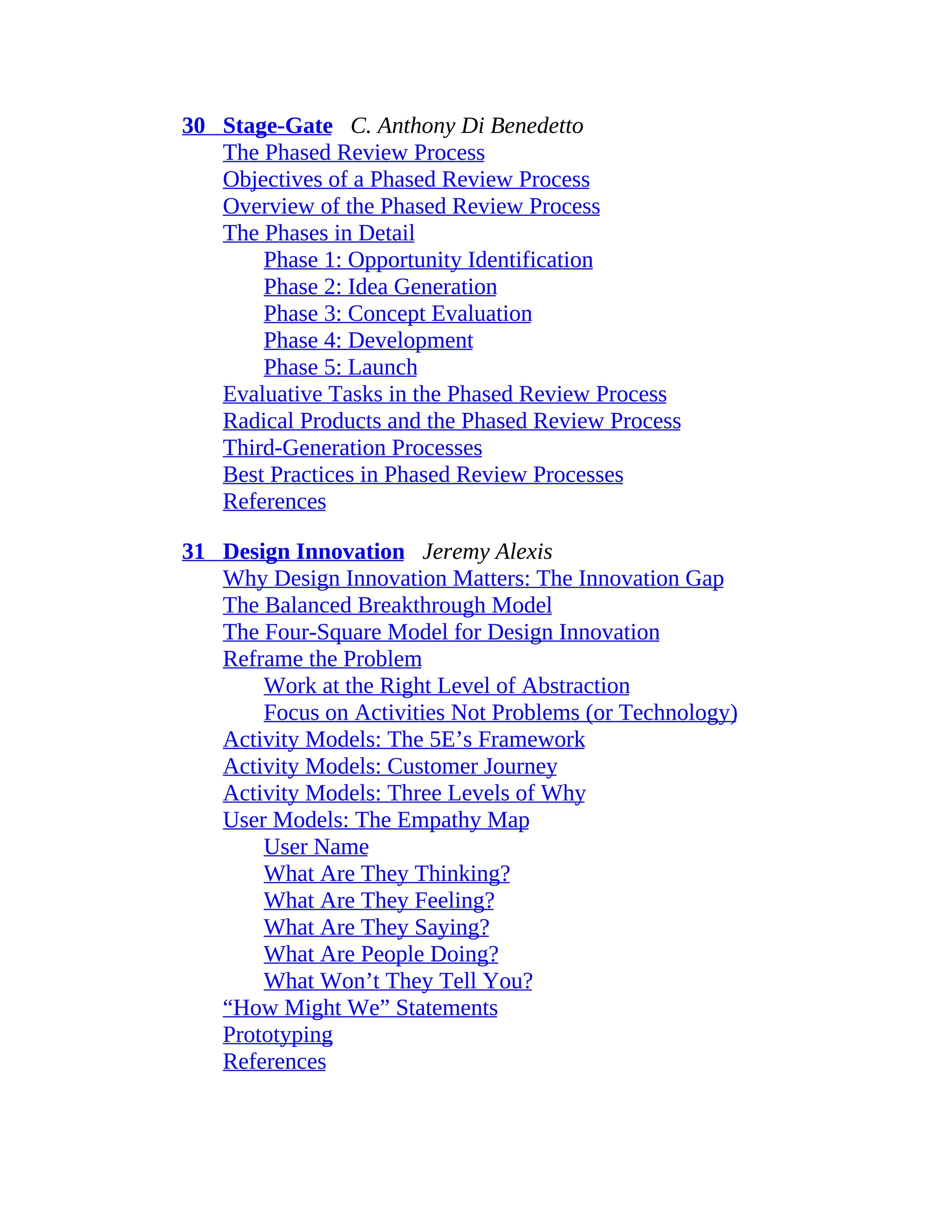
30 Stage-Gate C.Anthony Di Benedetto
The Phased Review Process
Objectives of a Phased Review Process
Overview of the Phased Review Process
The Phases in Detail
Phase 1: Opportunity Identification
Phase 2: Idea Generation
Phase 3: Concept Evaluation
Phase 4: Development
Phase 5: Launch
Evaluative Tasks in the Phased Review Process
Radical Products and the Phased Review Process
Third-Generation Processes
Best Practices in Phased Review Processes
References
31 Design Innovation Jeremy Alexis
Why Design Innovation Matters: The Innovation Gap
The Balanced Breakthrough Model
The Four-Square Model for Design Innovation
Reframe the Problem
Work at the Right Level of Abstraction
Focus on Activities Not Problems (or Technology)
Activity Models: The 5E’s Framework
Activity Models: Customer Journey
Activity Models: Three Levels of Why
User Models: The Empathy Map
User Name
What Are They Thinking?
What Are They Feeling?
What Are They Saying?
What Are People Doing?
What Won’t They Tell You?
“How Might We” Statements
Prototyping
References
22.
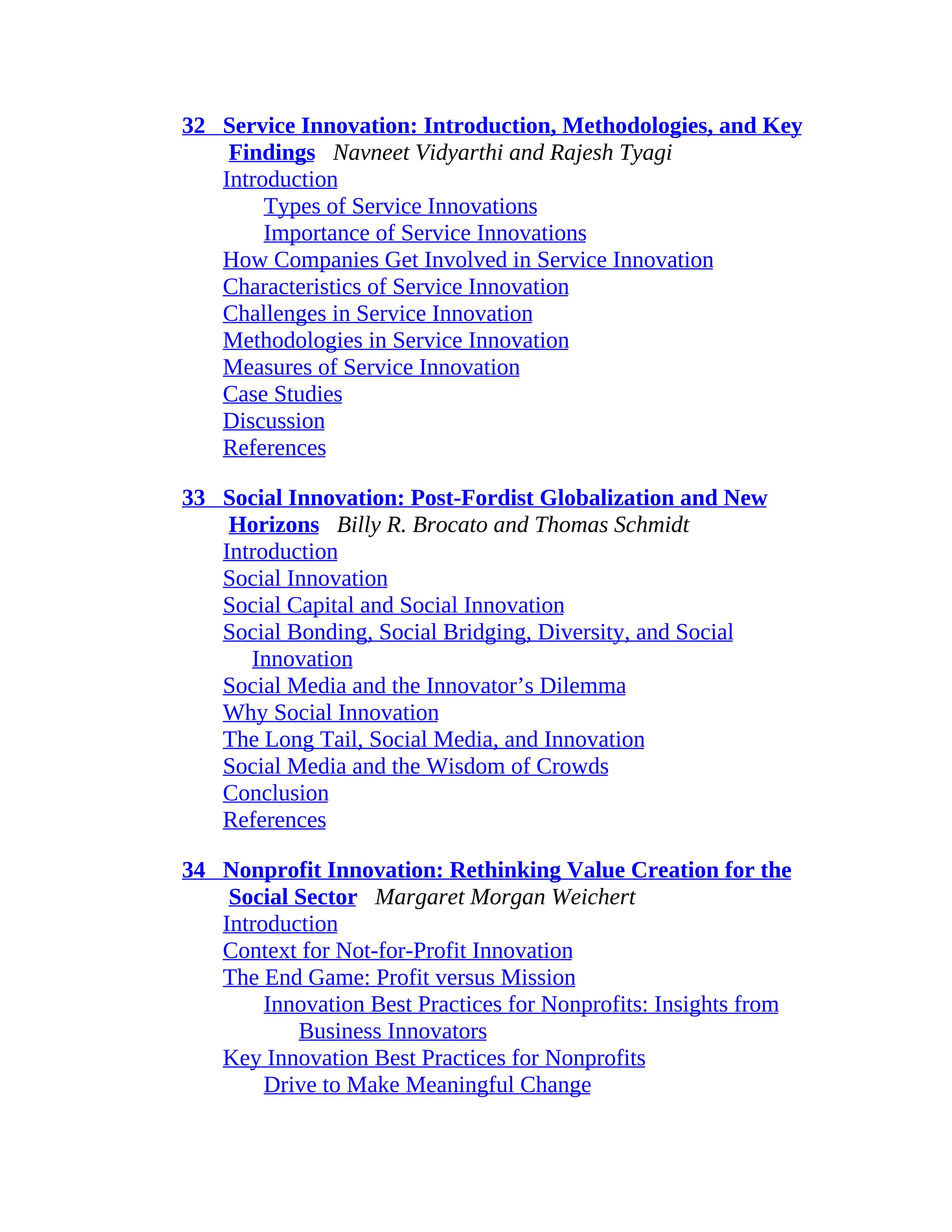
32 Service Innovation:Introduction, Methodologies, and Key
Findings Navneet Vidyarthi and Rajesh Tyagi
Introduction
Types of Service Innovations
Importance of Service Innovations
How Companies Get Involved in Service Innovation
Characteristics of Service Innovation
Challenges in Service Innovation
Methodologies in Service Innovation
Measures of Service Innovation
Case Studies
Discussion
References
33 Social Innovation: Post-Fordist Globalization and New
Horizons Billy R. Brocato and Thomas Schmidt
Introduction
Social Innovation
Social Capital and Social Innovation
Social Bonding, Social Bridging, Diversity, and Social
Innovation
Social Media and the Innovator’s Dilemma
Why Social Innovation
The Long Tail, Social Media, and Innovation
Social Media and the Wisdom of Crowds
Conclusion
References
34 Nonprofit Innovation: Rethinking Value Creation for the
Social Sector Margaret Morgan Weichert
Introduction
Context for Not-for-Profit Innovation
The End Game: Profit versus Mission
Innovation Best Practices for Nonprofits: Insights from
Business Innovators
Key Innovation Best Practices for Nonprofits
Drive to Make Meaningful Change
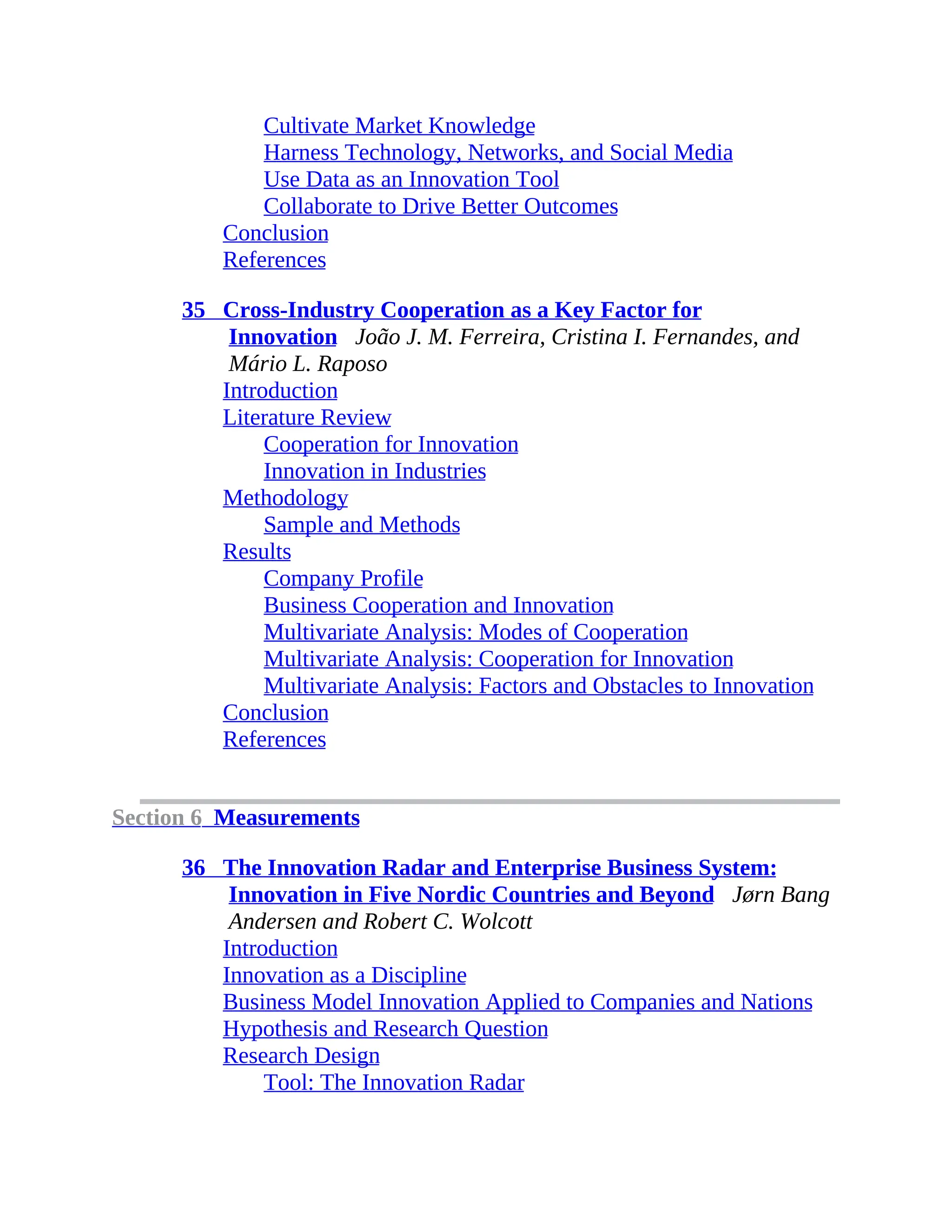
23.
Cultivate Market Knowledge
HarnessTechnology, Networks, and Social Media
Use Data as an Innovation Tool
Collaborate to Drive Better Outcomes
Conclusion
References
35 Cross-Industry Cooperation as a Key Factor for
Innovation João J. M. Ferreira, Cristina I. Fernandes, and
Mário L. Raposo
Introduction
Literature Review
Cooperation for Innovation
Innovation in Industries
Methodology
Sample and Methods
Results
Company Profile
Business Cooperation and Innovation
Multivariate Analysis: Modes of Cooperation
Multivariate Analysis: Cooperation for Innovation
Multivariate Analysis: Factors and Obstacles to Innovation
Conclusion
References
Section 6 Measurements
36 The Innovation Radar and Enterprise Business System:
Innovation in Five Nordic Countries and Beyond Jørn Bang
Andersen and Robert C. Wolcott
Introduction
Innovation as a Discipline
Business Model Innovation Applied to Companies and Nations
Hypothesis and Research Question
Research Design
Tool: The Innovation Radar
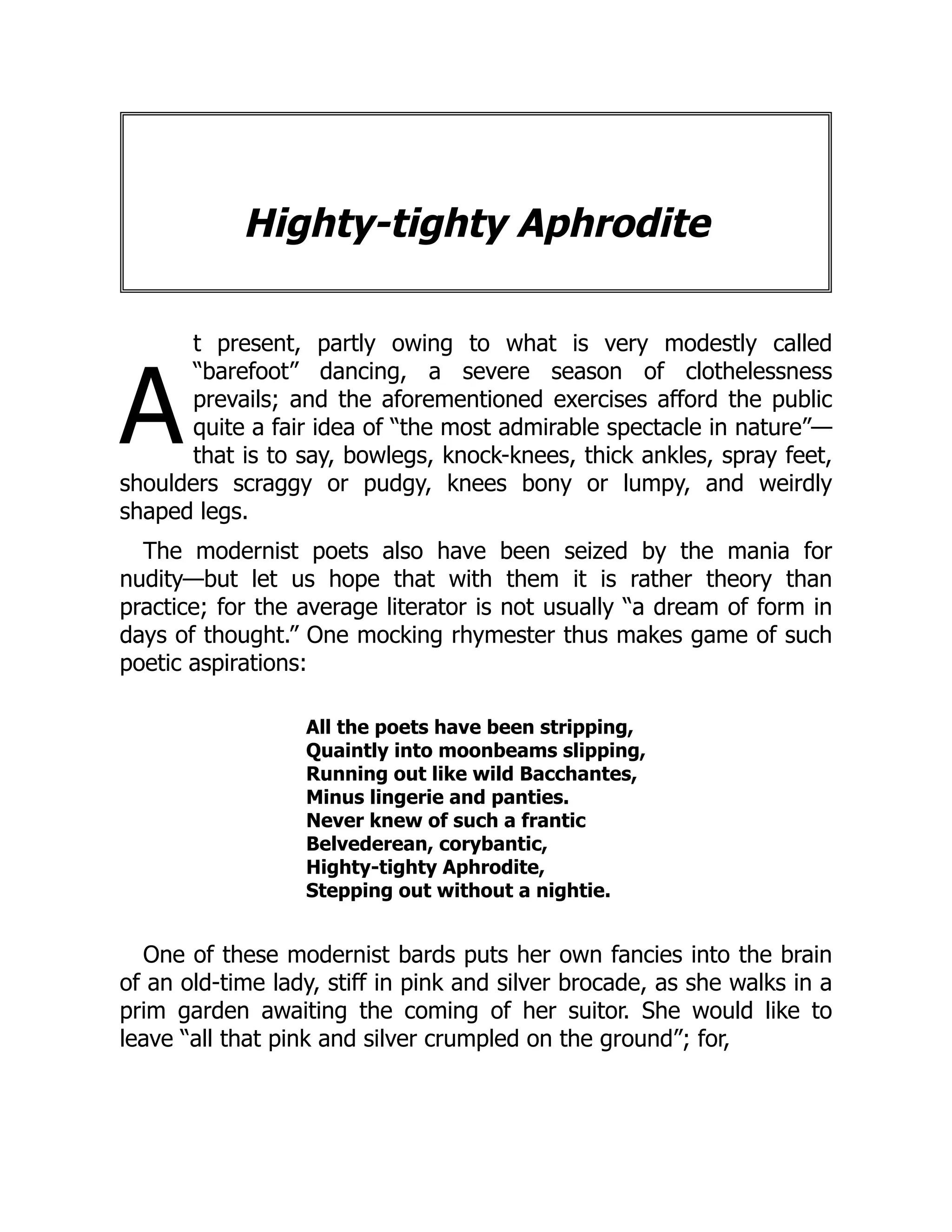
A
Highty-tighty Aphrodite
t present,partly owing to what is very modestly called
“barefoot” dancing, a severe season of clothelessness
prevails; and the aforementioned exercises afford the public
quite a fair idea of “the most admirable spectacle in nature”—
that is to say, bowlegs, knock-knees, thick ankles, spray feet,
shoulders scraggy or pudgy, knees bony or lumpy, and weirdly
shaped legs.
The modernist poets also have been seized by the mania for
nudity—but let us hope that with them it is rather theory than
practice; for the average literator is not usually “a dream of form in
days of thought.” One mocking rhymester thus makes game of such
poetic aspirations:
All the poets have been stripping,
Quaintly into moonbeams slipping,
Running out like wild Bacchantes,
Minus lingerie and panties.
Never knew of such a frantic
Belvederean, corybantic,
Highty-tighty Aphrodite,
Stepping out without a nightie.
One of these modernist bards puts her own fancies into the brain
of an old-time lady, stiff in pink and silver brocade, as she walks in a
prim garden awaiting the coming of her suitor. She would like to
leave “all that pink and silver crumpled on the ground”; for,
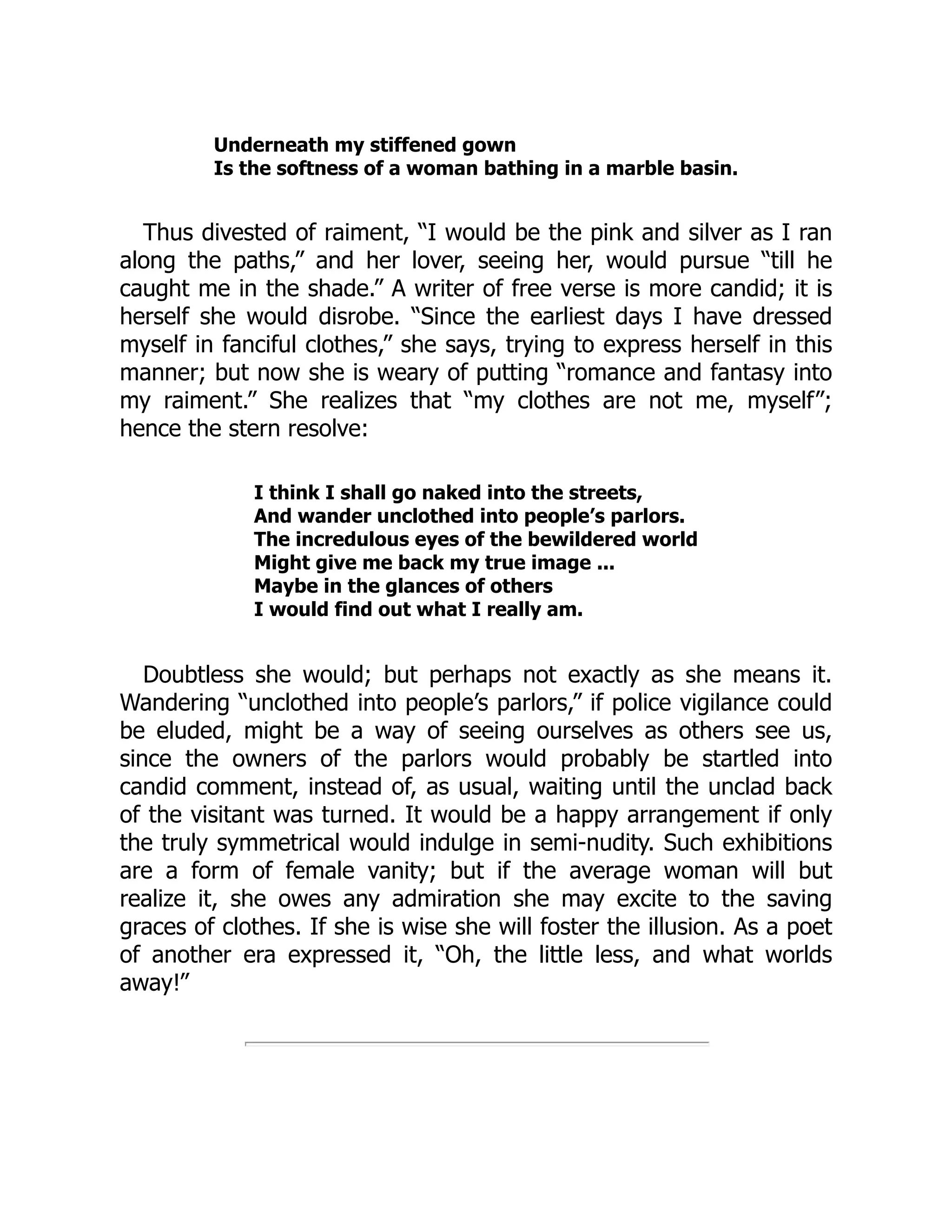
26.
Underneath my stiffenedgown
Is the softness of a woman bathing in a marble basin.
Thus divested of raiment, “I would be the pink and silver as I ran
along the paths,” and her lover, seeing her, would pursue “till he
caught me in the shade.” A writer of free verse is more candid; it is
herself she would disrobe. “Since the earliest days I have dressed
myself in fanciful clothes,” she says, trying to express herself in this
manner; but now she is weary of putting “romance and fantasy into
my raiment.” She realizes that “my clothes are not me, myself”;
hence the stern resolve:
I think I shall go naked into the streets,
And wander unclothed into people’s parlors.
The incredulous eyes of the bewildered world
Might give me back my true image ...
Maybe in the glances of others
I would find out what I really am.
Doubtless she would; but perhaps not exactly as she means it.
Wandering “unclothed into people’s parlors,” if police vigilance could
be eluded, might be a way of seeing ourselves as others see us,
since the owners of the parlors would probably be startled into
candid comment, instead of, as usual, waiting until the unclad back
of the visitant was turned. It would be a happy arrangement if only
the truly symmetrical would indulge in semi-nudity. Such exhibitions
are a form of female vanity; but if the average woman will but
realize it, she owes any admiration she may excite to the saving
graces of clothes. If she is wise she will foster the illusion. As a poet
of another era expressed it, “Oh, the little less, and what worlds
away!”
27.
T
In the Gripof a Dream
he dreamer is with us. From early youth there comes anon a
time when the sense of great loneliness and mysticism leads
one out to the wilderness of the Dream God. Conceptions of
dreams and of love are two difficult tasks, but Robert W.
Chambers seems to have made greater headway than other
authors. In his book, “The Danger Mark,” he thus describes the
feelings that passed over poor, troubled Geraldine:
“We’re pretty young yet, Geraldine.... I never saw a girl I cared for
as I might have cared for you. It’s true, no matter what I have done,
or may do.... But you’re quite right, a man of that sort isn’t to be
considered,” he laughed and pulled on one glove, “only—I knew as
soon as I saw you that it was to be you or—everybody. First, it was
anybody; then it was you—now it’s everybody. Good-bye.”
“Good-bye,” she managed to say. The dizzy waves swayed her;
she rested her cheeks between both hands and, leaning there
heavily, closed her eyes to fight against it. She had been seated on
the side of a lounge; and now, feeling blindly behind her, she moved
the cushions aside, turned and dropped among them, burying her
blazing face. Over her the scorching vertigo swept, subsided, rose,
and swept again. Oh, the horror of it!—the shame, the agonized
surprise. What was this dreadful thing that, for the second time, she
had unwittingly done? And this time it was so much more terrible.
How could such an accident have happened to her? How could she
face her own soul in the disgrace of it?
Fear, loathing, frightened incredulity that this could really be
herself, stiffened her body, and clinched her hands under her parted
lips. On them her hot breath fell irregularly.
28.
Rigid, motionless, shelay, breathing faster and more feverishly.
Tears came after a long while, and with them relaxation and
lassitude. She felt that the dreadful thing which had seized and held
her was letting go its hold, was freeing her body and mind; and as it
slowly released her and passed on its terrible silent way, she awoke
and sat up with a frightened cry, to find herself lying on her own bed
in utter darkness.
* * *
In France, we are told, the English officers stepped about as
though they owned the whole d——d country, whereas
The Americans walked about as though they didn’t give a d——n
who owned the country.
* * *
New York liquor spotters have discovered liquor in baby dolls.
That’s nothing new. Lots of baldheads have been buying wine for
baby dolls in New York for generations!
29.
Questions and Answers
DearCaptain Billy—I am 15 years old and have a sweetheart
who is just 18. He owns a flivver and wants me to go riding with
him. Should I?—Lizzie.
Walking is healthier.
* * *
Dear Captain Billy—I have a girl friend who insists on writing to
me and demanding an answer. What shall I do?—Charlie.
Tell her to enclose a stamp.
* * *
Dear Captain Billy—My husband is going out with another
woman all the time. What can I do to keep him home nights.—Mrs.
Brown.
Take the other woman in as a boarder.
* * *
Dear Captain Billy—I am a young lady attending a church
college. Do you think it would be all right for me to wear skirts 15
inches from the ground.—Marie.
That depends on your height. If you are six feet tall it would be all
right, but if you are only 29 inches “tall,” Not Yet Marie.
* * *
30.
Dear Captain Bill—Whatwould you call the unoccupied side of
an old maid’s bed?—Simple Susan.
No Man’s Land.
* * *
Dear Captain Billy—My daughter has a sweetheart who just got
back from France. He talks to her in French and says: “Villa vouz
promenade,” or something like that, and then they go to some park.
What does that mean?—Anxious Father.
That’s all right, old man. Your daughter’s sweetheart was only
asking her to take a walk.
* * *
Dear Captain Billy—What’s good for cooties?—Returned
Soldier.
Bread crumbs.
* * *
Dear Captain Billy—Please explain the uses of salpeter.—
Tommy.
You are hereby referred to any soldier who will tell you its principal
usage is in the manufacture of high explosives.
* * *
Dear Captain Bill—What’s worse than a cow with the cooties?—
Hi Ball.
A horse with a buggy behind.
* * *
31.
Dear Captain Bill—Weare organizing a new lodge in ’Frisco to
be known as the “Ancient Order of Modern Cavemen.” Will you kindly
suggest a motto for our lodge? Yours truly—Rough on Cats.
My suggestion is: “Catch ’em young; treat ’em rough, and tell ’em
nothin’.”
* * *
Dear Captain Billy—Why do they use castor oil in racing
automobiles and aeroplanes?—Eunice.
To make them run, of course, Eunice.
* * *
Dear Bilious Billy—What would you write about if the country
went wet again and you didn’t have the dry reformers to poke fun at
and kid about?—Reginald Pewter.
We cannot tell a lie—we wouldn’t be able to write during the first
few weeks.
* * *
Dear Whiz Bang—My husband, a returned soldier, did not get
home until 3 o’clock this morning. He said he was at the Fort all
night playing golf. Do soldiers play golf in the middle of the night?—
Worried War Bride.
Yes, Worried Wifie, they do. One of the favorite sports of the
naughty doughboy is the game known as African golf. Two galloping
dominoes are used in place of a small ball. Instead of the greens,
the latrine floor is usually garnished with greenbacks and set off in
silver. “Big Dick” and “Little Joe” act as caddies and there is more
cussing at a “flock of box cars” than a minister foozling a putt. I
indulged in a friendly game of dancing dominoes last night with my
old buddy, Mr. “Eighter from Decatur.” “Jimmy Hicks” and “Long
32.
Legged Liz” werethere, but before I got through I had “fever in the
South” and “crapped” out several points under par.
* * *
Dear Captain Bill—Please tell me what is golf?—Ignoramus.
Well, Ig., golf is a game where old men chase little balls around
when they are too old to chase anything else.
* * *
Dearest Billy—What’s the difference between a bachelor and a
worm?—Andy Gump.
Somebody told me there was no difference—the chickens get
them both.
* * *
Dear Captain Billy—I have been married a year and am the
mother of triplets who are now three months old. My husband has
asked me to take dancing lessons this winter because he says he
cannot afford to have any more children and that dancing will keep
one’s mind off maternal cares. What do you think about it?—Triple
Trixy.
Dancing’s all right, Trixy, providing you tango in the morning, fox
trot in the afternoon and hesitate at night. Fine exercise, I say.
* * *
Dear Captain Bill—I am struggling with myself to keep from
falling in love with a handsome football player because I heard that
football players were so terribly rough.—Troubled Tillie.
Move to the South Sea islands where it’s too hot to play football,
or else to Norway where the summer sport is fishing and in winter
it’s too cold to fish.
33.
* * *
DearWilliam—I recently met a cute little second lieutenant on
the train and am very anxious to get in touch with him. He said his
name was Joe Latrino and that he was in the Sanitary Corps. How
may I find him?—Winsome Winnifred.
Write to him in care of the Captain of the Head, U. S. Navy.
* * *
Dear Captain Billy—What is the difference between Spanish Flu
and Spanish Fly?—Swede Harriet.
Spanish Flu is a disease. Spanish Fly is a drug, technically known
as cantharides and is used as a plaster to cure rheumatism.
* * *
Dear Billy—I am infatuated with a handsome young man from
Akron, Ohio, but when he comes to visit me in a neighboring village
he acts so embarrassed and appears always to be in a mood of deep
thought. Do you suppose he wants to pop the question but hasn’t
the nerve?—Hellenic Helen.
Now, Hellenic Helen, how in Hell’s Gate or Helena do I know?
Overlook his seeming taciturnity and remember that “deep rivers
move with silent majesty; small brooks are noisy as hell, and actions
speak louder than words.”
* * *
Dear Doctor Billy—Please give me the definition of the spinal
column.—Slippery Lizz.
It’s a long disjointed bone, covered with knots—your head sits on
one end and you sit on the other.
* * *
34.
Dear Captain Bill—Whatis meant by “bigamy?” Dandy Dillon.
Bigamy is a form of insanity which causes a man to pay three
board bills instead of two.
* * *
Dear Billy—What’s the definition of a “humdinger?”—Iva
Hangover.
A man who can make a deaf and dumb girl say: “O, daddy.”
* * *
Dear Bilious Billy—I was married last June and my wife wants
me to obtain some polish in my manners so suggests that I take
music lessons. What do you think about it?—Silas Hopkins.
It’s a very good idea, Si. You’ll soon gain a musical education by
playing second fiddle. But beware of the jazz.
* * *
Dear Skipper—Why is a certain specie of beans called Navy
Beans?—Battle-Axe Liz.
I dunno, Liz. You might as well ask me why I labelled The Whiz
Bang an “Explosion of Pedigreed Bull.” No reason at all.
* * *
Dear Bill—They say there are germs on money. Do you think,
then, it is safe for a poor working girl to carry her salary home in her
stocking?—Sadie Woolworth.
Perfectly safe, I’d say. A germ couldn’t live on a working girl’s
salary.
* * *
35.
Betty’s Better Batter
BettyBotter bought some butter,
“But,” she said, “this butter’s bitter.
If I put it in my batter,
It will make my batter bitter.
But a bit of better butter
Will make my batter better.”
So she bought a bit o’ butter
Better than the bitter butter,
And made her bitter batter better.
So ’twas better Betty Botter
Bought a bit of better butter.
36.
R
Seeing Los Angeles
ByJACK ANDREWS
ubbernecking via the bally-ho wagons has received a terrible
set-back in the beautiful city of the Angels. No more will the
gossip-hungry tourists be fed on the scandal of the movie
colony from a megaphone in the hands of a husky-voiced
“spieler.” An edict has gone forth forbidding these caterers to
wet the appetites of the unlearned and seeking visitors of Los
Angeles to exploit the “affairs” of the celebrities in press agent
fashion.
Los Angeles officials contend that it is no nice way to entertain
their guests where skeletons are said to exist in every closet in
Hollywood.
There is no question but what the moving picture business has a
lot of deserving people in it, and some of the most admirable
characters to be found are of the cinema crowd, but we have
recently had a few stellar lights before the international eye in roles
that were disgusting.
Here are some of the utterances the city fathers say should be
dispensed with:
“To your right, folks, is the home of Charlie,
now used exclusively by Mildred and her
mother, who is also her business manager.”
“On your left is the home of Lottie, sister of
Mary, who has a standing offer to fight any
37.
woman in thebusiness.”
“Jack, who is also one of the family, was living
in the bungalow on yonder hill before his wife
came back from New York. He left for Arkansas
on the advice of his doctor the day before she
arrived. He was also in the service during the
war.”
“Now folks this beautiful chateau on the right
covering ten acres is the possession of an
illiterate cow-puncher, whose salary is greater
than the President’s.”
“To your left is the former home of Mable,
when she wasn’t at Vernon, and who is credited
with staging a “come-back” after the star of
Sennett passed below her horizon.”
“The one who was once called “America’s
Sweetheart” used to live in sweet simplicity in
the white bungalow on the right. She used to be
the idol of all children, but the page of her book
is closed that the youth should learn aright.”
Is it any wonder that these “rubberneck” wagons did a thriving
business in Los Angeles? It is said that each “spieler” tried to outrival
his competitor and from all reports the tourists were well supplied
with scandal.
* * *
Girls should remember that when they confide in a married
woman they are probably confiding in her husband also.
38.
Whiz Bang Bunk
Asyou show so shall we peep.
* * *
A shimmy dancer has to struggle for a living.
* * *
Many a rough neck is hidden by a silk collar.
* * *
Be it ever so homely there’s no face like your own.
* * *
You can’t feather your nest running after chickens.
* * *
Keeping whisky in your home is no crime—it’s an art.
* * *
Never slap children on the face; Nature provides a more suitable
place.
* * *
39.
Close the saloonand save the boys; close the garage and save the
girls.
* * *
Sign in dry goods store: “Our woolen underwear will tickle you to
death.”
* * *
A Shorthorn Bull
A man called for hair restorer at the drug store. The new clerk
gave him something to apply. In the course of time the man
returned with a complaint. He declared the stuff powerful enough for
some purpose but not to grow hair. His head was as bald as ever but
he was getting two big lumps like cocoanuts on the top. The clerk
looked at the empty bottle and turned ghastly pale as he exclaimed
“My Gawd, man, I’ve made a terrible mistake. I gave you bust
developer.”
* * *
Gosh All Hemlocks!
Listen my children and you shall hear
Of the midnight ride of a bucket of beer;
Up the street and down the line,
I’ve got the bucket; who’s got the dime?
* * *
“What’s Sauce for the Goose”
40.
A colored womanand her husband were conversing together
when the latter happened to express curiosity as to the meaning of
the word “propaganda” which he was constantly running across in
the newspapers.
“Well,” said his wife, “ah is not sure, but ah thinks ah know what
propaganda is. F’r instance, wif mah fust husband ah had one chile,
and two wif mah second. You’re mah third husband an’ we hain’t got
none at all. Now, I’m the propah goose, but you ain’t the
propahganda.”
41.
Whiz Bang Editorials
“TheBull is Mightier Than the Bullet”
Is the theater becoming immoral? The majority of critics claim it
is. The WHIZ BANG disagrees on this point. We claim the motion
picture development has stopped the sporadic growth of suggestive
plays on the legitimate stage.
The immoral, or at least suggestive plays made their first
appearance in any large number twenty years ago. Witness “Three
Weeks,” “Sappho,” “Du Barry,” and others, and still today you will
find these plays in oblivion. Together with them, the women who
starred in such plays are almost unheard of today. Most prominent
among these is Olga Nethersole.
She was an English governess in the ’80’s and startled London
with her portrayals of “The Transgressor,” “Magda” and other
productions of like character.
Twenty years ago Miss Nethersole shocked two continents with
her “Sappho Kiss.” She always maintained that playing the parts of
these easy women would “make” her. Witness her interview of more
than five years ago, in which she is quoted as having said:
“People have not understood that I chose to play prostitutes
because I have felt it my work to aid the world by showing the
suffering in it. If I felt that I had not been chosen for this task I
should never have given my life to it.
“Do you know the story of Alexander Dumas, the younger? He
was an illegitimate son, whose father refused to wed his mother.
Thereupon the son gave up his life to the cause of woman and wrote
42.
his plays withthe suffering of woman uppermost. ‘Camille’ will live
forever.
“I have felt that if I could show the suffering and the misery that
illicit passion causes I could do something for the world, could point
a way toward removing the evil.”
And today, Olga Nethersole’s prediction has fallen flat. Her name,
or the names of her mimics, no longer are blazoned on the electric
signs of Broadway. Olga Nethersole, and the principle for which she
stood, are in oblivion.
* * *
This is the era of keepers, too. Our collective national appetite has
been entrusted to the keeping of four Bills. I refer to Bill Bryan, Billy
Sunday, Bill Anderson of the Antisaloon League and Billy-Be-
Damned. Those of us who once owned thirsts rapidly are becoming
reconciled to the prospect of seeing about every other man in this
country established in the role of his brother’s keeper—not his
barkeeper, perish the thought—but the sort of keeper who keeps his
charges locked up in an iron barred cage and whacks them across
the nose with a steel rod of sumptuary discipline should they
manifest a desire once in a while to indulge in a little personal
liberty.
It has become the custom for many police departments to resort
to underhanded methods in obtaining evidence wherewith to bring
guilty persons to trial for certain offences, the plan adopted being
the employment of what is commonly known as “stool pigeons”—go-
betweens who act in direct conjunction with the police. Concerning
those who allow themselves to be so employed there is little to be
said other than that they are not fit for decent society. It is a
sneaking way of securing a living and those who lend themselves to
it ought to be ostracized by citizens who believe in conforming to the
ordinary decencies of life.
* * *
43.
Moral reformers arealtogether too ambitious. They want to
abolish vice but they cannot do it. Vice is not crime, although the
two things are often confounded. The word “vice” literally means a
fault or error. A crime is a deliberate violation of the law of God or
man.
Why should we be so serious and so violent in our attitude toward
human vice? The root of the evil is in the weakness or wickedness of
human nature. What is needed is to invigorate humanity with that
moral strength which resists the inroads of vice. There are periods in
the history of every nation when certain forms of vice are
particularly flagrant. This was so when civilized Greece had lost her
pristine manliness. It was so when pagan Rome was near her fall. It
was so, unhappily, in England in the nineties of the last century,
which saw the popularity of such literary and artistic decadents as
Oscar Wilde and Aubrey Beardsley. Wise reformers will not ever
deceive themselves by thinking that they can eradicate vice. They
will try to lessen vice by moral suasion and by removing the
economic causes which are the promoters of evil living. To put
wretched people into jail is not the best way to reform them. It is
better to make them see that a life of virtue pays better than a life
of vice. This may be a low utilitarian standard, but it will appeal to
those who are altogether guided by considerations of profit or loss.
* * *
The alimentary canal of the business world needs a physic. It’s the
same in business as with the human system, when things get
clogged. We’ve been gorging the system of the business world until
its tripe needs scraping. We’ve kept the hopper too full for a healthy
elimination, and we need calomel and rhubarb for a change. Capital
has allowed its cormorant-like propensities to assume the
proportions of a boa constrictor in trying to swallow not only the calf
but the whole herd. Labor, following closely in the wake of capital
and profiting by its example, has pulled the bridle off of the horse
and started it down the road of reason for a head-on collision with
44.
the captain ofindustry, who is stepping on the tail of his big
Packard, and both will be injured. Cornering the earth and setting
the price of all things required for man’s welfare has come home to
roost in demands for wages double and treble what they used to be,
and both capital and labor must be purged of this overload on the
liver of righteousness or the undertaker will have an unusually
thriving business very soon.
The tendency of present-day writers and authors of fiction stories
to deal in suggestiveness is perhaps explained in the popularity of
the magazines which cater to these outpourings. Gouverneur Morris
is one of these, and who can say that Mr. Morris is not one of the
foremost writers of the day? In his latest masterpiece, “The Wild
Goose,” which appeared recently in Hearst’s, he writes, for instance:
One of the shoulder-straps of her night-gown had slipped so that
Diana’s left breast was almost wholly bare. At her husband’s next
words she hastily pulled the night-gown back into place, as she
might have done if he had stepped suddenly into view.
“I could crawl to you on my hands and knees,” he said, “if I could
lay my head on your breast just one little moment.”
“Frank,” she exclaimed, “I am so sorry! But please, please—this is
no time to discuss what’s been and gone and happened. Do go back
to bed.... Count the sheep going over the hurdle.... Don’t you know
I’d do anything—anything—anything—except the things I can’t
do?...”
There was a long silence. Then the man spoke again.
“Do have pity,” he said, “for Christ’s sake!”
* * *
Then we have Arthur Somers Roche who quite often reveals much
truth in his fiction. Writing recently in the Cosmopolitan, Roche,
perhaps unconsciously, reveals a time-worn trick of the woman of
the street in “working” a male victim. He writes:
45.
The difficulty withthe Waiters’ Union had resulted in the engaging
of girls as waitresses at the Central. An extremely pretty girl had just
served Mr. Dabney with something. Inspiration had come to him as
he started to tip her.
“Worth just fifty cents, m’dear, if I put it in your hand. Worth five
dollars if I put it in your stocking. What say?”
The waitress essayed coyness, but failed in her endeavor. Five
dollars was five dollars. She turned slightly to one side; her skirt was
raised; into her stocking-top Dabney slipped the five-dollar bill.
No invention of modern history has ever been acclaimed with the
enthusiasm that greeted Mr. Dabney’s strikingly original idea. There
was a yell from Mr. Ladd’s table; as explanation shot about the room,
hilarity reached its highest pitch. Immediately a dozen girls stood
close to tables, while unsteady hands that held bills fumbled at the
tops of stockings.
* * *
Mary, Mary, quite contrary,
How did your brewing do?
It has the smell, and kicks like hell,
But tastes like rotten glue.
* * *
Pass Her a Palm Fan
“What sort of tree is that?” queried a Chicago girl, touring
California.
“Fig tree,” replied her escort.
“My goodness, I thought the leaves were larger.”
46.
* * *
A.W. O. L. means, according to officers who ought to know, “After
Women Or Liquor.” Usually it’s both.
47.
Smokehouse Poetry
The Passingof Old Smokehouse
When memory keeps me company and moves to smiles or
tears,
A weather-beaten object looms through the mist of years,
Behind the house and barn it stood, a half a mile or more,
And hurrying feet a path had made, straight to its swinging
door.
Its architecture was a type of simple classic art,
But in the tragedy of life it played a leading part;
And oft the passing traveler drove slow and heaved a sigh
To see the modest hired girl slip out with glances shy.
We had our posey garden that the women loved so well.
I loved it, too, but better still I loved the stronger smell
That filled the evening breezes so full of homely cheer,
And told the night-o’ertaken tramp that human life was near.
On lazy August afternoons it made a little bower,
Delighted, where my grandsire sat and whiled away an hour.
For there the summer morning its very cares entwined,
And berry bushes reddened in the steaming soil behind.
* * *
Poor Girlie
48.
My parents toldme not to smoke;
I don’t.
Nor listen to a naughty joke;
I don’t.
They told me it was wrong to wink
At handsome men, or even think
About intoxicating drink;
I don’t.
To dance or flirt was very wrong;
I don’t.
Wild girls chase men and wine and song;
I don’t.
I kiss no men, not even one—
In fact, I don’t know how it’s done;
You wouldn’t think I have much fun—
I don’t.
* * *
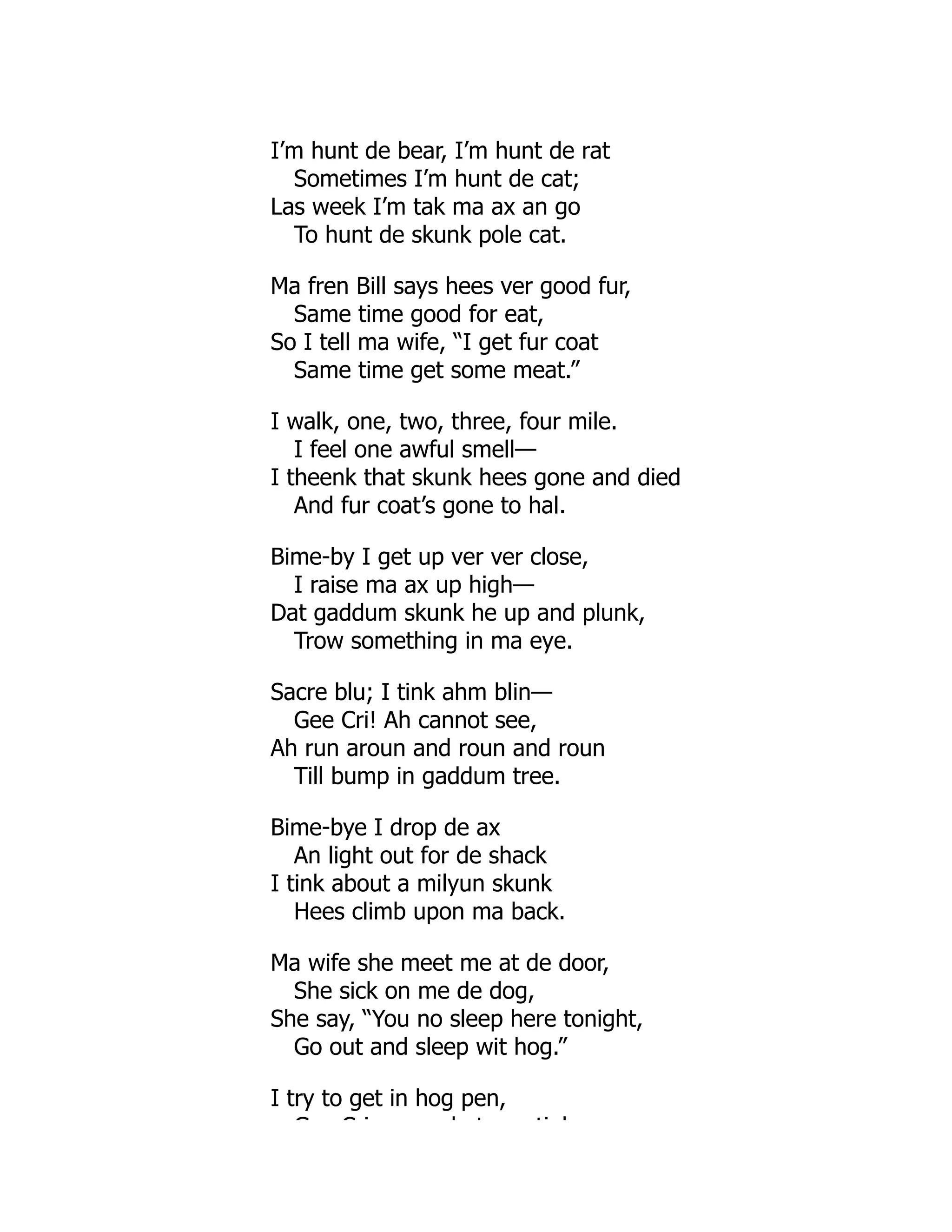
Hunting the Wily Pole Cat
(As told by a French-Canadian).
49.
I’m hunt debear, I’m hunt de rat
Sometimes I’m hunt de cat;
Las week I’m tak ma ax an go
To hunt de skunk pole cat.
Ma fren Bill says hees ver good fur,
Same time good for eat,
So I tell ma wife, “I get fur coat
Same time get some meat.”
I walk, one, two, three, four mile.
I feel one awful smell—
I theenk that skunk hees gone and died
And fur coat’s gone to hal.
Bime-by I get up ver ver close,
I raise ma ax up high—
Dat gaddum skunk he up and plunk,
Trow something in ma eye.
Sacre blu; I tink ahm blin—
Gee Cri! Ah cannot see,
Ah run aroun and roun and roun
Till bump in gaddum tree.
Bime-bye I drop de ax
An light out for de shack
I tink about a milyun skunk
Hees climb upon ma back.
Ma wife she meet me at de door,
She sick on me de dog,
She say, “You no sleep here tonight,
Go out and sleep wit hog.”
I try to get in hog pen,
G C i h t ti k
50.
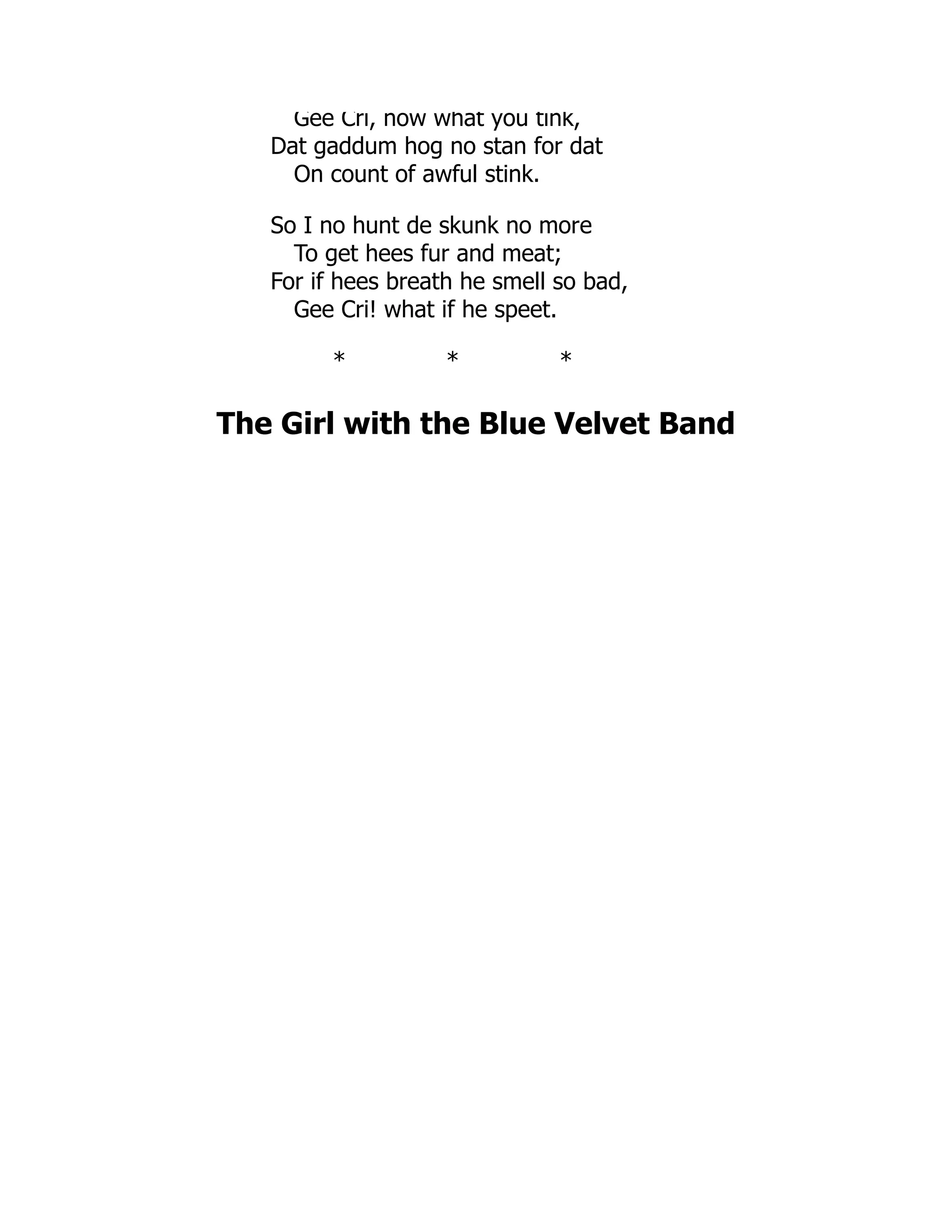
Gee Cri, nowwhat you tink,
Dat gaddum hog no stan for dat
On count of awful stink.
So I no hunt de skunk no more
To get hees fur and meat;
For if hees breath he smell so bad,
Gee Cri! what if he speet.
* * *
The Girl with the Blue Velvet Band
51.
Welcome to ourwebsite – the ideal destination for book lovers and
knowledge seekers. With a mission to inspire endlessly, we offer a
vast collection of books, ranging from classic literary works to
specialized publications, self-development books, and children's
literature. Each book is a new journey of discovery, expanding
knowledge and enriching the soul of the reade
Our website is not just a platform for buying books, but a bridge
connecting readers to the timeless values of culture and wisdom. With
an elegant, user-friendly interface and an intelligent search system,
we are committed to providing a quick and convenient shopping
experience. Additionally, our special promotions and home delivery
services ensure that you save time and fully enjoy the joy of reading.
Let us accompany you on the journey of exploring knowledge and
personal growth!
ebookluna.com