ORGANIC COMPOUNDS
FAMILIES OF CARBON COMPOUNDS: FUNCTIONAL
GROUPS
General Chemistry 1
ROMINA D. MEDIANA
Learning Competency:
Describe the different functional
groups (STEM_GC11OCIIg-j-87)
Specific Objectives:
1. Describe the major functional groups in organic chemistry and
name organic compounds;
2. Recognize from the structural formula which class of organic
compounds a certain molecule belongs; and
3. Identify all the functional groups present in a molecule given its
structural formula.
Organic Chemistry
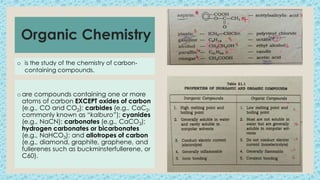
o are compounds containing one or more
atoms of carbon EXCEPT oxides of carbon
(e.g., CO and CO2); carbides (e.g., CaC2,
commonly known as “kalburo”); cyanides
(e.g., NaCN); carbonates (e.g., CaCO3);
hydrogen carbonates or bicarbonates
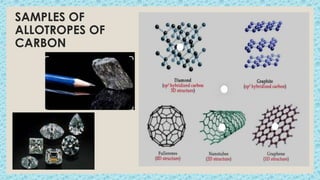
(e.g., NaHCO3); and allotropes of carbon
(e.g., diamond, graphite, graphene, and
fullerenes such as buckminsterfullerene, or
C60).
o is the study of the chemistry of carbon-
containing compounds.
SAMPLES OF
ALLOTROPES OF
CARBON
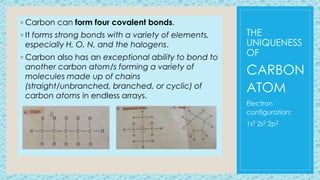
THE
UNIQUENESS
OF
◦ Carbon can form four covalent bonds.
◦ It forms strong bonds with a variety of elements,
especially H, O, N, and the halogens.
◦ Carbon also has an exceptional ability to bond to
another carbon atom/s forming a variety of
molecules made up of chains
(straight/unbranched, branched, or cyclic) of
carbon atoms in endless arrays.
CARBON
ATOM
Electron
configuration:
1s2 2s2 2p2
Molecular formula
◦is a chemical formula that indicates the
actual numbers of atoms present in a
molecule.
For example,
the molecular formula CH4 tells us that methane has one
carbon atom and four hydrogen atoms.
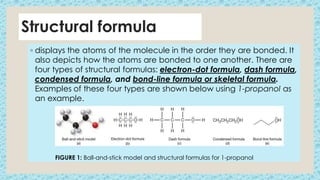
Structural formula
◦ displays the atoms of the molecule in the order they are bonded. It
also depicts how the atoms are bonded to one another. There are
four types of structural formulas: electron-dot formula, dash formula,
condensed formula, and bond-line formula or skeletal formula.
Examples of these four types are shown below using 1-propanol as
an example.
FIGURE 1: Ball-and-stick model and structural formulas for 1-propanol
◦ Bond-line formulas are easy to draw for molecules with multiple bonds and for cyclic molecules,
as well. The following are some examples.
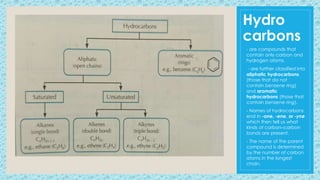
Hydro
carbons
- are compounds that
contain only carbon and
hydrogen atoms.
- are further classified into
aliphatic hydrocarbons
(those that do not
contain benzene ring)
and aromatic
hydrocarbons (those that
contain benzene ring).
- Names of hydrocarbons
end in -ane, -ene, or -yne
which then tell us what
kinds of carbon–carbon
bonds are present.
- The name of the parent
compound is determined
by the number of carbon
atoms in the longest
chain.
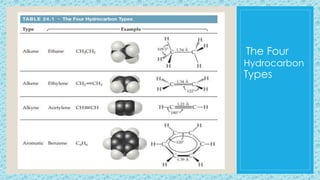
The Four
Hydrocarbon
Types
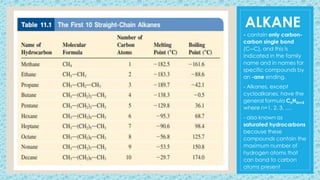
ALKANE
- contain only carbon-
carbon single bond
(C―C), and this is
indicated in the family
name and in names for
specific compounds by
an -ane ending.
- Alkanes, except
cycloalkanes, have the
general formula CnH2n+2
where n=1, 2, 3, ….
- also known as
saturated hydrocarbons
because these
compounds contain the
maximum number of
hydrogen atoms that
can bond to carbon
atoms present
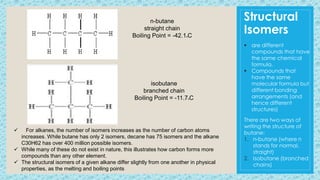
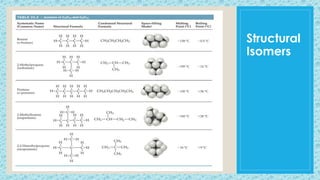
Structural
Isomers
 are different
compounds that have
the same chemical
formula.
 Compounds that
have the same
molecular formula but
different bonding
arrangements (and
hence different
structures)
There are two ways of
writing the structure of
butane:
1. n-butane (where n
stands for normal,
straight)
2. Isobutane (branched
chains)
n-butane
straight chain
Boiling Point = -42.1oC
isobutane
branched chain
Boiling Point = -11.7oC
 For alkanes, the number of isomers increases as the number of carbon atoms
increases. While butane has only 2 isomers, decane has 75 isomers and the alkane
C30H62 has over 400 million possible isomers.
 While many of these do not exist in nature, this illustrates how carbon forms more
compounds than any other element.
 The structural isomers of a given alkane differ slightly from one another in physical
properties, as the melting and boiling points
Structural
Isomers
EXAMPLE
OF
ISOMER
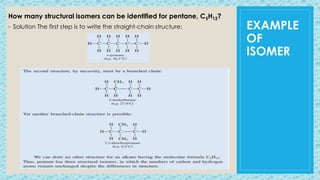
How many structural isomers can be identified for pentane, C5H12?
◦ Solution The first step is to write the straight-chain structure:
Alkyl Groups
and the
Symbol R
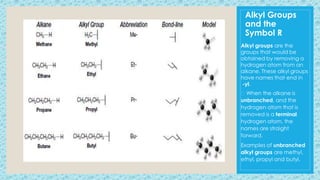
Alkyl groups are the
groups that would be
obtained by removing a
hydrogen atom from an
alkane. These alkyl groups
have names that end in
-yl.
When the alkane is
unbranched, and the
hydrogen atom that is
removed is a terminal
hydrogen atom, the
names are straight
forward.
Examples of unbranched
alkyl groups are methyl,
ethyl, propyl and butyl.
NOMENCLATURE OF ALKANES:
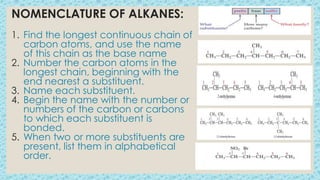
1. Find the longest continuous chain of
carbon atoms, and use the name
of this chain as the base name
2. Number the carbon atoms in the
longest chain, beginning with the
end nearest a substituent.
3. Name each substituent.
4. Begin the name with the number or
numbers of the carbon or carbons
to which each substituent is
bonded.
5. When two or more substituents are
present, list them in alphabetical
order.
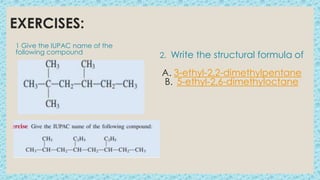
EXERCISES:
1 Give the IUPAC name of the
following compound:
2. Write the structural formula of
A. 3-ethyl-2,2-dimethylpentane
B. 5-ethyl-2,6-dimethyloctane
Cyclo
alkanes
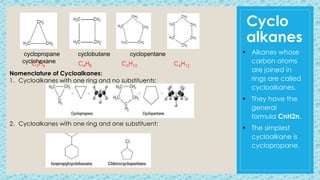
 Alkanes whose
carbon atoms
are joined in
rings are called
cycloalkanes.
 They have the
general
formula CnH2n.
 The simplest
cycloalkane is
cyclopropane.
cyclopropane cyclobutane cyclopentane
cyclohexane
C3H6 C4H8 C5H10 C6H12
Nomenclature of Cycloalkanes:
1. Cycloalkanes with one ring and no substituents:
2. Cycloalkanes with one ring and one substituent:
Cyclo
alkanes
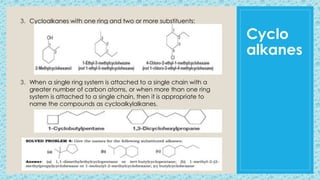
3. Cycloalkanes with one ring and two or more substituents:
3. When a single ring system is attached to a single chain with a
greater number of carbon atoms, or when more than one ring
system is attached to a single chain, then it is appropriate to
name the compounds as cycloalkylalkanes.
Alkenes
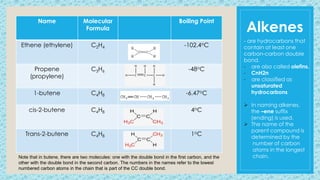
Name Molecular
Formula
Boiling Point
Ethene (ethylene) C2H4 -102.4oC
Propene
(propylene)
C3H6 -48oC
1-butene C4H8 -6.47oC
cis-2-butene C4H8 4oC
Trans-2-butene C4H8 1oC
- are hydrocarbons that
contain at least one
carbon-carbon double
bond.
- are also called olefins.
- CnH2n
- are classified as
unsaturated
hydrocarbons
 In naming alkenes,
the –ene suffix
(ending) is used.
 The name of the
parent compound is
determined by the
number of carbon
atoms in the longest
chain.
Note that in butene, there are two molecules: one with the double bond in the first carbon, and the
other with the double bond in the second carbon. The numbers in the names refer to the lowest
numbered carbon atoms in the chain that is part of the CC double bond.
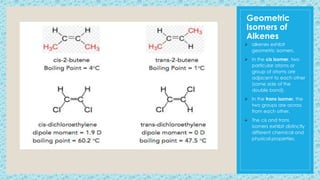
Geometric
Isomers of
Alkenes
 alkenes exhibit
geometric isomers.
 In the cis isomer, two
particular atoms or
group of atoms are
adjacent to each other
(same side of the
double bond).
 In the trans isomer, the
two groups are across
from each other.
 The cis and trans
isomers exhibit distinctly
different chemical and
physical properties.

5 ORGANIC-COMPOUNBBBNBNBFFHNDS-Part1.pdf

  • 2.
    ORGANIC COMPOUNDS FAMILIES OFCARBON COMPOUNDS: FUNCTIONAL GROUPS General Chemistry 1 ROMINA D. MEDIANA
  • 3.
    Learning Competency: Describe thedifferent functional groups (STEM_GC11OCIIg-j-87) Specific Objectives: 1. Describe the major functional groups in organic chemistry and name organic compounds; 2. Recognize from the structural formula which class of organic compounds a certain molecule belongs; and 3. Identify all the functional groups present in a molecule given its structural formula.
  • 4.
    Organic Chemistry o arecompounds containing one or more atoms of carbon EXCEPT oxides of carbon (e.g., CO and CO2); carbides (e.g., CaC2, commonly known as “kalburo”); cyanides (e.g., NaCN); carbonates (e.g., CaCO3); hydrogen carbonates or bicarbonates (e.g., NaHCO3); and allotropes of carbon (e.g., diamond, graphite, graphene, and fullerenes such as buckminsterfullerene, or C60). o is the study of the chemistry of carbon- containing compounds.
  • 5.
  • 6.
    THE UNIQUENESS OF ◦ Carbon canform four covalent bonds. ◦ It forms strong bonds with a variety of elements, especially H, O, N, and the halogens. ◦ Carbon also has an exceptional ability to bond to another carbon atom/s forming a variety of molecules made up of chains (straight/unbranched, branched, or cyclic) of carbon atoms in endless arrays. CARBON ATOM Electron configuration: 1s2 2s2 2p2
  • 7.
    Molecular formula ◦is achemical formula that indicates the actual numbers of atoms present in a molecule. For example, the molecular formula CH4 tells us that methane has one carbon atom and four hydrogen atoms.
  • 8.
    Structural formula ◦ displaysthe atoms of the molecule in the order they are bonded. It also depicts how the atoms are bonded to one another. There are four types of structural formulas: electron-dot formula, dash formula, condensed formula, and bond-line formula or skeletal formula. Examples of these four types are shown below using 1-propanol as an example. FIGURE 1: Ball-and-stick model and structural formulas for 1-propanol
  • 9.
    ◦ Bond-line formulasare easy to draw for molecules with multiple bonds and for cyclic molecules, as well. The following are some examples.
  • 10.
    Hydro carbons - are compoundsthat contain only carbon and hydrogen atoms. - are further classified into aliphatic hydrocarbons (those that do not contain benzene ring) and aromatic hydrocarbons (those that contain benzene ring). - Names of hydrocarbons end in -ane, -ene, or -yne which then tell us what kinds of carbon–carbon bonds are present. - The name of the parent compound is determined by the number of carbon atoms in the longest chain.
  • 11.
  • 12.
    ALKANE - contain onlycarbon- carbon single bond (C―C), and this is indicated in the family name and in names for specific compounds by an -ane ending. - Alkanes, except cycloalkanes, have the general formula CnH2n+2 where n=1, 2, 3, …. - also known as saturated hydrocarbons because these compounds contain the maximum number of hydrogen atoms that can bond to carbon atoms present
  • 13.
    Structural Isomers  are different compoundsthat have the same chemical formula.  Compounds that have the same molecular formula but different bonding arrangements (and hence different structures) There are two ways of writing the structure of butane: 1. n-butane (where n stands for normal, straight) 2. Isobutane (branched chains) n-butane straight chain Boiling Point = -42.1oC isobutane branched chain Boiling Point = -11.7oC  For alkanes, the number of isomers increases as the number of carbon atoms increases. While butane has only 2 isomers, decane has 75 isomers and the alkane C30H62 has over 400 million possible isomers.  While many of these do not exist in nature, this illustrates how carbon forms more compounds than any other element.  The structural isomers of a given alkane differ slightly from one another in physical properties, as the melting and boiling points
  • 14.
  • 15.
    EXAMPLE OF ISOMER How many structuralisomers can be identified for pentane, C5H12? ◦ Solution The first step is to write the straight-chain structure:
  • 16.
    Alkyl Groups and the SymbolR Alkyl groups are the groups that would be obtained by removing a hydrogen atom from an alkane. These alkyl groups have names that end in -yl. When the alkane is unbranched, and the hydrogen atom that is removed is a terminal hydrogen atom, the names are straight forward. Examples of unbranched alkyl groups are methyl, ethyl, propyl and butyl.
  • 17.
    NOMENCLATURE OF ALKANES: 1.Find the longest continuous chain of carbon atoms, and use the name of this chain as the base name 2. Number the carbon atoms in the longest chain, beginning with the end nearest a substituent. 3. Name each substituent. 4. Begin the name with the number or numbers of the carbon or carbons to which each substituent is bonded. 5. When two or more substituents are present, list them in alphabetical order.
  • 18.
    EXERCISES: 1 Give theIUPAC name of the following compound: 2. Write the structural formula of A. 3-ethyl-2,2-dimethylpentane B. 5-ethyl-2,6-dimethyloctane
  • 19.
    Cyclo alkanes  Alkanes whose carbonatoms are joined in rings are called cycloalkanes.  They have the general formula CnH2n.  The simplest cycloalkane is cyclopropane. cyclopropane cyclobutane cyclopentane cyclohexane C3H6 C4H8 C5H10 C6H12 Nomenclature of Cycloalkanes: 1. Cycloalkanes with one ring and no substituents: 2. Cycloalkanes with one ring and one substituent:
  • 20.
    Cyclo alkanes 3. Cycloalkanes withone ring and two or more substituents: 3. When a single ring system is attached to a single chain with a greater number of carbon atoms, or when more than one ring system is attached to a single chain, then it is appropriate to name the compounds as cycloalkylalkanes.
  • 21.
    Alkenes Name Molecular Formula Boiling Point Ethene(ethylene) C2H4 -102.4oC Propene (propylene) C3H6 -48oC 1-butene C4H8 -6.47oC cis-2-butene C4H8 4oC Trans-2-butene C4H8 1oC - are hydrocarbons that contain at least one carbon-carbon double bond. - are also called olefins. - CnH2n - are classified as unsaturated hydrocarbons  In naming alkenes, the –ene suffix (ending) is used.  The name of the parent compound is determined by the number of carbon atoms in the longest chain. Note that in butene, there are two molecules: one with the double bond in the first carbon, and the other with the double bond in the second carbon. The numbers in the names refer to the lowest numbered carbon atoms in the chain that is part of the CC double bond.
  • 22.
    Geometric Isomers of Alkenes  alkenesexhibit geometric isomers.  In the cis isomer, two particular atoms or group of atoms are adjacent to each other (same side of the double bond).  In the trans isomer, the two groups are across from each other.  The cis and trans isomers exhibit distinctly different chemical and physical properties.