FUNCTIONAL
GROUPS
Functional Groups
 The structural features that make it possible to
classify compounds by reactivity are called
functional groups.
 A functional groups is a group of atoms within a
larger molecule that has a characteristics chemical
behavior. Chemically, a given functional group
behave almost the same way in every molecule it,s
in.
Functional Groups
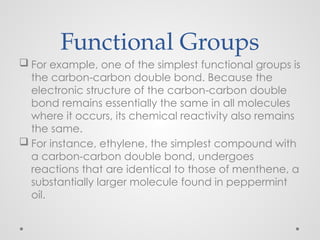
 For example, one of the simplest functional groups is
the carbon-carbon double bond. Because the
electronic structure of the carbon-carbon double
bond remains essentially the same in all molecules
where it occurs, its chemical reactivity also remains
the same.
 For instance, ethylene, the simplest compound with
a carbon-carbon double bond, undergoes
reactions that are identical to those of menthene, a
substantially larger molecule found in peppermint
oil.
The reactions of ethylene and menthene with Br2. In both cases, Br2.
reacts with the C=C functional group in exactly the same way. The
size and nature of the remainder of the molecule are not important.
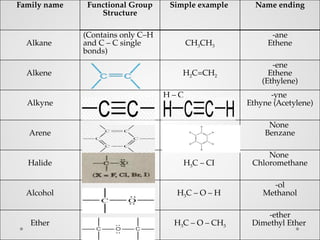
Family name Functional Group
Structure
Simple example Name ending
Alkane
(Contains only C–H
and C – C single
bonds)
CH3CH3
-ane
Ethene
Alkene H2C=CH2
-ene
Ethene
(Ethylene)
Alkyne
H – C -yne
Ethyne (Acetylene)
Arene
None
Benzane
Halide H3C – CI
None
Chloromethane
Alcohol H3C – O – H
-ol
Methanol
Ether H3C – O – CH3
-ether
Dimethyl Ether
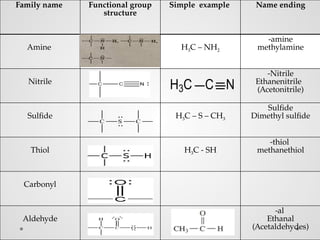
Family name Functional group
structure
Simple example Name ending
Amine H3C – NH2
-amine
methylamine
Nitrile
-Nitrile
Ethanenitrile
(Acetonitrile)
Sulfide H3C – S – CH3
Sulfide
Dimethyl sulfide
Thiol H3C - SH
-thiol
methanethiol
Carbonyl
Aldehyde
-al
Ethanal
(Acetaldehydes)
Family name Functional group
structure
Simple example Name ending
Ketone
-one
Proponone
(Acetone)
Carboxylic Acid
-oic
Ethanoic acid
(Acetic acid)
Ester
-oate
Methyl ethanoate
(Methyl Acetate)
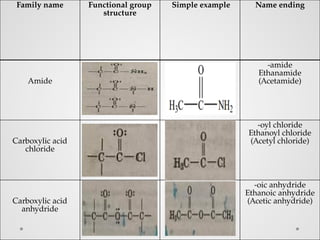
Family name Functional group
structure
Simple example Name ending
Amide
-amide
Ethanamide
(Acetamide)
Carboxylic acid
chloride
-oyl chloride
Ethanoyl chloride
(Acetyl chloride)
Carboxylic acid
anhydride
-oic anhydride
Ethanoic anhydride
(Acetic anhydride)
The nature of Organic
Compounds: Alkanes
 A carbon atom singly bonded to an
electronegative halogen, oxygen, nitrogen, or sulfur
atom: and still others have carbon – oxygen double
bonds.
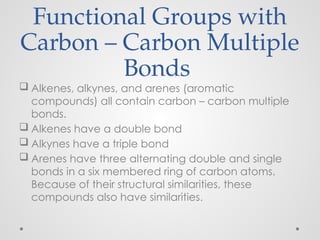
Functional Groups with
Carbon – Carbon Multiple
Bonds
 Alkenes, alkynes, and arenes (aromatic
compounds) all contain carbon – carbon multiple
bonds.
 Alkenes have a double bond
 Alkynes have a triple bond
 Arenes have three alternating double and single
bonds in a six membered ring of carbon atoms.
Because of their structural similarities, these
compounds also have similarities.
Functional Groups with Carbon Singly
Bonded to an Electronegative Atom
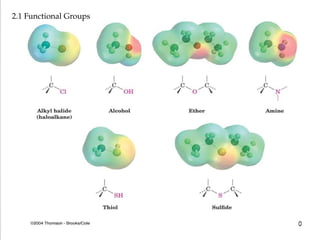
 Alkyl halides, alcohols, ethers, amines, thiols, and
sulfides all have a carbon atom singly bonded to an
electronegative atom-halogen, oxygen, nitrogen, or
sulfur. Alkyl halides have a carbon atom bonded to a
halogen (-X), alcohols have a carbon atom bonded
to a hydroxyl (-OH) group, ethers have two carbon
atoms bonded to the same oxygen, amines have a
carbon atom bonded to a nitrogen, thiols have a
carbon atom bonded to an -SH group, and sulfides
have two carbon atoms bonded to the same sulfur.
In all cases, the bonds are polar, with the carbon
atom bearing a partial positive charge (8+) and the
electronegative atom bearing a partial negative
charge (-8)
2.1 Functional Groups
Functional Groups with a Carbon-Oxygen
Double Bond (Carbonyl Groups)
 Note particularly in Table 2.1 the different families of
compounds that contain the carbonyl group, C=O
(pronounced car-bo-neel). Carbon-oxygen double
bonds are present in some of the most important
compounds in
2.2 Alkanes and Alkyl
Groups: Isonomers
 We saw in Section 1.7 that the C-C single bond in
ethane results from o (head-on) overlap of carbon
sp3 hybrid orbitals. If we imagine joining three, four,
five, or even more carbon atoms by C-C single
bonds, we generate the large family of molecules
called alkanes
 Alkanes are often described as saturated
hydrocarbons: hydrocarbons because they contain
only carbon and hydrogen atoms; saturated
because they have only C-Cand C-H single bonds
and thus contain the maximum possible number of
hydrogens per carbon. They have the general
formula Cn H2n + 29 where n is any integer. Alkanes
are also occasionally called aliphatic compounds,
a word derived from the Greek aleiphas, meaning
"fat" We'll see in Chapter 16 that animal fats contain
long carbon chains similar to alkanes.
• Think about the ways that carbon and hydrogen can
combine to make alkanes. With one carbon and four
hydrogens, only one structure is possible: methane,
CH4 Similarly, there is only one possible combination
of two car- bons with hydrogens (ethane, CH3CH3)
and only one possible combination of three carbons
with eight hydrogens (propane, CH3CH2CH3) If larger
numbers of carbons and hydrogens combine,
however one kind of molecule can form. For
example, there are two ways that molecules with the
formula C_{4}*H_{10} can form: The four carbons can
be in a row (butane), or they can branch
(isobutane). Similarly, there are three ways in which
CH5H12 molecules can form, and so on for larger
alkanes
 Compounds like butane, whose carbons, are connected in
a row, are called straight-chain alkanes, or normal (n)
alkanes, whereas compounds with branched carbon
chains, such as isobutane (2-methylpropane), are called
branched-chain alkanes. The difference between the two
is that you can draw a line connecting all the carbons of a
straight-chain alkane without retracing your path or lifting
your pencil from the paper. For a branched-chain alkane,
however, you either have to retrace your path or lift your
pencil from the paper to draw a line connecting all the
carbons.
 Compounds like the two C4H10 molecules, which have the
same formula but different structure, are called isomers,
from the Greek isos + meros, meaning “made of the same
parts” Isomers have the same numbers and kinds of atoms
but differ in the way the atoms are arranged, Compounds
like butane and isobutane, whose atoms are connected
differently, are called constitutional isomers.
 We'll see shortly that other kinds of isomerism are also
possible, even among compounds whose atoms are
connected in the same order.
 A given alkane can be arbitrarily shown in many ways. For
example, the straight-chain, four-carbon alkane called
butane can be represented by any of the structures shown in
Figure 2.2. These structures aren't intended to imply any
particular three-dimensional geometry for butane; they only
indicate the connections among atoms. In practice, chemists
rarely draw all the bonds in a molecule and usually refer to
butane by the condensed structure, CH3CH2CH2CH3 or
CH3(CH2)CH3. In In such representations, the C-C and C - H
"understood” rather than shown. If a carbon has three
hydrogens bonded to it, we write CH3; if a carbon has two
hydrogens bonded to it, we write CH2 and so on. Still more
simply, butane can even be represented as n – C4H10. where
a signifies normal, straight-chain butane.
 FIGURE 2.2
Some representations of butane (n-C4H10). The
molecule is the same regardless of how it's drawn.
These structures imply only that butane has a
continuous chain of four carbon atoms.
 Straight-chain alkanes are named according to the
number of carbon atoms they contain, as shown in
Table 2.2. With the exception of the first four
compounds-methane, ethane, propane, and
butane-whose names have historical origins, the
alkanes are named based on Greek numbers,
according to the number of carbons. The suffix -ane
is added to the end of each name to identify the
molecule as an alkane.
Table 2.2 Names of Straight – Chain Formula
 If a hydrogen atom is removed from an alkane, the
partial structure that remains is called an alkyl
group. Alkyl groups are named by replacing the -
ane ending of the parent alkane with an -yl ending.
For example, removal of a hydrogen atom from
methane, CH4 generates a methyl group, - CH3 and
removal of a hydrogen atom from ethane, CH3CH3,
generates an ethyl group, - CH2CH3 Similarly,
removal of a hydrogen atom from the end carbon
of any n-alkane gives the series of n-alkyl groups
shown in Table 2.3. Just as n-alkyl groups are
generated by removing a hydrogen from an end
carbon, branched alkyl groups are generated by
removing a hydrogen atom from an internal
carbon. Two 3-carbon alkyl groups and four 4-
carbon alkyl groups are possible (Figure 2.3).
Figure 2.3
Generation of straight – chain and branched – chain alkyl from alkanes.
TABLE 2.3 Some Straight – Chain Alkyl Groups
 refer to the number of other carbon atoms
attached to the branched carbon atom. There are
four possibilities: primary (1˚) secondary (2˚) tertiary
(3˚) and quaternary (4˚)
The symbol R is used here and throughout this text to
represent a generalized alkyl group. The R group can
be methyl, ethyl, or any of a multitude of others. You
might think of R as representing the Rest of the
molecule, which we aren't bothering to specify.
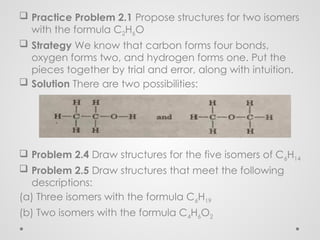
 Practice Problem 2.1 Propose structures for two isomers
with the formula C2H6O
 Strategy We know that carbon forms four bonds,
oxygen forms two, and hydrogen forms one. Put the
pieces together by trial and error, along with intuition.
 Solution There are two possibilities:
 Problem 2.4 Draw structures for the five isomers of C6H14
 Problem 2.5 Draw structures that meet the following
descriptions:
(a) Three isomers with the formula C6H19
(b) Two isomers with the formula C4H6O2
 Problem 2.6 Draw the eight possible five-carbon
alkyl groups (pentyl isomers).
 Problem 2.7 Draw alkanes that meet the following
descriptions:
(a) An alkane with two tertiary carbons
(b) An alkane that contains an isopropyl group (c) An
alkane that has one quaternary and one secondary
carbon
 Problem 2.8 Identify the carbon atoms in the
following molecules as primary, secondary, tertiary,
or quaternary:

FUNCTIONAL GROUPS.pptx FUNCTIONAL GROUPS.pptx

  • 1.
  • 2.
    Functional Groups  Thestructural features that make it possible to classify compounds by reactivity are called functional groups.  A functional groups is a group of atoms within a larger molecule that has a characteristics chemical behavior. Chemically, a given functional group behave almost the same way in every molecule it,s in.
  • 3.
    Functional Groups  Forexample, one of the simplest functional groups is the carbon-carbon double bond. Because the electronic structure of the carbon-carbon double bond remains essentially the same in all molecules where it occurs, its chemical reactivity also remains the same.  For instance, ethylene, the simplest compound with a carbon-carbon double bond, undergoes reactions that are identical to those of menthene, a substantially larger molecule found in peppermint oil.
  • 4.
    The reactions ofethylene and menthene with Br2. In both cases, Br2. reacts with the C=C functional group in exactly the same way. The size and nature of the remainder of the molecule are not important.
  • 5.
    Family name FunctionalGroup Structure Simple example Name ending Alkane (Contains only C–H and C – C single bonds) CH3CH3 -ane Ethene Alkene H2C=CH2 -ene Ethene (Ethylene) Alkyne H – C -yne Ethyne (Acetylene) Arene None Benzane Halide H3C – CI None Chloromethane Alcohol H3C – O – H -ol Methanol Ether H3C – O – CH3 -ether Dimethyl Ether
  • 6.
    Family name Functionalgroup structure Simple example Name ending Amine H3C – NH2 -amine methylamine Nitrile -Nitrile Ethanenitrile (Acetonitrile) Sulfide H3C – S – CH3 Sulfide Dimethyl sulfide Thiol H3C - SH -thiol methanethiol Carbonyl Aldehyde -al Ethanal (Acetaldehydes)
  • 7.
    Family name Functionalgroup structure Simple example Name ending Ketone -one Proponone (Acetone) Carboxylic Acid -oic Ethanoic acid (Acetic acid) Ester -oate Methyl ethanoate (Methyl Acetate)
  • 8.
    Family name Functionalgroup structure Simple example Name ending Amide -amide Ethanamide (Acetamide) Carboxylic acid chloride -oyl chloride Ethanoyl chloride (Acetyl chloride) Carboxylic acid anhydride -oic anhydride Ethanoic anhydride (Acetic anhydride)
  • 9.
    The nature ofOrganic Compounds: Alkanes  A carbon atom singly bonded to an electronegative halogen, oxygen, nitrogen, or sulfur atom: and still others have carbon – oxygen double bonds.
  • 10.
    Functional Groups with Carbon– Carbon Multiple Bonds  Alkenes, alkynes, and arenes (aromatic compounds) all contain carbon – carbon multiple bonds.  Alkenes have a double bond  Alkynes have a triple bond  Arenes have three alternating double and single bonds in a six membered ring of carbon atoms. Because of their structural similarities, these compounds also have similarities.
  • 12.
    Functional Groups withCarbon Singly Bonded to an Electronegative Atom  Alkyl halides, alcohols, ethers, amines, thiols, and sulfides all have a carbon atom singly bonded to an electronegative atom-halogen, oxygen, nitrogen, or sulfur. Alkyl halides have a carbon atom bonded to a halogen (-X), alcohols have a carbon atom bonded to a hydroxyl (-OH) group, ethers have two carbon atoms bonded to the same oxygen, amines have a carbon atom bonded to a nitrogen, thiols have a carbon atom bonded to an -SH group, and sulfides have two carbon atoms bonded to the same sulfur. In all cases, the bonds are polar, with the carbon atom bearing a partial positive charge (8+) and the electronegative atom bearing a partial negative charge (-8)
  • 13.
  • 14.
    Functional Groups witha Carbon-Oxygen Double Bond (Carbonyl Groups)  Note particularly in Table 2.1 the different families of compounds that contain the carbonyl group, C=O (pronounced car-bo-neel). Carbon-oxygen double bonds are present in some of the most important compounds in
  • 16.
    2.2 Alkanes andAlkyl Groups: Isonomers  We saw in Section 1.7 that the C-C single bond in ethane results from o (head-on) overlap of carbon sp3 hybrid orbitals. If we imagine joining three, four, five, or even more carbon atoms by C-C single bonds, we generate the large family of molecules called alkanes
  • 17.
     Alkanes areoften described as saturated hydrocarbons: hydrocarbons because they contain only carbon and hydrogen atoms; saturated because they have only C-Cand C-H single bonds and thus contain the maximum possible number of hydrogens per carbon. They have the general formula Cn H2n + 29 where n is any integer. Alkanes are also occasionally called aliphatic compounds, a word derived from the Greek aleiphas, meaning "fat" We'll see in Chapter 16 that animal fats contain long carbon chains similar to alkanes.
  • 18.
    • Think aboutthe ways that carbon and hydrogen can combine to make alkanes. With one carbon and four hydrogens, only one structure is possible: methane, CH4 Similarly, there is only one possible combination of two car- bons with hydrogens (ethane, CH3CH3) and only one possible combination of three carbons with eight hydrogens (propane, CH3CH2CH3) If larger numbers of carbons and hydrogens combine, however one kind of molecule can form. For example, there are two ways that molecules with the formula C_{4}*H_{10} can form: The four carbons can be in a row (butane), or they can branch (isobutane). Similarly, there are three ways in which CH5H12 molecules can form, and so on for larger alkanes
  • 21.
     Compounds likebutane, whose carbons, are connected in a row, are called straight-chain alkanes, or normal (n) alkanes, whereas compounds with branched carbon chains, such as isobutane (2-methylpropane), are called branched-chain alkanes. The difference between the two is that you can draw a line connecting all the carbons of a straight-chain alkane without retracing your path or lifting your pencil from the paper. For a branched-chain alkane, however, you either have to retrace your path or lift your pencil from the paper to draw a line connecting all the carbons.  Compounds like the two C4H10 molecules, which have the same formula but different structure, are called isomers, from the Greek isos + meros, meaning “made of the same parts” Isomers have the same numbers and kinds of atoms but differ in the way the atoms are arranged, Compounds like butane and isobutane, whose atoms are connected differently, are called constitutional isomers.
  • 22.
     We'll seeshortly that other kinds of isomerism are also possible, even among compounds whose atoms are connected in the same order.  A given alkane can be arbitrarily shown in many ways. For example, the straight-chain, four-carbon alkane called butane can be represented by any of the structures shown in Figure 2.2. These structures aren't intended to imply any particular three-dimensional geometry for butane; they only indicate the connections among atoms. In practice, chemists rarely draw all the bonds in a molecule and usually refer to butane by the condensed structure, CH3CH2CH2CH3 or CH3(CH2)CH3. In In such representations, the C-C and C - H "understood” rather than shown. If a carbon has three hydrogens bonded to it, we write CH3; if a carbon has two hydrogens bonded to it, we write CH2 and so on. Still more simply, butane can even be represented as n – C4H10. where a signifies normal, straight-chain butane.
  • 23.
     FIGURE 2.2 Somerepresentations of butane (n-C4H10). The molecule is the same regardless of how it's drawn. These structures imply only that butane has a continuous chain of four carbon atoms.
  • 24.
     Straight-chain alkanesare named according to the number of carbon atoms they contain, as shown in Table 2.2. With the exception of the first four compounds-methane, ethane, propane, and butane-whose names have historical origins, the alkanes are named based on Greek numbers, according to the number of carbons. The suffix -ane is added to the end of each name to identify the molecule as an alkane.
  • 25.
    Table 2.2 Namesof Straight – Chain Formula
  • 26.
     If ahydrogen atom is removed from an alkane, the partial structure that remains is called an alkyl group. Alkyl groups are named by replacing the - ane ending of the parent alkane with an -yl ending. For example, removal of a hydrogen atom from methane, CH4 generates a methyl group, - CH3 and removal of a hydrogen atom from ethane, CH3CH3, generates an ethyl group, - CH2CH3 Similarly, removal of a hydrogen atom from the end carbon of any n-alkane gives the series of n-alkyl groups shown in Table 2.3. Just as n-alkyl groups are generated by removing a hydrogen from an end carbon, branched alkyl groups are generated by removing a hydrogen atom from an internal carbon. Two 3-carbon alkyl groups and four 4- carbon alkyl groups are possible (Figure 2.3).
  • 27.
    Figure 2.3 Generation ofstraight – chain and branched – chain alkyl from alkanes.
  • 28.
    TABLE 2.3 SomeStraight – Chain Alkyl Groups
  • 29.
     refer tothe number of other carbon atoms attached to the branched carbon atom. There are four possibilities: primary (1˚) secondary (2˚) tertiary (3˚) and quaternary (4˚) The symbol R is used here and throughout this text to represent a generalized alkyl group. The R group can be methyl, ethyl, or any of a multitude of others. You might think of R as representing the Rest of the molecule, which we aren't bothering to specify.
  • 31.
     Practice Problem2.1 Propose structures for two isomers with the formula C2H6O  Strategy We know that carbon forms four bonds, oxygen forms two, and hydrogen forms one. Put the pieces together by trial and error, along with intuition.  Solution There are two possibilities:  Problem 2.4 Draw structures for the five isomers of C6H14  Problem 2.5 Draw structures that meet the following descriptions: (a) Three isomers with the formula C6H19 (b) Two isomers with the formula C4H6O2
  • 32.
     Problem 2.6Draw the eight possible five-carbon alkyl groups (pentyl isomers).  Problem 2.7 Draw alkanes that meet the following descriptions: (a) An alkane with two tertiary carbons (b) An alkane that contains an isopropyl group (c) An alkane that has one quaternary and one secondary carbon  Problem 2.8 Identify the carbon atoms in the following molecules as primary, secondary, tertiary, or quaternary: