7.4 Reaction Rates
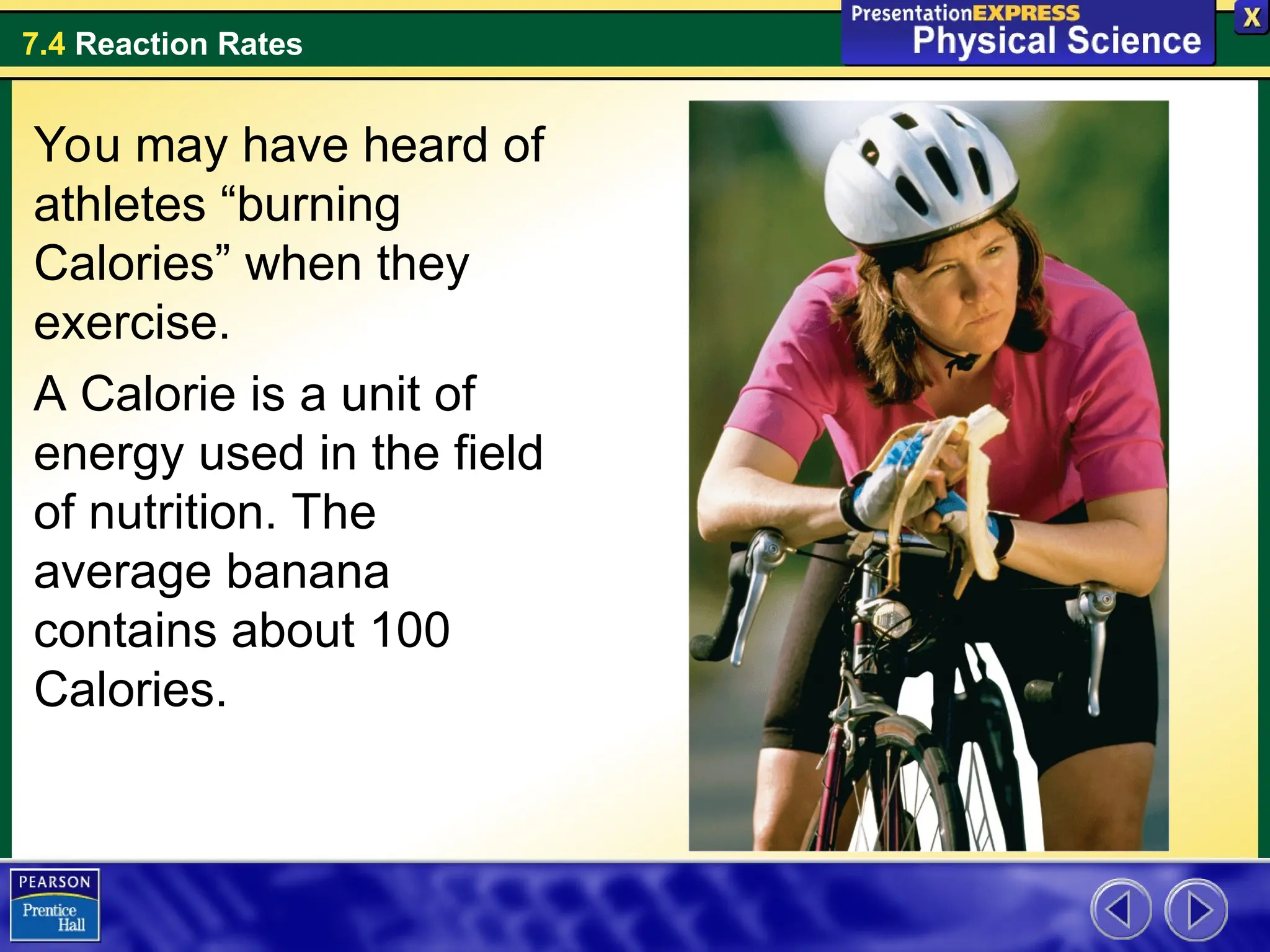
You may have heard of
athletes “burning
Calories” when they
exercise.
A Calorie is a unit of
energy used in the field
of nutrition. The
average banana
contains about 100
Calories.
7.4 Reaction Rates
If you eat a banana, you provide your body with
about 100 Calories to burn. This energy is released
in a series of reactions that take place inside your
body.
A much faster way of releasing the energy contained
in a banana is to burn it—outside the body—in a
combustion reaction.
The total amount of energy released is the same in
both cases.
7.4 Reaction Rates
What does a reaction rate tell you?
A reaction rate is the rate at which reactants
change into products over time.
Reactions Over Time
Reaction rates tell you how fast a reaction is
going.
7.4 Reaction Rates
Any change that happens over a period of time
can be expressed as a rate.
The reaction rate is how fast the reactants are
being consumed, how fast the products are being
formed, or how fast energy is being absorbed or
released.
Reactions Over Time
7.4 Reaction Rates
What factors cause reaction rates to
change?
Factors Affecting Reaction Rates
Factors that affect reaction rates include
temperature, surface area, concentration,
stirring, and catalysts.
7.4 Reaction Rates
The reaction rate of a chemical reaction depends
on how often reactant particles collide.
• If the collisions occur more frequently, then the
reaction rate increases.
• If the collisions occur less frequently, then the
reaction rate decreases.
• Reaction rates can be changed by varying
conditions.
Factors Affecting Reaction Rates
7.4 Reaction Rates
Temperature
Generally, an increase in temperature will
increase the reaction rate, while a decrease
in temperature will decrease the reaction
rate.
You store milk in a refrigerator to slow down
the reactions that cause the milk to spoil. The
rate of spoiling decreases if the milk is kept
cold.
Factors Affecting Reaction Rates
7.4 Reaction Rates
Increasing the temperature of a substance
causes its particles to move faster, on average.
Particles that move faster are both more likely to
collide and more likely to react. If the number of
collisions that produce reactions increases, then
the reaction rate increases.
Factors Affecting Reaction Rates
7.4 Reaction Rates
Surface Area
The smaller the particle size of a given mass,
the larger is its surface area.
• Increased surface area increases collisions that
involve reacting particles.
• With more collisions, more particles will react.
Factors Affecting Reaction Rates
7.4 Reaction Rates
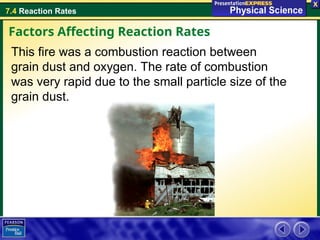
This fire was a combustion reaction between
grain dust and oxygen. The rate of combustion
was very rapid due to the small particle size of the
grain dust.
Factors Affecting Reaction Rates
7.4 Reaction Rates
Stirring
Stirring reactants increases their exposure to
each other.
In a washing machine, particles of detergent
react with particles of the stains on clothes. A
washing machine speeds up the reaction by
stirring the contents back and forth.
Factors Affecting Reaction Rates
7.4 Reaction Rates
Concentration
Concentration refers to the number of
particles in a given volume. You can change
the reaction rate by changing the
concentration of the reactants.
The more reacting particles that are present
in a given volume, the more opportunities
there are for collisions involving those
particles. The reaction rate is faster.
Factors Affecting Reaction Rates
7.4 Reaction Rates
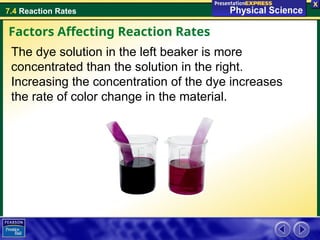
The dye solution in the left beaker is more
concentrated than the solution in the right.
Increasing the concentration of the dye increases
the rate of color change in the material.
Factors Affecting Reaction Rates
7.4 Reaction Rates
For gases, concentration changes with pressure.
The greater the pressure of a gaseous reactant,
the greater is its concentration, and the faster is
the reaction rate.
Factors Affecting Reaction Rates
7.4 Reaction Rates
Catalysts
A catalyst is a substance that affects the
reaction rate without being used up in the
reaction.
Chemists often use catalysts to speed up a
reaction or enable a reaction to occur at a
lower temperature.
Factors Affecting Reaction Rates
7.4 Reaction Rates
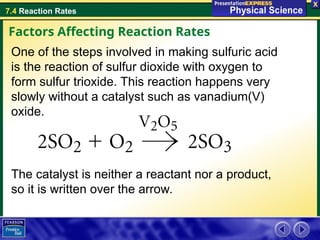
One of the steps involved in making sulfuric acid
is the reaction of sulfur dioxide with oxygen to
form sulfur trioxide. This reaction happens very
slowly without a catalyst such as vanadium(V)
oxide.
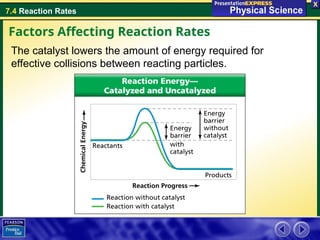
The catalyst is neither a reactant nor a product,
so it is written over the arrow.
Factors Affecting Reaction Rates
7.4 Reaction Rates
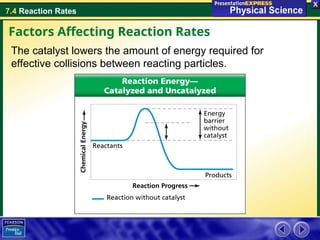
The catalyst lowers the amount of energy required for
effective collisions between reacting particles.
Factors Affecting Reaction Rates
7.4 Reaction Rates
The catalyst lowers the amount of energy required for
effective collisions between reacting particles.
Factors Affecting Reaction Rates
7.4 Reaction Rates
Assessment Questions
1. Which of the following changes will decrease the
rate of a chemical reaction?
a. increasing the temperature
b. grinding a reactant into a fine powder
c. stirring the reaction mixture
d. decreasing the concentration of one of the reactants
7.4 Reaction Rates
Assessment Questions
1. Which of the following changes will decrease the
rate of a chemical reaction?
a. increasing the temperature
b. grinding a reactant into a fine powder
c. stirring the reaction mixture
d. decreasing the concentration of one of the reactants
ANS: D
7.4 Reaction Rates
Assessment Questions
1. A reaction rate is the rate at which reactants
change into products over time.
True
False
7.4 Reaction Rates
Assessment Questions
1. A reaction rate is the rate at which reactants
change into products over time.
True
False
ANS: T

ch7_s4.ppt....................................

  • 1.
    7.4 Reaction Rates Youmay have heard of athletes “burning Calories” when they exercise. A Calorie is a unit of energy used in the field of nutrition. The average banana contains about 100 Calories.
  • 2.
    7.4 Reaction Rates Ifyou eat a banana, you provide your body with about 100 Calories to burn. This energy is released in a series of reactions that take place inside your body. A much faster way of releasing the energy contained in a banana is to burn it—outside the body—in a combustion reaction. The total amount of energy released is the same in both cases.
  • 3.
    7.4 Reaction Rates Whatdoes a reaction rate tell you? A reaction rate is the rate at which reactants change into products over time. Reactions Over Time Reaction rates tell you how fast a reaction is going.
  • 4.
    7.4 Reaction Rates Anychange that happens over a period of time can be expressed as a rate. The reaction rate is how fast the reactants are being consumed, how fast the products are being formed, or how fast energy is being absorbed or released. Reactions Over Time
  • 5.
    7.4 Reaction Rates Whatfactors cause reaction rates to change? Factors Affecting Reaction Rates Factors that affect reaction rates include temperature, surface area, concentration, stirring, and catalysts.
  • 6.
    7.4 Reaction Rates Thereaction rate of a chemical reaction depends on how often reactant particles collide. • If the collisions occur more frequently, then the reaction rate increases. • If the collisions occur less frequently, then the reaction rate decreases. • Reaction rates can be changed by varying conditions. Factors Affecting Reaction Rates
  • 7.
    7.4 Reaction Rates Temperature Generally,an increase in temperature will increase the reaction rate, while a decrease in temperature will decrease the reaction rate. You store milk in a refrigerator to slow down the reactions that cause the milk to spoil. The rate of spoiling decreases if the milk is kept cold. Factors Affecting Reaction Rates
  • 8.
    7.4 Reaction Rates Increasingthe temperature of a substance causes its particles to move faster, on average. Particles that move faster are both more likely to collide and more likely to react. If the number of collisions that produce reactions increases, then the reaction rate increases. Factors Affecting Reaction Rates
  • 9.
    7.4 Reaction Rates SurfaceArea The smaller the particle size of a given mass, the larger is its surface area. • Increased surface area increases collisions that involve reacting particles. • With more collisions, more particles will react. Factors Affecting Reaction Rates
  • 10.
    7.4 Reaction Rates Thisfire was a combustion reaction between grain dust and oxygen. The rate of combustion was very rapid due to the small particle size of the grain dust. Factors Affecting Reaction Rates
  • 11.
    7.4 Reaction Rates Stirring Stirringreactants increases their exposure to each other. In a washing machine, particles of detergent react with particles of the stains on clothes. A washing machine speeds up the reaction by stirring the contents back and forth. Factors Affecting Reaction Rates
  • 12.
    7.4 Reaction Rates Concentration Concentrationrefers to the number of particles in a given volume. You can change the reaction rate by changing the concentration of the reactants. The more reacting particles that are present in a given volume, the more opportunities there are for collisions involving those particles. The reaction rate is faster. Factors Affecting Reaction Rates
  • 13.
    7.4 Reaction Rates Thedye solution in the left beaker is more concentrated than the solution in the right. Increasing the concentration of the dye increases the rate of color change in the material. Factors Affecting Reaction Rates
  • 14.
    7.4 Reaction Rates Forgases, concentration changes with pressure. The greater the pressure of a gaseous reactant, the greater is its concentration, and the faster is the reaction rate. Factors Affecting Reaction Rates
  • 15.
    7.4 Reaction Rates Catalysts Acatalyst is a substance that affects the reaction rate without being used up in the reaction. Chemists often use catalysts to speed up a reaction or enable a reaction to occur at a lower temperature. Factors Affecting Reaction Rates
  • 16.
    7.4 Reaction Rates Oneof the steps involved in making sulfuric acid is the reaction of sulfur dioxide with oxygen to form sulfur trioxide. This reaction happens very slowly without a catalyst such as vanadium(V) oxide. The catalyst is neither a reactant nor a product, so it is written over the arrow. Factors Affecting Reaction Rates
  • 17.
    7.4 Reaction Rates Thecatalyst lowers the amount of energy required for effective collisions between reacting particles. Factors Affecting Reaction Rates
  • 18.
    7.4 Reaction Rates Thecatalyst lowers the amount of energy required for effective collisions between reacting particles. Factors Affecting Reaction Rates
  • 19.
    7.4 Reaction Rates AssessmentQuestions 1. Which of the following changes will decrease the rate of a chemical reaction? a. increasing the temperature b. grinding a reactant into a fine powder c. stirring the reaction mixture d. decreasing the concentration of one of the reactants
  • 20.
    7.4 Reaction Rates AssessmentQuestions 1. Which of the following changes will decrease the rate of a chemical reaction? a. increasing the temperature b. grinding a reactant into a fine powder c. stirring the reaction mixture d. decreasing the concentration of one of the reactants ANS: D
  • 21.
    7.4 Reaction Rates AssessmentQuestions 1. A reaction rate is the rate at which reactants change into products over time. True False
  • 22.
    7.4 Reaction Rates AssessmentQuestions 1. A reaction rate is the rate at which reactants change into products over time. True False ANS: T