Chapter 23: Substituted
Hydrocarbons and Their Reactions
CHEMISTRY
Matter and Change
Section 23.1 Alkyl Halides and Aryl Halides
Section 23.2 Alcohols, Ethers, and
Amines
Section 23.3 Carbonyl Compounds
Section 23.4 Other Reactions of Organic
Compounds
Section 23.5 Polymers
Exit
CHAPTER
23 Table Of Contents
Click a hyperlink to view the corresponding slides.
• Define functional group,
and give examples.
aliphatic compound: a
nonaromatic
hydrocarbon, such as an
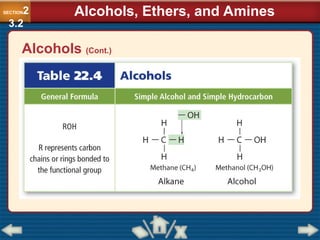
alkane, an alkene, or an
alkyne
• Compare and contrast
alkyl and aryl halide
structures.
• Evaluate the boiling
points of organic halides.
SECTION2
3.1
Alkyl Halides and Aryl Halides
functional group
halocarbon
alkyl halide
aryl halide
A halogen atom can replace a
hydrogen atom in some hydrocarbons.
plastic
substitution reaction
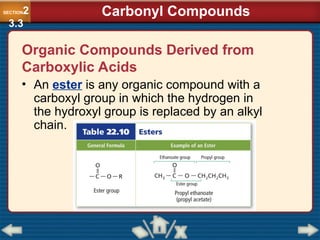
halogenation
SECTION2
3.1
Alkyl Halides and Aryl Halides
Functional Groups
• In an organic molecule, a functional
group is an atom or group of atoms that
always reacts in a certain way.
• Addition of a functional group to a
hydrocarbon always produces a substance
with different chemical and physical
properties.
• Double and triple bonds between carbon
atoms are considered functional groups.
SECTION2
3.1
Alkyl Halides and Aryl Halides
SECTION2
3.1
Alkyl Halides and Aryl Halides
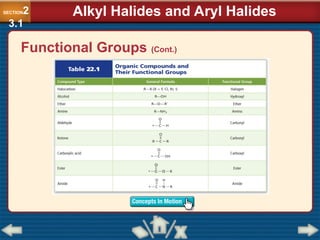
Functional Groups (Cont.)
Organic Compounds Containing Halogens
• Any organic compound that contains a
halogen substituent is called a halocarbon.
• An alkyl halide is an organic compound
containing a halogen atom covalently bonded
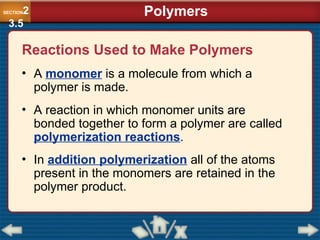
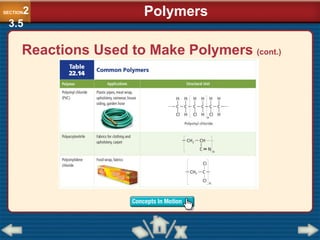
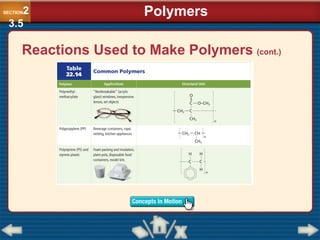
to an aliphatic carbon atom.
• An aryl halide is an organic compound
containing a halogen bonded to an aromatic
group.
SECTION2
3.1
Alkyl Halides and Aryl Halides
Organic Compounds Containing Halogens
(cont.)
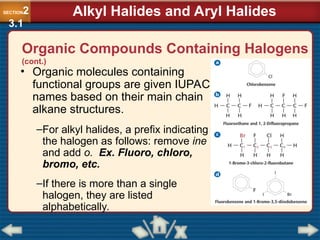
• Organic molecules containing
functional groups are given IUPAC
names based on their main chain
alkane structures.
–For alkyl halides, a prefix indicating
the halogen as follows: remove ine
and add o. Ex. Fluoro, chloro,
bromo, etc.
–If there is more than a single
halogen, they are listed
alphabetically.
SECTION2
3.1
Alkyl Halides and Aryl Halides
Organic Compounds Containing Halogens
(cont.)
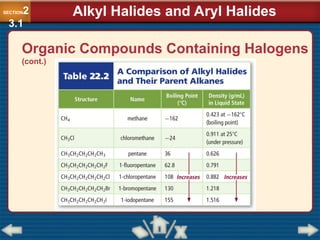
• Halocarbons have higher boiling points
because they have an increasing tendency
to form temporary dipoles.
• Dipoles attract each other, and require more
energy to separate.
• A plastic is a polymer that can be heated and
molded while relatively soft.
SECTION2
3.1
Alkyl Halides and Aryl Halides
SECTION2
3.1
Alkyl Halides and Aryl Halides
Organic Compounds Containing Halogens
(cont.)
Substitution Reactions
• Nearly all synthetic organic compounds
begin with petroleum.
• A substitution reaction is one in which one
atom or a group of atoms in a molecule is
replaced by another atom or group of atoms
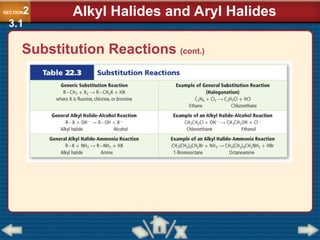
• Hydrogen atoms in an alkane can be
replaced by atoms of halogens in a process
called halogenation.
SECTION2
3.1
Alkyl Halides and Aryl Halides
Substitution Reactions (cont.)
SECTION2
3.1
Alkyl Halides and Aryl Halides
• Once halogenated, alkanes can undergo
further reactions.
• Reacting an alkyl halide with a basic solution
results in replacement of the halogen atom
with an –OH group to form an alcohol.
SECTION2
3.1
Alkyl Halides and Aryl Halides
Substitution Reactions (cont.)
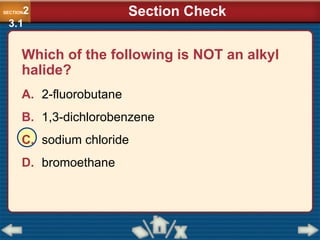
Which of the following is NOT an alkyl
halide?
A. 2-fluorobutane
B. 1,3-dichlorobenzene
C. sodium chloride
D. bromoethane
SECTION2
3.1
Section Check
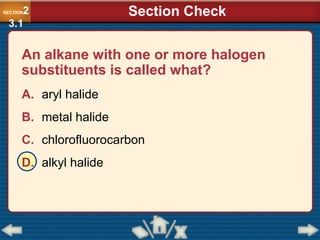
An alkane with one or more halogen
substituents is called what?
A. aryl halide
B. metal halide
C. chlorofluorocarbon
D. alkyl halide
SECTION2
3.1
Section Check
• Identify the functional
groups that characterize
alcohols, ethers, and
amines.
miscible: describes two
liquids that are soluble
in each other
• Draw the structures of
alcohols, ethers, and
amines.
• Discuss the properties
and uses of alcohols,
ethers, and amines.
SECTION2
3.2
Alcohols, Ethers, and Amines
hydroxyl group
alcohol
denatured alcohol
ether
amine
Oxygen and nitrogen are two of the
most-common atoms found in organic
functional groups.
SECTION2
3.2
Alcohols, Ethers, and Amines
Alcohols
• Oxygen commonly forms two covalent
bonds to form a stable octet.
• An oxygen-hydrogen group covalently
bonded to a carbon atom is called a hydroxyl
group.
• An organic compound in which a hydroxyl
group replaces a hydrogen is called an
alcohol.
SECTION2
3.2
Alcohols, Ethers, and Amines
Alcohols (Cont.)
SECTION2
3.2
Alcohols, Ethers, and Amines
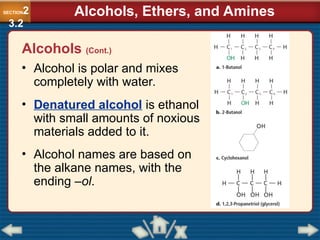
• Alcohol is polar and mixes
completely with water.
• Denatured alcohol is ethanol
with small amounts of noxious
materials added to it.
• Alcohol names are based on
the alkane names, with the
ending –ol.
SECTION2
3.2
Alcohols, Ethers, and Amines
Alcohols (Cont.)
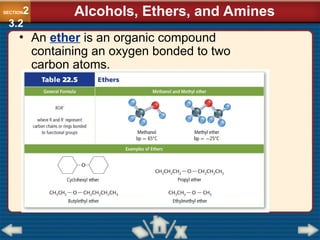
• An ether is an organic compound
containing an oxygen bonded to two
carbon atoms.
SECTION2
3.2
Alcohols, Ethers, and Amines
• Ethers have no hydrogen atoms bonded to
their oxygen atoms, so they cannot form
hydrogen bonds with each other.
• Ethers are volatile and have low boiling
points.
• Ethers with identical chains are named by the
chain followed by the word ether.
• Ethers with different chains are named in
alphabetical order followed by ether.
SECTION2
3.2
Alcohols, Ethers, and Amines
Ethers (Cont.)
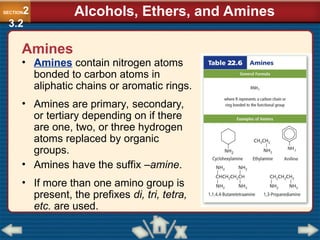
Amines
• Amines contain nitrogen atoms
bonded to carbon atoms in
aliphatic chains or aromatic rings.
SECTION2
3.2
Alcohols, Ethers, and Amines
• If more than one amino group is
present, the prefixes di, tri, tetra,
etc. are used.
• Amines have the suffix –amine.
• Amines are primary, secondary,
or tertiary depending on if there
are one, two, or three hydrogen
atoms replaced by organic
groups.
Which of the following is an alcohol?
A. cyclohexamine
B. 1-chlorobutanol
C. bromobutene
D. butylpropyl ether
SECTION2
3.2
Section Check
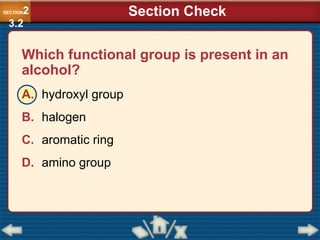
Which functional group is present in an
alcohol?
A. hydroxyl group
B. halogen
C. aromatic ring
D. amino group
SECTION2
3.2
Section Check
• Identify the structures of
carbonyl compounds,
including aldehydes,
ketones, carboxylic
acids, esters, and
amides.
electronegative:
indicates the relative
ability of an element’s
atoms to attract
electrons in a chemical
bond
• Discuss the properties
of compounds containing
the carbonyl group.
SECTION2
3.3
Carbonyl Compounds
carbonyl group
aldehyde
ketone
carboxylic acid
Carbonyl compounds contain a double-
bonded oxygen in the functional group.
carboxyl group
ester
amide
condensation reaction
SECTION2
3.3
Carbonyl Compounds
Organic Compounds Containing the
Carbonyl Group
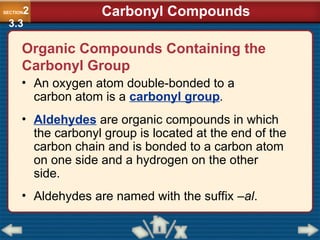
• An oxygen atom double-bonded to a
carbon atom is a carbonyl group.
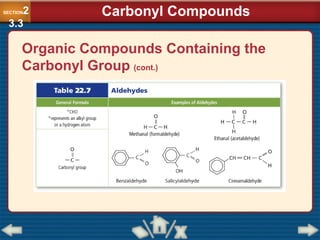
• Aldehydes are organic compounds in which
the carbonyl group is located at the end of the
carbon chain and is bonded to a carbon atom
on one side and a hydrogen on the other
side.
• Aldehydes are named with the suffix –al.
SECTION2
3.3
Carbonyl Compounds
Organic Compounds Containing the
Carbonyl Group (cont.)
SECTION2
3.3
Carbonyl Compounds
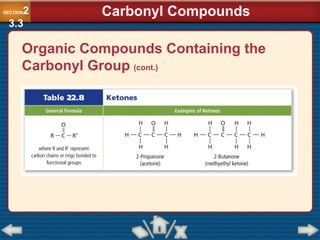
• A ketone is an organic compound in which the
carbon of the carbonyl group is bonded to two
other carbon atoms.
• Ketones are named by changing the –e at the
end of the alkane name to –one, and including a
number before the name to indicate the position
of the ketone group.
SECTION2
3.3
Carbonyl Compounds
Organic Compounds Containing the
Carbonyl Group (cont.)
• Ketones and aldehydes share many chemical
and physical properties because their structures
are similar.
• Ketones are popular solvents for moderately
polar substances.
• Ketones are somewhat soluble in water.
SECTION2
3.3
Carbonyl Compounds
Organic Compounds Containing the
Carbonyl Group (cont.)
SECTION2
3.3
Carbonyl Compounds
Organic Compounds Containing the
Carbonyl Group (cont.)
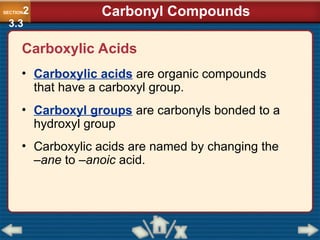
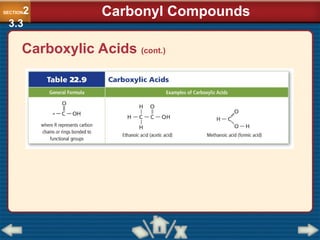
Carboxylic Acids
• Carboxylic acids are organic compounds
that have a carboxyl group.
• Carboxyl groups are carbonyls bonded to a
hydroxyl group
• Carboxylic acids are named by changing the
–ane to –anoic acid.
SECTION2
3.3
Carbonyl Compounds
Carboxylic Acids (cont.)
SECTION2
3.3
Carbonyl Compounds
• Carboxylic groups are represented by
–COOH.
• Carboxylic acids are polar and reactive, and
ionize in water to form acids.
SECTION2
3.3
Carbonyl Compounds
Carboxylic Acids (cont.)
Organic Compounds Derived from
Carboxylic Acids
• An ester is any organic compound with a
carboxyl group in which the hydrogen in
the hydroxyl group is replaced by an alkyl
chain.
SECTION2
3.3
Carbonyl Compounds
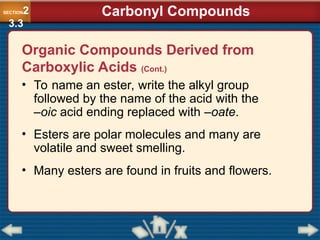
• To name an ester, write the alkyl group
followed by the name of the acid with the
–oic acid ending replaced with –oate.
• Esters are polar molecules and many are
volatile and sweet smelling.
• Many esters are found in fruits and flowers.
SECTION2
3.3
Carbonyl Compounds
Organic Compounds Derived from
Carboxylic Acids (Cont.)
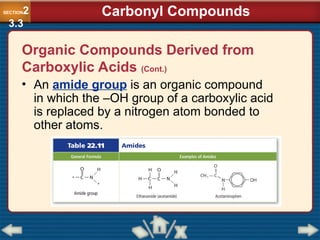
• An amide group is an organic compound
in which the –OH group of a carboxylic acid
is replaced by a nitrogen atom bonded to
other atoms.
SECTION2
3.3
Carbonyl Compounds
Organic Compounds Derived from
Carboxylic Acids (Cont.)
• The amide functional group is found
repeated many times in natural proteins
and some synthetic materials.
SECTION2
3.3
Carbonyl Compounds
Organic Compounds Derived from
Carboxylic Acids (Cont.)
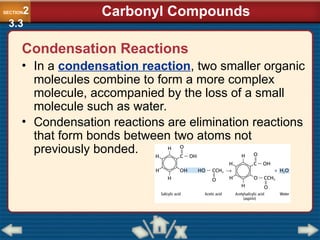
Condensation Reactions
• In a condensation reaction, two smaller organic
molecules combine to form a more complex
molecule, accompanied by the loss of a small
molecule such as water.
• Condensation reactions are elimination reactions
that form bonds between two atoms not
previously bonded.
SECTION2
3.3
Carbonyl Compounds
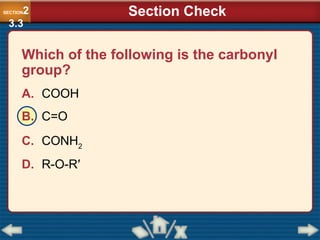
Which of the following is the carbonyl
group?
A. COOH
B. C=O
C. CONH2
D. R-O-R′
SECTION2
3.3
Section Check
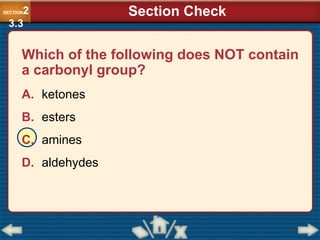
Which of the following does NOT contain
a carbonyl group?
A. ketones
B. esters
C. amines
D. aldehydes
SECTION2
3.3
Section Check
• Classify an organic reaction into one of five
categories: substitution, addition, elimination,
oxidation-reduction, or condensation.
catalyst: a substance that increases the rate of a
chemical reaction by lowering activation energies
but is not consumed in the reaction
• Use structural formulas to write equations for
reactions of organic compounds.

• Predict the products of common types of organic
reactions.
SECTION2
3.4
Other Reactions of Organic Compounds
elimination reaction
dehydrogenation reaction
dehydration reaction
Classifying the chemical reactions of
organic compounds makes predicting
products of reactions much easier.
addition reaction
hydration reaction
hydrogenation reaction
SECTION2
3.4
Other Reactions of Organic Compounds
Classifying Reactions of Organic
Substances
• Using combinations of reactions allows
chemical industries to convert simple
molecules from petroleum and natural gas
into large, complex organic molecules.
SECTION2
3.4
Other Reactions of Organic Compounds
• The formation of alkenes from alkanes is
an elimination reaction, where a
combination of atoms is removed from two
adjacent carbon atoms forming an
additional bond between the two carbon
atoms.
Other Reactions of Organic Compounds
SECTION2
3.4
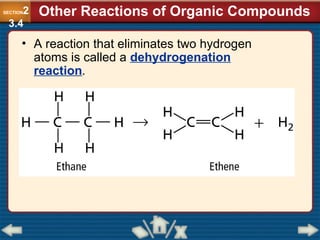
• A reaction that eliminates two hydrogen
atoms is called a dehydrogenation
reaction.
Other Reactions of Organic Compounds
SECTION2
3.4
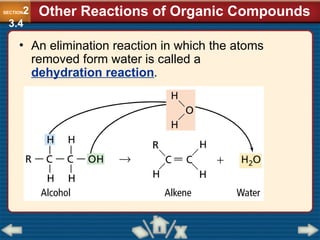
• An elimination reaction in which the atoms
removed form water is called a
dehydration reaction.
Other Reactions of Organic Compounds
SECTION2
3.4
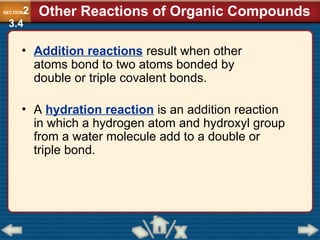
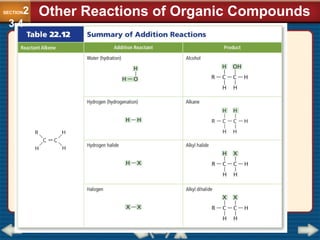
• Addition reactions result when other
atoms bond to two atoms bonded by
double or triple covalent bonds.
• A hydration reaction is an addition reaction
in which a hydrogen atom and hydroxyl group
from a water molecule add to a double or
triple bond.
Other Reactions of Organic Compounds
SECTION2
3.4
• A hydrogenation reaction involves the addition
of hydrogen to atoms in a double or triple bond.
• Catalysts are usually needed in hydrogenation
reactions.
• Hydrogenation reactions are commonly used to
convert liquid unsaturated fats into saturated fats
that are solid at room temperature.
Other Reactions of Organic Compounds
SECTION2
3.4
Other Reactions of Organic Compounds
SECTION2
3.4
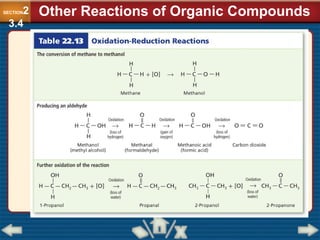
• Many organic compounds can be converted to
other compounds by oxidation-reduction
reactions.
Other Reactions of Organic Compounds
SECTION2
3.4
Classifying Reactions of Organic
Substances (Cont.)
Other Reactions of Organic Compounds
SECTION2
3.4
Predicting Products of Organic
Reactions
• Each type of reaction—substitution,
addition, elimination, oxidation-reduction,
and condensation—can be used to predict
the products of other organic reactions of
the same types.
Other Reactions of Organic Compounds
SECTION2
3.4
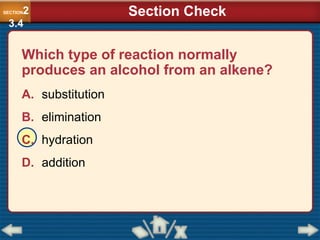
Which type of reaction normally
produces an alcohol from an alkene?
A. substitution
B. elimination
C. hydration
D. addition
SECTION2
3.4
Section Check
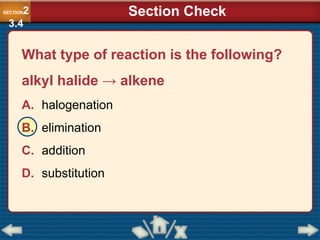
What type of reaction is the following?
alkyl halide → alkene
A. halogenation
B. elimination
C. addition
D. substitution
Section Check
SECTION2
3.4
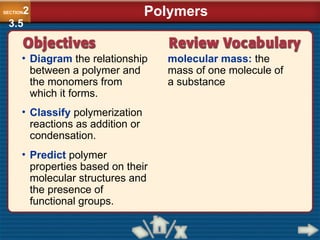
• Diagram the relationship
between a polymer and
the monomers from
which it forms.
molecular mass: the
mass of one molecule of
a substance
• Classify polymerization
reactions as addition or
condensation.
• Predict polymer
properties based on their
molecular structures and
the presence of
functional groups.
Polymers
SECTION2
3.5
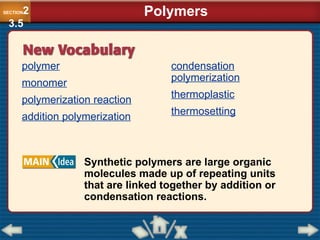
polymer
monomer
polymerization reaction
addition polymerization
Synthetic polymers are large organic
molecules made up of repeating units
that are linked together by addition or
condensation reactions.
condensation
polymerization
thermoplastic
thermosetting
Polymers
SECTION2
3.5
The Age of Polymers
• Polymers are large molecules consisting
of many repeating structural units.
• The turn of the 20th century saw the advent
of such polymers as rubber and celluloid.
Polymers
SECTION2
3.5
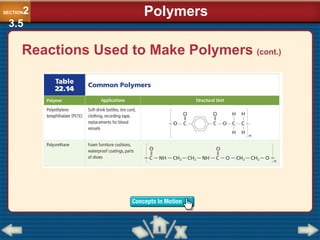
Reactions Used to Make Polymers
• A monomer is a molecule from which a
polymer is made.
• A reaction in which monomer units are
bonded together to form a polymer are called
polymerization reactions.
• In addition polymerization all of the atoms
present in the monomers are retained in the
polymer product.
Polymers
SECTION2
3.5
Polymers
SECTION2
3.5
Reactions Used to Make Polymers (cont.)
Polymers
SECTION2
3.5
Reactions Used to Make Polymers (cont.)
Polymers
SECTION2
3.5
Reactions Used to Make Polymers (cont.)
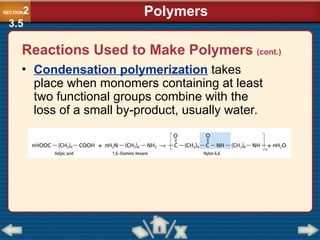
• Condensation polymerization takes
place when monomers containing at least
two functional groups combine with the
loss of a small by-product, usually water.
Polymers
SECTION2
3.5
Reactions Used to Make Polymers (cont.)
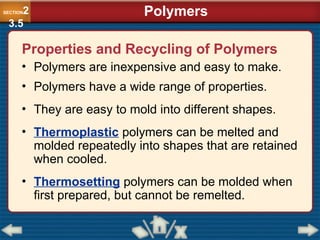
Properties and Recycling of Polymers
• Polymers are inexpensive and easy to make.
• Polymers have a wide range of properties.
• They are easy to mold into different shapes.
• Thermoplastic polymers can be melted and
molded repeatedly into shapes that are retained
when cooled.
• Thermosetting polymers can be molded when
first prepared, but cannot be remelted.
Polymers
SECTION2
3.5
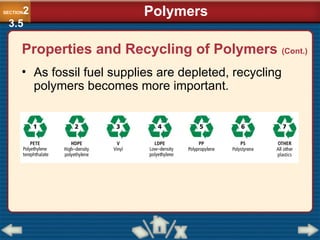
• As fossil fuel supplies are depleted, recycling
polymers becomes more important.
Polymers
SECTION2
3.5
Properties and Recycling of Polymers (Cont.)
The smaller, repeating units that make up
a polymer are called ____.
A. structural units
B. polyunits
C. monomers
D. building blocks
SECTION2
3.5
Section Check
One way polymers are synthesized is
through ____ reactions.
A. condensation
B. elimination
C. substitution
D. dehydration
SECTION2
3.5
Section Check
Chemistry Online
Study Guide
Chapter Assessment
Standardized Test Practice
Resources
Substituted Hydrocarbons and Their Reactions
CHAPTER
23
• The substitution of functional groups for hydrogen in
hydrocarbons creates a wide variety of organic
compounds.
• An alkyl halide is an organic compound that has one or
more halogen atoms bonded to a carbon atom in an
aliphatic compound.
Alkyl Halides and Aryl Halides
SECTION2
3.1
Study Guide
Key Concepts
• Alcohols, ethers, and amines are formed when specific
functional groups substitute for hydrogen in
hydrocarbons.
• Because they readily form hydrogen bonds, alcohols
have higher boiling points and higher water solubilities
than other organic compounds.
Key Concepts
Alcohols, Ethers, and Amines
SECTION2
3.2
Study Guide
• Carbonyl compounds are organic compounds that
contain the C=O group.
• Five important classes of organic compounds
containing carbonyl compounds are aldehydes,
ketones, carboxylic acids, esters, and amides.
Study Guide
Carbonyl Compounds
SECTION2
3.3
Key Concepts
• Most reactions of organic compounds can be
classified into one of five categories: substitution,
elimination, addition, oxidation-reduction, and
condensation.
• Knowing the types of organic compounds reacting can
enable you to predict the reaction products.
Key Concepts
Study Guide
SECTION2
3.4
Other Reactions of Organic Compounds
• Polymers are large molecules formed by combining
smaller molecules called monomers.
• Polymers are synthesized through addition or
condensation reactions.
• The functional groups present in polymers can be used
to predict polymer properties.
Study Guide
SECTION2
3.5
Polymers
Key Concepts
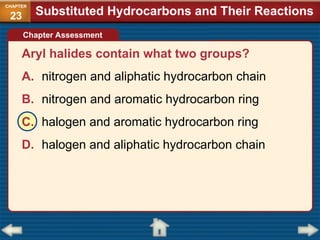
Aryl halides contain what two groups?
A. nitrogen and aliphatic hydrocarbon chain
B. nitrogen and aromatic hydrocarbon ring
C. halogen and aromatic hydrocarbon ring
D. halogen and aliphatic hydrocarbon chain
Chapter Assessment
Substituted Hydrocarbons and Their Reactions
CHAPTER
23
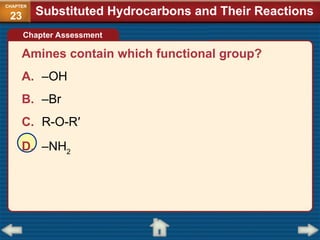
Amines contain which functional group?
A. –OH
B. –Br
C. R-O-R′
D. –NH2
Chapter Assessment
Substituted Hydrocarbons and Their Reactions
CHAPTER
23
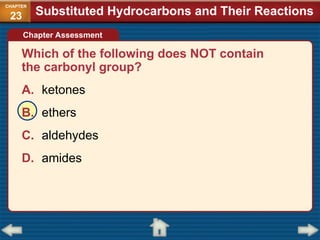
Which of the following does NOT contain
the carbonyl group?
A. ketones
B. ethers
C. aldehydes
D. amides
Chapter Assessment
Substituted Hydrocarbons and Their Reactions
CHAPTER
23
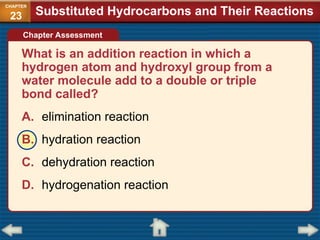
What is an addition reaction in which a
hydrogen atom and hydroxyl group from a
water molecule add to a double or triple
bond called?
A. elimination reaction
B. hydration reaction
C. dehydration reaction
D. hydrogenation reaction
Substituted Hydrocarbons and Their Reactions
CHAPTER
23
Chapter Assessment
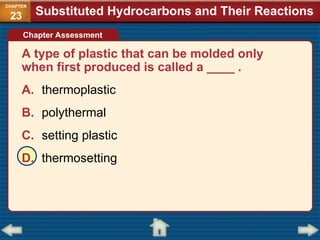
A type of plastic that can be molded only
when first produced is called a ____ .
A. thermoplastic
B. polythermal
C. setting plastic
D. thermosetting
Substituted Hydrocarbons and Their Reactions
CHAPTER
23
Chapter Assessment
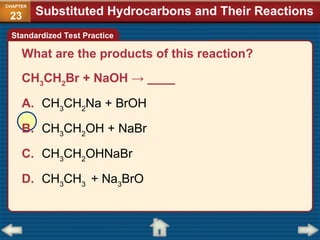
What are the products of this reaction?
CH3
CH2
Br + NaOH → ____
A. CH3
CH2
Na + BrOH
B. CH3
CH2
OH + NaBr
C. CH3
CH2
OHNaBr
D. CH3
CH3
+ Na3
BrO
Standardized Test Practice
Substituted Hydrocarbons and Their Reactions
CHAPTER
23
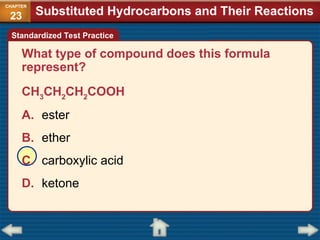
What type of compound does this formula
represent?
CH3
CH2
CH2
COOH
A. ester
B. ether
C. carboxylic acid
D. ketone
Substituted Hydrocarbons and Their Reactions
CHAPTER
23
Standardized Test Practice
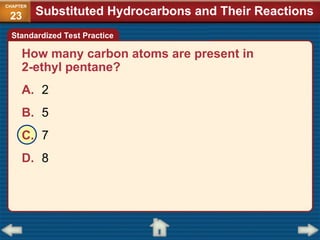
How many carbon atoms are present in
2-ethyl pentane?
A. 2
B. 5
C. 7
D. 8
Standardized Test Practice
Substituted Hydrocarbons and Their Reactions
CHAPTER
23
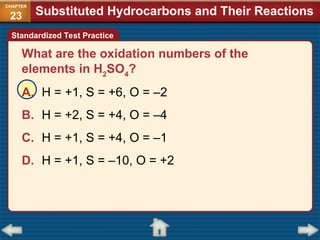
What are the oxidation numbers of the
elements in H2
SO4
?
A. H = +1, S = +6, O = –2
B. H = +2, S = +4, O = –4
C. H = +1, S = +4, O = –1
D. H = +1, S = –10, O = +2
Standardized Test Practice
Substituted Hydrocarbons and Their Reactions
CHAPTER
23
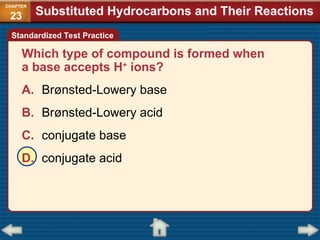
Which type of compound is formed when
a base accepts H+
ions?
A. Brønsted-Lowery base
B. Brønsted-Lowery acid
C. conjugate base
D. conjugate acid
Standardized Test Practice
Substituted Hydrocarbons and Their Reactions
CHAPTER
23
This slide is intentionally blank.

ch23_notes............................ppt

  • 1.
    Chapter 23: Substituted Hydrocarbonsand Their Reactions CHEMISTRY Matter and Change
  • 2.
    Section 23.1 AlkylHalides and Aryl Halides Section 23.2 Alcohols, Ethers, and Amines Section 23.3 Carbonyl Compounds Section 23.4 Other Reactions of Organic Compounds Section 23.5 Polymers Exit CHAPTER 23 Table Of Contents Click a hyperlink to view the corresponding slides.
  • 3.
    • Define functionalgroup, and give examples. aliphatic compound: a nonaromatic hydrocarbon, such as an alkane, an alkene, or an alkyne • Compare and contrast alkyl and aryl halide structures. • Evaluate the boiling points of organic halides. SECTION2 3.1 Alkyl Halides and Aryl Halides
  • 4.
    functional group halocarbon alkyl halide arylhalide A halogen atom can replace a hydrogen atom in some hydrocarbons. plastic substitution reaction halogenation SECTION2 3.1 Alkyl Halides and Aryl Halides
  • 5.
    Functional Groups • Inan organic molecule, a functional group is an atom or group of atoms that always reacts in a certain way. • Addition of a functional group to a hydrocarbon always produces a substance with different chemical and physical properties. • Double and triple bonds between carbon atoms are considered functional groups. SECTION2 3.1 Alkyl Halides and Aryl Halides
  • 6.
    SECTION2 3.1 Alkyl Halides andAryl Halides Functional Groups (Cont.)
  • 7.
    Organic Compounds ContainingHalogens • Any organic compound that contains a halogen substituent is called a halocarbon. • An alkyl halide is an organic compound containing a halogen atom covalently bonded to an aliphatic carbon atom. • An aryl halide is an organic compound containing a halogen bonded to an aromatic group. SECTION2 3.1 Alkyl Halides and Aryl Halides
  • 8.
    Organic Compounds ContainingHalogens (cont.) • Organic molecules containing functional groups are given IUPAC names based on their main chain alkane structures. –For alkyl halides, a prefix indicating the halogen as follows: remove ine and add o. Ex. Fluoro, chloro, bromo, etc. –If there is more than a single halogen, they are listed alphabetically. SECTION2 3.1 Alkyl Halides and Aryl Halides
  • 9.
    Organic Compounds ContainingHalogens (cont.) • Halocarbons have higher boiling points because they have an increasing tendency to form temporary dipoles. • Dipoles attract each other, and require more energy to separate. • A plastic is a polymer that can be heated and molded while relatively soft. SECTION2 3.1 Alkyl Halides and Aryl Halides
  • 10.
    SECTION2 3.1 Alkyl Halides andAryl Halides Organic Compounds Containing Halogens (cont.)
  • 11.
    Substitution Reactions • Nearlyall synthetic organic compounds begin with petroleum. • A substitution reaction is one in which one atom or a group of atoms in a molecule is replaced by another atom or group of atoms • Hydrogen atoms in an alkane can be replaced by atoms of halogens in a process called halogenation. SECTION2 3.1 Alkyl Halides and Aryl Halides
  • 12.
  • 13.
    • Once halogenated,alkanes can undergo further reactions. • Reacting an alkyl halide with a basic solution results in replacement of the halogen atom with an –OH group to form an alcohol. SECTION2 3.1 Alkyl Halides and Aryl Halides Substitution Reactions (cont.)
  • 14.
    Which of thefollowing is NOT an alkyl halide? A. 2-fluorobutane B. 1,3-dichlorobenzene C. sodium chloride D. bromoethane SECTION2 3.1 Section Check
  • 15.
    An alkane withone or more halogen substituents is called what? A. aryl halide B. metal halide C. chlorofluorocarbon D. alkyl halide SECTION2 3.1 Section Check
  • 17.
    • Identify thefunctional groups that characterize alcohols, ethers, and amines. miscible: describes two liquids that are soluble in each other • Draw the structures of alcohols, ethers, and amines. • Discuss the properties and uses of alcohols, ethers, and amines. SECTION2 3.2 Alcohols, Ethers, and Amines
  • 18.
    hydroxyl group alcohol denatured alcohol ether amine Oxygenand nitrogen are two of the most-common atoms found in organic functional groups. SECTION2 3.2 Alcohols, Ethers, and Amines
  • 19.
    Alcohols • Oxygen commonlyforms two covalent bonds to form a stable octet. • An oxygen-hydrogen group covalently bonded to a carbon atom is called a hydroxyl group. • An organic compound in which a hydroxyl group replaces a hydrogen is called an alcohol. SECTION2 3.2 Alcohols, Ethers, and Amines
  • 20.
  • 21.
    • Alcohol ispolar and mixes completely with water. • Denatured alcohol is ethanol with small amounts of noxious materials added to it. • Alcohol names are based on the alkane names, with the ending –ol. SECTION2 3.2 Alcohols, Ethers, and Amines Alcohols (Cont.)
  • 22.
    • An etheris an organic compound containing an oxygen bonded to two carbon atoms. SECTION2 3.2 Alcohols, Ethers, and Amines
  • 23.
    • Ethers haveno hydrogen atoms bonded to their oxygen atoms, so they cannot form hydrogen bonds with each other. • Ethers are volatile and have low boiling points. • Ethers with identical chains are named by the chain followed by the word ether. • Ethers with different chains are named in alphabetical order followed by ether. SECTION2 3.2 Alcohols, Ethers, and Amines Ethers (Cont.)
  • 24.
    Amines • Amines containnitrogen atoms bonded to carbon atoms in aliphatic chains or aromatic rings. SECTION2 3.2 Alcohols, Ethers, and Amines • If more than one amino group is present, the prefixes di, tri, tetra, etc. are used. • Amines have the suffix –amine. • Amines are primary, secondary, or tertiary depending on if there are one, two, or three hydrogen atoms replaced by organic groups.
  • 25.
    Which of thefollowing is an alcohol? A. cyclohexamine B. 1-chlorobutanol C. bromobutene D. butylpropyl ether SECTION2 3.2 Section Check
  • 26.
    Which functional groupis present in an alcohol? A. hydroxyl group B. halogen C. aromatic ring D. amino group SECTION2 3.2 Section Check
  • 28.
    • Identify thestructures of carbonyl compounds, including aldehydes, ketones, carboxylic acids, esters, and amides. electronegative: indicates the relative ability of an element’s atoms to attract electrons in a chemical bond • Discuss the properties of compounds containing the carbonyl group. SECTION2 3.3 Carbonyl Compounds
  • 29.
    carbonyl group aldehyde ketone carboxylic acid Carbonylcompounds contain a double- bonded oxygen in the functional group. carboxyl group ester amide condensation reaction SECTION2 3.3 Carbonyl Compounds
  • 30.
    Organic Compounds Containingthe Carbonyl Group • An oxygen atom double-bonded to a carbon atom is a carbonyl group. • Aldehydes are organic compounds in which the carbonyl group is located at the end of the carbon chain and is bonded to a carbon atom on one side and a hydrogen on the other side. • Aldehydes are named with the suffix –al. SECTION2 3.3 Carbonyl Compounds
  • 31.
    Organic Compounds Containingthe Carbonyl Group (cont.) SECTION2 3.3 Carbonyl Compounds
  • 32.
    • A ketoneis an organic compound in which the carbon of the carbonyl group is bonded to two other carbon atoms. • Ketones are named by changing the –e at the end of the alkane name to –one, and including a number before the name to indicate the position of the ketone group. SECTION2 3.3 Carbonyl Compounds Organic Compounds Containing the Carbonyl Group (cont.) • Ketones and aldehydes share many chemical and physical properties because their structures are similar.
  • 33.
    • Ketones arepopular solvents for moderately polar substances. • Ketones are somewhat soluble in water. SECTION2 3.3 Carbonyl Compounds Organic Compounds Containing the Carbonyl Group (cont.)
  • 34.
    SECTION2 3.3 Carbonyl Compounds Organic CompoundsContaining the Carbonyl Group (cont.)
  • 35.
    Carboxylic Acids • Carboxylicacids are organic compounds that have a carboxyl group. • Carboxyl groups are carbonyls bonded to a hydroxyl group • Carboxylic acids are named by changing the –ane to –anoic acid. SECTION2 3.3 Carbonyl Compounds
  • 36.
  • 37.
    • Carboxylic groupsare represented by –COOH. • Carboxylic acids are polar and reactive, and ionize in water to form acids. SECTION2 3.3 Carbonyl Compounds Carboxylic Acids (cont.)
  • 38.
    Organic Compounds Derivedfrom Carboxylic Acids • An ester is any organic compound with a carboxyl group in which the hydrogen in the hydroxyl group is replaced by an alkyl chain. SECTION2 3.3 Carbonyl Compounds
  • 39.
    • To namean ester, write the alkyl group followed by the name of the acid with the –oic acid ending replaced with –oate. • Esters are polar molecules and many are volatile and sweet smelling. • Many esters are found in fruits and flowers. SECTION2 3.3 Carbonyl Compounds Organic Compounds Derived from Carboxylic Acids (Cont.)
  • 40.
    • An amidegroup is an organic compound in which the –OH group of a carboxylic acid is replaced by a nitrogen atom bonded to other atoms. SECTION2 3.3 Carbonyl Compounds Organic Compounds Derived from Carboxylic Acids (Cont.)
  • 41.
    • The amidefunctional group is found repeated many times in natural proteins and some synthetic materials. SECTION2 3.3 Carbonyl Compounds Organic Compounds Derived from Carboxylic Acids (Cont.)
  • 42.
    Condensation Reactions • Ina condensation reaction, two smaller organic molecules combine to form a more complex molecule, accompanied by the loss of a small molecule such as water. • Condensation reactions are elimination reactions that form bonds between two atoms not previously bonded. SECTION2 3.3 Carbonyl Compounds
  • 43.
    Which of thefollowing is the carbonyl group? A. COOH B. C=O C. CONH2 D. R-O-R′ SECTION2 3.3 Section Check
  • 44.
    Which of thefollowing does NOT contain a carbonyl group? A. ketones B. esters C. amines D. aldehydes SECTION2 3.3 Section Check
  • 46.
    • Classify anorganic reaction into one of five categories: substitution, addition, elimination, oxidation-reduction, or condensation. catalyst: a substance that increases the rate of a chemical reaction by lowering activation energies but is not consumed in the reaction • Use structural formulas to write equations for reactions of organic compounds. • Predict the products of common types of organic reactions. SECTION2 3.4 Other Reactions of Organic Compounds
  • 47.
    elimination reaction dehydrogenation reaction dehydrationreaction Classifying the chemical reactions of organic compounds makes predicting products of reactions much easier. addition reaction hydration reaction hydrogenation reaction SECTION2 3.4 Other Reactions of Organic Compounds
  • 48.
    Classifying Reactions ofOrganic Substances • Using combinations of reactions allows chemical industries to convert simple molecules from petroleum and natural gas into large, complex organic molecules. SECTION2 3.4 Other Reactions of Organic Compounds
  • 49.
    • The formationof alkenes from alkanes is an elimination reaction, where a combination of atoms is removed from two adjacent carbon atoms forming an additional bond between the two carbon atoms. Other Reactions of Organic Compounds SECTION2 3.4
  • 50.
    • A reactionthat eliminates two hydrogen atoms is called a dehydrogenation reaction. Other Reactions of Organic Compounds SECTION2 3.4
  • 51.
    • An eliminationreaction in which the atoms removed form water is called a dehydration reaction. Other Reactions of Organic Compounds SECTION2 3.4
  • 52.
    • Addition reactionsresult when other atoms bond to two atoms bonded by double or triple covalent bonds. • A hydration reaction is an addition reaction in which a hydrogen atom and hydroxyl group from a water molecule add to a double or triple bond. Other Reactions of Organic Compounds SECTION2 3.4
  • 53.
    • A hydrogenationreaction involves the addition of hydrogen to atoms in a double or triple bond. • Catalysts are usually needed in hydrogenation reactions. • Hydrogenation reactions are commonly used to convert liquid unsaturated fats into saturated fats that are solid at room temperature. Other Reactions of Organic Compounds SECTION2 3.4
  • 54.
    Other Reactions ofOrganic Compounds SECTION2 3.4
  • 55.
    • Many organiccompounds can be converted to other compounds by oxidation-reduction reactions. Other Reactions of Organic Compounds SECTION2 3.4 Classifying Reactions of Organic Substances (Cont.)
  • 56.
    Other Reactions ofOrganic Compounds SECTION2 3.4
  • 57.
    Predicting Products ofOrganic Reactions • Each type of reaction—substitution, addition, elimination, oxidation-reduction, and condensation—can be used to predict the products of other organic reactions of the same types. Other Reactions of Organic Compounds SECTION2 3.4
  • 58.
    Which type ofreaction normally produces an alcohol from an alkene? A. substitution B. elimination C. hydration D. addition SECTION2 3.4 Section Check
  • 59.
    What type ofreaction is the following? alkyl halide → alkene A. halogenation B. elimination C. addition D. substitution Section Check SECTION2 3.4
  • 61.
    • Diagram therelationship between a polymer and the monomers from which it forms. molecular mass: the mass of one molecule of a substance • Classify polymerization reactions as addition or condensation. • Predict polymer properties based on their molecular structures and the presence of functional groups. Polymers SECTION2 3.5
  • 62.
    polymer monomer polymerization reaction addition polymerization Syntheticpolymers are large organic molecules made up of repeating units that are linked together by addition or condensation reactions. condensation polymerization thermoplastic thermosetting Polymers SECTION2 3.5
  • 63.
    The Age ofPolymers • Polymers are large molecules consisting of many repeating structural units. • The turn of the 20th century saw the advent of such polymers as rubber and celluloid. Polymers SECTION2 3.5
  • 64.
    Reactions Used toMake Polymers • A monomer is a molecule from which a polymer is made. • A reaction in which monomer units are bonded together to form a polymer are called polymerization reactions. • In addition polymerization all of the atoms present in the monomers are retained in the polymer product. Polymers SECTION2 3.5
  • 65.
  • 66.
  • 67.
  • 68.
    • Condensation polymerizationtakes place when monomers containing at least two functional groups combine with the loss of a small by-product, usually water. Polymers SECTION2 3.5 Reactions Used to Make Polymers (cont.)
  • 69.
    Properties and Recyclingof Polymers • Polymers are inexpensive and easy to make. • Polymers have a wide range of properties. • They are easy to mold into different shapes. • Thermoplastic polymers can be melted and molded repeatedly into shapes that are retained when cooled. • Thermosetting polymers can be molded when first prepared, but cannot be remelted. Polymers SECTION2 3.5
  • 70.
    • As fossilfuel supplies are depleted, recycling polymers becomes more important. Polymers SECTION2 3.5 Properties and Recycling of Polymers (Cont.)
  • 71.
    The smaller, repeatingunits that make up a polymer are called ____. A. structural units B. polyunits C. monomers D. building blocks SECTION2 3.5 Section Check
  • 72.
    One way polymersare synthesized is through ____ reactions. A. condensation B. elimination C. substitution D. dehydration SECTION2 3.5 Section Check
  • 74.
    Chemistry Online Study Guide ChapterAssessment Standardized Test Practice Resources Substituted Hydrocarbons and Their Reactions CHAPTER 23
  • 75.
    • The substitutionof functional groups for hydrogen in hydrocarbons creates a wide variety of organic compounds. • An alkyl halide is an organic compound that has one or more halogen atoms bonded to a carbon atom in an aliphatic compound. Alkyl Halides and Aryl Halides SECTION2 3.1 Study Guide Key Concepts
  • 76.
    • Alcohols, ethers,and amines are formed when specific functional groups substitute for hydrogen in hydrocarbons. • Because they readily form hydrogen bonds, alcohols have higher boiling points and higher water solubilities than other organic compounds. Key Concepts Alcohols, Ethers, and Amines SECTION2 3.2 Study Guide
  • 77.
    • Carbonyl compoundsare organic compounds that contain the C=O group. • Five important classes of organic compounds containing carbonyl compounds are aldehydes, ketones, carboxylic acids, esters, and amides. Study Guide Carbonyl Compounds SECTION2 3.3 Key Concepts
  • 78.
    • Most reactionsof organic compounds can be classified into one of five categories: substitution, elimination, addition, oxidation-reduction, and condensation. • Knowing the types of organic compounds reacting can enable you to predict the reaction products. Key Concepts Study Guide SECTION2 3.4 Other Reactions of Organic Compounds
  • 79.
    • Polymers arelarge molecules formed by combining smaller molecules called monomers. • Polymers are synthesized through addition or condensation reactions. • The functional groups present in polymers can be used to predict polymer properties. Study Guide SECTION2 3.5 Polymers Key Concepts
  • 80.
    Aryl halides containwhat two groups? A. nitrogen and aliphatic hydrocarbon chain B. nitrogen and aromatic hydrocarbon ring C. halogen and aromatic hydrocarbon ring D. halogen and aliphatic hydrocarbon chain Chapter Assessment Substituted Hydrocarbons and Their Reactions CHAPTER 23
  • 81.
    Amines contain whichfunctional group? A. –OH B. –Br C. R-O-R′ D. –NH2 Chapter Assessment Substituted Hydrocarbons and Their Reactions CHAPTER 23
  • 82.
    Which of thefollowing does NOT contain the carbonyl group? A. ketones B. ethers C. aldehydes D. amides Chapter Assessment Substituted Hydrocarbons and Their Reactions CHAPTER 23
  • 83.
    What is anaddition reaction in which a hydrogen atom and hydroxyl group from a water molecule add to a double or triple bond called? A. elimination reaction B. hydration reaction C. dehydration reaction D. hydrogenation reaction Substituted Hydrocarbons and Their Reactions CHAPTER 23 Chapter Assessment
  • 84.
    A type ofplastic that can be molded only when first produced is called a ____ . A. thermoplastic B. polythermal C. setting plastic D. thermosetting Substituted Hydrocarbons and Their Reactions CHAPTER 23 Chapter Assessment
  • 85.
    What are theproducts of this reaction? CH3 CH2 Br + NaOH → ____ A. CH3 CH2 Na + BrOH B. CH3 CH2 OH + NaBr C. CH3 CH2 OHNaBr D. CH3 CH3 + Na3 BrO Standardized Test Practice Substituted Hydrocarbons and Their Reactions CHAPTER 23
  • 86.
    What type ofcompound does this formula represent? CH3 CH2 CH2 COOH A. ester B. ether C. carboxylic acid D. ketone Substituted Hydrocarbons and Their Reactions CHAPTER 23 Standardized Test Practice
  • 87.
    How many carbonatoms are present in 2-ethyl pentane? A. 2 B. 5 C. 7 D. 8 Standardized Test Practice Substituted Hydrocarbons and Their Reactions CHAPTER 23
  • 88.
    What are theoxidation numbers of the elements in H2 SO4 ? A. H = +1, S = +6, O = –2 B. H = +2, S = +4, O = –4 C. H = +1, S = +4, O = –1 D. H = +1, S = –10, O = +2 Standardized Test Practice Substituted Hydrocarbons and Their Reactions CHAPTER 23
  • 89.
    Which type ofcompound is formed when a base accepts H+ ions? A. Brønsted-Lowery base B. Brønsted-Lowery acid C. conjugate base D. conjugate acid Standardized Test Practice Substituted Hydrocarbons and Their Reactions CHAPTER 23
  • 90.
    This slide isintentionally blank.