
By Shaik Mohammad Imran
SHAIK MOHAMMAD IMRAN
Content
• Introduction
• Concepts of Fundamental Analysis
• Table of Decision Making based on IntrinsicValue and Market Price
• Fundamental Analysis –A Framework
• Phases of Fundamental Analysis – (Picture)
• EconomyAnalysis
• Industry Analysis
• The Pioneering Stage
• The Expansion Stage
• The Stagnation Stage
• CompanyAnalysis
• Financial Ratio
SHAIK MOHAMMAD IMRAN
Introduction
Investment decisions are the most important factor involving stock market
operations. The investment analysis entails arriving at a decision after collection
and analysing the relevant information. Every investor intends to maximise return
and minimise the risk of his investment In order to maximise profits both the
decisions are equally important. The fundamental analysis is one of the tools to
estimate the intrinsic value of a company’s share on the basis of financial data.The
Fundamental analysis studies the company every aspect relating to sales,
production , profit earning per share and dividends paid etc.It also examines the
company’s financial strength , its managerial talent, caliber, skills and
competence.
SHAIK MOHAMMAD IMRAN
What is the 'IntrinsicValue'
The intrinsic value is the actual value of a company or an asset based on an
underlying perception of its true value including all aspects of the business,
in terms of both tangible and intangible factors. This value may or may not be
the same as the current market value.
Note : It is difficult to determine Intrinsic Value
SHAIK MOHAMMAD IMRAN
Concept of fundamental analysis
A fundamental analysis is a time honoured, value based approach depending
upon a careful assessment of the fundamental; of an economy, industry and
company. The fundamental analysis studies the general economic situation
, makes an evaluation of an industry and finally does an in depth analysis ,
both financial and non- financial of the company.
The Intrinsic value is the present value of future dividends and capital
appreciation computed at an appropriate discount rate to reflect the
riskiness of the share. The Intrinsic value is also known as fundamental
value. Based on the fundamental value the investor will make a decision to
buy or sell a share, by comparing the market price of the shares.
SHAIK MOHAMMAD IMRAN
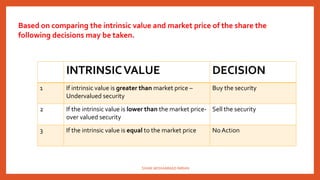
Based on comparing the intrinsic value and market price of the share the
following decisions may be taken.
INTRINSICVALUE DECISION
1 If intrinsic value is greater than market price –
Undervalued security
Buy the security
2 If the intrinsic value is lower than the market price-
over valued security
Sell the security
3 If the intrinsic value is equal to the market price NoAction
SHAIK MOHAMMAD IMRAN
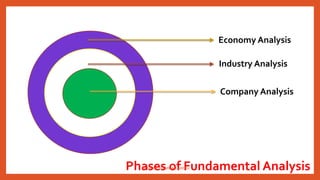
Economy Analysis
Industry Analysis
Company Analysis
Phases of Fundamental AnalysisSHAIK MOHAMMAD IMRAN
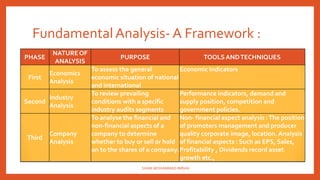
FundamentalAnalysis- A Framework :
PHASE
NATURE OF
ANALYSIS
PURPOSE TOOLS ANDTECHNIQUES
First
Economics
Analysis
To assess the general
economic situation of national
and international
Economic Indicators
Second
Industry
Analysis
To review prevailing
conditions with a specific
industry audits segments
Performance indicators, demand and
supply position, competition and
government policies.
Third
Company
Analysis
To analyse the financial and
non-financial aspects of a
company to determine
whether to buy or sell or hold
on to the shares of a company.
Non- financial aspect analysis :The position
of promoters management and producer
quality corporate image, location. Analysis
of financial aspects : Such as EPS, Sales,
Profitability , Dividends record asset
growth etc.,
SHAIK MOHAMMAD IMRAN
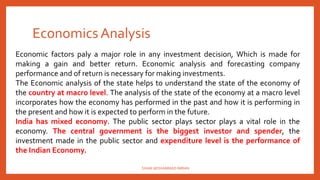
Economics Analysis
Economic factors paly a major role in any investment decision, Which is made for
making a gain and better return. Economic analysis and forecasting company
performance and of return is necessary for making investments.
The Economic analysis of the state helps to understand the state of the economy of
the country at macro level. The analysis of the state of the economy at a macro level
incorporates how the economy has performed in the past and how it is performing in
the present and how it is expected to perform in the future.
India has mixed economy. The public sector plays sector plays a vital role in the
economy. The central government is the biggest investor and spender, the
investment made in the public sector and expenditure level is the performance of
the Indian Economy.
SHAIK MOHAMMAD IMRAN
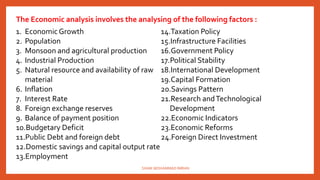
The Economic analysis involves the analysing of the following factors :
1. Economic Growth
2. Population
3. Monsoon and agricultural production
4. Industrial Production
5. Natural resource and availability of raw
material
6. Inflation
7. Interest Rate
8. Foreign exchange reserves
9. Balance of payment position
10.Budgetary Deficit
11.Public Debt and foreign debt
12.Domestic savings and capital output rate
13.Employment
14.Taxation Policy
15.Infrastructure Facilities
16.Government Policy
17.Political Stability
18.International Development
19.Capital Formation
20.Savings Pattern
21.Research andTechnological
Development
22.Economic Indicators
23.Economic Reforms
24.Foreign Direct Investment
SHAIK MOHAMMAD IMRAN
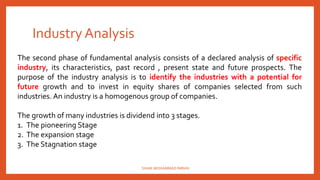
Industry Analysis
The second phase of fundamental analysis consists of a declared analysis of specific
industry, its characteristics, past record , present state and future prospects. The
purpose of the industry analysis is to identify the industries with a potential for
future growth and to invest in equity shares of companies selected from such
industries. An industry is a homogenous group of companies.
The growth of many industries is dividend into 3 stages.
1. The pioneering Stage
2. The expansion stage
3. The Stagnation stage
SHAIK MOHAMMAD IMRAN
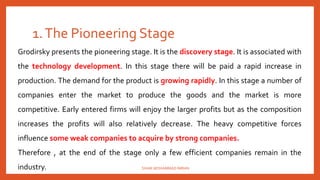
1.The Pioneering Stage
Grodirsky presents the pioneering stage. It is the discovery stage. It is associated with
the technology development. In this stage there will be paid a rapid increase in
production. The demand for the product is growing rapidly. In this stage a number of
companies enter the market to produce the goods and the market is more
competitive. Early entered firms will enjoy the larger profits but as the composition
increases the profits will also relatively decrease. The heavy competitive forces
influence some weak companies to acquire by strong companies.
Therefore , at the end of the stage only a few efficient companies remain in the
industry. SHAIK MOHAMMAD IMRAN
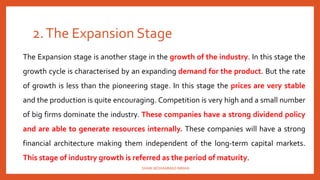
2.The Expansion Stage
The Expansion stage is another stage in the growth of the industry. In this stage the
growth cycle is characterised by an expanding demand for the product. But the rate
of growth is less than the pioneering stage. In this stage the prices are very stable
and the production is quite encouraging. Competition is very high and a small number
of big firms dominate the industry. These companies have a strong dividend policy
and are able to generate resources internally. These companies will have a strong
financial architecture making them independent of the long-term capital markets.
This stage of industry growth is referred as the period of maturity.
SHAIK MOHAMMAD IMRAN
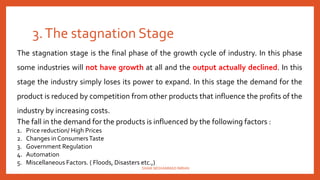
3.The stagnation Stage
The stagnation stage is the final phase of the growth cycle of industry. In this phase
some industries will not have growth at all and the output actually declined. In this
stage the industry simply loses its power to expand. In this stage the demand for the
product is reduced by competition from other products that influence the profits of the
industry by increasing costs.
The fall in the demand for the products is influenced by the following factors :
1. Price reduction/ High Prices
2. Changes in ConsumersTaste
3. Government Regulation
4. Automation
5. Miscellaneous Factors. ( Floods, Disasters etc.,)
SHAIK MOHAMMAD IMRAN
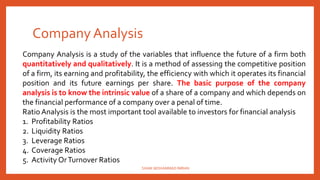
Company Analysis
Company Analysis is a study of the variables that influence the future of a firm both
quantitatively and qualitatively. It is a method of assessing the competitive position
of a firm, its earning and profitability, the efficiency with which it operates its financial
position and its future earnings per share. The basic purpose of the company
analysis is to know the intrinsic value of a share of a company and which depends on
the financial performance of a company over a penal of time.
Ratio Analysis is the most important tool available to investors for financial analysis
1. Profitability Ratios
2. Liquidity Ratios
3. Leverage Ratios
4. Coverage Ratios
5. Activity OrTurnover Ratios
SHAIK MOHAMMAD IMRAN
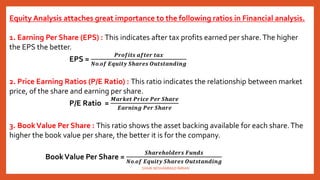
Equity Analysis attaches great importance to the following ratios in Financial analysis.
1. Earning Per Share (EPS) : This indicates after tax profits earned per share.The higher
the EPS the better.
EPS =
𝑷𝒓𝒐𝒇𝒊𝒕𝒔 𝒂𝒇𝒕𝒆𝒓 𝒕𝒂𝒙
𝑵𝒐.𝒐𝒇 𝑬𝒒𝒖𝒊𝒕𝒚 𝑺𝒉𝒂𝒓𝒆𝒔 𝑶𝒖𝒕𝒔𝒕𝒂𝒏𝒅𝒊𝒏𝒈
2. Price Earning Ratios (P/E Ratio) : This ratio indicates the relationship between market
price, of the share and earning per share.
P/E Ratio =
𝑴𝒂𝒓𝒌𝒆𝒕 𝑷𝒓𝒊𝒄𝒆 𝑷𝒆𝒓 𝑺𝒉𝒂𝒓𝒆
𝑬𝒂𝒓𝒏𝒊𝒏𝒈 𝑷𝒆𝒓 𝑺𝒉𝒂𝒓𝒆
3. BookValue Per Share : This ratio shows the asset backing available for each share.The
higher the book value per share, the better it is for the company.
BookValue Per Share =
𝑺𝒉𝒂𝒓𝒆𝒉𝒐𝒍𝒅𝒆𝒓𝒔 𝑭𝒖𝒏𝒅𝒔
𝑵𝒐.𝒐𝒇 𝑬𝒒𝒖𝒊𝒕𝒚 𝑺𝒉𝒂𝒓𝒆𝒔 𝑶𝒖𝒕𝒔𝒕𝒂𝒏𝒅𝒊𝒏𝒈
SHAIK MOHAMMAD IMRAN
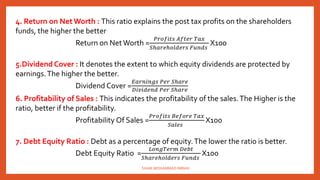
4. Return on Net Worth : This ratio explains the post tax profits on the shareholders
funds, the higher the better
Return on NetWorth =
𝑃𝑟𝑜𝑓𝑖𝑡𝑠 𝐴𝑓𝑡𝑒𝑟 𝑇𝑎𝑥
𝑆ℎ𝑎𝑟𝑒ℎ𝑜𝑙𝑑𝑒𝑟𝑠 𝐹𝑢𝑛𝑑𝑠
X100
5.Dividend Cover : It denotes the extent to which equity dividends are protected by
earnings.The higher the better.
Dividend Cover =
𝐸𝑎𝑟𝑛𝑖𝑛𝑔𝑠 𝑃𝑒𝑟 𝑆ℎ𝑎𝑟𝑒
𝐷𝑖𝑣𝑖𝑑𝑒𝑛𝑑 𝑃𝑒𝑟 𝑆ℎ𝑎𝑟𝑒
6. Profitability of Sales : This indicates the profitability of the sales.The Higher is the
ratio, better if the profitability.
Profitability Of Sales =
𝑃𝑟𝑜𝑓𝑖𝑡𝑠 𝐵𝑒𝑓𝑜𝑟𝑒 𝑇𝑎𝑥
𝑆𝑎𝑙𝑒𝑠
X100
7. Debt Equity Ratio : Debt as a percentage of equity.The lower the ratio is better.
Debt Equity Ratio =
𝐿𝑜𝑛𝑔𝑇𝑒𝑟𝑚 𝐷𝑒𝑏𝑡
𝑆ℎ𝑎𝑟𝑒ℎ𝑜𝑙𝑑𝑒𝑟𝑠 𝐹𝑢𝑛𝑑𝑠
X100
SHAIK MOHAMMAD IMRAN
Summary
• Introduction
• Concepts of Fundamental Analysis
• Table of Decision Making based on IntrinsicValue and Market Price
• Fundamental Analysis –A Framework
• Phases of Fundamental Analysis – (Picture)
• EconomyAnalysis
• Industry Analysis
• The Pioneering Stage
• The Expansion Stage
• The Stagnation Stage
• CompanyAnalysis
• Financial Ratio
SHAIK MOHAMMAD IMRAN

Unit 2 fundamental analysis

  • 1.
    By Shaik MohammadImran SHAIK MOHAMMAD IMRAN
  • 2.
    Content • Introduction • Conceptsof Fundamental Analysis • Table of Decision Making based on IntrinsicValue and Market Price • Fundamental Analysis –A Framework • Phases of Fundamental Analysis – (Picture) • EconomyAnalysis • Industry Analysis • The Pioneering Stage • The Expansion Stage • The Stagnation Stage • CompanyAnalysis • Financial Ratio SHAIK MOHAMMAD IMRAN
  • 3.
    Introduction Investment decisions arethe most important factor involving stock market operations. The investment analysis entails arriving at a decision after collection and analysing the relevant information. Every investor intends to maximise return and minimise the risk of his investment In order to maximise profits both the decisions are equally important. The fundamental analysis is one of the tools to estimate the intrinsic value of a company’s share on the basis of financial data.The Fundamental analysis studies the company every aspect relating to sales, production , profit earning per share and dividends paid etc.It also examines the company’s financial strength , its managerial talent, caliber, skills and competence. SHAIK MOHAMMAD IMRAN
  • 4.
    What is the'IntrinsicValue' The intrinsic value is the actual value of a company or an asset based on an underlying perception of its true value including all aspects of the business, in terms of both tangible and intangible factors. This value may or may not be the same as the current market value. Note : It is difficult to determine Intrinsic Value SHAIK MOHAMMAD IMRAN
  • 5.
    Concept of fundamentalanalysis A fundamental analysis is a time honoured, value based approach depending upon a careful assessment of the fundamental; of an economy, industry and company. The fundamental analysis studies the general economic situation , makes an evaluation of an industry and finally does an in depth analysis , both financial and non- financial of the company. The Intrinsic value is the present value of future dividends and capital appreciation computed at an appropriate discount rate to reflect the riskiness of the share. The Intrinsic value is also known as fundamental value. Based on the fundamental value the investor will make a decision to buy or sell a share, by comparing the market price of the shares. SHAIK MOHAMMAD IMRAN
  • 6.
    Based on comparingthe intrinsic value and market price of the share the following decisions may be taken. INTRINSICVALUE DECISION 1 If intrinsic value is greater than market price – Undervalued security Buy the security 2 If the intrinsic value is lower than the market price- over valued security Sell the security 3 If the intrinsic value is equal to the market price NoAction SHAIK MOHAMMAD IMRAN
  • 7.
    Economy Analysis Industry Analysis CompanyAnalysis Phases of Fundamental AnalysisSHAIK MOHAMMAD IMRAN
  • 8.
    FundamentalAnalysis- A Framework: PHASE NATURE OF ANALYSIS PURPOSE TOOLS ANDTECHNIQUES First Economics Analysis To assess the general economic situation of national and international Economic Indicators Second Industry Analysis To review prevailing conditions with a specific industry audits segments Performance indicators, demand and supply position, competition and government policies. Third Company Analysis To analyse the financial and non-financial aspects of a company to determine whether to buy or sell or hold on to the shares of a company. Non- financial aspect analysis :The position of promoters management and producer quality corporate image, location. Analysis of financial aspects : Such as EPS, Sales, Profitability , Dividends record asset growth etc., SHAIK MOHAMMAD IMRAN
  • 9.
    Economics Analysis Economic factorspaly a major role in any investment decision, Which is made for making a gain and better return. Economic analysis and forecasting company performance and of return is necessary for making investments. The Economic analysis of the state helps to understand the state of the economy of the country at macro level. The analysis of the state of the economy at a macro level incorporates how the economy has performed in the past and how it is performing in the present and how it is expected to perform in the future. India has mixed economy. The public sector plays sector plays a vital role in the economy. The central government is the biggest investor and spender, the investment made in the public sector and expenditure level is the performance of the Indian Economy. SHAIK MOHAMMAD IMRAN
  • 10.
    The Economic analysisinvolves the analysing of the following factors : 1. Economic Growth 2. Population 3. Monsoon and agricultural production 4. Industrial Production 5. Natural resource and availability of raw material 6. Inflation 7. Interest Rate 8. Foreign exchange reserves 9. Balance of payment position 10.Budgetary Deficit 11.Public Debt and foreign debt 12.Domestic savings and capital output rate 13.Employment 14.Taxation Policy 15.Infrastructure Facilities 16.Government Policy 17.Political Stability 18.International Development 19.Capital Formation 20.Savings Pattern 21.Research andTechnological Development 22.Economic Indicators 23.Economic Reforms 24.Foreign Direct Investment SHAIK MOHAMMAD IMRAN
  • 11.
    Industry Analysis The secondphase of fundamental analysis consists of a declared analysis of specific industry, its characteristics, past record , present state and future prospects. The purpose of the industry analysis is to identify the industries with a potential for future growth and to invest in equity shares of companies selected from such industries. An industry is a homogenous group of companies. The growth of many industries is dividend into 3 stages. 1. The pioneering Stage 2. The expansion stage 3. The Stagnation stage SHAIK MOHAMMAD IMRAN
  • 12.
    1.The Pioneering Stage Grodirskypresents the pioneering stage. It is the discovery stage. It is associated with the technology development. In this stage there will be paid a rapid increase in production. The demand for the product is growing rapidly. In this stage a number of companies enter the market to produce the goods and the market is more competitive. Early entered firms will enjoy the larger profits but as the composition increases the profits will also relatively decrease. The heavy competitive forces influence some weak companies to acquire by strong companies. Therefore , at the end of the stage only a few efficient companies remain in the industry. SHAIK MOHAMMAD IMRAN
  • 13.
    2.The Expansion Stage TheExpansion stage is another stage in the growth of the industry. In this stage the growth cycle is characterised by an expanding demand for the product. But the rate of growth is less than the pioneering stage. In this stage the prices are very stable and the production is quite encouraging. Competition is very high and a small number of big firms dominate the industry. These companies have a strong dividend policy and are able to generate resources internally. These companies will have a strong financial architecture making them independent of the long-term capital markets. This stage of industry growth is referred as the period of maturity. SHAIK MOHAMMAD IMRAN
  • 14.
    3.The stagnation Stage Thestagnation stage is the final phase of the growth cycle of industry. In this phase some industries will not have growth at all and the output actually declined. In this stage the industry simply loses its power to expand. In this stage the demand for the product is reduced by competition from other products that influence the profits of the industry by increasing costs. The fall in the demand for the products is influenced by the following factors : 1. Price reduction/ High Prices 2. Changes in ConsumersTaste 3. Government Regulation 4. Automation 5. Miscellaneous Factors. ( Floods, Disasters etc.,) SHAIK MOHAMMAD IMRAN
  • 15.
    Company Analysis Company Analysisis a study of the variables that influence the future of a firm both quantitatively and qualitatively. It is a method of assessing the competitive position of a firm, its earning and profitability, the efficiency with which it operates its financial position and its future earnings per share. The basic purpose of the company analysis is to know the intrinsic value of a share of a company and which depends on the financial performance of a company over a penal of time. Ratio Analysis is the most important tool available to investors for financial analysis 1. Profitability Ratios 2. Liquidity Ratios 3. Leverage Ratios 4. Coverage Ratios 5. Activity OrTurnover Ratios SHAIK MOHAMMAD IMRAN
  • 16.
    Equity Analysis attachesgreat importance to the following ratios in Financial analysis. 1. Earning Per Share (EPS) : This indicates after tax profits earned per share.The higher the EPS the better. EPS = 𝑷𝒓𝒐𝒇𝒊𝒕𝒔 𝒂𝒇𝒕𝒆𝒓 𝒕𝒂𝒙 𝑵𝒐.𝒐𝒇 𝑬𝒒𝒖𝒊𝒕𝒚 𝑺𝒉𝒂𝒓𝒆𝒔 𝑶𝒖𝒕𝒔𝒕𝒂𝒏𝒅𝒊𝒏𝒈 2. Price Earning Ratios (P/E Ratio) : This ratio indicates the relationship between market price, of the share and earning per share. P/E Ratio = 𝑴𝒂𝒓𝒌𝒆𝒕 𝑷𝒓𝒊𝒄𝒆 𝑷𝒆𝒓 𝑺𝒉𝒂𝒓𝒆 𝑬𝒂𝒓𝒏𝒊𝒏𝒈 𝑷𝒆𝒓 𝑺𝒉𝒂𝒓𝒆 3. BookValue Per Share : This ratio shows the asset backing available for each share.The higher the book value per share, the better it is for the company. BookValue Per Share = 𝑺𝒉𝒂𝒓𝒆𝒉𝒐𝒍𝒅𝒆𝒓𝒔 𝑭𝒖𝒏𝒅𝒔 𝑵𝒐.𝒐𝒇 𝑬𝒒𝒖𝒊𝒕𝒚 𝑺𝒉𝒂𝒓𝒆𝒔 𝑶𝒖𝒕𝒔𝒕𝒂𝒏𝒅𝒊𝒏𝒈 SHAIK MOHAMMAD IMRAN
  • 17.
    4. Return onNet Worth : This ratio explains the post tax profits on the shareholders funds, the higher the better Return on NetWorth = 𝑃𝑟𝑜𝑓𝑖𝑡𝑠 𝐴𝑓𝑡𝑒𝑟 𝑇𝑎𝑥 𝑆ℎ𝑎𝑟𝑒ℎ𝑜𝑙𝑑𝑒𝑟𝑠 𝐹𝑢𝑛𝑑𝑠 X100 5.Dividend Cover : It denotes the extent to which equity dividends are protected by earnings.The higher the better. Dividend Cover = 𝐸𝑎𝑟𝑛𝑖𝑛𝑔𝑠 𝑃𝑒𝑟 𝑆ℎ𝑎𝑟𝑒 𝐷𝑖𝑣𝑖𝑑𝑒𝑛𝑑 𝑃𝑒𝑟 𝑆ℎ𝑎𝑟𝑒 6. Profitability of Sales : This indicates the profitability of the sales.The Higher is the ratio, better if the profitability. Profitability Of Sales = 𝑃𝑟𝑜𝑓𝑖𝑡𝑠 𝐵𝑒𝑓𝑜𝑟𝑒 𝑇𝑎𝑥 𝑆𝑎𝑙𝑒𝑠 X100 7. Debt Equity Ratio : Debt as a percentage of equity.The lower the ratio is better. Debt Equity Ratio = 𝐿𝑜𝑛𝑔𝑇𝑒𝑟𝑚 𝐷𝑒𝑏𝑡 𝑆ℎ𝑎𝑟𝑒ℎ𝑜𝑙𝑑𝑒𝑟𝑠 𝐹𝑢𝑛𝑑𝑠 X100 SHAIK MOHAMMAD IMRAN
  • 18.
    Summary • Introduction • Conceptsof Fundamental Analysis • Table of Decision Making based on IntrinsicValue and Market Price • Fundamental Analysis –A Framework • Phases of Fundamental Analysis – (Picture) • EconomyAnalysis • Industry Analysis • The Pioneering Stage • The Expansion Stage • The Stagnation Stage • CompanyAnalysis • Financial Ratio SHAIK MOHAMMAD IMRAN