

Group No. 3
Shyamala Devi 
Shreya Pathak 
Aseem Kumar 
Bhartendu Gautam 
P. Brijesha 
Avunoori Satish
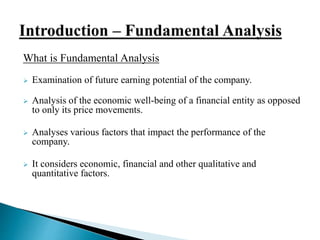
What is Fundamental Analysis 
 Examination of future earning potential of the company. 
 Analysis of the economic well-being of a financial entity as opposed 
to only its price movements. 
 Analyses various factors that impact the performance of the 
company. 
 It considers economic, financial and other qualitative and 
quantitative factors.
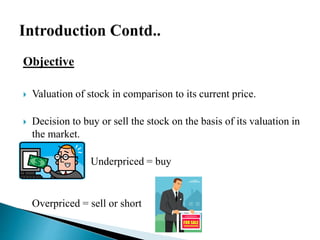
Objective 
 Valuation of stock in comparison to its current price. 
 Decision to buy or sell the stock on the basis of its valuation in 
the market. 
Underpriced = buy 
Overpriced = sell or short
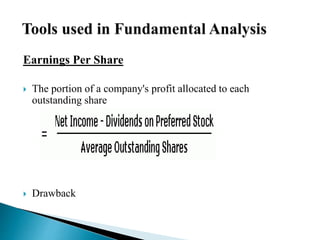
Earnings Per Share 
 The portion of a company's profit allocated to each 
outstanding share 
 Drawback
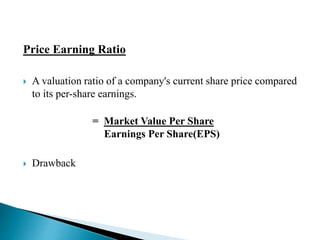
Price Earning Ratio 
 A valuation ratio of a company's current share price compared 
to its per-share earnings. 
= Market Value Per Share 
Earnings Per Share(EPS) 
 Drawback
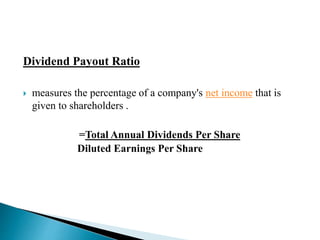
Dividend Payout Ratio 
 measures the percentage of a company's net income that is 
given to shareholders . 
=Total Annual Dividends Per Share 
Diluted Earnings Per Share
 Present value of all future cash flows in the form of dividends 
plus the present value of the sale price expected . 
P= [D1/(1+r)] + [P1/ (1+r)] 
Where, 
P = Current price/ market price of the share today 
D1 = Dividend expected at the end of one year 
r = discount rate/ required rate of return 
P1= market price/ expected price of share at the end of year 1
 Presumes that dividend per share is growing at the constant 
rate 
P= D1/ r-g 
Where, 
D1 = dividend per share at the end of first year 
r = Expected rate of return 
g = Constant growth rate
 It is important to analyse the economic activity in 
which all the companies operate. 
 For economic analysis we can see few economic 
indicators. 
• Global Economy 
• Domestic Economy 
 The top down analysis of company starts with 
global and domestic economy
Domestic Economy 
1. GDP 
2. EMPLOYMENT 
3. INFLATION 
4. INTEREST RATE 
5. BUDGET DEFICIT 
6. OTHER FACTORS:- Money supply, Fiscal policy, Monetary Policy, 
Labour productivity, Stock Price, FII & FDI investment etc.
1. Introduction: 
 Second phase of fundamental analysis. 
 Industries selected in the previous stage are scanned 
individually. 
 A micro study of each industry is carried out. 
 Objective is to provide information about the best industry for 
investment-making.
Steps taken for industry analysis: 
 Study of industry life cycle 
 Study of qualitative and quantitative factor.
Steps taken for industry analysis: 
1. Study of industry life cycle: 
 Pioneering stage 
 Rapid growth stage 
 Maturity and Stabilization 
 Decline/Diversification
Steps taken for industry analysis contd..: 
2. Study of Qualitative and quantitative factors: 
 Qualitative factors 
 Quantitative factors
 They rely on historical data 
 Poor predictors of how share price reacts to economic and 
industry level changes 
 Provides poor estimates of expected returns 
 Do not offer measures of variability of returns 
 Do not reflect underlying risk reward relationship
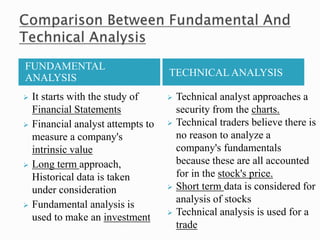
FUNDAMENTAL 
ANALYSIS 
TECHNICAL ANALYSIS 
 It starts with the study of 
Financial Statements 
 Financial analyst attempts to 
measure a company's 
intrinsic value 
 Long term approach, 
Historical data is taken 
under consideration 
 Fundamental analysis is 
used to make an investment 
 Technical analyst approaches a 
security from the charts. 
 Technical traders believe there is 
no reason to analyze a 
company's fundamentals 
because these are all accounted 
for in the stock's price. 
 Short term data is considered for 
analysis of stocks 
 Technical analysis is used for a 
trade
PLAY VIDEO
Traditional methods of security analysis - Fundamental Analysis

Traditional methods of security analysis - Fundamental Analysis

  • 1.
  • 2.
    Shyamala Devi ShreyaPathak Aseem Kumar Bhartendu Gautam P. Brijesha Avunoori Satish
  • 3.
    What is FundamentalAnalysis  Examination of future earning potential of the company.  Analysis of the economic well-being of a financial entity as opposed to only its price movements.  Analyses various factors that impact the performance of the company.  It considers economic, financial and other qualitative and quantitative factors.
  • 4.
    Objective  Valuationof stock in comparison to its current price.  Decision to buy or sell the stock on the basis of its valuation in the market. Underpriced = buy Overpriced = sell or short
  • 5.
    Earnings Per Share  The portion of a company's profit allocated to each outstanding share  Drawback
  • 6.
    Price Earning Ratio  A valuation ratio of a company's current share price compared to its per-share earnings. = Market Value Per Share Earnings Per Share(EPS)  Drawback
  • 7.
    Dividend Payout Ratio  measures the percentage of a company's net income that is given to shareholders . =Total Annual Dividends Per Share Diluted Earnings Per Share
  • 8.
     Present valueof all future cash flows in the form of dividends plus the present value of the sale price expected . P= [D1/(1+r)] + [P1/ (1+r)] Where, P = Current price/ market price of the share today D1 = Dividend expected at the end of one year r = discount rate/ required rate of return P1= market price/ expected price of share at the end of year 1
  • 9.
     Presumes thatdividend per share is growing at the constant rate P= D1/ r-g Where, D1 = dividend per share at the end of first year r = Expected rate of return g = Constant growth rate
  • 10.
     It isimportant to analyse the economic activity in which all the companies operate.  For economic analysis we can see few economic indicators. • Global Economy • Domestic Economy  The top down analysis of company starts with global and domestic economy
  • 11.
    Domestic Economy 1.GDP 2. EMPLOYMENT 3. INFLATION 4. INTEREST RATE 5. BUDGET DEFICIT 6. OTHER FACTORS:- Money supply, Fiscal policy, Monetary Policy, Labour productivity, Stock Price, FII & FDI investment etc.
  • 12.
    1. Introduction: Second phase of fundamental analysis.  Industries selected in the previous stage are scanned individually.  A micro study of each industry is carried out.  Objective is to provide information about the best industry for investment-making.
  • 13.
    Steps taken forindustry analysis:  Study of industry life cycle  Study of qualitative and quantitative factor.
  • 14.
    Steps taken forindustry analysis: 1. Study of industry life cycle:  Pioneering stage  Rapid growth stage  Maturity and Stabilization  Decline/Diversification
  • 15.
    Steps taken forindustry analysis contd..: 2. Study of Qualitative and quantitative factors:  Qualitative factors  Quantitative factors
  • 16.
     They relyon historical data  Poor predictors of how share price reacts to economic and industry level changes  Provides poor estimates of expected returns  Do not offer measures of variability of returns  Do not reflect underlying risk reward relationship
  • 17.
    FUNDAMENTAL ANALYSIS TECHNICALANALYSIS  It starts with the study of Financial Statements  Financial analyst attempts to measure a company's intrinsic value  Long term approach, Historical data is taken under consideration  Fundamental analysis is used to make an investment  Technical analyst approaches a security from the charts.  Technical traders believe there is no reason to analyze a company's fundamentals because these are all accounted for in the stock's price.  Short term data is considered for analysis of stocks  Technical analysis is used for a trade
  • 18.