FUNDAMENTAL ANALYSIS
PRESENTED BY
HARSH ADHIYA- 01
KESHAV AGARWAL- 02
NEIL GALA- 09
ABHISHEK OZA- 20
YATIN PRABHU-25
DHAVAL SOLANKI-29
INTRODUCTION
• Fundamental Analysis involves examining the economic, financial and
other qualitative and quantitative factors related to a security in order to
determine its intrinsic value.
• It attempts to study everything that can affect the security's value,
including macroeconomic factors (like the overall economy and industry
conditions) and individually specific factors (like the financial condition
and management of companies).
• Fundamental analysis, which is also known as quantitative analysis,
involves delving into a company’s financial statements such as profit and
loss account and balance sheet.
• Fundamental analysis is the examination of the underlying forces that
affect the wellbeing of the economy, industry groups, and companies
FUNDAMENTALS: QUANTITATIVE AND QUALITATIVE
Quantitative: Capable of being measured or expressed in numerical terms.
Qualitative: Related to or based on the quality or character of something,
often as opposed to its size or quantity.
• Quantitative fundamentals are numeric, measurable characteristics about
a business. It’s easy to see how the biggest source of quantitative data is
the financial statements. You can measure revenue, profit, assets and
more with great precision.
• Turning to qualitative fundamentals, these are the less tangible factors
surrounding a business - things such as the quality of a company’s board
members and key executives, its brand-name recognition, patents or
proprietary technology.
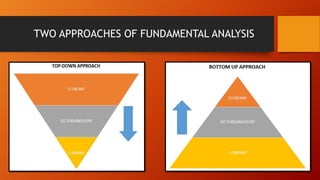
TWO APPROACHES OF FUNDAMENTAL ANALYSIS
ECONOMY ANALYSIS
• Macroeconomics is the study of the behavior of the economy as a whole.
Macro economy is very complicated and there are many factors that
influence it. These factors are analyzed with various economic indicators
that tell us about the overall health of the economy.
• Consumers want to know how easy it will be to find work, how much it
will cost to buy goods and services in the market.
• Businesses use macroeconomic analysis to determine whether expanding
production will be welcomed by the market.
• Governments turn to the macro economy when budgeting spending,
creating taxes, deciding on interest rates and making policy decisions.
CONTINUED
Economy analysis broadly focuses
on:
National Output: GDP
Unemployment
Inflation
INDUSTRY ANALYSIS
• Industry analysis is an essential responsibility for an equity research
analyst. As an equity research analyst, you need to analyze a particular
industry, see its past trends, demand-supply mechanics and future
outlook.
• Industry analysis is a tool that facilitates a company's understanding of its
position relative to other companies that produce similar products or
services.
• The industry analysis report sheds light on the economic health of the
company, underlining the understanding whether it will be beneficial for
the stakeholders to invest in such a company.
CONTINUED
Industry analysis broadly focuses
on:
Review available reports
Approach the correct industry
Demand & supply scenario
Competitive scenario
COMPANY ANALYSIS
• Company analysis refers to the process of evaluating a company's
profitability, profile and products or services. It is also known as
“fundamental analysis”.
• A company analysis incorporates basic info about the company, like the
mission statement and apparition and the goals and values.
• During the process of company analysis, an investor also considers the
company’s history, focusing on events which have contributed in shaping
the company.
• A company analysis looks into the goods and services proffered by the
company.
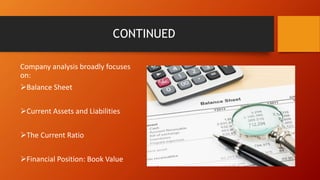
CONTINUED
Company analysis broadly focuses
on:
Balance Sheet
Current Assets and Liabilities
The Current Ratio
Financial Position: Book Value
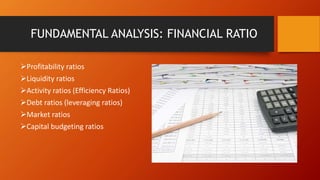
FUNDAMENTAL ANALYSIS: FINANCIAL RATIO
Profitability ratios
Liquidity ratios
Activity ratios (Efficiency Ratios)
Debt ratios (leveraging ratios)
Market ratios
Capital budgeting ratios
CONCLUSIONS
Fundamental analysis can be valuable, but it should be approached with
caution. If you are reading research written by a sell-side analyst, it is
important to be familiar with the analyst behind the report. We all have
personal biases, and every analyst has some sort of bias. There is nothing
wrong with this, and the research can still be of great value. Learn what the
ratings mean and the track record of an analyst before jumping off the deep
end. Corporate statements and press releases offer good information, but
they should be read with a healthy degree of skepticism to separate the
facts from the spin. Investors should become skilled readers to weed out the
important information and ignore the hype.
THANK YOU

Fundamental analysis ppt

  • 1.
    FUNDAMENTAL ANALYSIS PRESENTED BY HARSHADHIYA- 01 KESHAV AGARWAL- 02 NEIL GALA- 09 ABHISHEK OZA- 20 YATIN PRABHU-25 DHAVAL SOLANKI-29
  • 2.
    INTRODUCTION • Fundamental Analysisinvolves examining the economic, financial and other qualitative and quantitative factors related to a security in order to determine its intrinsic value. • It attempts to study everything that can affect the security's value, including macroeconomic factors (like the overall economy and industry conditions) and individually specific factors (like the financial condition and management of companies). • Fundamental analysis, which is also known as quantitative analysis, involves delving into a company’s financial statements such as profit and loss account and balance sheet. • Fundamental analysis is the examination of the underlying forces that affect the wellbeing of the economy, industry groups, and companies
  • 3.
    FUNDAMENTALS: QUANTITATIVE ANDQUALITATIVE Quantitative: Capable of being measured or expressed in numerical terms. Qualitative: Related to or based on the quality or character of something, often as opposed to its size or quantity. • Quantitative fundamentals are numeric, measurable characteristics about a business. It’s easy to see how the biggest source of quantitative data is the financial statements. You can measure revenue, profit, assets and more with great precision. • Turning to qualitative fundamentals, these are the less tangible factors surrounding a business - things such as the quality of a company’s board members and key executives, its brand-name recognition, patents or proprietary technology.
  • 4.
    TWO APPROACHES OFFUNDAMENTAL ANALYSIS
  • 6.
    ECONOMY ANALYSIS • Macroeconomicsis the study of the behavior of the economy as a whole. Macro economy is very complicated and there are many factors that influence it. These factors are analyzed with various economic indicators that tell us about the overall health of the economy. • Consumers want to know how easy it will be to find work, how much it will cost to buy goods and services in the market. • Businesses use macroeconomic analysis to determine whether expanding production will be welcomed by the market. • Governments turn to the macro economy when budgeting spending, creating taxes, deciding on interest rates and making policy decisions.
  • 7.
    CONTINUED Economy analysis broadlyfocuses on: National Output: GDP Unemployment Inflation
  • 8.
    INDUSTRY ANALYSIS • Industryanalysis is an essential responsibility for an equity research analyst. As an equity research analyst, you need to analyze a particular industry, see its past trends, demand-supply mechanics and future outlook. • Industry analysis is a tool that facilitates a company's understanding of its position relative to other companies that produce similar products or services. • The industry analysis report sheds light on the economic health of the company, underlining the understanding whether it will be beneficial for the stakeholders to invest in such a company.
  • 9.
    CONTINUED Industry analysis broadlyfocuses on: Review available reports Approach the correct industry Demand & supply scenario Competitive scenario
  • 10.
    COMPANY ANALYSIS • Companyanalysis refers to the process of evaluating a company's profitability, profile and products or services. It is also known as “fundamental analysis”. • A company analysis incorporates basic info about the company, like the mission statement and apparition and the goals and values. • During the process of company analysis, an investor also considers the company’s history, focusing on events which have contributed in shaping the company. • A company analysis looks into the goods and services proffered by the company.
  • 11.
    CONTINUED Company analysis broadlyfocuses on: Balance Sheet Current Assets and Liabilities The Current Ratio Financial Position: Book Value
  • 12.
    FUNDAMENTAL ANALYSIS: FINANCIALRATIO Profitability ratios Liquidity ratios Activity ratios (Efficiency Ratios) Debt ratios (leveraging ratios) Market ratios Capital budgeting ratios
  • 13.
    CONCLUSIONS Fundamental analysis canbe valuable, but it should be approached with caution. If you are reading research written by a sell-side analyst, it is important to be familiar with the analyst behind the report. We all have personal biases, and every analyst has some sort of bias. There is nothing wrong with this, and the research can still be of great value. Learn what the ratings mean and the track record of an analyst before jumping off the deep end. Corporate statements and press releases offer good information, but they should be read with a healthy degree of skepticism to separate the facts from the spin. Investors should become skilled readers to weed out the important information and ignore the hype.
  • 14.