WORLD HISTORY HONORS
MS. SAMM
World War I (WWI)
TODAY
 Lecture
 Text mark your notes AFTER we are finished
 Bell Work In & Out
 Short Video – Christmas during WWI (3:20)
 Begin your timeline (can be added to the back of
your notes!)
 Venn Diagram of World War I Powers
 Map activity (15 minutes)
Let’s Recap the Last Unit!
 So, we came through Industrialism, Nationalism and
Imperialism.
 We learned that Industrialism in Great Britain and
Japan was a period tremendous growth. That
Industrialism led to urbanization, dangers in the
workplace and horrible working conditions and child
exploitation.
 New economic ideas sprang up: capitalism,
democracy utilitarianism, socialism and
communism.
 Industrialism gave rise to Imperialism. This ideology
that led to control over other territories around the
world.
 Fueled by money, back by weapons and Social
Darwinism, along the need for raw materials,
Imperialism led to a direct and indirect control over
the continent of Africa and other parts of the world.
 Imperialism and The Berlin Conference resulted in
The Crimean War, The Opium War, acquisition of
the Suez Canal and Egypt, and control over India by
Great Britain.
 Imperialism gave rise to Nationalism, which was an
effect of Imperialism AND the Industrial Revolution.
 Italy became united.
 Germany became united.
 Greece became independent.
 Young Turks rise up in Turkey and the genocide of
the Armenians was the result of bad Nationalism.
 All of these factors became the sparks for the coming
World Wars.
 Let’s begin with World War I
World War I 1914-1918
1. It was the first war that involved
countries from all over the world.
2. It was described as the “war to
end all wars” but, its conclusion
set the stage for another war after
its ending.
Big Picture Causes
1. Nationalism: each country thinks
that they’re the best.
2. Imperialism: each country fights
over territory and resources; this
leads to mistrust and rivalry.
3. Militarism: glorifying military
power and keeping a large army.
Triple Alliance
1. This alliance was between
Germany, Austria-Hungary,
and Italy.
2. If one goes to war, the others
help out.
3. It was meant to isolate France.
Triple Entente
1. This alliance was between Great
Britain, France, and Russia.
2. It scared Germany because means
they would have to fight wars on
TWO fronts, IF they went to war
with either France or Russia.
Specific Causes of WWI
1. On June 28th, 1914, Austrian-
Hungarian Archduke Franz
Ferdinand and his wife were
assassinated in Serbia by a Serbian
nationalist named Gustav Princip.
2. He didn’t like the fact that Austria-
Hungary took over Bosnia by force.
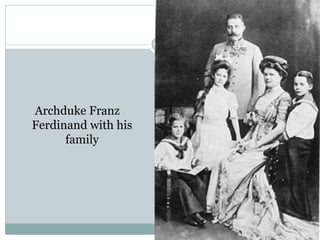
Archduke Franz
Ferdinand with his
family
They saved the shirt
from the Archduke’s
assassination. Today,
it can be seen
displayed in a
museum.
So, What Then?
1. Austria-Hungary decided to
punish Serbia and declared war
on them.
2. Russia, who was an ally of
Serbia, came to their rescue and
started to mobilize troops
against Austria-Hungary.
Allies All Over The Place!
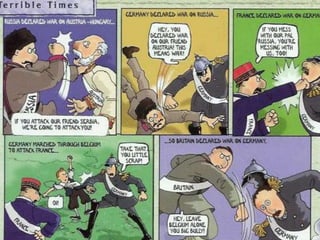
1. Germany, was an ally of Austria-
Hungary and declared war on Russia.
2. Germany, sensing that France will
help Russia, declared war on France.
3. Great Britain declared war on
Germany when it went through
Belgium to get to France.
Wait, What Were The Sides Again?
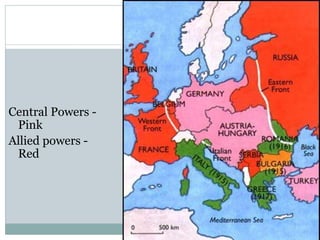
1. Central Powers = Germany,
Austria-Hungary and the
Ottoman Empire.
2.Allied Powers = Great
Britain, France, Russia,
Japan and Italy.
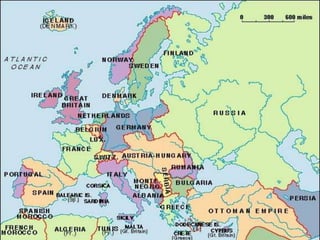
Central Powers -
Pink
Allied powers -
Red
Modern Warfare
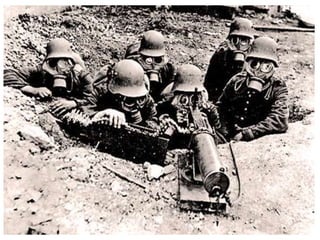
1. New Technology – poisonous
gases, fighter planes, machine
guns, grenades & tanks made this
war more horrible than ever.
2. Total war - all resources were
devoted to war.
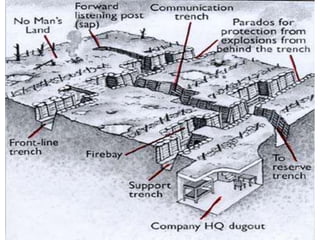
3. Trench Warfare - long narrow
ditches dug by soldiers to hide in.
4. These trenches zigzagged all along the
Western Front (between France and
Germany).
Video: What was it like to be in the trench?
https://www.youtube.com/watch?v=ersq3x0
xFM4
Summarize the Video (25 points)
1. How did they handle PTSD? (10 points)
Ms. Samm’s Sidebar
 In 1914, during World War I, the Central (Germany)
and Allied (Great Britain) powers were in the middle
of trench warfare. It was Christmas eve…what
happened between the two side was astounding. It
never happened in any war before OR after it.
https://www.youtube.com/watch?v=NWF2JBb1bvM
END LECTURE DAY 1
1. Get out a piece of paper (plain or lined). Draw two circles.
One circle should be labels “Allied Powers” and the other
“Central Powers.” Now, write which countries (from your
notes) in its respective circle. Turn in – 25 points.
2. On the back of the paper, begin your timeline. Add any and
all significant dates. (10 points)
3. MyPCS students, please do this by hand and submit. This
will be an on-going document we will work on until the
exam for this unit. Submit as required in Focus and/or
Canvas. Take a pic with Office Lens and upload.
Eye Witness Accounts
“Our father used to read the Bible to us, but whenever he
came to the passage mentioning ‘bloodless war’ he could
not explain to us what that term meant. When in 1933 he
was dying from hunger he called us to his deathbed and
said ‘This, children, is what is called bloodless war...’”
"What I saw that morning ... was inexpressibly horrible. On
a battlefield men die quickly, they fight back ... Here I saw
people dying in solitude by slow degrees, dying hideously,
without the excuse of sacrifice for a cause. They had been
trapped and left to starve, each in his own home, by a
political decision made in a far-off capital around
conference and banquet tables. There was not even the
consolation of inevitability to relieve the horror."

Unit 13: World War I Lecture - Part 1

  • 1.
    WORLD HISTORY HONORS MS.SAMM World War I (WWI)
  • 2.
    TODAY  Lecture  Textmark your notes AFTER we are finished  Bell Work In & Out  Short Video – Christmas during WWI (3:20)  Begin your timeline (can be added to the back of your notes!)  Venn Diagram of World War I Powers  Map activity (15 minutes)
  • 3.
    Let’s Recap theLast Unit!  So, we came through Industrialism, Nationalism and Imperialism.  We learned that Industrialism in Great Britain and Japan was a period tremendous growth. That Industrialism led to urbanization, dangers in the workplace and horrible working conditions and child exploitation.  New economic ideas sprang up: capitalism, democracy utilitarianism, socialism and communism.
  • 4.
     Industrialism gaverise to Imperialism. This ideology that led to control over other territories around the world.  Fueled by money, back by weapons and Social Darwinism, along the need for raw materials, Imperialism led to a direct and indirect control over the continent of Africa and other parts of the world.  Imperialism and The Berlin Conference resulted in The Crimean War, The Opium War, acquisition of the Suez Canal and Egypt, and control over India by Great Britain.
  • 5.
     Imperialism gaverise to Nationalism, which was an effect of Imperialism AND the Industrial Revolution.  Italy became united.  Germany became united.  Greece became independent.  Young Turks rise up in Turkey and the genocide of the Armenians was the result of bad Nationalism.  All of these factors became the sparks for the coming World Wars.  Let’s begin with World War I
  • 6.
    World War I1914-1918 1. It was the first war that involved countries from all over the world. 2. It was described as the “war to end all wars” but, its conclusion set the stage for another war after its ending.
  • 8.
    Big Picture Causes 1.Nationalism: each country thinks that they’re the best. 2. Imperialism: each country fights over territory and resources; this leads to mistrust and rivalry. 3. Militarism: glorifying military power and keeping a large army.
  • 10.
    Triple Alliance 1. Thisalliance was between Germany, Austria-Hungary, and Italy. 2. If one goes to war, the others help out. 3. It was meant to isolate France.
  • 12.
    Triple Entente 1. Thisalliance was between Great Britain, France, and Russia. 2. It scared Germany because means they would have to fight wars on TWO fronts, IF they went to war with either France or Russia.
  • 14.
    Specific Causes ofWWI 1. On June 28th, 1914, Austrian- Hungarian Archduke Franz Ferdinand and his wife were assassinated in Serbia by a Serbian nationalist named Gustav Princip. 2. He didn’t like the fact that Austria- Hungary took over Bosnia by force.
  • 15.
  • 16.
    They saved theshirt from the Archduke’s assassination. Today, it can be seen displayed in a museum.
  • 18.
    So, What Then? 1.Austria-Hungary decided to punish Serbia and declared war on them. 2. Russia, who was an ally of Serbia, came to their rescue and started to mobilize troops against Austria-Hungary.
  • 19.
    Allies All OverThe Place! 1. Germany, was an ally of Austria- Hungary and declared war on Russia. 2. Germany, sensing that France will help Russia, declared war on France. 3. Great Britain declared war on Germany when it went through Belgium to get to France.
  • 22.
    Wait, What WereThe Sides Again? 1. Central Powers = Germany, Austria-Hungary and the Ottoman Empire. 2.Allied Powers = Great Britain, France, Russia, Japan and Italy.
  • 23.
  • 24.
    Modern Warfare 1. NewTechnology – poisonous gases, fighter planes, machine guns, grenades & tanks made this war more horrible than ever. 2. Total war - all resources were devoted to war. 3. Trench Warfare - long narrow ditches dug by soldiers to hide in.
  • 25.
    4. These trencheszigzagged all along the Western Front (between France and Germany). Video: What was it like to be in the trench? https://www.youtube.com/watch?v=ersq3x0 xFM4 Summarize the Video (25 points) 1. How did they handle PTSD? (10 points)
  • 30.
    Ms. Samm’s Sidebar In 1914, during World War I, the Central (Germany) and Allied (Great Britain) powers were in the middle of trench warfare. It was Christmas eve…what happened between the two side was astounding. It never happened in any war before OR after it. https://www.youtube.com/watch?v=NWF2JBb1bvM
  • 31.
    END LECTURE DAY1 1. Get out a piece of paper (plain or lined). Draw two circles. One circle should be labels “Allied Powers” and the other “Central Powers.” Now, write which countries (from your notes) in its respective circle. Turn in – 25 points. 2. On the back of the paper, begin your timeline. Add any and all significant dates. (10 points) 3. MyPCS students, please do this by hand and submit. This will be an on-going document we will work on until the exam for this unit. Submit as required in Focus and/or Canvas. Take a pic with Office Lens and upload.
  • 32.
    Eye Witness Accounts “Ourfather used to read the Bible to us, but whenever he came to the passage mentioning ‘bloodless war’ he could not explain to us what that term meant. When in 1933 he was dying from hunger he called us to his deathbed and said ‘This, children, is what is called bloodless war...’” "What I saw that morning ... was inexpressibly horrible. On a battlefield men die quickly, they fight back ... Here I saw people dying in solitude by slow degrees, dying hideously, without the excuse of sacrifice for a cause. They had been trapped and left to starve, each in his own home, by a political decision made in a far-off capital around conference and banquet tables. There was not even the consolation of inevitability to relieve the horror."