Marketing Management
Curriculum
•Unit – 1 Product
•Unit – 2 Pricing
•Unit – 3 Place
•Unit – 4 Promotion
•Unit – 5 Product Level Planning
What is Product?
•Almost everything we come across in our
daily life is a product – it satisfies a need.
•The marketing man gives products an
identity or a personality of their own.
What is Product?
•Its various features and functions –
• The Brand Name,
• The Package,
• The Price Label,
• The Guarantees,
• The Manufacturer's Name
• & Prestige – all go into the personality of the product.
•And this total personality, is the real tool with
which the marketer satisfies the customer.
•The products convey meanings with them
and project distinctive images.
•These meanings and images arise out of
the many components that make up the
product personality.
•These are :
1. The Core Constituent
2. The Associated Features
3. The Brand Name and the Logo
4. The Package and Label
The Core Constituent
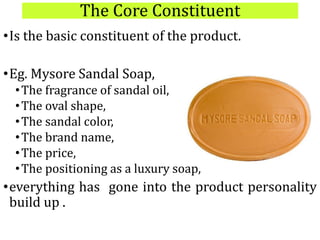
•Is the basic constituent of the product.
•Eg. Mysore Sandal Soap,
•The fragrance of sandal oil,
•The oval shape,
•The sandal color,
•The brand name,
•The price,
•The positioning as a luxury soap,
•everything has gone into the product personality
build up .
The Core Constituent
•The core component is the soap, the generic
constituent, as in case of any other bath soap.
•The other components are superimposed on this
basic constituent to develop the total personality.
•The 1st lesson in the product management is that the
basic product constituent has to be good, for the
total product personality to be effective.
The Associated Features
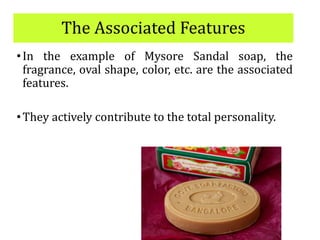
•In the example of Mysore Sandal soap, the
fragrance, oval shape, color, etc. are the associated
features.
•They actively contribute to the total personality.
The Associated Features
•In fact, most attempts of the marketers to
enhance the personality of their products get
centered around the associated features.
•Marketers compete by providing more and more
specialized product features and functions to the
basic product.
Brand Name
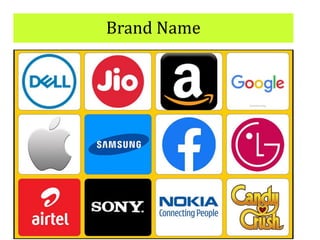
•A brand is defined as a ‘name, term, symbol,
design, or a combination of them, which is
intended to identify the goods and services of
one seller and to differentiate them from those
of competitors’.
•A trademark is a brand that has been given the
legal protection, thus ensuring its use
exclusively by one seller.
Brand Name
Brand Name
•Brand name is the major selling tool and one of
the most important components of “total Product
Personality”.
•The brand image, developed through advertising
and other promotional measures, creates strong
brand awareness and loyalty amongst consumers.
The Package & the Label
The package performs two essential roles:
1. Giving protection to the product
2. Adding to its aesthetics and sales appeal
The power of good packaging is prompting on
the spot purchases
The Package & the Label
• Label provides the written information
about the product.
• Labeling helps the buyer understand the
nature of the product, its distinctive feature,
its performance etc.
The Product Levels
•In his attempt to satisfy the customer and score
over competition, the marketer brings about
refinements on his basic product offer and takes
the product to higher levels of evolution
The Product levels
•According to Levitt, a product offer can be
considered at many different levels:
The Generic product
The Branded product
The Differentiated product
The Customized product
The Augmented product
The Potential Product
The Generic Product
•Is the unbranded, and undifferentiated
commodity like Rice, Bread or Flour.
•Here the product does not have an
identity through the name and is not
linked to any one maker or owner.
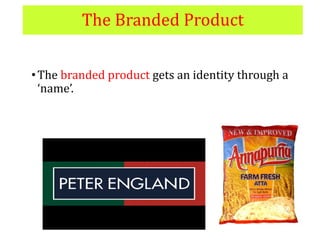
The Branded Product
•The branded product gets an identity through a
‘name’.
•E.g. - Peter England, Annapurna
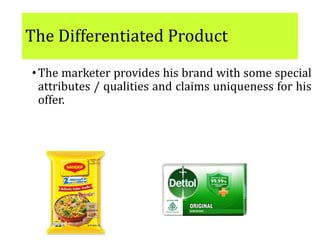
The Differentiated Product
•The marketer provides his brand with some special
attributes / qualities and claims uniqueness for his
offer.
•E.g. Maggie, Dettol soap
The scope for differentiation is immense: and to win
over customers, firms seek higher levels of
differentiation through customizing and
augmenting of the product
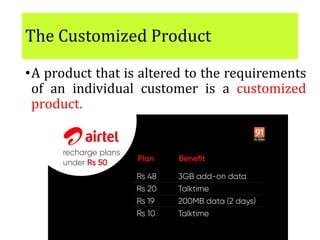
The Customized Product
•A product that is altered to the requirements
of an individual customer is a customized
product.
The Augmented Product
•The augmented product is the result of voluntary
improvements brought about by manufacturer in
order to enhance the value of the product.
•The firm goes beyond all the expectations of the
customers.
•E.g
• Water proof cosmetics
• Aristocrat luggage with wheels
The Potential Product
•The potential product is “tomorrow's
product”, carrying all the improvement and
finesse that is possible over a given
technological, economical and competitive
conditions.
•E.g. Robots for domestic help.
Classification of Products
Consumer Product
Classification
1) Convenience
Product
2) Shopping Product
3) Specialty Product
4) Unsought Product
Industrial Product
Classification
1) Raw Materials
2) Component Parts
3) Major Equipment
4) Operating Supplies
5) Services
Classification of Products
Consumer Product Classification
Convenience Product - A convenience product is an
inexpensive product that requires a minimum amount of
effort on the part of the consumer to select & purchase
it.
Examples - Bread, Soft Drinks, Pain Reliever, and coffee.
They also include headphones, power cords, and other
items that are easily misplaced.
Classification of Products
Consumer Product Classification
Shopping Product - Shopping products are usually
more expensive and are purchased occasionally.
The consumer is more likely to compare a number of
options to assess quality, cost, and features.
Example – T.V., Washing Machine, Computers, Mobile
Phone
Classification of Products
Consumer Product Classification
Specialty Product - From the consumer’s perspective,
these products are so unique that it’s worth it to go to
great lengths to find and purchase them.
Almost without exception, price is not the principle
factor affecting the sales of specialty goods.
Example – Special Jewelry, An Expensive Car, Wedding
Dress
Classification of Products
Consumer Product Classification
Unsought Product - Unsought products are those the
consumer never plans or hopes to buy.
These are either products that the customer is unaware
of or products the consumer hopes not to need.
Example – Life Insurance, Encyclopedias, Charity
donations, Fund Raising Events
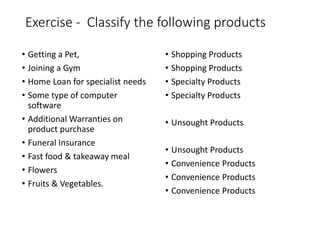
Exercise - Classify the following products
• Getting a Pet,
• Joining a Gym
• Home Loan for specialist needs
• Some type of computer
software
• Additional Warranties on
product purchase
• Funeral Insurance
• Fast food & takeaway meal
• Flowers
• Fruits & Vegetables.
• Shopping Products
• Shopping Products
• Specialty Products
• Unsought Products
• Unsought Products
• Convenience Products
Classification of Products
Industrial Product Classification
1) Raw Materials
2) Component Parts
3) Major Equipment
4) Operating Supplies
5) Services
Classification of Products
Industrial Product Classification
Raw Materials - These are industrial goods that will be
used in the making of other products.
Included in this category are natural resources such as
forest products, minerals, water, agricultural products
and livestock.
In most instances, raw materials lose their individual
identities when used in the final product.
Classification of Products
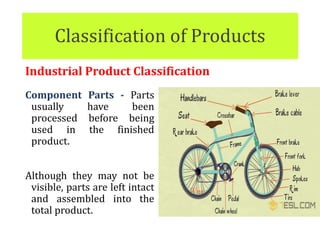
Industrial Product Classification
Component Parts - Parts
usually have been
processed before being
used in the finished
product.
Although they may not be
visible, parts are left intact
and assembled into the
total product.
Classification of Products
Industrial Product Classification
Major Equipment - This category comprises industrial
products used to make, process, or sell other goods.
These include machinery, computers, automobiles,
tractors, engines, and so on.
Classification of Products
Industrial Product Classification
Operating Supplies - Supplies include office stationery,
repair, and maintenance items.
Supplies can be treated as convenience products of the
industrial market as they are purchased with minimal
effort.
Classification of Products
Industrial Product Classification
Services - Business services include maintenance and
repair services, factory premise cleaning, office equipment
repair, and business consultancy services.
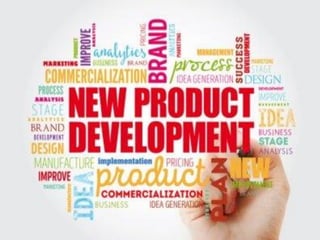
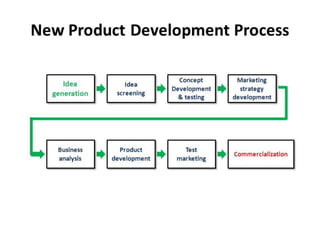
New Product Development
•New Product Development (NPD) refers to
the complete process of bringing a new
product to market.
•This can apply to
•Developing an entirely new product,
•Improving an existing one to keep it attractive
and competitive,
•Introducing an old product to a new market.
New Product Development
•The emergence of new product development
can be attributed to the needs of companies
to maintain a competitive advantage in the
market by introducing new products or
innovating existing ones.
Reasons:
•Meeting the changes in consumer demand
•Making new profits
•Combating environmental threats.
Generating the new Product Ideas:
•New product ideas can originate from:
• Customer Problems
• Dealers
• In company sources
• Market research agencies
• Brain storming
Idea screening
• The various new ideas are put under rigorous
screening by evaluation committees.
• Answers to questions are sought like:
1. Is there a felt need for a new product?
2. Is it an improvement over an existing product?
3. Is it close to our current lines of business? Or does
it need extra expertise in production and marketing
front?
The more attractive looking ideas pass
through the concept testing phase.
Concept Testing
•Is the concept testing of the product itself –
• whether the prospective consumers understand the
product idea,
• whether they will try out such a product.
•Clears the focus of product development.
Business/ Market Analysis
•A fairly reliable estimate of
demand for the proposed
product.
•Seasonal patterns in
consumption
•Other market features
affecting demand
•Competition – major
competitors, their market
share
•Type of Market channels
available
•The market organization
required for marketing their
product.
Actual Product Development
•The firm develops the product as such.
•A pilot production facility is set up.
Market Test
•The new product has to be tried out in select market
segments.
•Market test is essentially a risk control tool.
•It is experimental marketing at minimum cost and
risk.
•When firms decide on full scale manufacturing and
marketing of the product on the basis of results of the
experiment, it helps avoid costly business errors
Commercialization
•Company goes for large scale manufacturing and
marketing of the product.
•The company fully commits itself to commercialize
the new product with the required investment in
manufacturing and marketing.
Why do new Products fail?
•New products can fail for many reasons
•Shortage of important ideas in certain areas
– There may be few ways left to improve some
basis products e.g. steel or detergents
•Fragmented markets – Companies must aim
their new products at smaller market segments
and this can mean lower sales and profits for
each product.
Why do new Products fail?
•Social & governmental constraints – New
products must satisfy consumer safety &
environmental concerns.
•Cost of development – A company typically
must generate many ideas to find just one
worthy of development and often face high
R&D, manufacturing and marketing costs
Why do new Products fail?
•Capital shortage – Some companies with good
ideas cannot raise the funds needed to research
and launch them.
•Shorter product cycles – When a new product
is successful, rivals are quick to copy it.
Why do new Products fail?
•Ignored or misinterpreted market research,
•Overestimates of market size,
•High development costs,
•Ineffective advertising
•Insufficient distribution cost
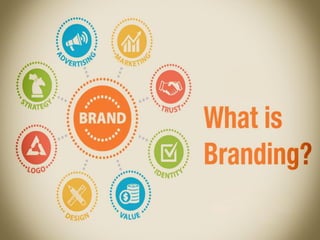
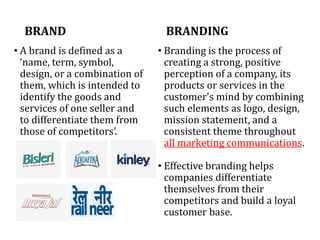
BRANDING
• Branding is the process of
creating a strong, positive
perception of a company, its
products or services in the
customer’s mind by combining
such elements as logo, design,
mission statement, and a
consistent theme throughout
all marketing communications.
• Effective branding helps
companies differentiate
themselves from their
competitors and build a loyal
customer base.
BRAND
• A brand is defined as a
‘name, term, symbol,
design, or a combination of
them, which is intended to
identify the goods and
services of one seller and
to differentiate them from
those of competitors’.
Branding – for whom?
• Consumers: A brand provides consumers with a decision-
making-shortcut when feeling indecisive about the same
product from different companies.
• Employees / shareholders: Besides helping consumers to
distinguish similar products, successful branding
strategies are also adding to a company’s reputation.
This asset can affect a range of people, from consumers to
employees, investors, shareholders and distributors.
Commodity Vs. Brand
A commodity is identical no matter who produces it, while
brand refers to a unique goods or service that is different
from other goods or services in some way.
The difference between a commodity and brand differs
depending on how much they share similarities.
Commodity Vs. Brand
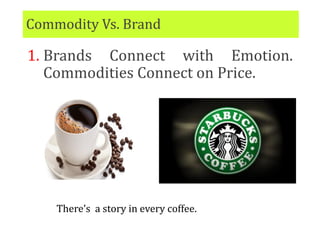
1. Brands Connect with Emotion.
Commodities Connect on Price.
There’s a story in every coffee.
Commodity Vs. Brand
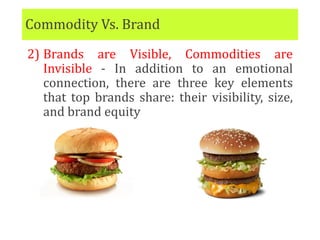
2) Brands are Visible, Commodities are
Invisible - In addition to an emotional
connection, there are three key elements
that top brands share: their visibility, size,
and brand equity
Commodity Vs. Brand
3) Brands Put Long - Term Promise Over
Short - Term Profits - Successful brand
convinces people to value what it offer
for far more than a similar product from
a competitor.
https://bookflow.in/
https://amazon.in/books
Commodity Vs. Brand
•A brand can incorporate any number of
companies, but it’s much harder to turn a
business into a brand.
•Phenomenal brands don’t happen overnight or
without a lot of painstaking work.

Unit - 1 - PRODUCT.pdf

  • 1.
  • 2.
    Curriculum •Unit – 1Product •Unit – 2 Pricing •Unit – 3 Place •Unit – 4 Promotion •Unit – 5 Product Level Planning
  • 3.
    What is Product? •Almosteverything we come across in our daily life is a product – it satisfies a need. •The marketing man gives products an identity or a personality of their own.
  • 4.
    What is Product? •Itsvarious features and functions – • The Brand Name, • The Package, • The Price Label, • The Guarantees, • The Manufacturer's Name • & Prestige – all go into the personality of the product. •And this total personality, is the real tool with which the marketer satisfies the customer.
  • 5.
    •The products conveymeanings with them and project distinctive images. •These meanings and images arise out of the many components that make up the product personality. •These are : 1. The Core Constituent 2. The Associated Features 3. The Brand Name and the Logo 4. The Package and Label
  • 6.
    The Core Constituent •Isthe basic constituent of the product. •Eg. Mysore Sandal Soap, •The fragrance of sandal oil, •The oval shape, •The sandal color, •The brand name, •The price, •The positioning as a luxury soap, •everything has gone into the product personality build up .
  • 7.
    The Core Constituent •Thecore component is the soap, the generic constituent, as in case of any other bath soap. •The other components are superimposed on this basic constituent to develop the total personality. •The 1st lesson in the product management is that the basic product constituent has to be good, for the total product personality to be effective.
  • 8.
    The Associated Features •Inthe example of Mysore Sandal soap, the fragrance, oval shape, color, etc. are the associated features. •They actively contribute to the total personality.
  • 9.
    The Associated Features •Infact, most attempts of the marketers to enhance the personality of their products get centered around the associated features. •Marketers compete by providing more and more specialized product features and functions to the basic product.
  • 10.
    Brand Name •A brandis defined as a ‘name, term, symbol, design, or a combination of them, which is intended to identify the goods and services of one seller and to differentiate them from those of competitors’. •A trademark is a brand that has been given the legal protection, thus ensuring its use exclusively by one seller.
  • 11.
  • 12.
    Brand Name •Brand nameis the major selling tool and one of the most important components of “total Product Personality”. •The brand image, developed through advertising and other promotional measures, creates strong brand awareness and loyalty amongst consumers.
  • 13.
    The Package &the Label The package performs two essential roles: 1. Giving protection to the product 2. Adding to its aesthetics and sales appeal The power of good packaging is prompting on the spot purchases
  • 14.
    The Package &the Label • Label provides the written information about the product. • Labeling helps the buyer understand the nature of the product, its distinctive feature, its performance etc.
  • 15.
    The Product Levels •Inhis attempt to satisfy the customer and score over competition, the marketer brings about refinements on his basic product offer and takes the product to higher levels of evolution
  • 16.
    The Product levels •Accordingto Levitt, a product offer can be considered at many different levels: The Generic product The Branded product The Differentiated product The Customized product The Augmented product The Potential Product
  • 17.
    The Generic Product •Isthe unbranded, and undifferentiated commodity like Rice, Bread or Flour. •Here the product does not have an identity through the name and is not linked to any one maker or owner.
  • 18.
    The Branded Product •Thebranded product gets an identity through a ‘name’. •E.g. - Peter England, Annapurna
  • 19.
    The Differentiated Product •Themarketer provides his brand with some special attributes / qualities and claims uniqueness for his offer. •E.g. Maggie, Dettol soap The scope for differentiation is immense: and to win over customers, firms seek higher levels of differentiation through customizing and augmenting of the product
  • 20.
    The Customized Product •Aproduct that is altered to the requirements of an individual customer is a customized product.
  • 21.
    The Augmented Product •Theaugmented product is the result of voluntary improvements brought about by manufacturer in order to enhance the value of the product. •The firm goes beyond all the expectations of the customers. •E.g • Water proof cosmetics • Aristocrat luggage with wheels
  • 22.
    The Potential Product •Thepotential product is “tomorrow's product”, carrying all the improvement and finesse that is possible over a given technological, economical and competitive conditions. •E.g. Robots for domestic help.
  • 23.
    Classification of Products ConsumerProduct Classification 1) Convenience Product 2) Shopping Product 3) Specialty Product 4) Unsought Product Industrial Product Classification 1) Raw Materials 2) Component Parts 3) Major Equipment 4) Operating Supplies 5) Services
  • 24.
    Classification of Products ConsumerProduct Classification Convenience Product - A convenience product is an inexpensive product that requires a minimum amount of effort on the part of the consumer to select & purchase it. Examples - Bread, Soft Drinks, Pain Reliever, and coffee. They also include headphones, power cords, and other items that are easily misplaced.
  • 25.
    Classification of Products ConsumerProduct Classification Shopping Product - Shopping products are usually more expensive and are purchased occasionally. The consumer is more likely to compare a number of options to assess quality, cost, and features. Example – T.V., Washing Machine, Computers, Mobile Phone
  • 26.
    Classification of Products ConsumerProduct Classification Specialty Product - From the consumer’s perspective, these products are so unique that it’s worth it to go to great lengths to find and purchase them. Almost without exception, price is not the principle factor affecting the sales of specialty goods. Example – Special Jewelry, An Expensive Car, Wedding Dress
  • 27.
    Classification of Products ConsumerProduct Classification Unsought Product - Unsought products are those the consumer never plans or hopes to buy. These are either products that the customer is unaware of or products the consumer hopes not to need. Example – Life Insurance, Encyclopedias, Charity donations, Fund Raising Events
  • 28.
    Exercise - Classifythe following products • Getting a Pet, • Joining a Gym • Home Loan for specialist needs • Some type of computer software • Additional Warranties on product purchase • Funeral Insurance • Fast food & takeaway meal • Flowers • Fruits & Vegetables. • Shopping Products • Shopping Products • Specialty Products • Specialty Products • Unsought Products • Unsought Products • Convenience Products • Convenience Products • Convenience Products
  • 29.
    Classification of Products IndustrialProduct Classification 1) Raw Materials 2) Component Parts 3) Major Equipment 4) Operating Supplies 5) Services
  • 30.
    Classification of Products IndustrialProduct Classification Raw Materials - These are industrial goods that will be used in the making of other products. Included in this category are natural resources such as forest products, minerals, water, agricultural products and livestock. In most instances, raw materials lose their individual identities when used in the final product.
  • 31.
    Classification of Products IndustrialProduct Classification Component Parts - Parts usually have been processed before being used in the finished product. Although they may not be visible, parts are left intact and assembled into the total product.
  • 32.
    Classification of Products IndustrialProduct Classification Major Equipment - This category comprises industrial products used to make, process, or sell other goods. These include machinery, computers, automobiles, tractors, engines, and so on.
  • 33.
    Classification of Products IndustrialProduct Classification Operating Supplies - Supplies include office stationery, repair, and maintenance items. Supplies can be treated as convenience products of the industrial market as they are purchased with minimal effort.
  • 34.
    Classification of Products IndustrialProduct Classification Services - Business services include maintenance and repair services, factory premise cleaning, office equipment repair, and business consultancy services.
  • 36.
    New Product Development •NewProduct Development (NPD) refers to the complete process of bringing a new product to market. •This can apply to •Developing an entirely new product, •Improving an existing one to keep it attractive and competitive, •Introducing an old product to a new market.
  • 37.
    New Product Development •Theemergence of new product development can be attributed to the needs of companies to maintain a competitive advantage in the market by introducing new products or innovating existing ones.
  • 38.
    Reasons: •Meeting the changesin consumer demand •Making new profits •Combating environmental threats.
  • 40.
    Generating the newProduct Ideas: •New product ideas can originate from: • Customer Problems • Dealers • In company sources • Market research agencies • Brain storming
  • 41.
    Idea screening • Thevarious new ideas are put under rigorous screening by evaluation committees. • Answers to questions are sought like: 1. Is there a felt need for a new product? 2. Is it an improvement over an existing product? 3. Is it close to our current lines of business? Or does it need extra expertise in production and marketing front? The more attractive looking ideas pass through the concept testing phase.
  • 42.
    Concept Testing •Is theconcept testing of the product itself – • whether the prospective consumers understand the product idea, • whether they will try out such a product. •Clears the focus of product development.
  • 43.
    Business/ Market Analysis •Afairly reliable estimate of demand for the proposed product. •Seasonal patterns in consumption •Other market features affecting demand •Competition – major competitors, their market share •Type of Market channels available •The market organization required for marketing their product.
  • 44.
    Actual Product Development •Thefirm develops the product as such. •A pilot production facility is set up.
  • 45.
    Market Test •The newproduct has to be tried out in select market segments. •Market test is essentially a risk control tool. •It is experimental marketing at minimum cost and risk. •When firms decide on full scale manufacturing and marketing of the product on the basis of results of the experiment, it helps avoid costly business errors
  • 46.
    Commercialization •Company goes forlarge scale manufacturing and marketing of the product. •The company fully commits itself to commercialize the new product with the required investment in manufacturing and marketing.
  • 47.
    Why do newProducts fail? •New products can fail for many reasons •Shortage of important ideas in certain areas – There may be few ways left to improve some basis products e.g. steel or detergents •Fragmented markets – Companies must aim their new products at smaller market segments and this can mean lower sales and profits for each product.
  • 48.
    Why do newProducts fail? •Social & governmental constraints – New products must satisfy consumer safety & environmental concerns. •Cost of development – A company typically must generate many ideas to find just one worthy of development and often face high R&D, manufacturing and marketing costs
  • 49.
    Why do newProducts fail? •Capital shortage – Some companies with good ideas cannot raise the funds needed to research and launch them. •Shorter product cycles – When a new product is successful, rivals are quick to copy it.
  • 50.
    Why do newProducts fail? •Ignored or misinterpreted market research, •Overestimates of market size, •High development costs, •Ineffective advertising •Insufficient distribution cost
  • 52.
    BRANDING • Branding isthe process of creating a strong, positive perception of a company, its products or services in the customer’s mind by combining such elements as logo, design, mission statement, and a consistent theme throughout all marketing communications. • Effective branding helps companies differentiate themselves from their competitors and build a loyal customer base. BRAND • A brand is defined as a ‘name, term, symbol, design, or a combination of them, which is intended to identify the goods and services of one seller and to differentiate them from those of competitors’.
  • 53.
    Branding – forwhom? • Consumers: A brand provides consumers with a decision- making-shortcut when feeling indecisive about the same product from different companies. • Employees / shareholders: Besides helping consumers to distinguish similar products, successful branding strategies are also adding to a company’s reputation. This asset can affect a range of people, from consumers to employees, investors, shareholders and distributors.
  • 54.
    Commodity Vs. Brand Acommodity is identical no matter who produces it, while brand refers to a unique goods or service that is different from other goods or services in some way. The difference between a commodity and brand differs depending on how much they share similarities.
  • 55.
    Commodity Vs. Brand 1.Brands Connect with Emotion. Commodities Connect on Price. There’s a story in every coffee.
  • 56.
    Commodity Vs. Brand 2)Brands are Visible, Commodities are Invisible - In addition to an emotional connection, there are three key elements that top brands share: their visibility, size, and brand equity
  • 57.
    Commodity Vs. Brand 3)Brands Put Long - Term Promise Over Short - Term Profits - Successful brand convinces people to value what it offer for far more than a similar product from a competitor. https://bookflow.in/ https://amazon.in/books
  • 58.
    Commodity Vs. Brand •Abrand can incorporate any number of companies, but it’s much harder to turn a business into a brand. •Phenomenal brands don’t happen overnight or without a lot of painstaking work.