Nimal D. Rathnayake
Ph.D(Aldersgate), MBA(USA), ACMI(UK), CIM (UK), ACBF(IBSL), MSLIM
Dip. in Export & Import Management (INDIA),
Dip. In Mass Media Communication (SL),
National Dip. in T& D (SLITAD)
Practicing Marketer (SL)
PCM – Module 10
2.
Marketing involves:
• Understandingthe real needs of the
customers
• Producing the tailor-made solutions
• Raising awareness of the existing
solutions
• Making the solutions available
2
01/31/2026
4
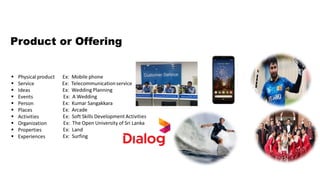
• A productis anything that can be offered to a market for
attention, acquisition, use or consumption that might
satisfy customer needs - Physical goods, Persons, Places,
Organizations, Ideas, Services, Experiences etc.,
• Product decisions - Customer benefits, Quality, Design,
Technical features , Branding, Packaging, Related
Services
• At the current context, no consumer is seeking for
products or services. A right Solution for the real needs
of the customer is the requirement. Currently, the
customers seek for more Values.
(1) WHAT IS A PRODUCT?
Definition of a Product
6
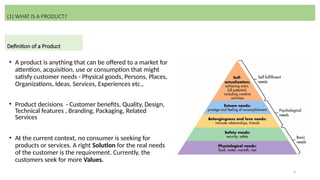
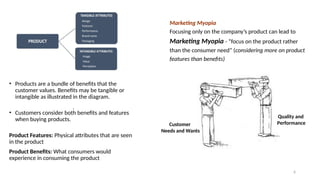
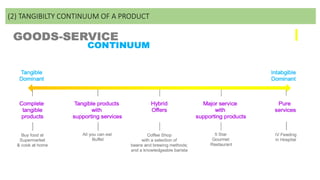
• Products area bundle of benefits that the
customer values. Benefits may be tangible or
intangible as illustrated in the diagram.
• Customers consider both benefits and features
when buying products.
Product Features: Physical attributes that are seen
in the product
Product Benefits: What consumers would
experience in consuming the product
.
Marketing Myopia
Focusing only on the company’s product can lead to
Marketing Myopia - “focus on the product rather
than the consumer need” (considering more on product
features than benefits)
Customer
Needs and Wants
Quality and
Performance
7.
7
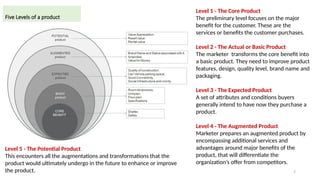
Five Levels ofa product
Level 1 - The Core Product
The preliminary level focuses on the major
benefit for the customer. These are the
services or benefits the customer purchases.
Level 2 - The Actual or Basic Product
The marketer transforms the core benefit into
a basic product. They need to improve product
features, design, quality level, brand name and
packaging.
Level 3 - The Expected Product
A set of attributes and conditions buyers
generally intend to have now they purchase a
product.
Level 4 - The Augmented Product
Marketer prepares an augmented product by
encompassing additional services and
advantages around major benefits of the
product, that will differentiate the
organization’s offer from competitors.
Level 5 - The Potential Product
This encounters all the augmentations and transformations that the
product would ultimately undergo in the future to enhance or improve
the product.
8.
8
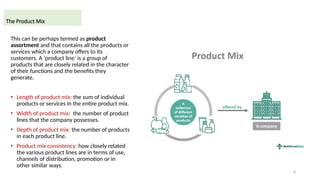
This can beperhaps termed as product
assortment and that contains all the products or
services which a company offers to its
customers. A ‘product line’ is a group of
products that are closely related in the character
of their functions and the benefits they
generate.
• Length of product mix: the sum of individual
products or services in the entire product mix.
• Width of product mix: the number of product
lines that the company possesses.
• Depth of product mix: the number of products
in each product line.
• Product mix consistency: how closely related
the various product lines are in terms of use,
channels of distribution, promotion or in
other similar ways.
The Product Mix
10
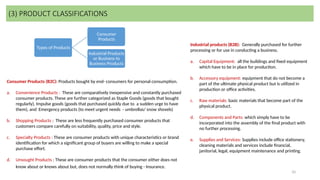
Types of Products
Consumer
Products
IndustrialProducts
or Business to
Business Products
(3) PRODUCT CLASSIFICATIONS
Consumer Products (B2C): Products bought by end- consumers for personal consumption.
a. Convenience Products : These are comparatively inexpensive and constantly purchased
consumer products. These are further categorized as Staple Goods (goods that bought
regularly), Impulse goods (goods that purchased quickly due to a sudden urge to have
them), and Emergency products (to meet urgent needs - umbrellas/ snow shovels)
b. Shopping Products : These are less frequently purchased consumer products that
customers compare carefully on suitability, quality, price and style.
c. Specialty Products : These are consumer products with unique characteristics or brand
identification for which a significant group of buyers are willing to make a special
purchase effort.
d. Unsought Products : These are consumer products that the consumer either does not
know about or knows about but, does not normally think of buying - Insurance.
Industrial products (B2B): Generally purchased for further
processing or for use in conducting a business.
a. Capital Equipment: all the buildings and fixed equipment
which have to be in place for production.
b. Accessory equipment: equipment that do not become a
part of the ultimate physical product but is utilized in
production or office activities.
c. Raw materials: basic materials that become part of the
physical product.
d. Components and Parts: which simply have to be
incorporated into the assembly of the final product with
no further processing.
e. Supplies and Services: Supplies include office stationery,
cleaning materials and services include financial,
janitorial, legal, equipment maintenance and printing.
11.
11
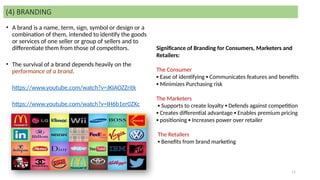
• A brandis a name, term, sign, symbol or design or a
combination of them, intended to identify the goods
or services of one seller or group of sellers and to
differentiate them from those of competitors.
• The survival of a brand depends heavily on the
performance of a brand.
https://www.youtube.com/watch?v=JKIAOZZritk
https://www.youtube.com/watch?v=IH6b1er0ZXc
(4) BRANDING
Significance of Branding for Consumers, Marketers and
Retailers:
The Consumer
▪ Ease of identifying ▪ Communicates features and benefits
▪ Minimizes Purchasing risk
The Marketers
▪ Supports to create loyalty ▪ Defends against competition
▪ Creates differential advantage ▪ Enables premium pricing
▪ positioning ▪ Increases power over retailer
The Retailers
▪ Benefits from brand marketing
12.
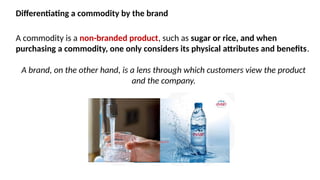
A commodity isa non-branded product, such as sugar or rice, and when
purchasing a commodity, one only considers its physical attributes and benefits.
A brand, on the other hand, is a lens through which customers view the product
and the company.
Differentiating a commodity by the brand
13.
13
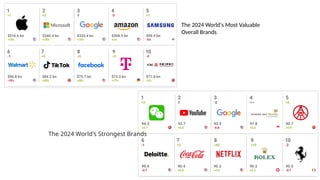
The 2024 World'sMost Valuable
Overall Brands
The 2024 World's Strongest Brands
14.
14
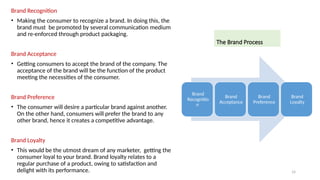
Brand Recognition
• Makingthe consumer to recognize a brand. In doing this, the
brand must be promoted by several communication medium
and re-enforced through product packaging.
Brand Acceptance
• Getting consumers to accept the brand of the company. The
acceptance of the brand will be the function of the product
meeting the necessities of the consumer.
Brand Preference
• The consumer will desire a particular brand against another.
On the other hand, consumers will prefer the brand to any
other brand, hence it creates a competitive advantage.
Brand Loyalty
• This would be the utmost dream of any marketer, getting the
consumer loyal to your brand. Brand loyalty relates to a
regular purchase of a product, owing to satisfaction and
delight with its performance.
The Brand Process
Brand
Recognitio
n
Brand
Acceptance
Brand
Preference
Brand
Loyalty
15.
15
A branding strategydepicts the way in which a marketer would brand a product.
• Individual Product Branding: An organization can come out with a number of products in a category and give
different names to each. For instance, Unilever offers several detergent powders such as surf, Rin, and Wheel.
• Blanket Family Branding: Same name is used to represent the brand in different categories. For instance,
General Motors uses the name Chevrolet for its range of sedans, SUVs coupes, vans, hatchbacks.
• Combination Brand names: A mixture of family and individual names capitalizes on the reputation of the
organization while allowing the individual brands to be distinguished and identified. For example, Microsoft
Office, Microsoft Outlook, Microsoft Windows
Branding Strategies
16.
16
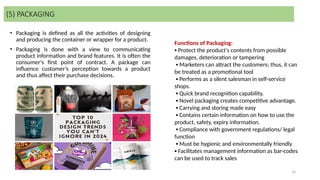
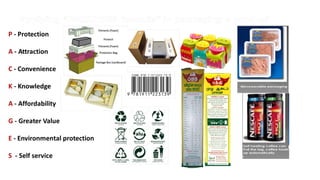
• Packaging isdefined as all the activities of designing
and producing the container or wrapper for a product.
• Packaging is done with a view to communicating
product information and brand features. It is often the
consumer's first point of contract. A package can
influence customer’s perception towards a product
and thus affect their purchase decisions.
(5) PACKAGING
Functions of Packaging:
▪ Protect the product's contents from possible
damages, deterioration or tampering
▪ Marketers can attract the customers; thus, it can
be treated as a promotional tool
▪ Performs as a silent salesman in self-service
shops.
▪ Quick brand recognition capability.
▪ Novel packaging creates competitive advantage.
▪ Carrying and storing made easy
▪ Contains certain information on how to use the
product, safety, expiry information.
▪ Compliance with government regulations/ legal
function
▪ Must be hygienic and environmentally friendly
▪ Facilitates management information as bar-codes
can be used to track sales
18.
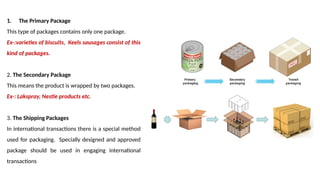
1. The PrimaryPackage
This type of packages contains only one package.
Ex-:varieties of biscuits, Keels sausages consist of this
kind of packages.
2. The Secondary Package
This means the product is wrapped by two packages.
Ex-: Lakspray, Nestle products etc.
3. The Shipping Packages
In international transactions there is a special method
used for packaging. Specially designed and approved
package should be used in engaging international
transactions
Level of Packages
19.
19
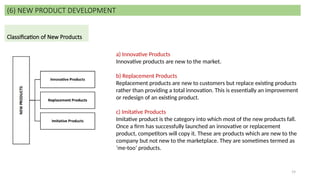
(6) NEW PRODUCTDEVELOPMENT
Classification of New Products
a) Innovative Products
Innovative products are new to the market.
b) Replacement Products
Replacement products are new to customers but replace existing products
rather than providing a total innovation. This is essentially an improvement
or redesign of an existing product.
c) Imitative Products
Imitative product is the category into which most of the new products fall.
Once a firm has successfully launched an innovative or replacement
product, competitors will copy it. These are products which are new to the
company but not new to the marketplace. They are sometimes termed as
‘me-too’ products.
20.
20
• Drastic Changesin Customer requirements – with the time, customers may have significantly changing needs and
they expect to derive satisfaction from products. In this context, marketers should pursue those trends and quickly
respond to those by introducing novel products.
• Market Saturation – When one product is stagnant or saturate for a longer period in a market, the value and the
acceptance for the product tends to decline and eventually it becomes obsolete. Thereby introducing new products
brings more importance to the organization.
• Long-Term business strategies – Novel products can always provide a greater competitive advantage over products
of the other competing firms in the market.
• Managing Risk through Diversity – Innovation will always lead to widen the portfolio of products that the company
offers to its markets. Hence, in diversifying their risk, it provides a greater support and enhance their worth.
• To Match Competition – responding to innovation and market trends before or shortly after competitors, to seize
marketing opportunities.
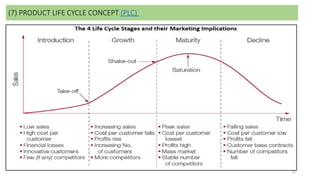
• Product Life Cycle Concept – Through product modifications, product life cycle can be extended.
• Technological Changes – new technology adoption has paved the way for extensive innovations.
Clauses for Introducing New Products
21.
21
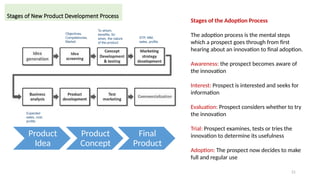
Stages of NewProduct Development Process
Product
Idea
Product
Concept
Final
Product
Objectives,
Competencies,
Market
To whom,
benefits, for
when, the nature
of the product
STP, MM,
sales, profits
Expected
sales, cost,
profits
Stages of the Adoption Process
The adoption process is the mental steps
which a prospect goes through from first
hearing about an innovation to final adoption.
Awareness: the prospect becomes aware of
the innovation
Interest: Prospect is interested and seeks for
information
Evaluation: Prospect considers whether to try
the innovation
Trial: Prospect examines, tests or tries the
innovation to determine its usefulness
Adoption: The prospect now decides to make
full and regular use
22.
22
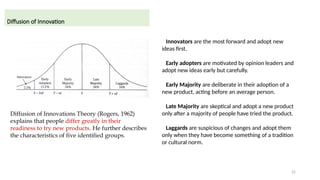
Diffusion of Innovation
Diffusionof Innovations Theory (Rogers, 1962)
explains that people differ greatly in their
readiness to try new products. He further describes
the characteristics of five identified groups.
Innovators are the most forward and adopt new
ideas first.
Early adopters are motivated by opinion leaders and
adopt new ideas early but carefully.
Early Majority are deliberate in their adoption of a
new product, acting before an average person.
Late Majority are skeptical and adopt a new product
only after a majority of people have tried the product.
Laggards are suspicious of changes and adopt them
only when they have become something of a tradition
or cultural norm.
24
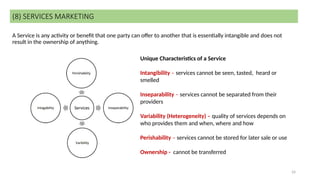
A Service isany activity or benefit that one party can offer to another that is essentially intangible and does not
result in the ownership of anything.
(8) SERVICES MARKETING
Unique Characteristics of a Service
Intangibility – services cannot be seen, tasted, heard or
smelled
Inseparability – services cannot be separated from their
providers
Variability (Heterogeneity) – quality of services depends on
who provides them and when, where and how
Perishability – services cannot be stored for later sale or use
Ownership - cannot be transferred