B.E (final year) Computer Science Engineering, WIT Solapur.
Math is my passion
I like craft, designing and teaching.
https://unacademy.com/user/dikshiv96
NUMBERS
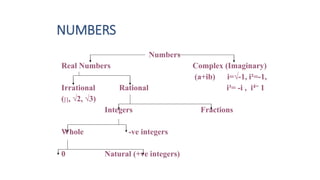
Numbers
Real Numbers Complex (Imaginary)
(a+ib) i=√-1, i²=-1,
Irrational Rational i³= -i , i4= 1
(∏, √2, √3)
Integers Fractions
Whole -ve integers
0 Natural (+ve integers)
• Perfect Number:
• Definition : “A perfect number is a number such that the sum of its
factors including 1 and excluding itself is equal to the number ”
Example: 1) Factors of 6 are 1,2,3
1+2+3 = 6
2)Factors of 28 are 1,2,4,7,14
1+2+4+7+14=28
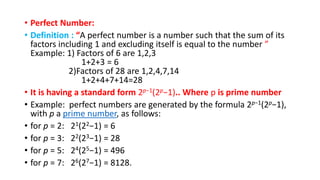
• It is having a standard form 2p−1(2p−1).. Where p is prime number
• Example: perfect numbers are generated by the formula 2p−1(2p−1),
with p a prime number, as follows:
• for p = 2: 21(22−1) = 6
• for p = 3: 22(23−1) = 28
• for p = 5: 24(25−1) = 496
• for p = 7: 26(27−1) = 8128.
Classification of Numbers /Integers
• Natural numbers Natural numbers are counting numbers which we use to count . For
example 1,2,3…. The lowest natural number is 1
• Whole numbers When zero is included in the list of natural numbers the numbers
are known as whole numbers .for example , 0, 1, 2….the lowest whole numbers is 0 .
• Integers  Integers are whole numbers ,the negative of whole numbers and zero .for
example ,43434235 ,28,2,0,-28 and -3030 are integers, but numbers like ½ , 2.5 are not
whole numbers .
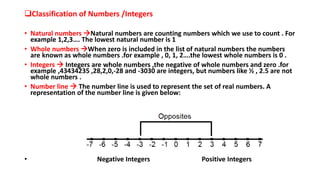
• Number line  The number line is used to represent the set of real numbers. A
representation of the number line is given below:
• Negative Integers Positive Integers
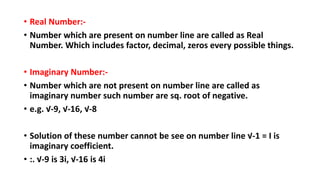
• Real Number:-
• Number which are present on number line are called as Real
Number. Which includes factor, decimal, zeros every possible things.
• Imaginary Number:-
• Number which are not present on number line are called as
imaginary number such number are sq. root of negative.
• e.g. √-9, √-16, √-8
• Solution of these number cannot be see on number line √-1 = I is
imaginary coefficient.
• :. √-9 is 3i, √-16 is 4i
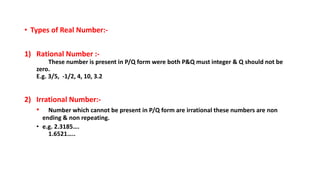
• Types of Real Number:-
1) Rational Number :-
These number is present in P/Q form were both P&Q must integer & Q should not be
zero.
E.g. 3/5, -1/2, 4, 10, 3.2
2) Irrational Number:-
• Number which cannot be present in P/Q form are irrational these numbers are non
ending & non repeating.
• e.g. 2.3185….
1.6521…..
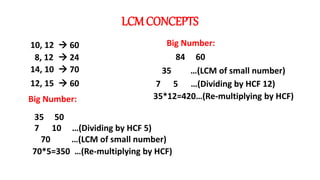
LCMCONCEPTS
10, 12  60
8, 12  24
14, 10  70
12, 15  60
35 50
7 10 …(Dividing by HCF 5)
70 …(LCM of small number)
70*5=350 …(Re-multiplying by HCF)
Big Number:
84 60
7 5 …(Dividing by HCF 12)
35 …(LCM of small number)
35*12=420…(Re-multiplying by HCF)
Big Number:
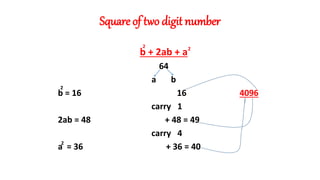
Square of two digit number
b + 2ab + a
64
a b
b = 16 16 4096
carry 1
2ab = 48 + 48 = 49
carry 4
a = 36 + 36 = 40
2
2
2 2
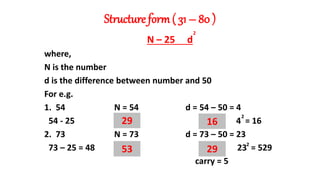
Structure form ( 31 – 80 )
N – 25 d
where,
N is the number
d is the difference between number and 50
For e.g.
1. 54 N = 54 d = 54 – 50 = 4
54 - 25 4 = 16
2. 73 N = 73 d = 73 – 50 = 23
73 – 25 = 48 23 = 529
carry = 5
2
29 16
2
2
53 29
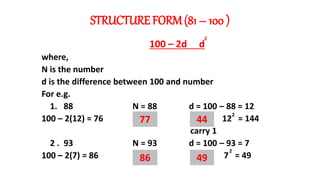
STRUCTURE FORM(81 – 100 )
100 – 2d d
where,
N is the number
d is the difference between 100 and number
For e.g.
1. 88 N = 88 d = 100 – 88 = 12
100 – 2(12) = 76 12 = 144
carry 1
2 . 93 N = 93 d = 100 – 93 = 7
100 – 2(7) = 86 7 = 49
2
77 44
86 49
2
2
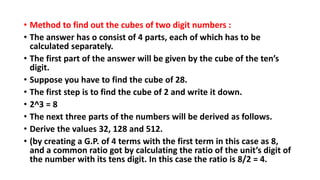
• Method to find out the cubes of two digit numbers :
• The answer has o consist of 4 parts, each of which has to be
calculated separately.
• The first part of the answer will be given by the cube of the ten’s
digit.
• Suppose you have to find the cube of 28.
• The first step is to find the cube of 2 and write it down.
• 2^3 = 8
• The next three parts of the numbers will be derived as follows.
• Derive the values 32, 128 and 512.
• (by creating a G.P. of 4 terms with the first term in this case as 8,
and a common ratio got by calculating the ratio of the unit’s digit of
the number with its tens digit. In this case the ratio is 8/2 = 4.
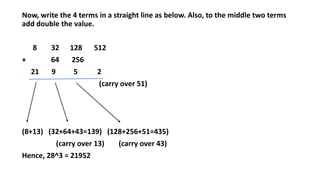
Now, write the 4 terms in a straight line as below. Also, to the middle two terms
add double the value.
8 32 128 512
+ 64 256
21 9 5 2
(carry over 51)
(8+13) (32+64+43=139) (128+256+51=435)
(carry over 13) (carry over 43)
Hence, 28^3 = 21952
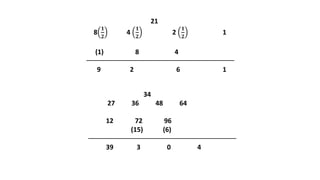
21
8
𝟏
𝟐
4
𝟏
𝟐
2
𝟏
𝟐
1
(1) 8 4
9 2 6 1
34
27 36 48 64
12 72 96
(15) (6)
39 3 0 4
For composite number
C= m x n ( Co prime )
( Rule should follow m , n )
Number of divisible /factors
If N is any number which can be factorized like
N= ap *bq *cr * ……
Where a, b, c are prime numbers.
Number of divisors = (p+1)(q+1)(r+1)…….
Q. Find the number of divisors of N =420.
N = 420 = 22 * 31 *71 * 51
So the number of divisors = (2+1)(1+1)(1+1)(1+1) = 24
• Number of zeroes in an expression:
• Suppose you have to find the number of zeroes in a product :
• 24*32*17*23*19=(2^3*3^1)*(2^5)*17^1*23*19.
• As you can notice, this product will have no zeroes because it has no 5 in
it.
• However, if you have an expression like : 8*15*23*17*25*22
• The above expression can be the rewritten in the standard form as;
• Zeroes are formed by a combination of 2*5. hence, the number of zeroes
will depends on the number of pairs of 2’s and 5’s that can be formed.
• In above product, there are four twos and two fives. Hence, we shall be
able to form only two pairs of (2*5).
• Hence, there will be 2 zeroes in the product.
Process for finding the number of zeroes :
Q. 81!
81/5 = 16
16/5 = 3
Thus, Answer = 16+3 = 19
Q. Find the number of zeroes in 27!
Number of zeroes is 27! = (27/5) + (27/25) where [x] indicates the integer
just lower than the fraction.
Hence, [27/5] = 5 and [27/5^2] = 1+6 = 7 zeroes.
Q. Find the number of zeroes in 137!
[137/5] + [137/5^2] + [137/5^3]
= 27+5+1 = 33 zeroes.
• Q. What power of 8 exactly divides 25! ?
• Sol. If were a prime number, the answer should be [25/8] = 3. But since 8
is not prime, use the following process.
• The prime factors of 8 is 2*2*2. For divisibility by 8, we need three twos.
So, every time we can find 3 twos, we add one to the power of 8 that
divides 25! To count how we get 3 twos, we do the following. All even
numbers will give one ‘two’ at least [25/2] = 12.
• Also, all numbers in 25! Divisible by 2^2 will give an additional two
[25/2^2] = 6
• Further, all number in 25! Divisible by 2^3 will give a third two. Hence
[25!/2^3] = 3
• And all numbers of twos in 25! Divisible by 2^4 will give a fourth two.
Hence [25!/2^4] = 1
• Hence, total number of twos in 25! Is 22. For a number to be divided by 8,
we need three twos. Hence, since 25! has 22 twos, it will be divided by 8
seven times.
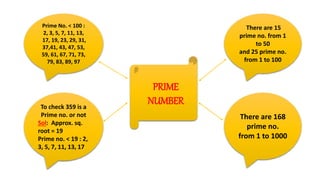
PRIME
NUMBER
Prime No. < 100 :
2, 3, 5, 7, 11, 13,
17, 19, 23, 29, 31,
37,41, 43, 47, 53,
59, 61, 67, 71, 73,
79, 83, 89, 97
To check 359 is a
Prime no. or not
Sol: Approx. sq.
root = 19
Prime no. < 19 : 2,
3, 5, 7, 11, 13, 17
There are 15
prime no. from 1
to 50
and 25 prime no.
from 1 to 100
There are 168
prime no.
from 1 to 1000
• Divisibility Rules 
• For 2 : If unit digit of any number is 0,2,4,6 or 8, then that number will be divisible by 2
• For 3 : If sum total of all the digits of any numbers is the visible by 3 then the number will be
divisible by 3, (e g ; 123 ,456 etc )
• For 4 : If the last two digits of a numbers are divisible by 4 , then that number will be divisible
by 4 (e g ; 3796 ,248 etc )
• For 5 : If the last digit of the number is 5 or 0 , then that number will be divisible by 5
• For 6 : Rule should follow 2 , 3
• For 7 : ( R -2L) should be multiple of 7
• R  Remaining number
• L  Last digit
• e g :- 441 , here R = 44 & L = 1 hence ,
• R- 2L= 44 – 2(1)
• =42
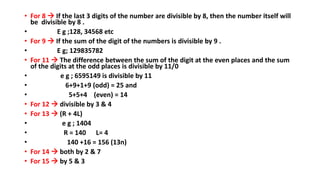
• For 8  If the last 3 digits of the number are divisible by 8, then the number itself will
be divisible by 8 .
• E g ;128, 34568 etc
• For 9  If the sum of the digit of the numbers is divisible by 9 .
• E g; 129835782
• For 11  The difference between the sum of the digit at the even places and the sum
of the digits at the odd places is divisible by 11/0
• e g ; 6595149 is divisible by 11
• 6+9+1+9 (odd) = 25 and
• 5+5+4 (even) = 14
• For 12  divisible by 3 & 4
• For 13  (R + 4L)
• e g ; 1404
• R = 140 L= 4
• 140 +16 = 156 (13n)
• For 14  both by 2 & 7
• For 15  by 5 & 3
Number system

Number system

  • 2.
    B.E (final year)Computer Science Engineering, WIT Solapur. Math is my passion I like craft, designing and teaching. https://unacademy.com/user/dikshiv96
  • 3.
    NUMBERS Numbers Real Numbers Complex(Imaginary) (a+ib) i=√-1, i²=-1, Irrational Rational i³= -i , i4= 1 (∏, √2, √3) Integers Fractions Whole -ve integers 0 Natural (+ve integers)
  • 4.
    • Perfect Number: •Definition : “A perfect number is a number such that the sum of its factors including 1 and excluding itself is equal to the number ” Example: 1) Factors of 6 are 1,2,3 1+2+3 = 6 2)Factors of 28 are 1,2,4,7,14 1+2+4+7+14=28 • It is having a standard form 2p−1(2p−1).. Where p is prime number • Example: perfect numbers are generated by the formula 2p−1(2p−1), with p a prime number, as follows: • for p = 2: 21(22−1) = 6 • for p = 3: 22(23−1) = 28 • for p = 5: 24(25−1) = 496 • for p = 7: 26(27−1) = 8128.
  • 5.
    Classification of Numbers/Integers • Natural numbers Natural numbers are counting numbers which we use to count . For example 1,2,3…. The lowest natural number is 1 • Whole numbers When zero is included in the list of natural numbers the numbers are known as whole numbers .for example , 0, 1, 2….the lowest whole numbers is 0 . • Integers  Integers are whole numbers ,the negative of whole numbers and zero .for example ,43434235 ,28,2,0,-28 and -3030 are integers, but numbers like ½ , 2.5 are not whole numbers . • Number line  The number line is used to represent the set of real numbers. A representation of the number line is given below: • Negative Integers Positive Integers
  • 6.
    • Real Number:- •Number which are present on number line are called as Real Number. Which includes factor, decimal, zeros every possible things. • Imaginary Number:- • Number which are not present on number line are called as imaginary number such number are sq. root of negative. • e.g. √-9, √-16, √-8 • Solution of these number cannot be see on number line √-1 = I is imaginary coefficient. • :. √-9 is 3i, √-16 is 4i
  • 7.
    • Types ofReal Number:- 1) Rational Number :- These number is present in P/Q form were both P&Q must integer & Q should not be zero. E.g. 3/5, -1/2, 4, 10, 3.2 2) Irrational Number:- • Number which cannot be present in P/Q form are irrational these numbers are non ending & non repeating. • e.g. 2.3185…. 1.6521…..
  • 8.
    LCMCONCEPTS 10, 12 60 8, 12  24 14, 10  70 12, 15  60 35 50 7 10 …(Dividing by HCF 5) 70 …(LCM of small number) 70*5=350 …(Re-multiplying by HCF) Big Number: 84 60 7 5 …(Dividing by HCF 12) 35 …(LCM of small number) 35*12=420…(Re-multiplying by HCF) Big Number:
  • 9.
    Square of twodigit number b + 2ab + a 64 a b b = 16 16 4096 carry 1 2ab = 48 + 48 = 49 carry 4 a = 36 + 36 = 40 2 2 2 2
  • 10.
    Structure form (31 – 80 ) N – 25 d where, N is the number d is the difference between number and 50 For e.g. 1. 54 N = 54 d = 54 – 50 = 4 54 - 25 4 = 16 2. 73 N = 73 d = 73 – 50 = 23 73 – 25 = 48 23 = 529 carry = 5 2 29 16 2 2 53 29
  • 11.
    STRUCTURE FORM(81 –100 ) 100 – 2d d where, N is the number d is the difference between 100 and number For e.g. 1. 88 N = 88 d = 100 – 88 = 12 100 – 2(12) = 76 12 = 144 carry 1 2 . 93 N = 93 d = 100 – 93 = 7 100 – 2(7) = 86 7 = 49 2 77 44 86 49 2 2
  • 12.
    • Method tofind out the cubes of two digit numbers : • The answer has o consist of 4 parts, each of which has to be calculated separately. • The first part of the answer will be given by the cube of the ten’s digit. • Suppose you have to find the cube of 28. • The first step is to find the cube of 2 and write it down. • 2^3 = 8 • The next three parts of the numbers will be derived as follows. • Derive the values 32, 128 and 512. • (by creating a G.P. of 4 terms with the first term in this case as 8, and a common ratio got by calculating the ratio of the unit’s digit of the number with its tens digit. In this case the ratio is 8/2 = 4.
  • 13.
    Now, write the4 terms in a straight line as below. Also, to the middle two terms add double the value. 8 32 128 512 + 64 256 21 9 5 2 (carry over 51) (8+13) (32+64+43=139) (128+256+51=435) (carry over 13) (carry over 43) Hence, 28^3 = 21952
  • 14.
    21 8 𝟏 𝟐 4 𝟏 𝟐 2 𝟏 𝟐 1 (1) 8 4 92 6 1 34 27 36 48 64 12 72 96 (15) (6) 39 3 0 4
  • 15.
    For composite number C=m x n ( Co prime ) ( Rule should follow m , n ) Number of divisible /factors If N is any number which can be factorized like N= ap *bq *cr * …… Where a, b, c are prime numbers. Number of divisors = (p+1)(q+1)(r+1)……. Q. Find the number of divisors of N =420. N = 420 = 22 * 31 *71 * 51 So the number of divisors = (2+1)(1+1)(1+1)(1+1) = 24
  • 16.
    • Number ofzeroes in an expression: • Suppose you have to find the number of zeroes in a product : • 24*32*17*23*19=(2^3*3^1)*(2^5)*17^1*23*19. • As you can notice, this product will have no zeroes because it has no 5 in it. • However, if you have an expression like : 8*15*23*17*25*22 • The above expression can be the rewritten in the standard form as; • Zeroes are formed by a combination of 2*5. hence, the number of zeroes will depends on the number of pairs of 2’s and 5’s that can be formed. • In above product, there are four twos and two fives. Hence, we shall be able to form only two pairs of (2*5). • Hence, there will be 2 zeroes in the product.
  • 17.
    Process for findingthe number of zeroes : Q. 81! 81/5 = 16 16/5 = 3 Thus, Answer = 16+3 = 19 Q. Find the number of zeroes in 27! Number of zeroes is 27! = (27/5) + (27/25) where [x] indicates the integer just lower than the fraction. Hence, [27/5] = 5 and [27/5^2] = 1+6 = 7 zeroes. Q. Find the number of zeroes in 137! [137/5] + [137/5^2] + [137/5^3] = 27+5+1 = 33 zeroes.
  • 18.
    • Q. Whatpower of 8 exactly divides 25! ? • Sol. If were a prime number, the answer should be [25/8] = 3. But since 8 is not prime, use the following process. • The prime factors of 8 is 2*2*2. For divisibility by 8, we need three twos. So, every time we can find 3 twos, we add one to the power of 8 that divides 25! To count how we get 3 twos, we do the following. All even numbers will give one ‘two’ at least [25/2] = 12. • Also, all numbers in 25! Divisible by 2^2 will give an additional two [25/2^2] = 6 • Further, all number in 25! Divisible by 2^3 will give a third two. Hence [25!/2^3] = 3 • And all numbers of twos in 25! Divisible by 2^4 will give a fourth two. Hence [25!/2^4] = 1 • Hence, total number of twos in 25! Is 22. For a number to be divided by 8, we need three twos. Hence, since 25! has 22 twos, it will be divided by 8 seven times.
  • 19.
    PRIME NUMBER Prime No. <100 : 2, 3, 5, 7, 11, 13, 17, 19, 23, 29, 31, 37,41, 43, 47, 53, 59, 61, 67, 71, 73, 79, 83, 89, 97 To check 359 is a Prime no. or not Sol: Approx. sq. root = 19 Prime no. < 19 : 2, 3, 5, 7, 11, 13, 17 There are 15 prime no. from 1 to 50 and 25 prime no. from 1 to 100 There are 168 prime no. from 1 to 1000
  • 20.
    • Divisibility Rules • For 2 : If unit digit of any number is 0,2,4,6 or 8, then that number will be divisible by 2 • For 3 : If sum total of all the digits of any numbers is the visible by 3 then the number will be divisible by 3, (e g ; 123 ,456 etc ) • For 4 : If the last two digits of a numbers are divisible by 4 , then that number will be divisible by 4 (e g ; 3796 ,248 etc ) • For 5 : If the last digit of the number is 5 or 0 , then that number will be divisible by 5 • For 6 : Rule should follow 2 , 3 • For 7 : ( R -2L) should be multiple of 7 • R  Remaining number • L  Last digit • e g :- 441 , here R = 44 & L = 1 hence , • R- 2L= 44 – 2(1) • =42
  • 21.
    • For 8 If the last 3 digits of the number are divisible by 8, then the number itself will be divisible by 8 . • E g ;128, 34568 etc • For 9  If the sum of the digit of the numbers is divisible by 9 . • E g; 129835782 • For 11  The difference between the sum of the digit at the even places and the sum of the digits at the odd places is divisible by 11/0 • e g ; 6595149 is divisible by 11 • 6+9+1+9 (odd) = 25 and • 5+5+4 (even) = 14 • For 12  divisible by 3 & 4 • For 13  (R + 4L) • e g ; 1404 • R = 140 L= 4 • 140 +16 = 156 (13n) • For 14  both by 2 & 7 • For 15  by 5 & 3