Federalism
                Unit #1 Chapter 3 (p.p. 66-94)
LEQ: Was the growth of the national government at the expense of
                           the states?
Defining Federalism
• Federalism (68)
• Unitary Government (68)
• States receive power from Constitution,
  not national government
• Confederation
Why is Federalism so important?


•   Decentralizes our politics, i.e. electoral systems
    (states), layers of government, powerful judicial
    branch

•   States are (still powerful) responsible for most
    public policy, Constitution does not give national
    government power to deal with most social, family
    and moral issues
States as Policy Makers
The Basics
• Why did Federalism work for early
  Americans?
 • central government would not work
    alone
 • great distances between states and
    primitive transportation and
    communication devices in place
The Division of Power
• Table 3.2 (72)
• According to Constitution, how are states
  still a vital aspect of government?
• In a dispute between state and national
  government, who prevails?
• Tenth Amendment (73)
• 1985 Garcia v San Antonio Metro
Why has the Federal Government gained
  power relative to the states? (1/4)
•   Elaboration of Implied Powers

•   McCulloch v Maryland (74)

    •   as long as national government follows constitution, national policies take
        precedence over state policies

•   Implied powers (74) go beyond enumerated powers (74)

    •   “make all laws necessary and proper for carrying into execution...”

•   Necessary and proper clause/elastic clause (75)

    •   as long as Congress uses national power for economic development
        through subsidies for business interests
Why has the Federal Government gained
  power relative to the states? (2/4)
•   Commerce Clause

•   Gibbons v Ogden (75)

      •    Supreme Court broadly interpreted Article I section VIII, giving
           Congress power to regulate interstate

                •    One of national government strongest sources of power

•   Supreme Court wants to limit (Congress’) commerce power:

      •    US v Lopez- guns in a school zone, State v Morrison- ’94 Violence
           Against Women Act, Printz v US & Mack v US- Brady Handgun
           Prevention Act
Why has the Federal Government gained
  power relative to the states? (3/4)
             Civil War
Why has the Federal Government gained
  power relative to the states? (4/4)


• Racial Equality
• Brown v Board of Ed
Why has the Federal Government gained
power relative to the states?

National government is strong within its sphere, but the
sphere for the sates remains a large and important one.
Intergovernmental Relations
•    Duel Federalism (78)

•    Cooperative Federalism (78)

       •    e.g. National Defense Education Act, federal aid to highways/schools

•    Table 3.3

•    What are the procedures of cooperative federalism?

       •    Trend: Reagan & ’90’s Republican Congress push closer to duel
            federalism, e.g. deficit reduction, states more say in social/
            environmental welfare
Intergovernmental Relations (cont’d)


• Fiscal Federalism (82)
• How does the national government
  influence states and localities?
Grant System
•   Catalogue of Federal Domestic Assistance (83)

•   Categorical Grants (83)

    •   direct orders are rare, exception discrimination/Equal Opportunity Act

    •   Federal regulation accomplished indirectly, give states conditions

    •   Project Grant (84)

    •   Formula Grant (84)

    •   Block Grant (84)
Scramble for Federal Money
Mandates

• Mandates (85)
• Problems? e.g. ’90 Americans with
  Disabilities Act or ’70 Clean Air Act
• How did Congress fix this problem?
Federalism and Democracy
• Advantages for democracy in the
  federalism system:
• policy making at state/local level
• increases access to government: more
  opportunities to vote/run
• diversity of opinion respected
• one party doesn’t dominate everything
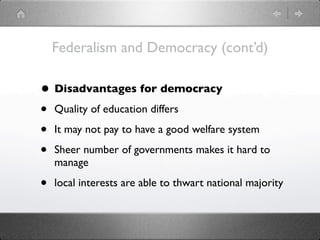
Federalism and Democracy (cont’d)

• Disadvantages for democracy
• Quality of education differs
• It may not pay to have a good welfare system
• Sheer number of governments makes it hard to
    manage

•   local interests are able to thwart national majority
Federalism & Scope of Government

•   Our founders: government got involved in
    industrializing the country

•   Protection against monopolies

•   Urbanization: union, minimum wage, education,
    housing, welfare all turn to national government

•   Why do people turn to national government
    instead of the state for curtain problems?
LEQ: Was the growth of the
national government at the
  expense of the states?

Unit 1.4

  • 1.
    Federalism Unit #1 Chapter 3 (p.p. 66-94) LEQ: Was the growth of the national government at the expense of the states?
  • 2.
    Defining Federalism • Federalism(68) • Unitary Government (68) • States receive power from Constitution, not national government • Confederation
  • 3.
    Why is Federalismso important? • Decentralizes our politics, i.e. electoral systems (states), layers of government, powerful judicial branch • States are (still powerful) responsible for most public policy, Constitution does not give national government power to deal with most social, family and moral issues
  • 4.
  • 5.
    The Basics • Whydid Federalism work for early Americans? • central government would not work alone • great distances between states and primitive transportation and communication devices in place
  • 6.
    The Division ofPower • Table 3.2 (72) • According to Constitution, how are states still a vital aspect of government? • In a dispute between state and national government, who prevails? • Tenth Amendment (73) • 1985 Garcia v San Antonio Metro
  • 7.
    Why has theFederal Government gained power relative to the states? (1/4) • Elaboration of Implied Powers • McCulloch v Maryland (74) • as long as national government follows constitution, national policies take precedence over state policies • Implied powers (74) go beyond enumerated powers (74) • “make all laws necessary and proper for carrying into execution...” • Necessary and proper clause/elastic clause (75) • as long as Congress uses national power for economic development through subsidies for business interests
  • 8.
    Why has theFederal Government gained power relative to the states? (2/4) • Commerce Clause • Gibbons v Ogden (75) • Supreme Court broadly interpreted Article I section VIII, giving Congress power to regulate interstate • One of national government strongest sources of power • Supreme Court wants to limit (Congress’) commerce power: • US v Lopez- guns in a school zone, State v Morrison- ’94 Violence Against Women Act, Printz v US & Mack v US- Brady Handgun Prevention Act
  • 9.
    Why has theFederal Government gained power relative to the states? (3/4) Civil War
  • 10.
    Why has theFederal Government gained power relative to the states? (4/4) • Racial Equality • Brown v Board of Ed
  • 11.
    Why has theFederal Government gained power relative to the states? National government is strong within its sphere, but the sphere for the sates remains a large and important one.
  • 12.
    Intergovernmental Relations • Duel Federalism (78) • Cooperative Federalism (78) • e.g. National Defense Education Act, federal aid to highways/schools • Table 3.3 • What are the procedures of cooperative federalism? • Trend: Reagan & ’90’s Republican Congress push closer to duel federalism, e.g. deficit reduction, states more say in social/ environmental welfare
  • 13.
    Intergovernmental Relations (cont’d) •Fiscal Federalism (82) • How does the national government influence states and localities?
  • 14.
    Grant System • Catalogue of Federal Domestic Assistance (83) • Categorical Grants (83) • direct orders are rare, exception discrimination/Equal Opportunity Act • Federal regulation accomplished indirectly, give states conditions • Project Grant (84) • Formula Grant (84) • Block Grant (84)
  • 15.
  • 16.
    Mandates • Mandates (85) •Problems? e.g. ’90 Americans with Disabilities Act or ’70 Clean Air Act • How did Congress fix this problem?
  • 17.
    Federalism and Democracy •Advantages for democracy in the federalism system: • policy making at state/local level • increases access to government: more opportunities to vote/run • diversity of opinion respected • one party doesn’t dominate everything
  • 18.
    Federalism and Democracy(cont’d) • Disadvantages for democracy • Quality of education differs • It may not pay to have a good welfare system • Sheer number of governments makes it hard to manage • local interests are able to thwart national majority
  • 19.
    Federalism & Scopeof Government • Our founders: government got involved in industrializing the country • Protection against monopolies • Urbanization: union, minimum wage, education, housing, welfare all turn to national government • Why do people turn to national government instead of the state for curtain problems?
  • 20.
    LEQ: Was thegrowth of the national government at the expense of the states?