UNINTENDED LEADERSHIP LESSONS
Christina M. Sax
Provost and Vice President for Academic & Student Affairs
Maryland University for Integrative Health
Twitter: @CMSax
Blog: saxchris.wordpress.com
SlideShare: slideshare.net/Csax
LinkedIn: linkedin.com/in/christinasax
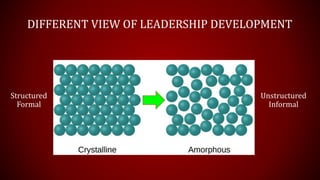
DIFFERENT VIEW OF LEADERSHIP DEVELOPMENT
Structured
Formal
Unstructured
Informal
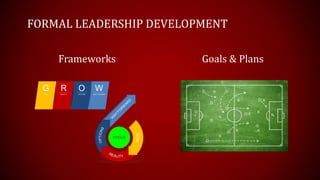
FORMAL LEADERSHIP DEVELOPMENT
Frameworks Goals & Plans
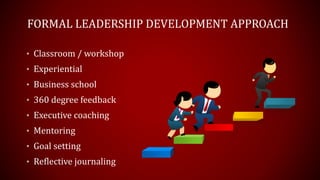
FORMAL LEADERSHIP DEVELOPMENT APPROACH
• Classroom / workshop
• Experiential
• Business school
• 360 degree feedback
• Executive coaching
• Mentoring
• Goal setting
• Reflective journaling
INFORMAL LEADERSHIP DEVELOPMENT
What can I learn everyday … in this particular experience?
• Knowledge, topic, content areas
• Skills, competencies
• Attributes, behaviors
• Process, workflow
• Decision making
• People, roles
• Culture
LOOKING BACK …
Five …
• Informal learning scenarios
• Unplanned development activities
• Keys to leadership success
UNINTENDED LEADERSHIP LESSONS
1. Personal mission statement
2. Know yourself
3. Depth, breadth, stretch
4. Fill organizational white space
5. Think like senior leadership
1. PERSONAL MISSION STATEMENT
PERSONAL MISSION STATEMENT
“Connecting with your own
unique purpose and the
profound satisfaction that
comes from fulfilling it”
Steven Covey, in First
Things First
“An articulation of what
you’re all about and what
success looks like to you”
Michael Goodman, in The
Potato Chip Difference
PERSONAL MISSION STATEMENT - PURPOSE
• Provides clarity
• Identifies what’s important
• Serves as a touchstone
• Guides decisions
• Illuminates purpose in daily activities
• Anchors during times of change
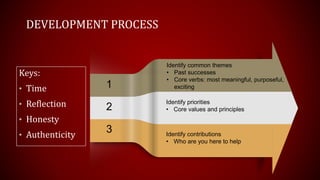
DEVELOPMENT PROCESS
1
2
3
Identify common themes
• Past successes
• Core verbs: most meaningful, purposeful,
exciting
Identify priorities
• Core values and principles
Identify contributions
• Who are you here to help
Keys:
• Time
• Reflection
• Honesty
• Authenticity
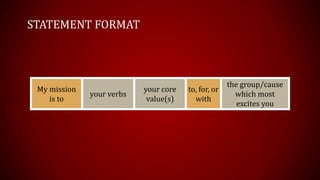
STATEMENT FORMAT
My mission
is to
your verbs
your core
value(s)
to, for, or
with
the group/cause
which most
excites you
2. KNOW YOURSELF
KNOW YOURSELF
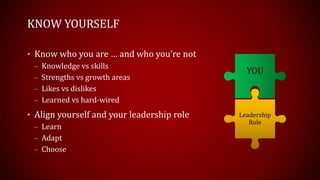
• Know who you are … and who you’re not
– Knowledge vs skills
– Strengths vs growth areas
– Likes vs dislikes
– Learned vs hard-wired
• Align yourself and your leadership role
– Learn
– Adapt
– Choose
YOU
Leadership
Role
ALIGNMENT
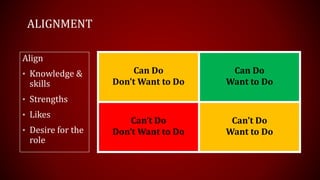
Can Do
Don’t Want to Do
Can Do
Want to Do
Can’t Do
Don’t Want to Do
Can’t Do
Want to Do
Align
• Knowledge &
skills
• Strengths
• Likes
• Desire for the
role
3. DEPTH, BREADTH, AND STRETCH
DEPTH, BREADTH, AND STRETCH
• Higher ed
– Complex and interconnected functions, perspectives, and problems
– Can no longer “just specialize”
• Learn and gain experience in many areas, related & far afield
– Identify who/functions to which you are connected (directly & indirectly)
• Experience
– Builds credibility
– Broadens opportunities in the future
ONLINE EDUCATION LEADERSHIP
• Online learning – design, pedagogy, learning science, assessment,
technology, teaching
• Students – audiences, services, support
• Faculty – audiences, services, support
• Curriculum & programs – design, development, structure,
function, purpose
• Enrollment management – recruiting, admissions, retention,
completion
• Administration, management, organization
• Finance, budgets, needs & cost/benefit analyses
• Collaboration, partnerships, relationship-building
ONLINE EDUCATION LEADERSHIP
• Leadership
• Strategic planning, critical thinking, creative problem solving,
integrative thinking
• Institutional culture & change management
• Marketing & communications – internal & external
• Technology – types, purposeful use, integration
• Risk management
• Higher ed benchmarking, best practices, breakthrough practices
• Higher ed policy, government relations
BALANCING OPPORTUNITIES
• “Have I got an opportunity for you!”
• Say yes … even if a partial yes
– Team player, extra mile
– Balance workload
– Still gain a new experience
• Know when to hand-off to others
– You’ve already mastered it
– Empower others
HOW TO DEVELOP …
• Attend to core business first, bright shiny objects second
• Choose manageable activities & carve out small amounts of time
• Tell others you’re looking for new learning opportunities
• Volunteer for committees
• Choose webinars on stretch topics (lots of free ones!)
• Join associations, step up for leadership roles
• Get on Twitter
– Research Finding: employees with diverse Twitter network that exposes them to
people & ideas they don’t already know tend to generate better ideas (Parise, S,
Whelan, E, Todd, S, How Twitter Users Can Generate Better Ideas, MIT Sloan
Management Review, June 1, 2015)
4. FILL ORGANIZATIONAL WHITE SPACE
FILL ORGANIZATIONAL WHITE SPACE
• One of nine impactful behaviors (Kelley, 1999)
• Individuals who practice these behaviors are:
– More highly valued and respected by colleagues and managers
– More sought out for
• Advice
• Information
• Recommendations
– Tapped for new projects and opportunities
Kelley, RE, How to Be a Star at Work: 9 Breakthrough Strategies You Need to Succeed,
Crown Business, 1999
KELLEY – NINE IMPACTFUL BEHAVIORS
1. Plug into those who know
2. Fill organizational white space
3. Manage Yourself
4. Learn others’ perspective
5. It’s not about you
6. Lead without the title
7. The “we” generation
8. Be organizationally intelligent
9. Target your message
Kelley, RE, How to Be a Star at Work: 9 Breakthrough Strategies You Need to Succeed,
Crown Business, 1999
FILL ORGANIZATIONAL WHITE SPACE
• Organizational whitespace: gaps between what is occurring and
what needs to occur
– What are the unmet needs?
– What questions remain unanswered?
– What work is sitting in the queue?
• Reveal themselves through:
– Daily problems
– Assessment & evaluation activities
– Program & institution self-reviews
Sax, CM, Cini, M, Becoming a Manager with Influence in Online Education: Behaviors to
Increase Your Impact, Distance Education Report, vol 16 no 4, Feb 15, 2012
FILL ORGANIZATIONAL WHITE SPACE
• Leaders with influence:
– Take note of the gaps (awareness)
– Access those aligned with expertise and skills of themselves and their
unit (credibility)
– Evaluate which they can realistically help to address (success)
– Step forward and offer to fill the white space (be noticed, contribute,
impact)
– Maximize institutional investment in you (value & perspective)
• Example Strategies
– Research & prepare best practices concept paper
– Form an interdisciplinary working group
– Pilot a new pedagogy or technology
5. THINK LIKE SENIOR LEADERSHIP
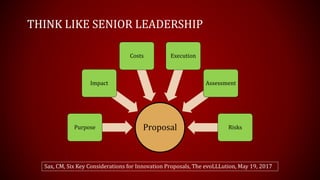
THINK LIKE SENIOR LEADERSHIP
ProposalPurpose
Impact
Costs Execution
Assessment
Risks
Sax, CM, Six Key Considerations for Innovation Proposals, The evoLLLution, May 19, 2017
• What is purpose, reason, goal of the project?
• What problem are you trying to solve?
• What change are you trying to affect?
• What advancement are you trying to achieve?
• Why would we want to do this?
• Why is this important, and to whom?
• What are the strategic, operational, moral imperatives?
• How does it align with unit/institutional strategic goals?
• What data/evidence demonstrates this as a priority?
PURPOSE
• What are direct/tangible & indirect/intangible benefits?
• Student access, success, retention, timely degree completion, gainful
employment
• Institutional effectiveness, efficiency, cost savings, revenue generation,
reputation, brand
• Internal community – faculty, staff, administrators, alumni
• External community & partnerships
• Accreditations
• What will be better known/understood as result of project?
• What are wider beneficial impacts beyond primary goals?
• What are potential unintended negative consequences?
IMPACT
COSTS
• What are direct/tangible and indirect/intangible
resources/costs?
• Dollars, human power, time and effort, access, collaborators, travel,
materials, equipment, space, technology, etc?
• Costs to perceptions, morale, reputation, awareness, and brand
• Can the goal be achieved another way?
• With less or shared resources?
• In less time with less effort or human power?
• Can project be added to, or an extension of, another project,
operation, or set of responsibilities?
EXECUTION
• What activities will be undertaken?
• How will results be disseminated, and used by others?
• Who will be involved in and impacted by the project?
• Planning, execution, assessment, sustainability, and outcomes
• Why is this the ideal unit/individual to do this project?
• Timeline for planning, launch, assessment/evaluation
• Why is now the best time to do this?
• When might we first begin to see the impact of the project?
• What else can’t we do if this proposal is funded?
• From what other activities will dollars, people, time, and effort be diverted to support this
proposal?
• Are project’s activities sustainable under proposed & likely future
conditions/levels of funding?
• Does project provide opportunity to explore creative, instructive, relevant,
adaptable, interoperable, or new models for other situations and problems?
• What data & research indicate project is needed, has validity, is
feasible, has reasonable chance of success?
• What other institutions/groups have already researched or
tried this? What was their experience? Why is this proposal
different/needed?
• What will success look like and how will we measure it?
• What are measures & indicators of success?
• Quantitative and qualitative aspects, direct and indirect indicators,
leading and lagging indicators, external benchmarks and internal targets.
Can we approximate qualitative success measures with quantitative
information?
ASSESSMENT
• Why do we think the project will succeed?
• What’s assessment and evaluation plan? Who is accountable
for the project?
• Are there interim milestones of success? Can they stand
alone & be sustained in absence of completion of the full
project?
• How and when will we know if the project is unsuccessful?
Are their opportunities for mid-course corrections and
adjustments? How should we proceed if the project is not
successful?
ASSESSMENT
Common Measures of Success
• KPI = key performance indicators
• ROI = return on investment
• ROV = return on value
• ROE = return on equity
• VOI = value on investment
ASSESSMENT
RISKS
• What are risks associated with approving proposal?
• Preventable and foreseeable, unpredictable and uncontrollable, internal and
external risks?
• Quality, strategic, operational, financial, compliance, brand, and reputational
risks?
• Appearances and perceptions, systemic and localized, organizational
effectiveness, morale, and governance risks?
• What is the overall level of risk – insignificant, low, moderate, high,
or extreme?
• How will we handle specific potential problems and scenarios?
• What are the potential risks and costs if we don’t approve and
pursue the project? For students, other members of the university
community, and the institution?
UNINTENDED LEADERSHIP LESSONS
1. Personal mission statement
2. Know yourself
3. Depth, breadth, stretch
4. Fill organizational white space
5. Think like senior leadership
WHERE WILL YOU FIND YOUR
UNINTENDED LEADERSHIP LESSONS ?
Have you already found some?

Unintended Leadership Lessons

  • 1.
    UNINTENDED LEADERSHIP LESSONS ChristinaM. Sax Provost and Vice President for Academic & Student Affairs Maryland University for Integrative Health Twitter: @CMSax Blog: saxchris.wordpress.com SlideShare: slideshare.net/Csax LinkedIn: linkedin.com/in/christinasax
  • 2.
    DIFFERENT VIEW OFLEADERSHIP DEVELOPMENT Structured Formal Unstructured Informal
  • 3.
  • 4.
    FORMAL LEADERSHIP DEVELOPMENTAPPROACH • Classroom / workshop • Experiential • Business school • 360 degree feedback • Executive coaching • Mentoring • Goal setting • Reflective journaling
  • 5.
    INFORMAL LEADERSHIP DEVELOPMENT Whatcan I learn everyday … in this particular experience? • Knowledge, topic, content areas • Skills, competencies • Attributes, behaviors • Process, workflow • Decision making • People, roles • Culture
  • 6.
    LOOKING BACK … Five… • Informal learning scenarios • Unplanned development activities • Keys to leadership success
  • 7.
    UNINTENDED LEADERSHIP LESSONS 1.Personal mission statement 2. Know yourself 3. Depth, breadth, stretch 4. Fill organizational white space 5. Think like senior leadership
  • 8.
  • 9.
    PERSONAL MISSION STATEMENT “Connectingwith your own unique purpose and the profound satisfaction that comes from fulfilling it” Steven Covey, in First Things First “An articulation of what you’re all about and what success looks like to you” Michael Goodman, in The Potato Chip Difference
  • 10.
    PERSONAL MISSION STATEMENT- PURPOSE • Provides clarity • Identifies what’s important • Serves as a touchstone • Guides decisions • Illuminates purpose in daily activities • Anchors during times of change
  • 11.
    DEVELOPMENT PROCESS 1 2 3 Identify commonthemes • Past successes • Core verbs: most meaningful, purposeful, exciting Identify priorities • Core values and principles Identify contributions • Who are you here to help Keys: • Time • Reflection • Honesty • Authenticity
  • 12.
    STATEMENT FORMAT My mission isto your verbs your core value(s) to, for, or with the group/cause which most excites you
  • 13.
  • 14.
    KNOW YOURSELF • Knowwho you are … and who you’re not – Knowledge vs skills – Strengths vs growth areas – Likes vs dislikes – Learned vs hard-wired • Align yourself and your leadership role – Learn – Adapt – Choose YOU Leadership Role
  • 15.
    ALIGNMENT Can Do Don’t Wantto Do Can Do Want to Do Can’t Do Don’t Want to Do Can’t Do Want to Do Align • Knowledge & skills • Strengths • Likes • Desire for the role
  • 16.
    3. DEPTH, BREADTH,AND STRETCH
  • 17.
    DEPTH, BREADTH, ANDSTRETCH • Higher ed – Complex and interconnected functions, perspectives, and problems – Can no longer “just specialize” • Learn and gain experience in many areas, related & far afield – Identify who/functions to which you are connected (directly & indirectly) • Experience – Builds credibility – Broadens opportunities in the future
  • 18.
    ONLINE EDUCATION LEADERSHIP •Online learning – design, pedagogy, learning science, assessment, technology, teaching • Students – audiences, services, support • Faculty – audiences, services, support • Curriculum & programs – design, development, structure, function, purpose • Enrollment management – recruiting, admissions, retention, completion • Administration, management, organization • Finance, budgets, needs & cost/benefit analyses • Collaboration, partnerships, relationship-building
  • 19.
    ONLINE EDUCATION LEADERSHIP •Leadership • Strategic planning, critical thinking, creative problem solving, integrative thinking • Institutional culture & change management • Marketing & communications – internal & external • Technology – types, purposeful use, integration • Risk management • Higher ed benchmarking, best practices, breakthrough practices • Higher ed policy, government relations
  • 20.
    BALANCING OPPORTUNITIES • “HaveI got an opportunity for you!” • Say yes … even if a partial yes – Team player, extra mile – Balance workload – Still gain a new experience • Know when to hand-off to others – You’ve already mastered it – Empower others
  • 21.
    HOW TO DEVELOP… • Attend to core business first, bright shiny objects second • Choose manageable activities & carve out small amounts of time • Tell others you’re looking for new learning opportunities • Volunteer for committees • Choose webinars on stretch topics (lots of free ones!) • Join associations, step up for leadership roles • Get on Twitter – Research Finding: employees with diverse Twitter network that exposes them to people & ideas they don’t already know tend to generate better ideas (Parise, S, Whelan, E, Todd, S, How Twitter Users Can Generate Better Ideas, MIT Sloan Management Review, June 1, 2015)
  • 22.
  • 23.
    FILL ORGANIZATIONAL WHITESPACE • One of nine impactful behaviors (Kelley, 1999) • Individuals who practice these behaviors are: – More highly valued and respected by colleagues and managers – More sought out for • Advice • Information • Recommendations – Tapped for new projects and opportunities Kelley, RE, How to Be a Star at Work: 9 Breakthrough Strategies You Need to Succeed, Crown Business, 1999
  • 24.
    KELLEY – NINEIMPACTFUL BEHAVIORS 1. Plug into those who know 2. Fill organizational white space 3. Manage Yourself 4. Learn others’ perspective 5. It’s not about you 6. Lead without the title 7. The “we” generation 8. Be organizationally intelligent 9. Target your message Kelley, RE, How to Be a Star at Work: 9 Breakthrough Strategies You Need to Succeed, Crown Business, 1999
  • 25.
    FILL ORGANIZATIONAL WHITESPACE • Organizational whitespace: gaps between what is occurring and what needs to occur – What are the unmet needs? – What questions remain unanswered? – What work is sitting in the queue? • Reveal themselves through: – Daily problems – Assessment & evaluation activities – Program & institution self-reviews Sax, CM, Cini, M, Becoming a Manager with Influence in Online Education: Behaviors to Increase Your Impact, Distance Education Report, vol 16 no 4, Feb 15, 2012
  • 26.
    FILL ORGANIZATIONAL WHITESPACE • Leaders with influence: – Take note of the gaps (awareness) – Access those aligned with expertise and skills of themselves and their unit (credibility) – Evaluate which they can realistically help to address (success) – Step forward and offer to fill the white space (be noticed, contribute, impact) – Maximize institutional investment in you (value & perspective) • Example Strategies – Research & prepare best practices concept paper – Form an interdisciplinary working group – Pilot a new pedagogy or technology
  • 27.
    5. THINK LIKESENIOR LEADERSHIP
  • 28.
    THINK LIKE SENIORLEADERSHIP ProposalPurpose Impact Costs Execution Assessment Risks Sax, CM, Six Key Considerations for Innovation Proposals, The evoLLLution, May 19, 2017
  • 29.
    • What ispurpose, reason, goal of the project? • What problem are you trying to solve? • What change are you trying to affect? • What advancement are you trying to achieve? • Why would we want to do this? • Why is this important, and to whom? • What are the strategic, operational, moral imperatives? • How does it align with unit/institutional strategic goals? • What data/evidence demonstrates this as a priority? PURPOSE
  • 30.
    • What aredirect/tangible & indirect/intangible benefits? • Student access, success, retention, timely degree completion, gainful employment • Institutional effectiveness, efficiency, cost savings, revenue generation, reputation, brand • Internal community – faculty, staff, administrators, alumni • External community & partnerships • Accreditations • What will be better known/understood as result of project? • What are wider beneficial impacts beyond primary goals? • What are potential unintended negative consequences? IMPACT
  • 31.
    COSTS • What aredirect/tangible and indirect/intangible resources/costs? • Dollars, human power, time and effort, access, collaborators, travel, materials, equipment, space, technology, etc? • Costs to perceptions, morale, reputation, awareness, and brand • Can the goal be achieved another way? • With less or shared resources? • In less time with less effort or human power? • Can project be added to, or an extension of, another project, operation, or set of responsibilities?
  • 32.
    EXECUTION • What activitieswill be undertaken? • How will results be disseminated, and used by others? • Who will be involved in and impacted by the project? • Planning, execution, assessment, sustainability, and outcomes • Why is this the ideal unit/individual to do this project? • Timeline for planning, launch, assessment/evaluation • Why is now the best time to do this? • When might we first begin to see the impact of the project? • What else can’t we do if this proposal is funded? • From what other activities will dollars, people, time, and effort be diverted to support this proposal? • Are project’s activities sustainable under proposed & likely future conditions/levels of funding? • Does project provide opportunity to explore creative, instructive, relevant, adaptable, interoperable, or new models for other situations and problems?
  • 33.
    • What data& research indicate project is needed, has validity, is feasible, has reasonable chance of success? • What other institutions/groups have already researched or tried this? What was their experience? Why is this proposal different/needed? • What will success look like and how will we measure it? • What are measures & indicators of success? • Quantitative and qualitative aspects, direct and indirect indicators, leading and lagging indicators, external benchmarks and internal targets. Can we approximate qualitative success measures with quantitative information? ASSESSMENT
  • 34.
    • Why dowe think the project will succeed? • What’s assessment and evaluation plan? Who is accountable for the project? • Are there interim milestones of success? Can they stand alone & be sustained in absence of completion of the full project? • How and when will we know if the project is unsuccessful? Are their opportunities for mid-course corrections and adjustments? How should we proceed if the project is not successful? ASSESSMENT
  • 35.
    Common Measures ofSuccess • KPI = key performance indicators • ROI = return on investment • ROV = return on value • ROE = return on equity • VOI = value on investment ASSESSMENT
  • 36.
    RISKS • What arerisks associated with approving proposal? • Preventable and foreseeable, unpredictable and uncontrollable, internal and external risks? • Quality, strategic, operational, financial, compliance, brand, and reputational risks? • Appearances and perceptions, systemic and localized, organizational effectiveness, morale, and governance risks? • What is the overall level of risk – insignificant, low, moderate, high, or extreme? • How will we handle specific potential problems and scenarios? • What are the potential risks and costs if we don’t approve and pursue the project? For students, other members of the university community, and the institution?
  • 37.
    UNINTENDED LEADERSHIP LESSONS 1.Personal mission statement 2. Know yourself 3. Depth, breadth, stretch 4. Fill organizational white space 5. Think like senior leadership
  • 38.
    WHERE WILL YOUFIND YOUR UNINTENDED LEADERSHIP LESSONS ? Have you already found some?