The Higher Ed Canvas:
Connecting Challenges and Tools
Christina M. Sax
Provost and Vice President for Academic Affairs
Keynote Presentation, Canvas MAGIC Conference
Mid-Atlantic Group Instructing with Canvas
April 7, 2017
@CMSax
#CanvasMagic
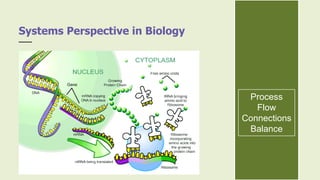
Systems Perspective in Biology
Process
Flow
Connections
Balance
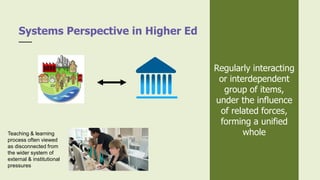
Systems Perspective in Higher Ed
Regularly interacting
or interdependent
group of items,
under the influence
of related forces,
forming a unified
wholeTeaching & learning
process often viewed
as disconnected from
the wider system of
external & institutional
pressures
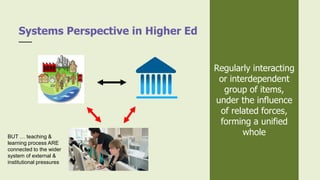
Systems Perspective in Higher Ed
Regularly interacting
or interdependent
group of items,
under the influence
of related forces,
forming a unified
wholeBUT … teaching &
learning process ARE
connected to the wider
system of external &
institutional pressures
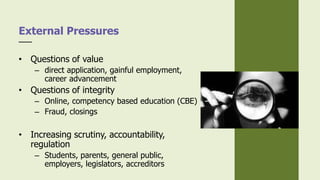
• Questions of value
– direct application, gainful employment,
career advancement
• Questions of integrity
– Online, competency based education (CBE)
– Fraud, closings
• Increasing scrutiny, accountability,
regulation
– Students, parents, general public,
employers, legislators, accreditors
External Pressures
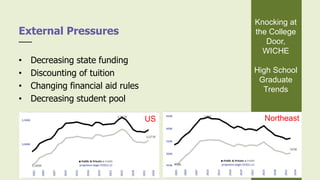
• Decreasing state funding
• Discounting of tuition
• Changing financial aid rules
• Decreasing student pool
External Pressures
Knocking at
the College
Door,
WICHE
High School
Graduate
Trends
US Northeast
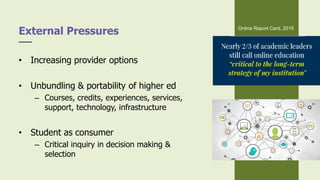
• Increasing provider options
• Unbundling & portability of higher ed
– Courses, credits, experiences, services,
support, technology, infrastructure
• Student as consumer
– Critical inquiry in decision making &
selection
External Pressures Online Report Card, 2015
• Increasing competition
– Students
– Faculty
– Staff & admin talent
• Unstable enrollments
• Unstable revenue & funding
• Increasing time, effort, costs
• Decreasing sustainability of traditional
higher ed structures and financial models
Resulting Internal Pressures
Increasing focus on …
• Retention
• Time to degree completion
• Learning outcomes
• Skills/competencies
• Assessment & accreditation
• Flexibility & personalization
• Competitive advantage
Resulting Internal Pressures
Other challenges
&
pressure points
Is this the culture at your
institution?
ENROLLMENT MANAGEMENT
is everybody’s job.
RETENTION is everybody’s job.
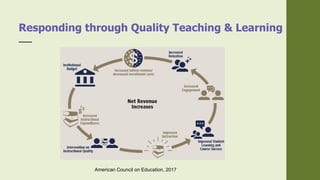
Responding through Quality Teaching & Learning
American Council on Education, 2017
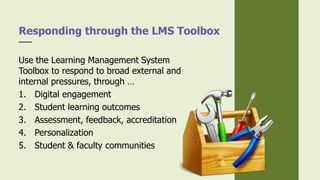
Use the Learning Management System
Toolbox to respond to broad external and
internal pressures, through …
1. Digital engagement
2. Student learning outcomes
3. Assessment, feedback, accreditation
4. Personalization
5. Student & faculty communities
Responding through the LMS Toolbox
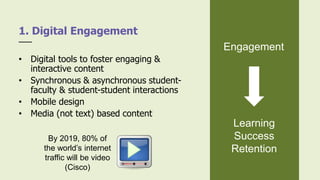
• Digital tools to foster engaging &
interactive content
• Synchronous & asynchronous student-
faculty & student-student interactions
• Mobile design
• Media (not text) based content
1. Digital Engagement
Engagement
Learning
Success
Retention
By 2019, 80% of
the world’s internet
traffic will be video
(Cisco)
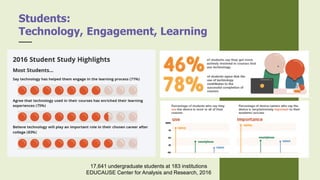
Students:
Technology, Engagement, Learning
17,641 undergraduate students at 183 institutions
EDUCAUSE Center for Analysis and Research, 2016
• Ready made templates, scaffolding, integration
create cohesive learning experience:
– Syllabus
– Objectives
– Low stakes practice/self-check
– Assignments
– Assessments
• Authentic assessment of skills & competencies
• Collaborative learning
• Online & hybrid/blended learning
– Flexibility for different needs & learning styles
2. Enhancing Student Learning Outcomes
Students report higher levels
of engagement and learning
at institutions where faculty
members use active and
collaborative learning
techniques, interact with
students, and emphasize
higher-order cognitive
activities. (American Council
on Education, 2017)
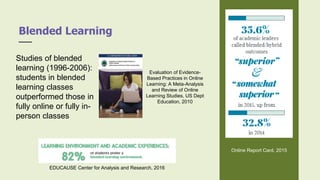
Blended Learning
Studies of blended
learning (1996-2006):
students in blended
learning classes
outperformed those in
fully online or fully in-
person classes
Online Report Card, 2015
Evaluation of Evidence-
Based Practices in Online
Learning: A Meta-Analysis
and Review of Online
Learning Studies, US Dept
Education, 2010
EDUCAUSE Center for Analysis and Research, 2016
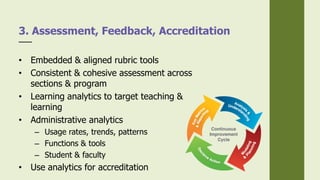
• Embedded & aligned rubric tools
• Consistent & cohesive assessment across
sections & program
• Learning analytics to target teaching &
learning
• Administrative analytics
– Usage rates, trends, patterns
– Functions & tools
– Student & faculty
• Use analytics for accreditation
3. Assessment, Feedback, Accreditation
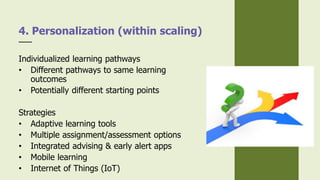
Individualized learning pathways
• Different pathways to same learning
outcomes
• Potentially different starting points
Strategies
• Adaptive learning tools
• Multiple assignment/assessment options
• Integrated advising & early alert apps
• Mobile learning
• Internet of Things (IoT)
4. Personalization (within scaling)
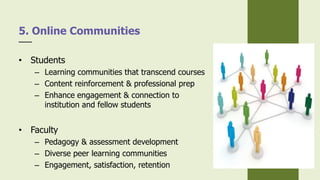
• Students
– Learning communities that transcend courses
– Content reinforcement & professional prep
– Enhance engagement & connection to
institution and fellow students
• Faculty
– Pedagogy & assessment development
– Diverse peer learning communities
– Engagement, satisfaction, retention
5. Online Communities
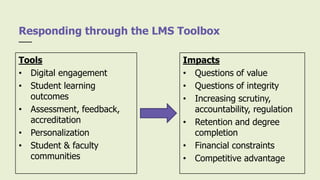
Tools
• Digital engagement
• Student learning
outcomes
• Assessment, feedback,
accreditation
• Personalization
• Student & faculty
communities
Responding through the LMS Toolbox
Impacts
• Questions of value
• Questions of integrity
• Increasing scrutiny,
accountability, regulation
• Retention and degree
completion
• Financial constraints
• Competitive advantage
Other teaching &
learning strategies
that can address overarching
higher ed challenges
Rising to the Challenge
The world is but a canvas
to the imagination.
- Henry David Thoreau
Challenges
• WICHE, Knocking at the Door: Projections of High School Graduates
Through 2032, Dec 2016, http://knocking.wiche.edu
• 2015 Online Report Card: Tracking Online Education in the United
States, Babson Survey Research Group,
https://onlinelearningconsortium.org/read/online-report-card-
tracking-online-education-united-states-2015
• Instructional Quality, Student Outcomes, and Institutional Finances,
American Council on Education, 2017,
http://www.acenet.edu/news-room/Pages/Instructional-Quality-
Student-Outcomes-and-Institutional-Finances.aspx
References – 1
• Cisco Visual Networking Index, 2015,
https://newsroom.cisco.com/press-release-
content?articleId=1644203
• Technology Research in the Academic Community, EDUCAUSE
Center for Analysis and Research, 2016,
https://www.educause.edu/ecar/technology-research-academic-
community-legacy
• Evaluation of Evidence-Based Practices in Online Learning: A Meta-
Analysis and Review of Online Learning Studies, US Department of
Education, 2010, www2.ed.gov/rschstat/eval/tech/evidence-based-
practices/finalreport.pdf
References – 2
Chris Sax
Provost & VP Academic Affairs
Maryland University of Integrative Health
CSAX@MUIH.EDU
Questions & Contact Info

The Higher Ed Canvas: Connecting Challenges and Tools

  • 1.
    The Higher EdCanvas: Connecting Challenges and Tools Christina M. Sax Provost and Vice President for Academic Affairs Keynote Presentation, Canvas MAGIC Conference Mid-Atlantic Group Instructing with Canvas April 7, 2017 @CMSax #CanvasMagic
  • 2.
    Systems Perspective inBiology Process Flow Connections Balance
  • 3.
    Systems Perspective inHigher Ed Regularly interacting or interdependent group of items, under the influence of related forces, forming a unified wholeTeaching & learning process often viewed as disconnected from the wider system of external & institutional pressures
  • 4.
    Systems Perspective inHigher Ed Regularly interacting or interdependent group of items, under the influence of related forces, forming a unified wholeBUT … teaching & learning process ARE connected to the wider system of external & institutional pressures
  • 5.
    • Questions ofvalue – direct application, gainful employment, career advancement • Questions of integrity – Online, competency based education (CBE) – Fraud, closings • Increasing scrutiny, accountability, regulation – Students, parents, general public, employers, legislators, accreditors External Pressures
  • 6.
    • Decreasing statefunding • Discounting of tuition • Changing financial aid rules • Decreasing student pool External Pressures Knocking at the College Door, WICHE High School Graduate Trends US Northeast
  • 7.
    • Increasing provideroptions • Unbundling & portability of higher ed – Courses, credits, experiences, services, support, technology, infrastructure • Student as consumer – Critical inquiry in decision making & selection External Pressures Online Report Card, 2015
  • 8.
    • Increasing competition –Students – Faculty – Staff & admin talent • Unstable enrollments • Unstable revenue & funding • Increasing time, effort, costs • Decreasing sustainability of traditional higher ed structures and financial models Resulting Internal Pressures
  • 9.
    Increasing focus on… • Retention • Time to degree completion • Learning outcomes • Skills/competencies • Assessment & accreditation • Flexibility & personalization • Competitive advantage Resulting Internal Pressures
  • 10.
  • 11.
    Is this theculture at your institution? ENROLLMENT MANAGEMENT is everybody’s job. RETENTION is everybody’s job.
  • 12.
    Responding through QualityTeaching & Learning American Council on Education, 2017
  • 13.
    Use the LearningManagement System Toolbox to respond to broad external and internal pressures, through … 1. Digital engagement 2. Student learning outcomes 3. Assessment, feedback, accreditation 4. Personalization 5. Student & faculty communities Responding through the LMS Toolbox
  • 14.
    • Digital toolsto foster engaging & interactive content • Synchronous & asynchronous student- faculty & student-student interactions • Mobile design • Media (not text) based content 1. Digital Engagement Engagement Learning Success Retention By 2019, 80% of the world’s internet traffic will be video (Cisco)
  • 15.
    Students: Technology, Engagement, Learning 17,641undergraduate students at 183 institutions EDUCAUSE Center for Analysis and Research, 2016
  • 16.
    • Ready madetemplates, scaffolding, integration create cohesive learning experience: – Syllabus – Objectives – Low stakes practice/self-check – Assignments – Assessments • Authentic assessment of skills & competencies • Collaborative learning • Online & hybrid/blended learning – Flexibility for different needs & learning styles 2. Enhancing Student Learning Outcomes Students report higher levels of engagement and learning at institutions where faculty members use active and collaborative learning techniques, interact with students, and emphasize higher-order cognitive activities. (American Council on Education, 2017)
  • 17.
    Blended Learning Studies ofblended learning (1996-2006): students in blended learning classes outperformed those in fully online or fully in- person classes Online Report Card, 2015 Evaluation of Evidence- Based Practices in Online Learning: A Meta-Analysis and Review of Online Learning Studies, US Dept Education, 2010 EDUCAUSE Center for Analysis and Research, 2016
  • 18.
    • Embedded &aligned rubric tools • Consistent & cohesive assessment across sections & program • Learning analytics to target teaching & learning • Administrative analytics – Usage rates, trends, patterns – Functions & tools – Student & faculty • Use analytics for accreditation 3. Assessment, Feedback, Accreditation
  • 19.
    Individualized learning pathways •Different pathways to same learning outcomes • Potentially different starting points Strategies • Adaptive learning tools • Multiple assignment/assessment options • Integrated advising & early alert apps • Mobile learning • Internet of Things (IoT) 4. Personalization (within scaling)
  • 20.
    • Students – Learningcommunities that transcend courses – Content reinforcement & professional prep – Enhance engagement & connection to institution and fellow students • Faculty – Pedagogy & assessment development – Diverse peer learning communities – Engagement, satisfaction, retention 5. Online Communities
  • 21.
    Tools • Digital engagement •Student learning outcomes • Assessment, feedback, accreditation • Personalization • Student & faculty communities Responding through the LMS Toolbox Impacts • Questions of value • Questions of integrity • Increasing scrutiny, accountability, regulation • Retention and degree completion • Financial constraints • Competitive advantage
  • 22.
    Other teaching & learningstrategies that can address overarching higher ed challenges
  • 23.
    Rising to theChallenge The world is but a canvas to the imagination. - Henry David Thoreau Challenges
  • 24.
    • WICHE, Knockingat the Door: Projections of High School Graduates Through 2032, Dec 2016, http://knocking.wiche.edu • 2015 Online Report Card: Tracking Online Education in the United States, Babson Survey Research Group, https://onlinelearningconsortium.org/read/online-report-card- tracking-online-education-united-states-2015 • Instructional Quality, Student Outcomes, and Institutional Finances, American Council on Education, 2017, http://www.acenet.edu/news-room/Pages/Instructional-Quality- Student-Outcomes-and-Institutional-Finances.aspx References – 1
  • 25.
    • Cisco VisualNetworking Index, 2015, https://newsroom.cisco.com/press-release- content?articleId=1644203 • Technology Research in the Academic Community, EDUCAUSE Center for Analysis and Research, 2016, https://www.educause.edu/ecar/technology-research-academic- community-legacy • Evaluation of Evidence-Based Practices in Online Learning: A Meta- Analysis and Review of Online Learning Studies, US Department of Education, 2010, www2.ed.gov/rschstat/eval/tech/evidence-based- practices/finalreport.pdf References – 2
  • 26.
    Chris Sax Provost &VP Academic Affairs Maryland University of Integrative Health CSAX@MUIH.EDU Questions & Contact Info