Who Are
 You?
Who?
                   Who?
      Who?
                  Who?

Claire Childress and Sarah Crockett
DSA Professional Development Day
      September 20, 2011
If you don’t understand
   yourself you don’t
understand anybody else.

          --Nikki Giovanni
DSA Aspiration

Pursue SELF-UNDERSTANDING and INTEGRITY

      Virginia Tech students will form
  a set of affirmative values and develop
 the self-understanding to integrate these
     values into their decision-making.
Self-Understanding
       and
  Career Services
How Can Career Services Help?
   • Exploring Careers and Majors
     –   Walk-in Advising
     –   Appointments
     –   UNIV 2004 Course
     –   Departmental Career Advisors
     –   Career Resource Center
     –   Extensive Online Resources

   • Gaining Experience
     – Cooperative Education / Internship Program

   • Self-Assessment
     – Online and Written
MyPlan Assessment
• Online Career Planning Program
   – Allows students to review careers and majors

• Results show preferences in four areas
   –   Personality
   –   Interests
   –   Skills
   –   Values
Strengths
Who Are You?
StrengthsQuest Talents
• A special natural ability or aptitude

• A capacity for achievement or success; ability

• A naturally recurring pattern of thought, feeling,
  or behavior that can be productively applied
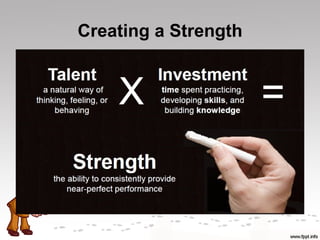
Creating a Strength
Values
Who Are You?
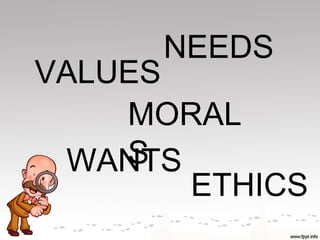
NEEDS
VALUES
    MORAL
    S
 WANTS
       ETHICS
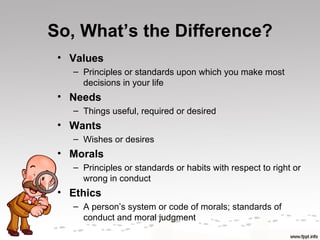
So, What’s the Difference?
 • Values
   – Principles or standards upon which you make most
     decisions in your life
 • Needs
   – Things useful, required or desired
 • Wants
   – Wishes or desires
 • Morals
   – Principles or standards or habits with respect to right or
     wrong in conduct
 • Ethics
   – A person’s system or code of morals; standards of
     conduct and moral judgment
Values Defined

  Deeply held commitments that
influence your thinking when you
      are faced with choices.
Values in Career Development
  • Few people really know what they want in life
    because they have never really taken the time
    and effort to determine what matters in their lives

  • To determine what you want, you must first know
    what is important to you in your life
     – The values that give your life meaning!

  • You will need to discover your hidden values
Where Do Your Values
     Come From?
• From YOU!!
   – People choose and formulate their values as they
     direct their lives

• From parents, family, friends, religious beliefs,
  community influence
• Can be seen in everyday actions and how you
  make your decisions

• You may not always be aware of them
Criteria for Values
• Prizing: emphasizing emotions and feelings

• Choosing: relies on thinking and reasoning

• Acting: implies behavior


       Basically we form our values
      by feeling, thoughts and actions
Values Clarification
 How Do Your Personal and Work
   Values Relate to Strengths
Instructions
  • On the orange sheet:
     – Check off all the values that you feel the most strongly
       about and from your selection choose your top five
  • Compare the top five you just chose with your
    MyPlan work values
  • Select your top five from both sets of values and
    write them on the green bull's-eye sheet
  • Review your top five strengths and consider how
    any of them relate to your values
  • Share your thoughts with a partner or small
    group
Interests
Who Are You?
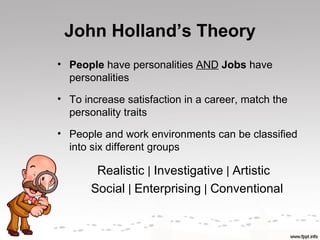
John Holland’s Theory
• People have personalities AND Jobs have
  personalities
• To increase satisfaction in a career, match the
  personality traits
• People and work environments can be classified
  into six different groups

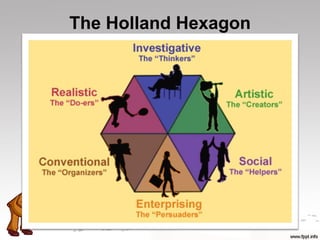
        Realistic | Investigative | Artistic
       Social | Enterprising | Conventional
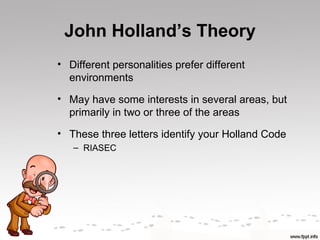
John Holland’s Theory
• Different personalities prefer different
  environments
• May have some interests in several areas, but
  primarily in two or three of the areas
• These three letters identify your Holland Code
   – RIASEC
The Holland Hexagon
Code Breakers
    Become More Familiar with
Interest Areas and How They Can
        Relate to Strengths
Personality
Who Are You?
Student Perspective
Self-Understanding and Integrity
Who Are You?
   Who? Who?
       Who?         Who?


 Questions?
 Claire Childress, childrec@vt.edu
 Sarah Crockett, sarahec@vt.edu
 Smith Career Center
 540-231-6241

DSAPresentation-Fall2011

  • 1.
    Who Are You? Who? Who? Who? Who? Claire Childress and Sarah Crockett DSA Professional Development Day September 20, 2011
  • 2.
    If you don’tunderstand yourself you don’t understand anybody else. --Nikki Giovanni
  • 3.
    DSA Aspiration Pursue SELF-UNDERSTANDINGand INTEGRITY Virginia Tech students will form a set of affirmative values and develop the self-understanding to integrate these values into their decision-making.
  • 4.
    Self-Understanding and Career Services
  • 5.
    How Can CareerServices Help? • Exploring Careers and Majors – Walk-in Advising – Appointments – UNIV 2004 Course – Departmental Career Advisors – Career Resource Center – Extensive Online Resources • Gaining Experience – Cooperative Education / Internship Program • Self-Assessment – Online and Written
  • 6.
    MyPlan Assessment • OnlineCareer Planning Program – Allows students to review careers and majors • Results show preferences in four areas – Personality – Interests – Skills – Values
  • 7.
  • 8.
    StrengthsQuest Talents • Aspecial natural ability or aptitude • A capacity for achievement or success; ability • A naturally recurring pattern of thought, feeling, or behavior that can be productively applied
  • 9.
  • 10.
  • 11.
    NEEDS VALUES MORAL S WANTS ETHICS
  • 12.
    So, What’s theDifference? • Values – Principles or standards upon which you make most decisions in your life • Needs – Things useful, required or desired • Wants – Wishes or desires • Morals – Principles or standards or habits with respect to right or wrong in conduct • Ethics – A person’s system or code of morals; standards of conduct and moral judgment
  • 13.
    Values Defined Deeply held commitments that influence your thinking when you are faced with choices.
  • 14.
    Values in CareerDevelopment • Few people really know what they want in life because they have never really taken the time and effort to determine what matters in their lives • To determine what you want, you must first know what is important to you in your life – The values that give your life meaning! • You will need to discover your hidden values
  • 15.
    Where Do YourValues Come From? • From YOU!! – People choose and formulate their values as they direct their lives • From parents, family, friends, religious beliefs, community influence • Can be seen in everyday actions and how you make your decisions • You may not always be aware of them
  • 16.
    Criteria for Values •Prizing: emphasizing emotions and feelings • Choosing: relies on thinking and reasoning • Acting: implies behavior Basically we form our values by feeling, thoughts and actions
  • 17.
    Values Clarification HowDo Your Personal and Work Values Relate to Strengths
  • 18.
    Instructions •On the orange sheet: – Check off all the values that you feel the most strongly about and from your selection choose your top five • Compare the top five you just chose with your MyPlan work values • Select your top five from both sets of values and write them on the green bull's-eye sheet • Review your top five strengths and consider how any of them relate to your values • Share your thoughts with a partner or small group
  • 19.
  • 20.
    John Holland’s Theory •People have personalities AND Jobs have personalities • To increase satisfaction in a career, match the personality traits • People and work environments can be classified into six different groups Realistic | Investigative | Artistic Social | Enterprising | Conventional
  • 21.
    John Holland’s Theory •Different personalities prefer different environments • May have some interests in several areas, but primarily in two or three of the areas • These three letters identify your Holland Code – RIASEC
  • 22.
  • 23.
    Code Breakers Become More Familiar with Interest Areas and How They Can Relate to Strengths
  • 24.
  • 25.
  • 27.
    Who Are You? Who? Who? Who? Who? Questions? Claire Childress, childrec@vt.edu Sarah Crockett, sarahec@vt.edu Smith Career Center 540-231-6241

Editor's Notes

  • #2 http://www.youtube.com/watch?v=PdLIerfXuZ4
  • #4 Both
  • #5 Sarah
  • #8 Claire
  • #11 Sarah
  • #15 Claire
  • #17 Prized and cherished Publicly affirmed Chosen freely Chosen from alternatives Chosen after consideration of consequences Acted upon Acted upon repeatedly and consistently to form a definite pattern
  • #19 Both
  • #21 Sarah
  • #25 Claire
  • #26 Claire