Copyright © President & Fellows of Harvard College
Developing Your Social Enterprise Pitch Deck
Margot Dushin, HBS Social Enterprise Initiative
Stephanie Dodson Cornell, Draper Richards Kaplan Foundation
February 11, 2020
Start with definitions
• Entrepreneurship – The pursuit of opportunity regardless of the resources
you currently control
• Social entrepreneurship – The pursuit of an opportunity to create pattern-
breaking social change regardless of the resources you currently control
(Whether non-profit, for-profit, or public sector)
2
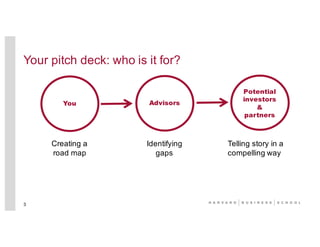
Your pitch deck: who is it for?
3
You Advisors
Potential
investors
&
partners
Telling story in a
compelling way
Identifying
gaps
Creating a
road map
Developing your pitch deck
Defining your approach
• The problem and the opportunity
• Competitive Landscape
• Mission
• Tying the vision to action: Theory of change & your solution
What you have to get right early on to succeed *
• Measurement and evaluation
• Leadership: team and board
• Revenue model
• Messaging/communications
* DRK focus areas with early stage organizations
4
DEFINING YOUR APPROACH
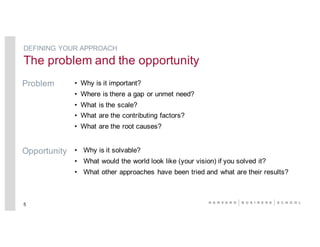
The problem and the opportunity
• Why is it important?
• Where is there a gap or unmet need?
• What is the scale?
• What are the contributing factors?
• What are the root causes?
• Why is it solvable?
• What would the world look like (your vision) if you solved it?
• What other approaches have been tried and what are their results?
5
Problem
Opportunity
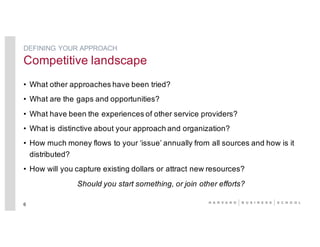
• What other approaches have been tried?
• What are the gaps and opportunities?
• What have been the experiences of other service providers?
• What is distinctive about your approach and organization?
• How much money flows to your ‘issue’ annually from all sources and how is it
distributed?
• How will you capture existing dollars or attract new resources?
Should you start something, or join other efforts?
6
DEFINING YOUR APPROACH
Competitive landscape
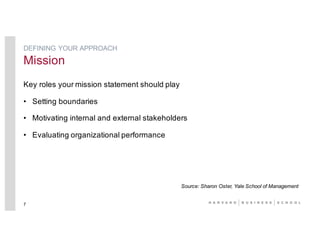
Key roles your mission statement should play
• Setting boundaries
• Motivating internal and external stakeholders
• Evaluating organizational performance
Source: Sharon Oster, Yale School of Management
7
DEFINING YOUR APPROACH
Mission
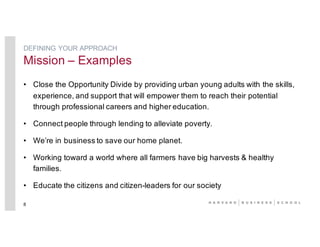
• Close the Opportunity Divide by providing urban young adults with the skills,
experience, and support that will empower them to reach their potential
through professional careers and higher education.
• Connect people through lending to alleviate poverty.
• We’re in business to save our home planet.
• Working toward a world where all farmers have big harvests & healthy
families.
• Educate the citizens and citizen-leaders for our society
8
DEFINING YOUR APPROACH
Mission – Examples
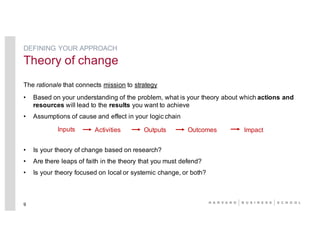
The rationale that connects mission to strategy
• Based on your understanding of the problem, what is your theory about which actions and
resources will lead to the results you want to achieve
• Assumptions of cause and effect in your logic chain
• Is your theory of change based on research?
• Are there leaps of faith in the theory that you must defend?
• Is your theory focused on local or systemic change, or both?
9
DEFINING YOUR APPROACH
Theory of change
Inputs Activities Outputs Outcomes Impact
DEFINING YOUR APPROACH
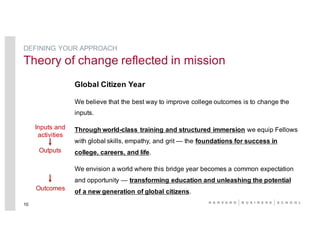
Theory of change reflected in mission
Global Citizen Year
We believe that the best way to improve college outcomes is to change the
inputs.
Through world-class training and structured immersion we equip Fellows
with global skills, empathy, and grit — the foundations for success in
college, careers, and life.
We envision a world where this bridge year becomes a common expectation
and opportunity — transforming education and unleashing the potential
of a new generation of global citizens.
10
Inputs and
activities
Outputs
Outcomes
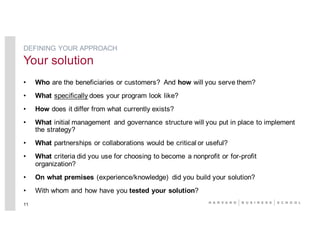
• Who are the beneficiaries or customers? And how will you serve them?
• What specifically does your program look like?
• How does it differ from what currently exists?
• What initial management and governance structure will you put in place to implement
the strategy?
• What partnerships or collaborations would be critical or useful?
• What criteria did you use for choosing to become a nonprofit or for-profit
organization?
• On what premises (experience/knowledge) did you build your solution?
• With whom and how have you tested your solution?
11
DEFINING YOUR APPROACH
Your solution
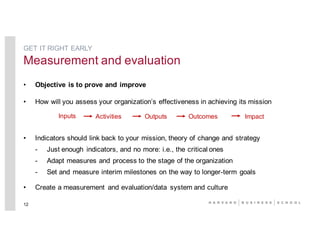
• Objective is to prove and improve
• How will you assess your organization’s effectiveness in achieving its mission
• Indicators should link back to your mission, theory of change and strategy
- Just enough indicators, and no more: i.e., the critical ones
- Adapt measures and process to the stage of the organization
- Set and measure interim milestones on the way to longer-term goals
• Create a measurement and evaluation/data system and culture
12
GET IT RIGHT EARLY
Measurement and evaluation
Inputs Activities Outputs Outcomes Impact
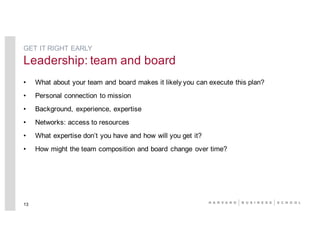
• What about your team and board makes it likely you can execute this plan?
• Personal connection to mission
• Background, experience, expertise
• Networks: access to resources
• What expertise don’t you have and how will you get it?
• How might the team composition and board change over time?
13
GET IT RIGHT EARLY
Leadership: team and board
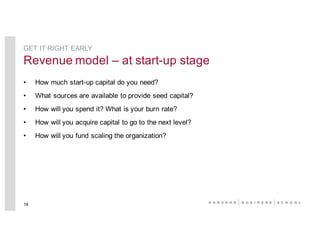
• How much start-up capital do you need?
• What sources are available to provide seed capital?
• How will you spend it? What is your burn rate?
• How will you acquire capital to go to the next level?
• How will you fund scaling the organization?
14
GET IT RIGHT EARLY
Revenue model – at start-up stage
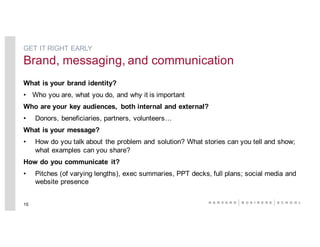
What is your brand identity?
• Who you are, what you do, and why it is important
Who are your key audiences, both internal and external?
• Donors, beneficiaries, partners, volunteers…
What is your message?
• How do you talk about the problem and solution? What stories can you tell and show;
what examples can you share?
How do you communicate it?
• Pitches (of varying lengths), exec summaries, PPT decks, full plans; social media and
website presence
15
GET IT RIGHT EARLY
Brand, messaging, and communication
Feb 19: Testing Your Social Venture: Iterating Based on Market Feedback
HBS New Venture Competition
Feb 26, 12:00 noon: Final entry deadline and exec summaries due
www.hbs.edu/nvc
16
WHAT’S NEXT?
Upcoming events and deadlines
Defining your approach [3 min individual work; 4 min presenting/feedback each]
• Mission
• Theory of change
Get it right early [4 min presenting/feedback each]
Choose an area where you would like feedback
• Leadership
• Measurement and evaluation
• Revenue model
• Messaging/communications
17
WHAT’S NEXT?
Opportunity for feedback

Developing Your SE Pitch Deck Feb 2020.pdf

  • 1.
    Copyright © President& Fellows of Harvard College Developing Your Social Enterprise Pitch Deck Margot Dushin, HBS Social Enterprise Initiative Stephanie Dodson Cornell, Draper Richards Kaplan Foundation February 11, 2020
  • 2.
    Start with definitions •Entrepreneurship – The pursuit of opportunity regardless of the resources you currently control • Social entrepreneurship – The pursuit of an opportunity to create pattern- breaking social change regardless of the resources you currently control (Whether non-profit, for-profit, or public sector) 2
  • 3.
    Your pitch deck:who is it for? 3 You Advisors Potential investors & partners Telling story in a compelling way Identifying gaps Creating a road map
  • 4.
    Developing your pitchdeck Defining your approach • The problem and the opportunity • Competitive Landscape • Mission • Tying the vision to action: Theory of change & your solution What you have to get right early on to succeed * • Measurement and evaluation • Leadership: team and board • Revenue model • Messaging/communications * DRK focus areas with early stage organizations 4
  • 5.
    DEFINING YOUR APPROACH Theproblem and the opportunity • Why is it important? • Where is there a gap or unmet need? • What is the scale? • What are the contributing factors? • What are the root causes? • Why is it solvable? • What would the world look like (your vision) if you solved it? • What other approaches have been tried and what are their results? 5 Problem Opportunity
  • 6.
    • What otherapproaches have been tried? • What are the gaps and opportunities? • What have been the experiences of other service providers? • What is distinctive about your approach and organization? • How much money flows to your ‘issue’ annually from all sources and how is it distributed? • How will you capture existing dollars or attract new resources? Should you start something, or join other efforts? 6 DEFINING YOUR APPROACH Competitive landscape
  • 7.
    Key roles yourmission statement should play • Setting boundaries • Motivating internal and external stakeholders • Evaluating organizational performance Source: Sharon Oster, Yale School of Management 7 DEFINING YOUR APPROACH Mission
  • 8.
    • Close theOpportunity Divide by providing urban young adults with the skills, experience, and support that will empower them to reach their potential through professional careers and higher education. • Connect people through lending to alleviate poverty. • We’re in business to save our home planet. • Working toward a world where all farmers have big harvests & healthy families. • Educate the citizens and citizen-leaders for our society 8 DEFINING YOUR APPROACH Mission – Examples
  • 9.
    The rationale thatconnects mission to strategy • Based on your understanding of the problem, what is your theory about which actions and resources will lead to the results you want to achieve • Assumptions of cause and effect in your logic chain • Is your theory of change based on research? • Are there leaps of faith in the theory that you must defend? • Is your theory focused on local or systemic change, or both? 9 DEFINING YOUR APPROACH Theory of change Inputs Activities Outputs Outcomes Impact
  • 10.
    DEFINING YOUR APPROACH Theoryof change reflected in mission Global Citizen Year We believe that the best way to improve college outcomes is to change the inputs. Through world-class training and structured immersion we equip Fellows with global skills, empathy, and grit — the foundations for success in college, careers, and life. We envision a world where this bridge year becomes a common expectation and opportunity — transforming education and unleashing the potential of a new generation of global citizens. 10 Inputs and activities Outputs Outcomes
  • 11.
    • Who arethe beneficiaries or customers? And how will you serve them? • What specifically does your program look like? • How does it differ from what currently exists? • What initial management and governance structure will you put in place to implement the strategy? • What partnerships or collaborations would be critical or useful? • What criteria did you use for choosing to become a nonprofit or for-profit organization? • On what premises (experience/knowledge) did you build your solution? • With whom and how have you tested your solution? 11 DEFINING YOUR APPROACH Your solution
  • 12.
    • Objective isto prove and improve • How will you assess your organization’s effectiveness in achieving its mission • Indicators should link back to your mission, theory of change and strategy - Just enough indicators, and no more: i.e., the critical ones - Adapt measures and process to the stage of the organization - Set and measure interim milestones on the way to longer-term goals • Create a measurement and evaluation/data system and culture 12 GET IT RIGHT EARLY Measurement and evaluation Inputs Activities Outputs Outcomes Impact
  • 13.
    • What aboutyour team and board makes it likely you can execute this plan? • Personal connection to mission • Background, experience, expertise • Networks: access to resources • What expertise don’t you have and how will you get it? • How might the team composition and board change over time? 13 GET IT RIGHT EARLY Leadership: team and board
  • 14.
    • How muchstart-up capital do you need? • What sources are available to provide seed capital? • How will you spend it? What is your burn rate? • How will you acquire capital to go to the next level? • How will you fund scaling the organization? 14 GET IT RIGHT EARLY Revenue model – at start-up stage
  • 15.
    What is yourbrand identity? • Who you are, what you do, and why it is important Who are your key audiences, both internal and external? • Donors, beneficiaries, partners, volunteers… What is your message? • How do you talk about the problem and solution? What stories can you tell and show; what examples can you share? How do you communicate it? • Pitches (of varying lengths), exec summaries, PPT decks, full plans; social media and website presence 15 GET IT RIGHT EARLY Brand, messaging, and communication
  • 16.
    Feb 19: TestingYour Social Venture: Iterating Based on Market Feedback HBS New Venture Competition Feb 26, 12:00 noon: Final entry deadline and exec summaries due www.hbs.edu/nvc 16 WHAT’S NEXT? Upcoming events and deadlines
  • 17.
    Defining your approach[3 min individual work; 4 min presenting/feedback each] • Mission • Theory of change Get it right early [4 min presenting/feedback each] Choose an area where you would like feedback • Leadership • Measurement and evaluation • Revenue model • Messaging/communications 17 WHAT’S NEXT? Opportunity for feedback