SEMESTRE FEBRERO –JUNIO 2016
PRESENTA MAESTRA:SOFIA BRENDA REYES CRUZ
RESUMEN
Con el siguiente material el alumno reforzará las
temáticas vistas en clase con breves explicaciones,
estructuras y ejemplos del curso de Inglés III,
SECUENCIA 3, con el enfoque en competencias. Esto
se lograra a través de ejemplos visuales en los cuales
el alumno será participe en diversas situaciones y
podrá desarrollar sus habilidades del idioma inglés.
ÍNDICE •Passive with prepositions
(present continuous and
present perfect)
•Would rather /Would prefer
UNIDADES
7 y 8
Objetivo:
Practicar el idioma inglés en contextos relacionados a la
tercera secuencia del curso de Ingles III, en los cuales el
alumno podrá poner en practica los verbos pasivos con
preposiciones y las estructuras gramaticales, así como
identificar y describir algún problema social, hablar
acerca de sus preferencias y usar el vocabulario en
situaciones de lo mas simple a los mas complejo.
Experiencia de aprendizaje: 3 / 3
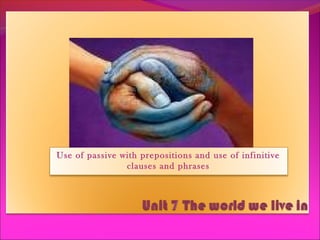
Use of passive with prepositions and use of infinitive
clauses and phrases
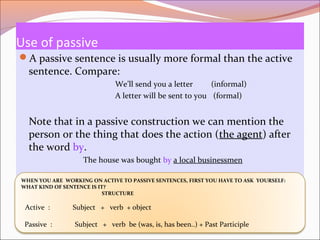
Use of passive
A passive sentence is usually more formal than the active
sentence. Compare:
We’ll send you a letter (informal)
A letter will be sent to you (formal)
Note that in a passive construction we can mention the
person or the thing that does the action (the agent) after
the word by.
The house was bought by a local businessmen
WHEN YOU ARE WORKING ON ACTIVE TO PASSIVE SENTENCES, FIRST YOU HAVE TO ASK YOURSELF:
WHAT KIND OF SENTENCE IS IT?
STRUCTURE
Active : Subject + verb + object
Passive : Subject + verb be (was, is, has been..) + Past Participle
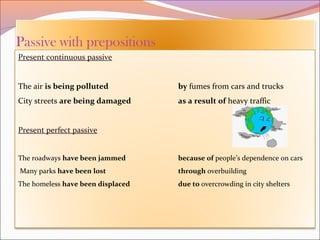
Present continuous passive
The air is being polluted by fumes from cars and trucks
City streets are being damaged as a result of heavy traffic
Present perfect passive
The roadways have been jammed because of people’s dependence on cars
Many parks have been lost through overbuilding
The homeless have been displaced due to overcrowding in city shelters
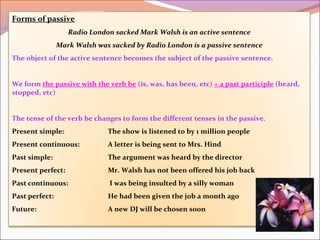
Forms of passive
Radio London sacked Mark Walsh is an active sentence
Mark Walsh was sacked by Radio London is a passive sentence
The object of the active sentence becomes the subject of the passive sentence.
We form the passive with the verb be (is, was, has been, etc) + a past participle (heard,
stopped, etc)
The tense of the verb be changes to form the different tenses in the passive.
Present simple: The show is listened to by 1 million people
Present continuous: A letter is being sent to Mrs. Hind
Past simple: The argument was heard by the director
Present perfect: Mr. Walsh has not been offered his job back
Past continuous: I was being insulted by a silly woman
Past perfect: He had been given the job a month ago
Future: A new DJ will be chosen soon
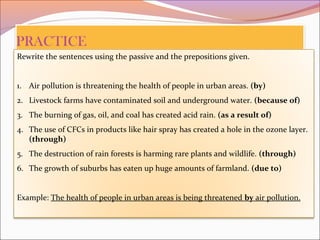
Rewrite the sentences using the passive and the prepositions given.
1. Air pollution is threatening the health of people in urban areas. (by)
2. Livestock farms have contaminated soil and underground water. (because of)
3. The burning of gas, oil, and coal has created acid rain. (as a result of)
4. The use of CFCs in products like hair spray has created a hole in the ozone layer.
(through)
5. The destruction of rain forests is harming rare plants and wildlife. (through)
6. The growth of suburbs has eaten up huge amounts of farmland. (due to)
Example: The health of people in urban areas is being threatened by air pollution.
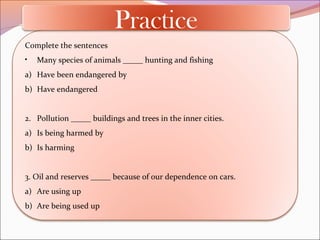
Complete the sentences
• Many species of animals _____ hunting and fishing
a) Have been endangered by
b) Have endangered
2. Pollution _____ buildings and trees in the inner cities.
a) Is being harmed by
b) Is harming
3. Oil and reserves _____ because of our dependence on cars.
a) Are using up
b) Are being used up
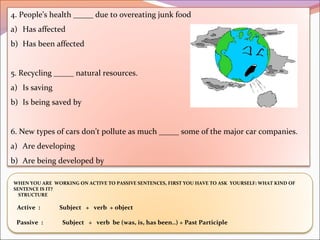
Practice
4. People’s health _____ due to overeating junk food
a) Has affected
b) Has been affected
5. Recycling _____ natural resources.
a) Is saving
b) Is being saved by
6. New types of cars don’t pollute as much _____ some of the major car companies.
a) Are developing
b) Are being developed by
WHEN YOU ARE WORKING ON ACTIVE TO PASSIVE SENTENCES, FIRST YOU HAVE TO ASK YOURSELF: WHAT KIND OF
SENTENCE IS IT?
STRUCTURE
Active : Subject + verb + object
Passive : Subject + verb be (was, is, has been..) + Past Participle
Infinitive clauses and phrases
Structure the sentences as follows:
(A way/ Two Ways) + infinitive + is/are + infinitive
One thing+ to do about it+ is+ to talk to the company’s management
Another way+ to stop them+ is +to get a TV station to run a story
The best ways+ to fight HIV / AIDS +are +to do more research and educate
people.
An infinitive is part of the subordinate clauses which are named after the form of
the verb . TO-INFINITIVE CLAUSE:
You must book early [to secure a seat]
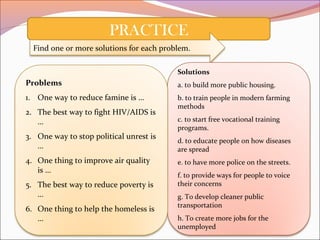
PRACTICE
Find one or more solutions for each problem.
Solutions
a. to build more public housing.
b. to train people in modern farming
methods
c. to start free vocational training
programs.
d. to educate people on how diseases
are spread
e. to have more police on the streets.
f. to provide ways for people to voice
their concerns
g. To develop cleaner public
transportation
h. To create more jobs for the
unemployed
Problems
1. One way to reduce famine is …
2. The best way to fight HIV/AIDS is
…
3. One way to stop political unrest is
…
4. One thing to improve air quality
is …
5. The best way to reduce poverty is
…
6. One thing to help the homeless is
…
UNIT 8
Use of would rather or would prefer
By+ gerung to describe how to do thing
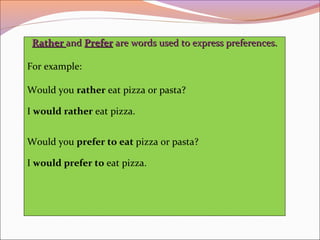
RatherRather andand PreferPrefer are words used to express preferences.are words used to express preferences.
For example:
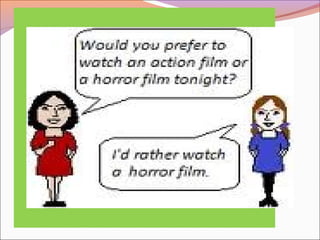
Would you rather eat pizza or pasta?
I would rather eat pizza.
Would you prefer to eat pizza or pasta?
I would prefer to eat pizza.
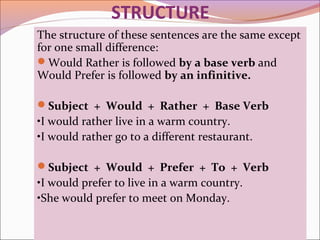
STRUCTURE
The structure of these sentences are the same except
for one small difference:
Would Rather is followed by a base verb and
Would Prefer is followed by an infinitive.
Subject + Would + Rather + Base Verb
•I would rather live in a warm country.
•I would rather go to a different restaurant.
Subject + Would + Prefer + To + Verb
•I would prefer to live in a warm country.
•She would prefer to meet on Monday.
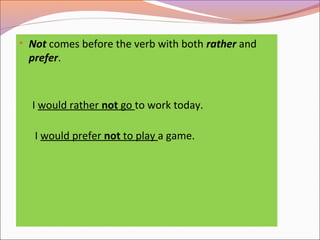
• Not comes before the verb with both rather and
prefer.
I would rather not go to work today.
I would prefer not to play a game.
Take a look at this conversation to see some examples of
would rather and would prefer:
Alex:
Would you rather stay home and cook dinner or go out?
Betty:
I'd rather go out. I am pretty tired today, so I don't want to
cook. What about you? Would you rather stay in or go out?
Alex:
I would prefer to stay in, but we can go out if you would like.
Betty:
That would be nice. What type of restaurant would you like to
go to?
Alex:
I'd prefer to go somewhere quiet.
Betty:
Really? Not me. I would rather go somewhere fun, maybe
even with some live music.
Alex:
But I thought you were tired?
Betty:
I am, but not too tired to have some fun.
Alex:
Well, I'd prefer not to, but…..OK.
Fill in the spaces with the correct words
1. They would prefer__________ (meet) on Monday than Tuesday.
2. He would prefer _________ (take) a Yoga class
3. Would you rather __________ (go) to an Italian or a Japanese
restaurant?
4. Dennis would prefer __________ (spend) his money at the
mall.
5. I would prefer _________ (drive) the jeep.
6. Would you prefer_________ (bring) a slad or dessert to the
dinner party?
7. I'd rather _________ (stay) at a different hotel.
8. We would rather_________ (sing) a slower song.
9. Would he prefer __________ (dance) to a different song?
10. She'd rather _________ (hear) another song.
P R A C T I C E
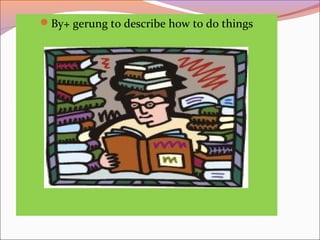
By+ gerung to describe how to do things
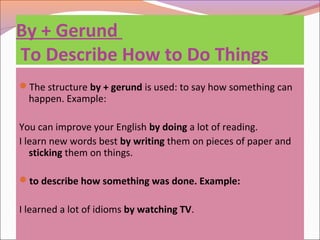
By + Gerund
To Describe How to Do Things
The structure by + gerund is used: to say how something can
happen. Example:
You can improve your English by doing a lot of reading.
I learn new words best by writing them on pieces of paper and
sticking them on things.
to describe how something was done. Example:
I learned a lot of idioms by watching TV.
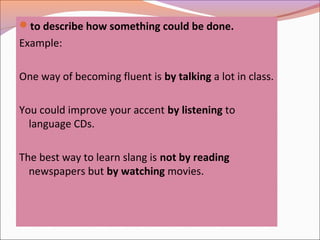
to describe how something could be done.
Example:
One way of becoming fluent is by talking a lot in class.
You could improve your accent by listening to
language CDs.
The best way to learn slang is not by reading
newspapers but by watching movies.
PRACTICE
BIBLIOGRAFIA
 A N U I E S ASOCIACIÓN NACIONAL DE UNIVERSIDADES E
INSTITUCIONES DE EDUCACIÓN SUPERIOR
 DISEÑO Y ELABORACIÓN DE MATERIALES EDUCATIVOS DIGITALES
AGOSTO 2013
 Richards, Jack C. Interchange Third Edition. Cambridge University
Press.Units.7 & 8
ELABORÓ: MTRA: SOFÍA BRENDA REYES CRUZ

Unidad 8 Inglés III

  • 1.
    SEMESTRE FEBRERO –JUNIO2016 PRESENTA MAESTRA:SOFIA BRENDA REYES CRUZ
  • 2.
    RESUMEN Con el siguientematerial el alumno reforzará las temáticas vistas en clase con breves explicaciones, estructuras y ejemplos del curso de Inglés III, SECUENCIA 3, con el enfoque en competencias. Esto se lograra a través de ejemplos visuales en los cuales el alumno será participe en diversas situaciones y podrá desarrollar sus habilidades del idioma inglés.
  • 3.
    ÍNDICE •Passive withprepositions (present continuous and present perfect) •Would rather /Would prefer UNIDADES 7 y 8
  • 4.
    Objetivo: Practicar el idiomainglés en contextos relacionados a la tercera secuencia del curso de Ingles III, en los cuales el alumno podrá poner en practica los verbos pasivos con preposiciones y las estructuras gramaticales, así como identificar y describir algún problema social, hablar acerca de sus preferencias y usar el vocabulario en situaciones de lo mas simple a los mas complejo. Experiencia de aprendizaje: 3 / 3
  • 5.
    Use of passivewith prepositions and use of infinitive clauses and phrases
  • 6.
    Use of passive Apassive sentence is usually more formal than the active sentence. Compare: We’ll send you a letter (informal) A letter will be sent to you (formal) Note that in a passive construction we can mention the person or the thing that does the action (the agent) after the word by. The house was bought by a local businessmen WHEN YOU ARE WORKING ON ACTIVE TO PASSIVE SENTENCES, FIRST YOU HAVE TO ASK YOURSELF: WHAT KIND OF SENTENCE IS IT? STRUCTURE Active : Subject + verb + object Passive : Subject + verb be (was, is, has been..) + Past Participle
  • 7.
    Present continuous passive Theair is being polluted by fumes from cars and trucks City streets are being damaged as a result of heavy traffic Present perfect passive The roadways have been jammed because of people’s dependence on cars Many parks have been lost through overbuilding The homeless have been displaced due to overcrowding in city shelters
  • 8.
    Forms of passive RadioLondon sacked Mark Walsh is an active sentence Mark Walsh was sacked by Radio London is a passive sentence The object of the active sentence becomes the subject of the passive sentence. We form the passive with the verb be (is, was, has been, etc) + a past participle (heard, stopped, etc) The tense of the verb be changes to form the different tenses in the passive. Present simple: The show is listened to by 1 million people Present continuous: A letter is being sent to Mrs. Hind Past simple: The argument was heard by the director Present perfect: Mr. Walsh has not been offered his job back Past continuous: I was being insulted by a silly woman Past perfect: He had been given the job a month ago Future: A new DJ will be chosen soon
  • 9.
    Rewrite the sentencesusing the passive and the prepositions given. 1. Air pollution is threatening the health of people in urban areas. (by) 2. Livestock farms have contaminated soil and underground water. (because of) 3. The burning of gas, oil, and coal has created acid rain. (as a result of) 4. The use of CFCs in products like hair spray has created a hole in the ozone layer. (through) 5. The destruction of rain forests is harming rare plants and wildlife. (through) 6. The growth of suburbs has eaten up huge amounts of farmland. (due to) Example: The health of people in urban areas is being threatened by air pollution.
  • 10.
    Complete the sentences •Many species of animals _____ hunting and fishing a) Have been endangered by b) Have endangered 2. Pollution _____ buildings and trees in the inner cities. a) Is being harmed by b) Is harming 3. Oil and reserves _____ because of our dependence on cars. a) Are using up b) Are being used up Practice
  • 11.
    4. People’s health_____ due to overeating junk food a) Has affected b) Has been affected 5. Recycling _____ natural resources. a) Is saving b) Is being saved by 6. New types of cars don’t pollute as much _____ some of the major car companies. a) Are developing b) Are being developed by WHEN YOU ARE WORKING ON ACTIVE TO PASSIVE SENTENCES, FIRST YOU HAVE TO ASK YOURSELF: WHAT KIND OF SENTENCE IS IT? STRUCTURE Active : Subject + verb + object Passive : Subject + verb be (was, is, has been..) + Past Participle
  • 12.
    Infinitive clauses andphrases Structure the sentences as follows: (A way/ Two Ways) + infinitive + is/are + infinitive One thing+ to do about it+ is+ to talk to the company’s management Another way+ to stop them+ is +to get a TV station to run a story The best ways+ to fight HIV / AIDS +are +to do more research and educate people. An infinitive is part of the subordinate clauses which are named after the form of the verb . TO-INFINITIVE CLAUSE: You must book early [to secure a seat]
  • 13.
    PRACTICE Find one ormore solutions for each problem. Solutions a. to build more public housing. b. to train people in modern farming methods c. to start free vocational training programs. d. to educate people on how diseases are spread e. to have more police on the streets. f. to provide ways for people to voice their concerns g. To develop cleaner public transportation h. To create more jobs for the unemployed Problems 1. One way to reduce famine is … 2. The best way to fight HIV/AIDS is … 3. One way to stop political unrest is … 4. One thing to improve air quality is … 5. The best way to reduce poverty is … 6. One thing to help the homeless is …
  • 14.
    UNIT 8 Use ofwould rather or would prefer By+ gerung to describe how to do thing
  • 16.
    RatherRather andand PreferPreferare words used to express preferences.are words used to express preferences. For example: Would you rather eat pizza or pasta? I would rather eat pizza. Would you prefer to eat pizza or pasta? I would prefer to eat pizza.
  • 17.
    STRUCTURE The structure ofthese sentences are the same except for one small difference: Would Rather is followed by a base verb and Would Prefer is followed by an infinitive. Subject + Would + Rather + Base Verb •I would rather live in a warm country. •I would rather go to a different restaurant. Subject + Would + Prefer + To + Verb •I would prefer to live in a warm country. •She would prefer to meet on Monday.
  • 18.
    • Not comesbefore the verb with both rather and prefer. I would rather not go to work today. I would prefer not to play a game.
  • 19.
    Take a lookat this conversation to see some examples of would rather and would prefer: Alex: Would you rather stay home and cook dinner or go out? Betty: I'd rather go out. I am pretty tired today, so I don't want to cook. What about you? Would you rather stay in or go out? Alex: I would prefer to stay in, but we can go out if you would like. Betty: That would be nice. What type of restaurant would you like to go to? Alex: I'd prefer to go somewhere quiet. Betty: Really? Not me. I would rather go somewhere fun, maybe even with some live music. Alex: But I thought you were tired? Betty: I am, but not too tired to have some fun. Alex: Well, I'd prefer not to, but…..OK.
  • 20.
    Fill in thespaces with the correct words 1. They would prefer__________ (meet) on Monday than Tuesday. 2. He would prefer _________ (take) a Yoga class 3. Would you rather __________ (go) to an Italian or a Japanese restaurant? 4. Dennis would prefer __________ (spend) his money at the mall. 5. I would prefer _________ (drive) the jeep. 6. Would you prefer_________ (bring) a slad or dessert to the dinner party? 7. I'd rather _________ (stay) at a different hotel. 8. We would rather_________ (sing) a slower song. 9. Would he prefer __________ (dance) to a different song? 10. She'd rather _________ (hear) another song. P R A C T I C E
  • 22.
    By+ gerung todescribe how to do things
  • 23.
    By + Gerund ToDescribe How to Do Things The structure by + gerund is used: to say how something can happen. Example: You can improve your English by doing a lot of reading. I learn new words best by writing them on pieces of paper and sticking them on things. to describe how something was done. Example: I learned a lot of idioms by watching TV.
  • 24.
    to describe howsomething could be done. Example: One way of becoming fluent is by talking a lot in class. You could improve your accent by listening to language CDs. The best way to learn slang is not by reading newspapers but by watching movies.
  • 25.
  • 26.
    BIBLIOGRAFIA  A NU I E S ASOCIACIÓN NACIONAL DE UNIVERSIDADES E INSTITUCIONES DE EDUCACIÓN SUPERIOR  DISEÑO Y ELABORACIÓN DE MATERIALES EDUCATIVOS DIGITALES AGOSTO 2013  Richards, Jack C. Interchange Third Edition. Cambridge University Press.Units.7 & 8 ELABORÓ: MTRA: SOFÍA BRENDA REYES CRUZ