C RELATIVE CLAUSES 
OF TIME 
Teacher Eli Stephanie Burciaga Gabaldon 
October 1st, 2014
Introduction 
• For this presentation, you will read about what is relative clauses of time, how 
to use it and identify them. Also adverbs of time.
Objective 
• You will learn how to use relative clauses of time and adverbs of time. 
• You will be able to recognize relative clauses of time and adverbs of time. 
• You will be able to practice relative clauses of time and adverbs of time.
Relative clauses of time 
• Relative clauses of time refer to a timepreviously mentioned. Relatives clauses are 
usually introduce by the verb “to be”. 
• February 14th is the day when people give cards to the ones they love. 
• Date be relative clause 
• New Year’s Eve is a night when I have fun with my friends. 
• Date be relative clause
Adverbial clauses of time 
• Time clauses are subordinate clauses and usually go with a main clause. When the time 
clause precedes the main clause, a comma is used. 
• Time clauses follow the rule of the sequence of tenses. That is, when the verb of the 
main clause is in a present or future form, the verb of the time clause is in a present 
form. When the verb of the main clause is in a past form, the verb of the time clause is 
in a past form too. 
• Adverbs of time: when, after, before, as soon as, by the time, since, etc.
Example: 
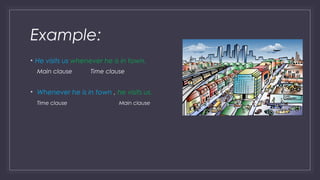
• He visits us whenever he is in town. 
Main clause Time clause 
• Whenever he is in town , he visits us. 
Time clause Main clause
Intructions for the activities 
• Write the answers in your notebook. 
• For the second activity write only the answers. 
• For example: if the answers for number letter a is 2, write: 
• A°2
Activity 
• Now complete the following dates or moments: 
• Christmas___________________________________________________________ 
• Thanksgiving___________________________________________________________ 
• November 20th_________________________________________________________ 
• Children´s day___________________________________________________________ 
• Mother´s day____________________________________________________________ 
• Day of the dead__________________________________________________________
Second activity 
• Read the sentences and match the columns. 
• A. Can you buy me a cartoon of orange juice 1. She takes off her shoes. 
• B. Tidy your bedroom. 2. Turn the lights off. 
• C. When we go to a party 3. They always do the homework. 
• D. before you go to bed 4. After he gets up. 
• E. After they eat 5. When you go shopping, please? 
• F. When she gets home 6. We take a gift with us. 
• G. He takes a shower 7. Before you go out to play.
Relative clauses of time.Level4

Relative clauses of time.Level4

  • 1.
    C RELATIVE CLAUSES OF TIME Teacher Eli Stephanie Burciaga Gabaldon October 1st, 2014
  • 2.
    Introduction • Forthis presentation, you will read about what is relative clauses of time, how to use it and identify them. Also adverbs of time.
  • 3.
    Objective • Youwill learn how to use relative clauses of time and adverbs of time. • You will be able to recognize relative clauses of time and adverbs of time. • You will be able to practice relative clauses of time and adverbs of time.
  • 4.
    Relative clauses oftime • Relative clauses of time refer to a timepreviously mentioned. Relatives clauses are usually introduce by the verb “to be”. • February 14th is the day when people give cards to the ones they love. • Date be relative clause • New Year’s Eve is a night when I have fun with my friends. • Date be relative clause
  • 5.
    Adverbial clauses oftime • Time clauses are subordinate clauses and usually go with a main clause. When the time clause precedes the main clause, a comma is used. • Time clauses follow the rule of the sequence of tenses. That is, when the verb of the main clause is in a present or future form, the verb of the time clause is in a present form. When the verb of the main clause is in a past form, the verb of the time clause is in a past form too. • Adverbs of time: when, after, before, as soon as, by the time, since, etc.
  • 6.
    Example: • Hevisits us whenever he is in town. Main clause Time clause • Whenever he is in town , he visits us. Time clause Main clause
  • 7.
    Intructions for theactivities • Write the answers in your notebook. • For the second activity write only the answers. • For example: if the answers for number letter a is 2, write: • A°2
  • 8.
    Activity • Nowcomplete the following dates or moments: • Christmas___________________________________________________________ • Thanksgiving___________________________________________________________ • November 20th_________________________________________________________ • Children´s day___________________________________________________________ • Mother´s day____________________________________________________________ • Day of the dead__________________________________________________________
  • 9.
    Second activity •Read the sentences and match the columns. • A. Can you buy me a cartoon of orange juice 1. She takes off her shoes. • B. Tidy your bedroom. 2. Turn the lights off. • C. When we go to a party 3. They always do the homework. • D. before you go to bed 4. After he gets up. • E. After they eat 5. When you go shopping, please? • F. When she gets home 6. We take a gift with us. • G. He takes a shower 7. Before you go out to play.