Shardul Agrawala
Head, Environment and Economy Integration Division
Environment Directorate, OECD
OECD Conference on Environmental Justice
28-29 May 2024
Restricted Use - À usage restreint
• Edward Bayliss
• Yuko Ishibashi
• Julia Kieloch
• Nicolina Lamhauge
Co-authors
Restricted Use - À usage restreint
Scope of the report
I. Examine the plurality of the concept of Environmental Justice (EJ), building blocks and
underlying causal mechanisms
II. Review how EJ concerns have emerged in different contexts around the world
III. First of its kind policy stocktake of how governments across the OECD and beyond are
identifying, assessing and addressing EJ
Restricted Use - À usage restreint
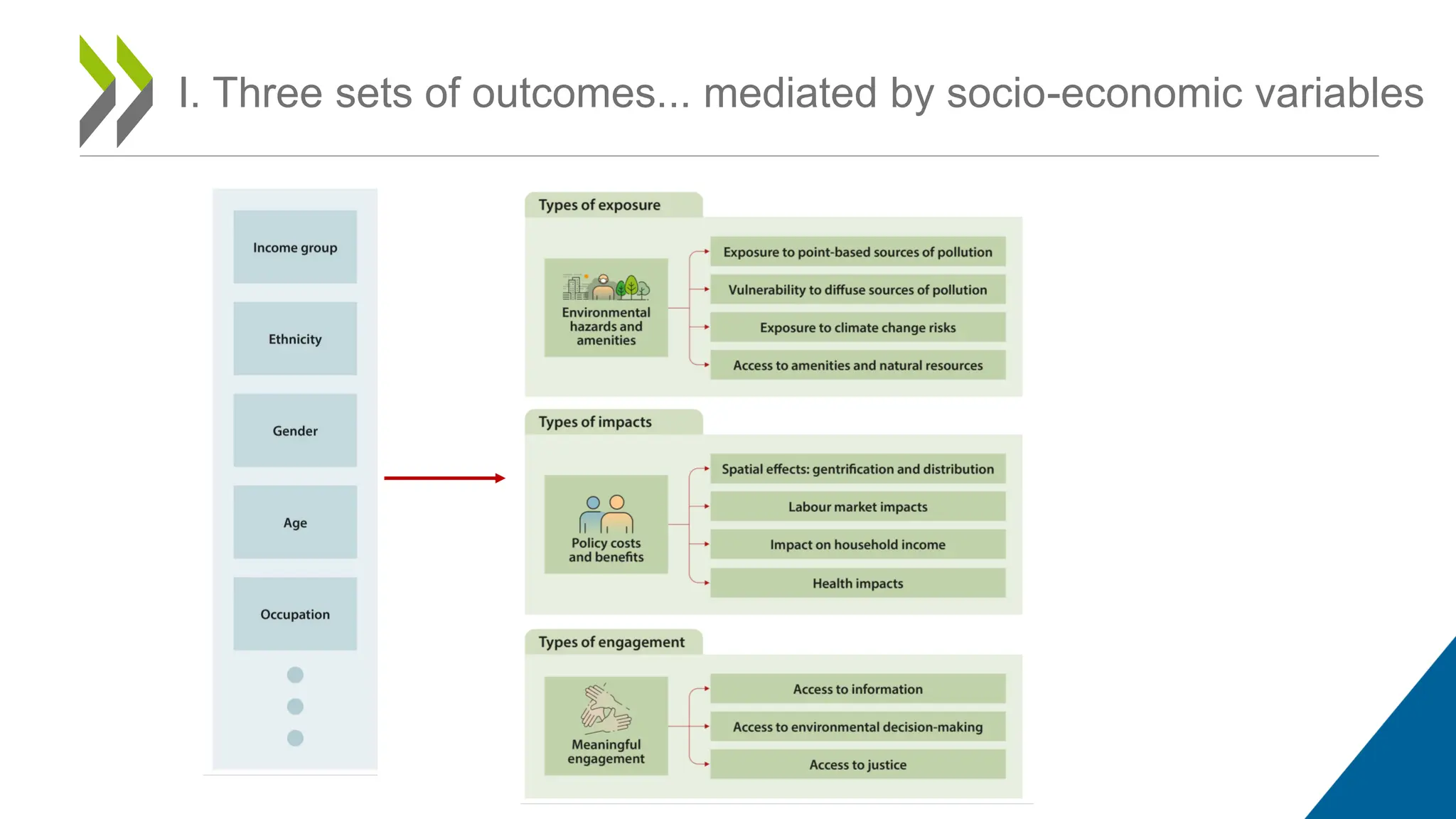
I. Three sets of outcomes... mediated by socio-economic variables
Restricted Use - À usage restreint
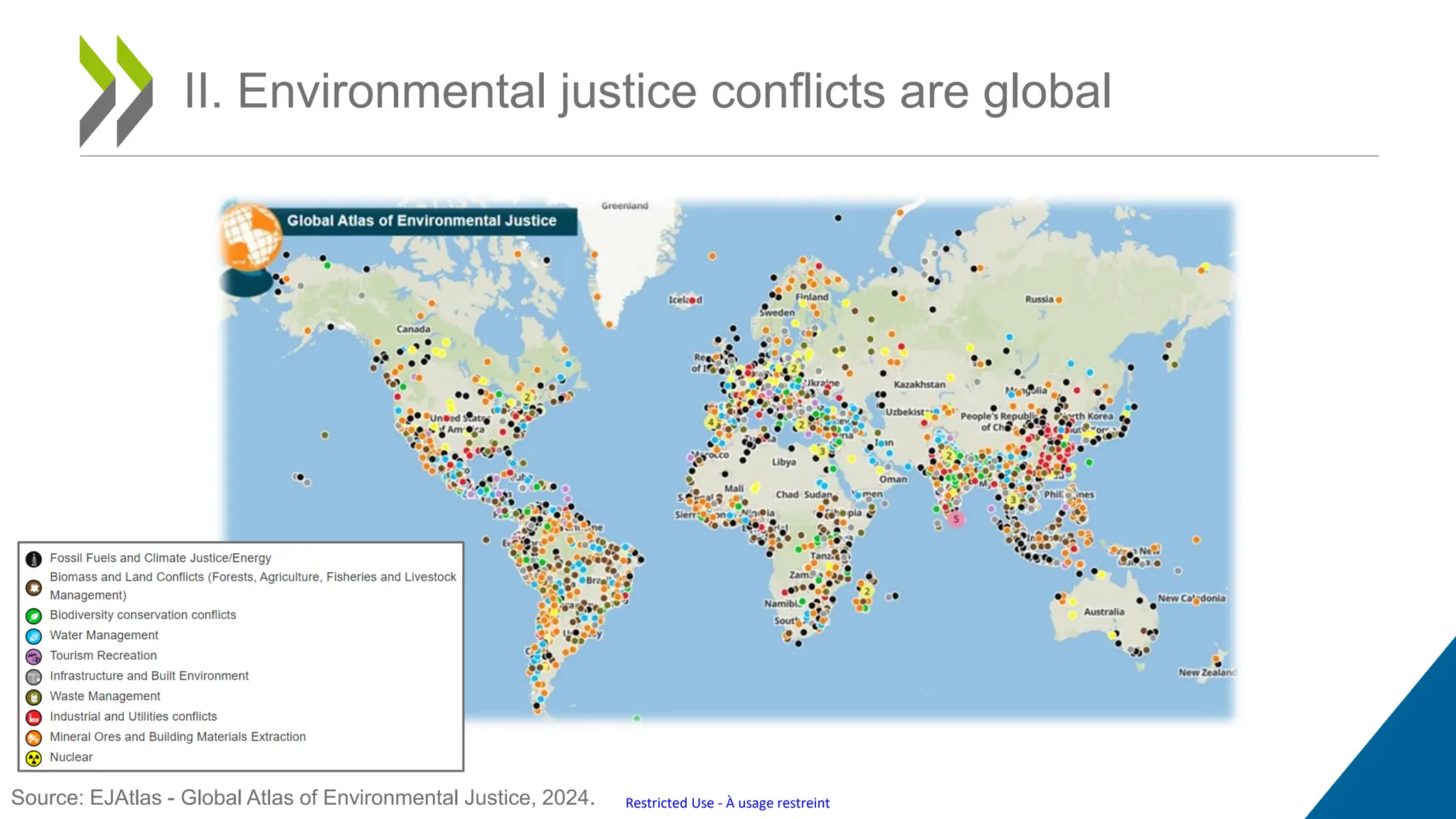
II. Environmental justice conflicts are global
Source: EJAtlas - Global Atlas of Environmental Justice, 2024.
Restricted Use - À usage restreint
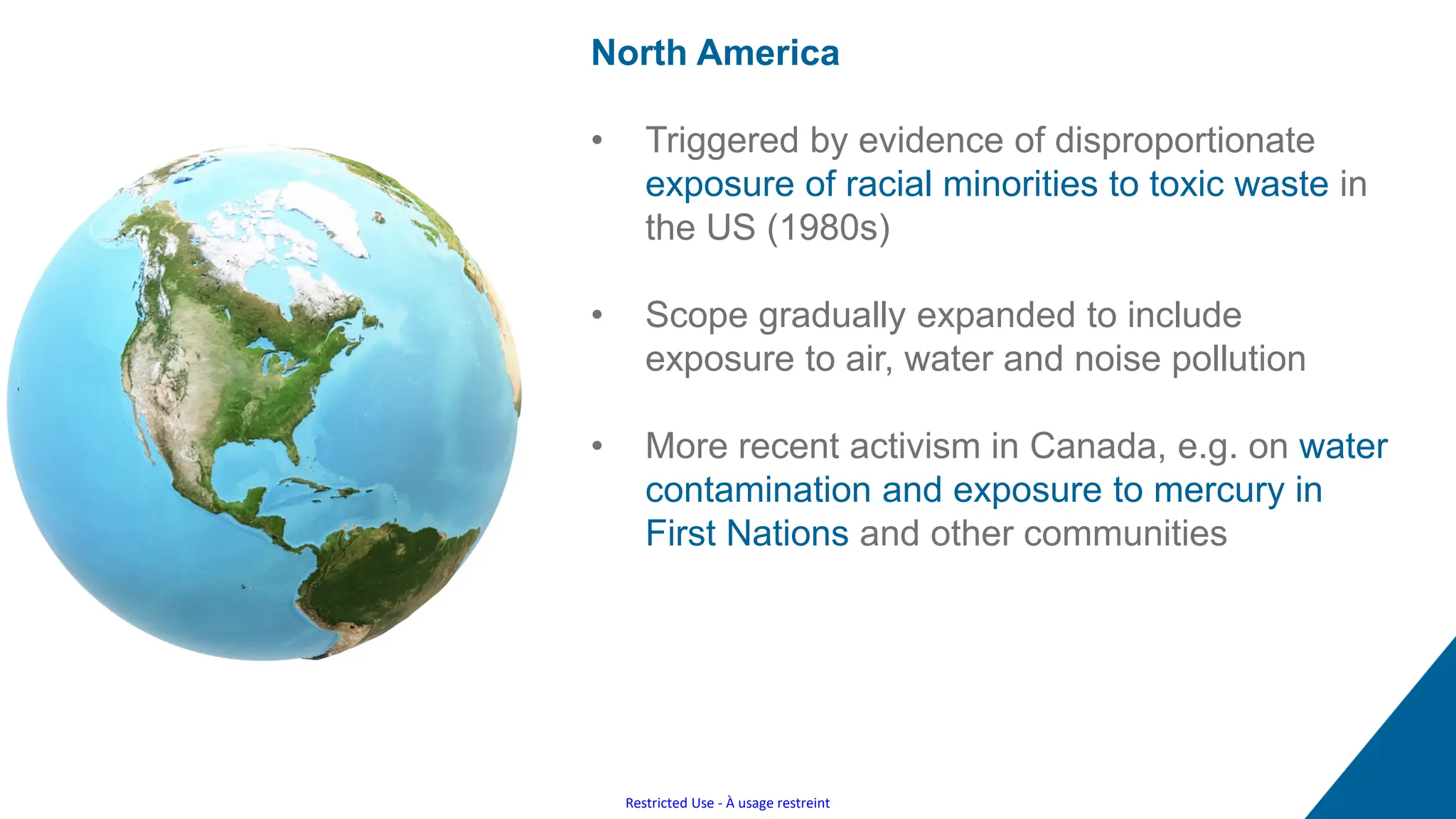
North America
• Triggered by evidence of disproportionate
exposure of racial minorities to toxic waste in
the US (1980s)
• Scope gradually expanded to include
exposure to air, water and noise pollution
• More recent activism in Canada, e.g. on water
contamination and exposure to mercury in
First Nations and other communities
Restricted Use - À usage restreint
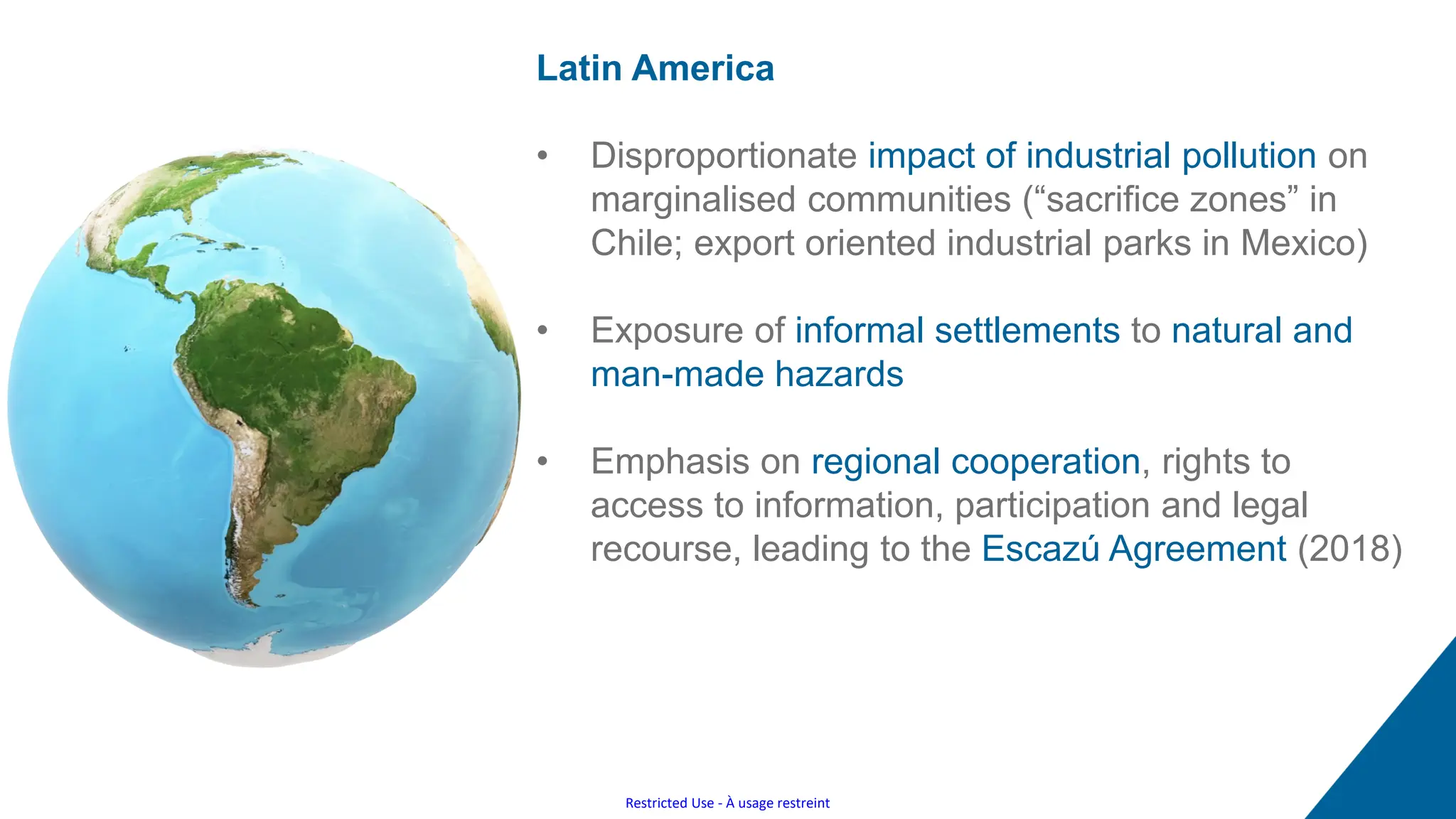
Latin America
• Disproportionate impact of industrial pollution on
marginalised communities (“sacrifice zones” in
Chile; export oriented industrial parks in Mexico)
• Exposure of informal settlements to natural and
man-made hazards
• Emphasis on regional cooperation, rights to
access to information, participation and legal
recourse, leading to the Escazú Agreement (2018)
Restricted Use - À usage restreint
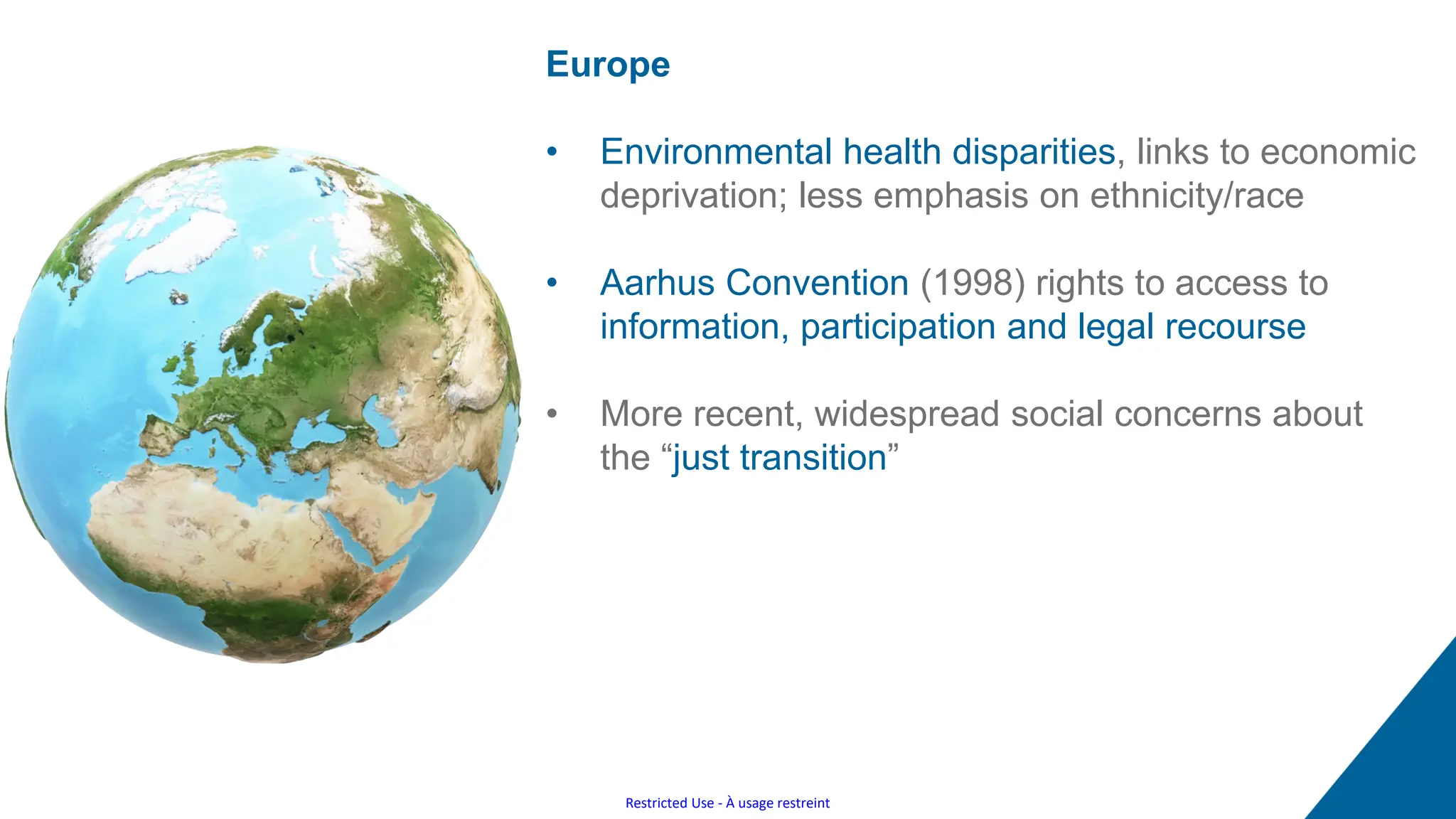
Europe
• Environmental health disparities, links to economic
deprivation; less emphasis on ethnicity/race
• Aarhus Convention (1998) rights to access to
information, participation and legal recourse
• More recent, widespread social concerns about
the “just transition”
Restricted Use - À usage restreint
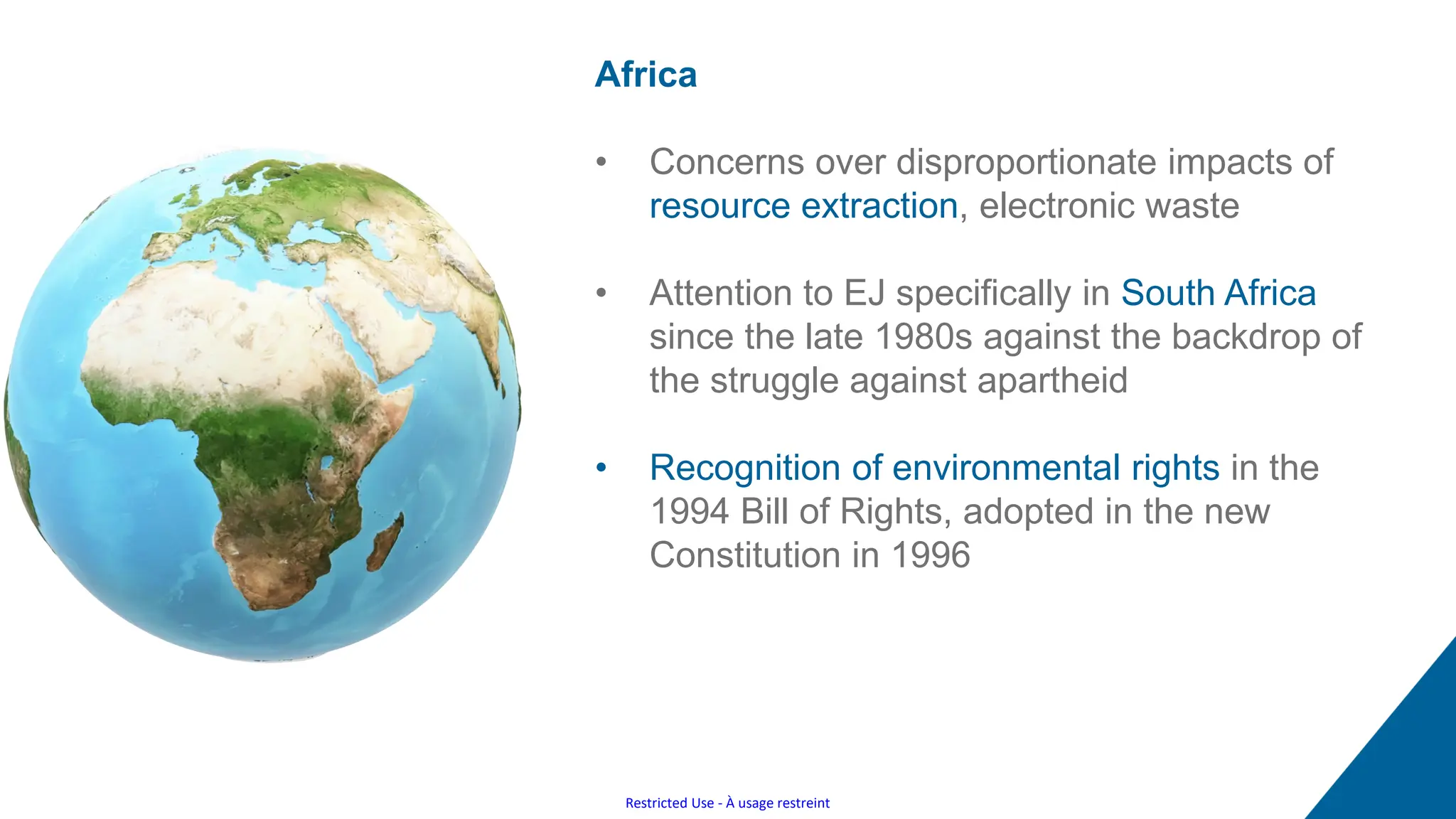
Africa
• Concerns over disproportionate impacts of
resource extraction, electronic waste
• Attention to EJ specifically in South Africa
since the late 1980s against the backdrop of
the struggle against apartheid
• Recognition of environmental rights in the
1994 Bill of Rights, adopted in the new
Constitution in 1996
Restricted Use - À usage restreint
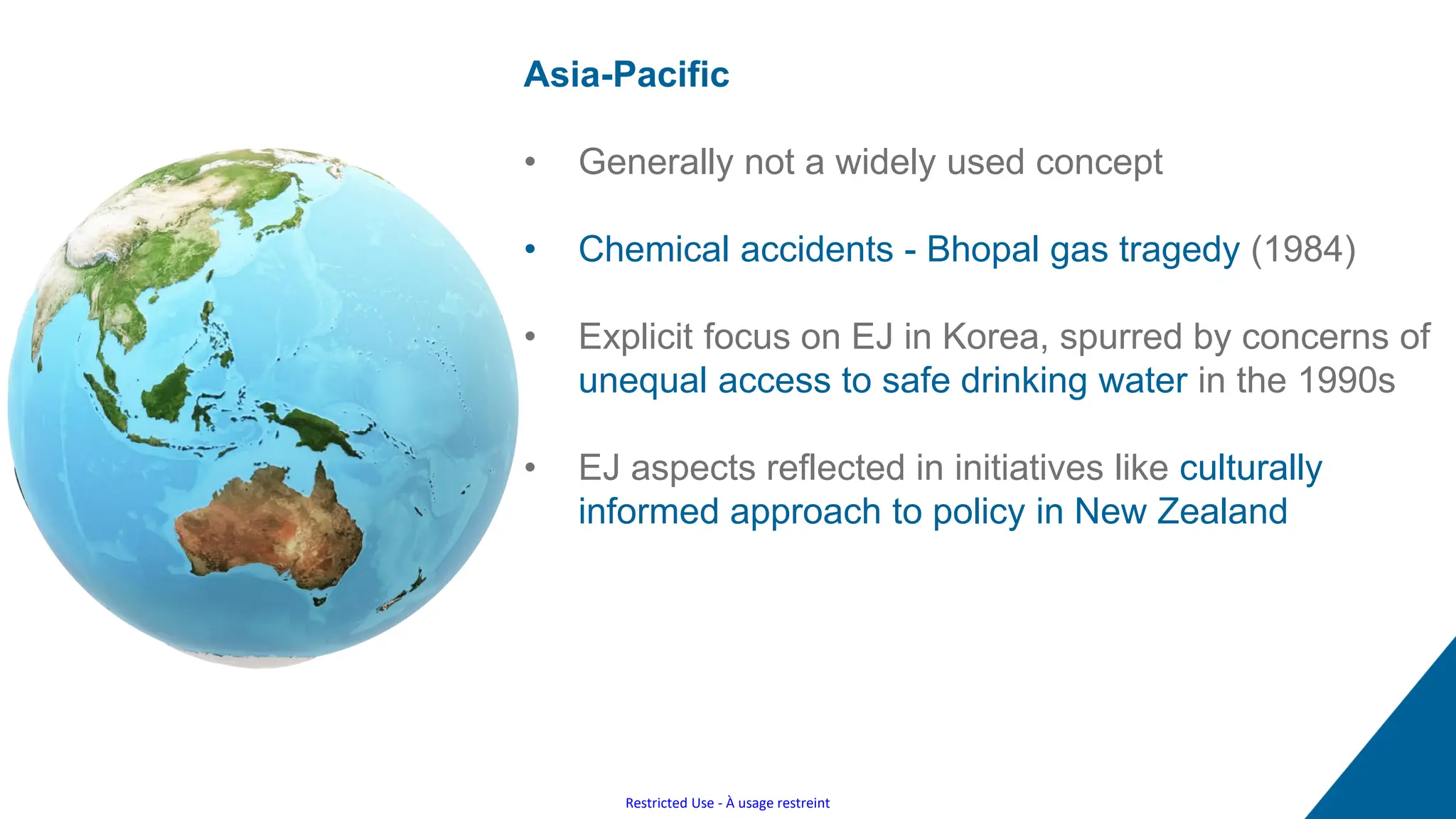
Asia-Pacific
• Generally not a widely used concept
• Chemical accidents - Bhopal gas tragedy (1984)
• Explicit focus on EJ in Korea, spurred by concerns of
unequal access to safe drinking water in the 1990s
• EJ aspects reflected in initiatives like culturally
informed approach to policy in New Zealand
Restricted Use - À usage restreint
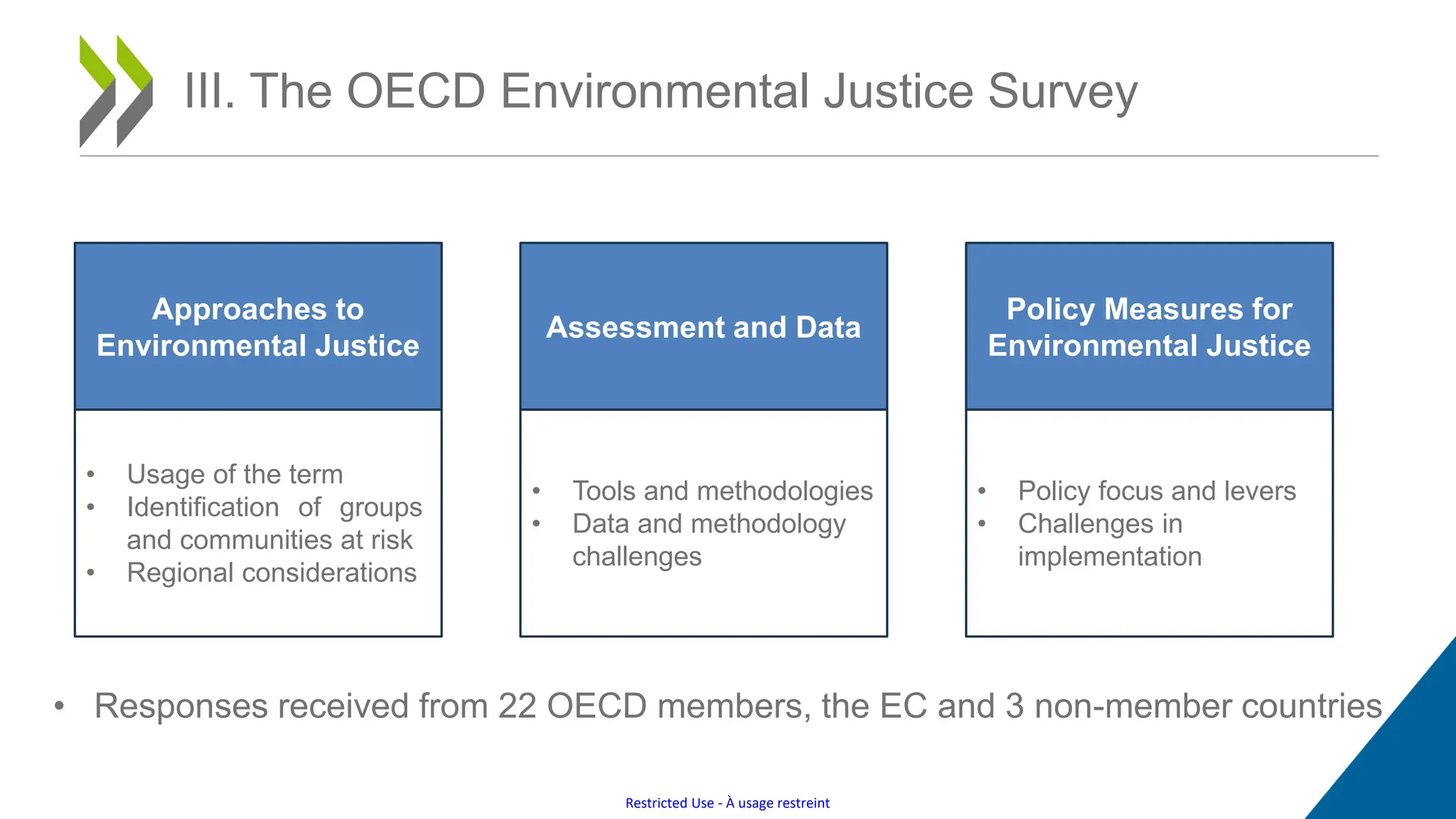
III. The OECD Environmental Justice Survey
Approaches to
Environmental Justice
Assessment and Data
Policy Measures for
Environmental Justice
• Usage of the term
• Identification of groups
and communities at risk
• Regional considerations
• Tools and methodologies
• Data and methodology
challenges
• Policy focus and levers
• Challenges in
implementation
• Responses received from 22 OECD members, the EC and 3 non-member countries
Restricted Use - À usage restreint
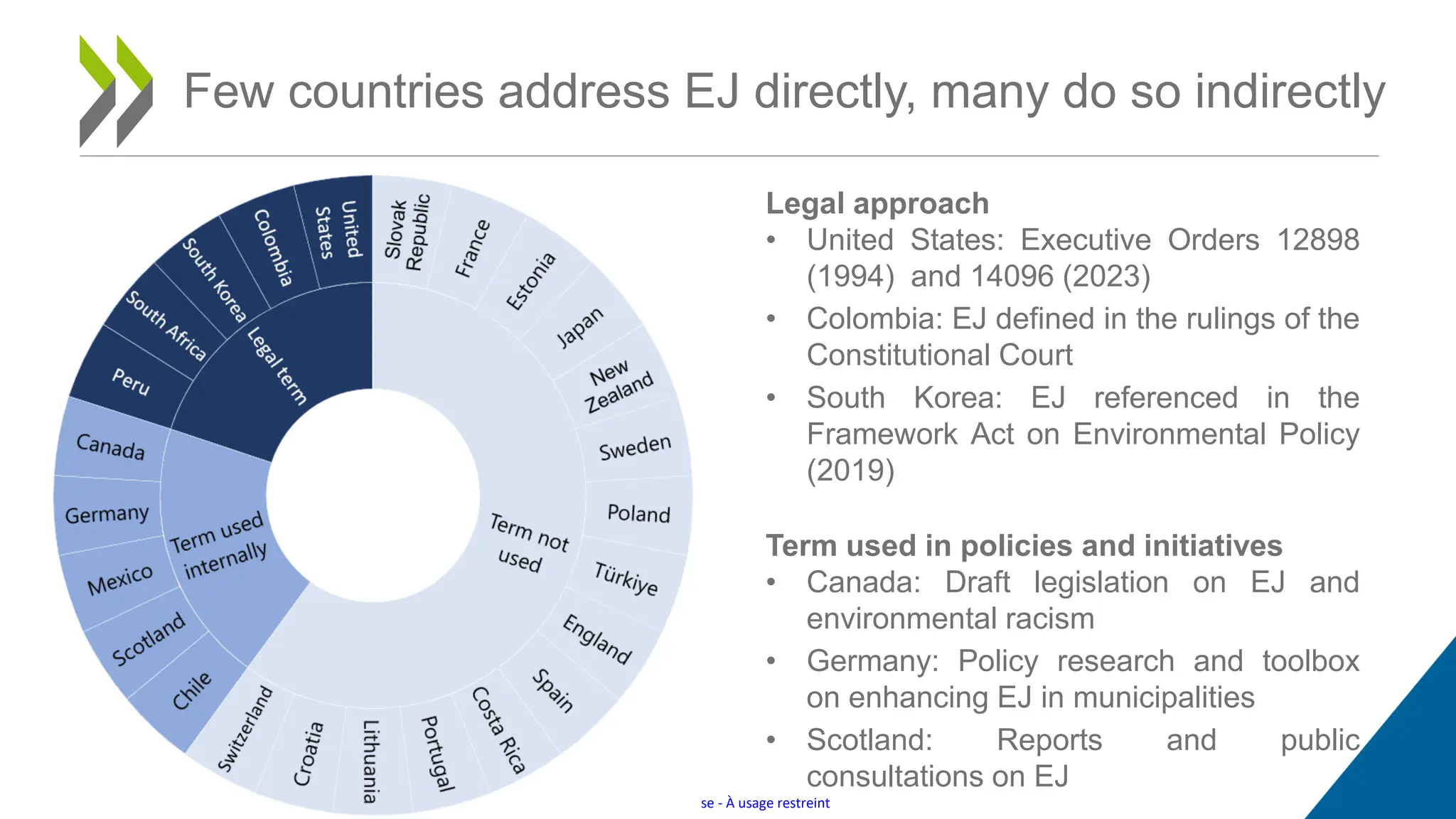
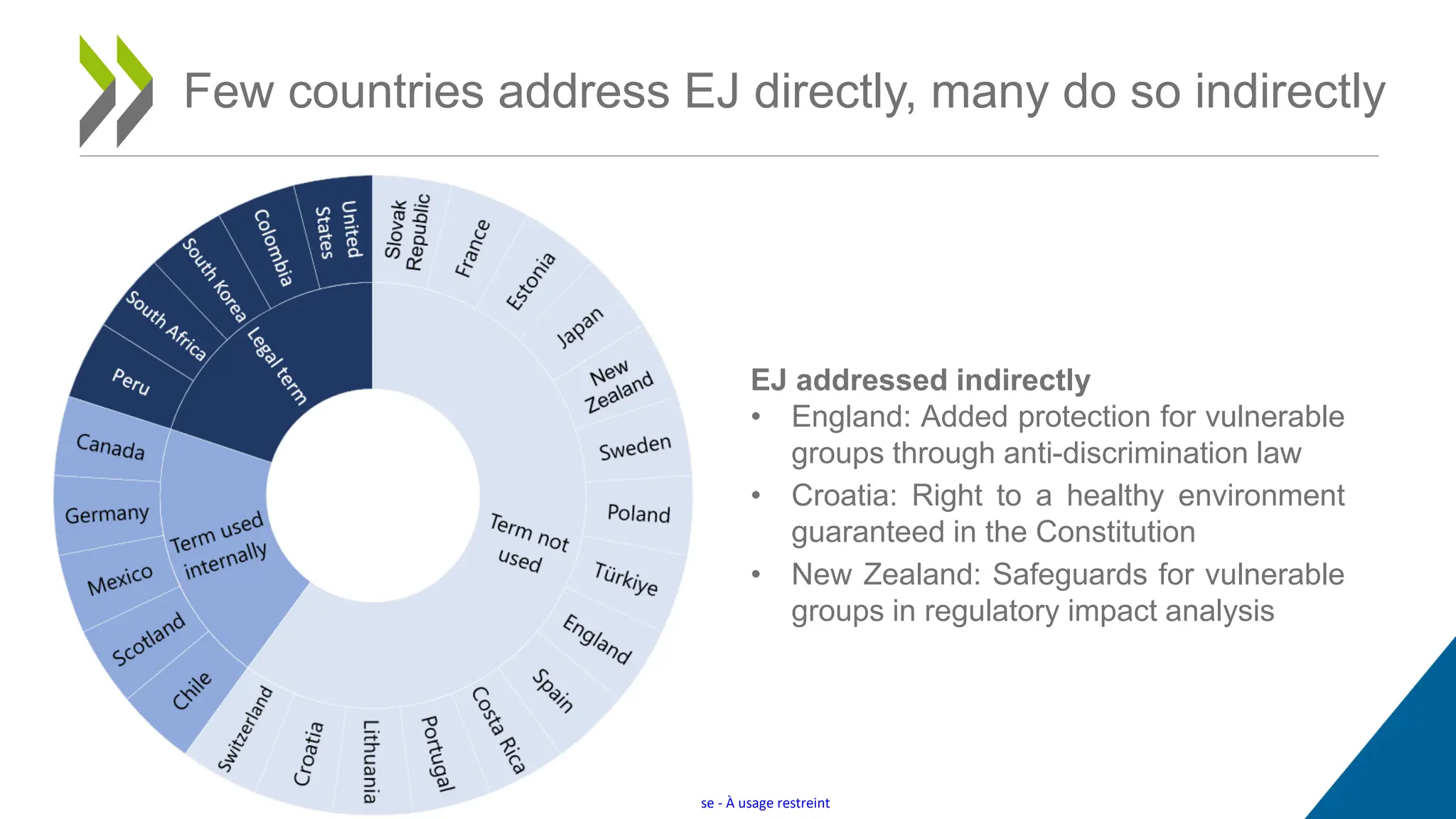
Few countries address EJ directly, many do so indirectly
Legal approach
• United States: Executive Orders 12898
(1994) and 14096 (2023)
• Colombia: EJ defined in the rulings of the
Constitutional Court
• South Korea: EJ referenced in the
Framework Act on Environmental Policy
(2019)
Term used in policies and initiatives
• Canada: Draft legislation on EJ and
environmental racism
• Germany: Policy research and toolbox
on enhancing EJ in municipalities
• Scotland: Reports and public
consultations on EJ
Restricted Use - À usage restreint
Few countries address EJ directly, many do so indirectly
EJ addressed indirectly
• England: Added protection for vulnerable
groups through anti-discrimination law
• Croatia: Right to a healthy environment
guaranteed in the Constitution
• New Zealand: Safeguards for vulnerable
groups in regulatory impact analysis
Restricted Use - À usage restreint
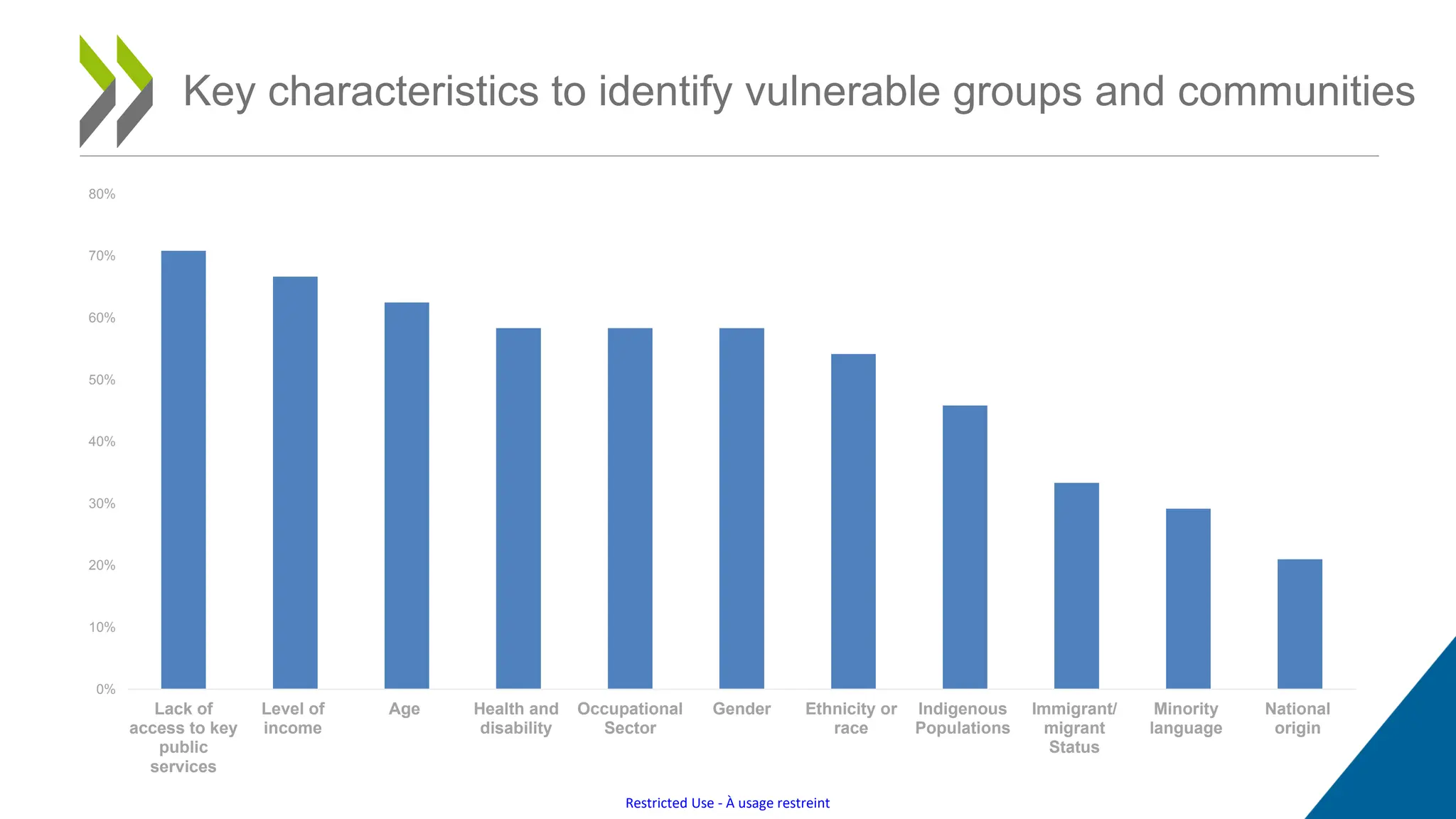
Key characteristics to identify vulnerable groups and communities
0%
10%
20%
30%
40%
50%
60%
70%
80%
Lack of
access to key
public
services
Level of
income
Age Health and
disability
Occupational
Sector
Gender Ethnicity or
race
Indigenous
Populations
Immigrant/
migrant
Status
Minority
language
National
origin
Restricted Use - À usage restreint
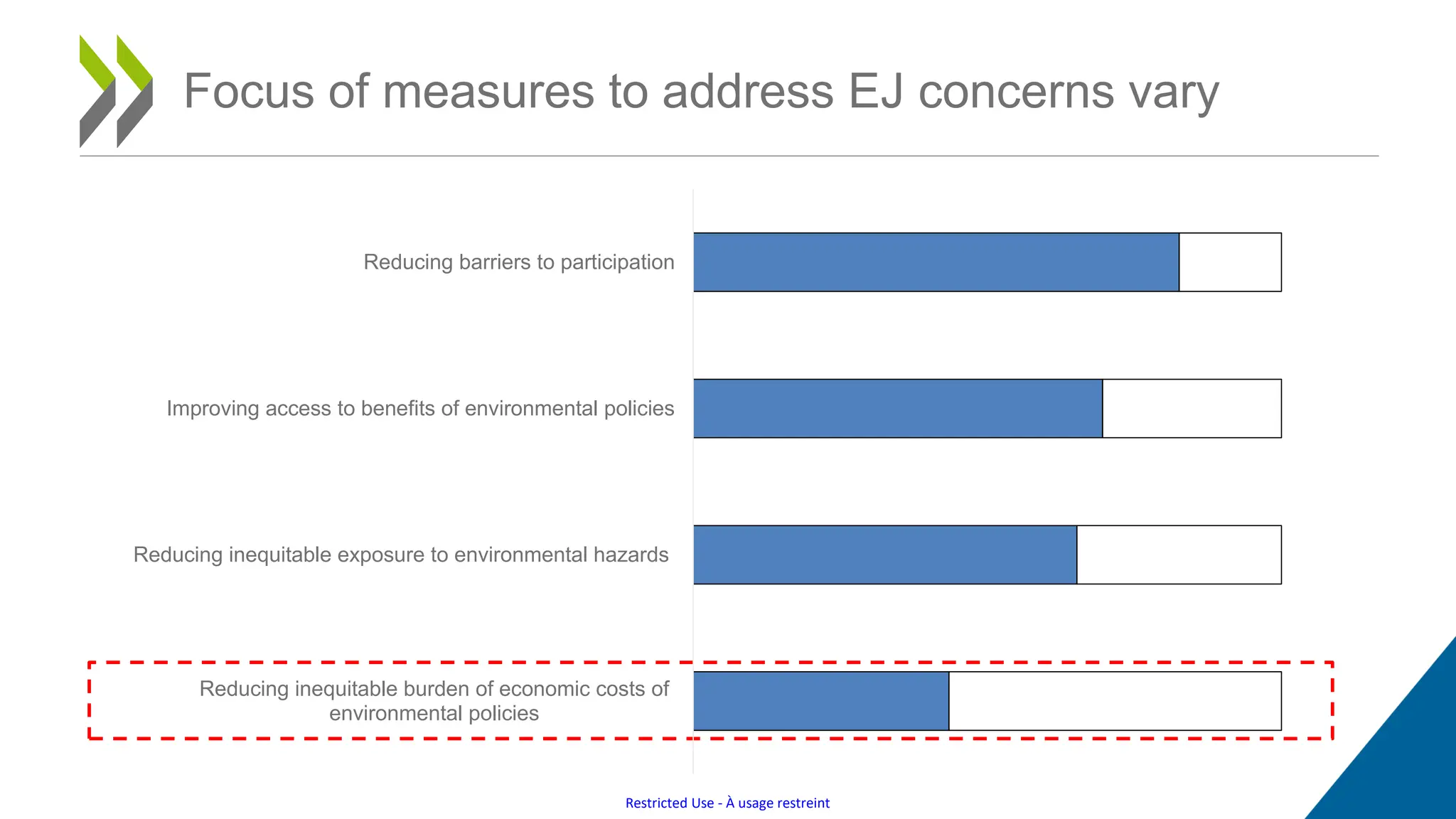
Focus of measures to address EJ concerns vary
Reducing inequitable burden of economic costs of
environmental policies
Reducing inequitable exposure to environmental hazards
Improving access to benefits of environmental policies
Reducing barriers to participation
Restricted Use - À usage restreint
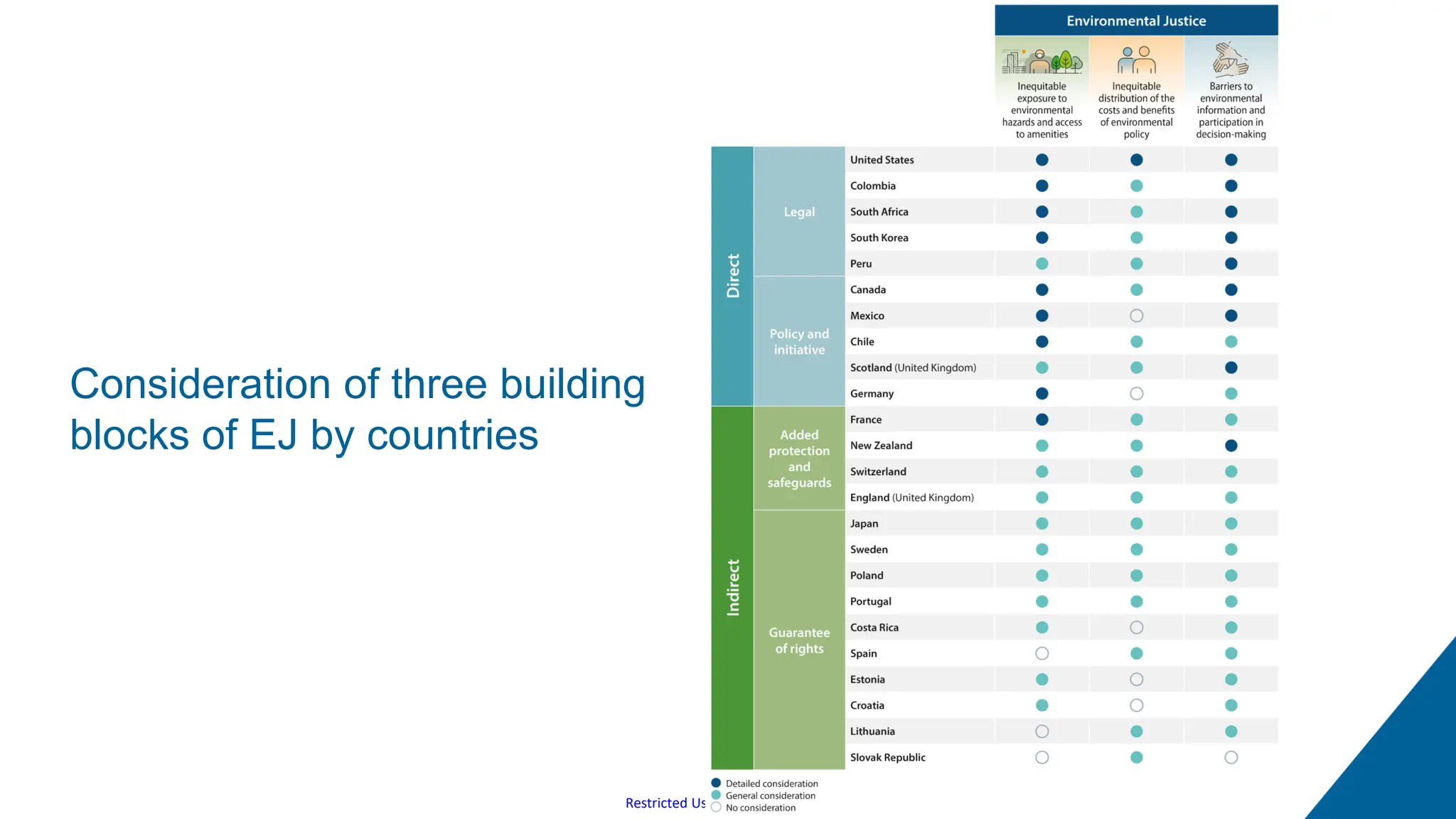
Consideration of three building
blocks of EJ by countries
Restricted Use - À usage restreint
IV. Final remarks
• Diverse approaches to address EJ are being used, regardless of terminology
• However, even countries with the most sophisticated frameworks still face
persistent challenges to address “traditional” EJ 1.0 concerns
• A new generation of EJ 2.0 challenges requires urgent global attention
(yellow vests movement, protests against lithium mining, renewables
expansion)
• There is value in mutual learning to propel progress
Thank you
Thank you
18
shardul.agrawala@oecd.org

Day1_Session1.3_Shardul_Agrawala (1).pdf

  • 1.
    Shardul Agrawala Head, Environmentand Economy Integration Division Environment Directorate, OECD OECD Conference on Environmental Justice 28-29 May 2024
  • 2.
    Restricted Use -À usage restreint • Edward Bayliss • Yuko Ishibashi • Julia Kieloch • Nicolina Lamhauge Co-authors
  • 3.
    Restricted Use -À usage restreint Scope of the report I. Examine the plurality of the concept of Environmental Justice (EJ), building blocks and underlying causal mechanisms II. Review how EJ concerns have emerged in different contexts around the world III. First of its kind policy stocktake of how governments across the OECD and beyond are identifying, assessing and addressing EJ
  • 4.
    Restricted Use -À usage restreint I. Three sets of outcomes... mediated by socio-economic variables
  • 5.
    Restricted Use -À usage restreint II. Environmental justice conflicts are global Source: EJAtlas - Global Atlas of Environmental Justice, 2024.
  • 6.
    Restricted Use -À usage restreint North America • Triggered by evidence of disproportionate exposure of racial minorities to toxic waste in the US (1980s) • Scope gradually expanded to include exposure to air, water and noise pollution • More recent activism in Canada, e.g. on water contamination and exposure to mercury in First Nations and other communities
  • 7.
    Restricted Use -À usage restreint Latin America • Disproportionate impact of industrial pollution on marginalised communities (“sacrifice zones” in Chile; export oriented industrial parks in Mexico) • Exposure of informal settlements to natural and man-made hazards • Emphasis on regional cooperation, rights to access to information, participation and legal recourse, leading to the Escazú Agreement (2018)
  • 8.
    Restricted Use -À usage restreint Europe • Environmental health disparities, links to economic deprivation; less emphasis on ethnicity/race • Aarhus Convention (1998) rights to access to information, participation and legal recourse • More recent, widespread social concerns about the “just transition”
  • 9.
    Restricted Use -À usage restreint Africa • Concerns over disproportionate impacts of resource extraction, electronic waste • Attention to EJ specifically in South Africa since the late 1980s against the backdrop of the struggle against apartheid • Recognition of environmental rights in the 1994 Bill of Rights, adopted in the new Constitution in 1996
  • 10.
    Restricted Use -À usage restreint Asia-Pacific • Generally not a widely used concept • Chemical accidents - Bhopal gas tragedy (1984) • Explicit focus on EJ in Korea, spurred by concerns of unequal access to safe drinking water in the 1990s • EJ aspects reflected in initiatives like culturally informed approach to policy in New Zealand
  • 11.
    Restricted Use -À usage restreint III. The OECD Environmental Justice Survey Approaches to Environmental Justice Assessment and Data Policy Measures for Environmental Justice • Usage of the term • Identification of groups and communities at risk • Regional considerations • Tools and methodologies • Data and methodology challenges • Policy focus and levers • Challenges in implementation • Responses received from 22 OECD members, the EC and 3 non-member countries
  • 12.
    Restricted Use -À usage restreint Few countries address EJ directly, many do so indirectly Legal approach • United States: Executive Orders 12898 (1994) and 14096 (2023) • Colombia: EJ defined in the rulings of the Constitutional Court • South Korea: EJ referenced in the Framework Act on Environmental Policy (2019) Term used in policies and initiatives • Canada: Draft legislation on EJ and environmental racism • Germany: Policy research and toolbox on enhancing EJ in municipalities • Scotland: Reports and public consultations on EJ
  • 13.
    Restricted Use -À usage restreint Few countries address EJ directly, many do so indirectly EJ addressed indirectly • England: Added protection for vulnerable groups through anti-discrimination law • Croatia: Right to a healthy environment guaranteed in the Constitution • New Zealand: Safeguards for vulnerable groups in regulatory impact analysis
  • 14.
    Restricted Use -À usage restreint Key characteristics to identify vulnerable groups and communities 0% 10% 20% 30% 40% 50% 60% 70% 80% Lack of access to key public services Level of income Age Health and disability Occupational Sector Gender Ethnicity or race Indigenous Populations Immigrant/ migrant Status Minority language National origin
  • 15.
    Restricted Use -À usage restreint Focus of measures to address EJ concerns vary Reducing inequitable burden of economic costs of environmental policies Reducing inequitable exposure to environmental hazards Improving access to benefits of environmental policies Reducing barriers to participation
  • 16.
    Restricted Use -À usage restreint Consideration of three building blocks of EJ by countries
  • 17.
    Restricted Use -À usage restreint IV. Final remarks • Diverse approaches to address EJ are being used, regardless of terminology • However, even countries with the most sophisticated frameworks still face persistent challenges to address “traditional” EJ 1.0 concerns • A new generation of EJ 2.0 challenges requires urgent global attention (yellow vests movement, protests against lithium mining, renewables expansion) • There is value in mutual learning to propel progress
  • 18.