ENPI East FLEG Contributions to
the ENA FLEG St. Petersburg
Ministerial Declaration
Andrew Mitchell
July 9, 2014
2
3
Declaration Signatories
Albania, Armenia, Austria, Azerbaijan, Belarus, Bulgaria,
Bosnia and Herzegovina, Canada, China Croatia,
Denmark, Estonia, Finland, Georgia, Germany, Greece,
Italy, Japan, Kazakhstan, Kyrgyzstan, Latvia, Lithuania,
Former Yugoslav Republic of Macedonia, Moldova,
Mongolia, the Netherlands, Norway, Poland, Portugal,
Romania, Russian Federation, Serbia and Montenegro,
Slovakia, Slovenia, Spain, Sweden, Switzerland,
Tajikistan, Turkey, Ukraine, United Kingdom, United
States, and Uzbekistan.
4
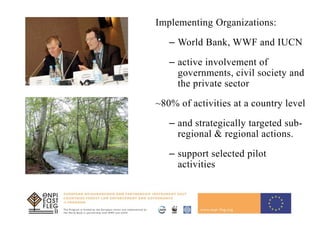
Implementing Organizations:
– World Bank, WWF and IUCN
– active involvement of
governments, civil society and
the private sector
~80% of activities at a country level
– and strategically targeted sub-
regional & regional actions.
– support selected pilot
activities
5
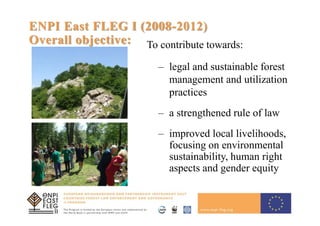
ENPI East FLEG I (2008-2012)
Overall objective: To contribute towards:
– legal and sustainable forest
management and utilization
practices
– a strengthened rule of law
– improved local livelihoods,
focusing on environmental
sustainability, human right
aspects and gender equity
6
ENPI East FLEG I: 7 Result Areas:
Result Area 1: Increased awareness and commitment of key
stakeholders on FLEG
Result Area 2: Effective national and regional FLEG action processes in
place
Result Area 3: Increased national ownership and capacity
Result Area 4: Improved regional and sub-regional collaboration and
knowledge sharing
Result Area 5: Effective engagement of key trading partners
Result Area 6: Continuation of the formal official Europe-North Asia
FLEG process
Result Area 7: Sustainable forest management practices implemented
7
Highlights:
• Analysis of the current forest sector status, and of the forest legislation,
forest policy, and forest institutions, (all countries);
• Support for increasing sustainable forest management capacities
through reviewing, enhancing both the basic and ‘in service’ training
for forestry professionals (e.g. specific training modules were
developed, trialed, and then mainstreamed into the standard training
program);
• Support given to both regional and national levels for forest
certification, and many of the policy and legislative recommendations
will also increase the sustainability of forest management;
• Support for forest policy (all countries), for support to develop
appropriate timber sales systems and transparency, support for forest
certification,
8
Highlights:
• Pilot activities (Belarus, Russia, Armenia, and Georgia),
• Training of forest guards and forestry staff, utilization practices will
have been enhanced;
• Training of forest guards and development of handbooks and guidelines
(Russia, Azerbaijan and Ukraine) for the implementation of processing
of forest crime, changes in policy and legislation to reduce the drivers
of poor forest governance, potential use of Log Tracking (Armenia),
information and communications technology (Moldova),
• Large outreach, public awareness raising will all help to strengthen the
rule of law; and,
• Specific pilot programs to support the development of alternative local
livelihoods and community participation
9
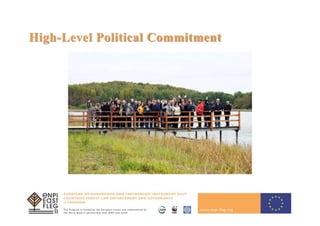
High-Level Political Commitment
10
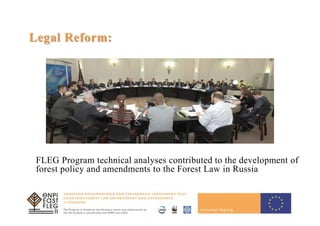
Legal Reform:
FLEG Program technical analyses contributed to the development of
forest policy and amendments to the Forest Law in Russia
11
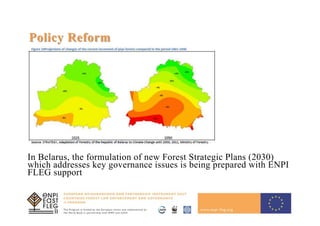
Policy Reform
In Belarus, the formulation of new Forest Strategic Plans (2030)
which addresses key governance issues is being prepared with ENPI
FLEG support
12
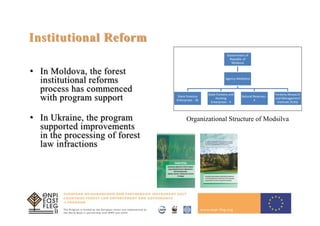
Institutional Reform
• In Moldova, the forest
institutional reforms
process has commenced
with program support
• In Ukraine, the program
supported improvements
in the processing of forest
law infractions
Government of
Republic of
Moldova
Agency Moldsilva
Stare Forestry
Enterprises - 16
State Forestry and
Hunting
Enterprises - 4
Natural Reserves -
4
Forestry Research
and Management
Institute (ICAS)
Organizational Structure of Modsilva
13
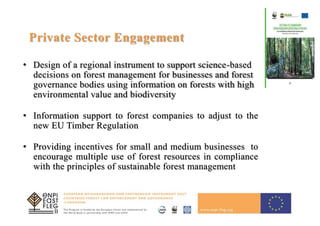
Private Sector Engagement
• Design of a regional instrument to support science-based
decisions on forest management for businesses and forest
governance bodies using information on forests with high
environmental value and biodiversity
• Information support to forest companies to adjust to the
new EU Timber Regulation
• Providing incentives for small and medium businesses to
encourage multiple use of forest resources in compliance
with the principles of sustainable forest management
14
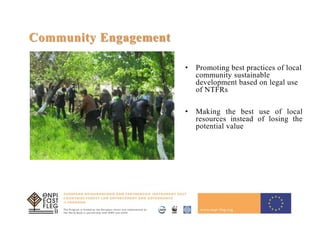
Community Engagement
• Promoting best practices of local
community sustainable
development based on legal use
of NTFRs
• Making the best use of local
resources instead of losing the
potential value
15
ENPI East FLEG II Program PDO to:
• Strengthen forest governance through improving
implementation of relevant international processes;
• Enhance forest policy, legislation and institutional
arrangements; and,
• Develop, test and evaluate sustainable forest management
models at the local level on a pilot basis for future
replication.
16
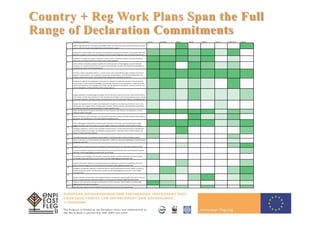
Country + Reg Work Plans Span the Full
Range of Declaration Commitments
Declaration Commitment Armenia Azerbaijan Belarus Georgia Moldova Ukraine Russian Fed Regional
1
Mobilize high-level political commitment and establish Forest Law Enforcement and Governance (FLEG) as an area of
concern within the broader national governance and development agenda
2
Review and as needed update forest legislation and regulations, ensuring their coherence and harmonize these with
legislation and policy in natul resource management and with relevant obligations under international agreements
3
Strengthen, as needed, inter-agency cooperation as well as human institutional capacity, particularly among law
enforcement and judicial authorities to enforce forest-related legislation
4
Assess, identify and develop strategies to address the underlying causes of illegallogging, associated trade and
corruption, the unauthorized extraction of wood for local consumption as well as the unauthorized exploitation of
protected forest areas, threatening biodiversity
5
Formulate, within a reasonable timeframe, concrete actions under clearly defined targets, including monitoring of
progress in implementation, e.g. by taking into account the recommendations of this Ministerial Declaration and
annexed indicative list of actions in the national forest programmes or equivalent frameworks
6
Recognize the rights of forest dependent communities by taking into consideration customary laws and practices,
and the respect of their traditional knowledge, and encourage and promote the participation of indigenous people
and the local population in the management of forests with the objective of providing for rural socio-economic and
cultural development and the protection of their natural resources
7
Engage stakeholders, including indigenous people, local communities, private forest owners, NGOs and the industry,
in formulation of forest laws and policies in their implementation through an open and participatory process, thereby
promoting transparency, reducing coruption, facilitating equity and minimizing undue influence of privileged groups
8
Develop and implement anti-corruption tools dealing with corruption in and impacting on the forest sector in line
with general anti-corruption efforts, including codes of conduct and best practices, and professional responsibility,
and apply internationally recognized principles to combat organized crime
9 Collect and disseminate transparent information on forest resources, their allocation and exploitation, in a form
readily accessible to the public
10
Monitor and disclose data on domestic and international trade flows of timber and timber products and promote, as
appropriate, the establishment of third party audited traceability systems
11
Inform and engage all stakeholders to enhance public awareness on the scope, scale and significance of illegal
logging, associated trade and corruption, and their negative impacts on the benefits forests provide to society
12
Strengthen cooperation, using as much as possible existing structures, for forest law enforcement and governance
and timely exchange of information and experience among countries, in particular, those involved in exports and
imports of timber and timber products
13
Encourage cooperation and strengthen national capacity in monitoring trade in timber and timber products
14 Support cooperation to combat poaching and illegaltrade in wildlife associated with illegallogging, including through
cooperation with CITES
15
Integrate within existing mechanisms the systematic monitoring, assessment and reporting of progress on FLEG
16
Promote and develop cooperation and partnerships with and among the private sector and civil society in order to
effectively combat illegal logging, associated trade and corruption
17
Give priority to and strengthen trans-boundary cooperation between countries with border areas which require
coordinated actions and effective control in order to combat illegal logging and associated trade
18
Enhance international capacity for monitoring, assessing and reporting on areas such as trade flows and customs
data to increase transparency on trade activities and to promote trade in legallyharvested timber
19
Strengthen international cooperation to build and enhance national institutional and human capacity as well as to
facilitate technology transfer and information sharing to combat illegal logging and to promote trade in legally
harvested timber
20
Enhance awareness of information about legality of products including their origin through means such as voluntary
chains of custody and forest certification systems, so as to promote marketing of legally harvested timber
21 Cooperate with civil society including the private sector to inform consumers of the problems caused by illegal
logging, associated trade and corruption
22
Work with other regions and with multilateral instruments and processes on FLEG related issues
17
Sustained Effort
Thank you!

2. ENPI East FLEG Contributions to the ENA FLEG St. Petersburg Ministerial Declaration

  • 1.
    ENPI East FLEGContributions to the ENA FLEG St. Petersburg Ministerial Declaration Andrew Mitchell July 9, 2014
  • 2.
  • 3.
    3 Declaration Signatories Albania, Armenia,Austria, Azerbaijan, Belarus, Bulgaria, Bosnia and Herzegovina, Canada, China Croatia, Denmark, Estonia, Finland, Georgia, Germany, Greece, Italy, Japan, Kazakhstan, Kyrgyzstan, Latvia, Lithuania, Former Yugoslav Republic of Macedonia, Moldova, Mongolia, the Netherlands, Norway, Poland, Portugal, Romania, Russian Federation, Serbia and Montenegro, Slovakia, Slovenia, Spain, Sweden, Switzerland, Tajikistan, Turkey, Ukraine, United Kingdom, United States, and Uzbekistan.
  • 4.
    4 Implementing Organizations: – WorldBank, WWF and IUCN – active involvement of governments, civil society and the private sector ~80% of activities at a country level – and strategically targeted sub- regional & regional actions. – support selected pilot activities
  • 5.
    5 ENPI East FLEGI (2008-2012) Overall objective: To contribute towards: – legal and sustainable forest management and utilization practices – a strengthened rule of law – improved local livelihoods, focusing on environmental sustainability, human right aspects and gender equity
  • 6.
    6 ENPI East FLEGI: 7 Result Areas: Result Area 1: Increased awareness and commitment of key stakeholders on FLEG Result Area 2: Effective national and regional FLEG action processes in place Result Area 3: Increased national ownership and capacity Result Area 4: Improved regional and sub-regional collaboration and knowledge sharing Result Area 5: Effective engagement of key trading partners Result Area 6: Continuation of the formal official Europe-North Asia FLEG process Result Area 7: Sustainable forest management practices implemented
  • 7.
    7 Highlights: • Analysis ofthe current forest sector status, and of the forest legislation, forest policy, and forest institutions, (all countries); • Support for increasing sustainable forest management capacities through reviewing, enhancing both the basic and ‘in service’ training for forestry professionals (e.g. specific training modules were developed, trialed, and then mainstreamed into the standard training program); • Support given to both regional and national levels for forest certification, and many of the policy and legislative recommendations will also increase the sustainability of forest management; • Support for forest policy (all countries), for support to develop appropriate timber sales systems and transparency, support for forest certification,
  • 8.
    8 Highlights: • Pilot activities(Belarus, Russia, Armenia, and Georgia), • Training of forest guards and forestry staff, utilization practices will have been enhanced; • Training of forest guards and development of handbooks and guidelines (Russia, Azerbaijan and Ukraine) for the implementation of processing of forest crime, changes in policy and legislation to reduce the drivers of poor forest governance, potential use of Log Tracking (Armenia), information and communications technology (Moldova), • Large outreach, public awareness raising will all help to strengthen the rule of law; and, • Specific pilot programs to support the development of alternative local livelihoods and community participation
  • 9.
  • 10.
    10 Legal Reform: FLEG Programtechnical analyses contributed to the development of forest policy and amendments to the Forest Law in Russia
  • 11.
    11 Policy Reform In Belarus,the formulation of new Forest Strategic Plans (2030) which addresses key governance issues is being prepared with ENPI FLEG support
  • 12.
    12 Institutional Reform • InMoldova, the forest institutional reforms process has commenced with program support • In Ukraine, the program supported improvements in the processing of forest law infractions Government of Republic of Moldova Agency Moldsilva Stare Forestry Enterprises - 16 State Forestry and Hunting Enterprises - 4 Natural Reserves - 4 Forestry Research and Management Institute (ICAS) Organizational Structure of Modsilva
  • 13.
    13 Private Sector Engagement •Design of a regional instrument to support science-based decisions on forest management for businesses and forest governance bodies using information on forests with high environmental value and biodiversity • Information support to forest companies to adjust to the new EU Timber Regulation • Providing incentives for small and medium businesses to encourage multiple use of forest resources in compliance with the principles of sustainable forest management
  • 14.
    14 Community Engagement • Promotingbest practices of local community sustainable development based on legal use of NTFRs • Making the best use of local resources instead of losing the potential value
  • 15.
    15 ENPI East FLEGII Program PDO to: • Strengthen forest governance through improving implementation of relevant international processes; • Enhance forest policy, legislation and institutional arrangements; and, • Develop, test and evaluate sustainable forest management models at the local level on a pilot basis for future replication.
  • 16.
    16 Country + RegWork Plans Span the Full Range of Declaration Commitments Declaration Commitment Armenia Azerbaijan Belarus Georgia Moldova Ukraine Russian Fed Regional 1 Mobilize high-level political commitment and establish Forest Law Enforcement and Governance (FLEG) as an area of concern within the broader national governance and development agenda 2 Review and as needed update forest legislation and regulations, ensuring their coherence and harmonize these with legislation and policy in natul resource management and with relevant obligations under international agreements 3 Strengthen, as needed, inter-agency cooperation as well as human institutional capacity, particularly among law enforcement and judicial authorities to enforce forest-related legislation 4 Assess, identify and develop strategies to address the underlying causes of illegallogging, associated trade and corruption, the unauthorized extraction of wood for local consumption as well as the unauthorized exploitation of protected forest areas, threatening biodiversity 5 Formulate, within a reasonable timeframe, concrete actions under clearly defined targets, including monitoring of progress in implementation, e.g. by taking into account the recommendations of this Ministerial Declaration and annexed indicative list of actions in the national forest programmes or equivalent frameworks 6 Recognize the rights of forest dependent communities by taking into consideration customary laws and practices, and the respect of their traditional knowledge, and encourage and promote the participation of indigenous people and the local population in the management of forests with the objective of providing for rural socio-economic and cultural development and the protection of their natural resources 7 Engage stakeholders, including indigenous people, local communities, private forest owners, NGOs and the industry, in formulation of forest laws and policies in their implementation through an open and participatory process, thereby promoting transparency, reducing coruption, facilitating equity and minimizing undue influence of privileged groups 8 Develop and implement anti-corruption tools dealing with corruption in and impacting on the forest sector in line with general anti-corruption efforts, including codes of conduct and best practices, and professional responsibility, and apply internationally recognized principles to combat organized crime 9 Collect and disseminate transparent information on forest resources, their allocation and exploitation, in a form readily accessible to the public 10 Monitor and disclose data on domestic and international trade flows of timber and timber products and promote, as appropriate, the establishment of third party audited traceability systems 11 Inform and engage all stakeholders to enhance public awareness on the scope, scale and significance of illegal logging, associated trade and corruption, and their negative impacts on the benefits forests provide to society 12 Strengthen cooperation, using as much as possible existing structures, for forest law enforcement and governance and timely exchange of information and experience among countries, in particular, those involved in exports and imports of timber and timber products 13 Encourage cooperation and strengthen national capacity in monitoring trade in timber and timber products 14 Support cooperation to combat poaching and illegaltrade in wildlife associated with illegallogging, including through cooperation with CITES 15 Integrate within existing mechanisms the systematic monitoring, assessment and reporting of progress on FLEG 16 Promote and develop cooperation and partnerships with and among the private sector and civil society in order to effectively combat illegal logging, associated trade and corruption 17 Give priority to and strengthen trans-boundary cooperation between countries with border areas which require coordinated actions and effective control in order to combat illegal logging and associated trade 18 Enhance international capacity for monitoring, assessing and reporting on areas such as trade flows and customs data to increase transparency on trade activities and to promote trade in legallyharvested timber 19 Strengthen international cooperation to build and enhance national institutional and human capacity as well as to facilitate technology transfer and information sharing to combat illegal logging and to promote trade in legally harvested timber 20 Enhance awareness of information about legality of products including their origin through means such as voluntary chains of custody and forest certification systems, so as to promote marketing of legally harvested timber 21 Cooperate with civil society including the private sector to inform consumers of the problems caused by illegal logging, associated trade and corruption 22 Work with other regions and with multilateral instruments and processes on FLEG related issues
  • 17.
  • 18.

Editor's Notes

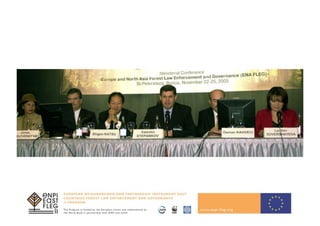
  • #3 In 2004 ENA FLEG process initiated which led to the 2005 St Petersburg conference on FLEG. Brought together more than 300 stakeholders Ministerial declaration signed by 44 countries as well as the EC and US made a total of 29 of commitments both nationally and internationally, such as moblize high level political support for the FLEG Review legislation Strengthen inter-agency cooperation Adopt strategies to address the under-lying causes Strengthen international and regional cooperation Prepare national action plans EC recognized that this process would not be easy and decided to support this process and included the Regional assistance under priority 2 of the ENPI East program.
  • #4 The ENPI FLEG Program directly engages 7 of the 43 country signatories to the St. Petersburg Declaration. The five Central Asian countries plus Turkey were observers; we are glad to have many of those observing countries represented at the conference today and we hope to have increased cooperation with these countries going forward. Full participants (7): Armenia Azerbaijan Belarus Georgia Republic of Moldova Russian Federation Ukraine Observers (5+1): Kazakhstan Kyrgyz Republic Tajikistan Turkmenistan Uzbekistan + Turkey
  • #5 The EC decided a partnership approach towards implementation of the Program was appropriate: The WB brings, governmental contacts, institutional and policy experience WWF experience with working with trade networks and the private sector IUCN works with civil society, conservation and public awareness The tasks to improve FLEG are huge: Clearly this program is just a start or support. So the activities are pilots for future replication both within the countries and on a more wider basis regionally Most of the activities are planned at the country level, but importantly , for the process of replication and building partnerships, some of the activities are regional, across countries and borders.
  • #10  The first Declaration commitment is to “mobilize high level political Commitment” One of the key achievements has been the significant increase in both national ownership of the FLEG processes that have commenced, and also the networking that has occurred both within and between the participating countries. The appointment of senior level civil servants as FLEG National Focal Points, to both chair the National Program Advisory Committees (NPACs) and to participate in the Program’s Operational Committee (the oversight and guidance body of the Program) was instrumental to the Program’s country ownership. The broad NPAC composition also helped create ownership, in that membership included different government (i.e. from related ministries, departments and/or agencies) and non-government (e.g. NGOs, professional associations, academia, and private sector) stakeholders depending on the country.
  • #12 Forest Policy Review conducted in all countries (ENPI FLEG 1) ; in Belarus the formulation of the new Forest Strategic Plans which addresses key governance issues is being prepared with ENPI FLEG support Image shows projection of the current increment of pine forests under climate change from the Belarus Ministry of Forestry Strategy.
  • #15 Local citizens receive information on best cases and will be supported in selecting and on the ground development of their own initiatives in this area. For example, best cases and practices of effective, legal, environmentally friendly and locally-controlled NTFRs use by remote forest-dependent communities across Russia are collected analyzed and provided for replication in the forest settlements of RFE.
  • #16 Local citizens receive information on best cases and will be supported in selecting and on the ground development of their own initiatives in this area. For example, best cases and practices of effective, legal, environmentally friendly and locally-controlled NTFRs use by remote forest-dependent communities across Russia are collected analyzed and provided for replication in the forest settlements of RFE.
  • #17 List of 22 Commitments with the 7 partner countries (and regional activities) listed across the top. Dark green indicates 4 or more activities, lighter shades mean less than 4 activities. Illustrates that our activities touch all areas of the declaration, some more intensely than others and it varies by country. Note certain gaps on the input side that may or may not need addressing in the Y3, Y4 work plans. Countries that are already making good progress in a given area will need less support from the Program in that area.
  • #18 Perhaps FLEG’s most important contribution is the steady, sustained effort of our engagement. Behaviour change takes time. Many, interlocking pieces have to come together to reform forest governance systems. Improving forest governance will always be a work in progress We look forward to continuing to work with our partner countries, engaging in new dialog with the Central Asia countries, and perhaps reaching out to some of the other signatories who have not been involved in the FLEG Program to date.