OECD Joint DAC-EPOC Task Team on Climate
Change and Development Co-operation
Adaptation Policy Developments towards COP21: Key Messages
20-21 April 2015, Paris
M. Letuma, LEG
Presentation Flow
1) Introduction
2) Current Mandate of the LEG
3) Key Messages
4) Key Milestone
Introduction – Least Developed Countries Experts Group (LEG)
1) Established at COP7 (2001)
• Has served 4 mandates [2002-2003, 2004-2005, 2006-2007,
2008-2010], and now in its 5th mandate [2011-2015].
2) Membership
• 10 Members from LDCs (5 Africa, 2 Asia, 2 SIDS, 1 LDC);
• 3 Members from Annex II Parties.
3) Proceedings
• Meets twice a year to discuss implementation of its work
programme
• Chair, Vice-Chair, 3 Rapporteurs (EN, FR, PT)
• 2 members (1 LDC and 1 Annex II) also members of the CGE
• Secretariat prepares reports on the LEG meetings
• LEG reports to the SBI at each session
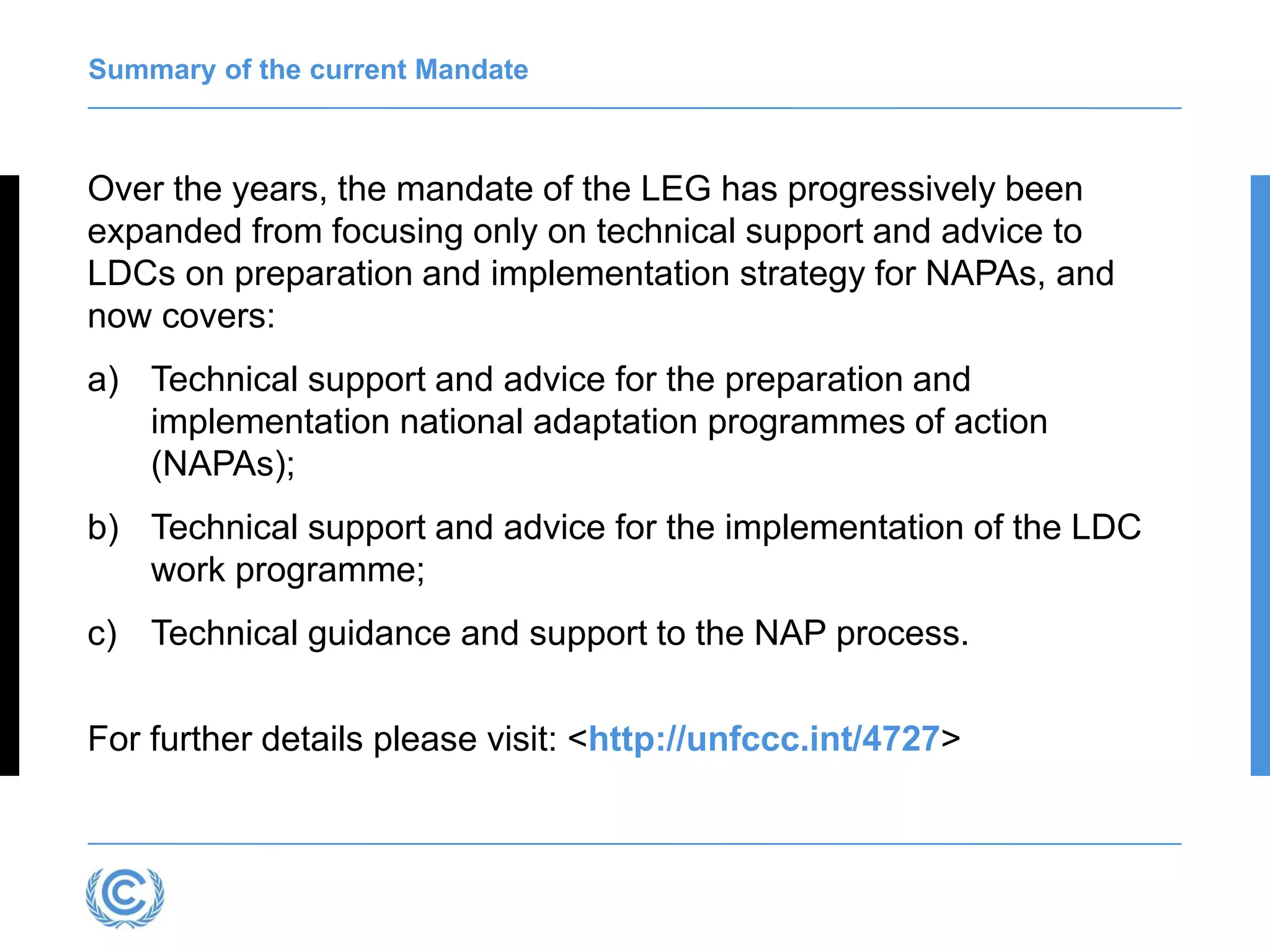
Summary of the current Mandate
Over the years, the mandate of the LEG has progressively been
expanded from focusing only on technical support and advice to
LDCs on preparation and implementation strategy for NAPAs, and
now covers:
a) Technical support and advice for the preparation and
implementation national adaptation programmes of action
(NAPAs);
b) Technical support and advice for the implementation of the LDC
work programme;
c) Technical guidance and support to the NAP process.
For further details please visit: <http://unfccc.int/4727>
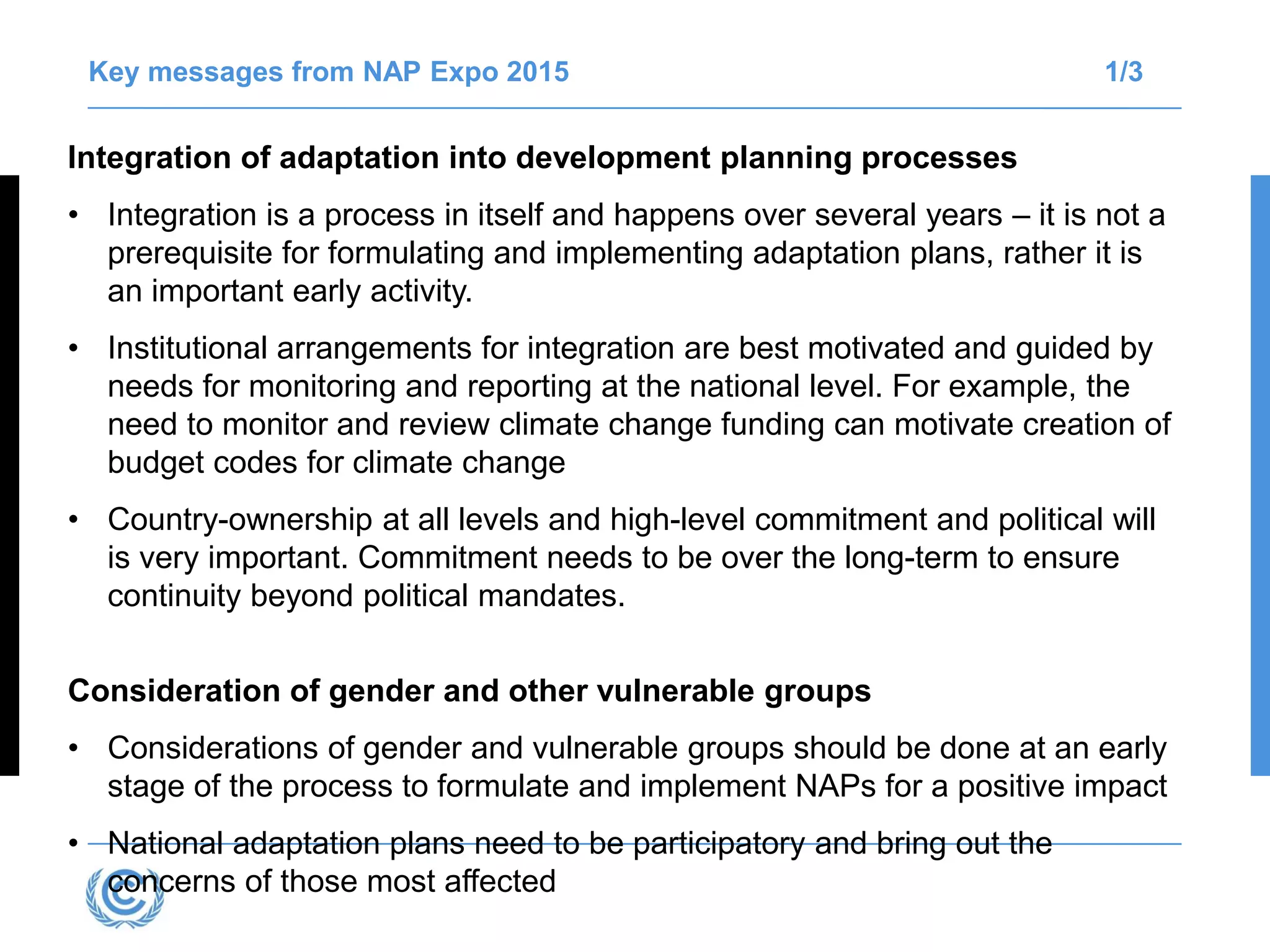
Key messages from NAP Expo 2015 1/3
Integration of adaptation into development planning processes
• Integration is a process in itself and happens over several years – it is not a
prerequisite for formulating and implementing adaptation plans, rather it is
an important early activity.
• Institutional arrangements for integration are best motivated and guided by
needs for monitoring and reporting at the national level. For example, the
need to monitor and review climate change funding can motivate creation of
budget codes for climate change
• Country-ownership at all levels and high-level commitment and political will
is very important. Commitment needs to be over the long-term to ensure
continuity beyond political mandates.
Consideration of gender and other vulnerable groups
• Considerations of gender and vulnerable groups should be done at an early
stage of the process to formulate and implement NAPs for a positive impact
• National adaptation plans need to be participatory and bring out the
concerns of those most affected
Key messages from NAP Expo 2015 2/3
Supporting an integrating approach for the NAP process
• Importance of coherence in the technical aspects of the NAPs through
integrated approaches across the various dimensions (sectors, scales,
themes), recognizing that NAPs are inherently cross-sectoral
• Establishment of NAP Technical Working Group to consider an
integrating framework for the preparatory element of the NAP process to
explore possible avenues for the integrated approaches for the
formulation and implementation of the NAPs, including through working on
country case studies.
Ecosystem-based approaches
• When undertaking ecosystem-based approaches to climate change
adaptation, it is important to take into account non-climate pressures on
ecosystems
Key messages from NAP Expo 2015 3/3
Regional approaches
• Enhanced and more formal collaboration between the LEG and regional centres
and networks would ensure better coverage of regional issues and promote
south-south collaboration between LDCs and non-LDCs
• Regional centres and networks are useful platforms for creating adaptation
communities of practice such as for regional programmes, technical
assessments and support to regional policies
• The region is another important scale for exploring adaptation options – both
policies, programmes and activities, in addition to the national and subnational
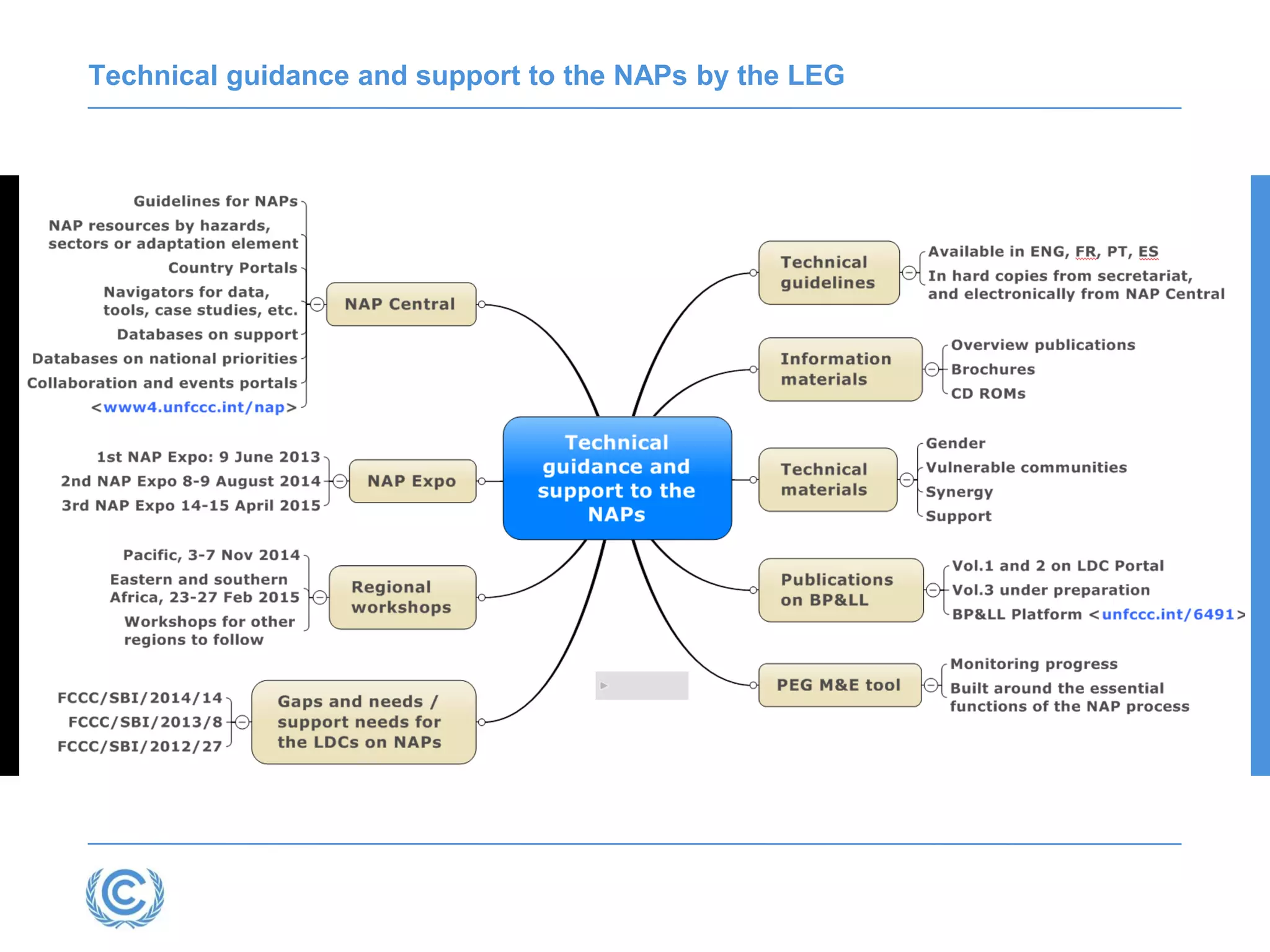
Technical guidance and support to the NAPs by the LEG
Key milestones in the LEG current mandate (2011-2015) 1/2
• 5 regional training workshops on NAPAs, the LDC work
programme and NAPs – a total of 247 participants trained
• Collaboration with over 50 organizations, including: 14 UN
organizations/programmes; 7 other multilateral organizations,
including development banks; 4 development/bilateral agencies; 9
research institutes and other organizations; 11 regional
organizations; 2 NGOs/civil society representatives; 3 private
sector/ consulting firms
• Production of several publications and outreach materials
Key milestones in the LEG current mandate (2011-2015) 2/2
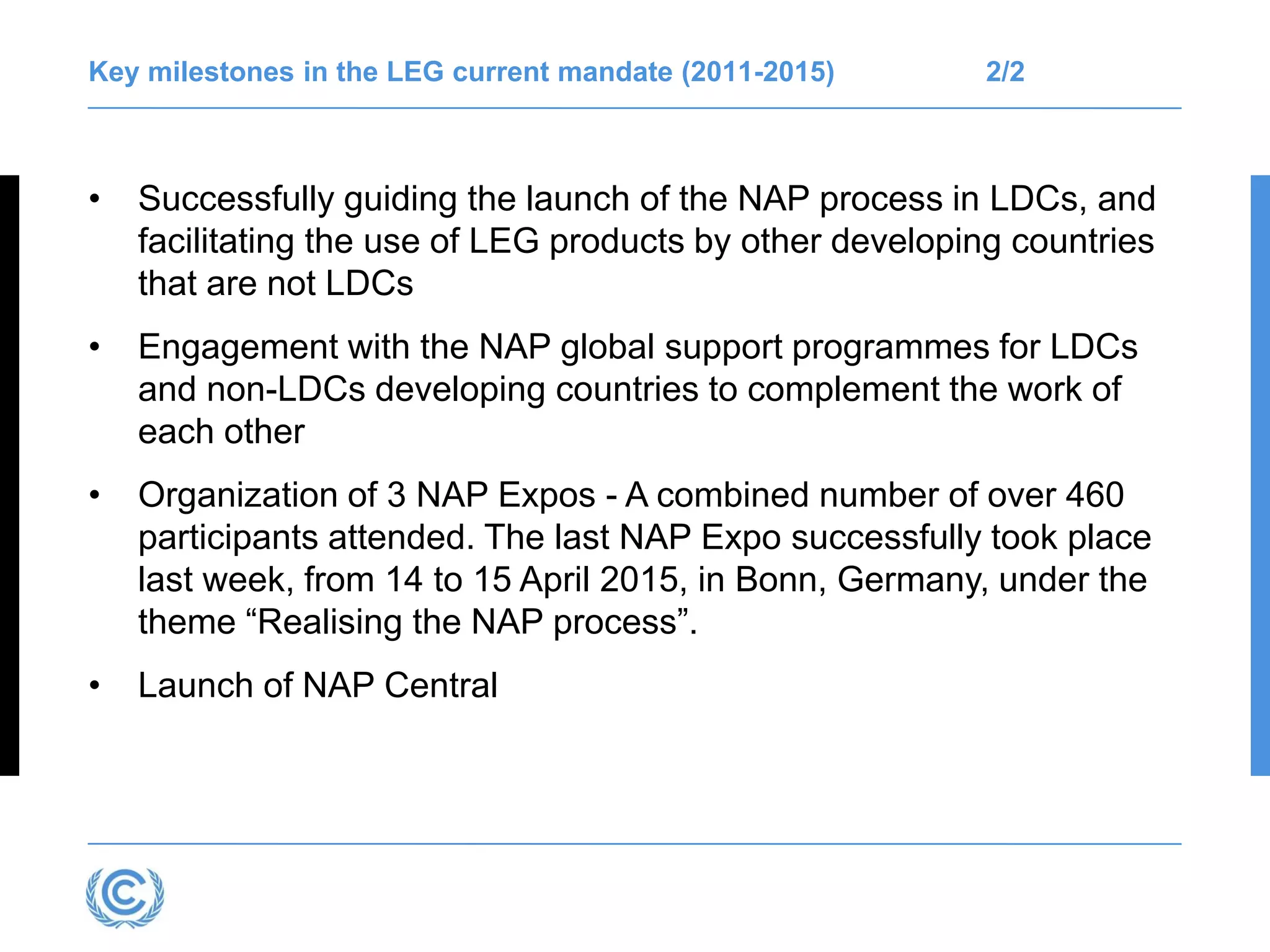
• Successfully guiding the launch of the NAP process in LDCs, and
facilitating the use of LEG products by other developing countries
that are not LDCs
• Engagement with the NAP global support programmes for LDCs
and non-LDCs developing countries to complement the work of
each other
• Organization of 3 NAP Expos - A combined number of over 460
participants attended. The last NAP Expo successfully took place
last week, from 14 to 15 April 2015, in Bonn, Germany, under the
theme “Realising the NAP process”.
• Launch of NAP Central
The Chair
Mr. Batu Krishna UPRETY
E-mail: upretybk@gmail.com
Secretariat
E-mail: leghelp@unfccc.int
To contact the LEG

III.2 DAC-EPOC JOINT TASK TEAM ON CLIMATE CHANGE AND DEVELOPMENT CO-OPERATION

  • 1.
    OECD Joint DAC-EPOCTask Team on Climate Change and Development Co-operation Adaptation Policy Developments towards COP21: Key Messages 20-21 April 2015, Paris M. Letuma, LEG
  • 2.
    Presentation Flow 1) Introduction 2)Current Mandate of the LEG 3) Key Messages 4) Key Milestone
  • 3.
    Introduction – LeastDeveloped Countries Experts Group (LEG) 1) Established at COP7 (2001) • Has served 4 mandates [2002-2003, 2004-2005, 2006-2007, 2008-2010], and now in its 5th mandate [2011-2015]. 2) Membership • 10 Members from LDCs (5 Africa, 2 Asia, 2 SIDS, 1 LDC); • 3 Members from Annex II Parties. 3) Proceedings • Meets twice a year to discuss implementation of its work programme • Chair, Vice-Chair, 3 Rapporteurs (EN, FR, PT) • 2 members (1 LDC and 1 Annex II) also members of the CGE • Secretariat prepares reports on the LEG meetings • LEG reports to the SBI at each session
  • 4.
    Summary of thecurrent Mandate Over the years, the mandate of the LEG has progressively been expanded from focusing only on technical support and advice to LDCs on preparation and implementation strategy for NAPAs, and now covers: a) Technical support and advice for the preparation and implementation national adaptation programmes of action (NAPAs); b) Technical support and advice for the implementation of the LDC work programme; c) Technical guidance and support to the NAP process. For further details please visit: <http://unfccc.int/4727>
  • 5.
    Key messages fromNAP Expo 2015 1/3 Integration of adaptation into development planning processes • Integration is a process in itself and happens over several years – it is not a prerequisite for formulating and implementing adaptation plans, rather it is an important early activity. • Institutional arrangements for integration are best motivated and guided by needs for monitoring and reporting at the national level. For example, the need to monitor and review climate change funding can motivate creation of budget codes for climate change • Country-ownership at all levels and high-level commitment and political will is very important. Commitment needs to be over the long-term to ensure continuity beyond political mandates. Consideration of gender and other vulnerable groups • Considerations of gender and vulnerable groups should be done at an early stage of the process to formulate and implement NAPs for a positive impact • National adaptation plans need to be participatory and bring out the concerns of those most affected
  • 6.
    Key messages fromNAP Expo 2015 2/3 Supporting an integrating approach for the NAP process • Importance of coherence in the technical aspects of the NAPs through integrated approaches across the various dimensions (sectors, scales, themes), recognizing that NAPs are inherently cross-sectoral • Establishment of NAP Technical Working Group to consider an integrating framework for the preparatory element of the NAP process to explore possible avenues for the integrated approaches for the formulation and implementation of the NAPs, including through working on country case studies. Ecosystem-based approaches • When undertaking ecosystem-based approaches to climate change adaptation, it is important to take into account non-climate pressures on ecosystems
  • 7.
    Key messages fromNAP Expo 2015 3/3 Regional approaches • Enhanced and more formal collaboration between the LEG and regional centres and networks would ensure better coverage of regional issues and promote south-south collaboration between LDCs and non-LDCs • Regional centres and networks are useful platforms for creating adaptation communities of practice such as for regional programmes, technical assessments and support to regional policies • The region is another important scale for exploring adaptation options – both policies, programmes and activities, in addition to the national and subnational
  • 8.
    Technical guidance andsupport to the NAPs by the LEG
  • 9.
    Key milestones inthe LEG current mandate (2011-2015) 1/2 • 5 regional training workshops on NAPAs, the LDC work programme and NAPs – a total of 247 participants trained • Collaboration with over 50 organizations, including: 14 UN organizations/programmes; 7 other multilateral organizations, including development banks; 4 development/bilateral agencies; 9 research institutes and other organizations; 11 regional organizations; 2 NGOs/civil society representatives; 3 private sector/ consulting firms • Production of several publications and outreach materials
  • 10.
    Key milestones inthe LEG current mandate (2011-2015) 2/2 • Successfully guiding the launch of the NAP process in LDCs, and facilitating the use of LEG products by other developing countries that are not LDCs • Engagement with the NAP global support programmes for LDCs and non-LDCs developing countries to complement the work of each other • Organization of 3 NAP Expos - A combined number of over 460 participants attended. The last NAP Expo successfully took place last week, from 14 to 15 April 2015, in Bonn, Germany, under the theme “Realising the NAP process”. • Launch of NAP Central
  • 11.
    The Chair Mr. BatuKrishna UPRETY E-mail: upretybk@gmail.com Secretariat E-mail: leghelp@unfccc.int To contact the LEG