Kris Hall MFA, IPEC/SBIRT Program Manager
Brianna Nalley MPH, SBIRT Program Coordinator
Collaborative SBIRT Training for Maine’s
Future Health Profession Leaders
Today’s Agenda
1. IPE at UNE
2. SBIRT and the School of
Social Work
3. SBIRT Student Leader
Program
4. Questions/Comments
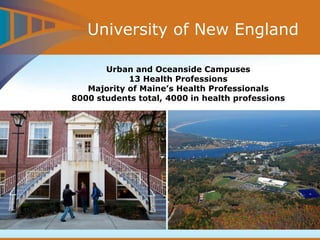
University of New England
Urban and Oceanside Campuses
13 Health Professions
Majority of Maine’s Health Professionals
8000 students total, 4000 in health professions
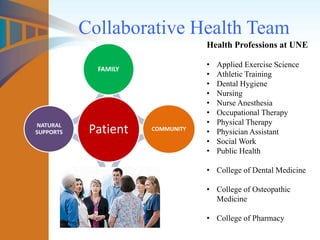
Health Professions at UNE
• Applied Exercise Science
• Athletic Training
• Dental Hygiene
• Nursing
• Nurse Anesthesia
• Occupational Therapy
• Physical Therapy
• Physician Assistant
• Social Work
• Public Health
• College of Dental Medicine
• College of Osteopathic
Medicine
• College of Pharmacy
Collaborative Health Team
Patient
FAMILY
NATURAL
SUPPORTS
COMMUNITY
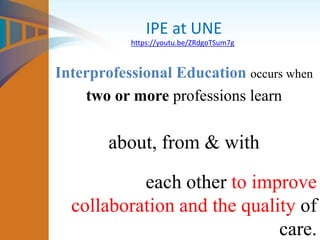
Interprofessional Education occurs when
two or more professions learn
about, from & with
each other to improve
collaboration and the quality of
care.
IPE at UNE
https://youtu.be/ZRdgoTSum7g
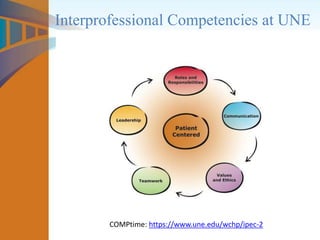
Interprofessional Competencies at UNE
COMPtime: https://www.une.edu/wchp/ipec-2
IPEC Grants
• Bingham - COMPtime
• Arthur Vining Davis - COMPtime
• Macy – Statewide Summit, Inaugural
Showcase
• Dallaire – Mini-grants
• AHEC – Mini-grants
• SBIRT – IP Activities
• Institutional Support – Events, Staff
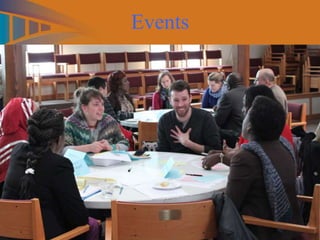
Events
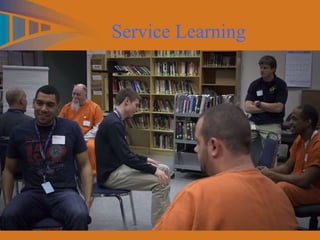
Service Learning
IP STUDENT-LED
MINI-GRANTS
GOAL
• Collaboration-ready health
professionals
METHODS
• Modest funding through a
comprehensive grantmaking process
• Deliberately crafted Interprofessional
Teams
• Service learning, cultural curiosity
and humility, and the use of arts
encouraged
• Student and faculty accountability
• Requirement to present finished
work
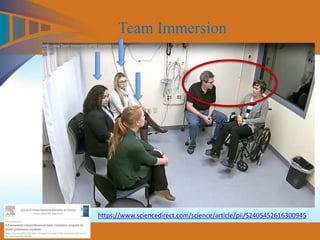
Team Immersion
https://www.sciencedirect.com/science/article/pii/S2405452616300945
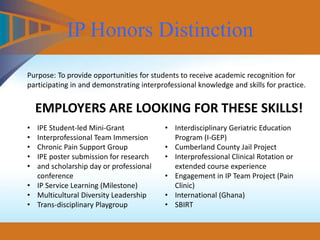
IP Honors Distinction
Purpose: To provide opportunities for students to receive academic recognition for
participating in and demonstrating interprofessional knowledge and skills for practice.
EMPLOYERS ARE LOOKING FOR THESE SKILLS!
• IPE Student-led Mini-Grant
• Interprofessional Team Immersion
• Chronic Pain Support Group
• IPE poster submission for research
• and scholarship day or professional
conference
• IP Service Learning (Milestone)
• Multicultural Diversity Leadership
• Trans-disciplinary Playgroup
• Interdisciplinary Geriatric Education
Program (I-GEP)
• Cumberland County Jail Project
• Interprofessional Clinical Rotation or
extended course experience
• Engagement in IP Team Project (Pain
Clinic)
• International (Ghana)
• SBIRT
Collaborative SBIRT Training for Maine’s
Future Health Profession Leaders
2016-2019
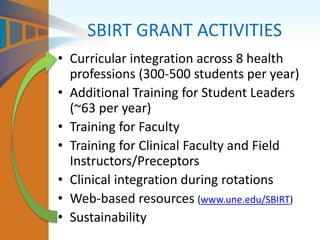
SBIRT GRANT ACTIVITIES
• Curricular integration across 8 health
professions (300-500 students per year)
• Additional Training for Student Leaders
(~63 per year)
• Training for Faculty
• Training for Clinical Faculty and Field
Instructors/Preceptors
• Clinical integration during rotations
• Web-based resources (www.une.edu/SBIRT)
• Sustainability
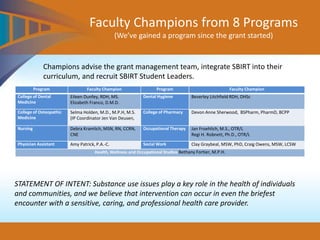
Faculty Champions from 8 Programs
(We’ve gained a program since the grant started)
Champions advise the grant management team, integrate SBIRT into their
curriculum, and recruit SBIRT Student Leaders.
Program Faculty Champion Program Faculty Champion
College of Dental
Medicine
Eileen Dunfey, RDH, MS.
Elizabeth Franco, D.M.D.
Dental Hygiene Beverley Litchfield RDH, DHSc
College of Osteopathic
Medicine
Selma Holden, M.D., M.P.H, M.S.
(IP Coordinator Jen Van Deusen,
College of Pharmacy Devon Anne Sherwood, BSPharm, PharmD, BCPP
Nursing Debra Kramlich, MSN, RN, CCRN,
CNE
Occupational Therapy Jan Froehlich, M.S., OTR/L
Regi H. Robnett, Ph.D., OTR/L
Physician Assistant Amy Patrick, P.A.-C. Social Work Clay Graybeal, MSW, PhD, Craig Owens, MSW, LCSW
Health, Wellness and Occupational Studies Bethany Fortier, M.P.H.
STATEMENT OF INTENT: Substance use issues play a key role in the health of individuals
and communities, and we believe that intervention can occur in even the briefest
encounter with a sensitive, caring, and professional health care provider.
Today’s Agenda
1. IPE at UNE
2. SBIRT and the School of
Social Work
3. SBIRT Student Leader
Program
4. Questions/Comments
Leadership
How to be an
Agent of Change
Today’s Agenda
1. IPE at UNE
2. SBIRT and the School of
Social Work
3. SBIRT Student Leader
Program
4. Questions/Comments
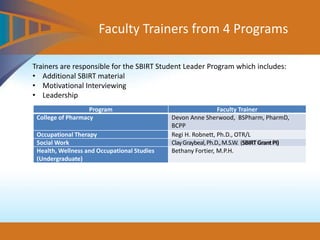
Faculty Trainers from 4 Programs
Trainers are responsible for the SBIRT Student Leader Program which includes:
• Additional SBIRT material
• Motivational Interviewing
• Leadership
Program Faculty Trainer
College of Pharmacy Devon Anne Sherwood, BSPharm, PharmD,
BCPP
Occupational Therapy Regi H. Robnett, Ph.D., OTR/L
Social Work ClayGraybeal,Ph.D.,M.S.W. (SBIRTGrantPI)
Health, Wellness and Occupational Studies
(Undergraduate)
Bethany Fortier, M.P.H.
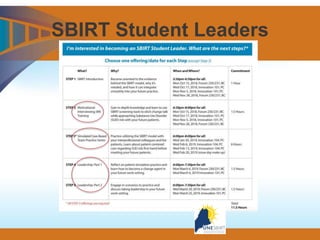
SBIRT Student Leaders
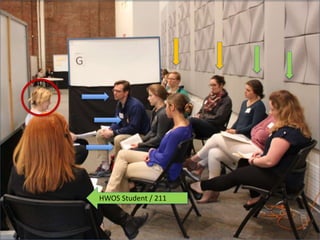
HWOS Student / 211
Today’s Agenda
1. IPE at UNE
2. SBIRT and the School of
Social Work
3. SBIRT Student Leader
Program
4. Questions/Comments
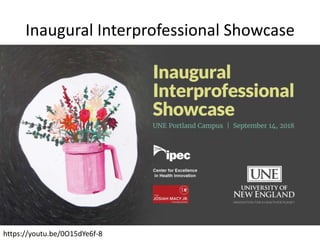
Inaugural Interprofessional Showcase
https://youtu.be/0O15dYe6f-8
University of New England
716 Stevens Avenue
326/7 Hersey Hall, Portland Campus
207/221-4491
sbirt@une.edu Twitter: @UNESBIRT
ipec@une.edu
Keep in Touch!
@UNEIPE or @IPE4all
Interprofessional
Education Collaborative

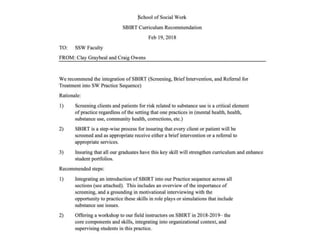
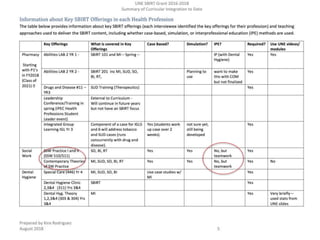
UNE SBIRT and Social Work

  • 1.
    Kris Hall MFA,IPEC/SBIRT Program Manager Brianna Nalley MPH, SBIRT Program Coordinator Collaborative SBIRT Training for Maine’s Future Health Profession Leaders
  • 2.
    Today’s Agenda 1. IPEat UNE 2. SBIRT and the School of Social Work 3. SBIRT Student Leader Program 4. Questions/Comments
  • 3.
    University of NewEngland Urban and Oceanside Campuses 13 Health Professions Majority of Maine’s Health Professionals 8000 students total, 4000 in health professions
  • 4.
    Health Professions atUNE • Applied Exercise Science • Athletic Training • Dental Hygiene • Nursing • Nurse Anesthesia • Occupational Therapy • Physical Therapy • Physician Assistant • Social Work • Public Health • College of Dental Medicine • College of Osteopathic Medicine • College of Pharmacy Collaborative Health Team Patient FAMILY NATURAL SUPPORTS COMMUNITY
  • 5.
    Interprofessional Education occurswhen two or more professions learn about, from & with each other to improve collaboration and the quality of care. IPE at UNE https://youtu.be/ZRdgoTSum7g
  • 6.
    Interprofessional Competencies atUNE COMPtime: https://www.une.edu/wchp/ipec-2
  • 7.
    IPEC Grants • Bingham- COMPtime • Arthur Vining Davis - COMPtime • Macy – Statewide Summit, Inaugural Showcase • Dallaire – Mini-grants • AHEC – Mini-grants • SBIRT – IP Activities • Institutional Support – Events, Staff
  • 8.
  • 9.
  • 10.
    IP STUDENT-LED MINI-GRANTS GOAL • Collaboration-readyhealth professionals METHODS • Modest funding through a comprehensive grantmaking process • Deliberately crafted Interprofessional Teams • Service learning, cultural curiosity and humility, and the use of arts encouraged • Student and faculty accountability • Requirement to present finished work
  • 11.
  • 12.
    IP Honors Distinction Purpose:To provide opportunities for students to receive academic recognition for participating in and demonstrating interprofessional knowledge and skills for practice. EMPLOYERS ARE LOOKING FOR THESE SKILLS! • IPE Student-led Mini-Grant • Interprofessional Team Immersion • Chronic Pain Support Group • IPE poster submission for research • and scholarship day or professional conference • IP Service Learning (Milestone) • Multicultural Diversity Leadership • Trans-disciplinary Playgroup • Interdisciplinary Geriatric Education Program (I-GEP) • Cumberland County Jail Project • Interprofessional Clinical Rotation or extended course experience • Engagement in IP Team Project (Pain Clinic) • International (Ghana) • SBIRT
  • 13.
    Collaborative SBIRT Trainingfor Maine’s Future Health Profession Leaders 2016-2019
  • 14.
    SBIRT GRANT ACTIVITIES •Curricular integration across 8 health professions (300-500 students per year) • Additional Training for Student Leaders (~63 per year) • Training for Faculty • Training for Clinical Faculty and Field Instructors/Preceptors • Clinical integration during rotations • Web-based resources (www.une.edu/SBIRT) • Sustainability
  • 15.
    Faculty Champions from8 Programs (We’ve gained a program since the grant started) Champions advise the grant management team, integrate SBIRT into their curriculum, and recruit SBIRT Student Leaders. Program Faculty Champion Program Faculty Champion College of Dental Medicine Eileen Dunfey, RDH, MS. Elizabeth Franco, D.M.D. Dental Hygiene Beverley Litchfield RDH, DHSc College of Osteopathic Medicine Selma Holden, M.D., M.P.H, M.S. (IP Coordinator Jen Van Deusen, College of Pharmacy Devon Anne Sherwood, BSPharm, PharmD, BCPP Nursing Debra Kramlich, MSN, RN, CCRN, CNE Occupational Therapy Jan Froehlich, M.S., OTR/L Regi H. Robnett, Ph.D., OTR/L Physician Assistant Amy Patrick, P.A.-C. Social Work Clay Graybeal, MSW, PhD, Craig Owens, MSW, LCSW Health, Wellness and Occupational Studies Bethany Fortier, M.P.H. STATEMENT OF INTENT: Substance use issues play a key role in the health of individuals and communities, and we believe that intervention can occur in even the briefest encounter with a sensitive, caring, and professional health care provider.
  • 16.
    Today’s Agenda 1. IPEat UNE 2. SBIRT and the School of Social Work 3. SBIRT Student Leader Program 4. Questions/Comments
  • 20.
    Leadership How to bean Agent of Change
  • 21.
    Today’s Agenda 1. IPEat UNE 2. SBIRT and the School of Social Work 3. SBIRT Student Leader Program 4. Questions/Comments
  • 22.
    Faculty Trainers from4 Programs Trainers are responsible for the SBIRT Student Leader Program which includes: • Additional SBIRT material • Motivational Interviewing • Leadership Program Faculty Trainer College of Pharmacy Devon Anne Sherwood, BSPharm, PharmD, BCPP Occupational Therapy Regi H. Robnett, Ph.D., OTR/L Social Work ClayGraybeal,Ph.D.,M.S.W. (SBIRTGrantPI) Health, Wellness and Occupational Studies (Undergraduate) Bethany Fortier, M.P.H.
  • 23.
  • 24.
  • 26.
    Today’s Agenda 1. IPEat UNE 2. SBIRT and the School of Social Work 3. SBIRT Student Leader Program 4. Questions/Comments
  • 27.
  • 28.
    University of NewEngland 716 Stevens Avenue 326/7 Hersey Hall, Portland Campus 207/221-4491 sbirt@une.edu Twitter: @UNESBIRT ipec@une.edu Keep in Touch! @UNEIPE or @IPE4all Interprofessional Education Collaborative

Editor's Notes

  • #2 Thanks to JBS for asking us, who we are, year three, staff of two, plus graduate assistants
  • #3 Brian’s suggested topic areas
  • #4 Shelley Cohen Konrad, Ph.D., and Associate Professor in the School of Social Work has worked for 10 years at UNE to affect culture change among the health professions at UNE, paving the way for a wide variety of interprofessional innovation and impact. Kris Hall is the Program Manager for the University of New England Center of Excellence in Interprofessional Education. She oversees the weekly IPE event series on campus, and the Student-Led Mini-Grant program. Kris is an MFA graduate of Maine College of Art and the Skowhegan School of Painting and Sculpture. She brings over 20 years of intensive teamwork in higher education and professional theatre to her work at the Collaborative. University of New England is a private institution that was founded in 1831. It has a total enrollment of 8000 students, half of which are studying for a health professions career of some kind. University of New England's ranking in the 2018 edition of Best Colleges is Regional Universities North, 78. Its tuition and fees are $36,530 (2017-18).
  • #5 Health Professions trained at UNE
  • #6 IP Is
  • #7 Competencies and culture
  • #8 Brian’s suggested topic areas
  • #9 IPE opportunities on campus
  • #10 IPE opportunities on campus
  • #11 KH Our students are beset on all sides with expectations for their future practice. Accreditation Standards. New ACA payment policies. As many as 210,000 people per year dying from medical error in the United States. Our challenge as interprofessional educators at UNE (where there are 13 health professions programs) is not to add to their burden, but rather inspire confidence in student’s ability to rely on each other to achieve excellent patient care, thereby making some of the other expectations easier to achieve. There are various ways to “do” interprofessional - and it is important to do it in a supervised setting before attempting it in the ”real” world, since our students are by and large much more IPE ready than their preceptors or rotation environments may be. In the educational setting, we can conduct case-based learning, simulated clinical environments, and interactive role playing. Some institutions have student led clinics, where IP is part of the infrastructure. Most formal clinical rotation requirements are not purposely interprofessional, and unless the experience is deliberately crafted to be so… With this program we seek to provide a bridge from the classroom to the clinic and create collaboration ready health professionals who have grant seeking experience, have crafted their own teams toward their own objectives, have incorporated service learning, cultural humility and the arts in their scope of practice, have been accountable to themselves, their patients/clients and us, and have presented their finished work at a conference, or conference-like forum. Relationship between gathering evidence and clinical practice – not just one or the other, but a continuum.   Student-Led Mini-Grant program provides modest funding for IP research and scholarship. Our goal is to develop collaboration-ready health professionals who have practiced successful teamwork, leadership and hands-on problem solving as part of their education. These grants fund interprofessional scholarship and research conceived and carried out by students with faculty mentorship. Methods: The presenters will provide the application and marketing materials to enable other institutions to develop their own Student-Led Mini-Grant program. Successful grants are widely varied in their approach and outcomes, presenters will discuss the challenges and opportunities that a small investment in IPE interest generated. Grant recipients share their perspectives on IPE as a result of developing and leading their own research and scholarship efforts. Results: Knowledge gained from the projects completed so far has led students and faculty to consider varied approaches to IP education and practice. Whether interviewing pain patients with an eye toward utilizing the power of their stories to help others, or providing physical therapy intervention at a Medically Oriented Gym for diabetes patients, students, faculty and clients are actively learning about, from, and with each other. Implications: Small-scale, hands-on experiences such as these help to create an IP leadership ethic among students that they will carry with them in addition to expertise in their field, making them dynamic members of their future teams. The discipline and organization necessary to apply for and execute a grant, the reassurance of faculty mentorship while providing a valuable community service are a powerful educational combination.
  • #12 Journal of Interprofessional Education & Practice Volume 6, March 2017, Pages 49-54 The interprofessional team immersion (IPTI) is a developmental, longitudinal, and sustainable curricular resource that was designed in response to student requests for small, interactive, cross-professional learning experiences. Learning objectives are aligned with behaviors as identified in the Core Competencies for Interprofessional Practice and aim to increase students' understanding of each other's roles and responsibilities, to apply teamwork principles, to refine communication skills for contextualized person-centered practice, and to utilize knowledge in the presentation of a collective project. Instructional formats include a team-building exercise, case-based learning, and simulation. Pre- and post-session evaluation measured students' attitudinal and behavioral changes. Rapid cycle program evaluation used student feedback to continuously improve the quality of the learning experience. Overall students found IPTI to increase their knowledge of other professions, build confidence in their team skills, and provide a basis for working collaboratively in their future workplace settings. Program evaluation feedback reinforced the efficacy of small group, interactive learning and full faculty engagement in IPE learning activities. Both a successful and sustainable shared learning activity, IPTI offers generalizable content, instructional approaches, and assessment strategies for other institutions seeking transformative team-based learning experiences.
  • #13 Various activities and Honors Distinction – all of these are available to SBIRT Student Leaders
  • #14 SBIRT Training Grant
  • #15 Key Grant Activities, some not completed during the year with 34% budget cut, sustainability reinforced by curricular integration.
  • #16 Cover the programs included, subsequently added, and statement of intent, as informed by IPE Culture
  • #17 Brian’s suggested topic areas
  • #18 Dental Hygiene Clinic!
  • #21 Brian’s suggested topic areas
  • #22 Brian’s suggested topic areas
  • #24 Students are accustomed to and looking for extracurricular because of IPEC, we know the best times to schedule, and the kind of programming that appeals to them. We always find a way to provide food.
  • #29 IPEC and SBIRT contact info.