The Insider’s Guide
Understanding Retargeting
Case StudyTrademob Insider Series
The mobile landscape is changing. Users are spending
more time in less apps1
, while the Apple App Store and
Google Play Store have never had more apps on offer2
.
On top of that, the cost of acquiring new users
is rising steadily3
.
This means that it is no longer an app advertiser’s singular
goal to get as many users into the app as possible. While a
large user base is of course preferable to a small one, the
quality of users is becoming more and more important.
Developers and advertisers aim for loyal users who engage
with the app. Mobile app retargeting can help to re-engage
dormant users, unlocking the potential
of the app’s sleeping giants.
Retargeting is a distinct service offering in mobile
advertising. This is due to two main reasons: the users who
are targeted are already familiar with the product or brand,
and it takes place almost exclusively via programmatic
means. In this guide we will explain why retargeting is
important, how it works and how it can make an app more
profitable at a much lower cost than acquiring new users.
www.trademob.com – info@trademob.com
Advertisers looking to start a retargeting
campaign must ensure they have the following
in place:
1. A solid user base
An effective retargeting campaign requires a
certain user base size. This varies according to the
app type. Each user’s device has a device ID (IDFA
in the case of iOS and Google Advertising ID for
Android). A list of these is essential, so that the
campaign can target individual users.
2. A tracking solution
This is vital for a retargeting campaign. The
tracking solution must be capable of retargeting
matching (clicks and actions are matched) and (re-)
attribution logic.
3. Deep linking
The app must be capable of providing deep links
that take users directly into the app. This way,
banner ads can be more specific and therefore
more effective.
As many as
only open an app
10 times or less
Requirements for Mobile App Retargeting
Sleeping Giants: The Dormant Potential in Your
User Base
The Mobile App Retargeting Process
While apps are being downloaded at a record rate of up
to 48,000 per minute4
, the chance of an app being used
regularly after it was downloaded is pretty low. One fifth of
apps are only opened once they were downloaded and as
many as 60% of apps are opened ten times or less5
. However,
since something encouraged the user to download an app
in the first place, this can and should be leveraged – by
retargeting the user.
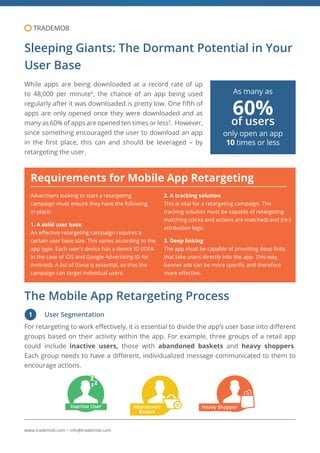
1 User Segmentation
For retargeting to work effectively, it is essential to divide the app’s user base into different
groups based on their activity within the app. For example, three groups of a retail app
could include inactive users, those with abandoned baskets and heavy shoppers.
Each group needs to have a different, individualized message communicated to them to
encourage actions.
60%
of users
inactive userInactive User Abandoned
Basket
Heavy Shopper
www.trademob.com – info@trademob.com Friedrichstraße 126, 10117 Berlin
2 Banner Design
After segmenting effectively, these groups can then be retargeted using bespoke messaging.
Banners should be designed based on the user’s behavior in the app.
Come back! Complete
purchase! Buy more!
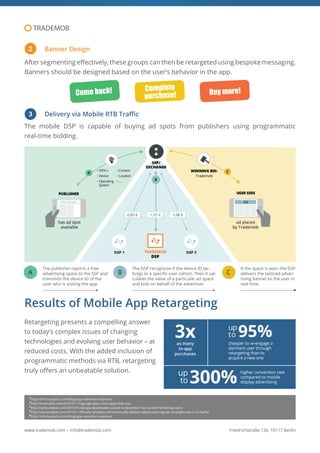
3 Delivery via Mobile RTB Traffic
The mobile DSP is capable of buying ad spots from publishers using programmatic
real-time bidding.
Retargeting presents a compelling answer
to today’s complex issues of changing
technologies and evolving user behavior – at
reduced costs. With the added inclusion of
programmatic methods via RTB, retargeting
truly offers an unbeatable solution.
A B C
The publisher reports a free
advertising space to the SSP and
transmits the device ID of the
user who is visiting the app.
1
http://info.localytics.com/blog/app-retention-improves
2
http://mashable.com/2015/01/15/google-play-more-apps-than-ios/
3
http://venturebeat.com/2015/01/26/app-downloads-soared-in-december-but-so-did-marketing-costs/
4
http://venturebeat.com/2014/11/09/why-phablets-will-eventually-replace-tablets-and-regular-smartphones-in-3-charts/
5
http://info.localytics.com/blog/app-retention-improves
The DSP recognizes if the device ID be-
longs to a specific user cohort. Then it cal-
culates the value of a particular ad space
and bids on behalf of the advertiser.
If the space is won, the DSP
delivers the tailored adver-
tising banner to the user in
real time.
Results of Mobile App Retargeting
as many
in-app
purchases
cheaper to re-engage a
dormant user through
retargeting than to
acquire a new one
up
to3x 95%
higher conversion rate
compared to mobile
display advertising
up
to 300%

understanding_retargeting

  • 1.
    The Insider’s Guide UnderstandingRetargeting Case StudyTrademob Insider Series
  • 2.
    The mobile landscapeis changing. Users are spending more time in less apps1 , while the Apple App Store and Google Play Store have never had more apps on offer2 . On top of that, the cost of acquiring new users is rising steadily3 . This means that it is no longer an app advertiser’s singular goal to get as many users into the app as possible. While a large user base is of course preferable to a small one, the quality of users is becoming more and more important. Developers and advertisers aim for loyal users who engage with the app. Mobile app retargeting can help to re-engage dormant users, unlocking the potential of the app’s sleeping giants. Retargeting is a distinct service offering in mobile advertising. This is due to two main reasons: the users who are targeted are already familiar with the product or brand, and it takes place almost exclusively via programmatic means. In this guide we will explain why retargeting is important, how it works and how it can make an app more profitable at a much lower cost than acquiring new users. www.trademob.com – info@trademob.com
  • 3.
    www.trademob.com – info@trademob.com Advertiserslooking to start a retargeting campaign must ensure they have the following in place: 1. A solid user base An effective retargeting campaign requires a certain user base size. This varies according to the app type. Each user’s device has a device ID (IDFA in the case of iOS and Google Advertising ID for Android). A list of these is essential, so that the campaign can target individual users. 2. A tracking solution This is vital for a retargeting campaign. The tracking solution must be capable of retargeting matching (clicks and actions are matched) and (re-) attribution logic. 3. Deep linking The app must be capable of providing deep links that take users directly into the app. This way, banner ads can be more specific and therefore more effective. As many as only open an app 10 times or less Requirements for Mobile App Retargeting Sleeping Giants: The Dormant Potential in Your User Base The Mobile App Retargeting Process While apps are being downloaded at a record rate of up to 48,000 per minute4 , the chance of an app being used regularly after it was downloaded is pretty low. One fifth of apps are only opened once they were downloaded and as many as 60% of apps are opened ten times or less5 . However, since something encouraged the user to download an app in the first place, this can and should be leveraged – by retargeting the user. 1 User Segmentation For retargeting to work effectively, it is essential to divide the app’s user base into different groups based on their activity within the app. For example, three groups of a retail app could include inactive users, those with abandoned baskets and heavy shoppers. Each group needs to have a different, individualized message communicated to them to encourage actions. 60% of users inactive userInactive User Abandoned Basket Heavy Shopper
  • 4.
    www.trademob.com – info@trademob.comFriedrichstraße 126, 10117 Berlin 2 Banner Design After segmenting effectively, these groups can then be retargeted using bespoke messaging. Banners should be designed based on the user’s behavior in the app. Come back! Complete purchase! Buy more! 3 Delivery via Mobile RTB Traffic The mobile DSP is capable of buying ad spots from publishers using programmatic real-time bidding. Retargeting presents a compelling answer to today’s complex issues of changing technologies and evolving user behavior – at reduced costs. With the added inclusion of programmatic methods via RTB, retargeting truly offers an unbeatable solution. A B C The publisher reports a free advertising space to the SSP and transmits the device ID of the user who is visiting the app. 1 http://info.localytics.com/blog/app-retention-improves 2 http://mashable.com/2015/01/15/google-play-more-apps-than-ios/ 3 http://venturebeat.com/2015/01/26/app-downloads-soared-in-december-but-so-did-marketing-costs/ 4 http://venturebeat.com/2014/11/09/why-phablets-will-eventually-replace-tablets-and-regular-smartphones-in-3-charts/ 5 http://info.localytics.com/blog/app-retention-improves The DSP recognizes if the device ID be- longs to a specific user cohort. Then it cal- culates the value of a particular ad space and bids on behalf of the advertiser. If the space is won, the DSP delivers the tailored adver- tising banner to the user in real time. Results of Mobile App Retargeting as many in-app purchases cheaper to re-engage a dormant user through retargeting than to acquire a new one up to3x 95% higher conversion rate compared to mobile display advertising up to 300%