Best Practices
Growthtipsforyourre-engagementstrategy
App Retargeting
R
etaining and re-engaging users has become absolutely essential for app marketers.
Acquiring an audience is expensive business, with CPIs rising and app abandon rates
making for depressing reading.
Prices are even steeper for high-quality users
opening an app three times or more, while
Appsflyer estimates the average app loses
97% of its new users after just 30 days1
.
What a gloomy picture!
Inthisdayandage,focusingonuseracquisition
alone is like trying to fill a glass that has a hole
in the bottom. You’ll need to keep the faucet
running full-blast to get anywhere. A waste of
water and money, no? But supplementing paid
installs with a solid re-engagement strategy
let’s you plug the hole, turn off the faucet and
save money.
After all, it’s much cheaper to re-engage an
existing user than to pay for a new one. With
app retargeting, you can even encourage
specific actions among your audience – from
first purchase right through to re-activation of
dormant customers.
1 Retail, travel and utility apps; http://www.emarketer.
com/Article/App-Marketers-Focus-on-Engagement-Re-
tention/1013111
Introduction
01
Set up and share post-install events
02
Slice and dice your audience the right way
03
Implement proper deep linking
04
Optimize your creatives
05
Sync your retargeting with other channels
Growth tips to help you maximize
thereturnonyourappretargeting
campaign ad spend:
2
F
or effective app retargeting, choose a tracking and attribution partner, such as
Appsflyer, Kochava, TUNE or adjust – this way you don’t need an additional SDK.
Next, select the post-install events you wish to track, enable your retargeter in the
platform and then share these events with the retargeter.
It’s a good idea to have full ownership of
your app tracking platform (as opposed to
delegating control to a 3rd
party), for a better
control of your marketing activities down the
line. Once set up, they’ll track in-app events
to help you determine which ad partner is
responsible for generating a given action.
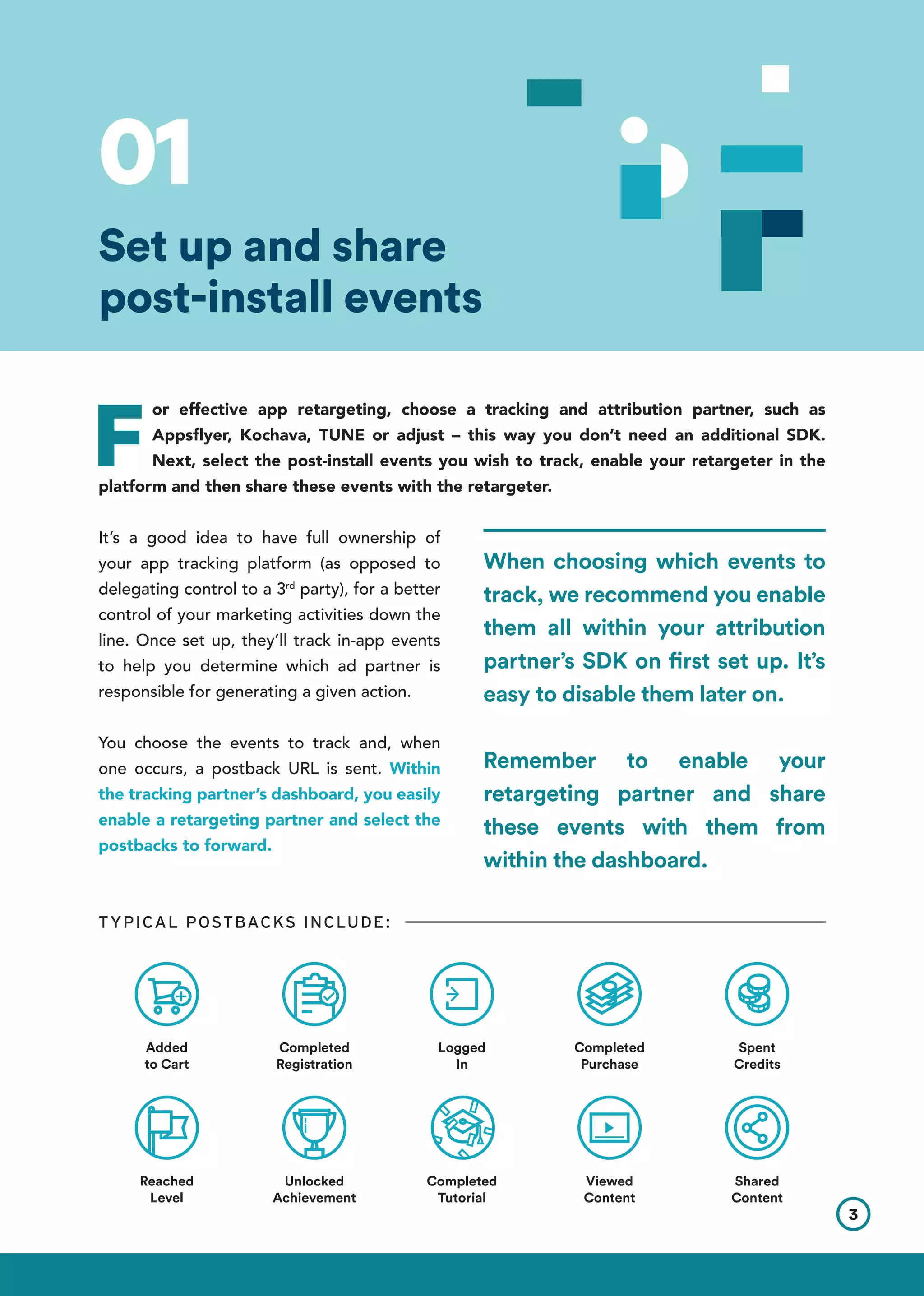
You choose the events to track and, when
one occurs, a postback URL is sent. Within
the tracking partner’s dashboard, you easily
enable a retargeting partner and select the
postbacks to forward.
TYPICAL POSTBACKS INCLUDE:
Set up and share
post-install events
Added
to Cart
Completed
Registration
Unlocked
Achievement
Completed
Tutorial
Viewed
Content
Shared
Content
Reached
Level
Logged
In
Completed
Purchase
Spent
Credits
3
01
When choosing which events to
track, we recommend you enable
them all within your attribution
partner’s SDK on first set up. It’s
easy to disable them later on.
Remember to enable your
retargeting partner and share
these events with them from
within the dashboard.
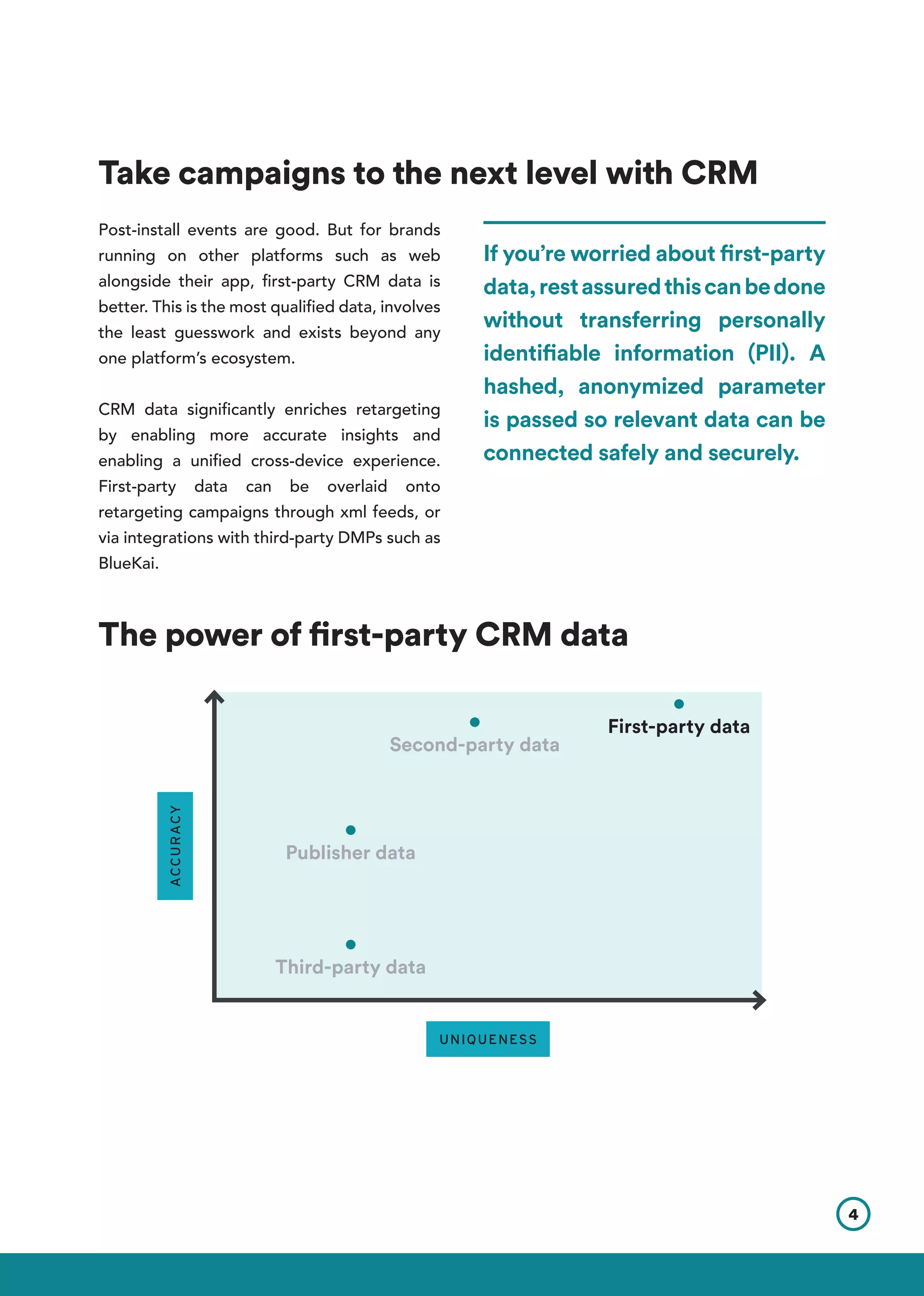
Take campaigns to the next level with CRM
Post-install events are good. But for brands
running on other platforms such as web
alongside their app, first-party CRM data is
better. This is the most qualified data, involves
the least guesswork and exists beyond any
one platform’s ecosystem.
CRM data significantly enriches retargeting
by enabling more accurate insights and
enabling a unified cross-device experience.
First-party data can be overlaid onto
retargeting campaigns through xml feeds, or
via integrations with third-party DMPs such as
BlueKai.
The power of first-party CRM data
If you’re worried about first-party
data,restassuredthiscanbedone
without transferring personally
identifiable information (PII). A
hashed, anonymized parameter
is passed so relevant data can be
connected safely and securely.
UNIQUENESS
Third-party data
ACCURACY
Publisher data
Second-party data
First-party data
4
Y
ou’ve probably already mapped the journey that users take through your app to
reach a conversion or desired event, right? Creating a sales or event funnel is a great
way to make sure you properly understand your audience.
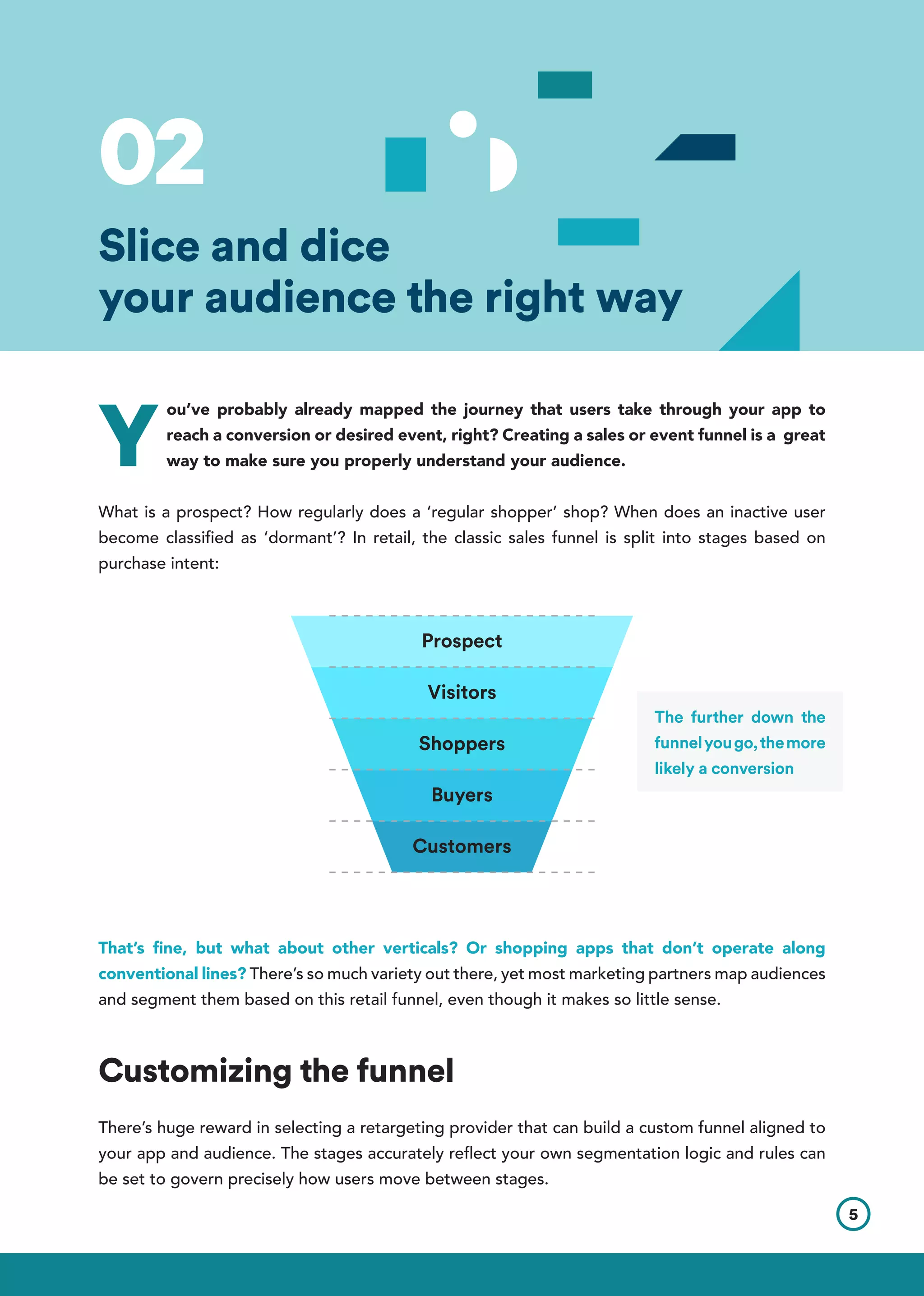
What is a prospect? How regularly does a ‘regular shopper’ shop? When does an inactive user
become classified as ‘dormant’? In retail, the classic sales funnel is split into stages based on
purchase intent:
That’s fine, but what about other verticals? Or shopping apps that don’t operate along
conventional lines? There’s so much variety out there, yet most marketing partners map audiences
and segment them based on this retail funnel, even though it makes so little sense.
Customizing the funnel
There’s huge reward in selecting a retargeting provider that can build a custom funnel aligned to
your app and audience. The stages accurately reflect your own segmentation logic and rules can
be set to govern precisely how users move between stages.
Prospect
Visitors
Shoppers
Buyers
Customers
5
Slice and dice
your audience the right way
02
The further down the
funnelyougo,themore
likely a conversion
With a more accurate picture of the user journey, the programmatic algorithms can better select
which impressions to bid on and optimize the campaign at each funnel stage.
A custom funnel also allows for better understanding of a retargeting campaign’s effectiveness. If
you know the ROI for each funnel stage, you can choose to re-allocate budgets to maximize the
overall return accordingly.
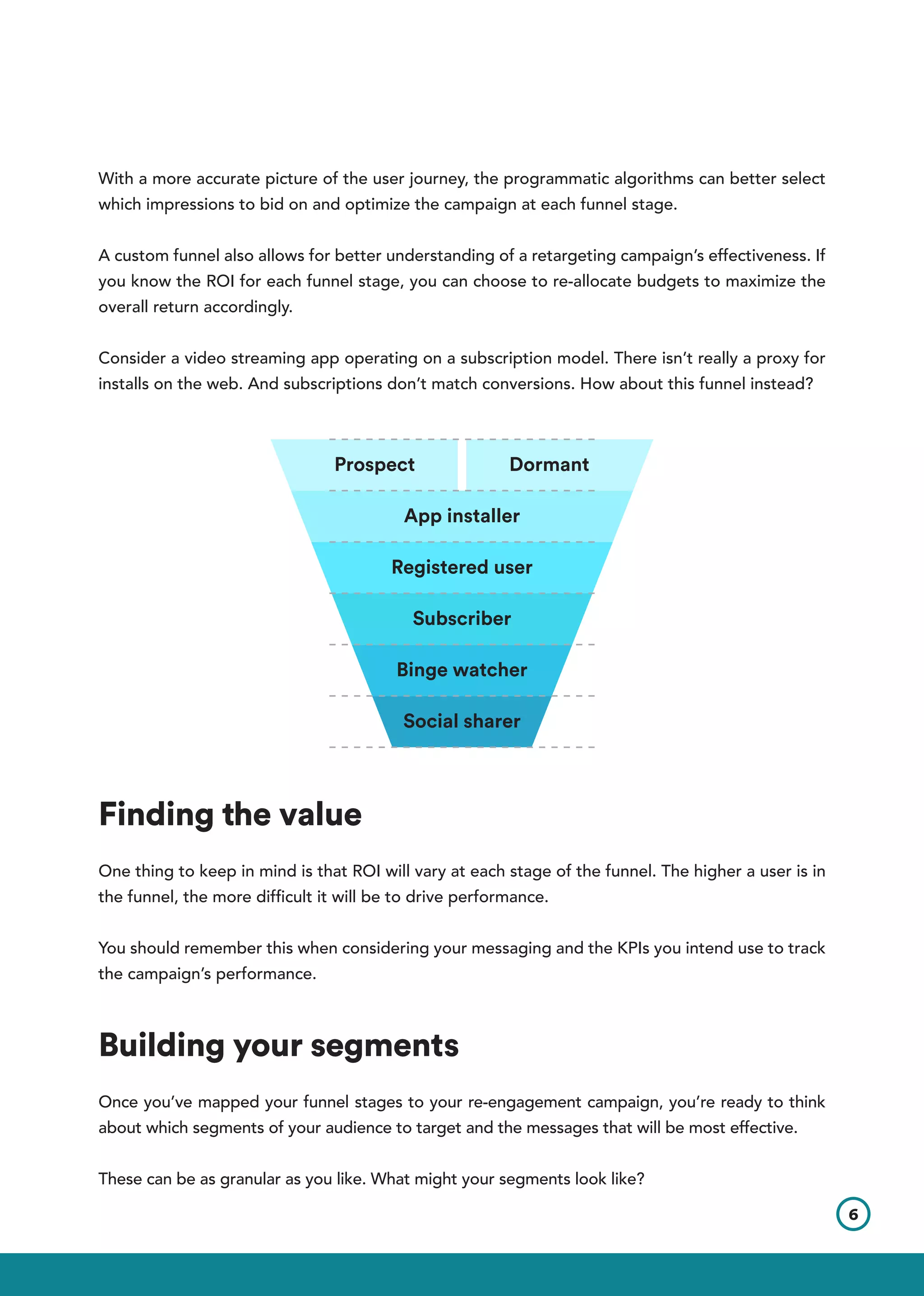
Consider a video streaming app operating on a subscription model. There isn’t really a proxy for
installs on the web. And subscriptions don’t match conversions. How about this funnel instead?
Finding the value
One thing to keep in mind is that ROI will vary at each stage of the funnel. The higher a user is in
the funnel, the more difficult it will be to drive performance.
You should remember this when considering your messaging and the KPIs you intend use to track
the campaign’s performance.
Building your segments
Once you’ve mapped your funnel stages to your re-engagement campaign, you’re ready to think
about which segments of your audience to target and the messages that will be most effective.
These can be as granular as you like. What might your segments look like?
6
App installer
Registered user
Subscriber
Binge watcher
Social sharer
Prospect Dormant
D
eep links serve as a way to make online resources more usable and accessible, whether
they’re on a website or in an app. On web, they’re simply hyperlinks that direct you
to a specific piece of content instead of the homepage.
With apps, the aim’s the same, but the methodology is slightly different. We’re dealing with
different types of uniform resource identifiers (URIs), namely App Links on Android and Universal
Links on iOS.
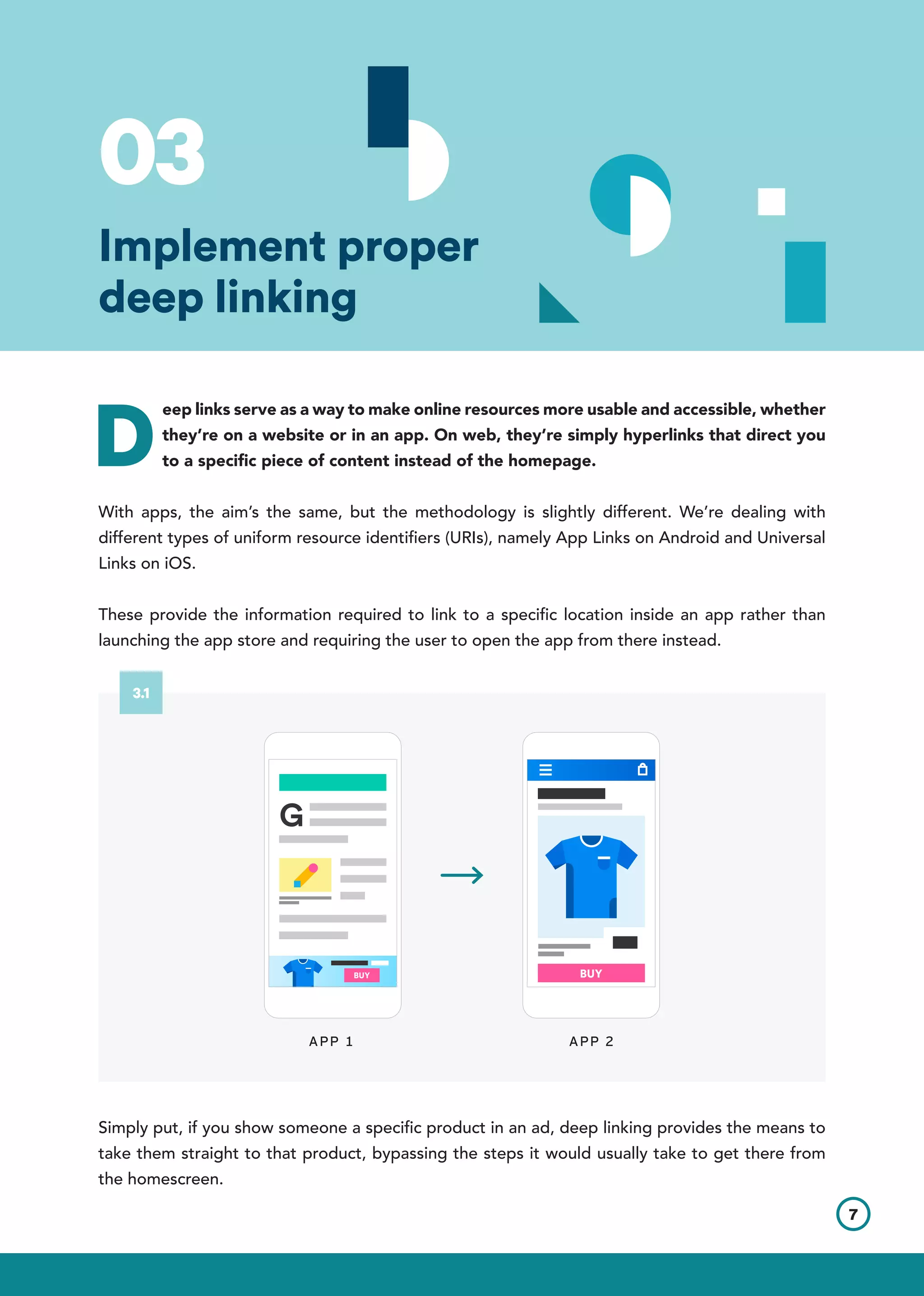
These provide the information required to link to a specific location inside an app rather than
launching the app store and requiring the user to open the app from there instead.
Simply put, if you show someone a specific product in an ad, deep linking provides the means to
take them straight to that product, bypassing the steps it would usually take to get there from
the homescreen.
APP 2APP 1
7
3.1
03
Implement proper
deep linking
When running retargeting campaigns on apps without deep linking enabled, we see that
engagement rates are typically 10x lower. That’s a massive price to pay for failing to do
something as simple as setting up proper deep links.
8
10x
Without
deep links
With deep links
enabled
3.2
Deferred deep linking
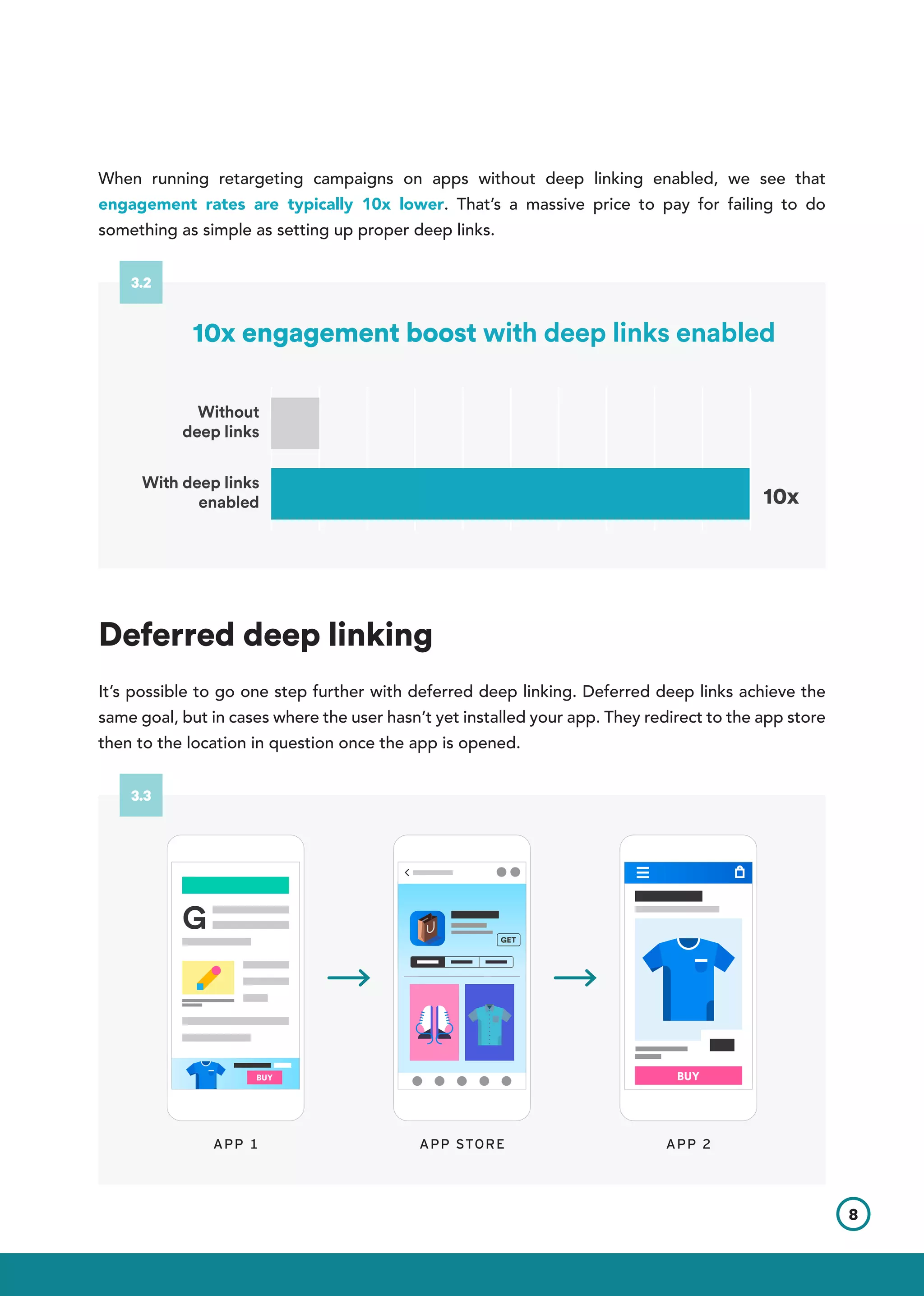
It’s possible to go one step further with deferred deep linking. Deferred deep links achieve the
same goal, but in cases where the user hasn’t yet installed your app. They redirect to the app store
then to the location in question once the app is opened.
APP 1 APP 2APP STORE
GET
3.3
10x engagement boost with deep links enabled
9
A user who clicks on an ad can get to the relevant part of your app as simply as above, but with
the added step of installing the app. This can be particularly effective at bringing people back to
your app after they have uninstalled it.
On iOS, your developers must work with a
tracking and attribution platform for deep
links to properly pass through the App Store
and redirect new users to the correct location
within your app, as this behavior is not
supported natively as it is on Android.
App Indexing
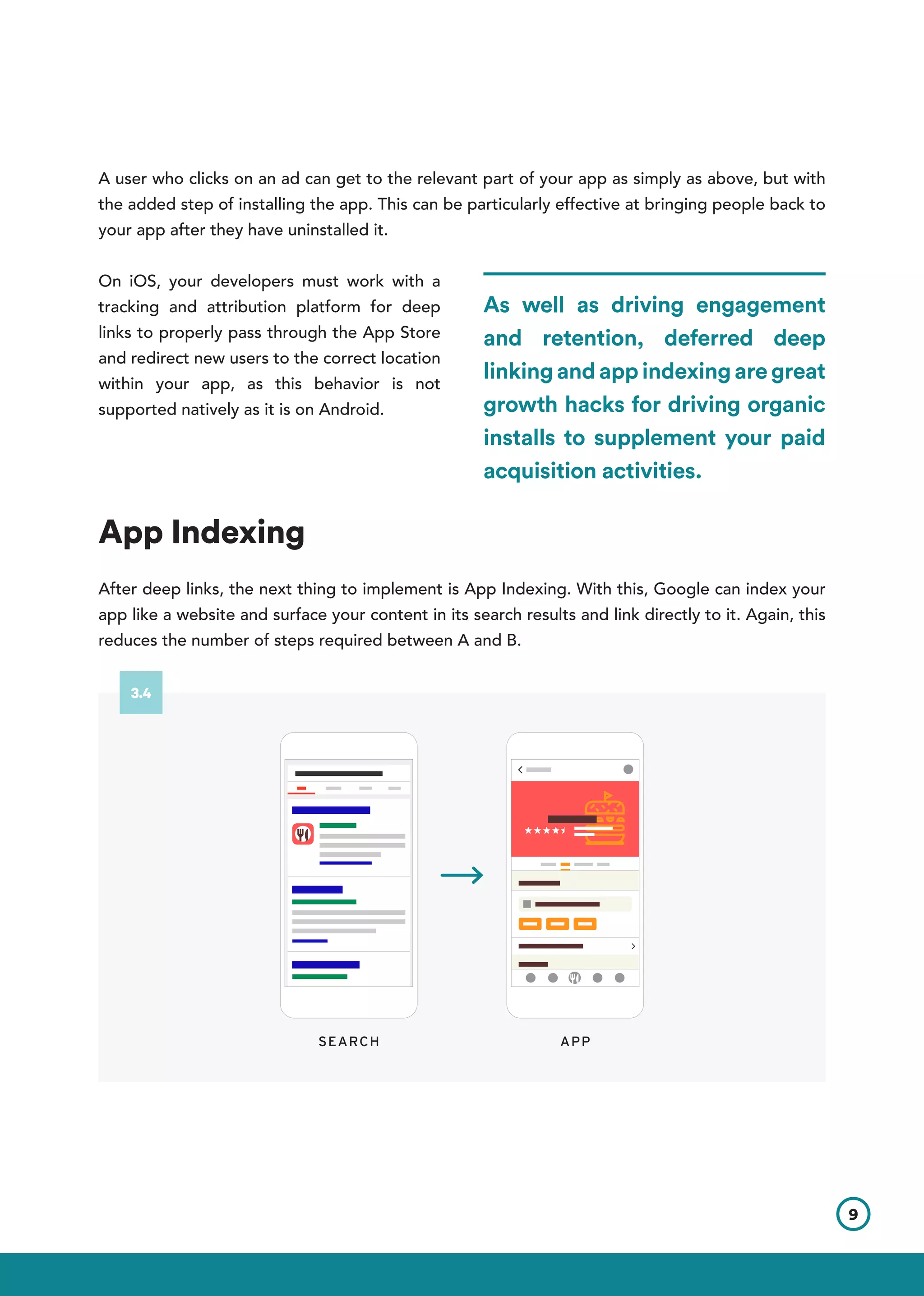
After deep links, the next thing to implement is App Indexing. With this, Google can index your
app like a website and surface your content in its search results and link directly to it. Again, this
reduces the number of steps required between A and B.
SEARCH APP
3.4
As well as driving engagement
and retention, deferred deep
linking and app indexing are great
growth hacks for driving organic
installs to supplement your paid
acquisition activities.
This functionality is available for both Android and iOS apps but requires an additional SDK. On
Android devices, App Indexing is also how you include your app’s content in Now on Tap results.
App Indexing can generate significant engagement uplift among your user base and is a positive
ranking signal with Google’s algorithms, so will boost search result impressions.
Cookpad, a recipe app with 50 million users, saw a 10% increase in weekly sessions for active users
and a 15% jump in re-engagement rates among dormant users after indexing two million recipe
pages2
.
2 https://developers.google.com/app-indexing/partners/case-study-cookpad.pdf	        	
10
O
ptimization is one of the most important aspects of any successful advertising
campaign. The key is to adopt the mindset that your campaign is always a work in
progress, no matter how well it may currently be performing.
Particularly in the data-rich world of apps, we have the tools to constantly strive for greater levels
of understanding into what does and doesn’t work. Nowhere is this more noticeable than with the
creatives of your campaign.
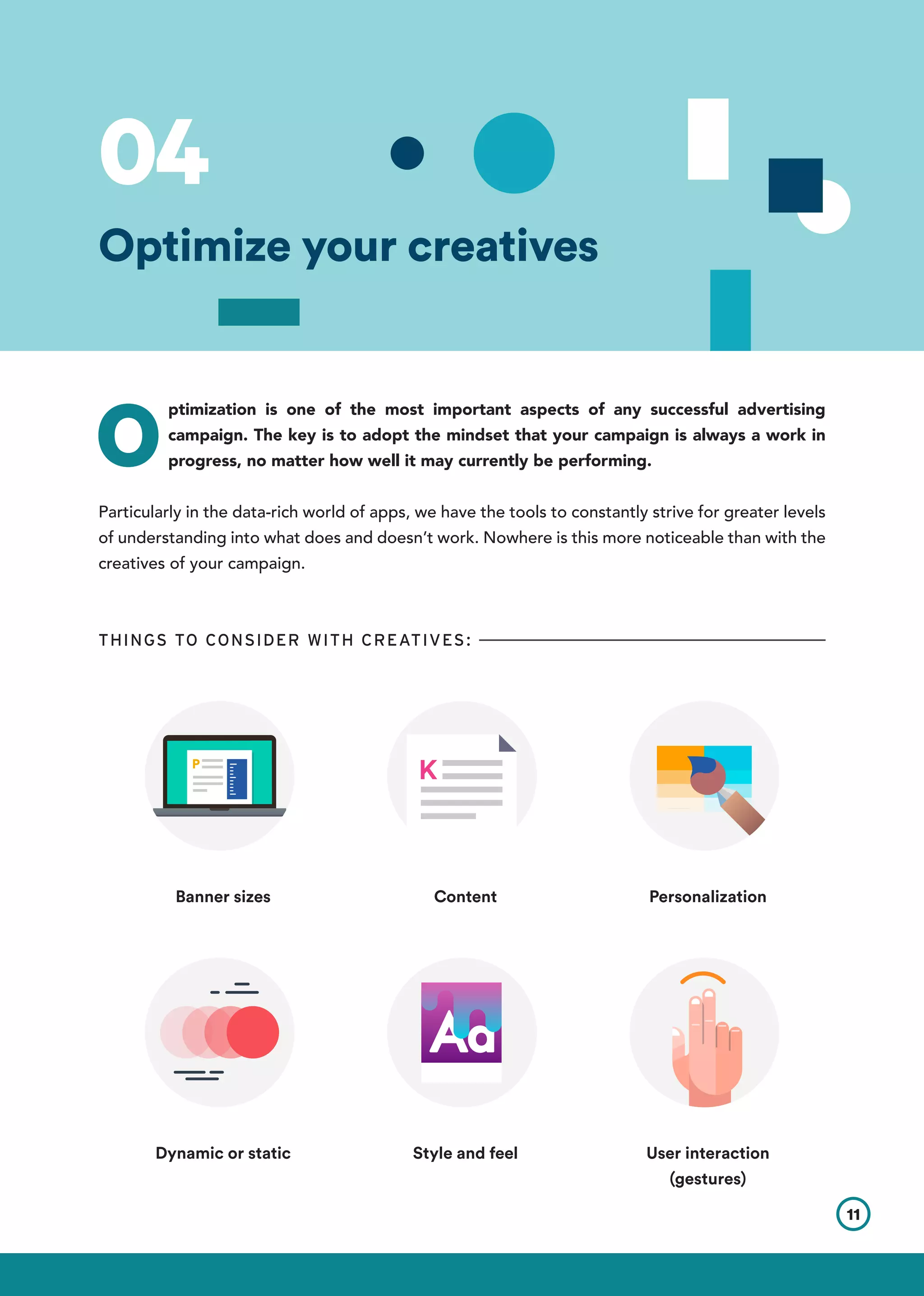
THINGS TO CONSIDER WITH CREATIVES:
Banner sizes Content
Style and feelDynamic or static
Personalization
User interaction
(gestures)
11
Optimize your creatives
04
Ad formats
The ad formats that are available for in-app banners are dependant on what is accepted by the
ad server in question. This will usually be based on IAB Standard Mobile Sizes, although some
support additional custom sizes and expandable creatives.
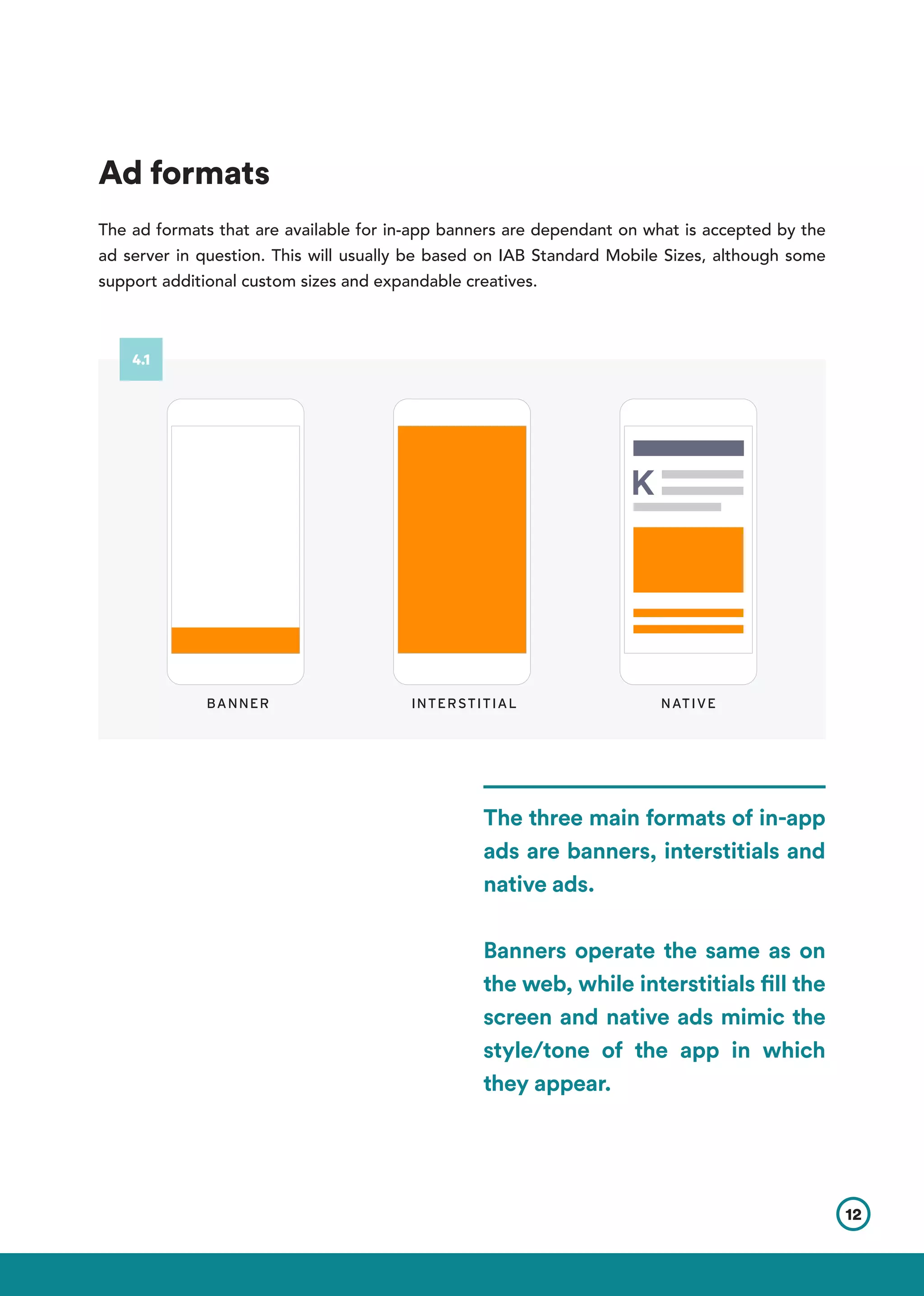
The three main formats of in-app
ads are banners, interstitials and
native ads.
Banners operate the same as on
the web, while interstitials fill the
screen and native ads mimic the
style/tone of the app in which
they appear.
BANNER INTERSTITIAL NATIVE
12
4.1
Native ads
Native advertising is one of the hottest topics in ad-tech because it drives such high engagement.
Banner ads generate a 34% lift in purchase intent, compared to 52% for native ads3
, and Facebook’s
native News Feed generates 10x the engagement of banner ads.
This is partially due to the way that they
mimic the design of the content of the apps
in which they appear. But such a high degree
of variance can be challenging from a creative
point of view.
So try to provide images from product feeds
in a way that allows for flexible layout and
placement. Automated image optimization
tools can help with this. When it comes to
titles, the best practice is to approach them
like you would an editorial headline, ensuring
that you pique readers’ interest.
3 http://www.sharethrough.com/resources/native-ads-vs-display-ads/	       	
Your assets should be provided
in a way that allows them to be
easily manipulated in real-time to
fit custom native ad formats.
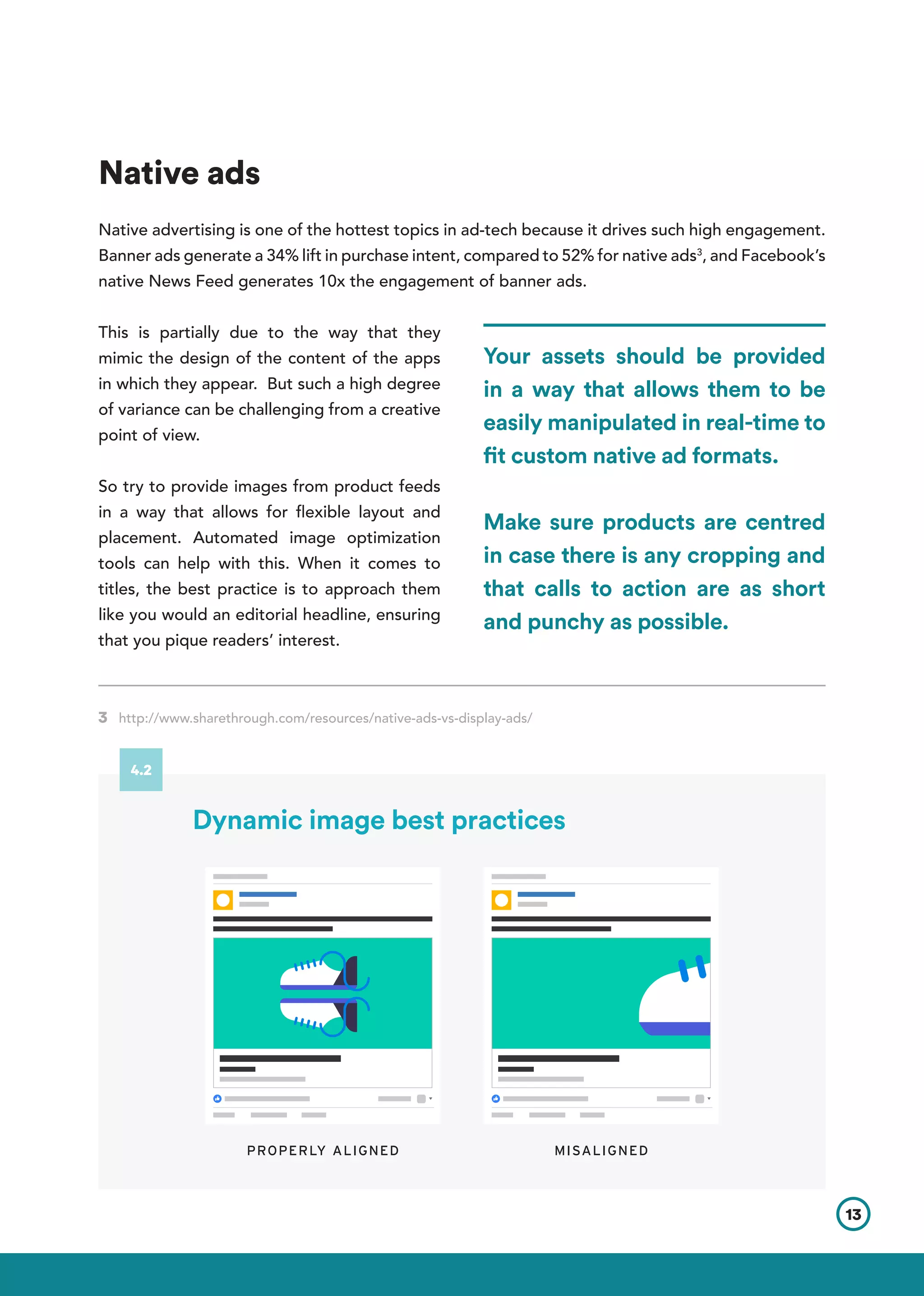
Make sure products are centred
in case there is any cropping and
that calls to action are as short
and punchy as possible.
PROPERLY ALIGNED MISALIGNED
13
4.2
Dynamic image best practices
A/B test your creatives
With so much choice, it can
be daunting if not impossible
to know what works best.
Luckily, marketers have
an excellent tool at their
disposal in A/B testing,
which enables them to
identify the most effective
creative variants.
14
$60
SHOP NOW
$60
SHOP NOW
$60
SHOP NOW
$60$60 $60
SHOP NOW
$60
BUY NOW
$60
BUY NOW
4.3
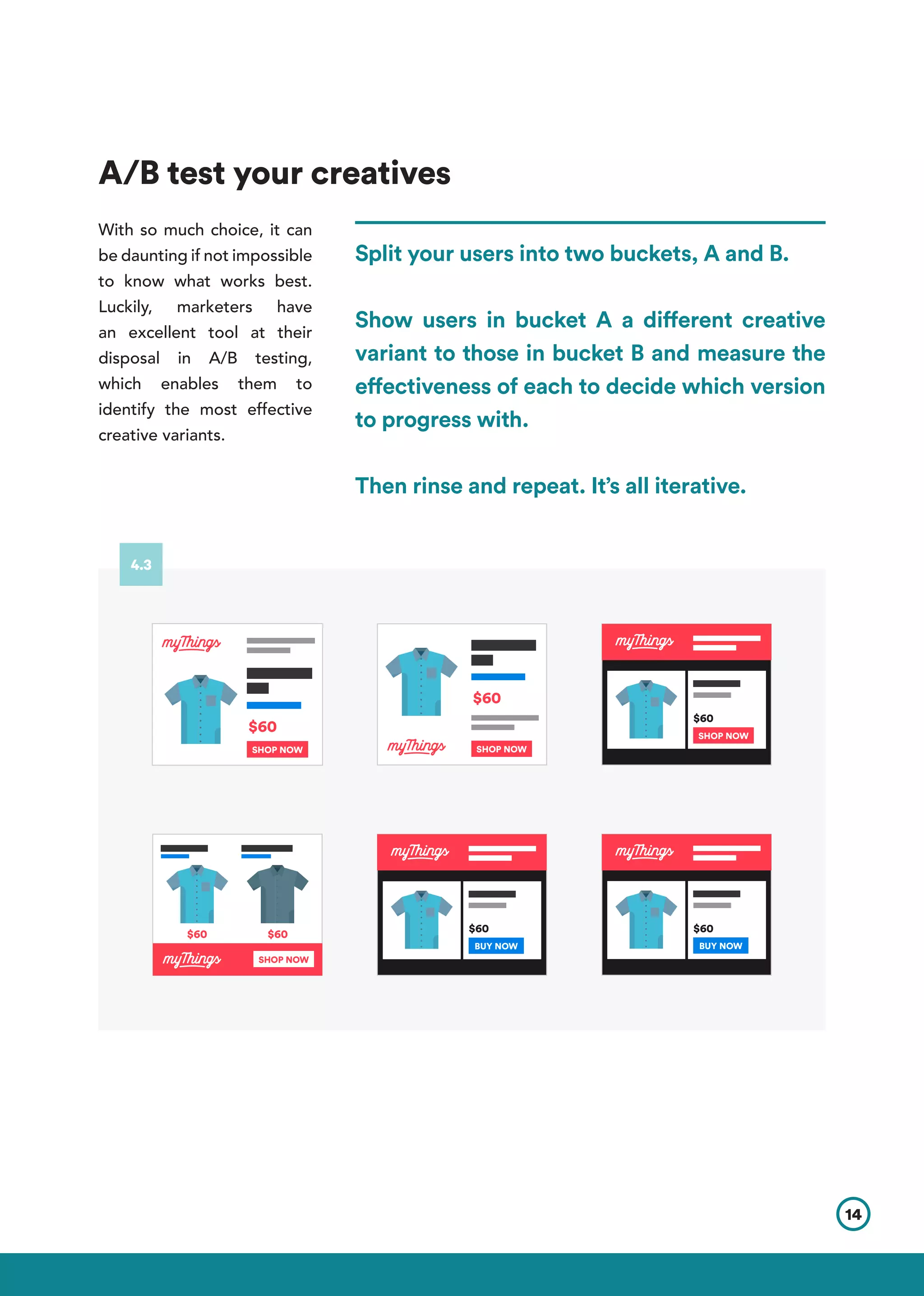
Split your users into two buckets, A and B.
Show users in bucket A a different creative
variant to those in bucket B and measure the
effectiveness of each to decide which version
to progress with.
Then rinse and repeat. It’s all iterative.
Tips for successful programmatic creatives
A	 Images
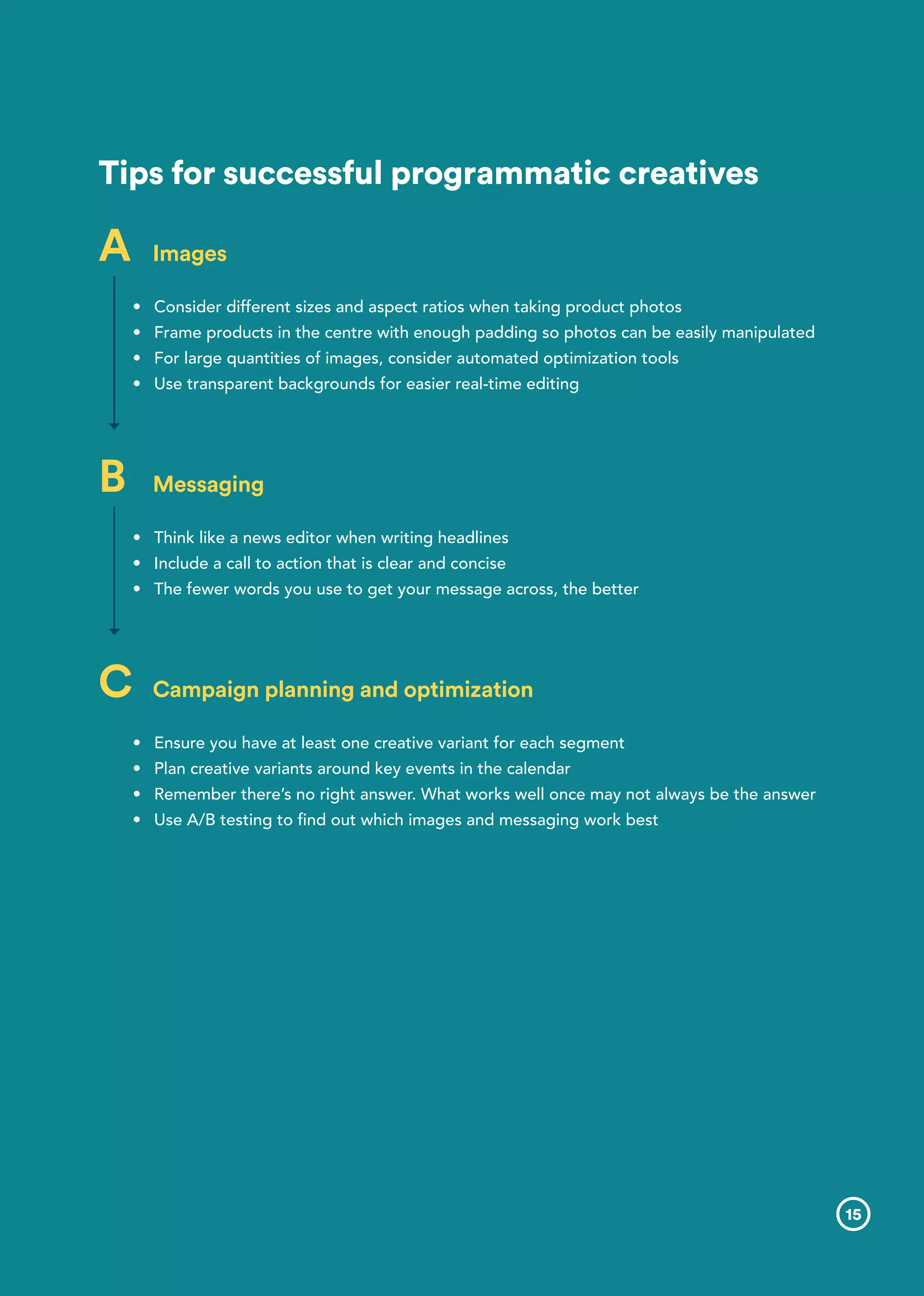
•	 	Consider different sizes and aspect ratios when taking product photos
•	 Frame products in the centre with enough padding so photos can be easily manipulated
•	 For large quantities of images, consider automated optimization tools
•	 Use transparent backgrounds for easier real-time editing
B	 Messaging
•	 Think like a news editor when writing headlines
•	 Include a call to action that is clear and concise
•	 The fewer words you use to get your message across, the better
C	 Campaign planning and optimization
•	 Ensure you have at least one creative variant for each segment
•	 Plan creative variants around key events in the calendar
•	 Remember there’s no right answer. What works well once may not always be the answer
•	 Use A/B testing to find out which images and messaging work best
15
05
W
e’ve focused exclusively on app retargeting, but most advertisers will re-engage
across several channels. There are plenty available, including in-app messaging,
push notifications, email and SMS.
The strength of app retargeting is that, unlike
push or in-app messaging, it operates outside
the app, extending your ability to reach users.
It’s also less intrusive than notifications.
Syncing across
channels
As powerful as retargeting is, it works even
better as part of a unified strategy operating
across numerous channels. This, after all, is
what today’s consumer expects: a joined up
experience across all touchpoints.
By working with a Mobile Engagement
Platform such as Urban Airship, Teradata or
Appboy, you can learn the most effective
segmentation strategy for each channel,
transposing segments from one channel to
another and ensuring messaging is aligned.
16
Sync up your retargeting
with other channels
Living outside the app
Unlike push notifications, app
retargeting lets you reach users
outside of your app. Because people
use all sorts of apps, you can find them
in the most unexpected of places.
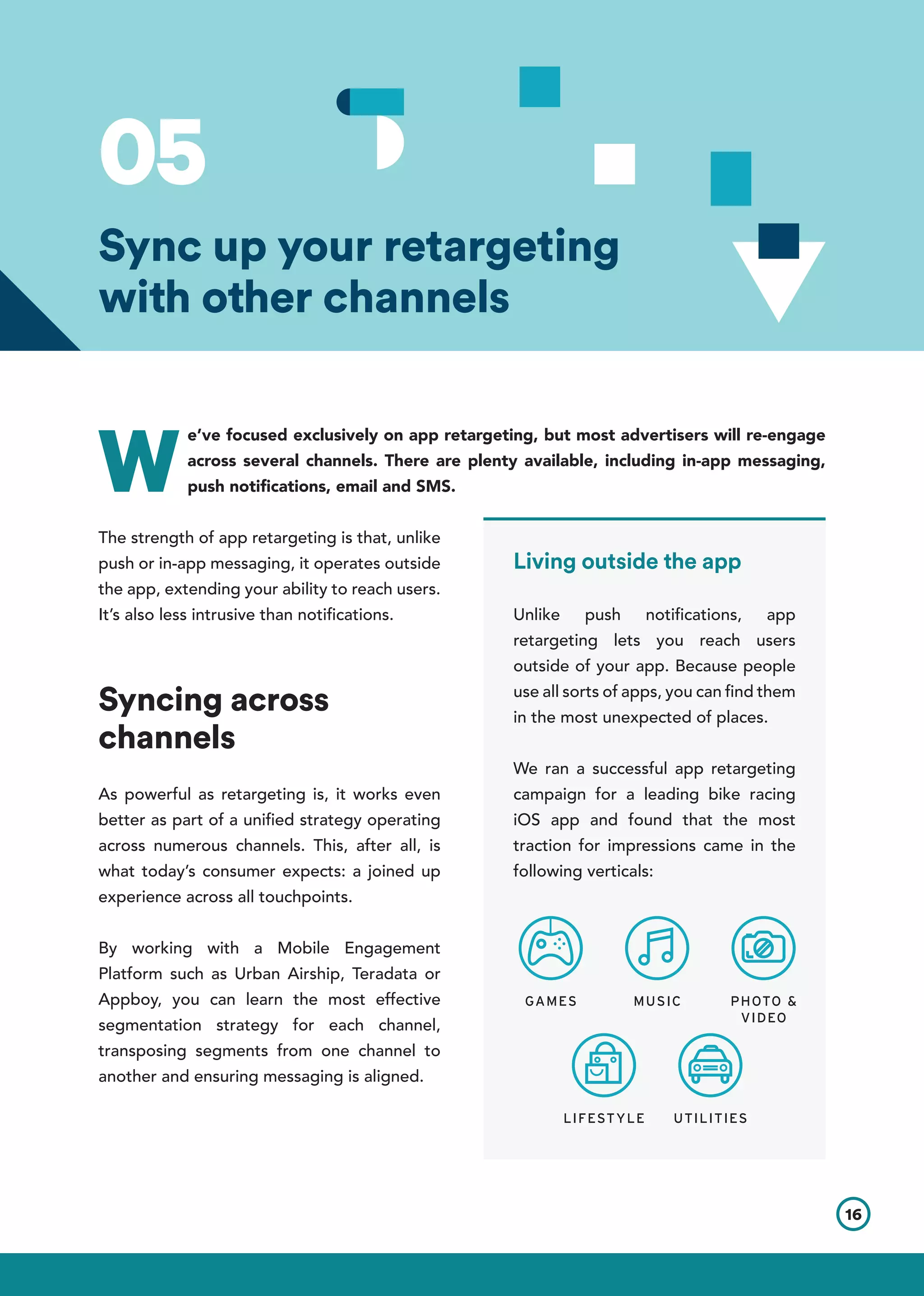
We ran a successful app retargeting
campaign for a leading bike racing
iOS app and found that the most
traction for impressions came in the
following verticals:
GAMES MUSIC PHOTO &
VIDEO
LIFESTYLE UTILITIES
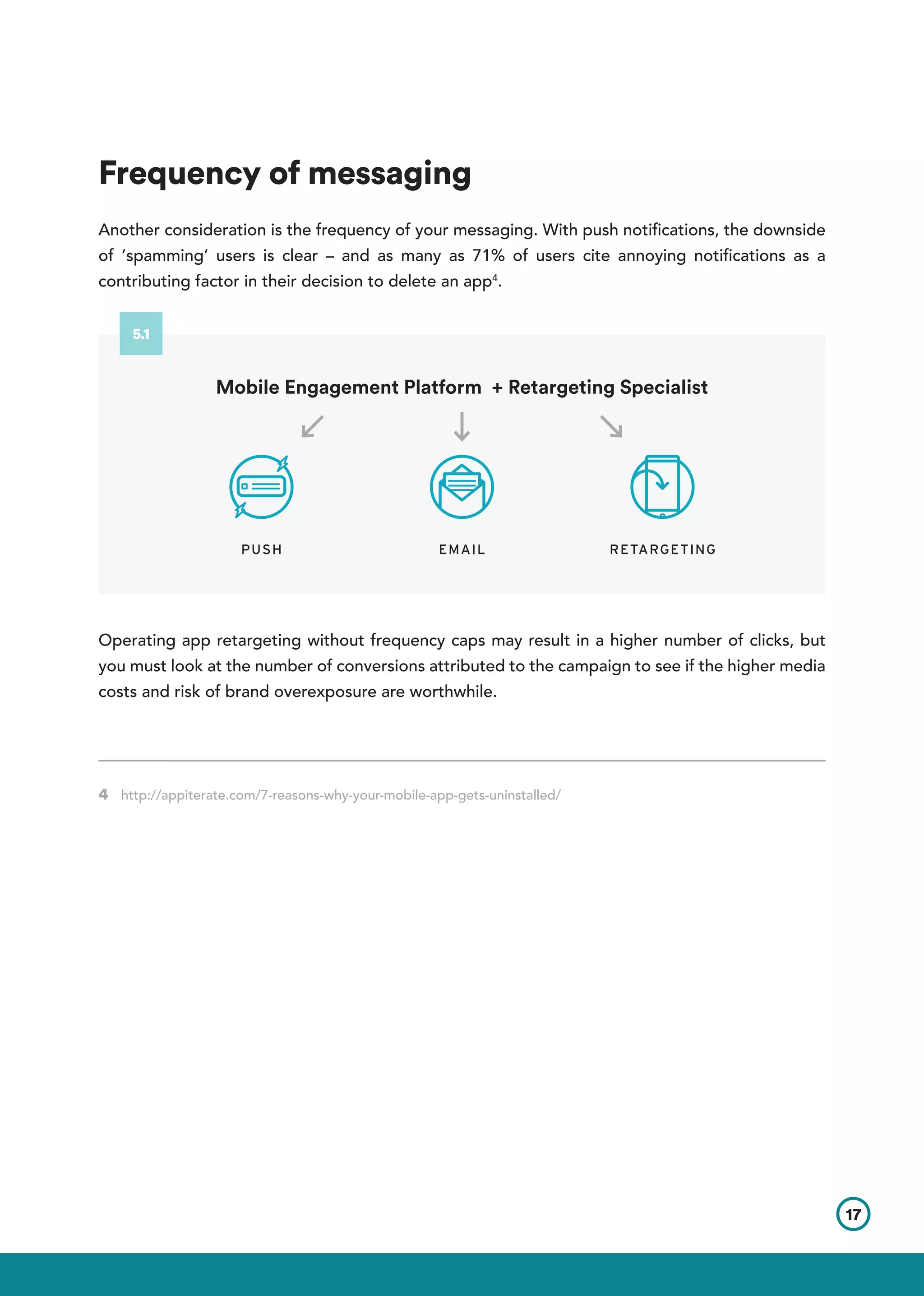
Frequency of messaging
Another consideration is the frequency of your messaging. With push notifications, the downside
of ‘spamming’ users is clear – and as many as 71% of users cite annoying notifications as a
contributing factor in their decision to delete an app4
.
Operating app retargeting without frequency caps may result in a higher number of clicks, but
you must look at the number of conversions attributed to the campaign to see if the higher media
costs and risk of brand overexposure are worthwhile.
4 http://appiterate.com/7-reasons-why-your-mobile-app-gets-uninstalled/      	
17
PUSH EMAIL RETARGETING
Mobile Engagement Platform + Retargeting Specialist
5.1
W
ith the sheer amount of apps fighting for people’s attention, acquisition of new
users is no longer enough to set your app apart from the crowd. They need to be
continuously engaged.
App retargeting provides advertisers with touch-points outside of their app and the mechanism
required to remind their users why they loved them in the first place.
Summary
To get the most from your
retargeting efforts:
Set up and share your post-install
events
Slice and dice your audience the
rightway
Implement Deep Links
Optimize your creatives
Sync up your retargeting with
everything else
18
READY TO RETARGET?
www.mythings.com
Performance
programmatic.
Made for you.
Setting up app retargeting with myThings
couldn’t be easier and no SDK is required.
Through our Mobile Attribution Partners
Program, we’re fully integrated with:
Simply enable us in your tracking partner’s
platform choose to forward your event
postbacks to us. We’ll do the rest.
myThings is a global leader in programmatic
performance advertising, specializing
in app and web retargeting that’s fully
managed and completely customized.
Bringing a decade of expertise from desktop
to the mobile ecosystem, we enable the
biggest brands to retain and re-engage their
audiences no matter the device, driving
performance at scale.
Among our clients are Puma, Nordstrom rack,
Microsoft, Very, French Connection, Boots
and Orange. Our dynamic, personalised ads
are fully brand-aligned and we use absolutely
no templates. They’re powered by custom
sales funnels, machine learning algorithms
unique to the advertiser and audience
segmentation built on first-party data.
Convertingbigdataintoincrementaldemand,
we personalize over 5 billion impressions a
month across all leading ad exchanges on
web and mobile.
Find out more at
www.mythings.com or @mythingsmedia.
About myThings
19
App Retargeting Best Practices

App Retargeting Best Practices

  • 1.
  • 2.
    R etaining and re-engagingusers has become absolutely essential for app marketers. Acquiring an audience is expensive business, with CPIs rising and app abandon rates making for depressing reading. Prices are even steeper for high-quality users opening an app three times or more, while Appsflyer estimates the average app loses 97% of its new users after just 30 days1 . What a gloomy picture! Inthisdayandage,focusingonuseracquisition alone is like trying to fill a glass that has a hole in the bottom. You’ll need to keep the faucet running full-blast to get anywhere. A waste of water and money, no? But supplementing paid installs with a solid re-engagement strategy let’s you plug the hole, turn off the faucet and save money. After all, it’s much cheaper to re-engage an existing user than to pay for a new one. With app retargeting, you can even encourage specific actions among your audience – from first purchase right through to re-activation of dormant customers. 1 Retail, travel and utility apps; http://www.emarketer. com/Article/App-Marketers-Focus-on-Engagement-Re- tention/1013111 Introduction 01 Set up and share post-install events 02 Slice and dice your audience the right way 03 Implement proper deep linking 04 Optimize your creatives 05 Sync your retargeting with other channels Growth tips to help you maximize thereturnonyourappretargeting campaign ad spend: 2
  • 3.
    F or effective appretargeting, choose a tracking and attribution partner, such as Appsflyer, Kochava, TUNE or adjust – this way you don’t need an additional SDK. Next, select the post-install events you wish to track, enable your retargeter in the platform and then share these events with the retargeter. It’s a good idea to have full ownership of your app tracking platform (as opposed to delegating control to a 3rd party), for a better control of your marketing activities down the line. Once set up, they’ll track in-app events to help you determine which ad partner is responsible for generating a given action. You choose the events to track and, when one occurs, a postback URL is sent. Within the tracking partner’s dashboard, you easily enable a retargeting partner and select the postbacks to forward. TYPICAL POSTBACKS INCLUDE: Set up and share post-install events Added to Cart Completed Registration Unlocked Achievement Completed Tutorial Viewed Content Shared Content Reached Level Logged In Completed Purchase Spent Credits 3 01 When choosing which events to track, we recommend you enable them all within your attribution partner’s SDK on first set up. It’s easy to disable them later on. Remember to enable your retargeting partner and share these events with them from within the dashboard.
  • 4.
    Take campaigns tothe next level with CRM Post-install events are good. But for brands running on other platforms such as web alongside their app, first-party CRM data is better. This is the most qualified data, involves the least guesswork and exists beyond any one platform’s ecosystem. CRM data significantly enriches retargeting by enabling more accurate insights and enabling a unified cross-device experience. First-party data can be overlaid onto retargeting campaigns through xml feeds, or via integrations with third-party DMPs such as BlueKai. The power of first-party CRM data If you’re worried about first-party data,restassuredthiscanbedone without transferring personally identifiable information (PII). A hashed, anonymized parameter is passed so relevant data can be connected safely and securely. UNIQUENESS Third-party data ACCURACY Publisher data Second-party data First-party data 4
  • 5.
    Y ou’ve probably alreadymapped the journey that users take through your app to reach a conversion or desired event, right? Creating a sales or event funnel is a great way to make sure you properly understand your audience. What is a prospect? How regularly does a ‘regular shopper’ shop? When does an inactive user become classified as ‘dormant’? In retail, the classic sales funnel is split into stages based on purchase intent: That’s fine, but what about other verticals? Or shopping apps that don’t operate along conventional lines? There’s so much variety out there, yet most marketing partners map audiences and segment them based on this retail funnel, even though it makes so little sense. Customizing the funnel There’s huge reward in selecting a retargeting provider that can build a custom funnel aligned to your app and audience. The stages accurately reflect your own segmentation logic and rules can be set to govern precisely how users move between stages. Prospect Visitors Shoppers Buyers Customers 5 Slice and dice your audience the right way 02 The further down the funnelyougo,themore likely a conversion
  • 6.
    With a moreaccurate picture of the user journey, the programmatic algorithms can better select which impressions to bid on and optimize the campaign at each funnel stage. A custom funnel also allows for better understanding of a retargeting campaign’s effectiveness. If you know the ROI for each funnel stage, you can choose to re-allocate budgets to maximize the overall return accordingly. Consider a video streaming app operating on a subscription model. There isn’t really a proxy for installs on the web. And subscriptions don’t match conversions. How about this funnel instead? Finding the value One thing to keep in mind is that ROI will vary at each stage of the funnel. The higher a user is in the funnel, the more difficult it will be to drive performance. You should remember this when considering your messaging and the KPIs you intend use to track the campaign’s performance. Building your segments Once you’ve mapped your funnel stages to your re-engagement campaign, you’re ready to think about which segments of your audience to target and the messages that will be most effective. These can be as granular as you like. What might your segments look like? 6 App installer Registered user Subscriber Binge watcher Social sharer Prospect Dormant
  • 7.
    D eep links serveas a way to make online resources more usable and accessible, whether they’re on a website or in an app. On web, they’re simply hyperlinks that direct you to a specific piece of content instead of the homepage. With apps, the aim’s the same, but the methodology is slightly different. We’re dealing with different types of uniform resource identifiers (URIs), namely App Links on Android and Universal Links on iOS. These provide the information required to link to a specific location inside an app rather than launching the app store and requiring the user to open the app from there instead. Simply put, if you show someone a specific product in an ad, deep linking provides the means to take them straight to that product, bypassing the steps it would usually take to get there from the homescreen. APP 2APP 1 7 3.1 03 Implement proper deep linking
  • 8.
    When running retargetingcampaigns on apps without deep linking enabled, we see that engagement rates are typically 10x lower. That’s a massive price to pay for failing to do something as simple as setting up proper deep links. 8 10x Without deep links With deep links enabled 3.2 Deferred deep linking It’s possible to go one step further with deferred deep linking. Deferred deep links achieve the same goal, but in cases where the user hasn’t yet installed your app. They redirect to the app store then to the location in question once the app is opened. APP 1 APP 2APP STORE GET 3.3 10x engagement boost with deep links enabled
  • 9.
    9 A user whoclicks on an ad can get to the relevant part of your app as simply as above, but with the added step of installing the app. This can be particularly effective at bringing people back to your app after they have uninstalled it. On iOS, your developers must work with a tracking and attribution platform for deep links to properly pass through the App Store and redirect new users to the correct location within your app, as this behavior is not supported natively as it is on Android. App Indexing After deep links, the next thing to implement is App Indexing. With this, Google can index your app like a website and surface your content in its search results and link directly to it. Again, this reduces the number of steps required between A and B. SEARCH APP 3.4 As well as driving engagement and retention, deferred deep linking and app indexing are great growth hacks for driving organic installs to supplement your paid acquisition activities.
  • 10.
    This functionality isavailable for both Android and iOS apps but requires an additional SDK. On Android devices, App Indexing is also how you include your app’s content in Now on Tap results. App Indexing can generate significant engagement uplift among your user base and is a positive ranking signal with Google’s algorithms, so will boost search result impressions. Cookpad, a recipe app with 50 million users, saw a 10% increase in weekly sessions for active users and a 15% jump in re-engagement rates among dormant users after indexing two million recipe pages2 . 2 https://developers.google.com/app-indexing/partners/case-study-cookpad.pdf         10
  • 11.
    O ptimization is oneof the most important aspects of any successful advertising campaign. The key is to adopt the mindset that your campaign is always a work in progress, no matter how well it may currently be performing. Particularly in the data-rich world of apps, we have the tools to constantly strive for greater levels of understanding into what does and doesn’t work. Nowhere is this more noticeable than with the creatives of your campaign. THINGS TO CONSIDER WITH CREATIVES: Banner sizes Content Style and feelDynamic or static Personalization User interaction (gestures) 11 Optimize your creatives 04
  • 12.
    Ad formats The adformats that are available for in-app banners are dependant on what is accepted by the ad server in question. This will usually be based on IAB Standard Mobile Sizes, although some support additional custom sizes and expandable creatives. The three main formats of in-app ads are banners, interstitials and native ads. Banners operate the same as on the web, while interstitials fill the screen and native ads mimic the style/tone of the app in which they appear. BANNER INTERSTITIAL NATIVE 12 4.1
  • 13.
    Native ads Native advertisingis one of the hottest topics in ad-tech because it drives such high engagement. Banner ads generate a 34% lift in purchase intent, compared to 52% for native ads3 , and Facebook’s native News Feed generates 10x the engagement of banner ads. This is partially due to the way that they mimic the design of the content of the apps in which they appear. But such a high degree of variance can be challenging from a creative point of view. So try to provide images from product feeds in a way that allows for flexible layout and placement. Automated image optimization tools can help with this. When it comes to titles, the best practice is to approach them like you would an editorial headline, ensuring that you pique readers’ interest. 3 http://www.sharethrough.com/resources/native-ads-vs-display-ads/         Your assets should be provided in a way that allows them to be easily manipulated in real-time to fit custom native ad formats. Make sure products are centred in case there is any cropping and that calls to action are as short and punchy as possible. PROPERLY ALIGNED MISALIGNED 13 4.2 Dynamic image best practices
  • 14.
    A/B test yourcreatives With so much choice, it can be daunting if not impossible to know what works best. Luckily, marketers have an excellent tool at their disposal in A/B testing, which enables them to identify the most effective creative variants. 14 $60 SHOP NOW $60 SHOP NOW $60 SHOP NOW $60$60 $60 SHOP NOW $60 BUY NOW $60 BUY NOW 4.3 Split your users into two buckets, A and B. Show users in bucket A a different creative variant to those in bucket B and measure the effectiveness of each to decide which version to progress with. Then rinse and repeat. It’s all iterative.
  • 15.
    Tips for successfulprogrammatic creatives A Images • Consider different sizes and aspect ratios when taking product photos • Frame products in the centre with enough padding so photos can be easily manipulated • For large quantities of images, consider automated optimization tools • Use transparent backgrounds for easier real-time editing B Messaging • Think like a news editor when writing headlines • Include a call to action that is clear and concise • The fewer words you use to get your message across, the better C Campaign planning and optimization • Ensure you have at least one creative variant for each segment • Plan creative variants around key events in the calendar • Remember there’s no right answer. What works well once may not always be the answer • Use A/B testing to find out which images and messaging work best 15
  • 16.
    05 W e’ve focused exclusivelyon app retargeting, but most advertisers will re-engage across several channels. There are plenty available, including in-app messaging, push notifications, email and SMS. The strength of app retargeting is that, unlike push or in-app messaging, it operates outside the app, extending your ability to reach users. It’s also less intrusive than notifications. Syncing across channels As powerful as retargeting is, it works even better as part of a unified strategy operating across numerous channels. This, after all, is what today’s consumer expects: a joined up experience across all touchpoints. By working with a Mobile Engagement Platform such as Urban Airship, Teradata or Appboy, you can learn the most effective segmentation strategy for each channel, transposing segments from one channel to another and ensuring messaging is aligned. 16 Sync up your retargeting with other channels Living outside the app Unlike push notifications, app retargeting lets you reach users outside of your app. Because people use all sorts of apps, you can find them in the most unexpected of places. We ran a successful app retargeting campaign for a leading bike racing iOS app and found that the most traction for impressions came in the following verticals: GAMES MUSIC PHOTO & VIDEO LIFESTYLE UTILITIES
  • 17.
    Frequency of messaging Anotherconsideration is the frequency of your messaging. With push notifications, the downside of ‘spamming’ users is clear – and as many as 71% of users cite annoying notifications as a contributing factor in their decision to delete an app4 . Operating app retargeting without frequency caps may result in a higher number of clicks, but you must look at the number of conversions attributed to the campaign to see if the higher media costs and risk of brand overexposure are worthwhile. 4 http://appiterate.com/7-reasons-why-your-mobile-app-gets-uninstalled/       17 PUSH EMAIL RETARGETING Mobile Engagement Platform + Retargeting Specialist 5.1
  • 18.
    W ith the sheeramount of apps fighting for people’s attention, acquisition of new users is no longer enough to set your app apart from the crowd. They need to be continuously engaged. App retargeting provides advertisers with touch-points outside of their app and the mechanism required to remind their users why they loved them in the first place. Summary To get the most from your retargeting efforts: Set up and share your post-install events Slice and dice your audience the rightway Implement Deep Links Optimize your creatives Sync up your retargeting with everything else 18 READY TO RETARGET? www.mythings.com
  • 19.
    Performance programmatic. Made for you. Settingup app retargeting with myThings couldn’t be easier and no SDK is required. Through our Mobile Attribution Partners Program, we’re fully integrated with: Simply enable us in your tracking partner’s platform choose to forward your event postbacks to us. We’ll do the rest. myThings is a global leader in programmatic performance advertising, specializing in app and web retargeting that’s fully managed and completely customized. Bringing a decade of expertise from desktop to the mobile ecosystem, we enable the biggest brands to retain and re-engage their audiences no matter the device, driving performance at scale. Among our clients are Puma, Nordstrom rack, Microsoft, Very, French Connection, Boots and Orange. Our dynamic, personalised ads are fully brand-aligned and we use absolutely no templates. They’re powered by custom sales funnels, machine learning algorithms unique to the advertiser and audience segmentation built on first-party data. Convertingbigdataintoincrementaldemand, we personalize over 5 billion impressions a month across all leading ad exchanges on web and mobile. Find out more at www.mythings.com or @mythingsmedia. About myThings 19