UNDERSTANDING THE SELF
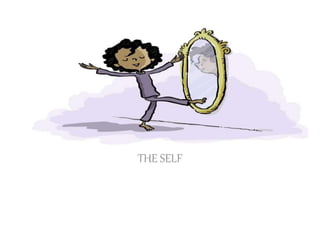
THE SELF
One of the greatest challenges has
been coming to terms with the nature
of the self. Every individual has a self,
yet no two selves are the same
The self usually provides a sense of
consistency, a sense that there is
some connection between who a
person was yesterday and who they
are today
The self was a source of continuity that
gave individuals a sense of
“connectedness” and “unbrokenness”
- WILLIAM JAMES
The “I” is the self as agent, thinker,
and knower, the executive function that
experiences and reacts to the world,
constructing mental representations
and memories as it does so
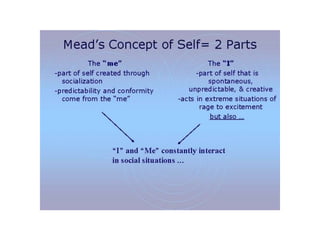
The “me” is the individual one recognizes
as the self, which for James included a
material, social, and spiritual self. The
material self refers to one’s physical body
and one’s physical possessions. The social
self refers to the various selves one may
express and others may recognize
depending on the social setting. The
spiritual self refers to the enduring core of
one’s being, including one’s values,
personality, beliefs about the self,
ACTIVITY ONE
Create a “Me Tree”
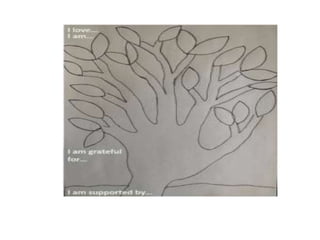
Steps:
Trace your hand on a piece of paper leaving
the fingertips open to draw longer branches.
Draw your branches from your fingertips
leaving room for lots of leaves.
Draw as many leaves as you want (make sure
to make them large enough to write things or
draw inside!)
Draw some soil on the bottom of your page
leaving room between the bottom of your
paper and the top of the soil for writing or
drawing!
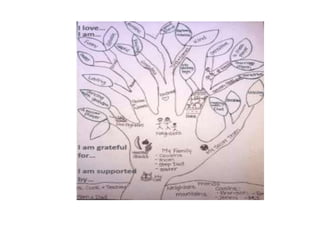
Soil: “I am supported by…”
Reflect on the people and communities that
support you to grow strong and kind.
Tree trunk and branches: “I am grateful for…”
Beginning at the bottom of the tree and
working your way up through the branches,
reflect on the places, things or experiences
that you are grateful for (e.g., my family,
friends, doctors that help me feel better when
sick, school where I meet my friends, the
outdoors where I can exercise and see new
things, etc.)
Leaves: “I love…”
Lastly, reflect on the many things that make
you – YOU! They could be adjectives (funny,
smart, kind, helpful, good friend etc.) or your
favorite hobbies and passions (playing soccer,
painting, dancing with grandpa, learning math,
etc.)
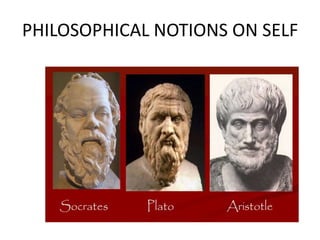
PHILOSOPHICAL NOTIONS ON SELF
Socrates: Life is Not Worth Living
For Socrates, life is not worth living if it not
examined. For him, the Soul is
synonymous with the Self. He believes that
human beings have immortal soul that lives
within the physical body.
Plato: The Self is an Immortal Soul
For plato, there are three elements of the
soul: Reason, Physical Appetite, Spirit or
Passion. Reason is the ability of the self to
think critically, and make wise decisions.
Physical Appetite is the basic needs of a
person, hunger, thirst and sexual desires.
Lastly, Spirit or Passion is composed of the
basic emotions that the self encounters.
Plato: The Self is an Immortal Soul
For plato, there are three elements of the soul: Reason, Physical
Appetite, Spirit or Passion. Reason is the ability of the self to
think critically, and make wise decisions. Physical Appetite is
the basic needs of a person, hunger, thirst and sexual desires.
Lastly, Spirit or Passion is composed of the basic emotions that
the self encounters.
Aristotle: The Soul is the Essence of the
Self
For Aristotle, the main goal of the self is to
leand a good, flourishing and fulfilling life.
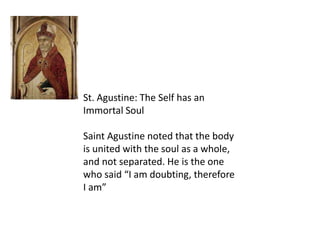
St. Agustine: The Self has an
Immortal Soul
Saint Agustine noted that the body
is united with the soul as a whole,
and not separated. He is the one
who said “I am doubting, therefore
I am”
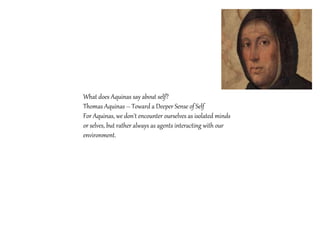
What does Aquinas say about self?
Thomas Aquinas – Toward a Deeper Sense of Self
For Aquinas, we don't encounter ourselves as isolated minds
or selves, but rather always as agents interacting with our
environment.
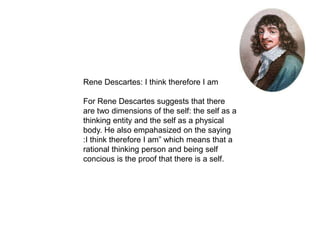
Rene Descartes: I think therefore I am
For Rene Descartes suggests that there
are two dimensions of the self: the self as a
thinking entity and the self as a physical
body. He also empahasized on the saying
:I think therefore I am” which means that a
rational thinking person and being self
concious is the proof that there is a self.
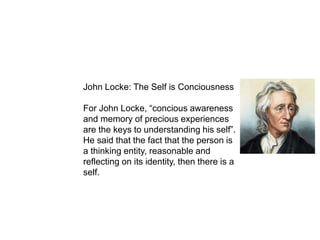
John Locke: The Self is Conciousness
For John Locke, “concious awareness
and memory of precious experiences
are the keys to understanding his self”.
He said that the fact that the person is
a thinking entity, reasonable and
reflecting on its identity, then there is a
self.
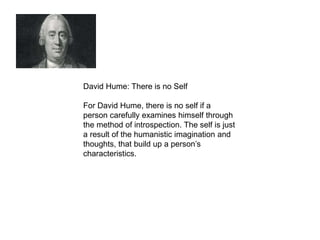
David Hume: There is no Self
For David Hume, there is no self if a
person carefully examines himself through
the method of introspection. The self is just
a result of the humanistic imagination and
thoughts, that build up a person’s
characteristics.
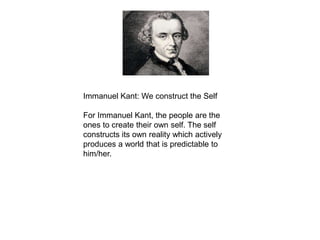
Immanuel Kant: We construct the Self
For Immanuel Kant, the people are the
ones to create their own self. The self
constructs its own reality which actively
produces a world that is predictable to
him/her.
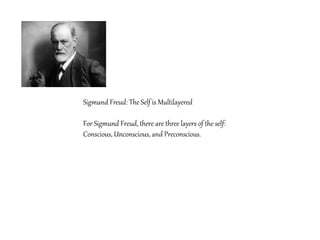
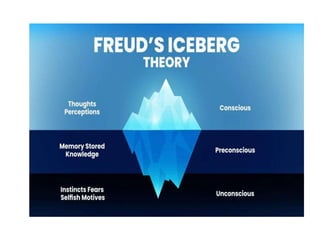
Sigmund Freud: The Self is Multilayered
For Sigmund Freud, there are three layers of the self:
Conscious, Unconscious, and Preconscious.
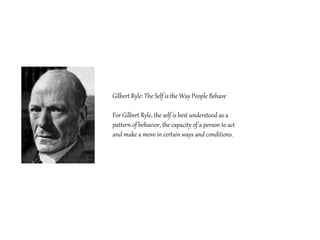
Gilbert Ryle: The Self is the Way People Behave
For Gilbert Ryle, the self is best understood as a
pattern of behavior, the capacity of a person to act
and make a move in certain ways and conditions.
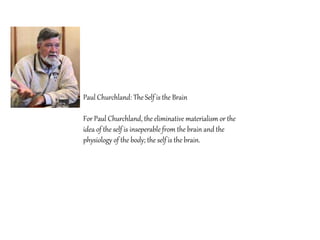
Paul Churchland: The Self is the Brain
For Paul Churchland, the eliminative materialism or the
idea of the self is inseperable from the brain and the
physiology of the body; the self is the brain.
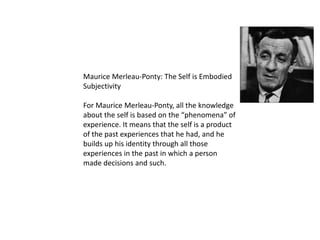
Maurice Merleau-Ponty: The Self is Embodied
Subjectivity
For Maurice Merleau-Ponty, all the knowledge
about the self is based on the “phenomena” of
experience. It means that the self is a product
of the past experiences that he had, and he
builds up his identity through all those
experiences in the past in which a person
made decisions and such.
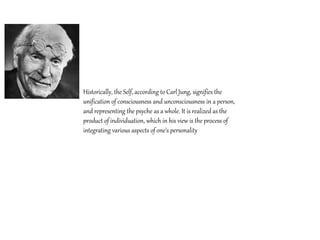
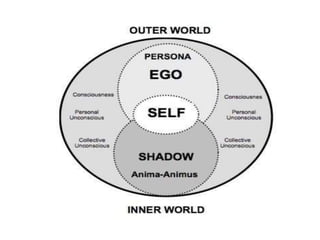
Historically, the Self, according to Carl Jung, signifies the
unification of consciousness and unconsciousness in a person,
and representing the psyche as a whole. It is realized as the
product of individuation, which in his view is the process of
integrating various aspects of one's personality
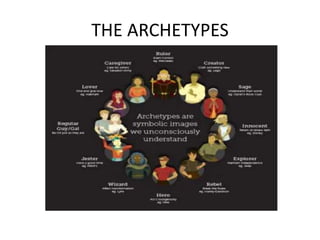
THE ARCHETYPES
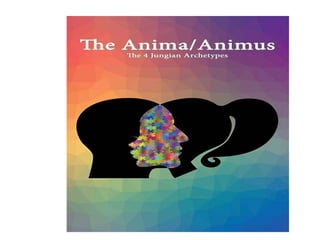
ANIMA AND ANIMUS
to describe certain functions of the
human “soul” (anima, Latin). Anima
names the feminine unconscious
factor in a man, while animus applies
to the corresponding masculine factor
in a woman's unconscious.
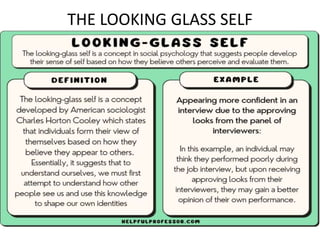
THE LOOKING GLASS SELF
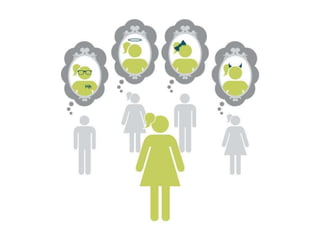
The concept consists of three components:
The imaginings of how one appears to another person
The imagination of how one is judged by that person
The feelings generated from these imaginations
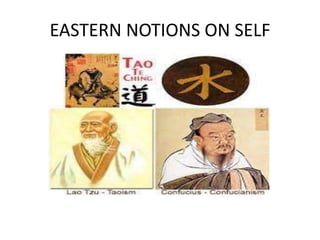
EASTERN NOTIONS ON SELF
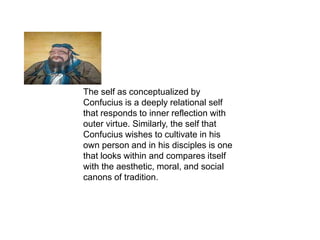
The self as conceptualized by
Confucius is a deeply relational self
that responds to inner reflection with
outer virtue. Similarly, the self that
Confucius wishes to cultivate in his
own person and in his disciples is one
that looks within and compares itself
with the aesthetic, moral, and social
canons of tradition.
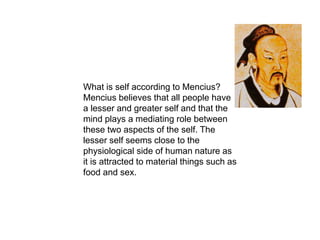
What is self according to Mencius?
Mencius believes that all people have
a lesser and greater self and that the
mind plays a mediating role between
these two aspects of the self. The
lesser self seems close to the
physiological side of human nature as
it is attracted to material things such as
food and sex.
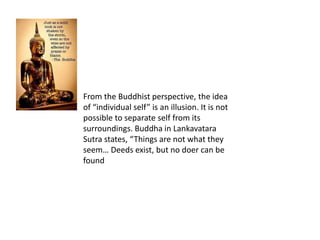
From the Buddhist perspective, the idea
of “individual self” is an illusion. It is not
possible to separate self from its
surroundings. Buddha in Lankavatara
Sutra states, “Things are not what they
seem… Deeds exist, but no doer can be
found
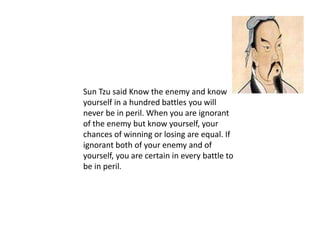
Sun Tzu said Know the enemy and know
yourself in a hundred battles you will
never be in peril. When you are ignorant
of the enemy but know yourself, your
chances of winning or losing are equal. If
ignorant both of your enemy and of
yourself, you are certain in every battle to
be in peril.
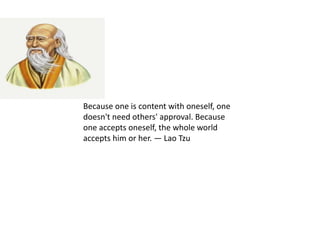
Because one is content with oneself, one
doesn't need others' approval. Because
one accepts oneself, the whole world
accepts him or her. — Lao Tzu
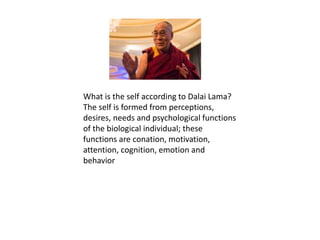
What is the self according to Dalai Lama?
The self is formed from perceptions,
desires, needs and psychological functions
of the biological individual; these
functions are conation, motivation,
attention, cognition, emotion and
behavior
UNDERSTANDING THE SELF.LESSON 1.pptx

UNDERSTANDING THE SELF.LESSON 1.pptx

  • 1.
  • 2.
    One of thegreatest challenges has been coming to terms with the nature of the self. Every individual has a self, yet no two selves are the same
  • 3.
    The self usuallyprovides a sense of consistency, a sense that there is some connection between who a person was yesterday and who they are today
  • 4.
    The self wasa source of continuity that gave individuals a sense of “connectedness” and “unbrokenness” - WILLIAM JAMES
  • 5.
    The “I” isthe self as agent, thinker, and knower, the executive function that experiences and reacts to the world, constructing mental representations and memories as it does so
  • 6.
    The “me” isthe individual one recognizes as the self, which for James included a material, social, and spiritual self. The material self refers to one’s physical body and one’s physical possessions. The social self refers to the various selves one may express and others may recognize depending on the social setting. The spiritual self refers to the enduring core of one’s being, including one’s values, personality, beliefs about the self,
  • 10.
    ACTIVITY ONE Create a“Me Tree” Steps: Trace your hand on a piece of paper leaving the fingertips open to draw longer branches. Draw your branches from your fingertips leaving room for lots of leaves. Draw as many leaves as you want (make sure to make them large enough to write things or draw inside!) Draw some soil on the bottom of your page leaving room between the bottom of your paper and the top of the soil for writing or drawing!
  • 12.
    Soil: “I amsupported by…” Reflect on the people and communities that support you to grow strong and kind. Tree trunk and branches: “I am grateful for…” Beginning at the bottom of the tree and working your way up through the branches, reflect on the places, things or experiences that you are grateful for (e.g., my family, friends, doctors that help me feel better when sick, school where I meet my friends, the outdoors where I can exercise and see new things, etc.) Leaves: “I love…” Lastly, reflect on the many things that make you – YOU! They could be adjectives (funny, smart, kind, helpful, good friend etc.) or your favorite hobbies and passions (playing soccer, painting, dancing with grandpa, learning math, etc.)
  • 14.
  • 15.
    Socrates: Life isNot Worth Living For Socrates, life is not worth living if it not examined. For him, the Soul is synonymous with the Self. He believes that human beings have immortal soul that lives within the physical body.
  • 16.
    Plato: The Selfis an Immortal Soul For plato, there are three elements of the soul: Reason, Physical Appetite, Spirit or Passion. Reason is the ability of the self to think critically, and make wise decisions. Physical Appetite is the basic needs of a person, hunger, thirst and sexual desires. Lastly, Spirit or Passion is composed of the basic emotions that the self encounters. Plato: The Self is an Immortal Soul For plato, there are three elements of the soul: Reason, Physical Appetite, Spirit or Passion. Reason is the ability of the self to think critically, and make wise decisions. Physical Appetite is the basic needs of a person, hunger, thirst and sexual desires. Lastly, Spirit or Passion is composed of the basic emotions that the self encounters.
  • 17.
    Aristotle: The Soulis the Essence of the Self For Aristotle, the main goal of the self is to leand a good, flourishing and fulfilling life.
  • 18.
    St. Agustine: TheSelf has an Immortal Soul Saint Agustine noted that the body is united with the soul as a whole, and not separated. He is the one who said “I am doubting, therefore I am”
  • 19.
    What does Aquinassay about self? Thomas Aquinas – Toward a Deeper Sense of Self For Aquinas, we don't encounter ourselves as isolated minds or selves, but rather always as agents interacting with our environment.
  • 20.
    Rene Descartes: Ithink therefore I am For Rene Descartes suggests that there are two dimensions of the self: the self as a thinking entity and the self as a physical body. He also empahasized on the saying :I think therefore I am” which means that a rational thinking person and being self concious is the proof that there is a self.
  • 21.
    John Locke: TheSelf is Conciousness For John Locke, “concious awareness and memory of precious experiences are the keys to understanding his self”. He said that the fact that the person is a thinking entity, reasonable and reflecting on its identity, then there is a self.
  • 22.
    David Hume: Thereis no Self For David Hume, there is no self if a person carefully examines himself through the method of introspection. The self is just a result of the humanistic imagination and thoughts, that build up a person’s characteristics.
  • 23.
    Immanuel Kant: Weconstruct the Self For Immanuel Kant, the people are the ones to create their own self. The self constructs its own reality which actively produces a world that is predictable to him/her.
  • 24.
    Sigmund Freud: TheSelf is Multilayered For Sigmund Freud, there are three layers of the self: Conscious, Unconscious, and Preconscious.
  • 26.
    Gilbert Ryle: TheSelf is the Way People Behave For Gilbert Ryle, the self is best understood as a pattern of behavior, the capacity of a person to act and make a move in certain ways and conditions.
  • 27.
    Paul Churchland: TheSelf is the Brain For Paul Churchland, the eliminative materialism or the idea of the self is inseperable from the brain and the physiology of the body; the self is the brain.
  • 28.
    Maurice Merleau-Ponty: TheSelf is Embodied Subjectivity For Maurice Merleau-Ponty, all the knowledge about the self is based on the “phenomena” of experience. It means that the self is a product of the past experiences that he had, and he builds up his identity through all those experiences in the past in which a person made decisions and such.
  • 29.
    Historically, the Self,according to Carl Jung, signifies the unification of consciousness and unconsciousness in a person, and representing the psyche as a whole. It is realized as the product of individuation, which in his view is the process of integrating various aspects of one's personality
  • 30.
  • 32.
    ANIMA AND ANIMUS todescribe certain functions of the human “soul” (anima, Latin). Anima names the feminine unconscious factor in a man, while animus applies to the corresponding masculine factor in a woman's unconscious.
  • 34.
  • 35.
    The concept consistsof three components: The imaginings of how one appears to another person The imagination of how one is judged by that person The feelings generated from these imaginations
  • 37.
  • 38.
    The self asconceptualized by Confucius is a deeply relational self that responds to inner reflection with outer virtue. Similarly, the self that Confucius wishes to cultivate in his own person and in his disciples is one that looks within and compares itself with the aesthetic, moral, and social canons of tradition.
  • 39.
    What is selfaccording to Mencius? Mencius believes that all people have a lesser and greater self and that the mind plays a mediating role between these two aspects of the self. The lesser self seems close to the physiological side of human nature as it is attracted to material things such as food and sex.
  • 40.
    From the Buddhistperspective, the idea of “individual self” is an illusion. It is not possible to separate self from its surroundings. Buddha in Lankavatara Sutra states, “Things are not what they seem… Deeds exist, but no doer can be found
  • 42.
    Sun Tzu saidKnow the enemy and know yourself in a hundred battles you will never be in peril. When you are ignorant of the enemy but know yourself, your chances of winning or losing are equal. If ignorant both of your enemy and of yourself, you are certain in every battle to be in peril.
  • 43.
    Because one iscontent with oneself, one doesn't need others' approval. Because one accepts oneself, the whole world accepts him or her. — Lao Tzu
  • 44.
    What is theself according to Dalai Lama? The self is formed from perceptions, desires, needs and psychological functions of the biological individual; these functions are conation, motivation, attention, cognition, emotion and behavior