UNDERSTANDING
THE SELF
BY : CARVIN PAUL G. TAMPOS
CHAPTER 1
DEFINING THE SELF: PERSONAL AND
DEVELOPMENTAL PERSPECTIVES ON
SELF IDENTITY
LESSON
1
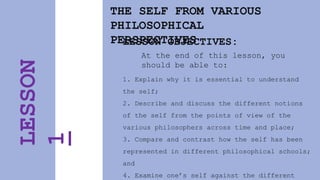
THE SELF FROM VARIOUS
PHILOSOPHICAL
PERSPECTIVES
LESSON OBJECTIVES:
At the end of this lesson, you
should be able to:
1. Explain why it is essential to understand
the self;
2. Describe and discuss the different notions
of the self from the points of view of the
various philosophers across time and place;
3. Compare and contrast how the self has been
represented in different philosophical schools;
and
4. Examine one’s self against the different
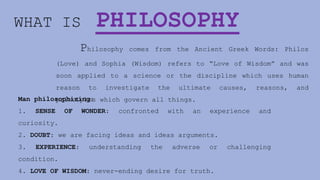
WHAT IS PHILOSOPHY
Philosophy comes from the Ancient Greek Words: Philos
(Love) and Sophia (Wisdom) refers to “Love of Wisdom” and was
soon applied to a science or the discipline which uses human
reason to investigate the ultimate causes, reasons, and
principles which govern all things.
Man philosophizing:
1. SENSE OF WONDER: confronted with an experience and
curiosity.
2. DOUBT: we are facing ideas and ideas arguments.
3. EXPERIENCE: understanding the adverse or challenging
condition.
4. LOVE OF WISDOM: never-ending desire for truth.
HISTORY OF PHILOSOPHY?
The history of philosophy is replete with men and women who
inquired into the fundamental nature of the self. Along with the question
of the primary substratum that defines the multiplicity of things in the
world, the inquiry on the self has preoccupied the
earliest thinkers in the history of philosophy: the Greeks. The Greeks
were the ones who seriously questioned myths and moved away from them in
attempting to understand reality and respond to perennial questions of
curiosity, including the question of the self. The different perspectives
and views on the self can be best seen and understood by revisiting its
prime movers and identity the most important conjectures made by
philosophers from ancient times to the contemporary period.
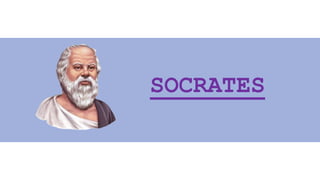
SOCRATES
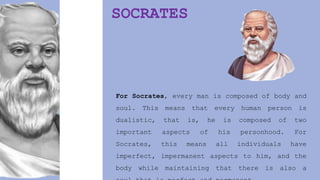
SOCRATES
For Socrates, every man is composed of body and
soul. This means that every human person is
dualistic, that is, he is composed of two
important aspects of his personhood. For
Socrates, this means all individuals have
imperfect, impermanent aspects to him, and the
body while maintaining that there is also a
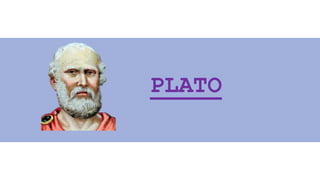
PLATO
PLATO
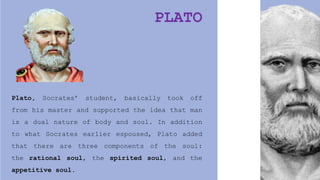
Plato, Socrates’ student, basically took off
from his master and supported the idea that man
is a dual nature of body and soul. In addition
to what Socrates earlier espoused, Plato added
that there are three components of the soul:
the rational soul, the spirited soul, and the
appetitive soul.
In his magnum opus, The Republic” (Plato 2000),
Plato emphasizes that justice in the human
person can only be attained if the three parts
of the soul work harmoniously with one another.
The rational soul forged by reason and
intellect has to govern the affairs of the
human person, the spirited part which is in
charge of emotions should be kept at bay, and
the appetitive soul in charge of base desires
like eating, drinking, sleeping, and having sex
are controlled as well. When this ideal state
is attained, then the human person’s soul
PLATO
AUGUSTINE
SAINT
AQUINAS
SAINT
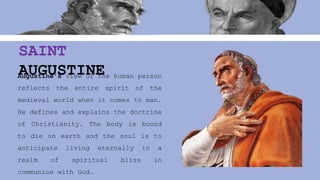
Augustine’s view of the human person
reflects the entire spirit of the
medieval world when it comes to man.
He defines and explains the doctrine
of Christianity. The body is bound
to die on earth and the soul is to
anticipate living eternally in a
realm of spiritual bliss in
communion with God.
SAINT
AUGUSTINE
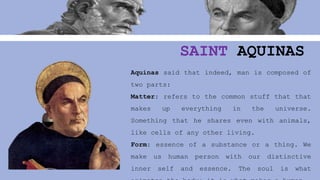
SAINT AQUINAS
Aquinas said that indeed, man is composed of
two parts:
Matter: refers to the common stuff that that
makes up everything in the universe.
Something that he shares even with animals,
like cells of any other living.
Form: essence of a substance or a thing. We
make us human person with our distinctive
inner self and essence. The soul is what
RENE
DESCARTES
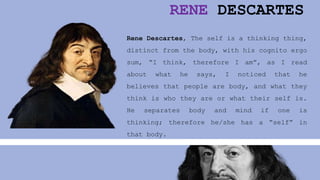
RENE DESCARTES
Rene Descartes, The self is a thinking thing,
distinct from the body, with his cognito ergo
sum, “I think, therefore I am”, as I read
about what he says, I noticed that he
believes that people are body, and what they
think is who they are or what their self is.
He separates body and mind if one is
thinking; therefore he/she has a “self” in
that body.
RENE DESCARTES
Therefore, I think, he is
implying that “self” is how,
what, and/or why we think and
that is separated from the body.
Unlike from the previous two that
believes we know ourselves,
Descartes believes more that we,
as a thinking body, is the “self”
itself.
Two distinct entities
1. Cogito- The thing that
thinks, which is the mind.
2. Extenza- extension of the
mind which is body.
The body is nothing else but a machine
that is attached to the mind – Of
course our body is connected to our
mind. What are mind we think the body
will make.
DAVID HUME
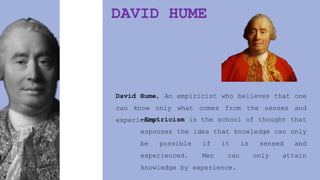
DAVID HUME
David Hume, An empiricist who believes that one
can know only what comes from the senses and
experience’
-Empiricism is the school of thought that
espouses the idea that knowledge can only
be possible if it is sensed and
experienced. Men can only attain
knowledge by experience.
DAVID HUME
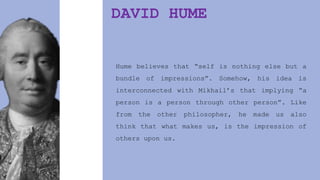
Hume believes that “self is nothing else but a
bundle of impressions”. Somehow, his idea is
interconnected with Mikhail’s that implying “a
person is a person through other person”. Like
from the other philosopher, he made us also
think that what makes us, is the impression of
others upon us.
DAVID HUME
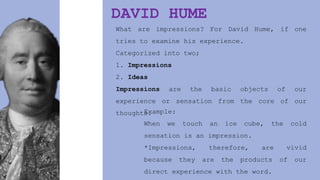
What are impressions? For David Hume, if one
tries to examine his experience.
Categorized into two;
1. Impressions
2. Ideas
Impressions are the basic objects of our
experience or sensation from the core of our
thoughts.
Example:
When we touch an ice cube, the cold
sensation is an impression.
*Impressions, therefore, are vivid
because they are the products of our
direct experience with the word.
DAVID HUME
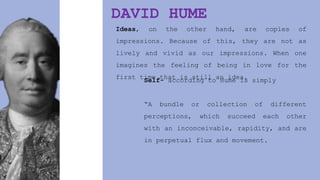
Ideas, on the other hand, are copies of
impressions. Because of this, they are not as
lively and vivid as our impressions. When one
imagines the feeling of being in love for the
first time that is still an idea.
Self- according to Hume is simply
“A bundle or collection of different
perceptions, which succeed each other
with an inconceivable, rapidity, and are
in perpetual flux and movement.
IMMANUEL
KANT
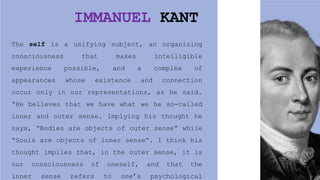
IMMANUEL KANT
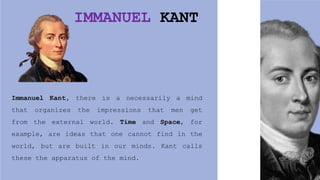
Immanuel Kant, there is a necessarily a mind
that organizes the impressions that men get
from the external world. Time and Space, for
example, are ideas that one cannot find in the
world, but are built in our minds. Kant calls
these the apparatus of the mind.
IMMANUEL KANT
The self is a unifying subject, an organizing
consciousness that makes intelligible
experience possible, and a complex of
appearances whose existence and connection
occur only in our representations, as he said.
“He believes that we have what we he so-called
inner and outer sense. Implying his thought he
says, “Bodies are objects of outer sense” while
“Souls are objects of inner sense”. I think his
thought implies that, in the outer sense, it is
our consciousness of oneself, and that the
inner sense refers to one’s psychological
GILBERT
RYLE
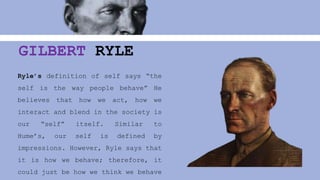
Ryle’s definition of self says “the
self is the way people behave” He
believes that how we act, how we
interact and blend in the society is
our “self” itself. Similar to
Hume’s, our self is defined by
impressions. However, Ryle says that
it is how we behave; therefore, it
could just be how we think we behave
GILBERT RYLE
MERLEAU
PONTY
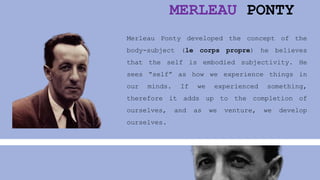
MERLEAU PONTY
Merleau Ponty developed the concept of the
body-subject (le corps propre) he believes
that the self is embodied subjectivity. He
sees “self” as how we experience things in
our minds. If we experienced something,
therefore it adds up to the completion of
ourselves, and as we venture, we develop
ourselves.
END.

UTS - Chapter 1 - Lesson 1.pptx

  • 1.
    UNDERSTANDING THE SELF BY :CARVIN PAUL G. TAMPOS
  • 2.
    CHAPTER 1 DEFINING THESELF: PERSONAL AND DEVELOPMENTAL PERSPECTIVES ON SELF IDENTITY
  • 3.
    LESSON 1 THE SELF FROMVARIOUS PHILOSOPHICAL PERSPECTIVES LESSON OBJECTIVES: At the end of this lesson, you should be able to: 1. Explain why it is essential to understand the self; 2. Describe and discuss the different notions of the self from the points of view of the various philosophers across time and place; 3. Compare and contrast how the self has been represented in different philosophical schools; and 4. Examine one’s self against the different
  • 4.
    WHAT IS PHILOSOPHY Philosophycomes from the Ancient Greek Words: Philos (Love) and Sophia (Wisdom) refers to “Love of Wisdom” and was soon applied to a science or the discipline which uses human reason to investigate the ultimate causes, reasons, and principles which govern all things. Man philosophizing: 1. SENSE OF WONDER: confronted with an experience and curiosity. 2. DOUBT: we are facing ideas and ideas arguments. 3. EXPERIENCE: understanding the adverse or challenging condition. 4. LOVE OF WISDOM: never-ending desire for truth.
  • 5.
    HISTORY OF PHILOSOPHY? Thehistory of philosophy is replete with men and women who inquired into the fundamental nature of the self. Along with the question of the primary substratum that defines the multiplicity of things in the world, the inquiry on the self has preoccupied the earliest thinkers in the history of philosophy: the Greeks. The Greeks were the ones who seriously questioned myths and moved away from them in attempting to understand reality and respond to perennial questions of curiosity, including the question of the self. The different perspectives and views on the self can be best seen and understood by revisiting its prime movers and identity the most important conjectures made by philosophers from ancient times to the contemporary period.
  • 6.
  • 7.
    SOCRATES For Socrates, everyman is composed of body and soul. This means that every human person is dualistic, that is, he is composed of two important aspects of his personhood. For Socrates, this means all individuals have imperfect, impermanent aspects to him, and the body while maintaining that there is also a
  • 8.
  • 9.
    PLATO Plato, Socrates’ student,basically took off from his master and supported the idea that man is a dual nature of body and soul. In addition to what Socrates earlier espoused, Plato added that there are three components of the soul: the rational soul, the spirited soul, and the appetitive soul.
  • 10.
    In his magnumopus, The Republic” (Plato 2000), Plato emphasizes that justice in the human person can only be attained if the three parts of the soul work harmoniously with one another. The rational soul forged by reason and intellect has to govern the affairs of the human person, the spirited part which is in charge of emotions should be kept at bay, and the appetitive soul in charge of base desires like eating, drinking, sleeping, and having sex are controlled as well. When this ideal state is attained, then the human person’s soul PLATO
  • 11.
  • 12.
    Augustine’s view ofthe human person reflects the entire spirit of the medieval world when it comes to man. He defines and explains the doctrine of Christianity. The body is bound to die on earth and the soul is to anticipate living eternally in a realm of spiritual bliss in communion with God. SAINT AUGUSTINE
  • 13.
    SAINT AQUINAS Aquinas saidthat indeed, man is composed of two parts: Matter: refers to the common stuff that that makes up everything in the universe. Something that he shares even with animals, like cells of any other living. Form: essence of a substance or a thing. We make us human person with our distinctive inner self and essence. The soul is what
  • 14.
  • 15.
    RENE DESCARTES Rene Descartes,The self is a thinking thing, distinct from the body, with his cognito ergo sum, “I think, therefore I am”, as I read about what he says, I noticed that he believes that people are body, and what they think is who they are or what their self is. He separates body and mind if one is thinking; therefore he/she has a “self” in that body.
  • 16.
    RENE DESCARTES Therefore, Ithink, he is implying that “self” is how, what, and/or why we think and that is separated from the body. Unlike from the previous two that believes we know ourselves, Descartes believes more that we, as a thinking body, is the “self” itself. Two distinct entities 1. Cogito- The thing that thinks, which is the mind. 2. Extenza- extension of the mind which is body. The body is nothing else but a machine that is attached to the mind – Of course our body is connected to our mind. What are mind we think the body will make.
  • 17.
  • 18.
    DAVID HUME David Hume,An empiricist who believes that one can know only what comes from the senses and experience’ -Empiricism is the school of thought that espouses the idea that knowledge can only be possible if it is sensed and experienced. Men can only attain knowledge by experience.
  • 19.
    DAVID HUME Hume believesthat “self is nothing else but a bundle of impressions”. Somehow, his idea is interconnected with Mikhail’s that implying “a person is a person through other person”. Like from the other philosopher, he made us also think that what makes us, is the impression of others upon us.
  • 20.
    DAVID HUME What areimpressions? For David Hume, if one tries to examine his experience. Categorized into two; 1. Impressions 2. Ideas Impressions are the basic objects of our experience or sensation from the core of our thoughts. Example: When we touch an ice cube, the cold sensation is an impression. *Impressions, therefore, are vivid because they are the products of our direct experience with the word.
  • 21.
    DAVID HUME Ideas, onthe other hand, are copies of impressions. Because of this, they are not as lively and vivid as our impressions. When one imagines the feeling of being in love for the first time that is still an idea. Self- according to Hume is simply “A bundle or collection of different perceptions, which succeed each other with an inconceivable, rapidity, and are in perpetual flux and movement.
  • 22.
  • 23.
    IMMANUEL KANT Immanuel Kant,there is a necessarily a mind that organizes the impressions that men get from the external world. Time and Space, for example, are ideas that one cannot find in the world, but are built in our minds. Kant calls these the apparatus of the mind.
  • 24.
    IMMANUEL KANT The selfis a unifying subject, an organizing consciousness that makes intelligible experience possible, and a complex of appearances whose existence and connection occur only in our representations, as he said. “He believes that we have what we he so-called inner and outer sense. Implying his thought he says, “Bodies are objects of outer sense” while “Souls are objects of inner sense”. I think his thought implies that, in the outer sense, it is our consciousness of oneself, and that the inner sense refers to one’s psychological
  • 25.
  • 26.
    Ryle’s definition ofself says “the self is the way people behave” He believes that how we act, how we interact and blend in the society is our “self” itself. Similar to Hume’s, our self is defined by impressions. However, Ryle says that it is how we behave; therefore, it could just be how we think we behave GILBERT RYLE
  • 27.
  • 28.
    MERLEAU PONTY Merleau Pontydeveloped the concept of the body-subject (le corps propre) he believes that the self is embodied subjectivity. He sees “self” as how we experience things in our minds. If we experienced something, therefore it adds up to the completion of ourselves, and as we venture, we develop ourselves.
  • 29.