Understanding Genetic
Counseling: Breast and
Ovarian Cancer
Rania Sheikh, MS, CGC
Genetic Counselor
Today’s Talk
• What is genetic counseling?
• What are the goals?
• Who needs a GC and what is the process like?
• Hereditary cancers
• How are genetic testing results used?
• How to find a genetic counselor?
• Time for questions
Genetic Counseling
Process of helping people understand and adapt to the medical,
psychological and familial implications of genetic contributions to
disease.
National Society of Genetic Counselors (NSGC)
• Founded in 1979
• Prenatal, Cancer, Cardiovascular, Neurology
Goals of Genetic Counseling
• Explanation for personal and family history
• Early detection and risk-reduction
• Treatment Decisions
• Family planning
• Provide support networks
• Opportunity to participate in research
Who is referred to Genetics?
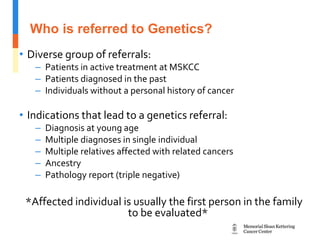
• Diverse group of referrals:
– Patients in active treatment at MSKCC
– Patients diagnosed in the past
– Individuals without a personal history of cancer
• Indications that lead to a genetics referral:
– Diagnosis at young age
– Multiple diagnoses in single individual
– Multiple relatives affected with related cancers
– Ancestry
– Pathology report (triple negative)
*Affected individual is usually the first person in the family
to be evaluated*
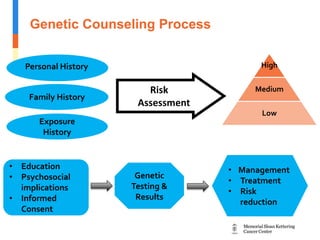
Family History
Personal History
Genetic
Testing &
Results
Risk
Assessment
Genetic Counseling Process
• Education
• Psychosocial
implications
• Informed
Consent
• Management
• Treatment
• Risk
reduction
Exposure
History
High
Medium
Low
How Common are Breast and Ovarian
Cancer?
1.3%12%
*General population risks
OvaryBreast
How common are Hereditary breast
and Ovarian cancer?
15%
5-10%
Sporadic
Familial
Hereditary
20%
Breast Ovary
Syndromes often considered For
Hereditary Breast Cancer
• Hereditary Breast and Ovarian Cancer
syndrome (BRCA1 & BRCA2)
• Hereditary Diffuse Gastric Cancer (CDH1)
• Li-Fraumeni syndrome (TP53)
• Cowden syndrome (PTEN)
• Moderate risk genes (CHEK2, PALB2, ATM)
Syndromes often considered For
Hereditary Ovarian Cancer
• Hereditary Breast and Ovarian Cancer
syndrome (BRCA1 & BRCA2)
• Lynch Syndrome(MLH1, MSH2, MSH6, PMS2,
and EPCAM)
• Moderate risk genes (BRIP1, RAD51C,
RAD51D, PALb2, ATM)
Chromosomes, DNA, and Genes
Genes and Proteins
• BRCA1 and BRCA2 genes
• Breast, ovary, prostate, pancreas cancers
• Founder mutations in Ashkenazi population
Hereditary Breast and Ovarian
Cancer Syndrome
………………………………………
185delAG 5382insC
6174delT
BRCA1
BRCA2
………………………………………………………………..
Chr 17
Chr 13
Prevalence in AJ = ~1 in 40
BRCA1 and BRCA2
How Genetic Testing
Results Can Be
Used?
• Lumpectomy vs mastectomy (Breast)
• Targeted therapy (Breast & Ovary)
Impact on Treatment
Risk Management
• Screening interval
– Earlier age
– Increased frequency
• Additional areas of the body at risk
• Preventative surgeries
– Risk-reducing mastectomies
– Oophorectomy
• Information for physicians
Family Planning: Pre-implantation Genetic
Diagnosis (PGD)
• Able to make
informed childbearing
decision
• In-vitro Fertilization
(IVF)
• Testing of single cell
from day-3 embryo
• Only embryos without
mutation are used for
implantation
Risk Perception
Some Factors That Influence Risk
Perception
Future Directions:
Research
Future Directions
• Population screening
– BRCA in Ashkenazi Jewish population (BFOR
Study at bforstudy.com)
• Personalized Medicine
– Refine risks based on an individual’s genetic
information
• Treatment
– PARPi
– Immunotherapy
Find a Genetic Counselor Closer To
Home
• www.nsgc.org/findageneticcounselor
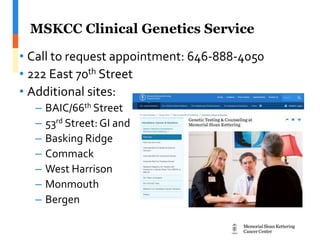
MSKCC Clinical Genetics Service
• Call to request appointment: 646-888-4050
• 222 East 70th Street
• Additional sites:
– BAIC/66th Street
– 53rd Street:GI and GYN
– Basking Ridge
– Commack
– West Harrison
– Monmouth
– Bergen
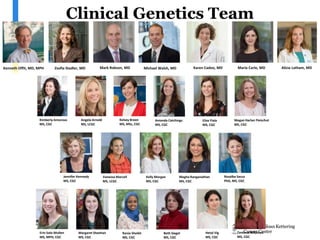
Clinical Genetics Team
Kimberly Amoroso
MS, CGC
Angela Arnold
MS, LCGC
Kelsey Breen
MS, MSc, CGC
Amanda Catchings
MS, CGC
Megan Harlan Fleischut
MS, CGC
Jennifer Kennedy
MS, CGC
Vanessa Marcell
MS, LCGC
Kelly Morgan
MS, CGC
Erin Salo-Mullen
MS, MPH, CGC
Margaret Sheehan
MS, CGC
Rania Sheikh
MS, CGC
Beth Siegel
MS, CGC
Hetal Vig
MS, CGC
Temima Wildman
MS, CGC
Kenneth Offit, MD, MPH Mark Robson, MDZsofia Stadler, MD Michael Walsh, MD Karen Cadoo, MD Maria Carlo, MD
Elise Fiala
MS, CGC
Alicia Latham, MD
Megha Ranganathan
MS, CGC
Rosalba Sacca
PhD, MS, CGC
Thank you! Questions?
MSKCC ClinicalGenetics Service
646-888-4050

Understanding Genetic Counseling

  • 1.
    Understanding Genetic Counseling: Breastand Ovarian Cancer Rania Sheikh, MS, CGC Genetic Counselor
  • 2.
    Today’s Talk • Whatis genetic counseling? • What are the goals? • Who needs a GC and what is the process like? • Hereditary cancers • How are genetic testing results used? • How to find a genetic counselor? • Time for questions
  • 3.
    Genetic Counseling Process ofhelping people understand and adapt to the medical, psychological and familial implications of genetic contributions to disease. National Society of Genetic Counselors (NSGC) • Founded in 1979 • Prenatal, Cancer, Cardiovascular, Neurology
  • 4.
    Goals of GeneticCounseling • Explanation for personal and family history • Early detection and risk-reduction • Treatment Decisions • Family planning • Provide support networks • Opportunity to participate in research
  • 5.
    Who is referredto Genetics? • Diverse group of referrals: – Patients in active treatment at MSKCC – Patients diagnosed in the past – Individuals without a personal history of cancer • Indications that lead to a genetics referral: – Diagnosis at young age – Multiple diagnoses in single individual – Multiple relatives affected with related cancers – Ancestry – Pathology report (triple negative) *Affected individual is usually the first person in the family to be evaluated*
  • 6.
    Family History Personal History Genetic Testing& Results Risk Assessment Genetic Counseling Process • Education • Psychosocial implications • Informed Consent • Management • Treatment • Risk reduction Exposure History High Medium Low
  • 7.
    How Common areBreast and Ovarian Cancer? 1.3%12% *General population risks OvaryBreast
  • 8.
    How common areHereditary breast and Ovarian cancer? 15% 5-10% Sporadic Familial Hereditary 20% Breast Ovary
  • 9.
    Syndromes often consideredFor Hereditary Breast Cancer • Hereditary Breast and Ovarian Cancer syndrome (BRCA1 & BRCA2) • Hereditary Diffuse Gastric Cancer (CDH1) • Li-Fraumeni syndrome (TP53) • Cowden syndrome (PTEN) • Moderate risk genes (CHEK2, PALB2, ATM)
  • 10.
    Syndromes often consideredFor Hereditary Ovarian Cancer • Hereditary Breast and Ovarian Cancer syndrome (BRCA1 & BRCA2) • Lynch Syndrome(MLH1, MSH2, MSH6, PMS2, and EPCAM) • Moderate risk genes (BRIP1, RAD51C, RAD51D, PALb2, ATM)
  • 11.
  • 12.
  • 13.
    • BRCA1 andBRCA2 genes • Breast, ovary, prostate, pancreas cancers • Founder mutations in Ashkenazi population Hereditary Breast and Ovarian Cancer Syndrome
  • 14.
  • 15.
  • 16.
    • Lumpectomy vsmastectomy (Breast) • Targeted therapy (Breast & Ovary) Impact on Treatment
  • 17.
    Risk Management • Screeninginterval – Earlier age – Increased frequency • Additional areas of the body at risk • Preventative surgeries – Risk-reducing mastectomies – Oophorectomy • Information for physicians
  • 18.
    Family Planning: Pre-implantationGenetic Diagnosis (PGD) • Able to make informed childbearing decision • In-vitro Fertilization (IVF) • Testing of single cell from day-3 embryo • Only embryos without mutation are used for implantation
  • 19.
  • 20.
    Some Factors ThatInfluence Risk Perception
  • 21.
  • 22.
    Future Directions • Populationscreening – BRCA in Ashkenazi Jewish population (BFOR Study at bforstudy.com) • Personalized Medicine – Refine risks based on an individual’s genetic information • Treatment – PARPi – Immunotherapy
  • 23.
    Find a GeneticCounselor Closer To Home • www.nsgc.org/findageneticcounselor
  • 24.
    MSKCC Clinical GeneticsService • Call to request appointment: 646-888-4050 • 222 East 70th Street • Additional sites: – BAIC/66th Street – 53rd Street:GI and GYN – Basking Ridge – Commack – West Harrison – Monmouth – Bergen
  • 25.
    Clinical Genetics Team KimberlyAmoroso MS, CGC Angela Arnold MS, LCGC Kelsey Breen MS, MSc, CGC Amanda Catchings MS, CGC Megan Harlan Fleischut MS, CGC Jennifer Kennedy MS, CGC Vanessa Marcell MS, LCGC Kelly Morgan MS, CGC Erin Salo-Mullen MS, MPH, CGC Margaret Sheehan MS, CGC Rania Sheikh MS, CGC Beth Siegel MS, CGC Hetal Vig MS, CGC Temima Wildman MS, CGC Kenneth Offit, MD, MPH Mark Robson, MDZsofia Stadler, MD Michael Walsh, MD Karen Cadoo, MD Maria Carlo, MD Elise Fiala MS, CGC Alicia Latham, MD Megha Ranganathan MS, CGC Rosalba Sacca PhD, MS, CGC
  • 26.
    Thank you! Questions? MSKCCClinicalGenetics Service 646-888-4050