FLASCO Fall Session, Orlando FL
Saturday, November 5th, 2016
Kathleen R. Blazer, EdD, MS, LCGC
Division of Clinical Cancer Genomics
City of Hope
Duarte, CA
Genetic Testing for Cancer Risk:
What you need to know
Disclosures
• I do not have any financial arrangements or affiliations with
any corporate organization relating to the topic being
presented
Genetic Cancer Risk Assessment
(GCRA)
• Interdisciplinary specialty practice that
uses genetic and genomic information to
– Identify individuals with inherited cancer risk
– Prescribe high-risk screening, preventive
care, targeted treatment
• Increasing demands for GCRA services in
community settings
• Guidelines/resources needed to help
community-based clinicians
• Recognize and refer patients
• Provide GCRA services
• Manage patients and families with cancer
predisposition
Learning Objectives
After this presentation, the participant should be able to:
• Identify patients with potential hereditary cancer risk
• Recognize the strategies and possible outcomes of genetic
testing for hereditary cancers
• Incorporate National Comprehensive Cancer Network (NCCN)
guidelines for cancer predisposition testing, high-risk cancer
screening and management into clinical practice
Sporadic, Familial, and
Strongly Hereditary Cancer
• 5% to 10% of cancers due to
high-penetrant hereditary
predisposition
• >50 single-gene syndromes
identified
• 15-20% ‘familial’ cancer clusters
• Shared environment
• Growing number of
low/moderate risk genes
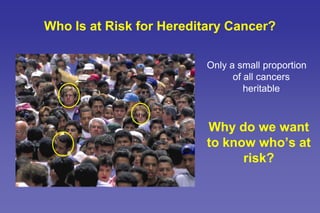
Who Is at Risk for Hereditary Cancer?
Only a small proportion
of all cancers
heritable
Why do we want
to know who’s at
risk?
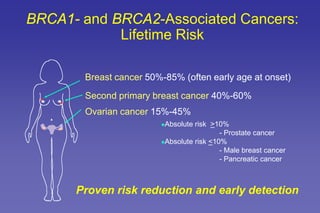
BRCA1- and BRCA2-Associated Cancers:
Lifetime Risk
Breast cancer 50%-85% (often early age at onset)
Second primary breast cancer 40%-60%
Ovarian cancer 15%-45%
Absolute risk >10%
- Prostate cancer
Absolute risk <10%
- Male breast cancer
- Pancreatic cancer
Proven risk reduction and early detection
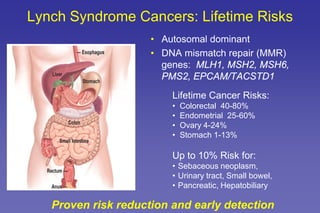
Lynch Syndrome Cancers: Lifetime Risks
• Autosomal dominant
• DNA mismatch repair (MMR)
genes: MLH1, MSH2, MSH6,
PMS2, EPCAM/TACSTD1
Proven risk reduction and early detection
Lifetime Cancer Risks:
• Colorectal 40-80%
• Endometrial 25-60%
• Ovary 4-24%
• Stomach 1-13%
Up to 10% Risk for:
• Sebaceous neoplasm,
• Urinary tract, Small bowel,
• Pancreatic, Hepatobiliary
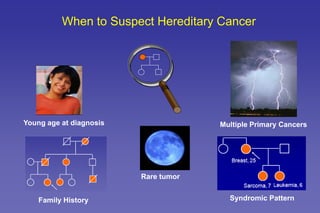
Young age at diagnosis
Rare tumor
Multiple Primary Cancers
When to Suspect Hereditary Cancer
Family History Syndromic Pattern
Document the Patient and Family History
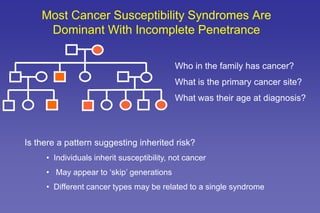
Most Cancer Susceptibility Syndromes Are
Dominant With Incomplete Penetrance
Who in the family has cancer?
What is the primary cancer site?
What was their age at diagnosis?
Is there a pattern suggesting inherited risk?
• Individuals inherit susceptibility, not cancer
• May appear to ‘skip’ generations
• Different cancer types may be related to a single syndrome
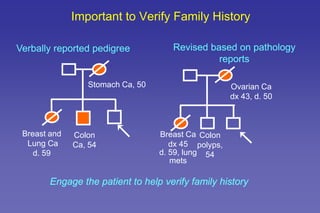
Important to Verify Family History
Breast Ca
dx 45
d. 59, lung
mets
Revised based on pathology
reports
Ovarian Ca
dx 43, d. 50
Colon
polyps,
54
Breast and
Lung Ca
d. 59
Verbally reported pedigree
Colon
Ca, 54
Stomach Ca, 50
Engage the patient to help verify family history
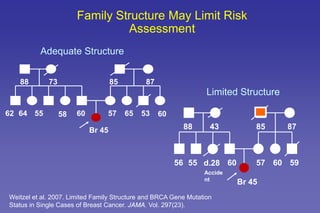
Family Structure May Limit Risk
Assessment
Adequate Structure
60
Br 45
57 65
85
60 5358
8788 73
64 5562
Limited Structure
Br 45
57 60
85
60 59
8788 43
56 55 d.28
Accide
nt
Weitzel et al. 2007. Limited Family Structure and BRCA Gene Mutation
Status in Single Cases of Breast Cancer. JAMA. Vol. 297(23).
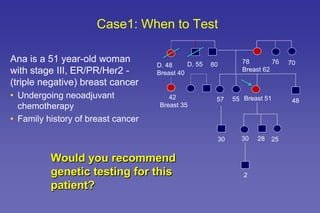
Case1: When to Test
Ana is a 51 year-old woman
with stage III, ER/PR/Her2 -
(triple negative) breast cancer
• Undergoing neoadjuvant
chemotherapy
• Family history of breast cancer
25
Breast 51
78
Breast 62
30 28
5557
80
48
30
76 70D. 48
Breast 40
D. 55
2
Would you recommend
genetic testing for this
patient?
42
Breast 35
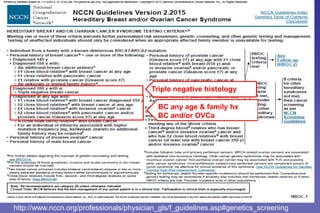
http://www.nccn.org/professionals/physician_gls/f_guidelines.asp#genetics_screening
Triple negative histology
BC any age & family hx
BC and/or OVCa
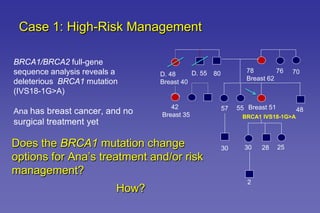
BRCA1/BRCA2 full-gene
sequence analysis reveals a
deleterious BRCA1 mutation
(IVS18-1G>A)
Ana has breast cancer, and no
surgical treatment yet
BRCA1 IVS18-1G>A
25
Breast 51
78
Breast 62
30 28
5557
80
48
30
76 70D. 48
Breast 40
D. 55
2
Case 1: High-Risk Management
Does the BRCA1 mutation change
options for Ana’s treatment and/or risk
management?
42
Breast 35
How?
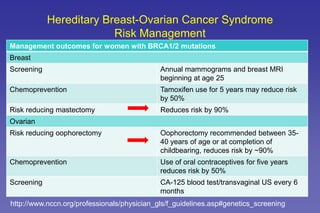
Hereditary Breast-Ovarian Cancer Syndrome
Risk Management
Management outcomes for women with BRCA1/2 mutations
Breast
Screening Annual mammograms and breast MRI
beginning at age 25
Chemoprevention Tamoxifen use for 5 years may reduce risk
by 50%
Risk reducing mastectomy Reduces risk by 90%
Ovarian
Risk reducing oophorectomy Oophorectomy recommended between 35-
40 years of age or at completion of
childbearing, reduces risk by ~90%
Chemoprevention Use of oral contraceptives for five years
reduces risk by 50%
Screening CA-125 blood test/transvaginal US every 6
months
http://www.nccn.org/professionals/physician_gls/f_guidelines.asp#genetics_screening
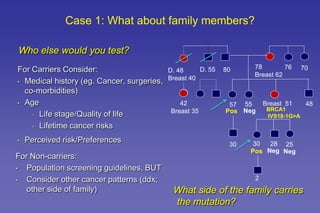
Case 1: What about family members?
Pos Neg
BRCA1
IVS18-1G>A
25
Breast 51
78
Breast 62
30 28
5557
80
30
76 70D. 55D. 48
Breast 40
48
Neg
NegPos
2
For Carriers Consider:
• Medical history (eg. Cancer, surgeries,
co-morbidities)
• Age
- Life stage/Quality of life
- Lifetime cancer risks
For Non-carriers:
• Population screening guidelines, BUT
• Consider other cancer patterns (ddx;
other side of family) What side of the family carries
the mutation?
42
Breast 35
• Perceived risk/Preferences
Who else would you test?
25
Breast 51
78
Breast 62
30 28
5557
80
30
76 70D. 55D. 48
Breast 40
48
2
42
Breast 35
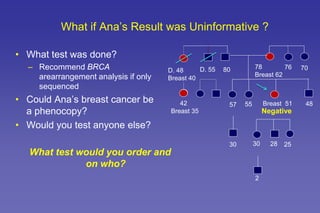
• What test was done?
– Recommend BRCA
arearrangement analysis if only
sequenced
• Could Ana’s breast cancer be
a phenocopy?
• Would you test anyone else?
What if Ana’s Result was Uninformative ?
Negative
What test would you order and
on who?
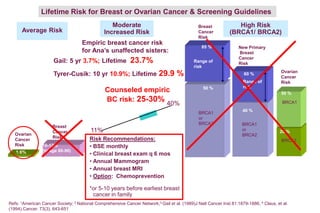
Lifetime Risk for Breast or Ovarian Cancer & Screening Guidelines
10-12%
(to age 80-90)
50 %
85 %
Average Risk
Moderate
Increased Risk
High Risk
(BRCA1/ BRCA2)
1.6%
BRCA2
20 %
50 %
Range of
risk
Ovarian
Cancer
Risk
Ovarian
Cancer
Risk
BRCA1
or
BRCA2
Gail: 5 yr 3.7%; Lifetime 23.7%
Tyrer-Cusik: 10 yr 10.9%; Lifetime 29.9 %
56 %
BRCA1
or
BRCA2
BRCA1
or
BRCA2
Range of
risk
40 %
60 %
BRCA1
Refs: 1American Cancer Society; 2 National Comprehensive Cancer Network;3 Gail et al. (1989)J Natl Cancer Inst 81:1879-1886; 4 Claus, et al.
(1994).Cancer. 73(3), 643-651
Breast
Cancer
Risk
Empiric breast cancer risk
for Ana’s unaffected sisters:
Breast
Cancer
Risk
New Primary
Breast
Cancer
Risk
Risk Recommendations:
• BSE monthly
• Clinical breast exam q 6 mos
• Annual Mammogram
• Annual breast MRI
• Option: Chemoprevention
*or 5-10 years before earliest breast
cancer in family
11%
40%
Counseled empiric
BC risk: 25-30%
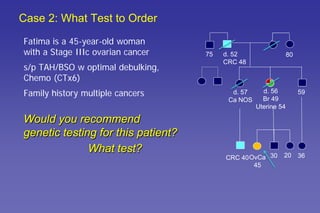
Fatima is a 45-year-old woman
with a Stage IIIc ovarian cancer
s/p TAH/BSO w optimal debulking,
Chemo (CTx6)
Family history multiple cancers
Case 2: What Test to Order
Would you recommend
genetic testing for this patient?
What test? 20
d. 56
Br 49
Uterine 54
30
d. 57
Ca NOS
d. 52
CRC 48
59
36CRC 40
8075
OvCa
45
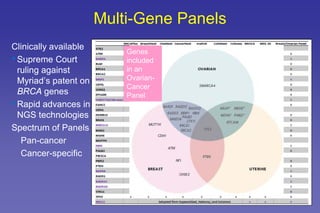
Multi-Gene Panels
Clinically available
•Supreme Court
ruling against
Myriad’s patent on
BRCA genes
•Rapid advances in
NGS technologies
Spectrum of Panels
Pan-cancer
Cancer-specific
Genes
included
in an
Ovarian-
Cancer
Panel
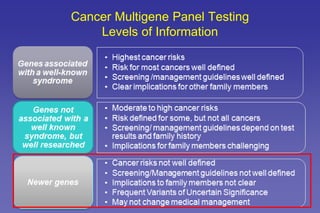
Cancer Multigene Panel Testing
Levels of Information
Fatima is a 45-year-old woman
with a Stage IIIc ovarian cancer
s/p TAH/BSO w optimal debulking,
Chemo (CTx6)
Family history multiple cancers
Case 2: What Test to Order
Multigene Panel Ordered (25 genes
associated with breast, ovary, GI,
other cancers) 20
d. 56
Br 49
Uterine 54
30
d. 57
Ca NOS
d. 52
CRC 48
59
36CRC 40
8075
OvCa
45
Results:
MSH2: del 1-9 (deleterious)
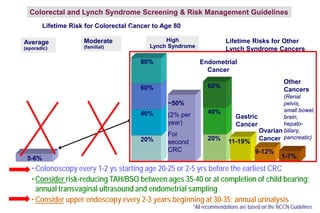
• Colonoscopy every 1-2 ys starting age 20-25 or 2-5 yrs before the earliest CRC
• Consider risk-reducing TAH/BSO between ages 35-40 or at completion of child bearing;
annual transvaginal ultrasound and endometrial sampling
• Consider upper endoscopy every 2-3 years beginning at 30-35; annual urinalysis
20%
Lifetime Risk for Colorectal Cancer to Age 80
5-6%
60%
80%
Average
(sporadic)
Moderate
(familial)
High
Lynch Syndrome
60%
Endometrial
Cancer
~50%
(2% per
year)
For
second
CRC
Ovarian
Cancer
9-12%
Lifetime Risks for Other
Lynch Syndrome Cancers
1-7%
Other
Cancers
(Renal
pelvis,
small bowel,
brain,
hepato-
biliary,
pancreatic)
40% 40%
20%
Gastric
Cancer
11-19%
*All recommendations are based on the NCCN Guidelines
Colorectal and Lynch Syndrome Screening & Risk Management Guidelines
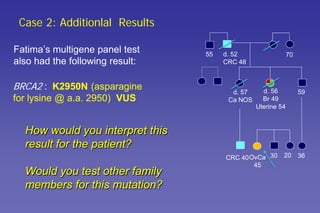
20
d. 56
Br 49
Uterine 54
30
d. 57
Ca NOS
d. 52
CRC 48
59
36CRC 40
7055
BRCA2 : K2950N (asparagine
for lysine @ a.a. 2950) VUS
Case 2: Additionlal Results
OvCa
45
Fatima’s multigene panel test
also had the following result:
How would you interpret this
result for the patient?
Would you test other family
members for this mutation?
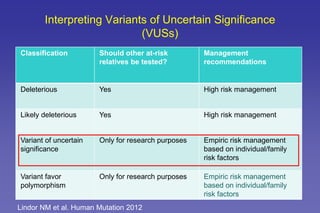
Interpreting Variants of Uncertain Significance
(VUSs)
Classification Should other at-risk
relatives be tested?
Management
recommendations
Deleterious Yes High risk management
Likely deleterious Yes High risk management
Variant of uncertain
significance
Only for research purposes Empiric risk management
based on individual/family
risk factors
Variant favor
polymorphism
Only for research purposes Empiric risk management
based on individual/family
risk factors
Lindor NM et al. Human Mutation 2012
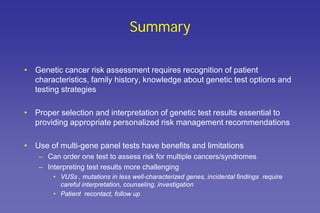
Summary
• Genetic cancer risk assessment requires recognition of patient
characteristics, family history, knowledge about genetic test options and
testing strategies
• Proper selection and interpretation of genetic test results essential to
providing appropriate personalized risk management recommendations
• Use of multi-gene panel tests have benefits and limitations
– Can order one test to assess risk for multiple cancers/syndromes
– Interpreting test results more challenging
• VUSs , mutations in less well-characterized genes, incidental findings require
careful interpretation, counseling, investigation
• Patient recontact, follow up
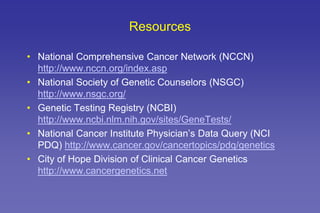
Resources
• National Comprehensive Cancer Network (NCCN)
http://www.nccn.org/index.asp
• National Society of Genetic Counselors (NSGC)
http://www.nsgc.org/
• Genetic Testing Registry (NCBI)
http://www.ncbi.nlm.nih.gov/sites/GeneTests/
• National Cancer Institute Physician’s Data Query (NCI
PDQ) http://www.cancer.gov/cancertopics/pdq/genetics
• City of Hope Division of Clinical Cancer Genetics
http://www.cancergenetics.net
CCGCoP Contact
• For Information: Clinical Cancer Genetics Community of Practice:
http://www.cancergenetics.net
• or contact Dr. Kathleen Blazer: kblazer@coh.org

Genetic Testing for Cancer Risk

  • 1.
    FLASCO Fall Session,Orlando FL Saturday, November 5th, 2016 Kathleen R. Blazer, EdD, MS, LCGC Division of Clinical Cancer Genomics City of Hope Duarte, CA Genetic Testing for Cancer Risk: What you need to know
  • 2.
    Disclosures • I donot have any financial arrangements or affiliations with any corporate organization relating to the topic being presented
  • 3.
    Genetic Cancer RiskAssessment (GCRA) • Interdisciplinary specialty practice that uses genetic and genomic information to – Identify individuals with inherited cancer risk – Prescribe high-risk screening, preventive care, targeted treatment • Increasing demands for GCRA services in community settings • Guidelines/resources needed to help community-based clinicians • Recognize and refer patients • Provide GCRA services • Manage patients and families with cancer predisposition
  • 6.
    Learning Objectives After thispresentation, the participant should be able to: • Identify patients with potential hereditary cancer risk • Recognize the strategies and possible outcomes of genetic testing for hereditary cancers • Incorporate National Comprehensive Cancer Network (NCCN) guidelines for cancer predisposition testing, high-risk cancer screening and management into clinical practice
  • 7.
    Sporadic, Familial, and StronglyHereditary Cancer • 5% to 10% of cancers due to high-penetrant hereditary predisposition • >50 single-gene syndromes identified • 15-20% ‘familial’ cancer clusters • Shared environment • Growing number of low/moderate risk genes
  • 8.
    Who Is atRisk for Hereditary Cancer? Only a small proportion of all cancers heritable Why do we want to know who’s at risk?
  • 9.
    BRCA1- and BRCA2-AssociatedCancers: Lifetime Risk Breast cancer 50%-85% (often early age at onset) Second primary breast cancer 40%-60% Ovarian cancer 15%-45% Absolute risk >10% - Prostate cancer Absolute risk <10% - Male breast cancer - Pancreatic cancer Proven risk reduction and early detection
  • 10.
    Lynch Syndrome Cancers:Lifetime Risks • Autosomal dominant • DNA mismatch repair (MMR) genes: MLH1, MSH2, MSH6, PMS2, EPCAM/TACSTD1 Proven risk reduction and early detection Lifetime Cancer Risks: • Colorectal 40-80% • Endometrial 25-60% • Ovary 4-24% • Stomach 1-13% Up to 10% Risk for: • Sebaceous neoplasm, • Urinary tract, Small bowel, • Pancreatic, Hepatobiliary
  • 11.
    Young age atdiagnosis Rare tumor Multiple Primary Cancers When to Suspect Hereditary Cancer Family History Syndromic Pattern
  • 12.
    Document the Patientand Family History
  • 13.
    Most Cancer SusceptibilitySyndromes Are Dominant With Incomplete Penetrance Who in the family has cancer? What is the primary cancer site? What was their age at diagnosis? Is there a pattern suggesting inherited risk? • Individuals inherit susceptibility, not cancer • May appear to ‘skip’ generations • Different cancer types may be related to a single syndrome
  • 14.
    Important to VerifyFamily History Breast Ca dx 45 d. 59, lung mets Revised based on pathology reports Ovarian Ca dx 43, d. 50 Colon polyps, 54 Breast and Lung Ca d. 59 Verbally reported pedigree Colon Ca, 54 Stomach Ca, 50 Engage the patient to help verify family history
  • 15.
    Family Structure MayLimit Risk Assessment Adequate Structure 60 Br 45 57 65 85 60 5358 8788 73 64 5562 Limited Structure Br 45 57 60 85 60 59 8788 43 56 55 d.28 Accide nt Weitzel et al. 2007. Limited Family Structure and BRCA Gene Mutation Status in Single Cases of Breast Cancer. JAMA. Vol. 297(23).
  • 16.
    Case1: When toTest Ana is a 51 year-old woman with stage III, ER/PR/Her2 - (triple negative) breast cancer • Undergoing neoadjuvant chemotherapy • Family history of breast cancer 25 Breast 51 78 Breast 62 30 28 5557 80 48 30 76 70D. 48 Breast 40 D. 55 2 Would you recommend genetic testing for this patient? 42 Breast 35
  • 17.
  • 18.
    BRCA1/BRCA2 full-gene sequence analysisreveals a deleterious BRCA1 mutation (IVS18-1G>A) Ana has breast cancer, and no surgical treatment yet BRCA1 IVS18-1G>A 25 Breast 51 78 Breast 62 30 28 5557 80 48 30 76 70D. 48 Breast 40 D. 55 2 Case 1: High-Risk Management Does the BRCA1 mutation change options for Ana’s treatment and/or risk management? 42 Breast 35 How?
  • 19.
    Hereditary Breast-Ovarian CancerSyndrome Risk Management Management outcomes for women with BRCA1/2 mutations Breast Screening Annual mammograms and breast MRI beginning at age 25 Chemoprevention Tamoxifen use for 5 years may reduce risk by 50% Risk reducing mastectomy Reduces risk by 90% Ovarian Risk reducing oophorectomy Oophorectomy recommended between 35- 40 years of age or at completion of childbearing, reduces risk by ~90% Chemoprevention Use of oral contraceptives for five years reduces risk by 50% Screening CA-125 blood test/transvaginal US every 6 months http://www.nccn.org/professionals/physician_gls/f_guidelines.asp#genetics_screening
  • 20.
    Case 1: Whatabout family members? Pos Neg BRCA1 IVS18-1G>A 25 Breast 51 78 Breast 62 30 28 5557 80 30 76 70D. 55D. 48 Breast 40 48 Neg NegPos 2 For Carriers Consider: • Medical history (eg. Cancer, surgeries, co-morbidities) • Age - Life stage/Quality of life - Lifetime cancer risks For Non-carriers: • Population screening guidelines, BUT • Consider other cancer patterns (ddx; other side of family) What side of the family carries the mutation? 42 Breast 35 • Perceived risk/Preferences Who else would you test?
  • 21.
    25 Breast 51 78 Breast 62 3028 5557 80 30 76 70D. 55D. 48 Breast 40 48 2 42 Breast 35 • What test was done? – Recommend BRCA arearrangement analysis if only sequenced • Could Ana’s breast cancer be a phenocopy? • Would you test anyone else? What if Ana’s Result was Uninformative ? Negative What test would you order and on who?
  • 22.
    Lifetime Risk forBreast or Ovarian Cancer & Screening Guidelines 10-12% (to age 80-90) 50 % 85 % Average Risk Moderate Increased Risk High Risk (BRCA1/ BRCA2) 1.6% BRCA2 20 % 50 % Range of risk Ovarian Cancer Risk Ovarian Cancer Risk BRCA1 or BRCA2 Gail: 5 yr 3.7%; Lifetime 23.7% Tyrer-Cusik: 10 yr 10.9%; Lifetime 29.9 % 56 % BRCA1 or BRCA2 BRCA1 or BRCA2 Range of risk 40 % 60 % BRCA1 Refs: 1American Cancer Society; 2 National Comprehensive Cancer Network;3 Gail et al. (1989)J Natl Cancer Inst 81:1879-1886; 4 Claus, et al. (1994).Cancer. 73(3), 643-651 Breast Cancer Risk Empiric breast cancer risk for Ana’s unaffected sisters: Breast Cancer Risk New Primary Breast Cancer Risk Risk Recommendations: • BSE monthly • Clinical breast exam q 6 mos • Annual Mammogram • Annual breast MRI • Option: Chemoprevention *or 5-10 years before earliest breast cancer in family 11% 40% Counseled empiric BC risk: 25-30%
  • 23.
    Fatima is a45-year-old woman with a Stage IIIc ovarian cancer s/p TAH/BSO w optimal debulking, Chemo (CTx6) Family history multiple cancers Case 2: What Test to Order Would you recommend genetic testing for this patient? What test? 20 d. 56 Br 49 Uterine 54 30 d. 57 Ca NOS d. 52 CRC 48 59 36CRC 40 8075 OvCa 45
  • 24.
    Multi-Gene Panels Clinically available •SupremeCourt ruling against Myriad’s patent on BRCA genes •Rapid advances in NGS technologies Spectrum of Panels Pan-cancer Cancer-specific Genes included in an Ovarian- Cancer Panel
  • 25.
    Cancer Multigene PanelTesting Levels of Information
  • 26.
    Fatima is a45-year-old woman with a Stage IIIc ovarian cancer s/p TAH/BSO w optimal debulking, Chemo (CTx6) Family history multiple cancers Case 2: What Test to Order Multigene Panel Ordered (25 genes associated with breast, ovary, GI, other cancers) 20 d. 56 Br 49 Uterine 54 30 d. 57 Ca NOS d. 52 CRC 48 59 36CRC 40 8075 OvCa 45 Results: MSH2: del 1-9 (deleterious)
  • 27.
    • Colonoscopy every1-2 ys starting age 20-25 or 2-5 yrs before the earliest CRC • Consider risk-reducing TAH/BSO between ages 35-40 or at completion of child bearing; annual transvaginal ultrasound and endometrial sampling • Consider upper endoscopy every 2-3 years beginning at 30-35; annual urinalysis 20% Lifetime Risk for Colorectal Cancer to Age 80 5-6% 60% 80% Average (sporadic) Moderate (familial) High Lynch Syndrome 60% Endometrial Cancer ~50% (2% per year) For second CRC Ovarian Cancer 9-12% Lifetime Risks for Other Lynch Syndrome Cancers 1-7% Other Cancers (Renal pelvis, small bowel, brain, hepato- biliary, pancreatic) 40% 40% 20% Gastric Cancer 11-19% *All recommendations are based on the NCCN Guidelines Colorectal and Lynch Syndrome Screening & Risk Management Guidelines
  • 28.
    20 d. 56 Br 49 Uterine54 30 d. 57 Ca NOS d. 52 CRC 48 59 36CRC 40 7055 BRCA2 : K2950N (asparagine for lysine @ a.a. 2950) VUS Case 2: Additionlal Results OvCa 45 Fatima’s multigene panel test also had the following result: How would you interpret this result for the patient? Would you test other family members for this mutation?
  • 29.
    Interpreting Variants ofUncertain Significance (VUSs) Classification Should other at-risk relatives be tested? Management recommendations Deleterious Yes High risk management Likely deleterious Yes High risk management Variant of uncertain significance Only for research purposes Empiric risk management based on individual/family risk factors Variant favor polymorphism Only for research purposes Empiric risk management based on individual/family risk factors Lindor NM et al. Human Mutation 2012
  • 30.
    Summary • Genetic cancerrisk assessment requires recognition of patient characteristics, family history, knowledge about genetic test options and testing strategies • Proper selection and interpretation of genetic test results essential to providing appropriate personalized risk management recommendations • Use of multi-gene panel tests have benefits and limitations – Can order one test to assess risk for multiple cancers/syndromes – Interpreting test results more challenging • VUSs , mutations in less well-characterized genes, incidental findings require careful interpretation, counseling, investigation • Patient recontact, follow up
  • 31.
    Resources • National ComprehensiveCancer Network (NCCN) http://www.nccn.org/index.asp • National Society of Genetic Counselors (NSGC) http://www.nsgc.org/ • Genetic Testing Registry (NCBI) http://www.ncbi.nlm.nih.gov/sites/GeneTests/ • National Cancer Institute Physician’s Data Query (NCI PDQ) http://www.cancer.gov/cancertopics/pdq/genetics • City of Hope Division of Clinical Cancer Genetics http://www.cancergenetics.net
  • 32.
    CCGCoP Contact • ForInformation: Clinical Cancer Genetics Community of Practice: http://www.cancergenetics.net • or contact Dr. Kathleen Blazer: kblazer@coh.org