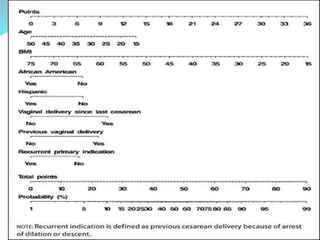
INTRODUCTION
 Rising incidence of CS worldwide is becoming a matter
of concern & more number of pregnancies following
CS are seen.
 This problem can be tackled by judicious selection of
patient for primary CS &
 More trial of labour for non reccuring condition
i.e.planned vaginal birth after previous caesarean
section (VBAC) instead of elective repeat caesarean
section (ERCS).
History of C-section in U.S.
 1916: Cragin “Once a cesarean, always a cesarean”
1920s the technique of low-transverse uterine incision
was introduced by Kerr (1921).
 1970 C-section rate: 5.5%
 1970’s: Advent of EFM, new medico-legal pressures,
increase in diagnosis of dystocia
 1988 C-section rate: 24.7%
History of VBAC
• 1980: NIH panel begins to encourage trial of labor (TOL)
for women with h/o C-section
 1981 VBAC rate: 3%
 American College of Obstetricians and Gynecologists
(1988)
 recommended that most women with one previous low-
transverse cesarean delivery should be counseled to
attempt labor in a subsequent pregnancy
• 1990: US Public Health Service propose goal of C-section
rate of 15% (and VBAC rate of 35%)
Swing of the pendulum
Pitkin (1991), wrote that “without question, the most
remarkable change in obstetric practice over the last
decade was management of the woman with prior
cesarean delivery.”
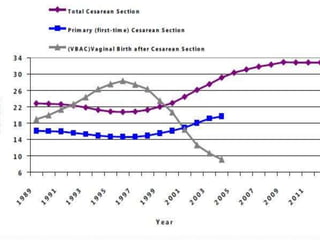
1996-VBACS rates 28.3% & CS Rates 20%
Paradigm shift on C-sections
New evidence is emerging to indicate that VBAC may
not be as safe as originally thought. These
factors,together with medico-legal fears, have led to a
recent decline in clinicians offering and women
accepting planned VBAC in the UK and America.
 2006-VBACS 8.5% & CS-31.1%
 What are the specific risks and benefits of VBAC?
 VBAC carries a risk of uterine rupture of 22–
74/10,000. There is virtually no risk of uterine
rupture in women undergoing ERCS
 planned VBAC compared with ERCS carries around
1% additional risk of either blood transfusion or
endometritis
 Planned VBAC carries an 8/10,000 risk of the
infant developing hypoxic ischaemic
encephalopathy. The effect on the long-term
outcome of the infant upon experiencing HIE
is unknown.
 VBAC probably reduces the risk that their
baby will have respiratory problems after
birth: rates are 2–3% with planned VBAC and
3–4% with ERCS
 The following risks significantly increase with
increasing number of repeated caesarean
deliveries:
 placenta accreta.
 injury to bladder, bowel or ureter; ileus;
 the need for postoperative ventilation;
 intensive care unit admission;
 hysterectomy;
 blood transfusion requiring four or more units
and the
 duration of operative time and hospital stay
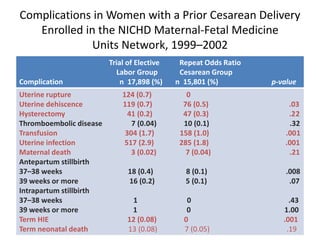
Complications in Women with a Prior Cesarean Delivery
Enrolled in the NICHD Maternal-Fetal Medicine
Units Network, 1999–2002
Trial of Elective Repeat Odds Ratio
Labor Group Cesarean Group
Complication n 17,898 (%) n 15,801 (%) p-value
Uterine rupture 124 (0.7) 0
Uterine dehiscence 119 (0.7) 76 (0.5) .03
Hysterectomy 41 (0.2) 47 (0.3) .22
Thromboembolic disease 7 (0.04) 10 (0.1) .32
Transfusion 304 (1.7) 158 (1.0) .001
Uterine infection 517 (2.9) 285 (1.8) .001
Maternal death 3 (0.02) 7 (0.04) .21
Antepartum stillbirth
37–38 weeks 18 (0.4) 8 (0.1) .008
39 weeks or more 16 (0.2) 5 (0.1) .07
Intrapartum stillbirth
37–38 weeks 1 0 .43
39 weeks or more 1 0 1.00
Term HIE 12 (0.08) 0 .001
Term neonatal death 13 (0.08) 7 (0.05) .19
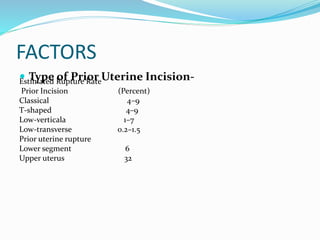
FACTORS
 Type of Prior Uterine Incision-Estimated Rupture Rate
Prior Incision (Percent)
Classical 4–9
T-shaped 4–9
Low-verticala 1–7
Low-transverse 0.2–1.5
Prior uterine rupture
Lower segment 6
Upper uterus 32
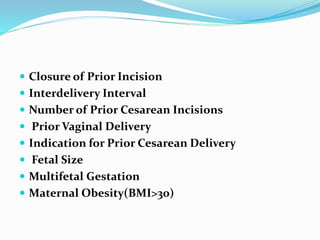
 Closure of Prior Incision
 Interdelivery Interval
 Number of Prior Cesarean Incisions
 Prior Vaginal Delivery
 Indication for Prior Cesarean Delivery
 Fetal Size
 Multifetal Gestation
 Maternal Obesity(BMI>30)
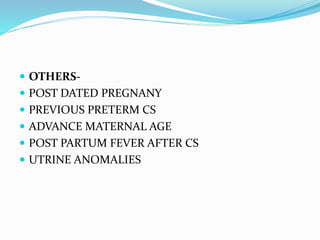
 OTHERS-
 POST DATED PREGNANY
 PREVIOUS PRETERM CS
 ADVANCE MATERNAL AGE
 POST PARTUM FEVER AFTER CS
 UTRINE ANOMALIES
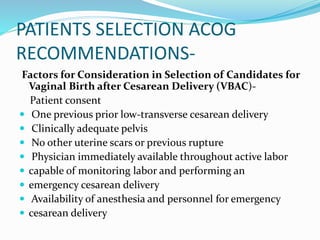
PATIENTS SELECTION ACOG
RECOMMENDATIONS-
Factors for Consideration in Selection of Candidates for
Vaginal Birth after Cesarean Delivery (VBAC)-
Patient consent
 One previous prior low-transverse cesarean delivery
 Clinically adequate pelvis
 No other uterine scars or previous rupture
 Physician immediately available throughout active labor
 capable of monitoring labor and performing an
 emergency cesarean delivery
 Availability of anesthesia and personnel for emergency
 cesarean delivery
Planned VBAC in special
circumstances
 PRETERM BIRTH-preterm VBAC has similar success rates
to planned term VBAC but with a lower risk of uterine
rupture
 TWIN GESTATION, FETAL MACROSOMIA, SHORT
INTERDELIVERY INTERVAL
 A cautious approach is advised when considering
planned VBAC in women with twin gestation, fetal
macrosomia and short interdelivery interval, as there
is uncertainty in the safety and efficacy of planned
VBAC in such situations
 External Cephalic Version
 Limited data suggest that external cephalic version for
breech presentation may be as successful in women
with a prior cesarean delivery who are contemplating a
trial of labor (American College of Obstetricians and
Gynecologists, 2004).
Contraindication to VBAC
 Prior classic,T shaped incision or other trans mural
uterine surgery.
 Contracted pelvis.
 Medical/obstetric complication that preclude vaginal
delivery.
 Previous rupture or scar dehiscence
 Previous two LSCS
 Lack of resource to perfom emergency CS round the
clock.
 How should women be counselled in the antenatal
period?
 Women with a prior history of one uncomplicated
lower-segment transverse caesarean section, in an
otherwise uncomplicated pregnancy at term, with no
contraindication to vaginal birth, should be able to
discuss the option of planned VBAC and the
alternative of a repeat caesarean section (ERCS).
 The antenatal counselling of women with a prior
caesarean birth should be documented in the notes.
 There should be provision of a patient information
leaflet with the consultation.
 A final decision for mode of birth should be agreed
between the woman and her obstetrician before the
expected/planned delivery date (ideally by 36 weeks of
gestation).
 A plan for the event of labour starting prior to the
scheduled date should be documented.
 Women considering their options for birth after a
single previous caesarean should be informed that,
overall, the chances of successful planned VBAC are
72–76%.
Ante natal care
 Apart from routine blood & urine investigation.
 USG to rule out GCA(level II) at 16-18 wk.
 USG for placental localisation,rule out adherent
placenta,scar thickness in third trimester.
Intrapartum support and
intervention during planned VBAC
 Where and how should VBAC be conducted?
 Women should be advised that planned VBAC should
be conducted in a suitably staffed and equipped
delivery suite, with continuous intrapartum care and
monitoring and available resources for immediate
caesarean section and advanced neonatal
resuscitation.
 Ideally spontaneous onset of labour is awaited.
 Establish IV line.
 Arrange X matched blood.
 Maternal vital monitoring.
 CTG
 Partogram
 Epidural anaesthesia is not contraindicated in planned
VBAC.
 Continuous intrapartum care is necessary to enable
prompt identification and management of uterine scar
rupture
Outlet forcep/vaccum can be used if second stage
>1hr.
 No routine digital exploration of scar.
 Observatin for at least 4 hr after delivery.
 Emergency caesarean section is required in 30-40% of
patient.
 Women should be advised to have continuous
electronic fetal monitoring following the onset of
uterine contractions for the duration of planned
VBAC.
Features of impending scar
rupture/dehiscence
 severe abdominal pain, especially if persisting between
contractions
 chest pain or shoulder tip pain, sudden onset of
shortness of breath
 acute onset scar tenderness
 abnormal vaginal bleeding or haematuria
 maternal tachycardia
 Abnormal CTG
 Meconium staining of liquor.
FEATURES OF SCAR RUPTURE
 Pain abdomen,
 shoulder pain
 Dizziness/weaness
 maternal tachycardia, hypotension or shock
 Tenderness over whole abdomen.
 Distension of abdomen
 Uterine contour not well made out.
 cessation of previously efficient uterine activity
 Fetal parts superficially palpated
 Recession of station of the presenting part
 Uterine rupture require urgent laparotomy followed by
repair or hysterectomy.
 The risks versus benefits, along with the pros and cons
of a woman electing a trial of labor for VBAC versus
elective repeat cesarean delivery, can be complex.
 The “best answer” for a given woman with a prior
cesarean delivery is unknown.
 Thus,she and her partner are encouraged to actively
participate with her healthcare provider in the final
decision after appropriate counseling.
 Pending relevant trials
 ● BAC (Birth After Caesarean) – planned vaginal birth or
planned caesarean section for women at term with a single
previous caesarean birth. University of Adelaide, Australia.
● The Twin Birth Study – a multicentre randomised
controlled trial comparing planned caesarean section with
planned vaginal birth for twins at 32–38wk
 ● DiAMOND (Decision Aids for Mode Of Next Delivery). ,
Bristol, UK.
 ● CAESAR (Caesarean Section Surgical Techniques).
National Perinatal Epidemiology Unit, Oxford, UK.

Vbacs

  • 2.
    INTRODUCTION  Rising incidenceof CS worldwide is becoming a matter of concern & more number of pregnancies following CS are seen.  This problem can be tackled by judicious selection of patient for primary CS &  More trial of labour for non reccuring condition i.e.planned vaginal birth after previous caesarean section (VBAC) instead of elective repeat caesarean section (ERCS).
  • 4.
    History of C-sectionin U.S.  1916: Cragin “Once a cesarean, always a cesarean” 1920s the technique of low-transverse uterine incision was introduced by Kerr (1921).  1970 C-section rate: 5.5%  1970’s: Advent of EFM, new medico-legal pressures, increase in diagnosis of dystocia  1988 C-section rate: 24.7%
  • 5.
    History of VBAC •1980: NIH panel begins to encourage trial of labor (TOL) for women with h/o C-section  1981 VBAC rate: 3%  American College of Obstetricians and Gynecologists (1988)  recommended that most women with one previous low- transverse cesarean delivery should be counseled to attempt labor in a subsequent pregnancy • 1990: US Public Health Service propose goal of C-section rate of 15% (and VBAC rate of 35%)
  • 6.
    Swing of thependulum Pitkin (1991), wrote that “without question, the most remarkable change in obstetric practice over the last decade was management of the woman with prior cesarean delivery.” 1996-VBACS rates 28.3% & CS Rates 20%
  • 7.
    Paradigm shift onC-sections New evidence is emerging to indicate that VBAC may not be as safe as originally thought. These factors,together with medico-legal fears, have led to a recent decline in clinicians offering and women accepting planned VBAC in the UK and America.  2006-VBACS 8.5% & CS-31.1%
  • 9.
     What arethe specific risks and benefits of VBAC?  VBAC carries a risk of uterine rupture of 22– 74/10,000. There is virtually no risk of uterine rupture in women undergoing ERCS
  • 10.
     planned VBACcompared with ERCS carries around 1% additional risk of either blood transfusion or endometritis  Planned VBAC carries an 8/10,000 risk of the infant developing hypoxic ischaemic encephalopathy. The effect on the long-term outcome of the infant upon experiencing HIE is unknown.  VBAC probably reduces the risk that their baby will have respiratory problems after birth: rates are 2–3% with planned VBAC and 3–4% with ERCS
  • 11.
     The followingrisks significantly increase with increasing number of repeated caesarean deliveries:  placenta accreta.  injury to bladder, bowel or ureter; ileus;  the need for postoperative ventilation;  intensive care unit admission;  hysterectomy;  blood transfusion requiring four or more units and the  duration of operative time and hospital stay
  • 12.
    Complications in Womenwith a Prior Cesarean Delivery Enrolled in the NICHD Maternal-Fetal Medicine Units Network, 1999–2002 Trial of Elective Repeat Odds Ratio Labor Group Cesarean Group Complication n 17,898 (%) n 15,801 (%) p-value Uterine rupture 124 (0.7) 0 Uterine dehiscence 119 (0.7) 76 (0.5) .03 Hysterectomy 41 (0.2) 47 (0.3) .22 Thromboembolic disease 7 (0.04) 10 (0.1) .32 Transfusion 304 (1.7) 158 (1.0) .001 Uterine infection 517 (2.9) 285 (1.8) .001 Maternal death 3 (0.02) 7 (0.04) .21 Antepartum stillbirth 37–38 weeks 18 (0.4) 8 (0.1) .008 39 weeks or more 16 (0.2) 5 (0.1) .07 Intrapartum stillbirth 37–38 weeks 1 0 .43 39 weeks or more 1 0 1.00 Term HIE 12 (0.08) 0 .001 Term neonatal death 13 (0.08) 7 (0.05) .19
  • 13.
    FACTORS  Type ofPrior Uterine Incision-Estimated Rupture Rate Prior Incision (Percent) Classical 4–9 T-shaped 4–9 Low-verticala 1–7 Low-transverse 0.2–1.5 Prior uterine rupture Lower segment 6 Upper uterus 32
  • 14.
     Closure ofPrior Incision  Interdelivery Interval  Number of Prior Cesarean Incisions  Prior Vaginal Delivery  Indication for Prior Cesarean Delivery  Fetal Size  Multifetal Gestation  Maternal Obesity(BMI>30)
  • 15.
     OTHERS-  POSTDATED PREGNANY  PREVIOUS PRETERM CS  ADVANCE MATERNAL AGE  POST PARTUM FEVER AFTER CS  UTRINE ANOMALIES
  • 17.
    PATIENTS SELECTION ACOG RECOMMENDATIONS- Factorsfor Consideration in Selection of Candidates for Vaginal Birth after Cesarean Delivery (VBAC)- Patient consent  One previous prior low-transverse cesarean delivery  Clinically adequate pelvis  No other uterine scars or previous rupture  Physician immediately available throughout active labor  capable of monitoring labor and performing an  emergency cesarean delivery  Availability of anesthesia and personnel for emergency  cesarean delivery
  • 18.
    Planned VBAC inspecial circumstances  PRETERM BIRTH-preterm VBAC has similar success rates to planned term VBAC but with a lower risk of uterine rupture  TWIN GESTATION, FETAL MACROSOMIA, SHORT INTERDELIVERY INTERVAL  A cautious approach is advised when considering planned VBAC in women with twin gestation, fetal macrosomia and short interdelivery interval, as there is uncertainty in the safety and efficacy of planned VBAC in such situations
  • 19.
     External CephalicVersion  Limited data suggest that external cephalic version for breech presentation may be as successful in women with a prior cesarean delivery who are contemplating a trial of labor (American College of Obstetricians and Gynecologists, 2004).
  • 20.
    Contraindication to VBAC Prior classic,T shaped incision or other trans mural uterine surgery.  Contracted pelvis.  Medical/obstetric complication that preclude vaginal delivery.  Previous rupture or scar dehiscence  Previous two LSCS  Lack of resource to perfom emergency CS round the clock.
  • 21.
     How shouldwomen be counselled in the antenatal period?  Women with a prior history of one uncomplicated lower-segment transverse caesarean section, in an otherwise uncomplicated pregnancy at term, with no contraindication to vaginal birth, should be able to discuss the option of planned VBAC and the alternative of a repeat caesarean section (ERCS).  The antenatal counselling of women with a prior caesarean birth should be documented in the notes.  There should be provision of a patient information leaflet with the consultation.
  • 22.
     A finaldecision for mode of birth should be agreed between the woman and her obstetrician before the expected/planned delivery date (ideally by 36 weeks of gestation).  A plan for the event of labour starting prior to the scheduled date should be documented.  Women considering their options for birth after a single previous caesarean should be informed that, overall, the chances of successful planned VBAC are 72–76%.
  • 23.
    Ante natal care Apart from routine blood & urine investigation.  USG to rule out GCA(level II) at 16-18 wk.  USG for placental localisation,rule out adherent placenta,scar thickness in third trimester.
  • 24.
    Intrapartum support and interventionduring planned VBAC  Where and how should VBAC be conducted?  Women should be advised that planned VBAC should be conducted in a suitably staffed and equipped delivery suite, with continuous intrapartum care and monitoring and available resources for immediate caesarean section and advanced neonatal resuscitation.
  • 25.
     Ideally spontaneousonset of labour is awaited.  Establish IV line.  Arrange X matched blood.  Maternal vital monitoring.  CTG  Partogram
  • 26.
     Epidural anaesthesiais not contraindicated in planned VBAC.  Continuous intrapartum care is necessary to enable prompt identification and management of uterine scar rupture Outlet forcep/vaccum can be used if second stage >1hr.
  • 27.
     No routinedigital exploration of scar.  Observatin for at least 4 hr after delivery.  Emergency caesarean section is required in 30-40% of patient.
  • 28.
     Women shouldbe advised to have continuous electronic fetal monitoring following the onset of uterine contractions for the duration of planned VBAC.
  • 29.
    Features of impendingscar rupture/dehiscence  severe abdominal pain, especially if persisting between contractions  chest pain or shoulder tip pain, sudden onset of shortness of breath  acute onset scar tenderness  abnormal vaginal bleeding or haematuria  maternal tachycardia  Abnormal CTG  Meconium staining of liquor.
  • 30.
    FEATURES OF SCARRUPTURE  Pain abdomen,  shoulder pain  Dizziness/weaness  maternal tachycardia, hypotension or shock  Tenderness over whole abdomen.  Distension of abdomen  Uterine contour not well made out.  cessation of previously efficient uterine activity  Fetal parts superficially palpated  Recession of station of the presenting part
  • 31.
     Uterine rupturerequire urgent laparotomy followed by repair or hysterectomy.
  • 32.
     The risksversus benefits, along with the pros and cons of a woman electing a trial of labor for VBAC versus elective repeat cesarean delivery, can be complex.  The “best answer” for a given woman with a prior cesarean delivery is unknown.  Thus,she and her partner are encouraged to actively participate with her healthcare provider in the final decision after appropriate counseling.
  • 33.
     Pending relevanttrials  ● BAC (Birth After Caesarean) – planned vaginal birth or planned caesarean section for women at term with a single previous caesarean birth. University of Adelaide, Australia. ● The Twin Birth Study – a multicentre randomised controlled trial comparing planned caesarean section with planned vaginal birth for twins at 32–38wk  ● DiAMOND (Decision Aids for Mode Of Next Delivery). , Bristol, UK.  ● CAESAR (Caesarean Section Surgical Techniques). National Perinatal Epidemiology Unit, Oxford, UK.