
Sacred Encounters
Perfect Care
Healthiest Communities
Sandra M. Brown, MS, LCGC
Manager, Cancer Genetics Program
St. Joseph Hospital and Mission Hospital
sandra.brown@stjoe.org
714-734-6229
Sacred Encounters
Perfect Care
Healthiest Communities
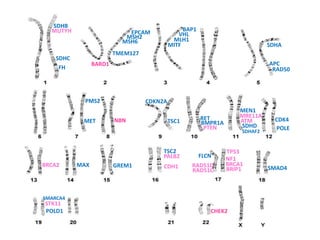
ATM
BRCA2
APC
BMPR1A
SMAD4
FH
MLH1MSH2
MSH6
PMS2
CDK4
CDKN2A
MEN1
RET
MUTYH
SDHD
SDHC
SDHB
STK11
PTEN
MET TSC1
VHL
BARD1
CHEK2
EPCAM
MAX
MITF
MRE11A
NBN
RAD50
CDH1
TSC2
PALB2
BRCA1
TP53
NF1FLCN
BRIP1RAD51C
RAD51D
SDHA
TMEM127
POLE
POLD1
GREM1
SDHAF2
SMARCA4
BAP1
Sacred Encounters
Perfect Care
Healthiest Communities
5
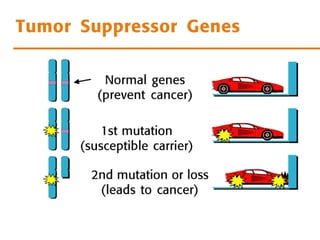
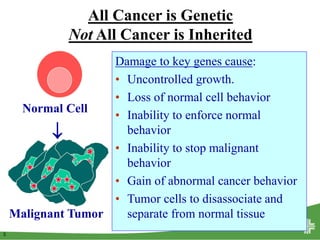
Damage to key genes cause:
• Uncontrolled growth.
• Loss of normal cell behavior
• Inability to enforce normal
behavior
• Inability to stop malignant
behavior
• Gain of abnormal cancer behavior
• Tumor cells to disassociate and
separate from normal tissueMalignant Tumor
Normal Cell

All Cancer is Genetic
Not All Cancer is Inherited
Sacred Encounters
Perfect Care
Healthiest Communities
Sacred Encounters
Perfect Care
Healthiest Communities
8
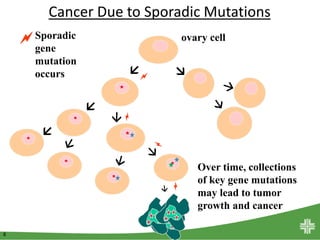
Cancer Due to Sporadic Mutations
 
ovary cellSporadic
gene
mutation
occurs
Over time, collections
of key gene mutations
may lead to tumor
growth and cancer



9
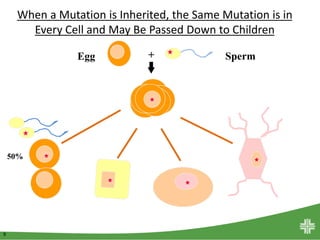
When a Mutation is Inherited, the Same Mutation is in
Every Cell and May Be Passed Down to Children
Egg Sperm+
50%
10
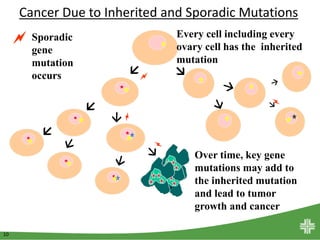
Cancer Due to Inherited and Sporadic Mutations
 
Every cell including every
ovary cell has the inherited
mutation
 Sporadic
gene
mutation
occurs
Over time, key gene
mutations may add to
the inherited mutation
and lead to tumor
growth and cancer



11
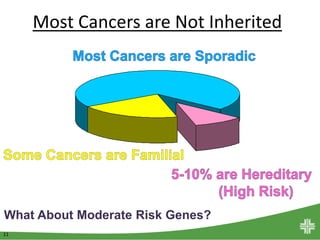
Most Cancers are Not Inherited
What About Moderate Risk Genes?
12
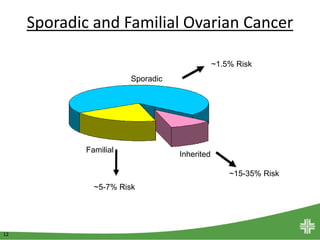
Sporadic and Familial Ovarian Cancer
~1.5% Risk
Sporadic
Familial
~5-7% Risk
~15-35% Risk
Inherited
13
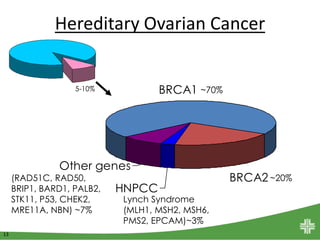
Hereditary Ovarian Cancer
BRCA1
BRCA2
HNPCC
Other genes
5-10% ~70%
~20%
Lynch Syndrome
(MLH1, MSH2, MSH6,
PMS2, EPCAM)~3%
(RAD51C, RAD50,
BRIP1, BARD1, PALB2,
STK11, P53, CHEK2,
MRE11A, NBN) ~7%
Sacred Encounters
Perfect Care
Healthiest Communities
15
NCCN and USPTF Recommend Genetic Counseling
for Breast Cancer Risk Assessment
When There is Personal or Family History of:
 Breast cancer diagnosis at ≤50
 Triple negative breast cancer diagnosis ≤60
 Breast cancer in ≥2 close relatives
 Ovarian cancer diagnosed at any age.
 Multiple primary breast cancers in an individual.
 Breast and other associated cancers including cancers of
the ovary, pancreas, aggressive prostate, thyroid, Kidney,
melanoma, sarcoma, stomach, uterus, diffuse gastric or
adrenal gland.
 Male breast cancer.
16
Contracting and patient assessment.
4 generation pedigree construction
Sporadic vs. familial vs. inherited pattern of cancer
diagnoses.
Probability of detecting a mutation and risks,
benefits, and limitations of testing.
Testing criteria and identification of individual
appropriate genetic testing.
Ethical, legal, psychological and social issues
If testing is not performed
Cancer genetic risk assessment using clinical
criteria and empiric model prediction
Individualized risk reduction planning
Pre-Test Cancer Risk Genetic Counseling
17
Working Through Common Myths
• “I don’t need counseling for a simple test”
• “I can just order testing from an online DTC lab”
• “I don’t need genetic counseling because I don’t want
genetic testing”
• “ I only have family history of breast cancer on my dad’s
side, so it doesn’t count”
• “ Tumor genetic testing is the same as familial genetic
testing”
• “I don’t want to have genetic counseling because I
don’t want to have mastectomies”
• “It’s too late for me to have genetic counseling or
testing, I’ve already had cancer”
18
Genetic Information
Nondiscrimination Act (GINA)
• Protects against health insurance and employment
discrimination
• Prohibits denial of coverage or increased premiums
• Prohibits employer discrimination.
• Does not apply to life, disability, &long-term care
insurances
• Exempt: several federal health systems including active
military, veteran, and Indian health services.
• Exempt: small employers (>15 employees)
19
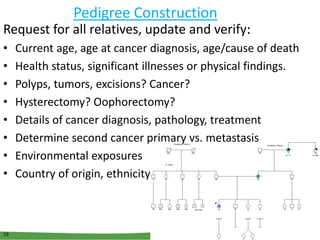
Pedigree Construction
Request for all relatives, update and verify:
• Current age, age at cancer diagnosis, age/cause of death
• Health status, significant illnesses or physical findings.
• Polyps, tumors, excisions? Cancer?
• Hysterectomy? Oophorectomy?
• Details of cancer diagnosis, pathology, treatment
• Determine second cancer primary vs. metastasis
• Environmental exposures
• Country of origin, ethnicity
20
Patient assessment
Interpret and explain genetic test results
Negative test result vs. variant of unknown
significance vs. deleterious mutation
detected vs. family history meets clinical
diagnostic criteria.
Cancer Risk Assessment using test
results, clinical criteria and empiric evidence
Individualized risk reduction planning
Implications to family members
Ethical, legal, psychological and social
issues
Post-Test Cancer Risk Genetic Counseling
Sacred Encounters
Perfect Care
Healthiest Communities
22
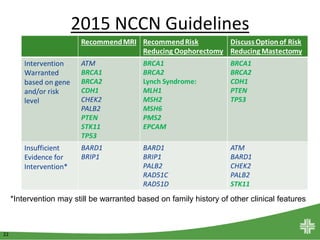
2015 NCCN Guidelines
*Intervention may still be warranted based on family history of other clinical features
23
Diagnosed with
Pancreatic CA 60s
Patient Presents
with Breast CA
dx @ 58
now 53,
Genetic
Testing
MSH2+
43
Diagnosed with
Colon CA. 50s
Diagnosed
with Uterine
Ca. 48
45
1. Sporadic Cancer
2. HNPCC/Lynch
syndrome
79
d. 80. Stroke
24
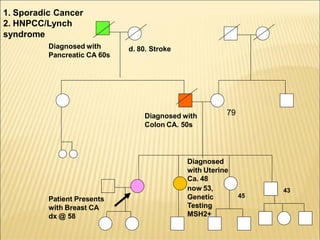
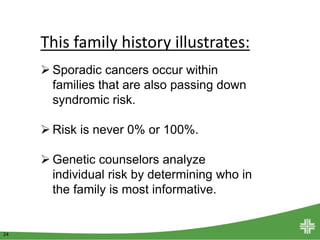
This family history illustrates:
 Sporadic cancers occur within
families that are also passing down
syndromic risk.
 Risk is never 0% or 100%.
 Genetic counselors analyze
individual risk by determining who in
the family is most informative.
25
Patient Presents
with Family
History.
Diagnosed
with Ovarian
CA @ 42
Died of
Ovarian CA.
70s
Diagnosed
with uterine
CA. 50,
now 75
1. Familial Risk,
2. No Mutation
Detected
Diagnosed with
Breast Ca 50,
now 55
6670
3 3
Diagnosed
with Prostate
CA 70s, now
70s
Diagnosed
with
Prostate
CA. 60s
Genetic Testing
was negative
40
26
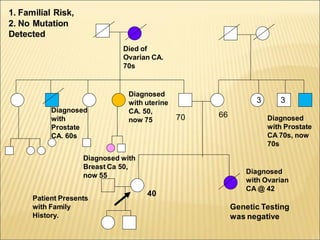
This family history illustrates:
 Without a known mutation, family history
trumps a genetic test result
 It is better to test affected relatives for accurate
risk assessment
 Genetic counseling can be an ongoing process
that continues to utilize new knowledge and
new technologies to refine risk assessment.
27
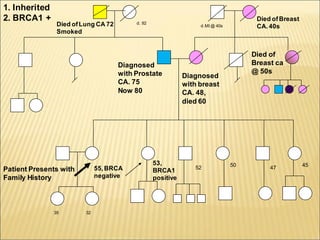
8/1 Diagnosed
with breast
CA. 48,
died 60
Died of
Breast ca
@ 50s
Died ofBreast
CA.40s
Patient Presents with
Family History
55,BRCA
negative
47
3235
d.MI @ 40s
53,
BRCA1
positive
52 50 45
1. Inherited
2. BRCA1 + d. 92Died ofLung CA 72
Smoked
Diagnosed
with Prostate
CA. 75
Now 80
28
This family history illustrates:
Genetic Information
Nondiscrimination Act of 2008
“GINA” protects against insurance
and employment discrimination.
Chromosomes/Genes are
independently assorted by eggs and
sperm, so that each sibling has
independent risk to inherit a
mutation.
29
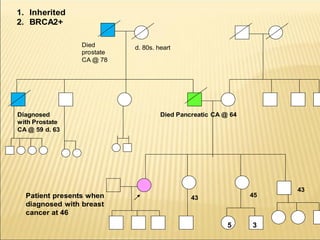
Patient presents when
diagnosed with breast
cancer at 46
3
Died
prostate
CA @ 78
43
5
43
Died Pancreatic CA @ 64
45
Diagnosed
with Prostate
CA @ 59 d. 63
d. 80s. heart
1. Inherited
2. BRCA2+
30
This family history illustrates:
Risk for breast/ovarian/uterine cancer
can be inherited through a father
Even though there was no family
history of breast or ovarian cancers,
there was risk. Genetic counselors
recognize these patterns.
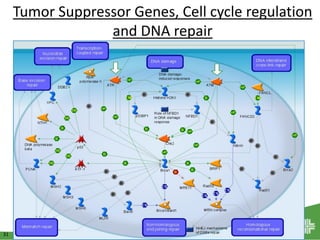
31
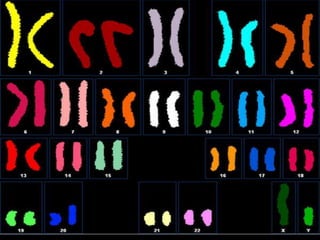
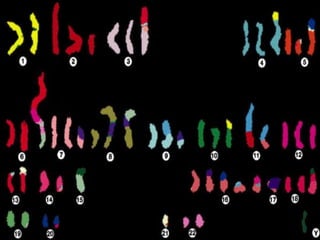
Tumor Suppressor Genes, Cell cycle regulation
and DNA repair
32
Current Controversies in Cancer Genetics
• Panel testing risk and management evidence
• Whole Genome/Whole Exome Testing
• FDA oversight of genetic testing announced
• Direct to consumer testing
• Variant Databases-collective variant classification
• Duty to warn family members case law argues it’s
not always satisfied by warning patient.
• Tumor analysis revealing germline
• Genotype-phenotype correlations
• Risk Modification via 2nd tier test/environment
33
Have Genetic Counseling When:
You have a personal or family history of
ovarian cancer.
34
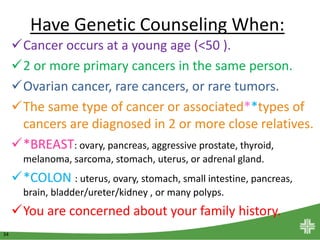
Have Genetic Counseling When:
Cancer occurs at a young age (<50 ).
2 or more primary cancers in the same person.
Ovarian cancer, rare cancers, or rare tumors.
The same type of cancer or associated**types of
cancers are diagnosed in 2 or more close relatives.
*BREAST: ovary, pancreas, aggressive prostate, thyroid,
melanoma, sarcoma, stomach, uterus, or adrenal gland.
*COLON : uterus, ovary, stomach, small intestine, pancreas,
brain, bladder/ureter/kidney , or many polyps.
You are concerned about your family history.
35
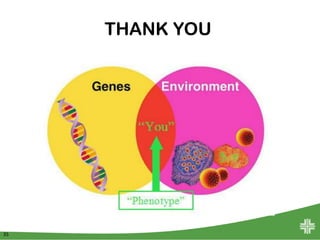
THANK YOU

Genetics 101: Sandra Brown, MS, LCGC

  • 1.
    Sacred Encounters Perfect Care HealthiestCommunities Sandra M. Brown, MS, LCGC Manager, Cancer Genetics Program St. Joseph Hospital and Mission Hospital sandra.brown@stjoe.org 714-734-6229
  • 2.
  • 3.
  • 4.
  • 5.
    5 Damage to keygenes cause: • Uncontrolled growth. • Loss of normal cell behavior • Inability to enforce normal behavior • Inability to stop malignant behavior • Gain of abnormal cancer behavior • Tumor cells to disassociate and separate from normal tissueMalignant Tumor Normal Cell  All Cancer is Genetic Not All Cancer is Inherited
  • 6.
  • 7.
  • 8.
    8 Cancer Due toSporadic Mutations   ovary cellSporadic gene mutation occurs Over time, collections of key gene mutations may lead to tumor growth and cancer   
  • 9.
    9 When a Mutationis Inherited, the Same Mutation is in Every Cell and May Be Passed Down to Children Egg Sperm+ 50%
  • 10.
    10 Cancer Due toInherited and Sporadic Mutations   Every cell including every ovary cell has the inherited mutation  Sporadic gene mutation occurs Over time, key gene mutations may add to the inherited mutation and lead to tumor growth and cancer   
  • 11.
    11 Most Cancers areNot Inherited What About Moderate Risk Genes?
  • 12.
    12 Sporadic and FamilialOvarian Cancer ~1.5% Risk Sporadic Familial ~5-7% Risk ~15-35% Risk Inherited
  • 13.
    13 Hereditary Ovarian Cancer BRCA1 BRCA2 HNPCC Othergenes 5-10% ~70% ~20% Lynch Syndrome (MLH1, MSH2, MSH6, PMS2, EPCAM)~3% (RAD51C, RAD50, BRIP1, BARD1, PALB2, STK11, P53, CHEK2, MRE11A, NBN) ~7%
  • 14.
  • 15.
    15 NCCN and USPTFRecommend Genetic Counseling for Breast Cancer Risk Assessment When There is Personal or Family History of:  Breast cancer diagnosis at ≤50  Triple negative breast cancer diagnosis ≤60  Breast cancer in ≥2 close relatives  Ovarian cancer diagnosed at any age.  Multiple primary breast cancers in an individual.  Breast and other associated cancers including cancers of the ovary, pancreas, aggressive prostate, thyroid, Kidney, melanoma, sarcoma, stomach, uterus, diffuse gastric or adrenal gland.  Male breast cancer.
  • 16.
    16 Contracting and patientassessment. 4 generation pedigree construction Sporadic vs. familial vs. inherited pattern of cancer diagnoses. Probability of detecting a mutation and risks, benefits, and limitations of testing. Testing criteria and identification of individual appropriate genetic testing. Ethical, legal, psychological and social issues If testing is not performed Cancer genetic risk assessment using clinical criteria and empiric model prediction Individualized risk reduction planning Pre-Test Cancer Risk Genetic Counseling
  • 17.
    17 Working Through CommonMyths • “I don’t need counseling for a simple test” • “I can just order testing from an online DTC lab” • “I don’t need genetic counseling because I don’t want genetic testing” • “ I only have family history of breast cancer on my dad’s side, so it doesn’t count” • “ Tumor genetic testing is the same as familial genetic testing” • “I don’t want to have genetic counseling because I don’t want to have mastectomies” • “It’s too late for me to have genetic counseling or testing, I’ve already had cancer”
  • 18.
    18 Genetic Information Nondiscrimination Act(GINA) • Protects against health insurance and employment discrimination • Prohibits denial of coverage or increased premiums • Prohibits employer discrimination. • Does not apply to life, disability, &long-term care insurances • Exempt: several federal health systems including active military, veteran, and Indian health services. • Exempt: small employers (>15 employees)
  • 19.
    19 Pedigree Construction Request forall relatives, update and verify: • Current age, age at cancer diagnosis, age/cause of death • Health status, significant illnesses or physical findings. • Polyps, tumors, excisions? Cancer? • Hysterectomy? Oophorectomy? • Details of cancer diagnosis, pathology, treatment • Determine second cancer primary vs. metastasis • Environmental exposures • Country of origin, ethnicity
  • 20.
    20 Patient assessment Interpret andexplain genetic test results Negative test result vs. variant of unknown significance vs. deleterious mutation detected vs. family history meets clinical diagnostic criteria. Cancer Risk Assessment using test results, clinical criteria and empiric evidence Individualized risk reduction planning Implications to family members Ethical, legal, psychological and social issues Post-Test Cancer Risk Genetic Counseling
  • 21.
  • 22.
    22 2015 NCCN Guidelines *Interventionmay still be warranted based on family history of other clinical features
  • 23.
    23 Diagnosed with Pancreatic CA60s Patient Presents with Breast CA dx @ 58 now 53, Genetic Testing MSH2+ 43 Diagnosed with Colon CA. 50s Diagnosed with Uterine Ca. 48 45 1. Sporadic Cancer 2. HNPCC/Lynch syndrome 79 d. 80. Stroke
  • 24.
    24 This family historyillustrates:  Sporadic cancers occur within families that are also passing down syndromic risk.  Risk is never 0% or 100%.  Genetic counselors analyze individual risk by determining who in the family is most informative.
  • 25.
    25 Patient Presents with Family History. Diagnosed withOvarian CA @ 42 Died of Ovarian CA. 70s Diagnosed with uterine CA. 50, now 75 1. Familial Risk, 2. No Mutation Detected Diagnosed with Breast Ca 50, now 55 6670 3 3 Diagnosed with Prostate CA 70s, now 70s Diagnosed with Prostate CA. 60s Genetic Testing was negative 40
  • 26.
    26 This family historyillustrates:  Without a known mutation, family history trumps a genetic test result  It is better to test affected relatives for accurate risk assessment  Genetic counseling can be an ongoing process that continues to utilize new knowledge and new technologies to refine risk assessment.
  • 27.
    27 8/1 Diagnosed with breast CA.48, died 60 Died of Breast ca @ 50s Died ofBreast CA.40s Patient Presents with Family History 55,BRCA negative 47 3235 d.MI @ 40s 53, BRCA1 positive 52 50 45 1. Inherited 2. BRCA1 + d. 92Died ofLung CA 72 Smoked Diagnosed with Prostate CA. 75 Now 80
  • 28.
    28 This family historyillustrates: Genetic Information Nondiscrimination Act of 2008 “GINA” protects against insurance and employment discrimination. Chromosomes/Genes are independently assorted by eggs and sperm, so that each sibling has independent risk to inherit a mutation.
  • 29.
    29 Patient presents when diagnosedwith breast cancer at 46 3 Died prostate CA @ 78 43 5 43 Died Pancreatic CA @ 64 45 Diagnosed with Prostate CA @ 59 d. 63 d. 80s. heart 1. Inherited 2. BRCA2+
  • 30.
    30 This family historyillustrates: Risk for breast/ovarian/uterine cancer can be inherited through a father Even though there was no family history of breast or ovarian cancers, there was risk. Genetic counselors recognize these patterns.
  • 31.
    31 Tumor Suppressor Genes,Cell cycle regulation and DNA repair
  • 32.
    32 Current Controversies inCancer Genetics • Panel testing risk and management evidence • Whole Genome/Whole Exome Testing • FDA oversight of genetic testing announced • Direct to consumer testing • Variant Databases-collective variant classification • Duty to warn family members case law argues it’s not always satisfied by warning patient. • Tumor analysis revealing germline • Genotype-phenotype correlations • Risk Modification via 2nd tier test/environment
  • 33.
    33 Have Genetic CounselingWhen: You have a personal or family history of ovarian cancer.
  • 34.
    34 Have Genetic CounselingWhen: Cancer occurs at a young age (<50 ). 2 or more primary cancers in the same person. Ovarian cancer, rare cancers, or rare tumors. The same type of cancer or associated**types of cancers are diagnosed in 2 or more close relatives. *BREAST: ovary, pancreas, aggressive prostate, thyroid, melanoma, sarcoma, stomach, uterus, or adrenal gland. *COLON : uterus, ovary, stomach, small intestine, pancreas, brain, bladder/ureter/kidney , or many polyps. You are concerned about your family history.
  • 35.